Curriculum
AP Physics C: Mechanics
1. Kinematics
0/45
2. Force and Translational Dynamics
0/823. Work, Energy, and Power
0/414. Linear Momentum
0/365. Torque and Rotational Dynamics
0/496. Energy and Momentum of Rotating Systems
0/517. Oscillations
0/44
Text lesson
2.8 Spring Forces
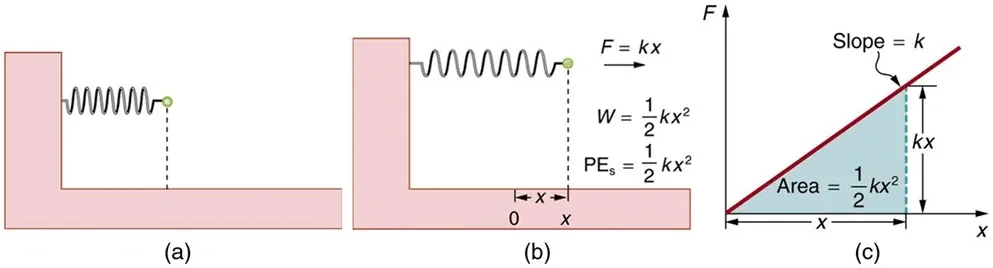
Spring Forces
2.8 Worked examples
Worked examples
- Example 2: Two springs in series3Example 2: Two springs in series · Example 3: Two springs in
- Force from a stretched spring
- A spring with spring constant 120 N/m is attached to a 2.0 kg block on a frictionless surface.
- The spring is stretched 0.15 m from its relaxed length.
- Find the magnitude and direction of the spring force on the block.
- The magnitude is Fs = kΔx = (120 N/m)(0.15 m) = 18 N. Since the spring is stretched, the force on the block points back toward the relaxed position of the spring
- which is the equilibrium position of the block–spring system.
- The spring force has magnitude 18 N and points toward the relaxed position of the spring. The mass of the block does not affect the spring force, although it does affect the acceleration.
- 1 / 3Next ▶
- Two springs in series
- Two springs in series
- A spring of constant 200 N/m is joined end to end with a spring of constant 300 N/m.
- A force of 12 N is applied to the free end of the combination.
- Find the equivalent spring constant, and the extension of each spring.
- From 1/keq = 1/200 + 1/300 = (3 + 2)/600 = 5/600, the equivalent constant is keq = 600/5 = 120 N/m.
- This is smaller than 200 N/m, as the rule predicts.
- The total extension is x = 12 N/120 N/m = 0.10 m.
- Each spring carries the full 12 N
- so the 200 N/m spring extends by 12/200 = 0.060 m and the 300 N/m spring extends by 12/300 = 0.040 m.
- These add to 0.10 m.
- ◀ Previous, 2 / 3Next ▶
- Two springs in series · Example 3: Two springs in parallel
- Two springs in series
- The equivalent spring constant is 120 N/m. The extensions are 0.060 m and 0.040 m
- which total 0.10 m.
- Two springs in parallel
- The same two springs, with constants 200 N/m and 300 N/m, are attached in parallel to a block that is displaced 0.020 m from equilibrium.
- Find the equivalent spring constant, the total force on the block, and the force carried by each spring.
- The equivalent constant is keq = 200 + 300 = 500 N/m. The total force is F = (500 N/m)(0.020 m) = 10 N. Each spring has the same extension, 0.020 m
- so the 200 N/m spring carries (200)(0.020) = 4.0 N and the 300 N/m spring carries (300)(0.020) = 6.0 N. These add to 10 N.
- The equivalent constant is 500 N/m, the total force is 10 N directed toward equilibrium, and the two springs carry 4.0 N and 6.0 N. The combination is stiffer than either spring alone.
- ◀ Previous, 3 / 3
2.8 Spring Forces · 5 / 7
Well done! You finished this lesson
What would you like to do next?