Curriculum
Chemistry 2e
Unit 1: Essential Ideas
0/14
Unit 2: Atoms, Molecules, and Ions
0/16
Unit 3: Composition of Substances and Solutions
0/10
Unit 4: Stoichiometry of Chemical Reactions
0/12
Unit 5: Thermochemistry
0/8
Unit 6: Electronic Structure and Periodic Properties of Elements
0/12
Unit 7: Chemical Bonding and Molecular Geometry
0/14
Unit 8: Advanced Theories of Covalent Bonding
0/10
Unit 9: Gases
0/23
Unit 10: Liquids and Solids
0/28
-
Unit 10 overview: Liquids and Solids
 Preview
-
10.1 Intermolecular Forces
Preview
-
Unit 10 overview: Liquids and Solids
Preview
-
10.1 Intermolecular Forces
Preview
-
10.1 Intermolecular Forces - Check yourself
 Preview
-
10.1 Intermolecular Forces - Check yourself
Preview
-
10.2 Properties of Liquids
Preview
-
10.2 Properties of Liquids - Check yourself
Preview
-
10.2 Properties of Liquids
Preview
-
10.2 Properties of Liquids - Check yourself
Preview
-
10.3 Phase Transitions
Preview
-
10.3 Phase Transitions - Check yourself
Preview
-
10.3 Phase Transitions
Preview
-
10.3 Phase Transitions - Check yourself
Preview
-
10.4 Phase Diagrams
Preview
-
10.4 Phase Diagrams
Preview
-
10.4 Phase Diagrams - Check yourself
Preview
-
10.4 Phase Diagrams - Check yourself
Preview
-
10.5 The Solid State of Matter
Preview
-
10.5 The Solid State of Matter
Preview
-
10.5 The Solid State of Matter - Check yourself
Preview
-
10.5 The Solid State of Matter - Check yourself
Preview
-
10.6 Lattice Structures in Crystalline Solids
Preview
-
10.6 Lattice Structures in Crystalline Solids
Preview
-
10.6 Lattice Structures in Crystalline Solids - Check yourself
Preview
-
10.6 Lattice Structures in Crystalline Solids - Check yourself
Preview
-
Unit 10 review quiz: Liquids and Solids
Preview
-
Unit 10 review quiz: Liquids and Solids
Preview
Unit 11: Solutions and Colloids
0/24
Unit 12: Kinetics
0/32
Unit 13: Fundamental Equilibrium Concepts
0/20
Unit 14: Acid-Base Equilibria
0/32
Unit 15: Equilibria of Other Reaction Classes
0/16
Unit 16: Thermodynamics
0/20
Unit 17: Electrochemistry
0/32
Unit 18: Representative Metals, Metalloids, and Nonmetals
0/52
Unit 19: Transition Metals and Coordination Chemistry
0/16
Unit 20: Organic Chemistry
0/20
Unit 21: Nuclear Chemistry
0/28
Text lesson
10.3 Phase Transitions
10.3 Phase Transitions — CHEMISTRY notes: You will be able to define phase transitions and their temperatures, relate those temperatures to intermolecular forces, and calculate heat flows and enthalpy changes for heating and cooling curves.
1Vaporization and Condensation2Vaporization and Condensation3Vaporization and Condensation
Vaporization and Condensation
Vaporization and Condensation
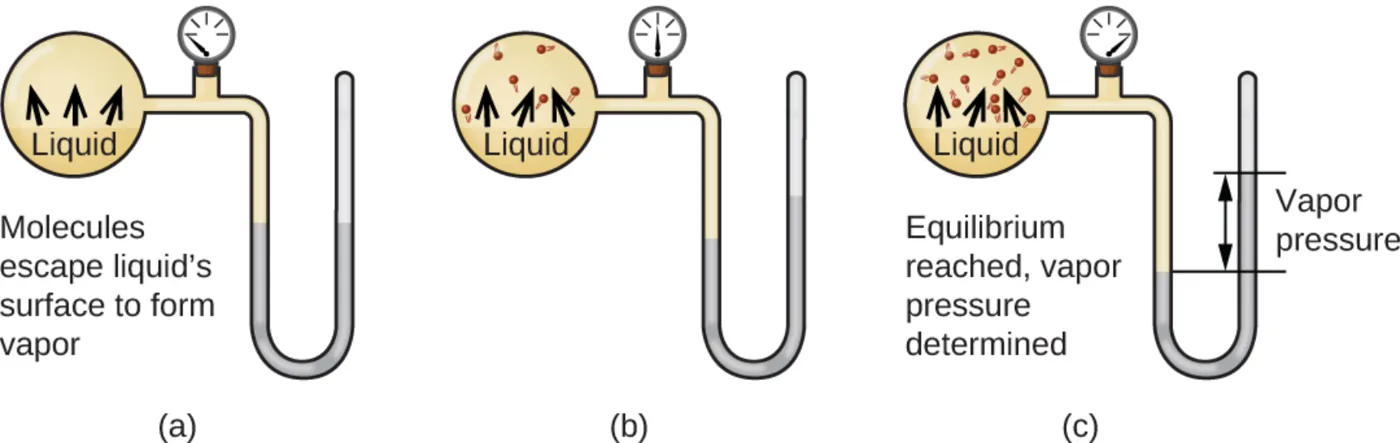
When a liquid vaporizes in a closed container, its gas molecules cannot escape.
They move randomly and sometimes strike the liquid surface
where some re-enter the liquid.
The change from gas back to liquid is called condensation.
When the rate of condensation becomes equal to the rate of vaporization, the amounts of liquid and vapor stop changing.
The vapor is then in equilibrium with the liquid.
This is not a static state
because molecules continue to move between the two phases.
1 / 3Next ▶
Vaporization and Condensation
1
A condition in which opposite processes occur at equal rates is called a dynamic equilibrium.
2
The pressure exerted by a vapor in equilibrium with its liquid, in a closed container at a given temperature, is the vapor pressure (also called the equilibrium vapor pressure).
3
The surface area of the liquid and the size of the container do not change the vapor pressure,
4
but they do change how long it takes to reach equilibrium.
5
The vapor pressure can be measured with a manometer, as shown in the figure below.
◀ Previous2 / 3Next ▶
A manometer shows the pressure rising as molecules escape the liquid, then stopping at a constant value once equilibrium is reached. Image: OpenStax, Chemistry 2e, CC BY 4.0.
Vaporization and Condensation
◀ Previous3 / 3
1Biomedical Applications of Capillary Action2Biomedical Applications of Capillary Action3Biomedical Applications of Capillary Action
Biomedical Applications of Capillary Action
Biomedical Applications of Capillary Action
Many medical tests,
such as measuring blood glucose in people with diabetes or the hematocrit level in an athlete, need only a small blood sample.
The sample is collected by capillary action
which is the ability of a liquid to flow up a narrow tube against gravity.
When a finger is pricked, a drop of blood forms and holds together because of surface tension,
which is the net inward pull of intermolecular attractions at the surface of a liquid.
When the open end of a narrow glass tube touches the drop, adhesive forces between the blood molecules and the glass pull the blood up the tube.
1 / 3Next ▶
Biomedical Applications of Capillary Action
1
A narrow tube has a large surface area for its volume of blood,
2
so the attractive forces are large relative to the amount of liquid,
3
and the blood rises farther.
4
The blood itself is held together by cohesive forces.
5
The rise stops when the weight of the liquid column produces a downward force equal to the upward capillary force.
◀ Previous2 / 3Next ▶
A narrow glass tube draws a drop of blood up by capillary action so that a small sample can be analyzed. Image: OpenStax, Chemistry 2e, CC BY 4.0.
Biomedical Applications of Capillary Action

◀ Previous3 / 3
Vapor Pressure and Intermolecular Forces
Vapor Pressure and Intermolecular Forces
Different liquids have different vapor pressures because their molecules have different types and strengths of intermolecular forces.
Strong attractions make it harder for molecules to escape the liquid,
and they make it more likely that gas molecules are recaptured when they strike the surface.
The result is a low vapor pressure.
Weak attractions present less of a barrier to vaporization and cause less recapture
so the vapor pressure is high.
1Vapor Pressure and Temperature2Vapor Pressure and Temperature
Vapor Pressure and Temperature
1
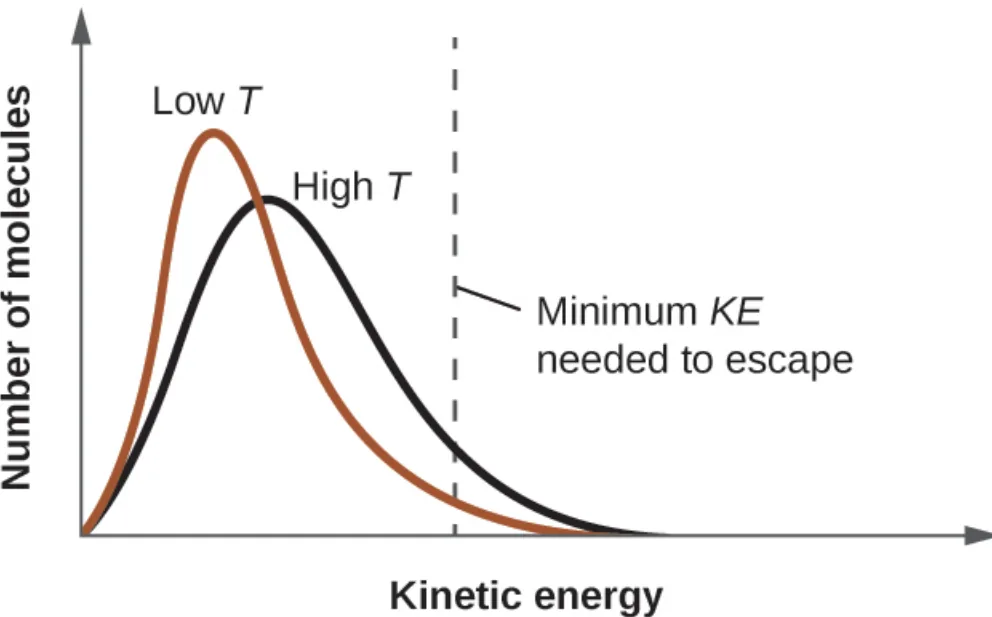
Vapor pressure rises with temperature because the average kinetic energy of the molecules increases.
2
At any temperature the molecules of a liquid have a range of kinetic energies.
3
At a higher temperature a larger fraction of the molecules has enough energy to overcome the intermolecular attractions and escape.
4
More molecules escape per unit time, and the escaping molecules move faster on average
so the vapor pressure is higher.
1 / 2Next ▶
At a higher temperature a larger share of the liquid molecules has enough kinetic energy to escape into the gas phase. Image: OpenStax, Chemistry 2e, CC BY 4.0.
Vapor Pressure and Temperature
◀ Previous2 / 2
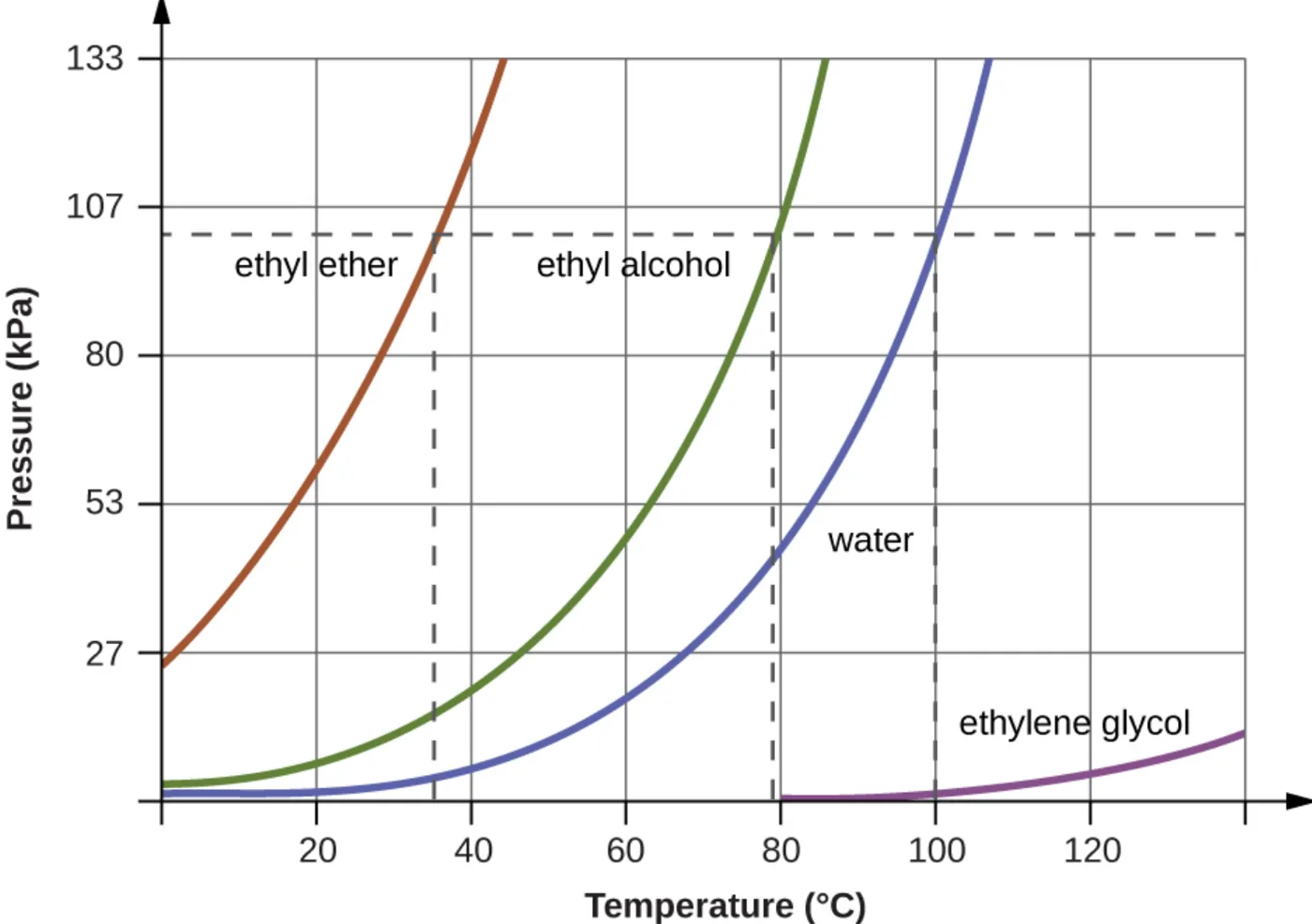
Vapor pressure curves for several liquids. Each liquid boils at the temperature where its curve reaches the external pressure. Image: OpenStax, Chemistry 2e, CC BY 4.0.
Boiling Points
 ⤢ Enlarge
Boiling Points
A liquid boils when its vapor pressure grows large enough to equal the pressure on its surface. The boiling point is the temperature at which the equilibrium vapor pressure of a liquid equals the external pressure. In an open container the external pressure is the atmosphere.
The normal boiling point is the boiling point when the external pressure is exactly 1 atm
which is 101.3 kPa. Because the boiling point depends on the external pressure, a vapor pressure curve can be read in two ways: as the vapor pressure at each temperature, or as the boiling point at each external pressure.
The Clausius-Clapeyron Equation
1
The quantitative relation between vapor pressure and temperature is the Clausius-Clapeyron equation. Its linear, logarithmic form is ln P = −(ΔHvap/R)(1/T) + A
where P is the vapor pressure (in kPa or any unit used consistently), ΔHvap is the enthalpy of vaporization in J/mol, R is the gas constant, 8.314 J/(mol·K), T is the absolute temperature in K, and A is a constant that depends on the substance.
2
Because A is the same at two temperatures, the two-point form is ln(P2/P1) = −(ΔHvap/R)(1/T2 − 1/T1). Temperatures must be in kelvin, and both pressures must use the same unit. This form lets us estimate an unknown vapor pressure, temperature, or enthalpy of vaporization from two known points.
1Enthalpy of Vaporization2Enthalpy of Vaporization
Enthalpy of Vaporization
1
Vaporization is an endothermic process: H2O(l) → H2O(g) absorbs heat.
2
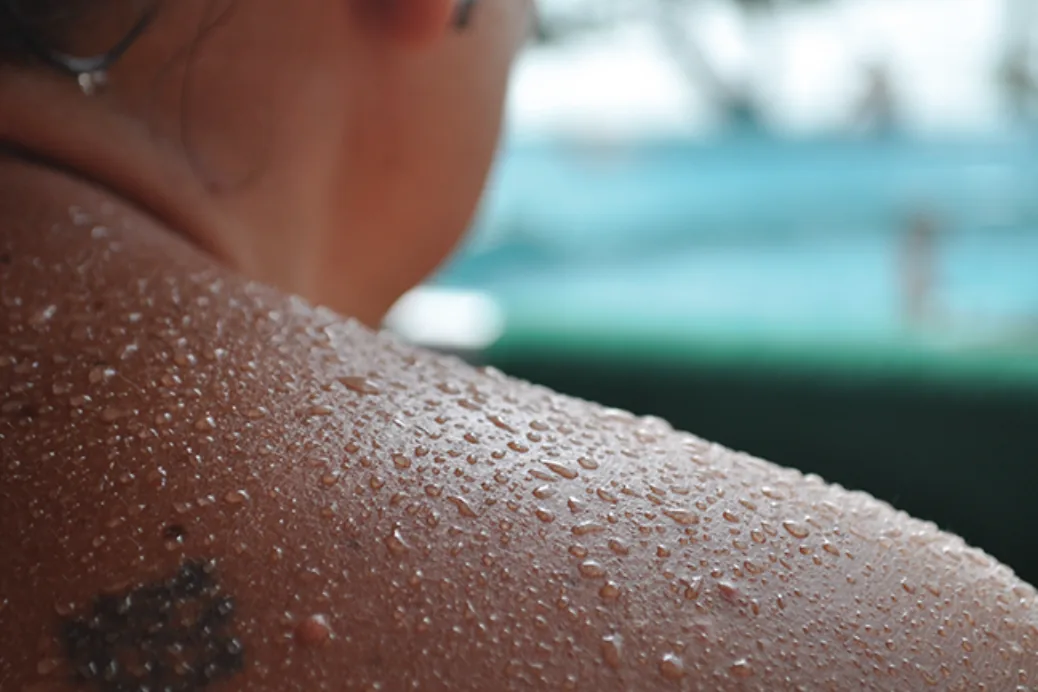
This is why you feel cold when you leave a swimming pool or shower.
3
As the water on your skin evaporates, it removes heat from your skin.
4
The enthalpy of vaporization, ΔHvap, is the energy needed to change one mole of a liquid into gas at its boiling point, in kJ/mol.
5
Condensation is the reverse process. It is exothermic, and it releases the same amount of energy with the opposite sign. Evaporation of sweat is one way the body is cooled, as shown in the figure below.
1 / 2Next ▶
Evaporation of sweat from the skin removes heat, which helps cool the body. Image: OpenStax, Chemistry 2e, CC BY 4.0.
Enthalpy of Vaporization
◀ Previous2 / 2
1Melting and Freezing2Melting and Freezing3Melting and Freezing
Melting and Freezing
1
When a crystalline solid is heated, the average energy of its particles increases and the solid gets hotter.
2
At some point the added energy partly overcomes the forces that hold the particles in fixed positions, and the solid begins to melt.
3
During melting the temperature stays constant, even though heat is still being added.
4
Only after all the solid has melted does further heating raise the temperature of the liquid, as the figure below shows.
1 / 3Next ▶
Ice warms to 0 °C, then melts at a constant temperature until it is all liquid. Only after that does the water warm further. Image: OpenStax, Chemistry 2e, CC BY 4.0.
Melting and Freezing
 ⤢ Enlarge
Melting and Freezing
If a mixture of solid and liquid is held in a perfectly insulated container, the two phases stay in equilibrium.
Melting and freezing then occur at equal rates, and the amounts of solid and liquid do not change.
The temperature at which solid and liquid are in equilibrium is the melting point of the solid, or the freezing point of the liquid.
The term used depends on the direction of the change.
Substances whose particles have weak attractive forces form crystals with low melting points.
Crystals whose particles have stronger attractions melt at higher temperatures.
◀ Previous2 / 3Next ▶
Melting and Freezing
Melting and Freezing
The enthalpy of fusion, ΔHfus, is the energy needed to change one mole of a solid into liquid.
For ice at 0 °C, ΔHfus is 6.0 kJ/mol.
Melting is endothermic, H2O(s) → H2O(l) with ΔH = +6.0 kJ/mol, and freezing is exothermic with ΔH = −6.0 kJ/mol.
◀ Previous3 / 3
1Sublimation and Deposition2Sublimation and Deposition3Sublimation and Deposition
Sublimation and Deposition
1
Some solids change directly into a gas without passing through the liquid state.
2
This process is sublimation.
3
Dry ice (solid CO2) sublimes at room temperature and standard pressure
so it seems to disappear without leaving any liquid.
4
Snow and ice sublime below the melting point of water, a slow process that winds and the low pressures of high altitudes can speed up.
5
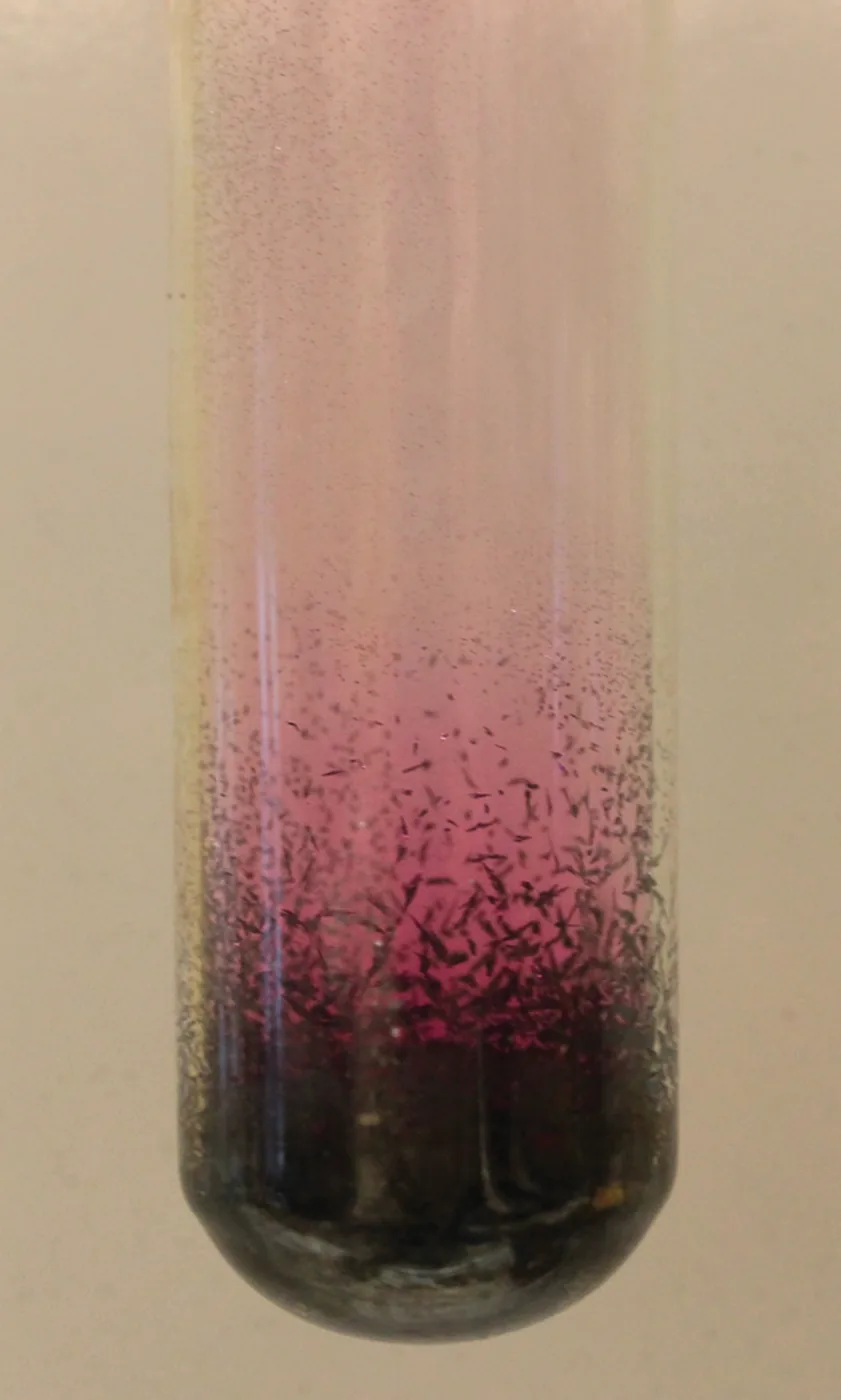
Solid iodine sublimes to form a vivid purple vapor, as shown below.
1 / 3Next ▶
Solid iodine at the bottom of a tube turns into purple vapor, which then deposits as solid on the cooler upper part of the tube. Image: OpenStax, Chemistry 2e, CC BY 4.0.
Sublimation and Deposition
 ⤢ Enlarge
1
The reverse of sublimation is deposition, in which a gas condenses directly into a solid.
2
Frost forms this way.
3
Sublimation also needs energy to overcome intermolecular attractions.
4
The enthalpy of sublimation, ΔHsub, is the energy needed to change one mole of a solid into gas.
5
For example, CO2(s) → CO2(g).
6
Deposition has the same magnitude with the opposite sign.
◀ Previous2 / 3Next ▶
For a given substance, the enthalpy of sublimation is approximately the sum of its enthalpy of fusion and its enthalpy of vaporization. Image: OpenStax, Chemistry 2e, CC BY 4.0.
Sublimation and Deposition
 ⤢ Enlarge
Sublimation and Deposition
Converting a solid to a liquid only partly overcomes the attractions
while converting to a gas must overcome them completely. So ΔHfus is smaller than ΔHvap. Sublimation can be modeled as melting followed by vaporization. Using Hess’s law, ΔHsub ≈ ΔHfus + ΔHvap. This is an approximation, illustrated in the figure below.
◀ Previous3 / 3
1Heating and Cooling Curves2Heating and Cooling Curves
Heating and Cooling Curves
1
The heat absorbed or released by a substance, q, is related to its temperature change by q = m × c × ΔT
where q is in J, m is the mass in g, c is the specific heat in J/(g·°C), and ΔT is the temperature change in °C. This applies only when the substance does not change state.
2
When a substance reaches a temperature at which it undergoes a phase transition, added heat changes the intermolecular attractions instead of the kinetic energies of the molecules.
3
While the change of state is in progress, the temperature stays constant.
4
For the phase change itself, q = n × ΔH
where n is the amount in mol and ΔH is the enthalpy change in J/mol.
5
For example, a pot of boiling water stays at 100 °C
a hotter burner makes the boiling more vigorous but does not raise the temperature.
6
A heating curve plots temperature against heat added.
1 / 2Next ▶
A typical heating curve. The flat sections are plateaus where the temperature is constant during a phase transition. Image: OpenStax, Chemistry 2e, CC BY 4.0.
Heating and Cooling Curves
 ⤢ Enlarge
Heating and Cooling Curves
It has sloped parts where the temperature rises and flat plateaus during phase transitions, as shown below.
◀ Previous2 / 2
1Example 10.5: Explaining vapor pressure in terms of intermol2Example 10.5: Explaining vapor pressure in terms of intermol3Example 10.5: Explaining vapor pressure in terms of intermol4Example 10.6: A boiling point at reduced pressure5Example 10.7: Estimating the enthalpy of vaporization6Example 10.7: Estimating the enthalpy of vaporization7Example 10.8: Estimating a temperature from a vapor pressure8Example 10.8: Estimating a temperature from a vapor pressure9Example 10.9: Using the enthalpy of vaporization10Example 10.10: Total heat needed to change temperature and p11Example 10.11: Total heat released as water cools and freeze12Example 10.11: Total heat released as water cools and freeze
Structural formulas of ethanol, ethylene glycol, diethyl ether, and water. Image: OpenStax, Chemistry 2e, CC BY 4.0.
Example 10.5: Explaining vapor pressure in terms of intermolecular forces
 ⤢ Enlarge
Example 10.5: Explaining vapor pressure in terms of intermolecular forces
The structures of ethanol, ethylene glycol, diethyl ether, and water are shown below. Explain their relative vapor pressures from the types and extents of their intermolecular forces.
Solution: Diethyl ether has a very small dipole
so its attractions are mainly London dispersion forces.
It is the largest of the four molecules
but its intermolecular forces are the weakestso its molecules escape most readily.
It has the highest vapor pressure.
Ethanol is smaller
so its dispersion forces are weaker than those of diethyl ether.
However, ethanol can form hydrogen bonds,
so its overall intermolecular forces are stronger,and its vapor pressure is lower than that of diethyl ether.
1 / 12Next ▶
Example 10.5: Explaining vapor pressure in terms of intermolecular forces
1
Water is much smaller and has weaker dispersion forces,
but its extensive hydrogen bonding gives stronger overall attractions,so its vapor pressure is lower than that of either ethanol or diethyl ether.
2
Ethylene glycol has two −OH groups and so hydrogen bonds extensively like water.
3
It is also much larger than water, with larger London forces.
4
Its overall intermolecular forces are the strongest of the four
so it vaporizes most slowly and has the lowest vapor pressure.
5
Order of vapor pressures: diethyl ether >
ethanol >water >ethylene glycol.
6
Check your learning: At 20 °C, the vapor pressures of four alcohols are: methanol CH3OH, 11.9 kPa
ethanol C2H5OH, 5.95 kPapropanol C3H7OH, 2.67 kPabutanol C4H9OH, 0.56 kPa. Explain these values.
◀ Previous2 / 12Next ▶
Example 10.5: Explaining vapor pressure in terms of intermolecular forces
Example 10.5: Explaining vapor pressure in terms of intermolecular forces
Answer: All four alcohols hydrogen bond
so their strong intermolecular forces make vaporization difficult and keep the vapor pressures fairly low. As the carbon chain lengthens from methanol to butanol, the dispersion forces increase. This makes the vapor pressures fall: Pmethanol >Pethanol >Ppropanol >Pbutanol.
◀ Previous3 / 12Next ▶
Example 10.6: A boiling point at reduced pressure
Example 10.6: A boiling point at reduced pressure
The atmospheric pressure in Leadville, Colorado (elevation 10,200 feet) is 68 kPa. Use Figure 10.24 to find the boiling point of water there.
Solution: The vapor pressure curve of water reaches 68 kPa at about 90 °C. At about 90 °C the vapor pressure of water equals the local atmospheric pressure
so water boils at about 90 °C in Leadville.
Check your learning: The boiling point of ethyl ether is 10 °C at a base camp on the slopes of Mount Everest. Use the curves to estimate the atmospheric pressure at the camp.
Answer: About 40 kPa (0.4 atm).
◀ Previous4 / 12Next ▶
Example 10.7: Estimating the enthalpy of vaporization
1
Isooctane (2,2,4-trimethylpentane) has a vapor pressure of 10.0 kPa at 34.0 °C and 100.0 kPa at 98.8 °C. Estimate its enthalpy of vaporization.
2
Solution: Convert the temperatures to kelvin: T1 = 34.0 + 273.15 = 307.2 K and T2 = 98.8 + 273.15 = 372.0 K.
3
The pressures are P1 = 10.0 kPa and P2 = 100.0 kPa.
4
Rearranging the two-point Clausius-Clapeyron equation gives ΔHvap = R ln(P2/P1) / (1/T1 − 1/T2).
5
Here ln(100.0/10.0) = 2.303, and 1/T1 − 1/T2 = 3.255×10⁻³ − 2.688×10−3 = 5.67×10⁻⁴ K−1.
6
So ΔHvap = (8.314 × 2.303) / (5.67×10⁻⁴) = 3.38×10⁴ J/mol, or about 33.8 kJ/mol.
◀ Previous5 / 12Next ▶
Example 10.7: Estimating the enthalpy of vaporization
Example 10.7: Estimating the enthalpy of vaporization
Check your learning: At 20.0 °C, the vapor pressure of ethanol is 5.95 kPa, and at 63.5 °C it is 53.3 kPa. Estimate its enthalpy of vaporization.
Answer: About 41,400 J/mol, or 41.4 kJ/mol. (Using T1 = 293.15 K and T2 = 336.65 K, ln(53.3/5.95) = 2.192 and 1/T1 − 1/T2 = 4.41×10⁻⁴ K−1.)
◀ Previous6 / 12Next ▶
Example 10.8: Estimating a temperature from a vapor pressure
Example 10.8: Estimating a temperature from a vapor pressure
Benzene (C6H6) has a normal boiling point of 80.1 °C and ΔHvap = 30.8 kJ/mol. What is its boiling point in Denver
where the atmospheric pressure is 83.4 kPa?
Solution: At sea level the normal boiling point gives T1 = 80.1 + 273.15 = 353.3 K and P1 = 101.3 kPa.
The unknown is T2 at P2 = 83.4 kPa.
Rearranging the two-point form gives 1/T2 = 1/T1 − (R/ΔHvap) ln(P2/P1).
Here 1/T1 = 2.830×10⁻³ K−1, R/ΔHvap = 8.314 J/(mol·K) ÷ 30 800 J/mol = 2.70×10⁻⁴ K−1, and ln(83.4/101.3) = −0.1946.
So 1/T2 = 2.830×10⁻³ + 5.25×10−5 = 2.883×10⁻³ K−1, giving T2 = 346.9 K, or about 73.7 °C.
The lower pressure lowers the boiling point, as expected.
◀ Previous7 / 12Next ▶
Example 10.8: Estimating a temperature from a vapor pressure
1
Check your learning: For acetone (CH3)2CO, the normal boiling point is 56.5 °C and ΔHvap = 31.3 kJ/mol. What is its vapor pressure at 25.0 °C?
2
Answer: About 30 kPa (30.1 kPa in the book’s answer
which is the value obtained with rounded intermediate numbers).
◀ Previous8 / 12Next ▶
Example 10.9: Using the enthalpy of vaporization
1
In hot climates the body can lose as much as 1.5 L of sweat per day, and evaporation of that water removes a large amount of heat. Treating sweat as pure water, find the heat required to evaporate 1.5 L of water (1.5 kg) at 37 °C
where ΔHvap = 43.46 kJ/mol.
2
Solution: Convert the mass to moles: 1500 g ÷ 18.02 g/mol = 83.2 mol. Then q = n × ΔHvap = 83.2 mol × 43.46 kJ/mol = 3.62×10³ kJ. So about 3600 kJ of heat is removed when 1.5 L of water evaporates.
3
Check your learning: How much heat is required to evaporate 100.0 g of liquid ammonia, NH3, at its boiling point, if ΔHvap = 4.8 kJ/mol?
4
Answer: 100.0 g ÷ 17.03 g/mol = 5.87 mol
q = 5.87 mol × 4.8 kJ/mol = 28 kJ.
◀ Previous9 / 12Next ▶
Example 10.10: Total heat needed to change temperature and phase
Example 10.10: Total heat needed to change temperature and phase
How much heat is required to convert 135 g of ice at −15 °C into water vapor at 120 °C?
Solution: The change has five steps: (1) heat ice from −15 °C to 0 °C
(2) melt the ice at 0 °C(3) heat water from 0 °C to 100 °C(4) boil the water at 100 °C(5) heat steam from 100 °C to 120 °C.
The constants are: specific heat of ice 2.09 J/(g·°C), water 4.184 J/(g·°C), steam 2.01 J/(g·°C)
ΔHfus = 6.0 kJ/molΔHvap = 40.7 kJ/mol.
The amount is n = 135 g ÷ 18.02 g/mol = 7.49 mol.
(1) q = 135 × 2.09 × 15 = 4.23×10³ J = 4.23 kJ.
(2) q = 7.49 × 6.0 kJ = 44.9 kJ.
(3) q = 135 × 4.184 × 100 = 5.65×10⁴ J = 56.5 kJ.
(4) q = 7.49 × 40.7 kJ = 305 kJ.
(5) q = 135 × 2.01 × 20 = 5.43×10³ J = 5.43 kJ.
(2) q = 7.49 × 6.0 kJ = 44.9 kJ.
(3) q = 135 × 4.184 × 100 = 5.65×10⁴ J = 56.5 kJ.
(4) q = 7.49 × 40.7 kJ = 305 kJ.
(5) q = 135 × 2.01 × 20 = 5.43×10³ J = 5.43 kJ.
Total: 4.23 + 44.9 + 56.5 + 305 + 5.43 ≈ 416 kJ. Notice that the two phase changes (steps 2 and 4) absorb most of the heat
while the temperature changes absorb much less.
◀ Previous10 / 12Next ▶
Example 10.11: Total heat released as water cools and freezes
1
Problem: How much heat is released when 94.0 g of water at 80.0 °C cools and freezes to form ice at −30.0 °C? The specific heats are 4.184 J/(g·°C) for liquid water and 2.09 J/(g·°C) for ice, and ΔHfus = 6.01 kJ/mol.
2
Solution: The process has three steps, and each heat released is counted as a positive amount here.
3
(1) Cool the water from 80.0 °C to 0 °C: q = 94.0 g × 4.184 J/(g·°C) × 80.0 °C = 3.15×10⁴ J = 31.46 kJ.
4
(2) Freeze the water at 0 °C.
5
The amount is 94.0 g ÷ 18.02 g/mol = 5.22 mol
so q = 5.22 mol × 6.01 kJ/mol = 31.35 kJ.
6
(3) Cool the ice from 0 °C to −30.0 °C: q = 94.0 g × 2.09 J/(g·°C) × 30.0 °C = 5.89×10³ J = 5.89 kJ.
◀ Previous11 / 12Next ▶
Example 10.11: Total heat released as water cools and freezes
Example 10.11: Total heat released as water cools and freezes
Adding the three steps gives 31.46 + 31.35 + 5.89 = 68.7 kJ.
Most of the heat comes from the freezing step
which is a phase change at a constant temperature.
Check your learning: How much heat is released when 50.0 g of water at 80.0 °C cools and freezes to form ice at −30.0 °C? Answer: About 36.6 kJ. The three steps are 16.74 kJ (cooling the water), 16.68 kJ (freezing, since 50.0 g ÷ 18.02 g/mol = 2.77 mol and 2.77 mol × 6.01 kJ/mol = 16.68 kJ) and 3.14 kJ (cooling the ice), for a total of 36.56 kJ.
◀ Previous12 / 12
Key terms
| Term | Meaning |
|---|---|
| Phase transition | A change of a substance from one physical state to another, such as solid to liquid or liquid to gas. |
| Condensation | The change of a substance from the gas phase to the liquid phase. |
| Dynamic equilibrium | A state in which two opposite processes, such as vaporization and condensation, occur at equal rates. |
| Vapor pressure | The pressure of a vapor in equilibrium with its liquid in a closed container at a given temperature. |
| Capillary action | The ability of a liquid to flow up a narrow tube against gravity. |
| Surface tension | The net inward pull of intermolecular attractions on the molecules at the surface of a liquid. |
| Boiling point | The temperature at which the vapor pressure of a liquid equals the external pressure. |
| Normal boiling point | The boiling point of a liquid when the external pressure is exactly 1 atm (101.3 kPa). |
| Enthalpy of vaporization (ΔHvap) | The energy needed to change one mole of a liquid into gas at its boiling point. |
| Clausius-Clapeyron equation | An equation relating the vapor pressure of a liquid to its absolute temperature and its enthalpy of vaporization. |
| Melting point | The temperature at which a solid and its liquid are in equilibrium. |
| Freezing point | The temperature at which a liquid and its solid are in equilibrium; for the same substance it equals the melting point. |
| Enthalpy of fusion (ΔHfus) | The energy needed to change one mole of a solid into liquid at its melting point. |
| Sublimation | The change of a solid directly into a gas without passing through the liquid state. |
| Deposition | The change of a gas directly into a solid without passing through the liquid state. |
| Enthalpy of sublimation (ΔHsub) | The energy needed to change one mole of a solid directly into gas. |
| Heating curve | A graph of temperature against heat added, showing constant-temperature plateaus during phase transitions. |
1Avoid these mistakes2Avoid these mistakes3Avoid these mistakes4Avoid these mistakes5Avoid these mistakes