Curriculum
Chemistry 2e
Unit 1: Essential Ideas
0/14
Unit 2: Atoms, Molecules, and Ions
0/16
Unit 3: Composition of Substances and Solutions
0/10
Unit 4: Stoichiometry of Chemical Reactions
0/12
Unit 5: Thermochemistry
0/8
Unit 6: Electronic Structure and Periodic Properties of Elements
0/12
Unit 7: Chemical Bonding and Molecular Geometry
0/14
Unit 8: Advanced Theories of Covalent Bonding
0/10
Unit 9: Gases
0/23
-
Unit 9 overview: Gases
 Preview
-
9.1 Gas Pressure
Preview
-
9.1 Gas Pressure - Check yourself
 Preview
-
9.2 Relating Pressure, Volume, Amount, and Temperature: The Ideal Gas Law
Preview
-
9.2 Relating Pressure, Volume, Amount, and Temperature: The Ideal Gas Law - Check yourself
Preview
-
9.3 Stoichiometry of Gaseous Substances, Mixtures, and Reactions
Preview
-
9.3 Stoichiometry of Gaseous Substances, Mixtures, and Reactions - Check yourself
Preview
-
9.3 Stoichiometry of Gaseous Substances, Mixtures, and Reactions
Preview
-
9.3 Stoichiometry of Gaseous Substances, Mixtures, and Reactions - Check yourself
Preview
-
9.4 Effusion and Diffusion of Gases
Preview
-
9.4 Effusion and Diffusion of Gases - Check yourself
Preview
-
9.4 Effusion and Diffusion of Gases
Preview
-
9.4 Effusion and Diffusion of Gases - Check yourself
Preview
-
Unit 9 review quiz: Gases
Preview
-
9.5 The Kinetic-Molecular Theory
Preview
-
9.5 The Kinetic-Molecular Theory - Check yourself
Preview
-
9.5 The Kinetic-Molecular Theory
Preview
-
9.5 The Kinetic-Molecular Theory - Check yourself
Preview
-
9.6 Non-Ideal Gas Behavior
Preview
-
9.6 Non-Ideal Gas Behavior - Check yourself
Preview
-
9.6 Non-Ideal Gas Behavior
Preview
-
9.6 Non-Ideal Gas Behavior - Check yourself
Preview
-
Unit 9 review quiz: Gases
Preview
Unit 10: Liquids and Solids
0/28
Unit 11: Solutions and Colloids
0/24
Unit 12: Kinetics
0/32
Unit 13: Fundamental Equilibrium Concepts
0/20
Unit 14: Acid-Base Equilibria
0/32
Unit 15: Equilibria of Other Reaction Classes
0/16
Unit 16: Thermodynamics
0/20
Unit 17: Electrochemistry
0/32
Unit 18: Representative Metals, Metalloids, and Nonmetals
0/52
Unit 19: Transition Metals and Coordination Chemistry
0/16
Unit 20: Organic Chemistry
0/20
Unit 21: Nuclear Chemistry
0/28
Text lesson
9.1 Gas Pressure
9.1 Gas Pressure — CHEMISTRY notes: After this lesson you will be able to define pressure, convert between common pressure units, explain how barometers and manometers measure gas pressure, and calculate a gas pressure from manometer readings.
1Atmospheric pressure2Atmospheric pressure
Hot air balloons rise because the heated air inside them is less dense than the cooler air outside. Image: OpenStax, Chemistry 2e, CC BY 4.0.
Atmospheric pressure
 ⤢ Enlarge
Atmospheric pressure
Gases fill the space around us, and their behavior explains many everyday events. Hot air is less dense than the cooler air around it
so a heated gas expands and rises. This buoyant force is what lifts a hot air balloon when its guy lines are released.
The atmosphere is a gas, and it exerts a pressure just as any other gas does.
We rarely notice this pressure
but we feel changes in it: our ears pop during a flight take-off or landing, and divers feel it increase with depth.
Gas pressure is produced by gas particles colliding with the surfaces they touch.
Each collision transfers only a tiny force,
but a surface of reasonable area is struck so many times in a short period that the total force becomes large.
Normal air pressure is strong enough to crush a metal drum if the air inside is pumped out and nothing balances the pressure from outside.
1 / 2Next ▶
The weight of the air above us presses on the ground with a pressure comparable to a bowling ball resting on a thumbnail-sized area. Image: OpenStax, Chemistry 2e, CC BY 4.0.
Atmospheric pressure
 ⤢ Enlarge
1
A short video demonstration on the Link to Learning feature shows a railway tanker car collapsing when the pressure inside it is reduced
which is a dramatic example of atmospheric pressure acting on a container.
2
Atmospheric pressure comes from the weight of the column of air above an object.
3
At sea level the pressure is about the same as the weight of a large elephant standing on a doormat.
4
Life on Earth has adapted to this pressure,
but a bowling ball balanced on a thumbnail would press on it with about twice the usual pressure,which is an unpleasant sensation.
◀ Previous2 / 2
1Defining pressure2Defining pressure3Defining pressure
Defining pressure
Defining pressure
Pressure is the force acting on a given area.
In symbols, P = F/A
where P is pressure in pascals (Pa), F is force in newtons (N), and A is area in square meters (m2).
Pressure is directly proportional to force and inversely proportional to area.
Increasing the force or reducing the area increases the pressure, and reducing the force or increasing the area decreases it.
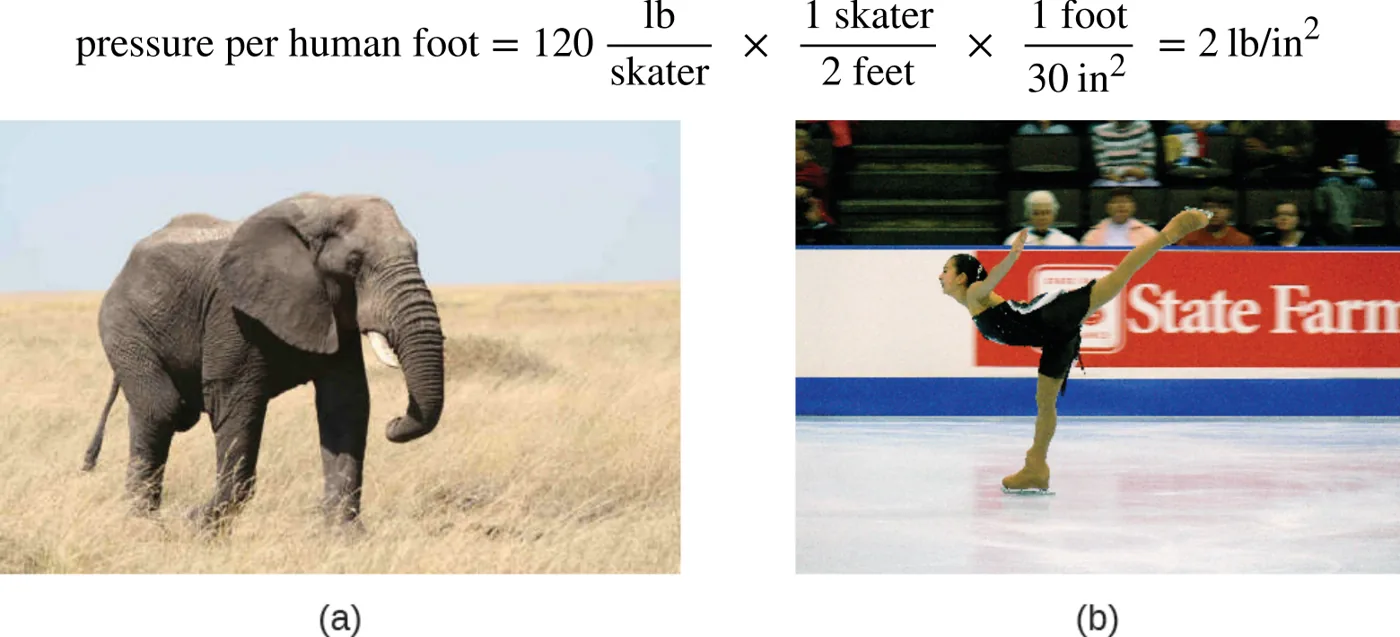
Consider an African elephant and a figure skater.
An elephant weighing about 7 tons (14,000 lb) stands on four feet, each with a footprint area of about 250 in2.
1 / 3Next ▶
Defining pressure
Defining pressure
Each foot therefore carries 3,500 lb, and the pressure under each foot is 3,500 lb ÷ 250 in2 = 14 lb/in2.
The skater weighs about 120 lb and is supported on two blades of about 2 in2 each.
Each blade carries 60 lb
so the pressure under each blade is 60 lb ÷ 2 in2 = 30 lb/in2.
Although the elephant is more than one hundred times heavier, it exerts less than half the pressure of the skater.
If the skater removes the skates and stands on bare feet, the weight is spread over a much larger area and the pressure falls sharply.
◀ Previous2 / 3Next ▶
An elephant spreads its weight over large feet, while a skater’s blades concentrate the same kind of force on a small area, so the skater produces the greater pressure on the ice. Image: OpenStax, Chemistry 2e, CC BY 4.0.
Defining pressure
◀ Previous3 / 3
Units of pressure
1
The SI unit of pressure is the pascal (Pa), defined as one newton per square meter
where one newton is the force needed to give a mass of 1 kg an acceleration of 1 m/s2.
2
One pascal is a small pressure
so the kilopascal (kPa), equal to 1,000 Pa, and the bar, equal to 100,000 Pa, are often more convenient.
3
In the United States pressure is often given in pounds per square inch (psi), for example for car tires.
4
The atmosphere (atm) was originally defined as the average sea-level air pressure at the latitude of Paris.
5
The table below summarizes these units and several others.
6
Conversions between these units use the relations in the table. For example, 1 atm = 760 torr
so a pressure in torr is converted to atmospheres by dividing by 760. The worked example in this part shows the method.
| Unit (abbreviation) | Definition or relation to other units |
|---|---|
| pascal (Pa) | 1 Pa = 1 N/m2; the recommended IUPAC unit |
| kilopascal (kPa) | 1 kPa = 1,000 Pa |
| pounds per square inch (psi) | Sea-level air pressure is about 14.7 psi |
| atmosphere (atm) | 1 atm = 101,325 Pa = 760 torr; sea-level air pressure is about 1 atm |
| bar (bar or b) | 1 bar = 100,000 Pa exactly; commonly used in meteorology |
| millibar (mbar or mb) | 1,000 mbar = 1 bar |
| inches of mercury (in. Hg) | 1 in. Hg = 3,386 Pa; used in aviation and some weather reports |
| torr | Named after Evangelista Torricelli, the inventor of the barometer; 1 torr is about 1 mm Hg |
| millimeters of mercury (mm Hg) | 1 mm Hg is approximately 1 torr |
1Barometers and hydrostatic pressure2Barometers and hydrostatic pressure3Barometers and hydrostatic pressure
Barometers and hydrostatic pressure
Barometers and hydrostatic pressure
A barometer measures atmospheric pressure.
It is a glass tube closed at one end, filled with a nonvolatile liquid such as mercury
and then inverted into a container of the same liquid.
The atmosphere pushes down on the liquid in the container,
and the column of liquid in the tube pushes down with a pressure that depends on its height.
Because the pressure at the liquid surface is the same inside and outside the tube, the height of the column is proportional to the atmospheric pressure.
1 / 3Next ▶
In a barometer the height of the liquid column is the measure of air pressure; mercury gives a practical tube size, while water would require a tube over 30 feet tall. Image: OpenStax, Chemistry 2e, CC BY 4.0.
Barometers and hydrostatic pressure
 ⤢ Enlarge
1
Mercury is used because it is about 13.6 times denser than water.
2
A water barometer would need to be over 10 m tall at sea level, whereas a mercury barometer needs to be only about 760 mm (29.92 in.) tall.
3
Standard atmospheric pressure of 1 atm at sea level, or 101,325 Pa, corresponds to this 760 mm column of mercury.
4
The torr was intended to equal one millimeter of mercury but no longer matches it exactly.
5
The pressure exerted by a fluid because of gravity is called hydrostatic pressure.
6
It is given by p = hρg,
where p is the hydrostatic pressure in Pa, h is the height of the fluid column in m, ρ (rho) is the fluid density in kg/m3,and g is the acceleration due to gravity, 9.81 m/s2.
◀ Previous2 / 3Next ▶
Barometers and hydrostatic pressure
Barometers and hydrostatic pressure
The height of a column of a given fluid therefore depends on its density: a denser liquid gives a shorter column for the same pressure.
◀ Previous3 / 3
1Manometers2Manometers
Manometers
Manometers
A manometer is a U-shaped tube containing a liquid, usually mercury, that measures the pressure of a gas in a container.
A closed-end manometer has one arm sealed and evacuated, and the other arm connected to the gas.
The gas pressure supports a column of liquid of height h
so the gas pressure equals the hydrostatic pressure of that column.
An open-end manometer has one arm open to the atmosphere.
In this case the difference in liquid levels gives the difference between the gas pressure and atmospheric pressure.
If the gas-side liquid is higher, the gas pressure is less than atmospheric
if the open-side liquid is higher, the gas pressure is greater than atmospheric.
1 / 2Next ▶
Three manometer diagrams: a closed-end tube reads the gas pressure directly, while an open-end tube reads the gas pressure as atmospheric pressure minus or plus the height difference. Image: OpenStax, Chemistry 2e, CC BY 4.0.
Manometers

◀ Previous2 / 2
1Measuring blood pressure2Measuring blood pressure
Measuring blood pressure
1
Blood pressure is measured with a sphygmomanometer, a name derived from the Greek word sphygmos meaning pulse.
2
The device has an inflatable cuff that restricts blood flow, a manometer that displays the pressure,
and a way of detecting when blood starts and stops flowing.
3
Since its invention in 1881 it has been an essential medical tool.
4
Manual models need a stethoscope and are used by medical staff, mercury models are used when the greatest accuracy is needed, mechanical models are less accurate,
and digital models are simple to use but have limitations.
1 / 2Next ▶
A nurse measuring a patient’s blood pressure with a cuff, and a typical hand-operated device with a rubber bulb pump and a pressure gauge. Image: OpenStax, Chemistry 2e, CC BY 4.0.
Measuring blood pressure
 ⤢ Enlarge
Measuring blood pressure
The cuff is placed on the upper arm and inflated until blood flow is completely blocked
then released slowly.
Each heartbeat forces blood through the arteries and raises the pressure.
The pressure at which blood begins to flow past the cuff is the systolic pressure, the peak pressure of the cardiac cycle.
At this point the flow creates sounds that can be heard through a stethoscope.
As the cuff pressure keeps falling, the sounds stop
the pressure at which they stop is the diastolic pressure, the lowest pressure of the cardiac cycle during the resting phase.
Blood pressure readings from a sphygmomanometer are given in millimeters of mercury (mm Hg).
◀ Previous2 / 2
1Meteorology and atmospheric science2Meteorology and atmospheric science3Meteorology and atmospheric science
Meteorology and atmospheric science
1
Meteorology, climatology, and atmospheric science use chemical principles to understand weather, the atmosphere, and climate.
2
Meteorology is the study of the atmosphere, atmospheric phenomena, and the effects of the atmosphere on weather.
3
Meteorologists aim to predict the weather in the short term
which can save lives and benefit the economy.
4
Weather forecasts are based on thousands of measurements of air pressure, temperature,
and other quantities,which are compiled, modeled,and analyzed at weather centers around the world.
5
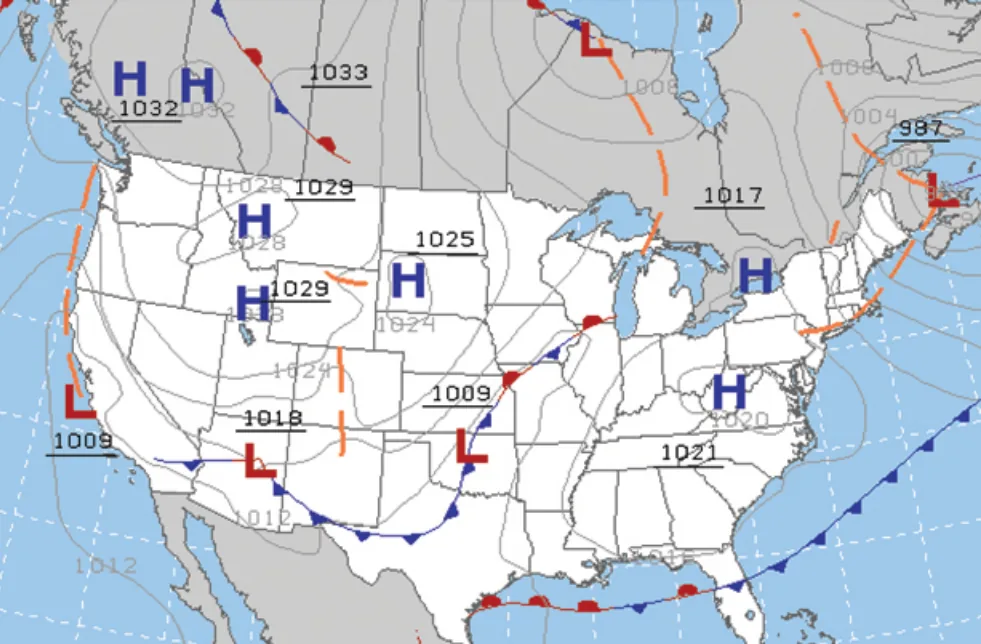
Weather maps show regions of high pressure (H) and low pressure (L)
which have large effects on weather. The gray lines on such maps are isobars, lines that join places of equal pressure.
1 / 3Next ▶
A weather map marking high and low pressure centers, with isobars drawn as gray lines of equal pressure. Image: OpenStax, Chemistry 2e, CC BY 4.0.
Meteorology and atmospheric science
 ⤢ Enlarge
Meteorology and atmospheric science
Low-pressure systems form when the air pressure at the surface is lower than in the surrounding environment. Moist air rises, cools and condenses, producing clouds. Most weather events are driven by the movement of moisture and air within weather fronts.
The atmosphere is the gaseous layer that surrounds a planet.
Earth’s atmosphere is roughly 100 to 125 km thick and consists of about 78.1% nitrogen and 21.0% oxygen.
It is divided into five layers.
The troposphere reaches up to about 12 km above sea level
it holds roughly 80% of the atmosphere’s mass and is the layer where most weather events originate.
As you rise through the troposphere, air density and temperature both decrease.
◀ Previous2 / 3Next ▶
Meteorology and atmospheric science
Meteorology and atmospheric science
Above it is the stratosphere, from about 12 to 50 km
then the mesosphere, from about 50 to 80 kmthen the thermosphere, from about 80 to 700 km.
The outermost layer, the exosphere, lies more than 700 km above sea level.
The climatology is the study of climate
which is the average of weather conditions over long periods, using atmospheric data. Climatologists study patterns and effects that occur over decades, centuries and millennia, whereas meteorologists focus on hours, days and weeks. Atmospheric science is broader still: it combines meteorology, climatology and other scientific disciplines that study the atmosphere.
◀ Previous3 / 3
1Example 9.1: Converting pressure units2Example 9.1: Converting pressure units3Example 9.2: Barometric pressure from a mercury column4Example 9.3: Pressure from a closed-end manometer5Worked examples6Example 9.4: Pressure from an open-end manometer7Example 9.4: Pressure from an open-end manometer8Example 9.4: Pressure from an open-end manometer
Example 9.1: Converting pressure units
1
The National Weather Service reports pressure in inches of mercury and in millibars. Convert 29.2 in. Hg into (a) torr, (b) atm, (c) kPa, and (d) mbar.
2
Solution: Use 1 in. Hg = 25.4 mm Hg = 25.4 torr for part (a)
then 1 atm = 760 torr, 1 in. Hg = 3,386 Pa, and 100 Pa = 1 mbar.
3
1
4
(a) 29.2 in. Hg × 25.4 mm/in. = 741.7 mm Hg
which is 741.7 torr, or about 742 torr.
5
2
6
(b) 741.7 torr ÷ 760 torr/atm = 0.976 atm.
1 / 8Next ▶
Example 9.1: Converting pressure units
1
3
2
(c) 29.2 in. Hg × 3,386 Pa/in. Hg = 98,871 Pa = 98.9 kPa.
3
4
4
(d) 98,871 Pa ÷ 100 Pa/mbar = 988.7 mbar, or about 989 mbar.
5
Check Your Learning: A typical barometric pressure in Kansas City is 740 torr. Convert it to atm, mm Hg, kPa, and bar. Answer: 0.974 atm
740 mm Hg98.7 kPa0.987 bar.
◀ Previous2 / 8Next ▶
Example 9.2: Barometric pressure from a mercury column
Example 9.2: Barometric pressure from a mercury column
Show that normal atmospheric pressure near sea level corresponds to a column of mercury about 760 mm high. The density of mercury is 13.6 g/cm3.
Solution: Convert the density to 13,600 kg/m3 and the height to 0.760 m. Then p = hρg = (0.760 m)(13,600 kg/m3)(9.81 m/s2) = 1.01 × 10⁵ Pa. This is about 101,325 Pa
which is 1 atmso the claim holds.
Check Your Learning: Calculate the height of a column of water at 25 °C that corresponds to normal atmospheric pressure. The density of water at this temperature is 1.0 g/cm3. Answer: h = p/(ρg) = 101,325 Pa ÷ (1,000 kg/m3 × 9.81 m/s2) = 10.3 m.
◀ Previous3 / 8Next ▶
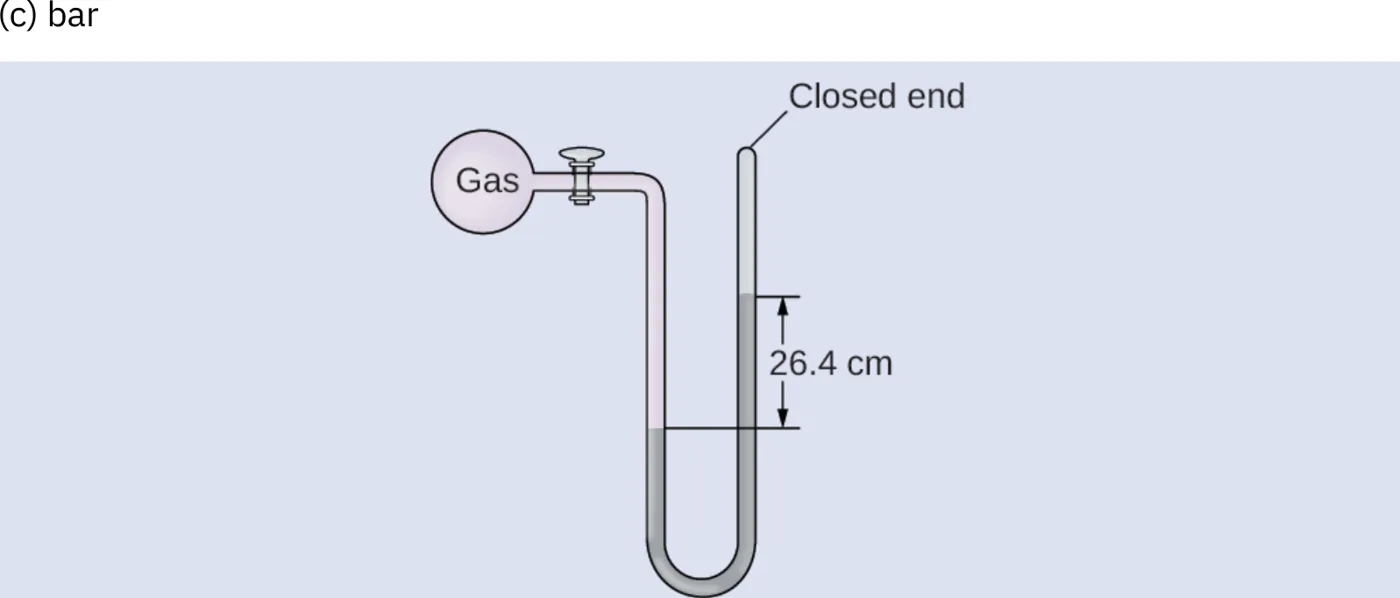
A closed-end mercury manometer whose liquid column is 26.4 cm high, with the sealed arm on the right. Image: OpenStax, Chemistry 2e, CC BY 4.0.
Example 9.3: Pressure from a closed-end manometer
 ⤢ Enlarge
1
A gas sample is measured with a closed-end mercury manometer, in which the mercury column is 26.4 cm high. Find the gas pressure in (a) torr, (b) Pa, and (c) bar.
2
Solution: In a closed-end manometer the gas pressure equals the pressure of a mercury column of height h
so the gas pressure is 26.4 cm = 264 mm Hg. Simple unit conversions are easier than using p = hρg here.
◀ Previous4 / 8Next ▶
Worked examples
Worked examples
(a) 264 mm Hg = 264 torr.
(b) 264 mm Hg × 133.3 Pa/mm Hg = 3.52 × 10⁴ Pa. Check: 264/760 × 101,325 Pa = 35,200 Pa.
(c) 3.52 × 10⁴ Pa ÷ 100,000 Pa/bar = 0.352 bar.
Check Your Learning: A gas sample is measured with a closed-end mercury manometer whose column is 6.0 in. high. Find the pressure in (a) torr, (b) Pa, and (c) bar. Answer: (a) about 150 torr
(b) about 20,000 Pa(c) about 0.20 bar.
◀ Previous5 / 8Next ▶
A closed-end mercury manometer whose column is 6.0 inches high, with the gas on the left. Image: OpenStax, Chemistry 2e, CC BY 4.0.
Example 9.4: Pressure from an open-end manometer
 ⤢ Enlarge
Example 9.4: Pressure from an open-end manometer
A gas sample is measured at sea level with an open-end mercury manometer whose column difference is 13.7 cm. Find the gas pressure in (a) mm Hg, (b) atm, and (c) kPa.
◀ Previous6 / 8Next ▶
An open-end mercury manometer with a 13.7 cm height difference; the gas side is lower, so the gas pressure is above atmospheric pressure. Image: OpenStax, Chemistry 2e, CC BY 4.0.
Example 9.4: Pressure from an open-end manometer
 ⤢ Enlarge
1
Solution: The gas pressure equals atmospheric pressure plus the 13.7 cm mercury column
because the mercury is higher on the open side. Here 13.7 cm = 137 mm Hgso the gas pressure is 137 mm Hg + 760 mm Hg = 897 mm Hg.
2
(a) 897 mm Hg.
3
(b) 897 mm Hg ÷ 760 mm Hg/atm = 1.18 atm.
4
(c) 897 mm Hg × 0.13332 kPa/mm Hg = 119.6 kPa, or about 120 kPa. Check: 1.18 atm × 101.325 kPa/atm = 119.6 kPa.
5
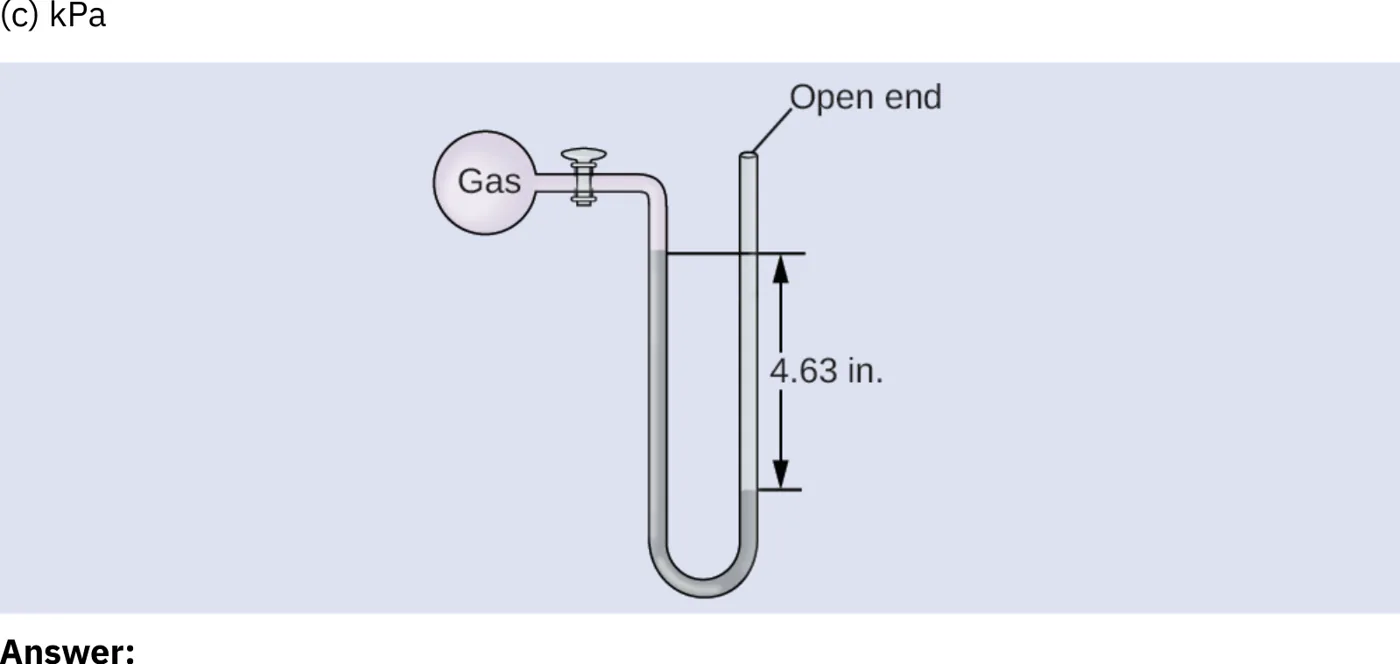
Check Your Learning: A gas sample is measured at sea level with an open-end mercury manometer whose column difference is 4.63 in., with the gas side higher.
6
Find the pressure in (a) mm Hg, (b) atm, and (c) kPa. Answer: (a) 642 mm Hg
(b) 0.845 atm(c) 85.6 kPa.
◀ Previous7 / 8Next ▶
An open-end mercury manometer with a 4.63 inch height difference, where the gas side is higher, so the gas pressure is below atmospheric pressure. Image: OpenStax, Chemistry 2e, CC BY 4.0.
Example 9.4: Pressure from an open-end manometer
 ⤢ Enlarge
Example 9.4: Pressure from an open-end manometer
Working: 4.63 in. = 117.6 mm, and 760 − 117.6 = 642 mm Hg.
◀ Previous8 / 8
Key terms
| Term | Meaning |
|---|---|
| Pressure | The force acting on a given area, P = F/A. |
| Pascal (Pa) | The SI unit of pressure, equal to one newton per square meter. |
| Newton (N) | The SI unit of force, equal to 1 kg·m/s2. |
| Kilopascal (kPa) | A unit of pressure equal to 1,000 Pa. |
| Bar | A unit of pressure equal to exactly 100,000 Pa. |
| Atmosphere (atm) | A unit of pressure equal to 101,325 Pa, the average sea-level air pressure. |
| Pounds per square inch (psi) | A unit of pressure in the United States: one pound of force per square inch. |
| Torr | A unit of pressure named after Torricelli, approximately equal to 1 mm Hg. |
| Millimeter of mercury (mm Hg) | The pressure exerted by a 1 mm column of mercury. |
| Barometer | A device that measures atmospheric pressure from the height of a liquid column in a tube. |
| Nonvolatile liquid | A liquid that does not evaporate appreciably, such as mercury, used in barometers and manometers. |
| Hydrostatic pressure | The pressure a fluid exerts because of gravity, p = hρg. |
| Density (ρ) | The mass of a substance per unit volume, in kg/m3 or g/cm3. |
| Manometer | A U-shaped tube that measures the pressure of a gas using a liquid column. |
| Closed-end manometer | A manometer with a sealed, evacuated arm, which reads the gas pressure directly. |
| Open-end manometer | A manometer with one arm open to the atmosphere, which reads the difference between gas and atmospheric pressure. |
| Sphygmomanometer | A device that measures blood pressure using an inflatable cuff and a manometer. |
| Systolic pressure | The peak blood pressure of the cardiac cycle, at which blood begins to flow past the cuff. |
| Diastolic pressure | The lowest blood pressure of the cardiac cycle, during the resting phase. |
| Meteorology | The study of the atmosphere and its effects on weather. |
| Isobar | A line on a weather map that joins places of equal pressure. |
| Atmosphere | The gaseous layer that surrounds a planet; Earth’s is about 100 to 125 km thick. |
| Troposphere | The lowest atmospheric layer, up to about 12 km, where most weather originates. |
| Stratosphere | The atmospheric layer from about 12 to 50 km above sea level. |
| Mesosphere | The atmospheric layer from about 50 to 80 km above sea level. |
| Thermosphere | The atmospheric layer from about 80 to 700 km above sea level. |
| Exosphere | The outermost atmospheric layer, more than 700 km above sea level. |
| Climatology | The study of climate, the average of weather conditions over long periods. |
| Atmospheric science | The broad field combining meteorology, climatology and other disciplines that study the atmosphere. |
1Avoid these mistakes2Avoid these mistakes3Avoid these mistakes4Avoid these mistakes