Curriculum
Chemistry 2e
Unit 1: Essential Ideas
0/14
-
Unit 1 overview: Essential Ideas
 Text lessonPreview
-
1.1 Chemistry in Context
Text lessonPreview
-
1.1 Chemistry in Context - Check yourself
 6 questionsPreview
-
1.2 Phases and Classification of Matter
Text lessonPreview
-
1.2 Phases and Classification of Matter - Check yourself
6 questionsPreview
-
1.3 Physical and Chemical Properties
Text lessonPreview
-
1.3 Physical and Chemical Properties - Check yourself
6 questionsPreview
-
1.4 Measurements
Text lessonPreview
-
1.4 Measurements - Check yourself
6 questionsPreview
-
1.5 Measurement Uncertainty, Accuracy, and Precision
Text lessonPreview
-
1.5 Measurement Uncertainty, Accuracy, and Precision - Check yourself
6 questionsPreview
-
1.6 Mathematical Treatment of Measurement Results
Text lessonPreview
-
1.6 Mathematical Treatment of Measurement Results - Check yourself
6 questionsPreview
-
Unit 1 review quiz: Essential Ideas
10 questionsPreview
Unit 2: Atoms, Molecules, and Ions
0/16
-
Unit 2 overview: Atoms, Molecules, and Ions
Text lessonPreview
-
2.1 Early Ideas in Atomic Theory
Text lessonPreview
-
2.1 Early Ideas in Atomic Theory - Check yourself
6 questionsPreview
-
2.2 Evolution of Atomic Theory
Text lessonPreview
-
2.2 Evolution of Atomic Theory - Check yourself
6 questionsPreview
-
2.3 Atomic Structure and Symbolism
Text lessonPreview
-
2.3 Atomic Structure and Symbolism - Check yourself
6 questionsPreview
-
2.4 Chemical Formulas
Text lessonPreview
-
2.4 Chemical Formulas - Check yourself
6 questionsPreview
-
2.5 The Periodic Table
Text lessonPreview
-
2.5 The Periodic Table - Check yourself
6 questionsPreview
-
2.6 Ionic and Molecular Compounds
Text lessonPreview
-
2.6 Ionic and Molecular Compounds - Check yourself
6 questionsPreview
-
2.7 Chemical Nomenclature
Text lessonPreview
-
2.7 Chemical Nomenclature - Check yourself
6 questionsPreview
-
Unit 2 review quiz: Atoms, Molecules, and Ions
10 questionsPreview
Unit 3: Composition of Substances and Solutions
0/10
-
Unit 3 overview: Composition of Substances and Solutions
Text lessonPreview
-
3.1 Formula Mass and the Mole Concept
Text lessonPreview
-
3.1 Formula Mass and the Mole Concept - Check yourself
6 questionsPreview
-
3.2 Determining Empirical and Molecular Formulas
Text lessonPreview
-
3.2 Determining Empirical and Molecular Formulas - Check yourself
6 questionsPreview
-
3.3 Molarity
Text lessonPreview
-
3.3 Molarity - Check yourself
6 questionsPreview
-
3.4 Other Units for Solution Concentrations
Text lessonPreview
-
3.4 Other Units for Solution Concentrations - Check yourself
6 questionsPreview
-
Unit 3 review quiz: Composition of Substances and Solutions
10 questionsPreview
Unit 4: Stoichiometry of Chemical Reactions
0/12
-
Unit 4 overview: Stoichiometry of Chemical Reactions
Text lessonPreview
-
4.1 Writing and Balancing Chemical Equations
Text lessonPreview
-
4.1 Writing and Balancing Chemical Equations - Check yourself
6 questionsPreview
-
4.2 Classifying Chemical Reactions
Text lessonPreview
-
4.2 Classifying Chemical Reactions - Check yourself
6 questionsPreview
-
4.3 Reaction Stoichiometry
Text lessonPreview
-
4.3 Reaction Stoichiometry - Check yourself
6 questionsPreview
-
4.4 Reaction Yields
Text lessonPreview
-
4.4 Reaction Yields - Check yourself
6 questionsPreview
-
4.5 Quantitative Chemical Analysis
Text lessonPreview
-
4.5 Quantitative Chemical Analysis - Check yourself
6 questionsPreview
-
Unit 4 review quiz: Stoichiometry of Chemical Reactions
10 questionsPreview
Unit 5: Thermochemistry
0/8
-
Unit 5 overview: Thermochemistry
Text lessonPreview
-
5.1 Energy Basics
Text lessonPreview
-
5.1 Energy Basics - Check yourself
6 questionsPreview
-
5.2 Calorimetry
Text lessonPreview
-
5.2 Calorimetry - Check yourself
7 questionsPreview
-
5.3 Enthalpy
Text lessonPreview
-
5.3 Enthalpy - Check yourself
6 questionsPreview
-
Unit 5 review quiz: Thermochemistry
10 questionsPreview
Unit 6: Electronic Structure and Periodic Properties of Elements
0/12
-
Unit 6 overview: Electronic Structure and Periodic Properties of Elements
Text lessonPreview
-
6.1 Electromagnetic Energy
Text lessonPreview
-
6.1 Electromagnetic Energy - Check yourself
6 questionsPreview
-
6.2 The Bohr Model
Text lessonPreview
-
6.2 The Bohr Model - Check yourself
6 questionsPreview
-
6.3 Development of Quantum Theory
Text lessonPreview
-
6.3 Development of Quantum Theory - Check yourself
6 questionsPreview
-
6.4 Electronic Structure of Atoms (Electron Configurations)
Text lessonPreview
-
6.4 Electronic Structure of Atoms (Electron Configurations) - Check yourself
6 questionsPreview
-
6.5 Periodic Variations in Element Properties
Text lessonPreview
-
6.5 Periodic Variations in Element Properties - Check yourself
6 questionsPreview
-
Unit 6 review quiz: Electronic Structure and Periodic Properties of Elements
10 questionsPreview
Unit 7: Chemical Bonding and Molecular Geometry
0/14
-
Unit 7 overview: Chemical Bonding and Molecular Geometry
Text lessonPreview
-
7.1 Ionic Bonding
Text lessonPreview
-
7.1 Ionic Bonding - Check yourself
6 questionsPreview
-
7.2 Covalent Bonding
Text lessonPreview
-
7.2 Covalent Bonding - Check yourself
6 questionsPreview
-
7.3 Lewis Symbols and Structures
Text lessonPreview
-
7.3 Lewis Symbols and Structures - Check yourself
6 questionsPreview
-
7.4 Formal Charges and Resonance
Text lessonPreview
-
7.4 Formal Charges and Resonance - Check yourself
6 questionsPreview
-
7.5 Strengths of Ionic and Covalent Bonds
Text lessonPreview
-
7.5 Strengths of Ionic and Covalent Bonds - Check yourself
6 questionsPreview
-
7.6 Molecular Structure and Polarity
Text lessonPreview
-
7.6 Molecular Structure and Polarity - Check yourself
6 questionsPreview
-
Unit 7 review quiz: Chemical Bonding and Molecular Geometry
10 questionsPreview
Unit 8: Advanced Theories of Covalent Bonding
0/10
-
Unit 8 overview: Advanced Theories of Covalent Bonding
Text lessonPreview
-
8.1 Valence Bond Theory
Text lessonPreview
-
8.1 Valence Bond Theory - Check yourself
6 questionsPreview
-
8.2 Hybrid Atomic Orbitals
Text lessonPreview
-
8.2 Hybrid Atomic Orbitals - Check yourself
6 questionsPreview
-
8.3 Multiple Bonds
Text lessonPreview
-
8.3 Multiple Bonds - Check yourself
6 questionsPreview
-
8.4 Molecular Orbital Theory
Text lessonPreview
-
8.4 Molecular Orbital Theory - Check yourself
6 questionsPreview
-
Unit 8 review quiz: Advanced Theories of Covalent Bonding
10 questionsPreview
Unit 9: Gases
0/23
-
Unit 9 overview: Gases
Text lessonPreview
-
9.1 Gas Pressure
Text lessonPreview
-
9.1 Gas Pressure - Check yourself
6 questionsPreview
-
9.2 Relating Pressure, Volume, Amount, and Temperature: The Ideal Gas Law
Text lessonPreview
-
9.2 Relating Pressure, Volume, Amount, and Temperature: The Ideal Gas Law - Check yourself
6 questionsPreview
-
9.3 Stoichiometry of Gaseous Substances, Mixtures, and Reactions
Text lessonPreview
-
9.3 Stoichiometry of Gaseous Substances, Mixtures, and Reactions - Check yourself
6 questionsPreview
-
9.3 Stoichiometry of Gaseous Substances, Mixtures, and Reactions
Text lessonPreview
-
9.3 Stoichiometry of Gaseous Substances, Mixtures, and Reactions - Check yourself
6 questionsPreview
-
9.4 Effusion and Diffusion of Gases
Text lessonPreview
-
9.4 Effusion and Diffusion of Gases - Check yourself
6 questionsPreview
-
9.4 Effusion and Diffusion of Gases
Text lessonPreview
-
9.4 Effusion and Diffusion of Gases - Check yourself
6 questionsPreview
-
Unit 9 review quiz: Gases
10 questionsPreview
-
9.5 The Kinetic-Molecular Theory
Text lessonPreview
-
9.5 The Kinetic-Molecular Theory - Check yourself
6 questionsPreview
-
9.5 The Kinetic-Molecular Theory
Text lessonPreview
-
9.5 The Kinetic-Molecular Theory - Check yourself
6 questionsPreview
-
9.6 Non-Ideal Gas Behavior
Text lessonPreview
-
9.6 Non-Ideal Gas Behavior - Check yourself
6 questionsPreview
-
9.6 Non-Ideal Gas Behavior
Text lessonPreview
-
9.6 Non-Ideal Gas Behavior - Check yourself
6 questionsPreview
-
Unit 9 review quiz: Gases
10 questionsPreview
Unit 10: Liquids and Solids
0/28
-
Unit 10 overview: Liquids and Solids
Text lessonPreview
-
10.1 Intermolecular Forces
Text lessonPreview
-
Unit 10 overview: Liquids and Solids
Text lessonPreview
-
10.1 Intermolecular Forces
Text lessonPreview
-
10.1 Intermolecular Forces - Check yourself
6 questionsPreview
-
10.1 Intermolecular Forces - Check yourself
6 questionsPreview
-
10.2 Properties of Liquids
Text lessonPreview
-
10.2 Properties of Liquids - Check yourself
6 questionsPreview
-
10.2 Properties of Liquids
Text lessonPreview
-
10.2 Properties of Liquids - Check yourself
6 questionsPreview
-
10.3 Phase Transitions
Text lessonPreview
-
10.3 Phase Transitions - Check yourself
6 questionsPreview
-
10.3 Phase Transitions
Text lessonPreview
-
10.3 Phase Transitions - Check yourself
6 questionsPreview
-
10.4 Phase Diagrams
Text lessonPreview
-
10.4 Phase Diagrams
Text lessonPreview
-
10.4 Phase Diagrams - Check yourself
6 questionsPreview
-
10.4 Phase Diagrams - Check yourself
6 questionsPreview
-
10.5 The Solid State of Matter
Text lessonPreview
-
10.5 The Solid State of Matter
Text lessonPreview
-
10.5 The Solid State of Matter - Check yourself
6 questionsPreview
-
10.5 The Solid State of Matter - Check yourself
6 questionsPreview
-
10.6 Lattice Structures in Crystalline Solids
Text lessonPreview
-
10.6 Lattice Structures in Crystalline Solids
Text lessonPreview
-
10.6 Lattice Structures in Crystalline Solids - Check yourself
6 questionsPreview
-
10.6 Lattice Structures in Crystalline Solids - Check yourself
6 questionsPreview
-
Unit 10 review quiz: Liquids and Solids
10 questionsPreview
-
Unit 10 review quiz: Liquids and Solids
10 questionsPreview
Unit 11: Solutions and Colloids
0/24
-
Unit 11 overview: Solutions and Colloids
Text lessonPreview
-
11.1 The Dissolution Process
Text lessonPreview
-
Unit 11 overview: Solutions and Colloids
Text lessonPreview
-
11.1 The Dissolution Process
Text lessonPreview
-
11.1 The Dissolution Process - Check yourself
6 questionsPreview
-
11.1 The Dissolution Process - Check yourself
6 questionsPreview
-
11.2 Electrolytes
Text lessonPreview
-
11.2 Electrolytes - Check yourself
6 questionsPreview
-
11.2 Electrolytes
Text lessonPreview
-
11.2 Electrolytes - Check yourself
6 questionsPreview
-
11.3 Solubility
Text lessonPreview
-
11.3 Solubility - Check yourself
6 questionsPreview
-
11.3 Solubility
Text lessonPreview
-
11.3 Solubility - Check yourself
6 questionsPreview
-
11.4 Colligative Properties
Text lessonPreview
-
11.4 Colligative Properties - Check yourself
6 questionsPreview
-
11.4 Colligative Properties
Text lessonPreview
-
11.4 Colligative Properties - Check yourself
6 questionsPreview
-
11.5 Colloids
Text lessonPreview
-
11.5 Colloids - Check yourself
6 questionsPreview
-
11.5 Colloids
Text lessonPreview
-
11.5 Colloids - Check yourself
6 questionsPreview
-
Unit 11 review quiz: Solutions and Colloids
10 questionsPreview
-
Unit 11 review quiz: Solutions and Colloids
10 questionsPreview
Unit 12: Kinetics
0/32
-
Unit 12 overview: Kinetics
Text lessonPreview
-
12.1 Chemical Reaction Rates
Text lessonPreview
-
12.1 Chemical Reaction Rates - Check yourself
6 questionsPreview
-
Unit 12 overview: Kinetics
Text lessonPreview
-
12.1 Chemical Reaction Rates
Text lessonPreview
-
12.1 Chemical Reaction Rates - Check yourself
6 questionsPreview
-
12.2 Factors Affecting Reaction Rates
Text lessonPreview
-
12.2 Factors Affecting Reaction Rates - Check yourself
6 questionsPreview
-
12.2 Factors Affecting Reaction Rates
Text lessonPreview
-
12.2 Factors Affecting Reaction Rates - Check yourself
6 questionsPreview
-
12.3 Rate Laws
Text lessonPreview
-
12.3 Rate Laws - Check yourself
6 questionsPreview
-
12.3 Rate Laws
Text lessonPreview
-
12.3 Rate Laws - Check yourself
6 questionsPreview
-
12.4 Integrated Rate Laws
Text lessonPreview
-
12.4 Integrated Rate Laws - Check yourself
6 questionsPreview
-
12.4 Integrated Rate Laws
Text lessonPreview
-
12.4 Integrated Rate Laws - Check yourself
6 questionsPreview
-
12.5 Collision Theory
Text lessonPreview
-
12.5 Collision Theory - Check yourself
6 questionsPreview
-
12.5 Collision Theory
Text lessonPreview
-
Unit 12 review quiz: Kinetics
10 questionsPreview
-
12.5 Collision Theory - Check yourself
6 questionsPreview
-
12.6 Reaction Mechanisms
Text lessonPreview
-
12.6 Reaction Mechanisms - Check yourself
6 questionsPreview
-
12.6 Reaction Mechanisms
Text lessonPreview
-
12.6 Reaction Mechanisms - Check yourself
6 questionsPreview
-
12.7 Catalysis
Text lessonPreview
-
12.7 Catalysis - Check yourself
6 questionsPreview
-
12.7 Catalysis
Text lessonPreview
-
12.7 Catalysis - Check yourself
6 questionsPreview
-
Unit 12 review quiz: Kinetics
10 questionsPreview
Unit 13: Fundamental Equilibrium Concepts
0/20
-
Unit 13 overview: Fundamental Equilibrium Concepts
Text lessonPreview
-
13.1 Chemical Equilibria
Text lessonPreview
-
13.1 Chemical Equilibria - Check yourself
6 questionsPreview
-
13.1 Chemical Equilibria
Text lessonPreview
-
13.1 Chemical Equilibria - Check yourself
6 questionsPreview
-
13.2 Equilibrium Constants
Text lessonPreview
-
13.2 Equilibrium Constants - Check yourself
6 questionsPreview
-
13.2 Equilibrium Constants
Text lessonPreview
-
Unit 13 overview: Fundamental Equilibrium Concepts
Text lessonPreview
-
13.2 Equilibrium Constants - Check yourself
6 questionsPreview
-
13.3 Shifting Equilibria: Le Châtelier’s Principle
Text lessonPreview
-
13.3 Shifting Equilibria: Le Châtelier’s Principle - Check yourself
6 questionsPreview
-
13.3 Shifting Equilibria: Le Châtelier’s Principle
Text lessonPreview
-
Unit 13 review quiz: Fundamental Equilibrium Concepts
10 questionsPreview
-
13.3 Shifting Equilibria: Le Châtelier’s Principle - Check yourself
6 questionsPreview
-
13.4 Equilibrium Calculations
Text lessonPreview
-
13.4 Equilibrium Calculations - Check yourself
6 questionsPreview
-
13.4 Equilibrium Calculations
Text lessonPreview
-
13.4 Equilibrium Calculations - Check yourself
6 questionsPreview
-
Unit 13 review quiz: Fundamental Equilibrium Concepts
10 questionsPreview
Unit 14: Acid-Base Equilibria
0/32
-
Unit 14 overview: Acid-Base Equilibria
Text lessonPreview
-
14.1 Brønsted-Lowry Acids and Bases
Text lessonPreview
-
14.1 Brønsted-Lowry Acids and Bases - Check yourself
6 questionsPreview
-
14.1 Brønsted-Lowry Acids and Bases
Text lessonPreview
-
14.1 Brønsted-Lowry Acids and Bases - Check yourself
6 questionsPreview
-
14.2 pH and pOH
Text lessonPreview
-
14.2 pH and pOH - Check yourself
6 questionsPreview
-
14.2 pH and pOH
Text lessonPreview
-
14.2 pH and pOH - Check yourself
6 questionsPreview
-
14.3 Relative Strengths of Acids and Bases
Text lessonPreview
-
14.3 Relative Strengths of Acids and Bases - Check yourself
6 questionsPreview
-
14.3 Relative Strengths of Acids and Bases
Text lessonPreview
-
14.3 Relative Strengths of Acids and Bases - Check yourself
6 questionsPreview
-
14.4 Hydrolysis of Salts
Text lessonPreview
-
14.4 Hydrolysis of Salts - Check yourself
6 questionsPreview
-
Unit 14 review quiz: Acid-Base Equilibria
10 questionsPreview
-
Unit 14 overview: Acid-Base Equilibria
Text lessonPreview
-
14.4 Hydrolysis of Salts
Text lessonPreview
-
14.4 Hydrolysis of Salts - Check yourself
6 questionsPreview
-
14.5 Polyprotic Acids
Text lessonPreview
-
14.5 Polyprotic Acids - Check yourself
6 questionsPreview
-
14.5 Polyprotic Acids
Text lessonPreview
-
14.5 Polyprotic Acids - Check yourself
6 questionsPreview
-
14.6 Buffers
Text lessonPreview
-
14.6 Buffers - Check yourself
6 questionsPreview
-
14.6 Buffers
Text lessonPreview
-
14.6 Buffers - Check yourself
6 questionsPreview
-
14.7 Acid-Base Titrations
Text lessonPreview
-
14.7 Acid-Base Titrations - Check yourself
6 questionsPreview
-
14.7 Acid-Base Titrations
Text lessonPreview
-
14.7 Acid-Base Titrations - Check yourself
6 questionsPreview
-
Unit 14 review quiz: Acid-Base Equilibria
10 questionsPreview
Unit 15: Equilibria of Other Reaction Classes
0/16
-
Unit 15 overview: Equilibria of Other Reaction Classes
Text lessonPreview
-
15.1 Precipitation and Dissolution
Text lessonPreview
-
15.1 Precipitation and Dissolution - Check yourself
6 questionsPreview
-
15.1 Precipitation and Dissolution
Text lessonPreview
-
15.1 Precipitation and Dissolution - Check yourself
6 questionsPreview
-
15.2 Lewis Acids and Bases
Text lessonPreview
-
15.2 Lewis Acids and Bases - Check yourself
6 questionsPreview
-
Unit 15 review quiz: Equilibria of Other Reaction Classes
10 questionsPreview
-
Unit 15 overview: Equilibria of Other Reaction Classes
Text lessonPreview
-
15.2 Lewis Acids and Bases
Text lessonPreview
-
15.2 Lewis Acids and Bases - Check yourself
6 questionsPreview
-
15.3 Coupled Equilibria
Text lessonPreview
-
15.3 Coupled Equilibria - Check yourself
6 questionsPreview
-
15.3 Coupled Equilibria
Text lessonPreview
-
15.3 Coupled Equilibria - Check yourself
6 questionsPreview
-
Unit 15 review quiz: Equilibria of Other Reaction Classes
10 questionsPreview
Unit 16: Thermodynamics
0/20
-
Unit 16 overview: Thermodynamics
Text lessonPreview
-
16.1 Spontaneity
Text lessonPreview
-
16.1 Spontaneity - Check yourself
6 questionsPreview
-
16.1 Spontaneity
Text lessonPreview
-
16.1 Spontaneity - Check yourself
6 questionsPreview
-
16.2 Entropy
Text lessonPreview
-
16.2 Entropy - Check yourself
6 questionsPreview
-
16.2 Entropy
Text lessonPreview
-
16.2 Entropy - Check yourself
6 questionsPreview
-
Unit 16 review quiz: Thermodynamics
10 questionsPreview
-
Unit 16 overview: Thermodynamics
Text lessonPreview
-
16.3 The Second and Third Laws of Thermodynamics
Text lessonPreview
-
16.3 The Second and Third Laws of Thermodynamics - Check yourself
6 questionsPreview
-
16.3 The Second and Third Laws of Thermodynamics
Text lessonPreview
-
16.3 The Second and Third Laws of Thermodynamics - Check yourself
6 questionsPreview
-
16.4 Free Energy
Text lessonPreview
-
16.4 Free Energy - Check yourself
6 questionsPreview
-
16.4 Free Energy
Text lessonPreview
-
16.4 Free Energy - Check yourself
6 questionsPreview
-
Unit 16 review quiz: Thermodynamics
10 questionsPreview
Unit 17: Electrochemistry
0/32
-
Unit 17 overview: Electrochemistry
Text lessonPreview
-
17.1 Review of Redox Chemistry
Text lessonPreview
-
17.1 Review of Redox Chemistry - Check yourself
6 questionsPreview
-
17.1 Review of Redox Chemistry
Text lessonPreview
-
17.1 Review of Redox Chemistry - Check yourself
6 questionsPreview
-
17.2 Galvanic Cells
Text lessonPreview
-
17.2 Galvanic Cells - Check yourself
6 questionsPreview
-
17.2 Galvanic Cells
Text lessonPreview
-
17.2 Galvanic Cells - Check yourself
6 questionsPreview
-
17.3 Electrode and Cell Potentials
Text lessonPreview
-
17.3 Electrode and Cell Potentials - Check yourself
6 questionsPreview
-
17.3 Electrode and Cell Potentials
Text lessonPreview
-
17.3 Electrode and Cell Potentials - Check yourself
6 questionsPreview
-
17.4 Potential, Free Energy, and Equilibrium
Text lessonPreview
-
17.4 Potential, Free Energy, and Equilibrium - Check yourself
6 questionsPreview
-
Unit 17 review quiz: Electrochemistry
10 questionsPreview
-
Unit 17 overview: Electrochemistry
Text lessonPreview
-
17.4 Potential, Free Energy, and Equilibrium
Text lessonPreview
-
17.4 Potential, Free Energy, and Equilibrium - Check yourself
6 questionsPreview
-
17.5 Batteries and Fuel Cells
Text lessonPreview
-
17.5 Batteries and Fuel Cells - Check yourself
6 questionsPreview
-
17.5 Batteries and Fuel Cells
Text lessonPreview
-
17.5 Batteries and Fuel Cells - Check yourself
6 questionsPreview
-
17.6 Corrosion
Text lessonPreview
-
17.6 Corrosion - Check yourself
6 questionsPreview
-
17.6 Corrosion
Text lessonPreview
-
17.6 Corrosion - Check yourself
6 questionsPreview
-
17.7 Electrolysis
Text lessonPreview
-
17.7 Electrolysis - Check yourself
6 questionsPreview
-
17.7 Electrolysis
Text lessonPreview
-
17.7 Electrolysis - Check yourself
6 questionsPreview
-
Unit 17 review quiz: Electrochemistry
10 questionsPreview
Unit 18: Representative Metals, Metalloids, and Nonmetals
0/52
-
Unit 18 overview: Representative Metals, Metalloids, and Nonmetals
Text lessonPreview
-
18.1 Periodicity
Text lessonPreview
-
18.1 Periodicity - Check yourself
6 questionsPreview
-
18.1 Periodicity
Text lessonPreview
-
18.1 Periodicity - Check yourself
6 questionsPreview
-
18.2 Occurrence and Preparation of the Representative Metals
Text lessonPreview
-
18.2 Occurrence and Preparation of the Representative Metals - Check yourself
6 questionsPreview
-
18.2 Occurrence and Preparation of the Representative Metals
Text lessonPreview
-
18.2 Occurrence and Preparation of the Representative Metals - Check yourself
6 questionsPreview
-
18.3 Structure and General Properties of the Metalloids
Text lessonPreview
-
18.3 Structure and General Properties of the Metalloids - Check yourself
6 questionsPreview
-
18.3 Structure and General Properties of the Metalloids
Text lessonPreview
-
18.3 Structure and General Properties of the Metalloids - Check yourself
6 questionsPreview
-
18.4 Structure and General Properties of the Nonmetals
Text lessonPreview
-
18.4 Structure and General Properties of the Nonmetals - Check yourself
6 questionsPreview
-
18.4 Structure and General Properties of the Nonmetals
Text lessonPreview
-
18.4 Structure and General Properties of the Nonmetals - Check yourself
6 questionsPreview
-
18.5 Occurrence, Preparation, and Compounds of Hydrogen
Text lessonPreview
-
18.5 Occurrence, Preparation, and Compounds of Hydrogen - Check yourself
6 questionsPreview
-
18.5 Occurrence, Preparation, and Compounds of Hydrogen
Text lessonPreview
-
18.5 Occurrence, Preparation, and Compounds of Hydrogen - Check yourself
6 questionsPreview
-
18.6 Occurrence, Preparation, and Properties of Carbonates
Text lessonPreview
-
18.6 Occurrence, Preparation, and Properties of Carbonates - Check yourself
6 questionsPreview
-
18.6 Occurrence, Preparation, and Properties of Carbonates
Text lessonPreview
-
18.6 Occurrence, Preparation, and Properties of Carbonates - Check yourself
6 questionsPreview
-
Unit 18 review quiz: Representative Metals, Metalloids, and Nonmetals
10 questionsPreview
-
Unit 18 overview: Representative Metals, Metalloids, and Nonmetals
Text lessonPreview
-
18.7 Occurrence, Preparation, and Properties of Nitrogen
Text lessonPreview
-
18.7 Occurrence, Preparation, and Properties of Nitrogen - Check yourself
6 questionsPreview
-
18.7 Occurrence, Preparation, and Properties of Nitrogen
Text lessonPreview
-
18.7 Occurrence, Preparation, and Properties of Nitrogen - Check yourself
6 questionsPreview
-
18.8 Occurrence, Preparation, and Properties of Phosphorus
Text lessonPreview
-
18.8 Occurrence, Preparation, and Properties of Phosphorus - Check yourself
6 questionsPreview
-
18.8 Occurrence, Preparation, and Properties of Phosphorus
Text lessonPreview
-
18.8 Occurrence, Preparation, and Properties of Phosphorus - Check yourself
6 questionsPreview
-
18.9 Occurrence, Preparation, and Compounds of Oxygen
Text lessonPreview
-
18.9 Occurrence, Preparation, and Compounds of Oxygen - Check yourself
6 questionsPreview
-
18.9 Occurrence, Preparation, and Compounds of Oxygen
Text lessonPreview
-
18.9 Occurrence, Preparation, and Compounds of Oxygen - Check yourself
6 questionsPreview
-
18.10 Occurrence, Preparation, and Properties of Sulfur
Text lessonPreview
-
18.10 Occurrence, Preparation, and Properties of Sulfur - Check yourself
6 questionsPreview
-
18.10 Occurrence, Preparation, and Properties of Sulfur
Text lessonPreview
-
18.10 Occurrence, Preparation, and Properties of Sulfur - Check yourself
6 questionsPreview
-
18.11 Occurrence, Preparation, and Properties of Halogens
Text lessonPreview
-
18.11 Occurrence, Preparation, and Properties of Halogens - Check yourself
6 questionsPreview
-
18.11 Occurrence, Preparation, and Properties of Halogens
Text lessonPreview
-
18.11 Occurrence, Preparation, and Properties of Halogens - Check yourself
6 questionsPreview
-
18.12 Occurrence, Preparation, and Properties of the Noble Gases
Text lessonPreview
-
18.12 Occurrence, Preparation, and Properties of the Noble Gases - Check yourself
6 questionsPreview
-
18.12 Occurrence, Preparation, and Properties of the Noble Gases
Text lessonPreview
-
18.12 Occurrence, Preparation, and Properties of the Noble Gases - Check yourself
6 questionsPreview
-
Unit 18 review quiz: Representative Metals, Metalloids, and Nonmetals
10 questionsPreview
Unit 19: Transition Metals and Coordination Chemistry
0/16
-
Unit 19 overview: Transition Metals and Coordination Chemistry
Text lessonPreview
-
19.1 Occurrence, Preparation, and Properties of Transition Metals and Their Compounds
Text lessonPreview
-
19.1 Occurrence, Preparation, and Properties of Transition Metals and Their Compounds - Check yourself
6 questionsPreview
-
19.1 Occurrence, Preparation, and Properties of Transition Metals and Their Compounds
Text lessonPreview
-
19.1 Occurrence, Preparation, and Properties of Transition Metals and Their Compounds - Check yourself
6 questionsPreview
-
19.2 Coordination Chemistry of Transition Metals
Text lessonPreview
-
19.2 Coordination Chemistry of Transition Metals - Check yourself
6 questionsPreview
-
Unit 19 review quiz: Transition Metals and Coordination Chemistry
10 questionsPreview
-
Unit 19 overview: Transition Metals and Coordination Chemistry
Text lessonPreview
-
19.2 Coordination Chemistry of Transition Metals
Text lessonPreview
-
19.2 Coordination Chemistry of Transition Metals - Check yourself
6 questionsPreview
-
19.3 Spectroscopic and Magnetic Properties of Coordination Compounds
Text lessonPreview
-
19.3 Spectroscopic and Magnetic Properties of Coordination Compounds - Check yourself
6 questionsPreview
-
19.3 Spectroscopic and Magnetic Properties of Coordination Compounds
Text lessonPreview
-
19.3 Spectroscopic and Magnetic Properties of Coordination Compounds - Check yourself
6 questionsPreview
-
Unit 19 review quiz: Transition Metals and Coordination Chemistry
10 questionsPreview
Unit 20: Organic Chemistry
0/20
-
Unit 20 overview: Organic Chemistry
Text lessonPreview
-
20.1 Hydrocarbons
Text lessonPreview
-
20.1 Hydrocarbons - Check yourself
6 questionsPreview
-
20.1 Hydrocarbons
Text lessonPreview
-
20.1 Hydrocarbons - Check yourself
6 questionsPreview
-
20.2 Alcohols and Ethers
Text lessonPreview
-
20.2 Alcohols and Ethers - Check yourself
6 questionsPreview
-
20.2 Alcohols and Ethers
Text lessonPreview
-
20.2 Alcohols and Ethers - Check yourself
6 questionsPreview
-
Unit 20 review quiz: Organic Chemistry
10 questionsPreview
-
Unit 20 overview: Organic Chemistry
Text lessonPreview
-
20.3 Aldehydes, Ketones, Carboxylic Acids, and Esters
Text lessonPreview
-
20.3 Aldehydes, Ketones, Carboxylic Acids, and Esters - Check yourself
6 questionsPreview
-
20.3 Aldehydes, Ketones, Carboxylic Acids, and Esters
Text lessonPreview
-
20.3 Aldehydes, Ketones, Carboxylic Acids, and Esters - Check yourself
6 questionsPreview
-
20.4 Amines and Amides
Text lessonPreview
-
20.4 Amines and Amides - Check yourself
6 questionsPreview
-
20.4 Amines and Amides
Text lessonPreview
-
20.4 Amines and Amides - Check yourself
6 questionsPreview
-
Unit 20 review quiz: Organic Chemistry
10 questionsPreview
Unit 21: Nuclear Chemistry
0/28
-
Unit 21 overview: Nuclear Chemistry
Text lessonPreview
-
21.1 Nuclear Structure and Stability
Text lessonPreview
-
21.1 Nuclear Structure and Stability - Check yourself
6 questionsPreview
-
21.1 Nuclear Structure and Stability
Text lessonPreview
-
21.1 Nuclear Structure and Stability - Check yourself
6 questionsPreview
-
21.2 Nuclear Equations
Text lessonPreview
-
21.2 Nuclear Equations - Check yourself
6 questionsPreview
-
21.2 Nuclear Equations
Text lessonPreview
-
21.2 Nuclear Equations - Check yourself
6 questionsPreview
-
21.3 Radioactive Decay
Text lessonPreview
-
21.3 Radioactive Decay - Check yourself
6 questionsPreview
-
21.3 Radioactive Decay
Text lessonPreview
-
21.3 Radioactive Decay - Check yourself
6 questionsPreview
-
Unit 21 review quiz: Nuclear Chemistry
10 questionsPreview
-
Unit 21 overview: Nuclear Chemistry
Text lessonPreview
-
21.4 Transmutation and Nuclear Energy
Text lessonPreview
-
21.4 Transmutation and Nuclear Energy - Check yourself
6 questionsPreview
-
21.4 Transmutation and Nuclear Energy
Text lessonPreview
-
21.4 Transmutation and Nuclear Energy - Check yourself
6 questionsPreview
-
21.5 Uses of Radioisotopes
Text lessonPreview
-
21.5 Uses of Radioisotopes - Check yourself
6 questionsPreview
-
21.5 Uses of Radioisotopes
Text lessonPreview
-
21.5 Uses of Radioisotopes - Check yourself
6 questionsPreview
-
21.6 Biological Effects of Radiation
Text lessonPreview
-
21.6 Biological Effects of Radiation - Check yourself
6 questionsPreview
-
21.6 Biological Effects of Radiation
Text lessonPreview
-
21.6 Biological Effects of Radiation - Check yourself
6 questionsPreview
-
Unit 21 review quiz: Nuclear Chemistry
10 questionsPreview
Text lesson
7.2 Covalent Bonding
7.2 Covalent Bonding — CHEMISTRY notes: You will be able to describe how covalent bonds form, and use electronegativity to decide whether a bond is pure covalent, polar covalent or ionic.
1Ionic and covalent bonding compared2Ionic and covalent bonding compared
Ionic and covalent bonding compared
Ionic and covalent bonding compared
Ionic bonding comes from the electrostatic attraction between oppositely charged ions
which are usually formed when electrons are transferred from a metal atom to a nonmetal atom.
A covalent bond is different: it forms when two atoms attract a shared pair of electrons to themselves.
Covalent bonds form between two atoms when both atoms have similar tendencies to attract electrons, that is,
when their ionization energies and electron affinities are identical or fairly similar.
For example, two hydrogen atoms bond covalently to form an H2 molecule. Each hydrogen atom in the molecule has two electrons around it
so each atom has the same number of valence electrons as the noble gas helium.
Covalent compounds have different physical properties from ionic compounds.
Their molecules are electrically neutral
so the attractions between molecules are weaker than the attractions between charged ions.
1 / 2Next ▶
Ionic and covalent bonding compared
1
As a result, covalent compounds generally have much lower melting and boiling points than ionic compounds.
2
Many covalent compounds are liquids or gases at room temperature, and solid covalent compounds are usually much softer than ionic solids.
3
Ionic compounds conduct electricity when dissolved in water
but most covalent compounds are insoluble in water.
4
Because they are electrically neutral, covalent compounds are poor conductors of electricity in every state.
◀ Previous2 / 2
1Formation of covalent bonds2Formation of covalent bonds
Potential energy of two hydrogen atoms as they move together. The energy falls to a lowest point at a spacing of 74 pm, which is the H–H bond length, and rises again if the nuclei are pushed closer. Image: OpenStax, Chemistry 2e, CC BY 4.0.
Formation of covalent bonds
 ⤢ Enlarge
Formation of covalent bonds
Nonmetal atoms frequently form covalent bonds with other nonmetal atoms. The hydrogen molecule, H2, contains a covalent bond between its two hydrogen atoms. The diagram below shows why this bond forms, by plotting the potential energy of the two atoms against the distance between them.
Start with two separate hydrogen atoms that are far apart
so their potential energy is high.
As the atoms approach each other, their 1s valence orbitals begin to overlap.
Each single electron then interacts with both nuclei and occupies the space around both atoms.
The strong attraction of each shared electron to both nuclei lowers the potential energy of the system as the distance between the atoms decreases.
If the atoms come even closer, the two positive nuclei repel each other strongly, and the potential energy rises again. The bond length is the internuclear distance at which the potential energy is lowest. For H2, this distance is 74 pm, and the lowest energy is about −7.24 × 10⁻¹⁹ J per bond.
1 / 2Next ▶
Formation of covalent bonds
Formation of covalent bonds
Breaking a chemical bond requires energy
so bond breaking is an endothermic process.
Forming a chemical bond releases energy
so bond forming is an exothermic process.
The H–H bond is very strong: breaking the bonds in one mole of H2 molecules
so that the atoms separate, requires 436 kJ.
The same 436 kJ is released when one mole of H2 molecules forms from two moles of H atoms.
◀ Previous2 / 2
1Pure and polar covalent bonds2Pure and polar covalent bonds
Pure and polar covalent bonds
1
If the two atoms in a covalent bond are identical, as in H2, Cl2 and other diatomic molecules, the bonding electrons are shared equally. This is called a pure covalent bond. In a pure covalent bond, the shared electrons have an equal probability of being near each nucleus.
2
In a chlorine molecule, each chlorine atom starts with seven valence electrons, and each atom shares one electron with the other to form one covalent bond.
3
Each chlorine atom then has six nonbonding electrons and two bonding electrons,
which gives eight electrons around it, the same number of valence electrons as the noble gas argon.
4
Because both atoms are identical, Cl2 also contains a pure covalent bond.
5
When the two atoms in a covalent bond are different, the bonding electrons are still shared
but not equally. One atom attracts the bonding electrons more stronglyso the electron density shifts toward that atom. This is a polar covalent bond. One atom in the bond carries a partial positive charge and the other carries a partial negative charge.
6
In a hydrogen chloride molecule, the electrons in the H–Cl bond spend more time near the chlorine atom than near the hydrogen atom.
1 / 2Next ▶
Electron density in the HCl molecule is uneven, with most of the electron density near the chlorine nucleus. The symbols δ+ and δ− on the right show the partial charges of the H–Cl bond. Image: OpenStax, Chemistry 2e, CC BY 4.0.
Pure and polar covalent bonds
 ⤢ Enlarge
1
The chlorine atom therefore has a partial negative charge, and the hydrogen atom has a partial positive charge.
2
The figure below shows this uneven distribution of electron density.
3
The shaded area around chlorine is much larger than the area around hydrogen,
which is different from the even distribution of electrons in the nonpolar H2 bond.
4
Chemists write the partial charges with the lowercase Greek letter delta, δ, followed by a plus or minus sign. The symbol δ+ marks the atom with a partial positive charge, and δ− marks the atom with a partial negative charge. In HCl, hydrogen is δ+ and chlorine is δ−.
◀ Previous2 / 2
1Electronegativity2Electronegativity3Electronegativity
Electronegativity
Electronegativity
Whether a bond is nonpolar or polar covalent depends on a property of the bonding atoms called electronegativity.
Electronegativity is a measure of how strongly an atom attracts electrons, or electron density, toward itself in a bond.
It determines how the shared electrons are distributed between the two atoms.
The more strongly an atom attracts bonding electrons, the larger its electronegativity.
In a polar covalent bond, the electrons shift toward the more electronegative atom
which becomes the atom with the partial negative charge. The greater the difference in electronegativity between the two atoms, the more polarized the electron distribution and the larger the partial charges.
The figure below shows the electronegativity values of the elements, as proposed by Linus Pauling.
1 / 3Next ▶
Electronegativity
1
Electronegativity increases from left to right across a period of the periodic table and decreases down a group.
2
The nonmetals in the upper right of the table have the highest electronegativities.
3
Fluorine is the most electronegative element, with a value of 4.0. Metals are less electronegative, and the Group 1 metals have the lowest values.
4
Noble gases are left out of the figure
because they usually do not share electrons with other atoms because their valence shells are full.
5
Some noble gas compounds, such as XeO2, can form only under extreme conditions and do not fit the general model of electronegativity.
◀ Previous2 / 3Next ▶
Pauling electronegativity values for the elements, arranged in the periodic table. Values rise toward the upper right, with fluorine highest. Image: OpenStax, Chemistry 2e, CC BY 4.0.
Electronegativity
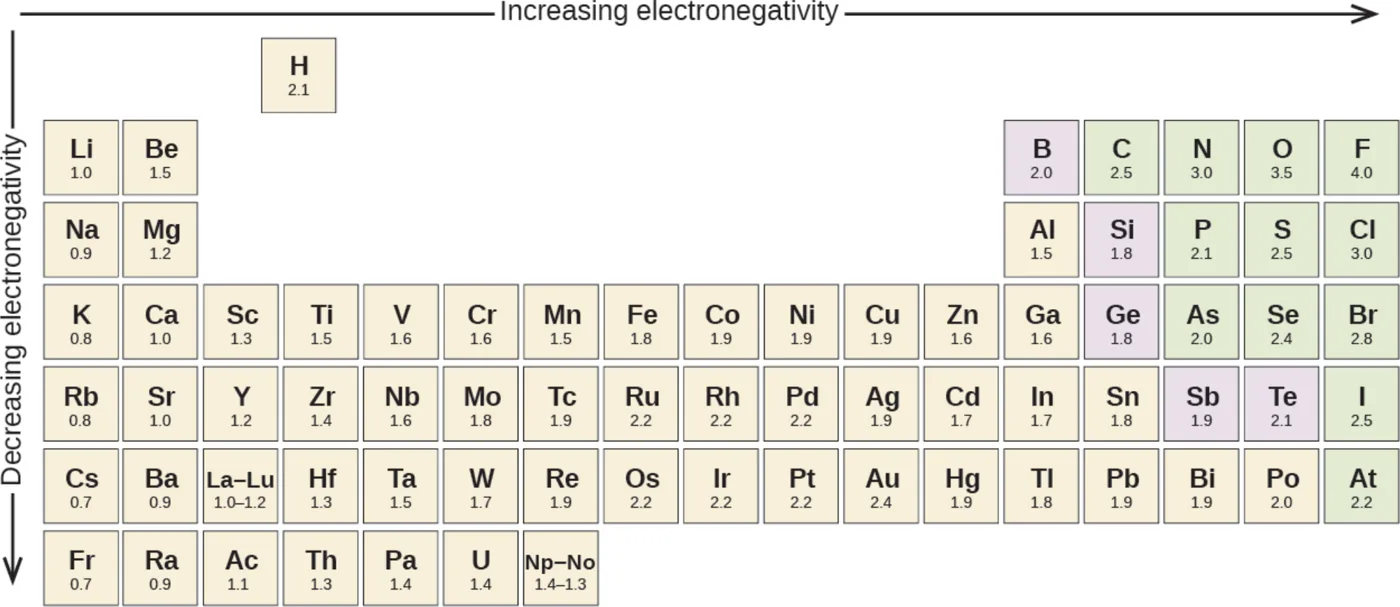
◀ Previous3 / 3
Electronegativity versus electron affinity
Electronegativity versus electron affinity
Electronegativity must not be confused with electron affinity. The electron affinity of an element is a measured quantity: the energy released or absorbed when an isolated gas-phase atom gains an electron, expressed in kJ/mol. Electronegativity describes how strongly an atom attracts electrons within a bond. It is a dimensionless quantity that is calculated, not measured.
Pauling derived the first electronegativity values by comparing the energies needed to break different types of bonds. He chose an arbitrary relative scale that runs from 0 to 4.
Portrait of Linus Pauling, the chemist who developed the electronegativity scale and was also a prominent activist for health and nuclear disarmament. Image: OpenStax, Chemistry 2e, CC BY 4.0.
Portrait of a chemist: Linus Pauling
 ⤢ Enlarge
1
Linus Pauling is the only person to have won two individual Nobel Prizes: one for chemistry in 1954, for his work on the nature of chemical bonds, and one for peace in 1962, for his opposition to weapons of mass destruction. He developed many of the theories and concepts that form the foundation of modern chemistry, including electronegativity and resonance structures.
2
Pauling also made important contributions outside chemistry.
3
His research on sickle cell anemia showed that the disease is caused by an abnormal protein, inherited genetically, that is present in the blood.
4
This work helped open the field of molecular genetics.
5
He also showed that radioactive fallout from nuclear weapons testing poses a risk to public health,
which helped to reduce the testing of nuclear weapons.
1Electronegativity difference and bond type2Electronegativity difference and bond type3Electronegativity difference and bond type
Electronegativity difference and bond type
1
The absolute value of the difference in electronegativity, written ΔEN, between two bonded atoms gives a rough measure of the bond polarity to expect, and therefore the bond type.
2
When the difference is very small or zero, the bond is pure covalent.
3
When the difference is large, the bond is polar covalent or ionic.
4
For example, the ΔEN values for H–H, H–Cl and Na–Cl are 0 (nonpolar), 0.9 (polar covalent) and 2.1 (ionic).
5
The sharing of electrons ranges from completely equal, in a pure covalent bond, to not shared at all, in an ionic bond.
6
The figure below shows the relationship between electronegativity difference and bond type.
1 / 3Next ▶
Rough guide to bond type from electronegativity difference: pure covalent below 0.4, polar covalent from 0.4 to 1.8, and ionic above 1.8. Covalent character decreases and ionic character increases as the difference grows. Image: OpenStax, Chemistry 2e, CC BY 4.0.
Electronegativity difference and bond type
 ⤢ Enlarge
Electronegativity difference and bond type
It is a general guide with many exceptions.
For example, HF has a ΔEN of 1.9 and NH3 has a ΔEN of 0.9, yet both form polar covalent bonds.
NaCl has a ΔEN of 2.1 and MnI2 has a ΔEN of 1.0, yet both are ionic compounds.
The most reliable guide to whether a bond is covalent or ionic is the types of atoms involved and their positions in the periodic table. Bonds between two nonmetals are generally covalent
while bonds between a metal and a nonmetal are often ionic.
Some compounds contain both covalent and ionic bonds.
Polyatomic ions such as hydroxide (OH−), ammonium (NH4+) and nitrate (NO3−) are held together by polar covalent bonds.
◀ Previous2 / 3Next ▶
Electronegativity difference and bond type
1
These polyatomic ions form ionic compounds by combining with ions of opposite charge.
2
Potassium nitrate, KNO3, contains the K+ cation and the nitrate anion, NO3−.
3
Its bonding is therefore ionic,
from the electrostatic attraction between K+ and NO3−,and covalent between the nitrogen and oxygen atoms within the nitrate ion.
◀ Previous3 / 3
1Example 7.3: Electronegativity and bond polarity2Example 7.3: Electronegativity and bond polarity
Example 7.3: Electronegativity and bond polarity
Example 7.3: Electronegativity and bond polarity
Bond polarities help determine the structure of proteins. Using the electronegativity values, arrange these covalent bonds, all common in amino acids, in order of increasing polarity, and mark the positive and negative atoms with δ+ and δ−: C–H, C–N, C–O, N–H, O–H and S–H.
Solution: The polarity of a bond increases as the absolute value of the electronegativity difference increases. The atom with δ− is the more electronegative atom of the two. Using Pauling values (H 2.1, C 2.5, N 3.0, O 3.5, S 2.5):
Answer: In order of increasing polarity: C–H and S–H (tied at 0.4)
then C–N (0.5), N–H (0.9), C–O (1.0) and O–H (1.4). O–H is the most polar bond in the list, with the oxygen atom δ− and the hydrogen atom δ+.
Check Your Learning: Silicones contain Si–O, Si–C, C–H and C–C bonds.
Using the electronegativity values (C 2.5, H 2.1, Si 1.8, O 3.5), arrange these bonds in order of increasing polarity and mark the partial charges. Answer: C–C (ΔEN 0.0, nonpolar), C–H (0.4), Si–C (0.7) and Si–O (1.7, the most polar).
In C–H the carbon is δ− and the hydrogen is δ+.
| Bond | ΔEN | More electronegative atom (δ−) | Less electronegative atom (δ+) |
|---|---|---|---|
| C–H | 2.5 − 2.1 = 0.4 | C | H |
| S–H | 2.5 − 2.1 = 0.4 | S | H |
| C–N | 3.0 − 2.5 = 0.5 | N | C |
| N–H | 3.0 − 2.1 = 0.9 | N | H |
| C–O | 3.5 − 2.5 = 1.0 | O | C |
| O–H | 3.5 − 2.1 = 1.4 | O | H |
1 / 2Next ▶
Example 7.3: Electronegativity and bond polarity
Example 7.3: Electronegativity and bond polarity
In Si–C the carbon is δ− and the silicon is δ+.
In Si–O the oxygen is δ− and the silicon is δ+.
◀ Previous2 / 2
Key terms
| Term | Meaning |
|---|---|
| Covalent bond | A bond formed when two atoms attract a shared pair of electrons to themselves. |
| Nonmetal | An element on the upper right side of the periodic table that usually forms covalent bonds with other nonmetals. |
| Bond length | The internuclear distance at which the potential energy of a bonded pair of atoms is lowest. |
| Endothermic process | A process that absorbs energy, such as breaking a chemical bond. |
| Exothermic process | A process that releases energy, such as forming a chemical bond. |
| Pure covalent bond | A covalent bond between identical atoms, in which the electrons are shared equally. |
| Polar covalent bond | A covalent bond between different atoms, in which the electrons are shared unequally. |
| Partial charge (δ+, δ−) | A small positive or negative charge on an atom in a polar bond, shown with the Greek letter delta. |
| Electronegativity | A measure of how strongly an atom attracts bonding electrons toward itself. |
| Electronegativity difference (ΔEN) | The absolute difference in electronegativity between two bonded atoms, used to estimate bond polarity and bond type. |
| Electron affinity | The energy released or absorbed when an isolated gas-phase atom gains an electron, measured in kJ/mol. |
| Polyatomic ion | A charged group of atoms held together by covalent bonds, such as nitrate, NO3−. |
| Nonbonding electrons | Valence electrons on an atom that are not shared with another atom in a bond. |
1Avoid these mistakes2Avoid these mistakes3Avoid these mistakes4Avoid these mistakes5Avoid these mistakes
Avoid these mistakes
1Avoid this
Confusing electronegativity with electron affinity.Avoid this
Electron affinity is a measured energy in kJ/mol for an isolated atom,Avoid this
while electronegativity is a dimensionless, calculated value for an atom in a bond.Avoid this
2Avoid this
Putting δAvoid this
1 / 5Next ▶
Avoid these mistakes
+Avoid this
on the more electronegative atom. In a polar bond, the more electronegative atom is the one with δAvoid this
−Avoid this
.Avoid this
3Avoid this
Thinking that covalent bonds form only between identical atoms.Avoid this
◀ Previous2 / 5Next ▶
Avoid these mistakes
Bonds between different nonmetals are covalent too, and they are polar when the electronegativities differ.Avoid this
4Avoid this
Treating the electronegativity difference table as a strict rule.Avoid this
HF (ΔEN 1.9) and NH3 (ΔEN 0.9) form polar covalent bonds,Avoid this
while MnI2 (ΔEN 1.0) is ionic,Avoid this
so the bond type also depends on the atoms’ positions in the periodic table.Avoid this
◀ Previous3 / 5Next ▶
Avoid these mistakes
5Avoid this
Reading electronegativity as increasing down a group. Electronegativity increases from left to right across a period and decreases down a group.Avoid this
6Avoid this
Thinking that bond formation absorbs energy. Forming a bond releases energy (exothermic), and breaking a bond requires energy (endothermic).Avoid this
7Avoid this
Placing the bond length at the point where the atoms are closest.Avoid this
◀ Previous4 / 5Next ▶
Avoid these mistakes
The bond length is at the lowest point of potential energy, because closer approach makes the nuclei repel each other.Avoid this
◀ Previous5 / 5