Curriculum
Chemistry 2e
Unit 1: Essential Ideas
0/14
Unit 2: Atoms, Molecules, and Ions
0/16
Unit 3: Composition of Substances and Solutions
0/10
Unit 4: Stoichiometry of Chemical Reactions
0/12
Unit 5: Thermochemistry
0/8
Unit 6: Electronic Structure and Periodic Properties of Elements
0/12
Unit 7: Chemical Bonding and Molecular Geometry
0/14
Unit 8: Advanced Theories of Covalent Bonding
0/10
Unit 9: Gases
0/23
Unit 10: Liquids and Solids
0/28
Unit 11: Solutions and Colloids
0/24
Unit 12: Kinetics
0/32
Unit 13: Fundamental Equilibrium Concepts
0/20
Unit 14: Acid-Base Equilibria
0/32
Unit 15: Equilibria of Other Reaction Classes
0/16
Unit 16: Thermodynamics
0/20
-
Unit 16 overview: Thermodynamics
 Preview
-
16.1 Spontaneity
Preview
-
16.1 Spontaneity - Check yourself
 Preview
-
16.1 Spontaneity
Preview
-
16.1 Spontaneity - Check yourself
Preview
-
16.2 Entropy
Preview
-
16.2 Entropy - Check yourself
Preview
-
16.2 Entropy
Preview
-
16.2 Entropy - Check yourself
Preview
-
Unit 16 review quiz: Thermodynamics
Preview
-
Unit 16 overview: Thermodynamics
Preview
-
16.3 The Second and Third Laws of Thermodynamics
Preview
-
16.3 The Second and Third Laws of Thermodynamics - Check yourself
Preview
-
16.3 The Second and Third Laws of Thermodynamics
Preview
-
16.3 The Second and Third Laws of Thermodynamics - Check yourself
Preview
-
16.4 Free Energy
Preview
-
16.4 Free Energy - Check yourself
Preview
-
16.4 Free Energy
Preview
-
16.4 Free Energy - Check yourself
Preview
-
Unit 16 review quiz: Thermodynamics
Preview
Unit 17: Electrochemistry
0/32
Unit 18: Representative Metals, Metalloids, and Nonmetals
0/52
Unit 19: Transition Metals and Coordination Chemistry
0/16
Unit 20: Organic Chemistry
0/20
Unit 21: Nuclear Chemistry
0/28
Text lesson
16.2 Entropy
16.2 Entropy — CHEMISTRY notes: You will be able to define entropy, explain how entropy depends on the number of microstates, and predict the sign of the entropy change for physical and chemical processes.
1Clausius and reversible processes2Clausius and reversible processes
Clausius and reversible processes
Clausius and reversible processes
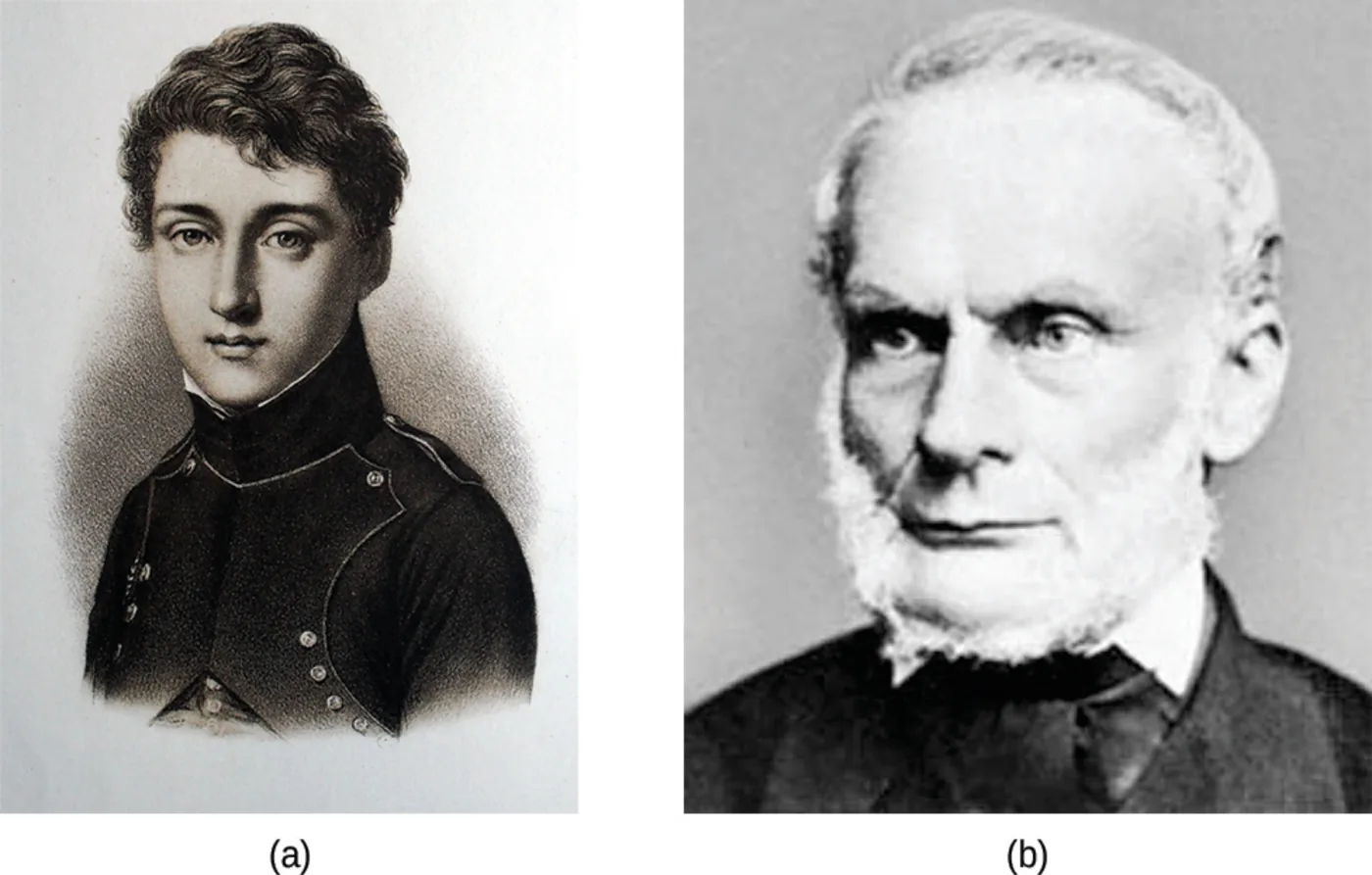
In 1824, the French engineer Sadi Carnot studied how efficiently steam-powered heat engines worked.
Decades later, Rudolf Clausius reviewed Carnot’s findings and introduced a new thermodynamic property.
This property connects the heat that flows spontaneously during a process with the temperature at which that flow happens.
Clausius defined it as the ratio of the reversible heat, qrev, to the kelvin temperature, T.
A reversible process is an idealized process that runs so slowly that the system is always at equilibrium. A tiny change in a condition can reverse its direction. No real process is truly reversible
so real processes are called irreversible. Reversible processes are still essentialbecause they give a reference path for calculating thermodynamic changes.
1 / 2Next ▶
Sadi Carnot’s steam-engine research and Rudolf Clausius’s later review of it led to the new idea of entropy. Image: OpenStax, Chemistry 2e, CC BY 4.0.
Clausius and reversible processes
 ⤢ Enlarge
1
Like enthalpy and internal energy, entropy is a state function. Its change depends only on the initial and final states of the system, not on the path taken between them. In 1865, Clausius named this property entropy and gave the symbol S. For any process, the entropy change is:
2
ΔS = qrev / T
where ΔS is the entropy change in joules per kelvin (J/K), qrev is the heat transferred reversibly in joules (J), and T is the absolute temperature in kelvin (K).
3
The entropy change of a real, irreversible process is equal to the entropy change of the reversible process that connects the same initial and final states. This means we can always calculate ΔS by imagining a reversible path between the same two states.
◀ Previous2 / 2
1Entropy and microstates2Entropy and microstates3Entropy and microstates4Entropy and microstates
Entropy and microstates
Entropy and microstates
Ludwig Boltzmann later built a molecular-scale model that connects entropy to the number of microstates, W. A microstate is one specific arrangement of the locations and energies of all the atoms or molecules in a system. The relation is:
S = k ln W
where S is the entropy in J/K, k is the Boltzmann constant (1.38×10⁻²³ J/K), W is the number of microstates (a pure number with no unit), and ln is the natural logarithm.
Because entropy is a state function, the entropy change of a process is the difference between its final and initial values: ΔS = Sf − Si. If a process increases the number of microstates (Wf >
Wi), the entropy rises and ΔS >0. If a process reduces the number of microstates (Wf <Wi), the entropy falls and ΔS <0. This molecular picture also explains why some processes are more likely than others.
Consider N particles spread among n boxes.
The total number of microstates is nN.
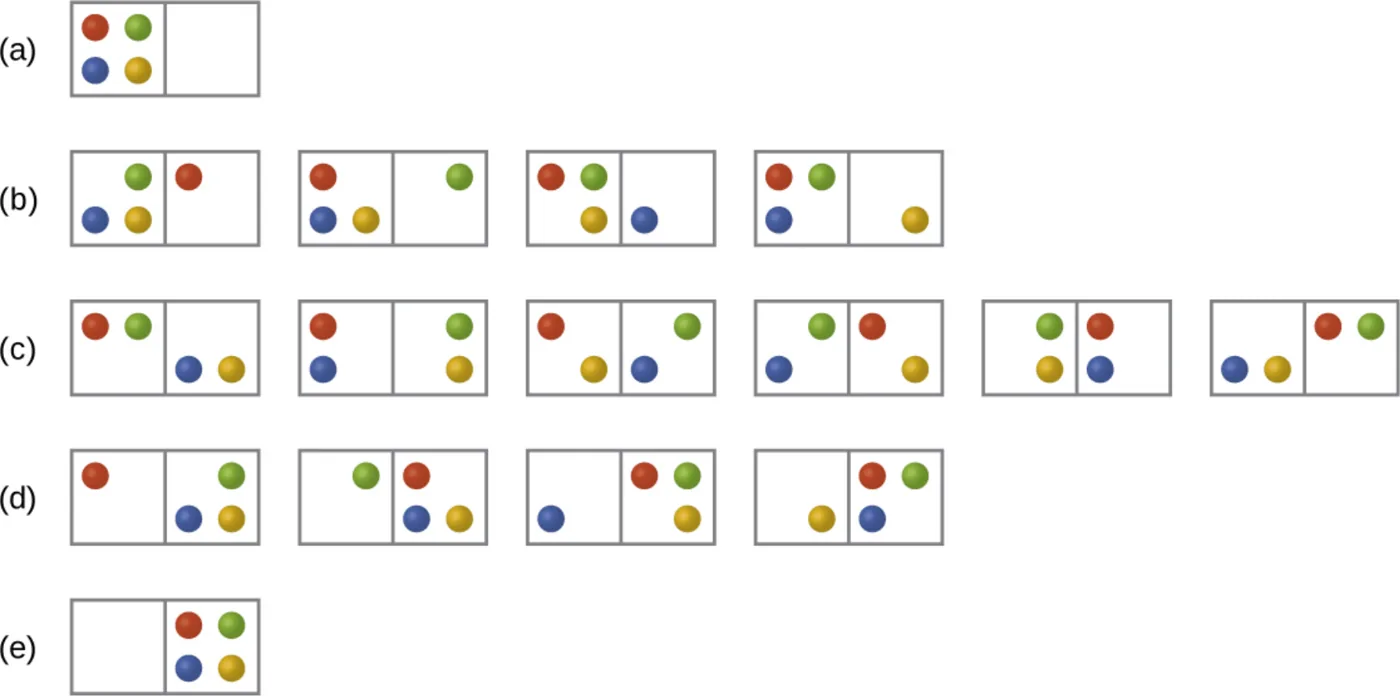
For example, placing four particles in two boxes gives 24 = 16 different microstates.
1 / 4Next ▶
The sixteen possible arrangements of four particles in two boxes, sorted into five groups according to how the particles are split between the boxes. Image: OpenStax, Chemistry 2e, CC BY 4.0.
Entropy and microstates
 ⤢ Enlarge
Entropy and microstates
Microstates that look the same when particle identities are ignored form a group called a distribution.
The probability that a system is found in a given distribution is proportional to how many microstates that distribution contains.
Because entropy grows with the logarithm of the number of microstates, the most probable distribution is also the one with the greatest entropy.
For four particles in two boxes, the most probable distribution has two particles in each box.
It contains six of the sixteen microstates
so its probability is 6/16, or about 37.5%.
The least probable outcomes put all four particles in one box.
◀ Previous2 / 4Next ▶
Entropy and microstates
1
Each of those two distributions has one microstate, a probability of 1/16 (about 6.25%).
2
The chance that all particles end up in just one box, in either the left or the right box, is therefore 2/16, or 12.5%.
3
As particles are added, the number of microstates grows exponentially as 2N. A laboratory-sized sample contains about 1023 particles
so its number of microstates is enormous. Even so, arrangements with roughly equal numbers of particles in each box remain the most probable.
4
Entropy is often described as a measure of disorder
but the more precise picture is matter dispersal. Arrangements in which all particles sit in one box are the most ordered and have the least entropy. Arrangements in which the particles spread more evenly over the boxes are more disordered and have greater entropy.
5
The expansion of an ideal gas into an evacuated flask is a large-scale version of this particle-in-a-box model.
6
At first the gas molecules are confined to one flask.
◀ Previous3 / 4Next ▶
Entropy and microstates
1
Opening a valve between the flasks increases the volume available to them, and with it the number of possible microstates.
2
Since Wf >
Wi, the expansion has ΔS >0 and occurs spontaneously.
3
The gas ends up spread evenly between the two flasks, the most probable distribution.
◀ Previous4 / 4
1Heat flow as a microstate model2Heat flow as a microstate model3Heat flow as a microstate model
Heat flow as a microstate model
Heat flow as a microstate model
The same counting method explains why heat flows from a hot object to a cold object.
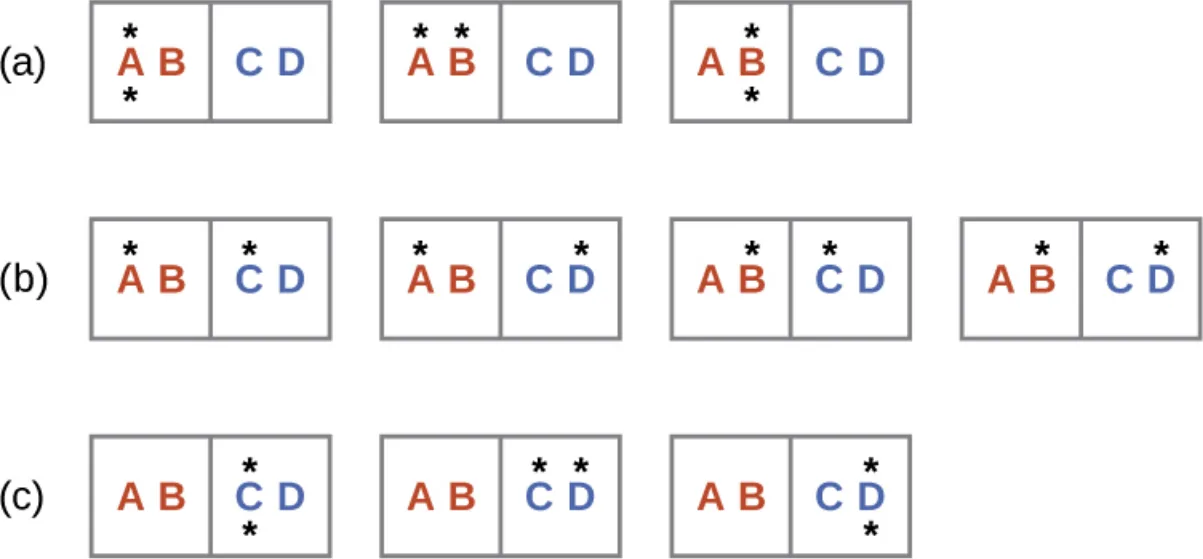
Take two objects, each containing two particles, and two units of thermal energy.
The hot object contains particles A and B and starts with both energy units.
The cold object contains particles C and D and starts with none.
Every arrangement of the energy units among the four particles is a microstate.
When the objects are in the initial state, all energy stays in the hot object.
1 / 3Next ▶
Heat flow as a microstate model
1
This distribution has three microstates.
2
If one energy unit moves to the cold object, the result is a distribution with four microstates.
3
If both units move, the result is a distribution with three microstates.
4
The system therefore has ten microstates in total.
5
The probability that heat does not flow
so the system stays in the initial distribution, is 3/10.
6
The probability that heat does flow to one of the other two distributions is 7/10.
◀ Previous2 / 3Next ▶
Two objects sharing two energy units (shown as stars) in every possible arrangement, from all energy in the hot object, to an even split, to all energy in the cold object. Image: OpenStax, Chemistry 2e, CC BY 4.0.
Heat flow as a microstate model
 ⤢ Enlarge
Heat flow as a microstate model
The most probable outcome is the one with one energy unit in each object, a distribution with four microstates, and its probability is 4/10.
This uniform spread of energy is what we observe when a hot and a cold object touch and reach a common temperature.
This spontaneous heat flow also increases the entropy of the system.
◀ Previous3 / 3
1Predicting the sign of ΔS2Predicting the sign of ΔS3Predicting the sign of ΔS4Predicting the sign of ΔS
Predicting the sign of ΔS
Predicting the sign of ΔS
The links among entropy, microstates and the spreading of matter and energy let us predict the sign of ΔS for many processes without doing calculations.
Consider the three phases of a substance.
In a solid, the particles stay at nearly fixed positions and only vibrate.
The number of microstates is small.
In a liquid, particles move freely over and around one another while staying close together.
There are many more possible positions
so the number of microstates is larger, and Sliquid >Ssolid.
1 / 4Next ▶
Entropy rises as a substance goes from solid to liquid to gas, and falls when the same changes run in reverse. Image: OpenStax, Chemistry 2e, CC BY 4.0.
Predicting the sign of ΔS
 ⤢ Enlarge
1
Melting, the solid-to-liquid change, has ΔS >
0. Freezing has ΔS <0.
2
In a gas, the same number of particles fill a much larger volume
so each particle can be found in many more places. Therefore, for any substance, Sgas >Sliquid >Ssolid. Vaporization and sublimation both increase entropy (ΔS >0)while condensation and deposition both decrease it (ΔS <0).
3
Temperature also matters.
4
Temperature is proportional to the average kinetic energy of the particles.
5
Raising the temperature makes particles vibrate more strongly in solids and move faster in liquids and gases.
6
At higher temperature, the spread of kinetic energies among the particles is also wider.
◀ Previous2 / 4Next ▶
Left: the spread of kinetic energies widens at the higher temperature. Right: the entropy of a substance rises with temperature and jumps at melting and boiling. Image: OpenStax, Chemistry 2e, CC BY 4.0.
Predicting the sign of ΔS
 ⤢ Enlarge
1
The entropy of any substance therefore increases with temperature.
2
Phase changes cause especially large jumps in entropy.
3
Atomic structure also affects entropy. At the same temperature, heavier atoms have greater entropy than lighter atoms
because of how their mass affects the spacing of their energy levels. For molecules, more atoms mean more ways to vibrateso there are more microstates and higher entropy.
4
Mixtures also have higher entropy than pure substances.
5
In a mixture, the particles can take more orientations and form more kinds of interactions
because the components are not identical.
6
When a solid dissolves in a liquid, its particles gain freedom of motion and interact with solvent particles.
◀ Previous3 / 4Next ▶
Predicting the sign of ΔS
Predicting the sign of ΔS
Matter and energy spread out more uniformly, and the number of microstates grows.
Dissolution therefore has ΔS >
0.
Link to learning: An online interactive simulation shows how particle location and freedom of motion depend on physical state and temperature for several atoms and molecules. Use it to compare solids, liquids and gases.
◀ Previous4 / 4
1Example 16.2: Calculating ΔS from microstates2Example 16.3: Predicting the sign of ΔS3Example 16.3: Predicting the sign of ΔS4Example 16.3: Predicting the sign of ΔS5Example 16.3: Predicting the sign of ΔS6Example 16.3: Predicting the sign of ΔS7Example 16.3: Predicting the sign of ΔS8Example 16.3: Predicting the sign of ΔS9Example 16.3: Predicting the sign of ΔS
Four particles starting in one box and the six equal-split arrangements they can take when two boxes are available. Image: OpenStax, Chemistry 2e, CC BY 4.0.
Example 16.2: Calculating ΔS from microstates
 ⤢ Enlarge
1
Problem: Calculate the entropy change for the process shown in the picture, in which four particles move from one box
where all four are together, to an arrangement with two particles in each box.
2
Solution: The initial state has one microstate (Wi = 1). The final state with two particles in each box has six microstates (Wf = 6). Using S = k ln W:
3
ΔS = k ln(Wf/Wi) = (1.38×10⁻²³ J/K) × ln(6/1) = (1.38×10⁻²³ J/K) × 1.79 = 2.47×10⁻²³ J/K
4
The sign is positive
which matches expectationbecause the final state has more microstates than the initial state.
5
Check Your Learning: Consider the heat-flow system described earlier. What is the entropy change when all the energy moves from the hot object (AB) to the cold object (CD)? Answer: 0 J/K. The initial distribution has three microstates and the final distribution, with all energy in the cold object, also has three microstates. So ΔS = k ln(3/3) = 0.
1 / 9Next ▶
Example 16.3: Predicting the sign of ΔS
Example 16.3: Predicting the sign of ΔS
Problem: Predict the sign of the entropy change for each process and give a reason.
1
(a) One mole of liquid water at room temperature becomes one mole of liquid water at 50 °C.
2
(b) Ag
+
◀ Previous2 / 9Next ▶
Example 16.3: Predicting the sign of ΔS
Example 16.3: Predicting the sign of ΔS
(
aq
) + Cl
−
) → AgCl(
s
◀ Previous3 / 9Next ▶
Example 16.3: Predicting the sign of ΔS
1
)
2
3
3
(c) C
4
6
5
H
6
l
◀ Previous4 / 9Next ▶
Example 16.3: Predicting the sign of ΔS
1
) + (15/2) O
2
g
3
) → 6 CO
4
) + 3 H
5
O(
6
4
◀ Previous5 / 9Next ▶
Example 16.3: Predicting the sign of ΔS
Example 16.3: Predicting the sign of ΔS
(d) NH
) → NH
Solution:
(a) Positive. The temperature increases
so the particles have more kinetic energy and a wider spread of energieswhich means more microstates.
(b) Negative. Two dissolved ions combine into one solid
so there are fewer particles dispersed in solution and matter is less spread out.
(c) Negative. Gaseous species decrease from 7.5 mol of O
◀ Previous6 / 9Next ▶
Example 16.3: Predicting the sign of ΔS
1
to 6 mol of CO
2
, a net decrease in the amount of gas
which lowers dispersal of matter.
3
(d) Positive. A solid changes to a liquid, a phase transition that increases the dispersal of matter.
4
Check Your Learning: Predict the sign of the entropy change for each process and give a reason.
5
(a) NaNO
6
) → Na
◀ Previous7 / 9Next ▶
Example 16.3: Predicting the sign of ΔS
Example 16.3: Predicting the sign of ΔS
) + NO
(b) The freezing of liquid water
(c) CO
) → CO
(d) CaCO
) → CaO(
◀ Previous8 / 9Next ▶
Example 16.3: Predicting the sign of ΔS
Example 16.3: Predicting the sign of ΔS
) + CO
Answer: (a) Positive. The solid dissolves to give more mobile ions in solution. (b) Negative. The liquid becomes a more ordered solid. (c) Positive. A relatively ordered solid becomes a gas. (d) Positive. The number of gaseous species increases.
◀ Previous9 / 9
Key terms
| Term | Meaning |
|---|---|
| Entropy (S) | A state function that measures how spread out matter and energy are in a system; its change is ΔS = qrev/T, in J/K. |
| Reversible process | An idealized process that stays at equilibrium and can be reversed by an infinitesimal change in a condition. |
| State function | A property whose change depends only on the initial and final states, not on the path between them. |
| Reversible heat (qrev) | The heat transferred in a reversible process, in joules (J). |
| Microstate (W) | One specific arrangement of the locations and energies of all particles in a system. |
| Distribution | A group of microstates that look the same when particle identities are ignored. |
| Boltzmann constant (k) | The constant 1.38×10⁻²³ J/K that links entropy to the number of microstates in S = k ln W. |
| Matter dispersal | How evenly matter is spread among the available locations; greater dispersal means greater entropy. |
| Disorder (qualitative) | A loose everyday description of entropy, meaning more ways to arrange particles and energy. |
| Spontaneous heat flow | Heat moving from a hotter object to a colder one, which spreads energy and increases entropy. |
| Kinetic energy distribution | The spread of particle kinetic energies; it widens as temperature rises, which increases entropy. |
| Dissolution | The process of a solid dispersing into a liquid, which usually increases entropy (ΔS > 0). |
1Avoid these mistakes2Avoid these mistakes3Avoid these mistakes4Avoid these mistakes