Curriculum
Chemistry 2e
Unit 1: Essential Ideas
0/14
Unit 2: Atoms, Molecules, and Ions
0/16
Unit 3: Composition of Substances and Solutions
0/10
Unit 4: Stoichiometry of Chemical Reactions
0/12
Unit 5: Thermochemistry
0/8
Unit 6: Electronic Structure and Periodic Properties of Elements
0/12
Unit 7: Chemical Bonding and Molecular Geometry
0/14
Unit 8: Advanced Theories of Covalent Bonding
0/10
Unit 9: Gases
0/23
Unit 10: Liquids and Solids
0/28
Unit 11: Solutions and Colloids
0/24
Unit 12: Kinetics
0/32
Unit 13: Fundamental Equilibrium Concepts
0/20
-
Unit 13 overview: Fundamental Equilibrium Concepts
 Preview
-
13.1 Chemical Equilibria
Preview
-
13.1 Chemical Equilibria - Check yourself
 Preview
-
13.1 Chemical Equilibria
Preview
-
13.1 Chemical Equilibria - Check yourself
Preview
-
13.2 Equilibrium Constants
Preview
-
13.2 Equilibrium Constants - Check yourself
Preview
-
13.2 Equilibrium Constants
Preview
-
Unit 13 overview: Fundamental Equilibrium Concepts
Preview
-
13.2 Equilibrium Constants - Check yourself
Preview
-
13.3 Shifting Equilibria: Le Châtelier’s Principle
Preview
-
13.3 Shifting Equilibria: Le Châtelier’s Principle - Check yourself
Preview
-
13.3 Shifting Equilibria: Le Châtelier’s Principle
Preview
-
Unit 13 review quiz: Fundamental Equilibrium Concepts
Preview
-
13.3 Shifting Equilibria: Le Châtelier’s Principle - Check yourself
Preview
-
13.4 Equilibrium Calculations
Preview
-
13.4 Equilibrium Calculations - Check yourself
Preview
-
13.4 Equilibrium Calculations
Preview
-
13.4 Equilibrium Calculations - Check yourself
Preview
-
Unit 13 review quiz: Fundamental Equilibrium Concepts
Preview
Unit 14: Acid-Base Equilibria
0/32
Unit 15: Equilibria of Other Reaction Classes
0/16
Unit 16: Thermodynamics
0/20
Unit 17: Electrochemistry
0/32
Unit 18: Representative Metals, Metalloids, and Nonmetals
0/52
Unit 19: Transition Metals and Coordination Chemistry
0/16
Unit 20: Organic Chemistry
0/20
Unit 21: Nuclear Chemistry
0/28
Text lesson
13.4 Equilibrium Calculations
13.4 Equilibrium Calculations — CHEMISTRY notes: You will be able to relate concentration changes to reaction stoichiometry and use ICE tables with equilibrium constants to calculate equilibrium concentrations.
1Why equilibrium calculations matter2Why equilibrium calculations matter
Why equilibrium calculations matter
Why equilibrium calculations matter
Earlier sections described chemical equilibrium in qualitative terms.
This section shows how to put numbers to it.
Equilibrium calculations are needed in many areas of science and technology, for example in the formulation and dosing of pharmaceutical products.
After a drug is taken, it takes part in several chemical equilibria that affect its concentration in the body.
Knowing the quantitative side of these equilibria lets a chemist calculate a dose that produces the desired therapeutic effect.
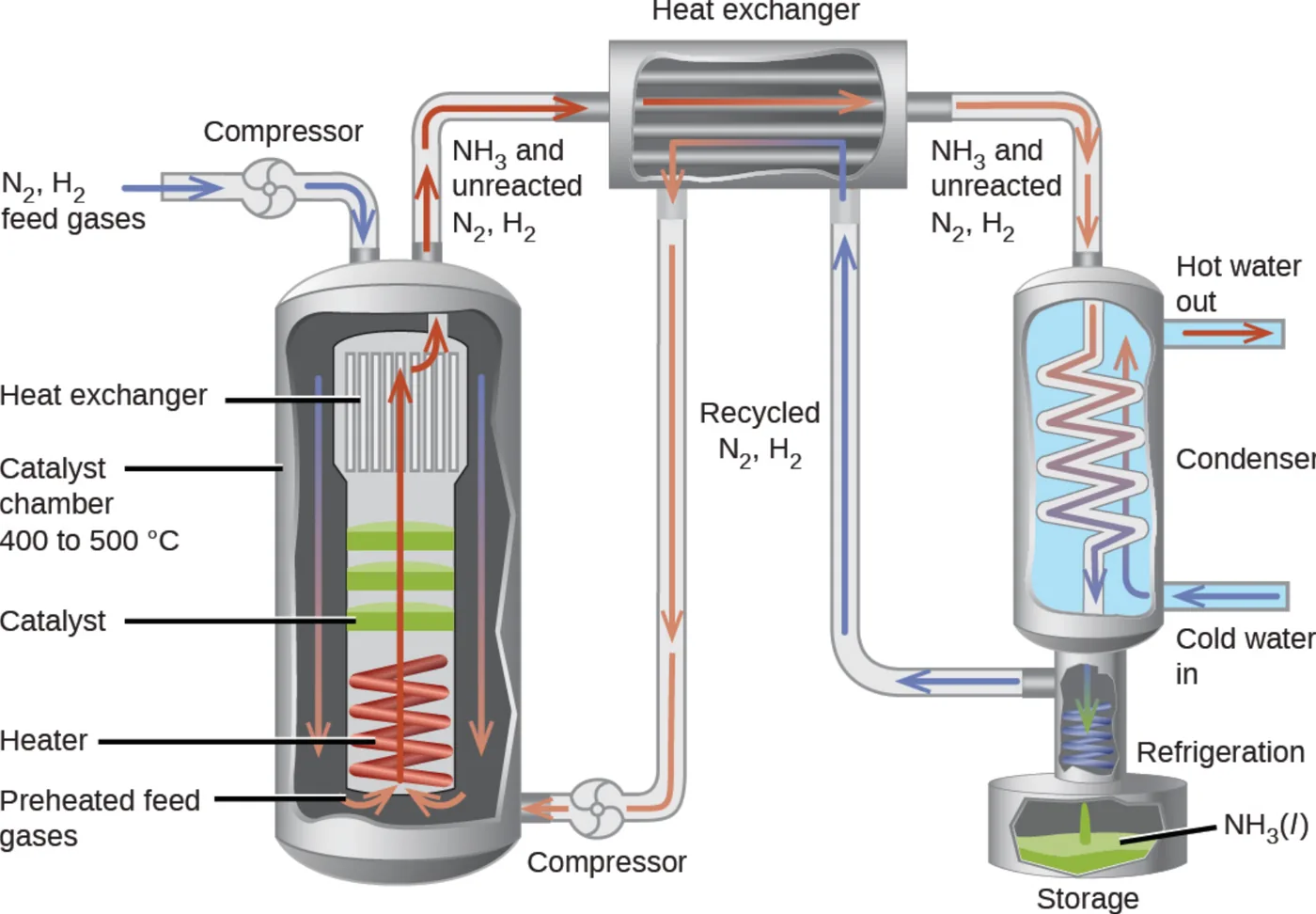
Industry depends on the same calculations. The diagram below shows the Haber-Bosch process
which makes ammonia from nitrogen and hydrogen. Operating conditions are chosen to push this equilibrium toward the product, and the equilibrium constant tells engineers how far the reaction will go under those conditions.
1 / 2Next ▶
An industrial ammonia plant: feed gases are compressed, heated over an iron catalyst, cooled in heat exchangers, and the liquid ammonia that condenses is collected in storage. Image: OpenStax, Chemistry 2e, CC BY 4.0.
Why equilibrium calculations matter
◀ Previous2 / 2
1Stoichiometry of concentration changes2Stoichiometry of concentration changes
Calculating an equilibrium constant
1
The equilibrium constant is calculated from equilibrium concentrations (or pressures) of the reactants and products. If all of them are known, the calculation is a direct substitution into the K expression. A harder case is one in which only the initial concentrations and a single equilibrium concentration are given. Then the stoichiometry is used to find the rest.
2
The approach is called ICE
which stands for Initial, Change and Equilibrium.
3
The concentrations are arranged in a table: a row of initial concentrations, a row of changes written in terms of an unknown x,
and a row of equilibrium concentrations.
4
Once one equilibrium concentration is known, x is found and the remaining equilibrium concentrations follow.
5
The equilibrium constant is then computed from the K expression with these values.
Finding a missing equilibrium concentration
1
When the equilibrium constant and all but one of the equilibrium concentrations are known, the missing concentration can be calculated.
2
The known values are substituted into the K expression, and the expression is rearranged to solve for the unknown.
3
A useful check is to substitute the result back into the K expression and confirm that it reproduces the given K, within the rounding of the data.
4
For example, nitrogen oxides form when nitrogen and oxygen react at high temperature.
5
N2(g) + O2(g) ⇌ 2NO(g) has a known Kc at 2000 °C, and the N2 and O2 concentrations at equilibrium are measured.
6
The NO concentration follows from the square root of Kc times the product of the other two concentrations.
1Equilibrium concentrations from initial concentrations2Equilibrium concentrations from initial concentrations3Equilibrium concentrations from initial concentrations
Simplifying with a small-change approximation
Simplifying with a small-change approximation
When K is very small, the amount of reactant that converts is small compared with its initial concentration. In that case the term for the change can be dropped from the equilibrium concentration of the reactant
so that its equilibrium value is taken as equal to its initial value. This avoids solving a quadratic equation and gives the answer directly.
The approximation must be checked. A common rule is that the calculated x should be less than about 5 percent of the initial concentration. If the result fails this test, the calculation must be repeated without the approximation, using the full quadratic equation.
1Example 13.6: Relative changes in concentration2Example 13.7: Calculating an equilibrium constant3Example 13.7: Calculating an equilibrium constant4Example 13.7: Calculating an equilibrium constant5Example 13.7: Calculating an equilibrium constant6Example 13.8: Calculating a missing equilibrium concentratio7Example 13.8: Calculating a missing equilibrium concentratio8Example 13.9: Calculating equilibrium concentrations from in9Example 13.9: Calculating equilibrium concentrations from in10Example 13.9: Calculating equilibrium concentrations from in11Example 13.10: Using an algebra-simplifying assumption12Example 13.10: Using an algebra-simplifying assumption
Example 13.6: Relative changes in concentration
1
For the reaction 2NO(g) + O2(g) ⇌ 2NO2(g), suppose the O2 concentration increases by x.
2
The coefficient of O2 is 1
so the change is +x.
3
NO has a coefficient of 2
so its change is −2x.
4
NO2 has a coefficient of 2 and forms as NO is consumed
so its change is +2x.
5
The changes are +x, −2x and +2x.
6
Check Your Learning: For 2SO2(g) + O2(g) ⇌ 2SO3(g), if the SO3 concentration rises by 2x, what are the changes in SO2 and O2?
Answer: SO2 changes by −2x and O2 changes by −x. The SO3 change is +2x
Answer: SO2 changes by −2x and O2 changes by −x. The SO3 change is +2x
which is the forward reaction with extent xso SO2 falls by 2x and O2 falls by x.
1 / 12Next ▶
Example 13.7: Calculating an equilibrium constant
1
Iodine molecules react reversibly with iodide ions to form triiodide ions: I2(aq) + I−(aq) ⇌ I3−(aq).
2
A solution starts with [I2] = 1.000 × 10⁻³ M and [I−] = 1.000 × 10⁻³ M, and no triiodide.
3
At equilibrium [I2] = 6.61 × 10⁻⁴ M.
4
Find Kc.
5
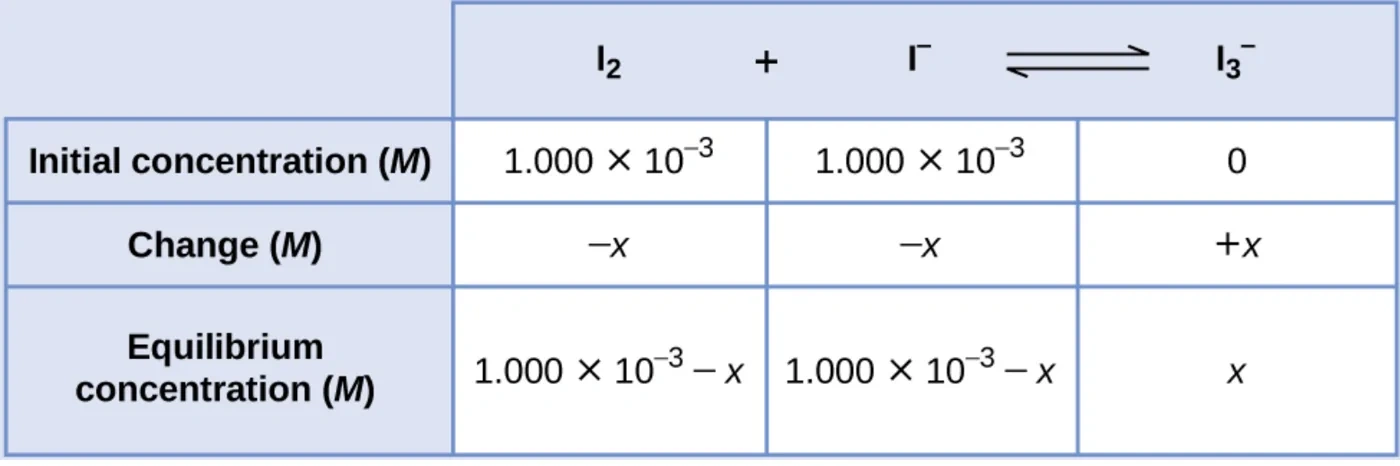
Solution: Let x be the amount of I2 consumed. The ICE table is shown below, with I− also changing by −x and I3− changing by +x.
◀ Previous2 / 12Next ▶
ICE table for the iodine and iodide reaction, with initial values, changes written as minus x and plus x, and equilibrium concentrations. Image: OpenStax, Chemistry 2e, CC BY 4.0.
Example 13.7: Calculating an equilibrium constant
 ⤢ Enlarge
Example 13.7: Calculating an equilibrium constant
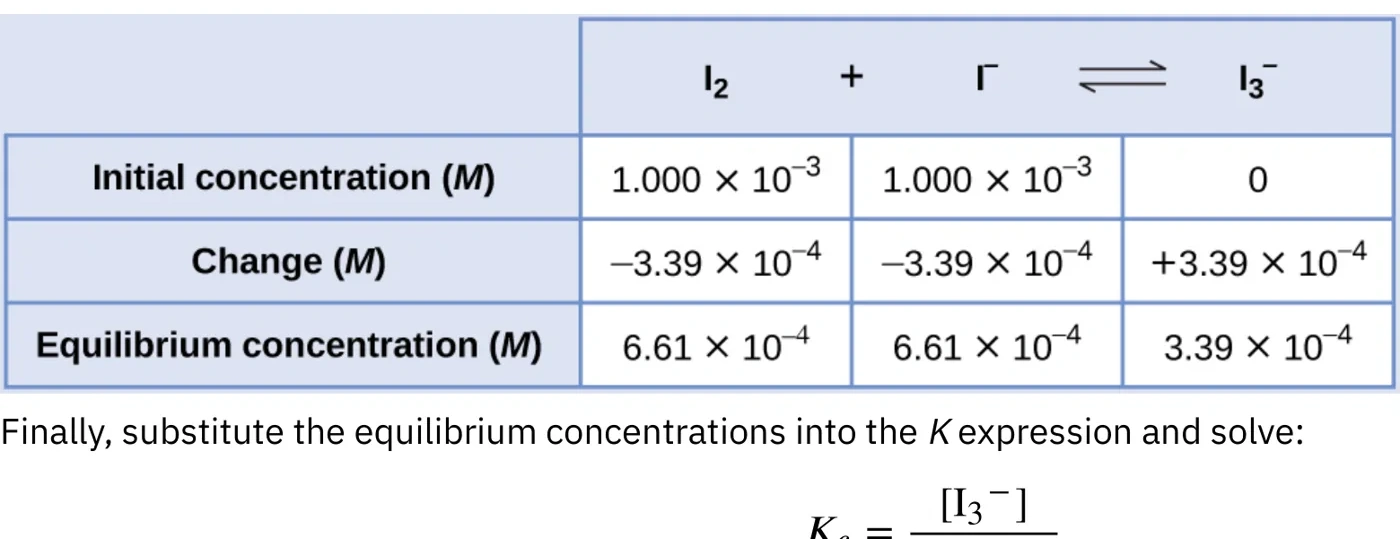
Since the equilibrium [I2] is 6.61 × 10⁻⁴ M, 1.000 × 10⁻³ − x = 6.61 × 10⁻⁴
so x = 3.39 × 10⁻⁴ M. The completed table gives [I2] = 6.61 × 10⁻⁴ M, [I−] = 6.61 × 10⁻⁴ M and [I3−] = 3.39 × 10⁻⁴ M.
◀ Previous3 / 12Next ▶
The completed ICE table with numerical values for initial, change and equilibrium concentrations of each species. Image: OpenStax, Chemistry 2e, CC BY 4.0.
Example 13.7: Calculating an equilibrium constant
 ⤢ Enlarge
1
Substitute into the Kc expression: Kc = [I3−] / ([I2][I−]) = (3.39 × 10⁻⁴) / ((6.61 × 10⁻⁴)(6.61 × 10⁻⁴)) = 3.39 × 10⁻⁴ / 4.37 × 10⁻⁷ ≈ 776. The equilibrium constant is Kc ≈ 776
which is a dimensionless number.
2
What the symbols mean:
3
K
4
c
5
= equilibrium constant in terms of concentration · [ ] = concentration at equilibrium (mol dm
6
−3
◀ Previous4 / 12Next ▶
Example 13.7: Calculating an equilibrium constant
Example 13.7: Calculating an equilibrium constant
) · each power is the number in front of that substance in the balanced equation
Check Your Learning: Ethanol and acetic acid react to form water and ethyl acetate.
Starting with 1 mol of each reactant in 1 L of dioxane, equilibrium is reached when one-third mol of each reactant remains.
Calculate Kc.
Water is a solute in this reaction.
Answer: The products each form 2/3 mol per liter
Answer: The products each form 2/3 mol per liter
so Kc = (2/3)2 / (1/3)2 = 4.
◀ Previous5 / 12Next ▶
Example 13.8: Calculating a missing equilibrium concentration
Example 13.8: Calculating a missing equilibrium concentration
At 2000 °C, Kc for N2(g) + O2(g) ⇌ 2NO(g) is 4.1 × 10⁻⁴. In air at 1 atm and 2000 °C, [N2] = 0.036 M and [O2] = 0.0089 M. Find [NO] at equilibrium.
Solution: Write Kc = [NO]2 / ([N2][O2]).
Rearranging gives [NO]2 = Kc[N2][O2] = (4.1 × 10⁻⁴)(0.036)(0.0089) = 1.31 × 10⁻⁷.
Taking the square root, [NO] = 3.6 × 10⁻⁴ mol/L.
To confirm, Kc = (3.6 × 10⁻⁴)2 / ((0.036)(0.0089)) = 4.0 × 10⁻⁴.
This matches the given value, within one digit in the last place
which is acceptable rounding.
◀ Previous6 / 12Next ▶
Example 13.8: Calculating a missing equilibrium concentration
1
Check Your Learning: For N2(g) + 3H2(g) ⇌ 2NH3(g), Kc = 6.00 × 10⁻² at a certain temperature.
2
If [N2] = 4.26 M and [H2] = 2.09 M at equilibrium, what is [NH3]?
Answer: [NH3] = 1.53 mol/L.
Answer: [NH3] = 1.53 mol/L.
3
Since [NH3]2 = Kc[N2][H2]3 = (0.0600)(4.26)(2.09)3 ≈ 2.33, the square root is about 1.53.
◀ Previous7 / 12Next ▶
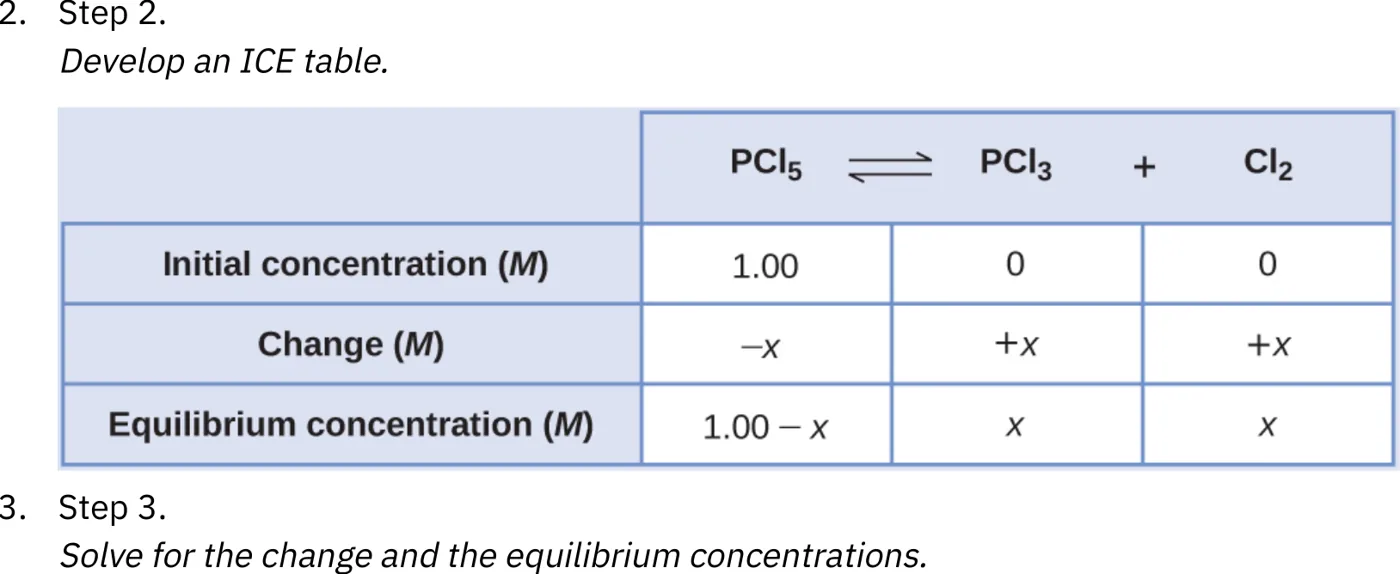
ICE table for PCl5 decomposing into PCl3 and Cl2, starting from 1.00 M PCl5 and no products. Image: OpenStax, Chemistry 2e, CC BY 4.0.
Example 13.9: Calculating equilibrium concentrations from initial concentrations
 ⤢ Enlarge
1
At a certain temperature Kc = 0.0211 for PCl5(g) ⇌ PCl3(g) + Cl2(g). A mixture starts with only PCl5 at 1.00 M. Find the equilibrium concentrations.
2
Solution: Step 1. Qc = 0 because no products are present
so Qc is less than Kc and the reaction proceeds to the right. Step 2. The ICE table is shown below.
3
Step 3. Substituting the equilibrium terms gives Kc = x2 / (1.00 − x) = 0.0211. Rearranged, x2 + 0.0211x − 0.0211 = 0. Using the quadratic formula with a = 1, b = 0.0211 and c = −0.0211, the two roots are x ≈ 0.135 and x ≈ −0.156. Only the positive root is physically meaningful
so x = 0.135 M. The equilibrium concentrations are [PCl5] = 0.865 M, [PCl3] = 0.135 M and [Cl2] = 0.135 M.
4
Step 4. Check: Kc = (0.135)2 / 0.865 = 0.0211
which matches the given value.
5
Check Your Learning: Acetic acid reacts with ethanol to form water and ethyl acetate.
6
Kc = 4.0 in dioxane.
◀ Previous8 / 12Next ▶
Example 13.9: Calculating equilibrium concentrations from initial concentrations
Example 13.9: Calculating equilibrium concentrations from initial concentrations
A mixture starts at 0.15 M acetic acid, 0.15 M ethanol, 0.40 M ethyl acetate and 0.40 M water.
Find the equilibrium concentrations.
Answer: [CH3CO2H] = 0.18 M, [C2H5OH] = 0.18 M, [CH3CO2C2H5] = 0.37 M, [H2O] = 0.37 M.
Answer: [CH3CO2H] = 0.18 M, [C2H5OH] = 0.18 M, [CH3CO2C2H5] = 0.37 M, [H2O] = 0.37 M.
The reaction quotient is Qc = (0.40)(0.40) / (0.15)(0.15) ≈ 7.1
which is larger than Kcso the reaction runs backward.
Check Your Learning: A 1.00 L flask contains 1.00 mol H2 and 2.00 mol I2.
Kc = 50.5 for H2(g) + I2(g) ⇌ 2HI(g).
Find the equilibrium concentrations.
Answer: Solving the quadratic gives [H2] ≈ 0.065 M, [I2] ≈ 1.065 M and [HI] ≈ 1.87 M.
Answer: Solving the quadratic gives [H2] ≈ 0.065 M, [I2] ≈ 1.065 M and [HI] ≈ 1.87 M.
◀ Previous9 / 12Next ▶
Example 13.9: Calculating equilibrium concentrations from initial concentrations
Example 13.9: Calculating equilibrium concentrations from initial concentrations
The source answer lists 0.06, 1.06 and 1.88 M
which is the same result rounded differently.
◀ Previous10 / 12Next ▶
ICE table for HCN dissociating in water, with x for H+ and CN minus and 0.15 minus x for HCN. Image: OpenStax, Chemistry 2e, CC BY 4.0.
Example 13.10: Using an algebra-simplifying assumption
 ⤢ Enlarge
Example 13.10: Using an algebra-simplifying assumption
Find the equilibrium concentrations in a 0.15 M solution of HCN, with Ka = 4.9 × 10⁻¹⁰ for HCN(aq) ⇌ H+(aq) + CN−(aq).
Solution: Let x be the equilibrium concentration of each product. The ICE table is shown below.
Substituting gives x2 / (0.15 − x) = 4.9 × 10⁻¹⁰.
Solving the quadratic exactly is unnecessary here
because x will be much smaller than 0.15.Assuming 0.15 − x ≈ 0.15 gives x2 = (4.9 × 10⁻¹⁰)(0.15) = 7.35 × 10⁻¹¹, so x = 8.6 × 10⁻⁶ M.
Thus [H+] = [CN−] = 8.6 × 10⁻⁶ M and [HCN] ≈ 0.15 M.
The change is about 0.006 percent of the initial concentration, far below 5 percent
so the approximation is justified.
◀ Previous11 / 12Next ▶
Example 13.10: Using an algebra-simplifying assumption
Example 13.10: Using an algebra-simplifying assumption
Check Your Learning: Find the equilibrium concentrations in a 0.25 M NH3 solution, using Kb = 1.8 × 10⁻⁵ for NH3(aq) + H2O(l) ⇌ NH4+(aq) + OH−(aq).
Answer: [NH3] ≈ 0.25 M, and [NH4+] = [OH−] ≈ 2.1 × 10⁻³ M, since x = √(1.8 × 10−5 × 0.25) ≈ 2.1 × 10⁻³. The change is under 1 percent
Answer: [NH3] ≈ 0.25 M, and [NH4+] = [OH−] ≈ 2.1 × 10⁻³ M, since x = √(1.8 × 10−5 × 0.25) ≈ 2.1 × 10⁻³. The change is under 1 percent
so the approximation holds.
◀ Previous12 / 12
Key terms
| Term | Meaning |
|---|---|
| ICE table | A table listing initial concentrations, changes and equilibrium concentrations for every species in a reaction, used to organize equilibrium calculations. |
| Initial concentration | The concentration of a species at the start of a reaction, before any change has occurred. |
| Change in concentration | The amount a concentration rises or falls as a reaction moves toward equilibrium, written in terms of x and the reaction coefficients. |
| Equilibrium concentration | The concentration of a species once the reaction has reached equilibrium, equal to its initial concentration plus its change. |
| Stoichiometry | The quantitative relationship between the amounts of reactants and products in a balanced chemical equation. |
| Equilibrium constant Kc | The value obtained from the equilibrium concentrations of products and reactants, each raised to its coefficient power, for a reaction at a given temperature. |
| Reaction quotient Qc | The same ratio as Kc but calculated from concentrations at any moment, used to find the direction in which a reaction will proceed. |
| Quadratic equation | An equation of the form ax2 + bx + c = 0, whose solutions give x when the equilibrium expression is rearranged. |
| Physically meaningful root | The solution of a quadratic equation that gives a positive concentration; a negative root is rejected. |
| Approximation | Dropping a small change term from a reactant concentration when the change is much less than the initial concentration, simplifying the algebra. |
| 5 percent rule | The check that an approximation is valid when the calculated change x is less than about 5 percent of the initial concentration. |
| Confirmation step | Substituting the calculated equilibrium concentrations back into the K expression to verify the result. |
1Avoid these mistakes2Avoid these mistakes3Avoid these mistakes4Avoid these mistakes