Curriculum
Chemistry 2e
Unit 1: Essential Ideas
0/14
Unit 2: Atoms, Molecules, and Ions
0/16
Unit 3: Composition of Substances and Solutions
0/10
Unit 4: Stoichiometry of Chemical Reactions
0/12
Unit 5: Thermochemistry
0/8
Unit 6: Electronic Structure and Periodic Properties of Elements
0/12
Unit 7: Chemical Bonding and Molecular Geometry
0/14
Unit 8: Advanced Theories of Covalent Bonding
0/10
Unit 9: Gases
0/23
Unit 10: Liquids and Solids
0/28
Unit 11: Solutions and Colloids
0/24
Unit 12: Kinetics
0/32
Unit 13: Fundamental Equilibrium Concepts
0/20
Unit 14: Acid-Base Equilibria
0/32
Unit 15: Equilibria of Other Reaction Classes
0/16
-
Unit 15 overview: Equilibria of Other Reaction Classes
 Preview
-
15.1 Precipitation and Dissolution
Preview
-
15.1 Precipitation and Dissolution - Check yourself
 Preview
-
15.1 Precipitation and Dissolution
Preview
-
15.1 Precipitation and Dissolution - Check yourself
Preview
-
15.2 Lewis Acids and Bases
Preview
-
15.2 Lewis Acids and Bases - Check yourself
Preview
-
Unit 15 review quiz: Equilibria of Other Reaction Classes
Preview
-
Unit 15 overview: Equilibria of Other Reaction Classes
Preview
-
15.2 Lewis Acids and Bases
Preview
-
15.2 Lewis Acids and Bases - Check yourself
Preview
-
15.3 Coupled Equilibria
Preview
-
15.3 Coupled Equilibria - Check yourself
Preview
-
15.3 Coupled Equilibria
Preview
-
15.3 Coupled Equilibria - Check yourself
Preview
-
Unit 15 review quiz: Equilibria of Other Reaction Classes
Preview
Unit 16: Thermodynamics
0/20
Unit 17: Electrochemistry
0/32
Unit 18: Representative Metals, Metalloids, and Nonmetals
0/52
Unit 19: Transition Metals and Coordination Chemistry
0/16
Unit 20: Organic Chemistry
0/20
Unit 21: Nuclear Chemistry
0/28
Text lesson
15.1 Precipitation and Dissolution
15.1 Precipitation and Dissolution — CHEMISTRY notes: You will be able to write dissolution equations and solubility product expressions, calculate solubilities and Ksp values, and predict whether a precipitate will form.
1Why solubility equilibria matter2Why solubility equilibria matter
Why solubility equilibria matter
Why solubility equilibria matter
Solubility equilibria are reached when a solid dissolves and the dissolved species precipitate back out at the same rate. These equilibria control many natural and industrial processes, from tooth decay to water purification
so managing them well depends on understanding what affects how much of a compound dissolves.
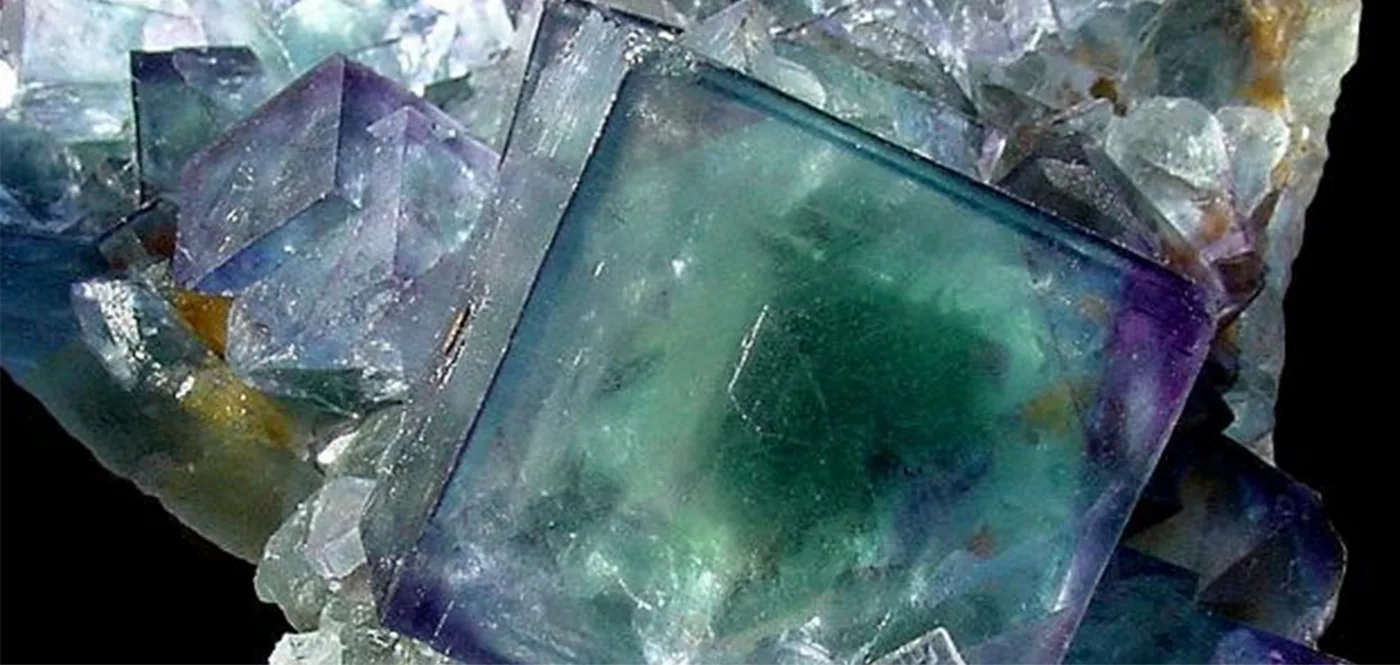
The mineral fluorite, CaF2, is a good example.
Deposits of fluorite form when calcium ions and fluoride ions dissolved in groundwater combine to give insoluble CaF2 after conditions change.
A drop in temperature can trigger precipitation if the solubility is exceeded at the lower temperature.
Because fluoride is a weak base, changes in pH also shift the solubility of fluorite.
The sample in the picture below is coloured by traces of other metal ions
while pure fluorite is colourless.
1 / 2Next ▶
A sample of the mineral fluorite, which formed when dissolved calcium and fluoride ions precipitated underground. Its colour comes from other metal ions in the crystal, not from fluorite itself. Image: OpenStax, Chemistry 2e, CC BY 4.0.
Why solubility equilibria matter
 ⤢ Enlarge
Why solubility equilibria matter
In this section you will write the equilibrium expressions for sparingly soluble ionic compounds and use them to solve problems involving solubility, ion concentrations and precipitation.
◀ Previous2 / 2
1The solubility product2The solubility product
The solubility product
The solubility product
The solubility of a substance can range from essentially zero (insoluble or sparingly soluble) to unlimited (miscible). When a solute is added to a solvent in an amount greater than its solubility, the result is a saturated solution in equilibrium with excess undissolved solute
which forms a heterogeneous mixture.
Take silver chloride as an example.
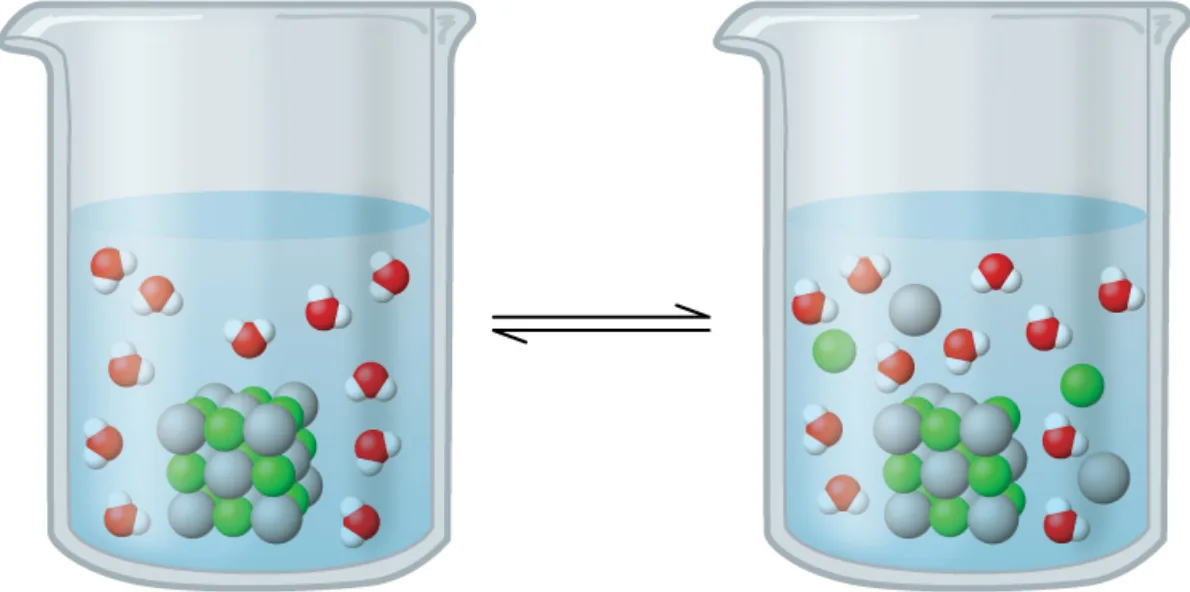
In a saturated solution, solid AgCl dissolves to form aqueous Ag+ and Cl− ions at exactly the same rate that these ions recombine and precipitate as solid AgCl.
Because AgCl is sparingly soluble, the concentrations of its dissolved ions are very low.
The picture below shows a small amount of solid AgCl in water, with a very dilute solution of ions in equilibrium with the solid.
1 / 2Next ▶
Solid silver chloride in water: a little of the solid dissolves, leaving a very dilute solution of silver and chloride ions in equilibrium with the undissolved solid. Image: OpenStax, Chemistry 2e, CC BY 4.0.
The solubility product
 ⤢ Enlarge
The solubility product
The equilibrium constant for a solubility equilibrium is called the solubility product constant, Ksp.
For the dissolution of AgCl, the expression is Ksp = [Ag+][Cl−].
Only gases and dissolved solutes appear in equilibrium constant expressions
so the undissolved solid AgCl is not included.
Values of Ksp for many sparingly soluble compounds are listed in Appendix J of the book.
To write a solubility product expression, first write the dissolution equation with the solid on the left and its ions on the right, balance it
and then raise each ion concentration to the power of its stoichiometric coefficient. For example, for Ca5(PO4)3OH the coefficients give Ksp = [Ca2+]5[PO43−]3[OH−].
◀ Previous2 / 2
1Ksp and solubility2Ksp and solubility
1Predicting precipitation2Predicting precipitation3Predicting precipitation
Selective precipitation
Selective precipitation
When a solution contains two or more ions that can form insoluble compounds with the same counter ion, selective precipitation can remove them one at a time.
The counter ion concentration is increased slowly and in a controlled way.
If the target ions start at the same concentration, the ion that forms the least soluble compound precipitates first, at the lowest counter ion concentration.
The other ions precipitate later, when their own solubility limits are reached.
The method works only when the solubilities of the compounds are sufficiently different.
Common ion effect
1
A sparingly soluble ionic compound is less soluble in a solution that already contains one of its ions than in pure water.
2
This is the common ion effect.
3
It follows from Le Châtelier’s principle: adding Ag+ or I− to a saturated solution of AgI shifts the equilibrium AgI(s) ⇌ Ag+(aq) + I−(aq) to the left,
so more solid AgI forms and the dissolved ion concentrations fall.
4
The same effect follows from the solubility product expression. In an equilibrium mixture the product [Ag+][I−] is constant. If one ion’s concentration rises, the other must fall in proportion.
5
Link to learning: An interactive simulation lets you add soluble salts to a saturated solution and watch how the solubility of a sparingly soluble salt responds
which is a helpful way to see the common ion effect in action.
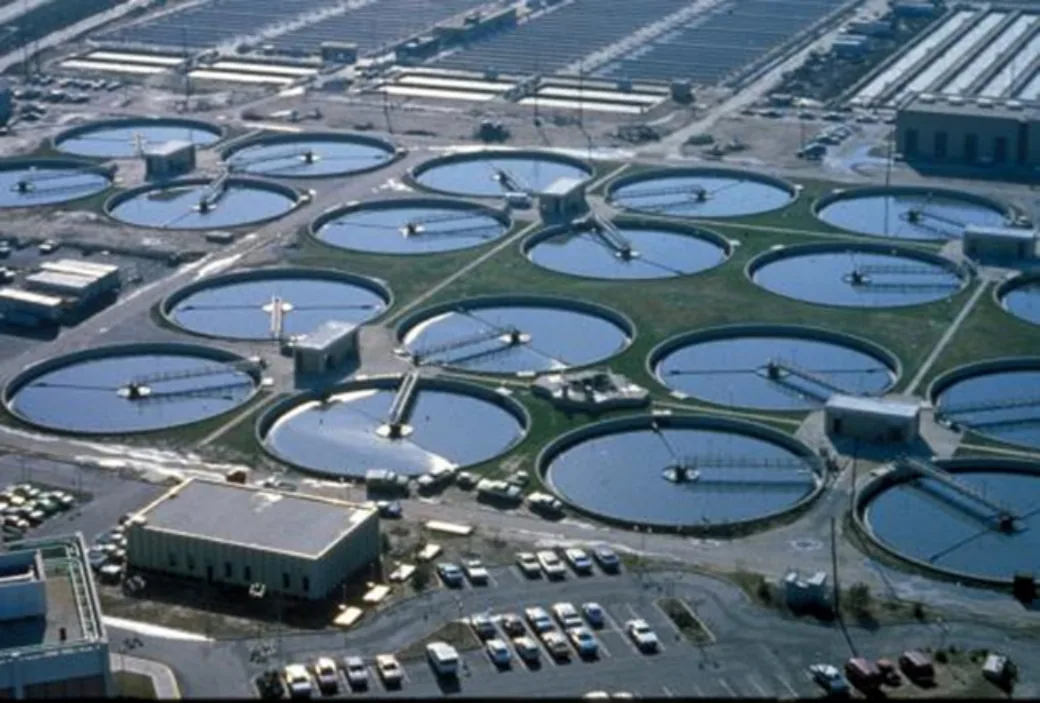
A wastewater treatment facility, where contaminants such as phosphate are removed by precipitation before the water is returned to the environment. Image: OpenStax, Chemistry 2e, CC BY 4.0.
Chemistry in everyday life: the role of precipitation in wastewater treatment
 ⤢ Enlarge
1
Solubility equilibria are used in wastewater treatment plants
which remove contaminants before treated water returns to rivers and lakes. Phosphate ions in water discharged from factories cause excess algae to grow. This uses up oxygen needed by marine life and makes the water unsuitable for drinking.
2
A common way to remove phosphate is to add calcium hydroxide, also called lime.
3
As the water becomes more basic, calcium ions react with phosphate ions to form hydroxylapatite, Ca5(PO4)3OH
which precipitates from the solution.
4
The amount of calcium added does not exceed the solubility products of other calcium salts
so the other anions stay in the water.
5
The precipitate is removed by filtration, and the water is returned to a neutral pH by adding CO2 in a process called recarbonation.
6
Iron(III) chloride and aluminium sulfate can also remove phosphates by precipitation.
1How sciences interconnect: using barium sulfate for medical 2How sciences interconnect: using barium sulfate for medical
How sciences interconnect: using barium sulfate for medical imaging
How sciences interconnect: using barium sulfate for medical imaging
Medical imaging is often used to diagnose illness without surgery.
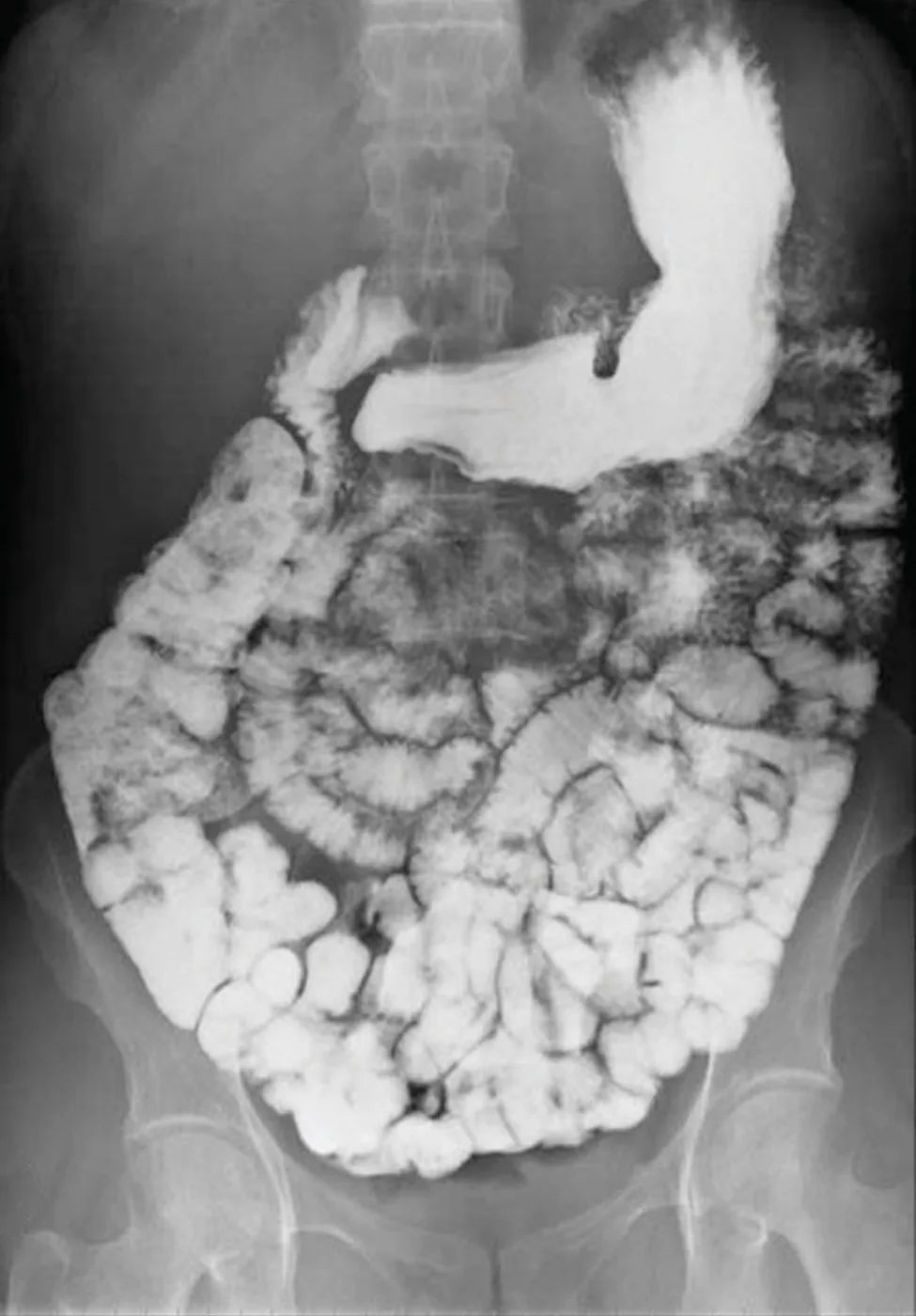
In one technique the patient drinks a suspension of barium sulfate, a chalky powder, before an X-ray is taken.
Barium sulfate has a very small Ksp (about 1.08 × 10⁻¹⁰)
so very little of it dissolves while it coats the lining of the intestinal tract.
The coated areas appear white on the X-ray
which gives more detail than an ordinary X-ray.
1 / 2Next ▶
A barium sulfate suspension coats the intestinal tract, so the outline of the digestive organs shows clearly on an X-ray image. Image: OpenStax, Chemistry 2e, CC BY 4.0.
How sciences interconnect: using barium sulfate for medical imaging
 ⤢ Enlarge
How sciences interconnect: using barium sulfate for medical imaging
This technique can help diagnose acid reflux disease, Crohn’s disease, ulcers and other conditions.
◀ Previous2 / 2
1Example 15.1: Writing equations and solubility products2Example 15.1: Writing equations and solubility products3Example 15.2: Calculation of Ksp from equilibrium concentrat4Example 15.3: Determination of molar solubility from Ksp5Example 15.4: Determination of molar solubility from Ksp6Example 15.5: Determination of Ksp from gram solubility7Example 15.6: Calculating the solubility of Hg2Cl28Example 15.7: Precipitation of Mg(OH)29Example 15.8: Precipitation of AgCl10Example 15.9: Precipitation of calcium oxalate11Example 15.9: Precipitation of calcium oxalate12Example 15.10: Concentrations following precipitation13Example 15.11: Precipitation of silver halides14Example 15.12: Common ion effect on solubility15Example 15.13: Common ion effect (molar solubility of CdS in16Example 15.13: Common ion effect (molar solubility of CdS in
Example 15.1: Writing equations and solubility products
Example 15.1: Writing equations and solubility products
Write the dissolution equation and the Ksp expression for each slightly soluble compound.
(a) AgI (silver iodide): AgI(s) ⇌ Ag+(aq) + I−(aq)
Ksp = [Ag+][I−].
(b) CaCO3 (calcium carbonate): CaCO3(s) ⇌ Ca2+(aq) + CO32−(aq)
Ksp = [Ca2+][CO32−].
(c) Mg(OH)2 (magnesium hydroxide): Mg(OH)2(s) ⇌ Mg2+(aq) + 2OH−(aq)
Ksp = [Mg2+][OH−]2.
(d) Mg(NH4)PO4 (magnesium ammonium phosphate): Mg(NH4)PO4(s) ⇌ Mg2+(aq) + NH4+(aq) + PO43−(aq)
Ksp = [Mg2+][NH4+][PO43−].
(e) Ca5(PO4)3OH (apatite): Ca5(PO4)3OH(s) ⇌ 5Ca2+(aq) + 3PO43−(aq) + OH−(aq)
Ksp = [Ca2+]5[PO43−]3[OH−].
1 / 16Next ▶
Example 15.1: Writing equations and solubility products
Example 15.1: Writing equations and solubility products
Check your learning: (a) BaSO4: Ksp = [Ba2+][SO42−].
(b) Ag2SO4: Ag2SO4(s) ⇌ 2Ag+ + SO42−
Ksp = [Ag+]2[SO42−].
(c) Al(OH)3: Al(OH)3(s) ⇌ Al3+ + 3OH−
Ksp = [Al3+][OH−]3.
(d) Pb(OH)Cl: Pb(OH)Cl(s) ⇌ Pb2+ + OH− + Cl−
Ksp = [Pb2+][OH−][Cl−].
◀ Previous2 / 16Next ▶
Example 15.2: Calculation of Ksp from equilibrium concentrations
1
Fluorite, CaF2, dissolves as CaF2(s) ⇌ Ca2+(aq) + 2F−(aq). A saturated solution has [Ca2+] = 2.15 × 10⁻⁴ M. Find Ksp.
2
Solution: Each formula unit gives two fluoride ions
so [F−] = 2 × 2.15 × 10−4 M = 4.30 × 10⁻⁴ M. Then Ksp = [Ca2+][F−]2 = (2.15 × 10⁻⁴)(4.30 × 10⁻⁴)2 = 3.97 × 10⁻¹¹.
3
Check your learning: In a saturated Mg(OH)2 solution, [Mg2+] = 1.31 × 10⁻⁴ M. Then [OH−] = 2.62 × 10⁻⁴ M and Ksp = (1.31 × 10⁻⁴)(2.62 × 10⁻⁴)2 = 8.99 × 10⁻¹².
◀ Previous3 / 16Next ▶
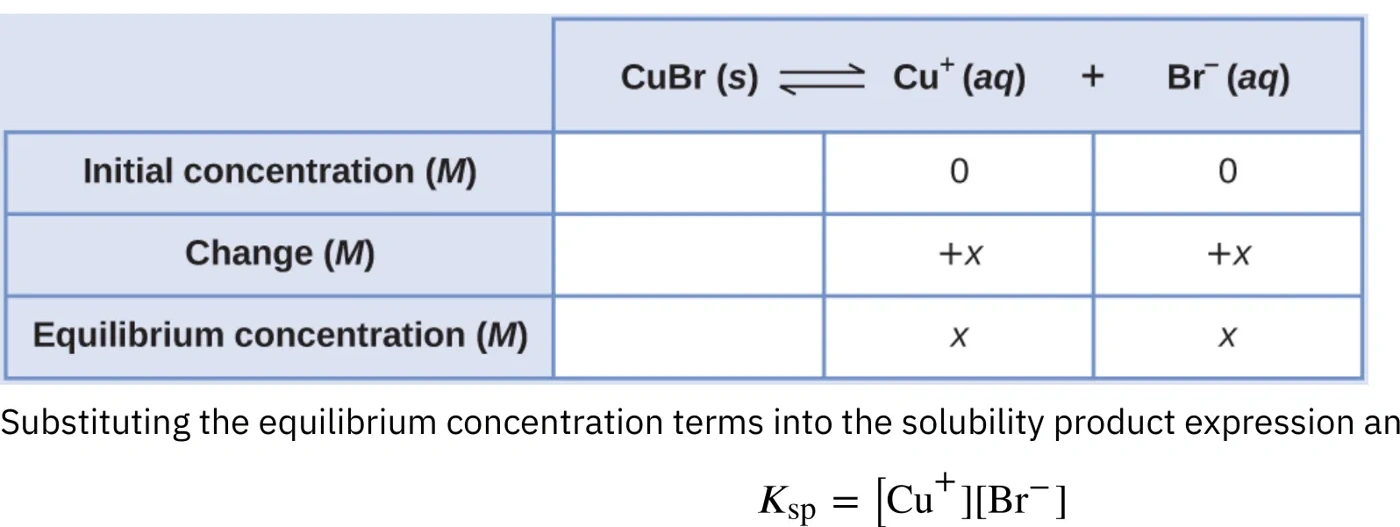
ICE table for CuBr: the solid is left out, and the copper and bromide ion concentrations are x at equilibrium. Image: OpenStax, Chemistry 2e, CC BY 4.0.
Example 15.3: Determination of molar solubility from Ksp
 ⤢ Enlarge
1
The Ksp of copper(I) bromide is 6.3 × 10⁻⁹. Find its molar solubility.
2
Solution: CuBr(s) ⇌ Cu+(aq) + Br−(aq) and Ksp = [Cu+][Br−]. Use an ICE table (initial, change, equilibrium) with x as the amount dissolved. The table below shows the ion concentrations in terms of x.
3
Substituting into the expression gives 6.3 × 10−9 = x2
so x = √(6.3 × 10⁻⁹) = 7.9 × 10⁻⁵ M. Because one mole of CuBr gives one mole of each ion, the molar solubility of CuBr is 7.9 × 10⁻⁵ M.
4
Check your learning: The Ksp of AgI is 1.5 × 10⁻¹⁶. Then x = √(1.5 × 10⁻¹⁶) = 1.2 × 10⁻⁸ M
which is the molar solubility of AgI.
◀ Previous4 / 16Next ▶
ICE table for calcium hydroxide: calcium ion is x and hydroxide ion is 2x at equilibrium. Image: OpenStax, Chemistry 2e, CC BY 4.0.
Example 15.4: Determination of molar solubility from Ksp
 ⤢ Enlarge
Example 15.4: Determination of molar solubility from Ksp
The Ksp of calcium hydroxide is 1.3 × 10⁻⁶. Find its molar solubility.
Solution: Ca(OH)2(s) ⇌ Ca2+(aq) + 2OH−(aq) and Ksp = [Ca2+][OH−]2. The ICE table below uses x for the calcium ion concentration
so the hydroxide concentration is 2x.
Substituting gives 1.3 × 10−6 = x(2x)2 = 4x3
so x3 = 3.25 × 10⁻⁷ and x = 6.9 × 10⁻³ M. Since x is the calcium ion concentration and each formula unit gives one calcium ion, the molar solubility is 6.9 × 10⁻³ M.
Check your learning: The Ksp of PbI2 is 1.4 × 10⁻⁸. Then 4x3 = 1.4 × 10⁻⁸ gives x = 1.5 × 10⁻³ M
which is the molar solubility of lead(II) iodide.
◀ Previous5 / 16Next ▶
Oil paint pigments, including chrome yellow, are only very slightly soluble in water. Image: OpenStax, Chemistry 2e, CC BY 4.0.
Example 15.5: Determination of Ksp from gram solubility
 ⤢ Enlarge
1
Artists’ pigments such as chrome yellow are sparingly soluble in water. The solubility of PbCrO4 is 4.6 × 10⁻⁶ g/L. Find Ksp.
2
Solution: Convert the solubility to molarity.
3
The molar mass of PbCrO4 is 323.2 g/mol
so the molar solubility is 4.6 × 10⁻⁶ g/L ÷ 323.2 g/mol = 1.4 × 10⁻⁸ M.
4
The dissolution PbCrO4(s) ⇌ Pb2+(aq) + CrO42−(aq) is 1:1
so both ion concentrations equal 1.4 × 10⁻⁸ M.
5
Then Ksp = (1.4 × 10⁻⁸)(1.4 × 10⁻⁸) = 2.0 × 10⁻¹⁶.
6
Check your learning: Thallium(I) chloride has a solubility of 3.12 g/L at 20 °C. Its molar mass is 239.8 g/mol
so its molar solubility is 1.30 × 10⁻² M and Ksp = (1.30 × 10⁻²)2 = 1.69 × 10⁻⁴.
◀ Previous6 / 16Next ▶
ICE table for calomel: mercury(I) ion is x and chloride ion is 2x at equilibrium. Image: OpenStax, Chemistry 2e, CC BY 4.0.
Example 15.6: Calculating the solubility of Hg2Cl2
 ⤢ Enlarge
Example 15.6: Calculating the solubility of Hg2Cl2
Calomel, Hg2Cl2, contains the diatomic mercury(I) ion, Hg22+, and chloride ions. Its Ksp is very small
which is why it dissolves so little. Using the Ksp value of 1.1 × 10⁻¹⁸ from Appendix J, calculate its molar solubility.
Solution: Hg2Cl2(s) ⇌ Hg22+(aq) + 2Cl−(aq). The ICE table below uses x for the mercury(I) ion concentration
so the chloride concentration is 2x.
Substituting gives 1.1 × 10−18 = x(2x)2 = 4x3
so x = 6.5 × 10⁻⁷ M. The molar solubility of Hg2Cl2 equals the mercury(I) ion concentrationso it is 6.5 × 10⁻⁷ M.
Check your learning: For MgF2, Ksp = 6.4 × 10⁻⁹. Since MgF2 gives Mg2+ and 2F−, Ksp = 4x3
so x = 1.2 × 10⁻³ M, the molar solubility of MgF2.
◀ Previous7 / 16Next ▶
Example 15.7: Precipitation of Mg(OH)2
Example 15.7: Precipitation of Mg(OH)2
Magnesium metal is prepared by precipitating Mg(OH)2 from sea water with lime, Ca(OH)2. Sea water has [Mg2+] = 0.0537 M. Will Mg(OH)2 precipitate when [OH−] reaches 0.0010 M?
Solution: Qsp = [Mg2+][OH−]2 = (0.0537)(0.0010)2 = 5.4 × 10⁻⁸. Since Qsp is greater than Ksp = 8.9 × 10⁻¹², the solution is supersaturated and Mg(OH)2 precipitates until Qsp = Ksp.
Check your learning: Will CaHPO4 precipitate when [Ca2+] = 0.0001 M and [HPO42−] = 0.001 M? Qsp = 1 × 10⁻⁷
which is less than Ksp = 7 × 10⁻⁷so there is no precipitation.
◀ Previous8 / 16Next ▶
Example 15.8: Precipitation of AgCl
1
Do AgCl crystals form when equal volumes of 2.0 × 10⁻⁴ M AgNO3 and 2.0 × 10⁻⁴ M NaCl are mixed? Ksp for AgCl is 1.6 × 10⁻¹⁰.
2
Solution: Mixing equal volumes doubles the volume
so each ion concentration is halved to 1.0 × 10⁻⁴ M. Then Qsp = (1.0 × 10⁻⁴)(1.0 × 10⁻⁴) = 1.0 × 10⁻⁸. Because Qsp is much greater than Ksp, AgCl precipitates until Qsp = Ksp.
3
Check your learning: Will KClO4 precipitate when 20 mL of 0.050 M K+ is added to 80 mL of 0.50 M ClO4−?
4
After dilution, [K+] = 0.010 M and [ClO4−] = 0.40 M
so Qsp = 4.0 × 10⁻³.
5
This is less than Ksp = 1.05 × 10⁻²
so no KClO4 precipitates.
◀ Previous9 / 16Next ▶
Example 15.9: Precipitation of calcium oxalate
1
Anticoagulant tubes contain oxalate salts that remove calcium from blood plasma.
2
At high enough concentrations, Ca2+ and oxalate form solid CaC2O4·H2O.
3
A blood serum sample has [Ca2+] = 2.2 × 10⁻³ M.
4
What oxalate concentration is needed before precipitation begins?
5
Use Ksp = 2.3 × 10⁻⁹ from Appendix J.
◀ Previous10 / 16Next ▶
Anticoagulants added to blood combine with calcium ions in the serum and stop the blood from clotting. Image: OpenStax, Chemistry 2e, CC BY 4.0.
Example 15.9: Precipitation of calcium oxalate
 ⤢ Enlarge
Example 15.9: Precipitation of calcium oxalate
Solution: Ksp = [Ca2+][C2O42−]. Rearranging, [C2O42−] = Ksp / [Ca2+] = 2.3 × 10⁻⁹ / 2.2 × 10−3 = 1.0 × 10⁻⁶ M. Precipitation begins at about this oxalate concentration.
Check your learning: A solution contains 0.0020 M CrO42−. Using Ksp = 9.0 × 10⁻¹² for Ag2CrO4, [Ag+]2 = 9.0 × 10⁻¹² / 0.0020 = 4.5 × 10⁻⁹
so [Ag+] = 6.7 × 10⁻⁵ M before Ag2CrO4 begins to precipitate.
◀ Previous11 / 16Next ▶
Example 15.10: Concentrations following precipitation
1
Manganese(II) in laundry water stains clothes when it oxidises. Adding base precipitates Mn(OH)2. What pH keeps [Mn2+] at 1.8 × 10⁻⁶ M? Use Ksp = 1.9 × 10⁻¹³.
2
Solution: Mn(OH)2(s) ⇌ Mn2+(aq) + 2OH−(aq)
so Ksp = [Mn2+][OH−]2.
3
Then [OH−]2 = 1.9 × 10⁻¹³ / 1.8 × 10−6 = 1.06 × 10⁻⁷
giving [OH−] = 3.25 × 10⁻⁴ M.
4
The pOH is 3.49
so the pH is 14.00 − 3.49 = 10.5.
5
Check your learning: Sea water has [Mg2+] = 5.37 × 10⁻² M. The pH needed to lower [Mg2+] to 1.0 × 10⁻⁵ M is found from [OH−]2 = 8.9 × 10⁻¹² / 1.0 × 10⁻⁵
which gives [OH−] = 9.4 × 10⁻⁴ M, pOH = 3.03 and pH = 10.97.
◀ Previous12 / 16Next ▶
Example 15.11: Precipitation of silver halides
Example 15.11: Precipitation of silver halides
A solution contains 1.0 × 10⁻⁴ M KBr and 0.10 M KCl. AgNO3 is added slowly. Which silver halide forms first?
Solution: AgBr begins to precipitate when [Ag+] = Ksp(AgBr) / [Br−] = 5.0 × 10⁻¹³ / 1.0 × 10−4 = 5.0 × 10⁻⁹ M.
AgCl begins to precipitate when [Ag+] = 1.6 × 10⁻¹⁰ / 0.10 = 1.6 × 10⁻⁹ M.
AgCl needs the lower silver ion concentration
so AgCl precipitates first, even though its Ksp is larger.
This happens because the chloride concentration is much higher than the bromide concentration.
Check your learning: In a solution that is 0.050 M in both Cl− and Br−, AgBr needs [Ag+] = 5.0 × 10⁻¹³ / 0.050 = 1.0 × 10⁻¹¹ M
while AgCl needs 3.2 × 10⁻⁹ M. So AgBr precipitates first at [Ag+] = 1.0 × 10⁻¹¹ M.
◀ Previous13 / 16Next ▶
Example 15.12: Common ion effect on solubility
Example 15.12: Common ion effect on solubility
What happens to the amount of solid Mg(OH)2 and to [Mg2+] and [OH−] when each of the following is added to a saturated Mg(OH)2 solution?
(a) MgCl2: Mg2+ is a common ion. The equilibrium shifts left
so [OH−] falls and more solid Mg(OH)2 forms.
(b) KOH: OH− is a common ion. The equilibrium shifts left
so [Mg2+] falls and more solid Mg(OH)2 forms.
(c) NaNO3: this salt has no common ion
so the solubility equilibrium is not affected.
(d) Solid Mg(OH)2: the solution is already saturated
so the ion concentrations stay the same and only the amount of undissolved solid increases.
Check your learning: For a saturated NiCO3 solution: (a) adding Ni(NO3)2 increases the mass of solid, increases [Ni2+] and decreases [CO32−]
(b) adding KClO4 has no appreciable effect(c) adding more solid NiCO3 only increases the amount of solid(d) adding K2CO3 increases the mass of solid, decreases [Ni2+] and increases [CO32−].
◀ Previous14 / 16Next ▶
Example 15.13: Common ion effect (molar solubility of CdS in CdBr2)
1
Calculate the molar solubility of cadmium sulfide in a 0.010 M solution of cadmium bromide. Use Ksp(CdS) = 8.0 × 10⁻²⁷ from Appendix J.
2
Solution: CdS(s) ⇌ Cd2+(aq) + S2−(aq).
3
CdBr2 supplies [Cd2+] = 0.010 M
so the cadmium ion concentration is already high.
4
If x mol/L of CdS dissolves, [Cd2+] = 0.010 + x ≈ 0.010 M and [S2−] = x.
5
Then Ksp = (0.010)(x)
so x = 8.0 × 10⁻²⁷ / 0.010 = 8.0 × 10⁻²⁵ M.
6
This is far smaller than pure water would allow
which shows the common ion effect.
◀ Previous15 / 16Next ▶
Example 15.13: Common ion effect (molar solubility of CdS in CdBr2)
1
Check your learning: Calculate the molar solubility of Al(OH)3 in a 0.015 M solution of Al(NO3)3, given Ksp = 2 × 10⁻³². Answer: Al(NO3)3 supplies [Al3+] = 0.015 M
which is much larger than the small amount of Al(OH)3 that dissolves.
2
With x as the molar solubility, [Al3+] ≈ 0.015 M and [OH−] = 3x
so Ksp = (0.015)(3x)3 = 0.405x3.
3
Then x3 = (2 × 10⁻³²) / 0.405 = 4.9 × 10⁻³² and x = 3.7 × 10⁻¹¹ M
which rounds to 4 × 10⁻¹¹ M.
◀ Previous16 / 16
Key terms
| Term | Meaning |
|---|---|
| Solubility equilibrium | The state in which a solid dissolves and the dissolved ions recombine and precipitate at equal rates. |
| Saturated solution | A solution in equilibrium with excess undissolved solute. |
| Molar solubility | The moles of dissolved solute per litre of saturated solution, in mol/L (M). |
| Solubility product constant (Ksp) | The equilibrium constant for a solubility equilibrium, equal to the product of the ion concentrations raised to their stoichiometric powers. |
| Reaction quotient (Qsp) | The ion product calculated from the actual concentrations in a solution, compared with Ksp to predict precipitation. |
| Supersaturated solution | A solution in which Qsp is greater than Ksp, so precipitation occurs. |
| Precipitation | The formation of a solid from ions in solution. |
| Dissolution | The process by which a solid breaks up into its ions in solution. |
| ICE table | A table listing initial, change and equilibrium concentrations used to solve equilibrium problems. |
| Selective precipitation | Removing one ion from a solution by precipitating it with a counter ion, while others remain dissolved. |
| Common ion effect | The decrease in solubility of a compound when a solution already contains one of its ions. |
| Le Châtelier’s principle | The rule that a system at equilibrium shifts to oppose a change in conditions. |
| Hydroxylapatite | The insoluble calcium phosphate mineral Ca5(PO4)3OH formed when lime is added to remove phosphate from wastewater. |
| Recarbonation | Adding CO2 to treated water to bring its pH back to neutral. |
1Avoid these mistakes2Avoid these mistakes3Avoid these mistakes4Avoid these mistakes