Curriculum
Chemistry 2e
Unit 1: Essential Ideas
0/14
Unit 2: Atoms, Molecules, and Ions
0/16
-
Unit 2 overview: Atoms, Molecules, and Ions
 Preview
-
2.1 Early Ideas in Atomic Theory
Preview
-
2.1 Early Ideas in Atomic Theory - Check yourself
 Preview
-
2.2 Evolution of Atomic Theory
Preview
-
2.2 Evolution of Atomic Theory - Check yourself
Preview
-
2.3 Atomic Structure and Symbolism
Preview
-
2.3 Atomic Structure and Symbolism - Check yourself
Preview
-
2.4 Chemical Formulas
Preview
-
2.4 Chemical Formulas - Check yourself
Preview
-
2.5 The Periodic Table
Preview
-
2.5 The Periodic Table - Check yourself
Preview
-
2.6 Ionic and Molecular Compounds
Preview
-
2.6 Ionic and Molecular Compounds - Check yourself
Preview
-
2.7 Chemical Nomenclature
Preview
-
2.7 Chemical Nomenclature - Check yourself
Preview
-
Unit 2 review quiz: Atoms, Molecules, and Ions
Preview
Unit 3: Composition of Substances and Solutions
0/10
Unit 4: Stoichiometry of Chemical Reactions
0/12
Unit 5: Thermochemistry
0/8
Unit 6: Electronic Structure and Periodic Properties of Elements
0/12
Unit 7: Chemical Bonding and Molecular Geometry
0/14
Unit 8: Advanced Theories of Covalent Bonding
0/10
Unit 9: Gases
0/23
Unit 10: Liquids and Solids
0/28
Unit 11: Solutions and Colloids
0/24
Unit 12: Kinetics
0/32
Unit 13: Fundamental Equilibrium Concepts
0/20
Unit 14: Acid-Base Equilibria
0/32
Unit 15: Equilibria of Other Reaction Classes
0/16
Unit 16: Thermodynamics
0/20
Unit 17: Electrochemistry
0/32
Unit 18: Representative Metals, Metalloids, and Nonmetals
0/52
Unit 19: Transition Metals and Coordination Chemistry
0/16
Unit 20: Organic Chemistry
0/20
Unit 21: Nuclear Chemistry
0/28
Text lesson
2.4 Chemical Formulas
2.4 Chemical Formulas — CHEMISTRY notes: By the end of this lesson you will be able to write molecular and empirical formulas for substances, and represent the bonding arrangement of atoms with structural formulas.
1Molecular formulas2Molecular formulas3Molecular formulas
Molecular formulas
Molecular formulas
Chemists describe a substance by its composition.
A molecular formula uses chemical symbols to show which types of atoms a molecule contains,
and a subscript after each symbol gives the number of atoms of that type in one molecule.
A subscript is written only when more than one atom of a given element is present
so a single atom carries no subscript.
Molecular formulas are also used as short abbreviations for the names of compounds.
The composition of a substance can be checked by experiment.
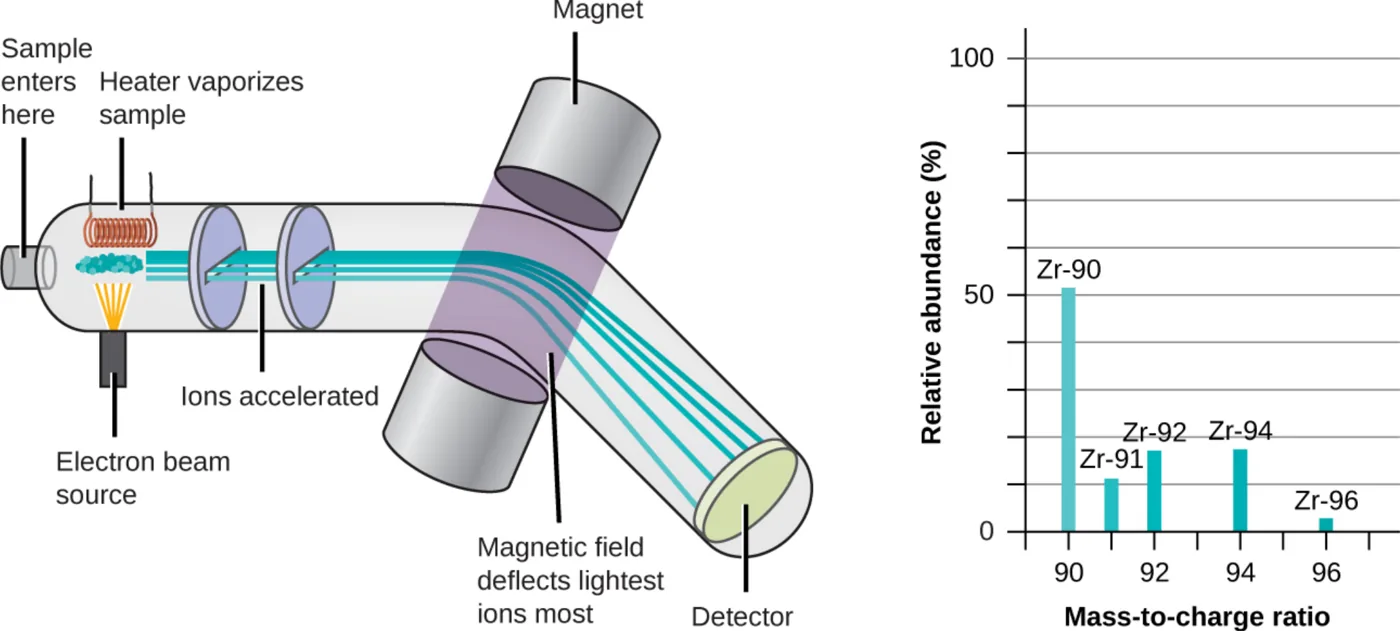
A mass spectrometer vaporizes a sample, gives its particles an electric charge,
and sends them through an electric or magnetic field that deflects each particle by an amount depending on its mass and charge.
1 / 3Next ▶
Molecular formulas
1
The ions are detected, and the result is a mass spectrum: a plot of the relative number of ions against their mass-to-charge ratio.
2
The height of each peak is proportional to the fraction of ions with that ratio.
3
Mass spectrometry is used in chemistry, forensics, medicine and environmental science to identify the substances in a sample.
4
The diagram below shows the analysis of zirconium, whose peaks reveal its several isotopes.
◀ Previous2 / 3Next ▶
A mass spectrometer separates charged atoms by their mass-to-charge ratio, and the resulting spectrum of zirconium shows one peak for each of its isotopes. Image: OpenStax, Chemistry 2e, CC BY 4.0.
Molecular formulas
 ⤢ Enlarge
Molecular formulas
Link to learning: an online animation explains how a mass spectrometer works, and a short video from the Royal Society of Chemistry gives a brief description of the same basic ideas.
◀ Previous3 / 3
1Structural formulas2Structural formulas
Structural formulas
Structural formulas
A structural formula gives the same information as a molecular formula, the types and numbers of atoms in a molecule, and also shows how those atoms are connected.
The structural formula for methane contains one carbon atom and four hydrogen atoms, CH4.
The lines in the structural formula represent chemical bonds,
which are attractions between atoms or ions that hold them together in a molecule or a crystal.
Bonding is studied in more detail later
so for now treat each line simply as an indication that two atoms are connected.
Other models show the same molecule in different ways.
A ball-and-stick model shows the geometric arrangement of the atoms, with the bonds drawn as sticks
the atoms are not drawn to scale.
1 / 2Next ▶
Methane is shown four ways: as a molecular formula, as a structural formula, as a ball-and-stick model and as a space-filling model, with carbon atoms dark and hydrogen atoms white. Image: OpenStax, Chemistry 2e, CC BY 4.0.
Structural formulas
 ⤢ Enlarge
1
A space-filling model shows the relative sizes of the atoms and how much space they occupy.
2
The figure below shows methane as a molecular formula, a structural formula, a ball-and-stick model and a space-filling model.
3
Link to learning: an online molecule-building simulation lets you assemble molecules from atoms and view them in three dimensions. It is a useful way to check that a structural formula matches a molecular formula.
◀ Previous2 / 2
1Elements that form molecules2Elements that form molecules
Elements that form molecules
1
Many elements consist of individual atoms
but some exist as molecules made of two or more atoms of the same element bonded together.
2
Most samples of hydrogen, oxygen and nitrogen are made of molecules that each contain two atoms.
3
These are called diatomic molecules, and their molecular formulas are H2, O2 and N2.
4
Other elements that commonly occur as diatomic molecules are fluorine (F2), chlorine (Cl2), bromine (Br2) and iodine (I2).
5
The most common form of sulfur consists of molecules of eight sulfur atoms
so its molecular formula is S8, as shown below.
1 / 2Next ▶
A molecule of sulfur contains eight sulfur atoms, shown as a structural formula, a ball-and-stick model and a space-filling model. Image: OpenStax, Chemistry 2e, CC BY 4.0.
Elements that form molecules

◀ Previous2 / 2
1Reading 2H, H2 and 2H2 correctly2Reading 2H, H2 and 2H2 correctly
Reading 2H, H2 and 2H2 correctly
1
A subscript after a symbol and a number in front of a symbol mean different things
so H2 and 2H describe very different species.
2
H2 is a molecular formula for one diatomic molecule of hydrogen, in which two hydrogen atoms are chemically bonded together.
3
The expression 2H means two separate hydrogen atoms that are not combined as a unit.
4
The expression 2H2 means two molecules of diatomic hydrogen
which contain four hydrogen atoms in total.
5
The figure below compares these four expressions.
1 / 2Next ▶
The symbols H, 2H, H2 and 2H2 each describe a different number of hydrogen atoms or molecules, from one atom to two molecules. Image: OpenStax, Chemistry 2e, CC BY 4.0.
Reading 2H, H2 and 2H2 correctly

◀ Previous2 / 2
1Empirical formulas2Empirical formulas
Empirical formulas
Empirical formulas
Compounds are formed when two or more elements chemically combine.
Hydrogen and oxygen react to form water, and sodium and chlorine react to form table salt.
The composition of a compound can be described with an empirical formula,
which gives the types of atoms present and the simplest whole-number ratio of the numbers of atoms or ions in the compound.
Table salt, NaCl, is always described this way because it does not form separate molecules.
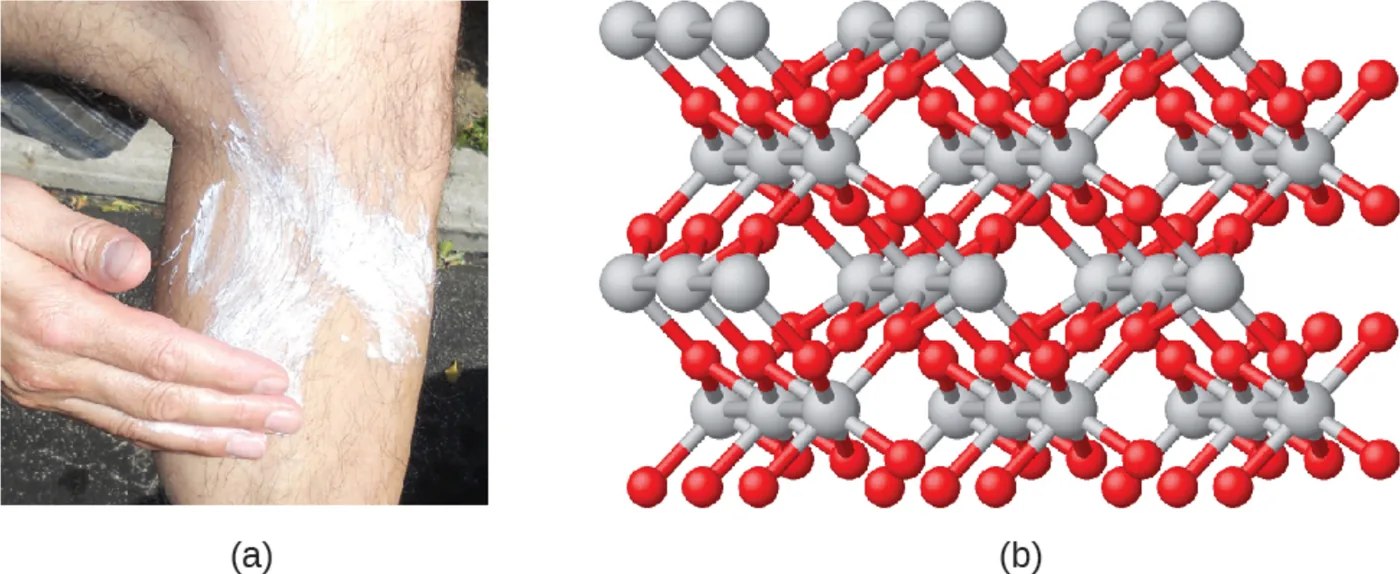
Titanium dioxide is a useful example.
It is the white pigment in paint and the thick, white, blocking type of sunscreen.
1 / 2Next ▶
Titanium dioxide protects skin from the sun as a white cream, and its crystal contains titanium and oxygen atoms in a ratio of 1 to 2. Image: OpenStax, Chemistry 2e, CC BY 4.0.
Empirical formulas
 ⤢ Enlarge
1
Its empirical formula is TiO2.
2
This identifies titanium (Ti) and oxygen (O) as its constituents and shows that there are twice as many oxygen atoms as titanium atoms.
3
The figure below shows the compound in use and as a crystal.
◀ Previous2 / 2
1Molecular formulas from experimental data2Molecular formulas from experimental data
Molecular formulas from experimental data
1
In many cases the molecular formula of a substance is found from experiment.
2
First the empirical formula is determined
and then the molecular mass, the sum of the atomic masses of all the atoms in one molecule, is measured.
3
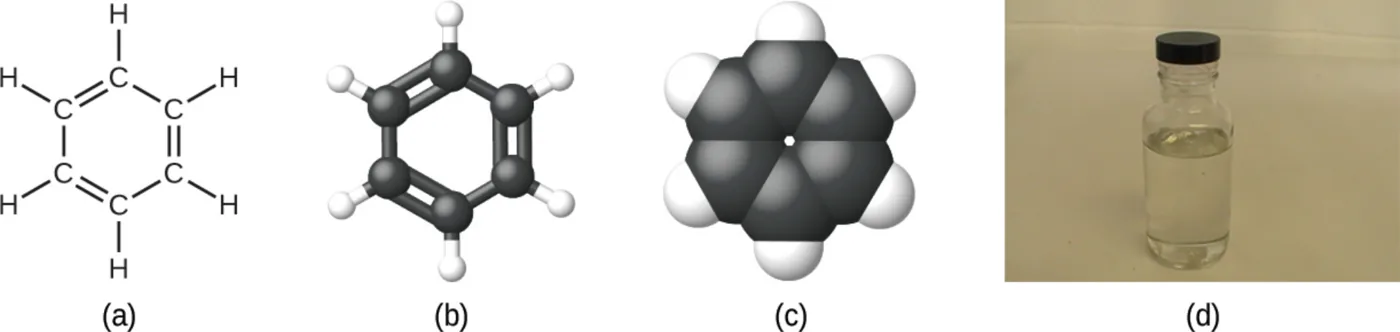
Benzene is a good example.
4
Experiments show that it contains carbon and hydrogen, with one hydrogen atom for every carbon atom
so its empirical formula is CH.
5
Its molecular mass shows that each molecule has six carbon atoms and six hydrogen atoms
so its molecular formula is C6H6.
6
As a check, the molecular mass of about 78.11 g/mol divided by the mass of one CH unit, about 13.02 g/mol, gives 6.
Benzene is produced during oil refining and has many industrial uses.
1 / 2Next ▶
Benzene, C6H6, is shown as a structural formula, a ball-and-stick model, a space-filling model and as a clear liquid in a bottle. Image: OpenStax, Chemistry 2e, CC BY 4.0.
Molecular formulas from experimental data
◀ Previous2 / 2
1Finding the empirical formula from a molecular formula2Finding the empirical formula from a molecular formula
Finding the empirical formula from a molecular formula
1
If the molecular formula of a compound is known, its empirical formula can be found by reducing the ratio of its atoms to the simplest whole numbers.
2
In practice chemists usually determine the empirical formula first
so this step is mostly an exercise.
3
Acetic acid, C2H4O2, is the component that gives vinegar its sharp taste.
4
A molecule contains 2 carbon, 4 hydrogen and 2 oxygen atoms, a ratio of 2:4:2.
Dividing by the lowest common factor, 2, gives 1:2:1, so the empirical formula is CH2O.
5
A molecular formula is always a whole-number multiple of its empirical formula
here the molecule is twice the CH2O unit.
6
The figure below shows vinegar and the acetic acid molecule.
1 / 2Next ▶
Vinegar contains acetic acid, which has the empirical formula CH2O; it is shown as a bottle of vinegar, a structural formula and a ball-and-stick model. Image: OpenStax, Chemistry 2e, CC BY 4.0.
Finding the empirical formula from a molecular formula

◀ Previous2 / 2
1Isomers: the same formula with a different structure2Isomers: the same formula with a different structure3Isomers: the same formula with a different structure
1Portrait of a Chemist: Paula Hammond2Portrait of a Chemist: Paula Hammond3Portrait of a Chemist: Paula Hammond
Portrait of a Chemist: Paula Hammond
Portrait of a Chemist: Paula Hammond
The structure of a molecule determines how it behaves.
The structure of a molecule on a virus surface lets the virus attach to a cell,
and the structure of antibodies, substances made by the immune system, can block that attachment.
The structure of chlorophyll lets it use sunlight to make glucose.
Chemists and chemical engineers do more than observe these structures
they can design new ones.
Paula Hammond is a chemical engineer who has developed precise techniques for building chemical structures.
She chairs the chemical engineering department at MIT,
and she leads a research team that assembles unique molecular structures to solve problems ranging from cancer to energy use.
1 / 3Next ▶
Portrait of a Chemist: Paula Hammond
1
The team has created nanoparticle-sized drug carriers that can deliver medicines directly into tumors while avoiding the body’s defenses.
2
These coatings are built layer by layer, and by using electrical and chemical properties the researchers tune them for particular cancers.
3
A company she founded uses similar technology to release medicine into the eyes of cataract patients and to improve wound healing.
4
Students take part in this work as well, and their participation helps prepare the next generation of problem-solvers.
◀ Previous2 / 3Next ▶
Paula Hammond, a chemical engineer who leads research on assembling molecular structures for medicine and energy. Image: OpenStax, Chemistry 2e, CC BY 4.0.
Portrait of a Chemist: Paula Hammond

◀ Previous3 / 3
1Example: empirical and molecular formulas of glucose2Check your learning: empirical and molecular formulas of met
Key terms
| Term | Meaning |
|---|---|
| Molecular formula | A representation of a molecule that uses chemical symbols for its atom types, with subscripts giving the number of atoms of each type in one molecule. |
| Subscript | A small number written after and below a symbol in a formula; it shows how many atoms of that element are present, and it is omitted when there is only one. |
| Structural formula | A formula that shows the types and numbers of atoms in a molecule and also how those atoms are connected. |
| Chemical bond | An attraction between atoms or ions that holds them together in a molecule or a crystal. |
| Ball-and-stick model | A model that shows the geometric arrangement of atoms as balls joined by sticks, with the atoms not drawn to scale. |
| Space-filling model | A model that shows the relative sizes of atoms and how they fill the space around the molecule. |
| Diatomic molecule | A molecule made of exactly two atoms, usually of the same element, such as H2 or O2. |
| Empirical formula | A formula that gives the types of atoms in a compound and their simplest whole-number ratio. |
| Molecular mass | The sum of the atomic masses of all the atoms in one molecule. |
| Isomers | Compounds that have the same chemical formula but different molecular structures. |
| Mass spectrometer | An instrument that charges the particles of a sample, separates them by mass-to-charge ratio and records how many of each kind there are. |
| Mass spectrum | A plot of the relative number of ions against their mass-to-charge ratio, with peaks showing the particles that were detected. |
| Structural isomers | Isomers whose molecules have the same formula but differ in how the atoms are connected to each other. |
| Spatial isomers | Isomers whose atoms are connected in the same order but are arranged differently in space, such as mirror-image molecules. |
1Avoid these mistakes2Avoid these mistakes3Avoid these mistakes4Avoid these mistakes5Avoid these mistakes6Avoid these mistakes
Avoid these mistakes
1Avoid this
Confusing HAvoid this
2Avoid this
with 2H: HAvoid this
is one diatomic molecule of two bonded atoms, while 2H is two separate atoms.Avoid this
Reading a subscript as a number of molecules: in HAvoid this
1 / 6Next ▶
Avoid these mistakes
O the 2 means two hydrogen atoms in each molecule, not two molecules.Avoid this
3Avoid this
Forgetting to divide by the greatest common factor when finding an empirical formula,Avoid this
so that C6H12O6 is wrongly reduced to a different ratio instead of CH2O.Avoid this
4Avoid this
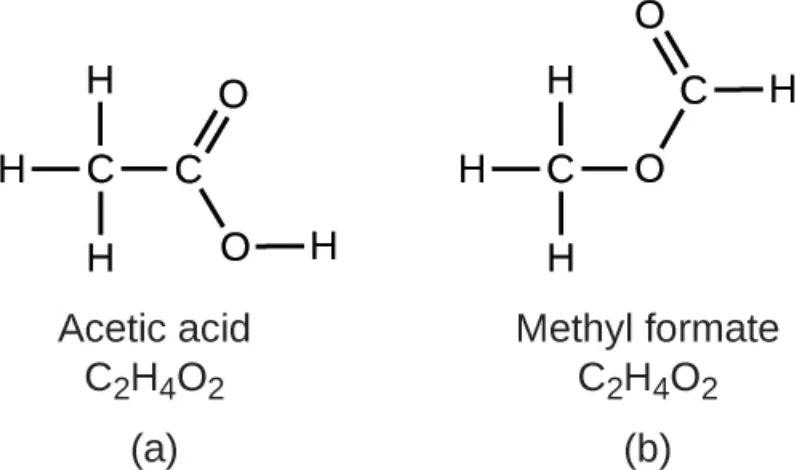
Assuming that the same molecular formula always means the same structure; acetic acid and methyl formate are isomers with different properties.Avoid this
◀ Previous2 / 6Next ▶
Avoid these mistakes
5Avoid this
Thinking a structural formula shows the three-dimensional shape of a molecule; the lines show which atoms are connected,Avoid this
while a ball-and-stick or space-filling model shows geometry.Avoid this
6Avoid this
Writing S instead of SAvoid this
8Avoid this
◀ Previous3 / 6Next ▶
Avoid these mistakes
for sulfur, or writing H instead of HAvoid this
for hydrogen gas, which ignores the diatomic or multi-atom form of the molecule.Avoid this
7Avoid this
Using the molecular mass directly as the empirical unit: the molecular mass must be divided by the empirical formula mass to find the whole-number multiple.Avoid this
◀ Previous4 / 6Next ▶
Two structures with the same formula, C₂H₄O₂: acetic acid on the left and methyl formate on the right. The atoms are joined in a different order, so the molecules are different compounds. Image: OpenStax, Chemistry 2e, CC BY 4.0.
Avoid these mistakes
◀ Previous5 / 6Next ▶
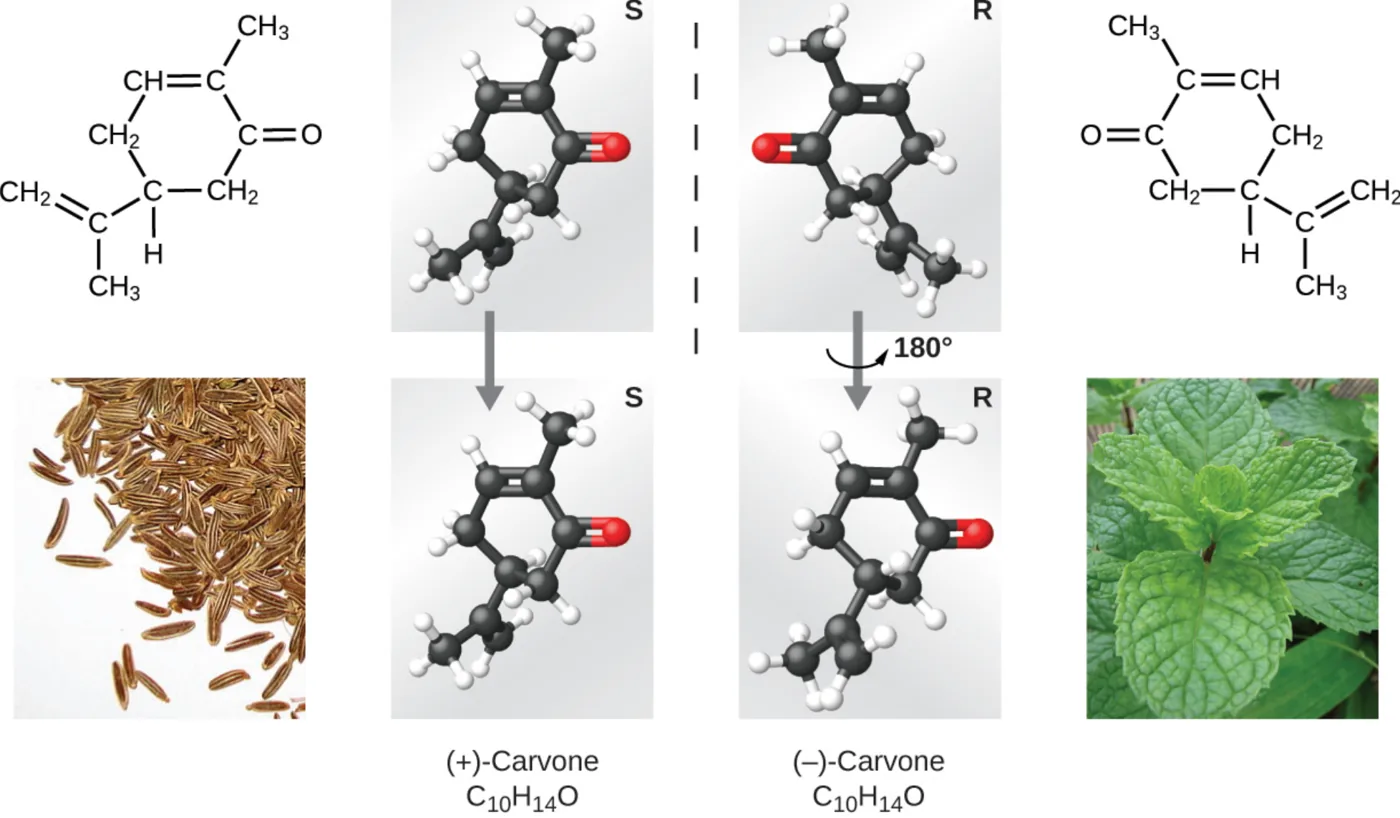
The two spatial isomers of carvone, drawn as mirror images, with caraway seeds that contain the S form and spearmint leaves that contain the R form. Image: OpenStax, Chemistry 2e, CC BY 4.0.
Avoid these mistakes
◀ Previous6 / 6