Curriculum
Chemistry 2e
Unit 1: Essential Ideas
0/14
-
Unit 1 overview: Essential Ideas
 Text lessonPreview
-
1.1 Chemistry in Context
Text lessonPreview
-
1.1 Chemistry in Context - Check yourself
 6 questionsPreview
-
1.2 Phases and Classification of Matter
Text lessonPreview
-
1.2 Phases and Classification of Matter - Check yourself
6 questionsPreview
-
1.3 Physical and Chemical Properties
Text lessonPreview
-
1.3 Physical and Chemical Properties - Check yourself
6 questionsPreview
-
1.4 Measurements
Text lessonPreview
-
1.4 Measurements - Check yourself
6 questionsPreview
-
1.5 Measurement Uncertainty, Accuracy, and Precision
Text lessonPreview
-
1.5 Measurement Uncertainty, Accuracy, and Precision - Check yourself
6 questionsPreview
-
1.6 Mathematical Treatment of Measurement Results
Text lessonPreview
-
1.6 Mathematical Treatment of Measurement Results - Check yourself
6 questionsPreview
-
Unit 1 review quiz: Essential Ideas
10 questionsPreview
Unit 2: Atoms, Molecules, and Ions
0/16
-
Unit 2 overview: Atoms, Molecules, and Ions
Text lessonPreview
-
2.1 Early Ideas in Atomic Theory
Text lessonPreview
-
2.1 Early Ideas in Atomic Theory - Check yourself
6 questionsPreview
-
2.2 Evolution of Atomic Theory
Text lessonPreview
-
2.2 Evolution of Atomic Theory - Check yourself
6 questionsPreview
-
2.3 Atomic Structure and Symbolism
Text lessonPreview
-
2.3 Atomic Structure and Symbolism - Check yourself
6 questionsPreview
-
2.4 Chemical Formulas
Text lessonPreview
-
2.4 Chemical Formulas - Check yourself
6 questionsPreview
-
2.5 The Periodic Table
Text lessonPreview
-
2.5 The Periodic Table - Check yourself
6 questionsPreview
-
2.6 Ionic and Molecular Compounds
Text lessonPreview
-
2.6 Ionic and Molecular Compounds - Check yourself
6 questionsPreview
-
2.7 Chemical Nomenclature
Text lessonPreview
-
2.7 Chemical Nomenclature - Check yourself
6 questionsPreview
-
Unit 2 review quiz: Atoms, Molecules, and Ions
10 questionsPreview
Unit 3: Composition of Substances and Solutions
0/10
-
Unit 3 overview: Composition of Substances and Solutions
Text lessonPreview
-
3.1 Formula Mass and the Mole Concept
Text lessonPreview
-
3.1 Formula Mass and the Mole Concept - Check yourself
6 questionsPreview
-
3.2 Determining Empirical and Molecular Formulas
Text lessonPreview
-
3.2 Determining Empirical and Molecular Formulas - Check yourself
6 questionsPreview
-
3.3 Molarity
Text lessonPreview
-
3.3 Molarity - Check yourself
6 questionsPreview
-
3.4 Other Units for Solution Concentrations
Text lessonPreview
-
3.4 Other Units for Solution Concentrations - Check yourself
6 questionsPreview
-
Unit 3 review quiz: Composition of Substances and Solutions
10 questionsPreview
Unit 4: Stoichiometry of Chemical Reactions
0/12
-
Unit 4 overview: Stoichiometry of Chemical Reactions
Text lessonPreview
-
4.1 Writing and Balancing Chemical Equations
Text lessonPreview
-
4.1 Writing and Balancing Chemical Equations - Check yourself
6 questionsPreview
-
4.2 Classifying Chemical Reactions
Text lessonPreview
-
4.2 Classifying Chemical Reactions - Check yourself
6 questionsPreview
-
4.3 Reaction Stoichiometry
Text lessonPreview
-
4.3 Reaction Stoichiometry - Check yourself
6 questionsPreview
-
4.4 Reaction Yields
Text lessonPreview
-
4.4 Reaction Yields - Check yourself
6 questionsPreview
-
4.5 Quantitative Chemical Analysis
Text lessonPreview
-
4.5 Quantitative Chemical Analysis - Check yourself
6 questionsPreview
-
Unit 4 review quiz: Stoichiometry of Chemical Reactions
10 questionsPreview
Unit 5: Thermochemistry
0/8
-
Unit 5 overview: Thermochemistry
Text lessonPreview
-
5.1 Energy Basics
Text lessonPreview
-
5.1 Energy Basics - Check yourself
6 questionsPreview
-
5.2 Calorimetry
Text lessonPreview
-
5.2 Calorimetry - Check yourself
7 questionsPreview
-
5.3 Enthalpy
Text lessonPreview
-
5.3 Enthalpy - Check yourself
6 questionsPreview
-
Unit 5 review quiz: Thermochemistry
10 questionsPreview
Unit 6: Electronic Structure and Periodic Properties of Elements
0/12
-
Unit 6 overview: Electronic Structure and Periodic Properties of Elements
Text lessonPreview
-
6.1 Electromagnetic Energy
Text lessonPreview
-
6.1 Electromagnetic Energy - Check yourself
6 questionsPreview
-
6.2 The Bohr Model
Text lessonPreview
-
6.2 The Bohr Model - Check yourself
6 questionsPreview
-
6.3 Development of Quantum Theory
Text lessonPreview
-
6.3 Development of Quantum Theory - Check yourself
6 questionsPreview
-
6.4 Electronic Structure of Atoms (Electron Configurations)
Text lessonPreview
-
6.4 Electronic Structure of Atoms (Electron Configurations) - Check yourself
6 questionsPreview
-
6.5 Periodic Variations in Element Properties
Text lessonPreview
-
6.5 Periodic Variations in Element Properties - Check yourself
6 questionsPreview
-
Unit 6 review quiz: Electronic Structure and Periodic Properties of Elements
10 questionsPreview
Unit 7: Chemical Bonding and Molecular Geometry
0/14
-
Unit 7 overview: Chemical Bonding and Molecular Geometry
Text lessonPreview
-
7.1 Ionic Bonding
Text lessonPreview
-
7.1 Ionic Bonding - Check yourself
6 questionsPreview
-
7.2 Covalent Bonding
Text lessonPreview
-
7.2 Covalent Bonding - Check yourself
6 questionsPreview
-
7.3 Lewis Symbols and Structures
Text lessonPreview
-
7.3 Lewis Symbols and Structures - Check yourself
6 questionsPreview
-
7.4 Formal Charges and Resonance
Text lessonPreview
-
7.4 Formal Charges and Resonance - Check yourself
6 questionsPreview
-
7.5 Strengths of Ionic and Covalent Bonds
Text lessonPreview
-
7.5 Strengths of Ionic and Covalent Bonds - Check yourself
6 questionsPreview
-
7.6 Molecular Structure and Polarity
Text lessonPreview
-
7.6 Molecular Structure and Polarity - Check yourself
6 questionsPreview
-
Unit 7 review quiz: Chemical Bonding and Molecular Geometry
10 questionsPreview
Unit 8: Advanced Theories of Covalent Bonding
0/10
-
Unit 8 overview: Advanced Theories of Covalent Bonding
Text lessonPreview
-
8.1 Valence Bond Theory
Text lessonPreview
-
8.1 Valence Bond Theory - Check yourself
6 questionsPreview
-
8.2 Hybrid Atomic Orbitals
Text lessonPreview
-
8.2 Hybrid Atomic Orbitals - Check yourself
6 questionsPreview
-
8.3 Multiple Bonds
Text lessonPreview
-
8.3 Multiple Bonds - Check yourself
6 questionsPreview
-
8.4 Molecular Orbital Theory
Text lessonPreview
-
8.4 Molecular Orbital Theory - Check yourself
6 questionsPreview
-
Unit 8 review quiz: Advanced Theories of Covalent Bonding
10 questionsPreview
Unit 9: Gases
0/23
-
Unit 9 overview: Gases
Text lessonPreview
-
9.1 Gas Pressure
Text lessonPreview
-
9.1 Gas Pressure - Check yourself
6 questionsPreview
-
9.2 Relating Pressure, Volume, Amount, and Temperature: The Ideal Gas Law
Text lessonPreview
-
9.2 Relating Pressure, Volume, Amount, and Temperature: The Ideal Gas Law - Check yourself
6 questionsPreview
-
9.3 Stoichiometry of Gaseous Substances, Mixtures, and Reactions
Text lessonPreview
-
9.3 Stoichiometry of Gaseous Substances, Mixtures, and Reactions - Check yourself
6 questionsPreview
-
9.3 Stoichiometry of Gaseous Substances, Mixtures, and Reactions
Text lessonPreview
-
9.3 Stoichiometry of Gaseous Substances, Mixtures, and Reactions - Check yourself
6 questionsPreview
-
9.4 Effusion and Diffusion of Gases
Text lessonPreview
-
9.4 Effusion and Diffusion of Gases - Check yourself
6 questionsPreview
-
9.4 Effusion and Diffusion of Gases
Text lessonPreview
-
9.4 Effusion and Diffusion of Gases - Check yourself
6 questionsPreview
-
Unit 9 review quiz: Gases
10 questionsPreview
-
9.5 The Kinetic-Molecular Theory
Text lessonPreview
-
9.5 The Kinetic-Molecular Theory - Check yourself
6 questionsPreview
-
9.5 The Kinetic-Molecular Theory
Text lessonPreview
-
9.5 The Kinetic-Molecular Theory - Check yourself
6 questionsPreview
-
9.6 Non-Ideal Gas Behavior
Text lessonPreview
-
9.6 Non-Ideal Gas Behavior - Check yourself
6 questionsPreview
-
9.6 Non-Ideal Gas Behavior
Text lessonPreview
-
9.6 Non-Ideal Gas Behavior - Check yourself
6 questionsPreview
-
Unit 9 review quiz: Gases
10 questionsPreview
Unit 10: Liquids and Solids
0/28
-
Unit 10 overview: Liquids and Solids
Text lessonPreview
-
10.1 Intermolecular Forces
Text lessonPreview
-
Unit 10 overview: Liquids and Solids
Text lessonPreview
-
10.1 Intermolecular Forces
Text lessonPreview
-
10.1 Intermolecular Forces - Check yourself
6 questionsPreview
-
10.1 Intermolecular Forces - Check yourself
6 questionsPreview
-
10.2 Properties of Liquids
Text lessonPreview
-
10.2 Properties of Liquids - Check yourself
6 questionsPreview
-
10.2 Properties of Liquids
Text lessonPreview
-
10.2 Properties of Liquids - Check yourself
6 questionsPreview
-
10.3 Phase Transitions
Text lessonPreview
-
10.3 Phase Transitions - Check yourself
6 questionsPreview
-
10.3 Phase Transitions
Text lessonPreview
-
10.3 Phase Transitions - Check yourself
6 questionsPreview
-
10.4 Phase Diagrams
Text lessonPreview
-
10.4 Phase Diagrams
Text lessonPreview
-
10.4 Phase Diagrams - Check yourself
6 questionsPreview
-
10.4 Phase Diagrams - Check yourself
6 questionsPreview
-
10.5 The Solid State of Matter
Text lessonPreview
-
10.5 The Solid State of Matter
Text lessonPreview
-
10.5 The Solid State of Matter - Check yourself
6 questionsPreview
-
10.5 The Solid State of Matter - Check yourself
6 questionsPreview
-
10.6 Lattice Structures in Crystalline Solids
Text lessonPreview
-
10.6 Lattice Structures in Crystalline Solids
Text lessonPreview
-
10.6 Lattice Structures in Crystalline Solids - Check yourself
6 questionsPreview
-
10.6 Lattice Structures in Crystalline Solids - Check yourself
6 questionsPreview
-
Unit 10 review quiz: Liquids and Solids
10 questionsPreview
-
Unit 10 review quiz: Liquids and Solids
10 questionsPreview
Unit 11: Solutions and Colloids
0/24
-
Unit 11 overview: Solutions and Colloids
Text lessonPreview
-
11.1 The Dissolution Process
Text lessonPreview
-
Unit 11 overview: Solutions and Colloids
Text lessonPreview
-
11.1 The Dissolution Process
Text lessonPreview
-
11.1 The Dissolution Process - Check yourself
6 questionsPreview
-
11.1 The Dissolution Process - Check yourself
6 questionsPreview
-
11.2 Electrolytes
Text lessonPreview
-
11.2 Electrolytes - Check yourself
6 questionsPreview
-
11.2 Electrolytes
Text lessonPreview
-
11.2 Electrolytes - Check yourself
6 questionsPreview
-
11.3 Solubility
Text lessonPreview
-
11.3 Solubility - Check yourself
6 questionsPreview
-
11.3 Solubility
Text lessonPreview
-
11.3 Solubility - Check yourself
6 questionsPreview
-
11.4 Colligative Properties
Text lessonPreview
-
11.4 Colligative Properties - Check yourself
6 questionsPreview
-
11.4 Colligative Properties
Text lessonPreview
-
11.4 Colligative Properties - Check yourself
6 questionsPreview
-
11.5 Colloids
Text lessonPreview
-
11.5 Colloids - Check yourself
6 questionsPreview
-
11.5 Colloids
Text lessonPreview
-
11.5 Colloids - Check yourself
6 questionsPreview
-
Unit 11 review quiz: Solutions and Colloids
10 questionsPreview
-
Unit 11 review quiz: Solutions and Colloids
10 questionsPreview
Unit 12: Kinetics
0/32
-
Unit 12 overview: Kinetics
Text lessonPreview
-
12.1 Chemical Reaction Rates
Text lessonPreview
-
12.1 Chemical Reaction Rates - Check yourself
6 questionsPreview
-
Unit 12 overview: Kinetics
Text lessonPreview
-
12.1 Chemical Reaction Rates
Text lessonPreview
-
12.1 Chemical Reaction Rates - Check yourself
6 questionsPreview
-
12.2 Factors Affecting Reaction Rates
Text lessonPreview
-
12.2 Factors Affecting Reaction Rates - Check yourself
6 questionsPreview
-
12.2 Factors Affecting Reaction Rates
Text lessonPreview
-
12.2 Factors Affecting Reaction Rates - Check yourself
6 questionsPreview
-
12.3 Rate Laws
Text lessonPreview
-
12.3 Rate Laws - Check yourself
6 questionsPreview
-
12.3 Rate Laws
Text lessonPreview
-
12.3 Rate Laws - Check yourself
6 questionsPreview
-
12.4 Integrated Rate Laws
Text lessonPreview
-
12.4 Integrated Rate Laws - Check yourself
6 questionsPreview
-
12.4 Integrated Rate Laws
Text lessonPreview
-
12.4 Integrated Rate Laws - Check yourself
6 questionsPreview
-
12.5 Collision Theory
Text lessonPreview
-
12.5 Collision Theory - Check yourself
6 questionsPreview
-
12.5 Collision Theory
Text lessonPreview
-
Unit 12 review quiz: Kinetics
10 questionsPreview
-
12.5 Collision Theory - Check yourself
6 questionsPreview
-
12.6 Reaction Mechanisms
Text lessonPreview
-
12.6 Reaction Mechanisms - Check yourself
6 questionsPreview
-
12.6 Reaction Mechanisms
Text lessonPreview
-
12.6 Reaction Mechanisms - Check yourself
6 questionsPreview
-
12.7 Catalysis
Text lessonPreview
-
12.7 Catalysis - Check yourself
6 questionsPreview
-
12.7 Catalysis
Text lessonPreview
-
12.7 Catalysis - Check yourself
6 questionsPreview
-
Unit 12 review quiz: Kinetics
10 questionsPreview
Unit 13: Fundamental Equilibrium Concepts
0/20
-
Unit 13 overview: Fundamental Equilibrium Concepts
Text lessonPreview
-
13.1 Chemical Equilibria
Text lessonPreview
-
13.1 Chemical Equilibria - Check yourself
6 questionsPreview
-
13.1 Chemical Equilibria
Text lessonPreview
-
13.1 Chemical Equilibria - Check yourself
6 questionsPreview
-
13.2 Equilibrium Constants
Text lessonPreview
-
13.2 Equilibrium Constants - Check yourself
6 questionsPreview
-
13.2 Equilibrium Constants
Text lessonPreview
-
Unit 13 overview: Fundamental Equilibrium Concepts
Text lessonPreview
-
13.2 Equilibrium Constants - Check yourself
6 questionsPreview
-
13.3 Shifting Equilibria: Le Châtelier’s Principle
Text lessonPreview
-
13.3 Shifting Equilibria: Le Châtelier’s Principle - Check yourself
6 questionsPreview
-
13.3 Shifting Equilibria: Le Châtelier’s Principle
Text lessonPreview
-
Unit 13 review quiz: Fundamental Equilibrium Concepts
10 questionsPreview
-
13.3 Shifting Equilibria: Le Châtelier’s Principle - Check yourself
6 questionsPreview
-
13.4 Equilibrium Calculations
Text lessonPreview
-
13.4 Equilibrium Calculations - Check yourself
6 questionsPreview
-
13.4 Equilibrium Calculations
Text lessonPreview
-
13.4 Equilibrium Calculations - Check yourself
6 questionsPreview
-
Unit 13 review quiz: Fundamental Equilibrium Concepts
10 questionsPreview
Unit 14: Acid-Base Equilibria
0/32
-
Unit 14 overview: Acid-Base Equilibria
Text lessonPreview
-
14.1 Brønsted-Lowry Acids and Bases
Text lessonPreview
-
14.1 Brønsted-Lowry Acids and Bases - Check yourself
6 questionsPreview
-
14.1 Brønsted-Lowry Acids and Bases
Text lessonPreview
-
14.1 Brønsted-Lowry Acids and Bases - Check yourself
6 questionsPreview
-
14.2 pH and pOH
Text lessonPreview
-
14.2 pH and pOH - Check yourself
6 questionsPreview
-
14.2 pH and pOH
Text lessonPreview
-
14.2 pH and pOH - Check yourself
6 questionsPreview
-
14.3 Relative Strengths of Acids and Bases
Text lessonPreview
-
14.3 Relative Strengths of Acids and Bases - Check yourself
6 questionsPreview
-
14.3 Relative Strengths of Acids and Bases
Text lessonPreview
-
14.3 Relative Strengths of Acids and Bases - Check yourself
6 questionsPreview
-
14.4 Hydrolysis of Salts
Text lessonPreview
-
14.4 Hydrolysis of Salts - Check yourself
6 questionsPreview
-
Unit 14 review quiz: Acid-Base Equilibria
10 questionsPreview
-
Unit 14 overview: Acid-Base Equilibria
Text lessonPreview
-
14.4 Hydrolysis of Salts
Text lessonPreview
-
14.4 Hydrolysis of Salts - Check yourself
6 questionsPreview
-
14.5 Polyprotic Acids
Text lessonPreview
-
14.5 Polyprotic Acids - Check yourself
6 questionsPreview
-
14.5 Polyprotic Acids
Text lessonPreview
-
14.5 Polyprotic Acids - Check yourself
6 questionsPreview
-
14.6 Buffers
Text lessonPreview
-
14.6 Buffers - Check yourself
6 questionsPreview
-
14.6 Buffers
Text lessonPreview
-
14.6 Buffers - Check yourself
6 questionsPreview
-
14.7 Acid-Base Titrations
Text lessonPreview
-
14.7 Acid-Base Titrations - Check yourself
6 questionsPreview
-
14.7 Acid-Base Titrations
Text lessonPreview
-
14.7 Acid-Base Titrations - Check yourself
6 questionsPreview
-
Unit 14 review quiz: Acid-Base Equilibria
10 questionsPreview
Unit 15: Equilibria of Other Reaction Classes
0/16
-
Unit 15 overview: Equilibria of Other Reaction Classes
Text lessonPreview
-
15.1 Precipitation and Dissolution
Text lessonPreview
-
15.1 Precipitation and Dissolution - Check yourself
6 questionsPreview
-
15.1 Precipitation and Dissolution
Text lessonPreview
-
15.1 Precipitation and Dissolution - Check yourself
6 questionsPreview
-
15.2 Lewis Acids and Bases
Text lessonPreview
-
15.2 Lewis Acids and Bases - Check yourself
6 questionsPreview
-
Unit 15 review quiz: Equilibria of Other Reaction Classes
10 questionsPreview
-
Unit 15 overview: Equilibria of Other Reaction Classes
Text lessonPreview
-
15.2 Lewis Acids and Bases
Text lessonPreview
-
15.2 Lewis Acids and Bases - Check yourself
6 questionsPreview
-
15.3 Coupled Equilibria
Text lessonPreview
-
15.3 Coupled Equilibria - Check yourself
6 questionsPreview
-
15.3 Coupled Equilibria
Text lessonPreview
-
15.3 Coupled Equilibria - Check yourself
6 questionsPreview
-
Unit 15 review quiz: Equilibria of Other Reaction Classes
10 questionsPreview
Unit 16: Thermodynamics
0/20
-
Unit 16 overview: Thermodynamics
Text lessonPreview
-
16.1 Spontaneity
Text lessonPreview
-
16.1 Spontaneity - Check yourself
6 questionsPreview
-
16.1 Spontaneity
Text lessonPreview
-
16.1 Spontaneity - Check yourself
6 questionsPreview
-
16.2 Entropy
Text lessonPreview
-
16.2 Entropy - Check yourself
6 questionsPreview
-
16.2 Entropy
Text lessonPreview
-
16.2 Entropy - Check yourself
6 questionsPreview
-
Unit 16 review quiz: Thermodynamics
10 questionsPreview
-
Unit 16 overview: Thermodynamics
Text lessonPreview
-
16.3 The Second and Third Laws of Thermodynamics
Text lessonPreview
-
16.3 The Second and Third Laws of Thermodynamics - Check yourself
6 questionsPreview
-
16.3 The Second and Third Laws of Thermodynamics
Text lessonPreview
-
16.3 The Second and Third Laws of Thermodynamics - Check yourself
6 questionsPreview
-
16.4 Free Energy
Text lessonPreview
-
16.4 Free Energy - Check yourself
6 questionsPreview
-
16.4 Free Energy
Text lessonPreview
-
16.4 Free Energy - Check yourself
6 questionsPreview
-
Unit 16 review quiz: Thermodynamics
10 questionsPreview
Unit 17: Electrochemistry
0/32
-
Unit 17 overview: Electrochemistry
Text lessonPreview
-
17.1 Review of Redox Chemistry
Text lessonPreview
-
17.1 Review of Redox Chemistry - Check yourself
6 questionsPreview
-
17.1 Review of Redox Chemistry
Text lessonPreview
-
17.1 Review of Redox Chemistry - Check yourself
6 questionsPreview
-
17.2 Galvanic Cells
Text lessonPreview
-
17.2 Galvanic Cells - Check yourself
6 questionsPreview
-
17.2 Galvanic Cells
Text lessonPreview
-
17.2 Galvanic Cells - Check yourself
6 questionsPreview
-
17.3 Electrode and Cell Potentials
Text lessonPreview
-
17.3 Electrode and Cell Potentials - Check yourself
6 questionsPreview
-
17.3 Electrode and Cell Potentials
Text lessonPreview
-
17.3 Electrode and Cell Potentials - Check yourself
6 questionsPreview
-
17.4 Potential, Free Energy, and Equilibrium
Text lessonPreview
-
17.4 Potential, Free Energy, and Equilibrium - Check yourself
6 questionsPreview
-
Unit 17 review quiz: Electrochemistry
10 questionsPreview
-
Unit 17 overview: Electrochemistry
Text lessonPreview
-
17.4 Potential, Free Energy, and Equilibrium
Text lessonPreview
-
17.4 Potential, Free Energy, and Equilibrium - Check yourself
6 questionsPreview
-
17.5 Batteries and Fuel Cells
Text lessonPreview
-
17.5 Batteries and Fuel Cells - Check yourself
6 questionsPreview
-
17.5 Batteries and Fuel Cells
Text lessonPreview
-
17.5 Batteries and Fuel Cells - Check yourself
6 questionsPreview
-
17.6 Corrosion
Text lessonPreview
-
17.6 Corrosion - Check yourself
6 questionsPreview
-
17.6 Corrosion
Text lessonPreview
-
17.6 Corrosion - Check yourself
6 questionsPreview
-
17.7 Electrolysis
Text lessonPreview
-
17.7 Electrolysis - Check yourself
6 questionsPreview
-
17.7 Electrolysis
Text lessonPreview
-
17.7 Electrolysis - Check yourself
6 questionsPreview
-
Unit 17 review quiz: Electrochemistry
10 questionsPreview
Unit 18: Representative Metals, Metalloids, and Nonmetals
0/52
-
Unit 18 overview: Representative Metals, Metalloids, and Nonmetals
Text lessonPreview
-
18.1 Periodicity
Text lessonPreview
-
18.1 Periodicity - Check yourself
6 questionsPreview
-
18.1 Periodicity
Text lessonPreview
-
18.1 Periodicity - Check yourself
6 questionsPreview
-
18.2 Occurrence and Preparation of the Representative Metals
Text lessonPreview
-
18.2 Occurrence and Preparation of the Representative Metals - Check yourself
6 questionsPreview
-
18.2 Occurrence and Preparation of the Representative Metals
Text lessonPreview
-
18.2 Occurrence and Preparation of the Representative Metals - Check yourself
6 questionsPreview
-
18.3 Structure and General Properties of the Metalloids
Text lessonPreview
-
18.3 Structure and General Properties of the Metalloids - Check yourself
6 questionsPreview
-
18.3 Structure and General Properties of the Metalloids
Text lessonPreview
-
18.3 Structure and General Properties of the Metalloids - Check yourself
6 questionsPreview
-
18.4 Structure and General Properties of the Nonmetals
Text lessonPreview
-
18.4 Structure and General Properties of the Nonmetals - Check yourself
6 questionsPreview
-
18.4 Structure and General Properties of the Nonmetals
Text lessonPreview
-
18.4 Structure and General Properties of the Nonmetals - Check yourself
6 questionsPreview
-
18.5 Occurrence, Preparation, and Compounds of Hydrogen
Text lessonPreview
-
18.5 Occurrence, Preparation, and Compounds of Hydrogen - Check yourself
6 questionsPreview
-
18.5 Occurrence, Preparation, and Compounds of Hydrogen
Text lessonPreview
-
18.5 Occurrence, Preparation, and Compounds of Hydrogen - Check yourself
6 questionsPreview
-
18.6 Occurrence, Preparation, and Properties of Carbonates
Text lessonPreview
-
18.6 Occurrence, Preparation, and Properties of Carbonates - Check yourself
6 questionsPreview
-
18.6 Occurrence, Preparation, and Properties of Carbonates
Text lessonPreview
-
18.6 Occurrence, Preparation, and Properties of Carbonates - Check yourself
6 questionsPreview
-
Unit 18 review quiz: Representative Metals, Metalloids, and Nonmetals
10 questionsPreview
-
Unit 18 overview: Representative Metals, Metalloids, and Nonmetals
Text lessonPreview
-
18.7 Occurrence, Preparation, and Properties of Nitrogen
Text lessonPreview
-
18.7 Occurrence, Preparation, and Properties of Nitrogen - Check yourself
6 questionsPreview
-
18.7 Occurrence, Preparation, and Properties of Nitrogen
Text lessonPreview
-
18.7 Occurrence, Preparation, and Properties of Nitrogen - Check yourself
6 questionsPreview
-
18.8 Occurrence, Preparation, and Properties of Phosphorus
Text lessonPreview
-
18.8 Occurrence, Preparation, and Properties of Phosphorus - Check yourself
6 questionsPreview
-
18.8 Occurrence, Preparation, and Properties of Phosphorus
Text lessonPreview
-
18.8 Occurrence, Preparation, and Properties of Phosphorus - Check yourself
6 questionsPreview
-
18.9 Occurrence, Preparation, and Compounds of Oxygen
Text lessonPreview
-
18.9 Occurrence, Preparation, and Compounds of Oxygen - Check yourself
6 questionsPreview
-
18.9 Occurrence, Preparation, and Compounds of Oxygen
Text lessonPreview
-
18.9 Occurrence, Preparation, and Compounds of Oxygen - Check yourself
6 questionsPreview
-
18.10 Occurrence, Preparation, and Properties of Sulfur
Text lessonPreview
-
18.10 Occurrence, Preparation, and Properties of Sulfur - Check yourself
6 questionsPreview
-
18.10 Occurrence, Preparation, and Properties of Sulfur
Text lessonPreview
-
18.10 Occurrence, Preparation, and Properties of Sulfur - Check yourself
6 questionsPreview
-
18.11 Occurrence, Preparation, and Properties of Halogens
Text lessonPreview
-
18.11 Occurrence, Preparation, and Properties of Halogens - Check yourself
6 questionsPreview
-
18.11 Occurrence, Preparation, and Properties of Halogens
Text lessonPreview
-
18.11 Occurrence, Preparation, and Properties of Halogens - Check yourself
6 questionsPreview
-
18.12 Occurrence, Preparation, and Properties of the Noble Gases
Text lessonPreview
-
18.12 Occurrence, Preparation, and Properties of the Noble Gases - Check yourself
6 questionsPreview
-
18.12 Occurrence, Preparation, and Properties of the Noble Gases
Text lessonPreview
-
18.12 Occurrence, Preparation, and Properties of the Noble Gases - Check yourself
6 questionsPreview
-
Unit 18 review quiz: Representative Metals, Metalloids, and Nonmetals
10 questionsPreview
Unit 19: Transition Metals and Coordination Chemistry
0/16
-
Unit 19 overview: Transition Metals and Coordination Chemistry
Text lessonPreview
-
19.1 Occurrence, Preparation, and Properties of Transition Metals and Their Compounds
Text lessonPreview
-
19.1 Occurrence, Preparation, and Properties of Transition Metals and Their Compounds - Check yourself
6 questionsPreview
-
19.1 Occurrence, Preparation, and Properties of Transition Metals and Their Compounds
Text lessonPreview
-
19.1 Occurrence, Preparation, and Properties of Transition Metals and Their Compounds - Check yourself
6 questionsPreview
-
19.2 Coordination Chemistry of Transition Metals
Text lessonPreview
-
19.2 Coordination Chemistry of Transition Metals - Check yourself
6 questionsPreview
-
Unit 19 review quiz: Transition Metals and Coordination Chemistry
10 questionsPreview
-
Unit 19 overview: Transition Metals and Coordination Chemistry
Text lessonPreview
-
19.2 Coordination Chemistry of Transition Metals
Text lessonPreview
-
19.2 Coordination Chemistry of Transition Metals - Check yourself
6 questionsPreview
-
19.3 Spectroscopic and Magnetic Properties of Coordination Compounds
Text lessonPreview
-
19.3 Spectroscopic and Magnetic Properties of Coordination Compounds - Check yourself
6 questionsPreview
-
19.3 Spectroscopic and Magnetic Properties of Coordination Compounds
Text lessonPreview
-
19.3 Spectroscopic and Magnetic Properties of Coordination Compounds - Check yourself
6 questionsPreview
-
Unit 19 review quiz: Transition Metals and Coordination Chemistry
10 questionsPreview
Unit 20: Organic Chemistry
0/20
-
Unit 20 overview: Organic Chemistry
Text lessonPreview
-
20.1 Hydrocarbons
Text lessonPreview
-
20.1 Hydrocarbons - Check yourself
6 questionsPreview
-
20.1 Hydrocarbons
Text lessonPreview
-
20.1 Hydrocarbons - Check yourself
6 questionsPreview
-
20.2 Alcohols and Ethers
Text lessonPreview
-
20.2 Alcohols and Ethers - Check yourself
6 questionsPreview
-
20.2 Alcohols and Ethers
Text lessonPreview
-
20.2 Alcohols and Ethers - Check yourself
6 questionsPreview
-
Unit 20 review quiz: Organic Chemistry
10 questionsPreview
-
Unit 20 overview: Organic Chemistry
Text lessonPreview
-
20.3 Aldehydes, Ketones, Carboxylic Acids, and Esters
Text lessonPreview
-
20.3 Aldehydes, Ketones, Carboxylic Acids, and Esters - Check yourself
6 questionsPreview
-
20.3 Aldehydes, Ketones, Carboxylic Acids, and Esters
Text lessonPreview
-
20.3 Aldehydes, Ketones, Carboxylic Acids, and Esters - Check yourself
6 questionsPreview
-
20.4 Amines and Amides
Text lessonPreview
-
20.4 Amines and Amides - Check yourself
6 questionsPreview
-
20.4 Amines and Amides
Text lessonPreview
-
20.4 Amines and Amides - Check yourself
6 questionsPreview
-
Unit 20 review quiz: Organic Chemistry
10 questionsPreview
Unit 21: Nuclear Chemistry
0/28
-
Unit 21 overview: Nuclear Chemistry
Text lessonPreview
-
21.1 Nuclear Structure and Stability
Text lessonPreview
-
21.1 Nuclear Structure and Stability - Check yourself
6 questionsPreview
-
21.1 Nuclear Structure and Stability
Text lessonPreview
-
21.1 Nuclear Structure and Stability - Check yourself
6 questionsPreview
-
21.2 Nuclear Equations
Text lessonPreview
-
21.2 Nuclear Equations - Check yourself
6 questionsPreview
-
21.2 Nuclear Equations
Text lessonPreview
-
21.2 Nuclear Equations - Check yourself
6 questionsPreview
-
21.3 Radioactive Decay
Text lessonPreview
-
21.3 Radioactive Decay - Check yourself
6 questionsPreview
-
21.3 Radioactive Decay
Text lessonPreview
-
21.3 Radioactive Decay - Check yourself
6 questionsPreview
-
Unit 21 review quiz: Nuclear Chemistry
10 questionsPreview
-
Unit 21 overview: Nuclear Chemistry
Text lessonPreview
-
21.4 Transmutation and Nuclear Energy
Text lessonPreview
-
21.4 Transmutation and Nuclear Energy - Check yourself
6 questionsPreview
-
21.4 Transmutation and Nuclear Energy
Text lessonPreview
-
21.4 Transmutation and Nuclear Energy - Check yourself
6 questionsPreview
-
21.5 Uses of Radioisotopes
Text lessonPreview
-
21.5 Uses of Radioisotopes - Check yourself
6 questionsPreview
-
21.5 Uses of Radioisotopes
Text lessonPreview
-
21.5 Uses of Radioisotopes - Check yourself
6 questionsPreview
-
21.6 Biological Effects of Radiation
Text lessonPreview
-
21.6 Biological Effects of Radiation - Check yourself
6 questionsPreview
-
21.6 Biological Effects of Radiation
Text lessonPreview
-
21.6 Biological Effects of Radiation - Check yourself
6 questionsPreview
-
Unit 21 review quiz: Nuclear Chemistry
10 questionsPreview
Text lesson
5.3 Enthalpy
5.3 Enthalpy — CHEMISTRY notes: you will be able to state the first law of thermodynamics, explain why enthalpy is a state function, write and balance thermochemical equations, calculate enthalpy changes, and use Hess’s law to find reaction enthalpies.
1Learning objectives2Learning objectives
Learning objectives
Learning objectives
1
State the first law of thermodynamics.
2
Define enthalpy and explain why it is a state function.
3
Write and balance thermochemical equations.
1 / 2Next ▶
Learning objectives
1
4
2
Calculate enthalpy changes for a range of chemical reactions.
3
5
4
Explain Hess’s law and use it to compute reaction enthalpies.
◀ Previous2 / 2
1Energy in food2Energy in food3Energy in food
Energy in food
Energy in food
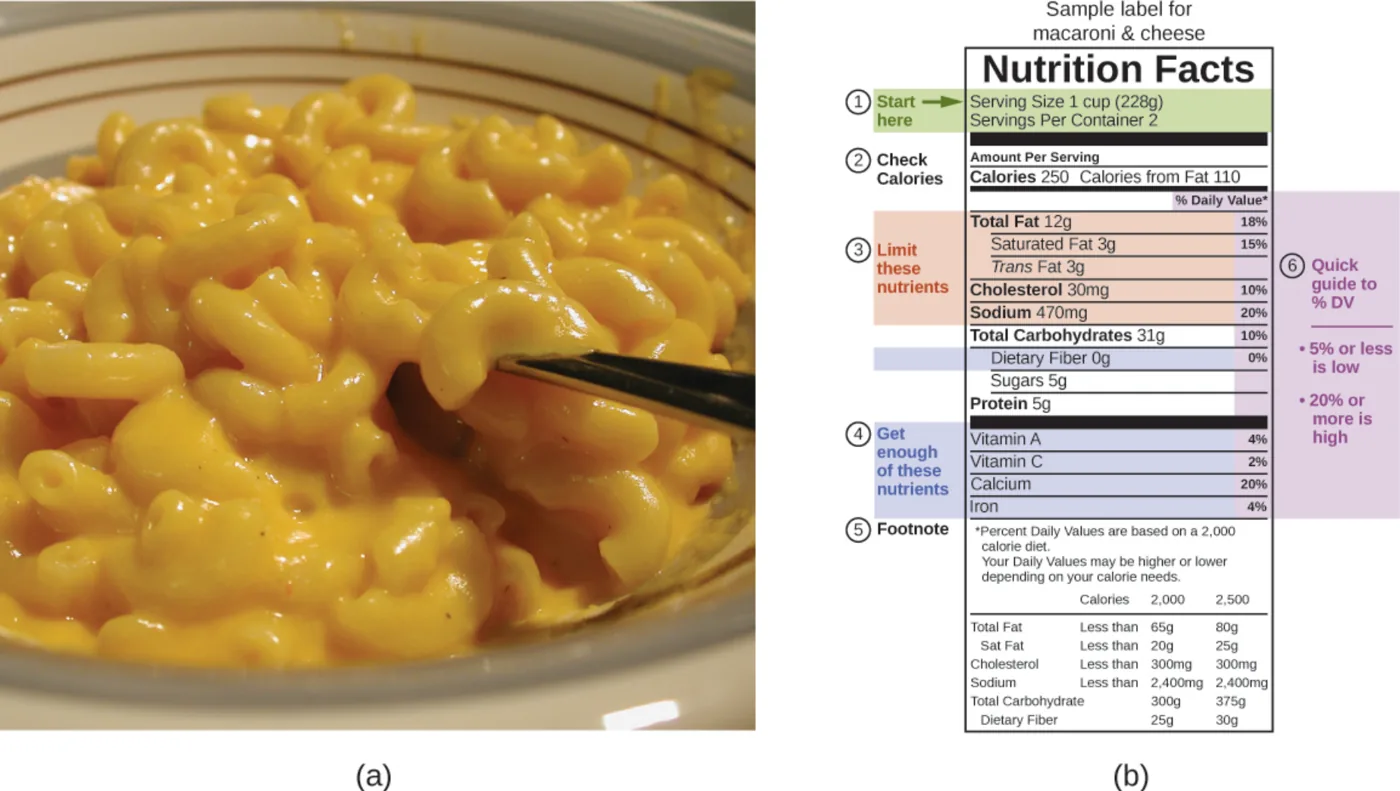
Every food label gives an energy value,
and that value is the chemical energy the food releases when it is burned or broken down in the body.
The energy content of a food can be measured with bomb calorimetry.
A sample is weighed, blended, freeze-dried, ground into a powder and pressed into a pellet.
The pellet is burned inside a bomb calorimeter, and the measured temperature change is converted into energy per gram of food.
Most labels today are not based on burning each food.
1 / 3Next ▶
Energy in food
Energy in food
They use the Atwater system,
which assigns average energy values to the three macronutrients: about 4 Calories per gram for protein, about 4 Calories per gram for carbohydrate and about 9 Calories per gram for fat.
These averages come from many bomb-calorimetry results on whole foods.
Fiber is indigestible carbohydrate
so its contribution is subtracted from the carbohydrate total.
The energy of a food is the sum of the three products: the mass of each macronutrient multiplied by its energy per gram.
The US Department of Agriculture maintains a national nutrient database with energy and nutrient values for more than 8000 foods,
◀ Previous2 / 3Next ▶
Packaged macaroni and cheese lists its energy on the label, because the food stores chemical energy in its fat, protein and carbohydrate. Image: OpenStax, Chemistry 2e, CC BY 4.0.
Energy in food
 ⤢ Enlarge
1
so a value can be looked up rather than measured.
2
A food-label Calorie is a kilocalorie, and one kilocalorie equals 4.184 kJ.
◀ Previous3 / 3
1Thermodynamics and energy transfer2Thermodynamics and energy transfer
Thermodynamics and energy transfer
1
Thermochemistry is the branch of chemical thermodynamics that studies the relationships between heat, work and other forms of energy in chemical and physical processes.
2
A substance acts as a reservoir of energy
so energy can be added to it or removed from it.
3
Energy is stored in a substance when the kinetic energy of its atoms or molecules increases.
4
This extra kinetic energy can appear as faster straight-line motion (translation), faster vibration or faster rotation.
5
When thermal energy is lost, these motions slow down and the kinetic energy falls.
6
The total of all possible kinds of energy in a substance is its internal energy, U (sometimes written E).
1 / 2Next ▶
Thermodynamics and energy transfer
Thermodynamics and energy transfer
When a system changes, its internal energy can change.
Energy enters a system when it absorbs heat, q, from the surroundings, or when the surroundings do work, w, on it.
Energy leaves a system when it loses heat or when it does work on the surroundings.
For example, a room-temperature metal wire warms up if it is placed in hot water
because it absorbs heat.
It also warms up if it is bent back and forth rapidly
because work is done on it.
Both processes raise the internal energy of the wire
which is seen as a higher temperature.
◀ Previous2 / 2
1The first law of thermodynamics2The first law of thermodynamics3The first law of thermodynamics
The first law of thermodynamics
1
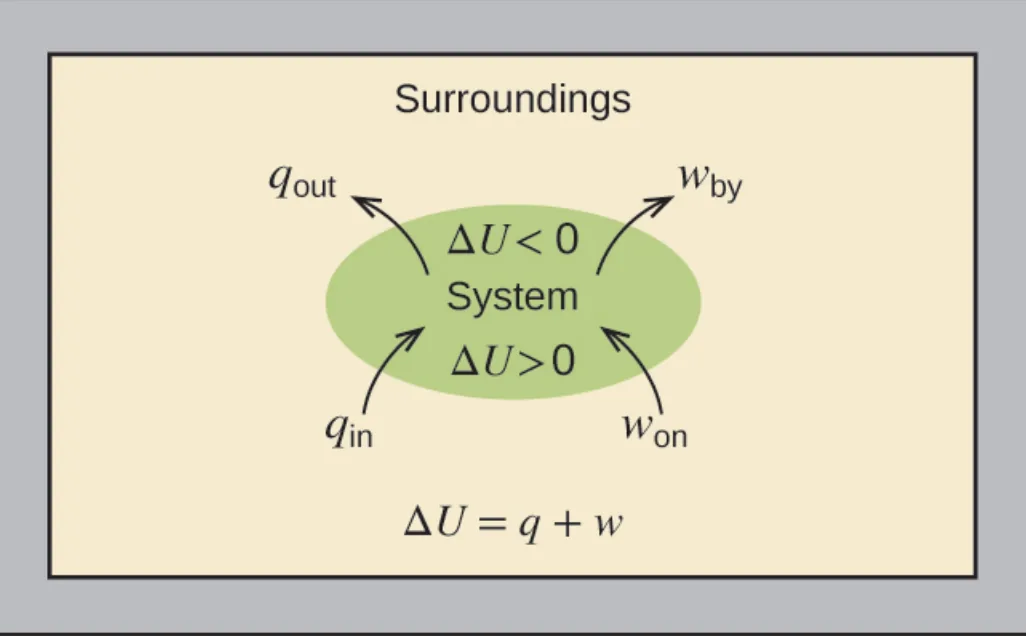
The relationship between internal energy, heat and work is the first law of thermodynamics: ΔU = q + w.
2
The change in internal energy of a system equals the heat added to it plus the work done on it.
3
The sign convention is as follows.
4
Heat is positive when it flows into the system and negative when it flows out.
5
Work is positive when it is done on the system and negative when the system does work on the surroundings.
6
So heat flowing in, or work done on the system, increases U (ΔU is positive).
1 / 3Next ▶
The first law of thermodynamics
The first law of thermodynamics
Heat flowing out, or work done by the system, decreases U (ΔU is negative).
Expansion work, also called pressure-volume work, occurs when a system pushes back its surroundings against a restraining pressure, or when the surroundings compress the system.
An internal combustion engine is an example.
Gasoline reacts with oxygen in an exothermic reaction.
Part of the energy leaves as heat, and part does work by pushing the piston in the cylinder.
The reacting substances are the system, and the engine and the rest of the universe are the surroundings.
◀ Previous2 / 3Next ▶
The internal energy of a system rises when heat flows in or work is done on it, and falls when heat flows out or the system does work. Image: OpenStax, Chemistry 2e, CC BY 4.0.
The first law of thermodynamics
 ⤢ Enlarge
The first law of thermodynamics
The system loses energy both as heat and as work
so its internal energy decreases.
The engine keeps the car moving because this process repeats many times every second while the engine runs.
The link to learning on this topic shows an internal combustion engine. The idea it illustrates is that the energy released by the exothermic burning of a fuel such as gasoline is converted into energy of motion.
◀ Previous3 / 3
1State functions2State functions
State functions
1
Internal energy is a state function
but heat and work are not.
2
The value of a state function depends only on the state a system is in, not on how that state was reached.
3
Altitude is a good example.
4
The summit of Mt.
5
Kilimanjaro is 5895 m above sea level, whether you hiked up or were flown up.
6
The distance you walked, however, is not a state function.
1 / 2Next ▶
Two routes up a mountain end at the same height, although the distances walked along each route are different. Image: OpenStax, Chemistry 2e, CC BY 4.0.
State functions
 ⤢ Enlarge
1
A direct route and a winding route to the same summit give the same altitude but different distances.
2
Because ΔU is a state function, its value depends only on the starting and ending states of a change. Heat and work are not state functions
so each one depends on the path taken. Their sum, q + w, always equals the same ΔU for a given changebecause the path differences cancel in the sum.
◀ Previous2 / 2
1Enthalpy2Enthalpy
Enthalpy
Enthalpy
Chemists usually describe the thermodynamics of chemical and physical processes with enthalpy, H.
Enthalpy is defined as the sum of a system’s internal energy and the product of its pressure and volume: H = U + PV.
Enthalpy is also a state function.
The enthalpy of a specific substance cannot be measured directly.
Only enthalpy changes, ΔH, for a process can be determined.
For a process that takes place at constant pressure
which is the usual condition for chemical and physical changes, the enthalpy change is ΔH = ΔU + PΔV.
1 / 2Next ▶
Enthalpy
1
The product PΔV is the pressure-volume work
but its sign is opposite to the sign of wso w = −PΔV.
2
Substituting this into the first law gives ΔH = qp
where qp is the heat of reaction at constant pressure.
3
So when a process occurs at constant pressure and the only work is expansion or contraction, the heat flow and the enthalpy change are equal.
◀ Previous2 / 2
Constant-pressure heat and enthalpy change
Constant-pressure heat and enthalpy change
The heat released when a Bunsen burner is lit equals the enthalpy change of the methane combustion reaction
because the reaction occurs at the essentially constant pressure of the atmosphere.
In contrast, the heat measured in a bomb calorimeter is not equal to ΔH.
The bomb is a closed, constant-volume metal container
so the pressure cannot stay constant.
The pressure may rise or fall if the reaction produces more or fewer gas molecules.
Chemists usually carry out experiments at normal atmospheric conditions
which means constant external pressure. Under those conditions q = ΔHwhich makes enthalpy the most convenient quantity for describing heat changes in chemical reactions.
Sign conventions for enthalpy change
Sign conventions for enthalpy change
A negative ΔH means the reaction is exothermic: it releases heat to the surroundings.
A positive ΔH means the reaction is endothermic: it absorbs heat from the surroundings.
If a chemical equation is reversed, the sign of its ΔH is changed.
A process that is endothermic in one direction is exothermic in the opposite direction.
Thermochemical equations
1
A thermochemical equation shows both the change in matter and the change in energy. The enthalpy change is written as a ΔH value after the balanced equation, and it applies to the number of moles of reactants and products shown in that equation.
2
Consider hydrogen burning in oxygen to form liquid water: H2(g) + ½O2(g) → H2O(l), ΔH = −285.8 kJ. This means that when 1 mol of hydrogen gas reacts with ½ mol of oxygen gas at a given temperature and pressure to give 1 mol of liquid water at the same temperature and pressure, 285.8 kJ of heat are released to the surroundings.
3
Enthalpy is an extensive property
so ΔH is proportional to the amount of substance. If every coefficient in the equation is multiplied by a factor, the enthalpy change is multiplied by the same factor: 2H2(g) + O2(g) → 2H2O(l), ΔH = −571.6 kJ.
4
The physical states of reactants and products must be shown
because the state changes the enthalpy change.
5
If gaseous water forms instead of liquid water, only 241.8 kJ are released: H2(g) + ½O2(g) → H2O(g), ΔH = −241.8 kJ.
6
The difference, 44.0 kJ, is the heat needed to condense the water vapor to liquid water at this temperature.
1Standard states and standard enthalpy changes2Standard states and standard enthalpy changes
Standard states and standard enthalpy changes
1
Enthalpy changes are usually tabulated for reactions in which the reactants and products are in a standard state.
2
A standard state is a commonly accepted set of conditions used as a reference point for properties under other conditions.
3
For chemists, the IUPAC standard state is a material at a pressure of 1 bar and a solution at a concentration of 1 M, with no temperature specified.
4
Many thermochemical tables instead use 1 atm.
5
Because 1 bar equals 0.987 atm, the ΔH values are essentially the same under both standards, except for the most precisely measured values.
6
A superscript circle marks the standard state
so ΔH°.
1 / 2Next ▶
Standard states and standard enthalpy changes
Standard states and standard enthalpy changes
The usual temperature is 298.15 K (25 °C), and this temperature is assumed unless another one is stated.
The symbol ΔH without the superscript describes an enthalpy change under nonstandard conditions.
Because an enthalpy change is proportional to the amounts involved, it can be reported for the amounts given in a reaction.
It is often more useful to divide the extensive value by the amount of substance and report an intensive value per mole.
This is the same idea as finding the intensive property specific heat from the extensive property heat capacity.
◀ Previous2 / 2
1Standard enthalpy of combustion2Standard enthalpy of combustion
Standard enthalpy of combustion
1
The standard enthalpy of combustion, ΔH°c, is the enthalpy change when 1 mol of a substance burns completely in oxygen under standard-state conditions.
2
It is sometimes called the heat of combustion.
3
For example, the enthalpy of combustion of ethanol is −1366.8 kJ/mol.
4
This is the heat produced when 1 mol of ethanol undergoes complete combustion at 25 °C and 1 atm, with the products also at 25 °C and 1 atm: C2H5OH(l) + 3O2(g) → 2CO2(g) + 3H2O(l).
5
Many substances with large enthalpies of combustion are used as fuels. These include hydrogen, carbon (as coal or charcoal) and hydrocarbons
which are compounds of only hydrogen and carbon, such as methane, propane and the main components of gasoline.
1 / 2Next ▶
Burning gasoline releases a very large amount of heat, so its combustion is strongly exothermic. Image: OpenStax, Chemistry 2e, CC BY 4.0.
Standard enthalpy of combustion
 ⤢ Enlarge
Standard enthalpy of combustion
Standard molar enthalpies of combustion at 25 °C for selected substances:
| Substance | Combustion reaction | ΔH°c (kJ/mol) |
|---|---|---|
| Carbon (graphite) | C(s) + O2(g) → CO2(g) | −393.5 |
| Hydrogen | H2(g) + ½O2(g) → H2O(l) | −285.8 |
| Magnesium | Mg(s) + ½O2(g) → MgO(s) | −601.6 |
| Sulfur | S(s) + O2(g) → SO2(g) | −296.8 |
| Carbon monoxide | CO(g) + ½O2(g) → CO2(g) | −283.0 |
| Methane | CH4(g) + 2O2(g) → CO2(g) + 2H2O(l) | −890.8 |
| Acetylene | C2H2(g) + 2½O2(g) → 2CO2(g) + H2O(l) | −1301.1 |
| Ethanol | C2H5OH(l) + 3O2(g) → 2CO2(g) + 3H2O(l) | −1366.8 |
| Methanol | CH3OH(l) + 1½O2(g) → CO2(g) + 2H2O(l) | −726.1 |
| Isooctane | C8H18(l) + 12½O2(g) → 8CO2(g) + 9H2O(l) | −5465.5 |
◀ Previous2 / 2
1Chemistry in everyday life: algae-based biofuels2Chemistry in everyday life: algae-based biofuels3Chemistry in everyday life: algae-based biofuels4Chemistry in everyday life: algae-based biofuels
Chemistry in everyday life: algae-based biofuels
Chemistry in everyday life: algae-based biofuels
As reserves of fossil fuels shrink and become more costly to extract, the search continues for replacement fuels.
Among the most promising are biofuels made from algae.
The algal species used are nontoxic, biodegradable and among the fastest-growing organisms on Earth.
About half of an alga’s weight is oil
which can be converted readily into fuel such as biodiesel.
Algae can yield about 26,000 gallons of biofuel per hectare
which is much more energy per area than most crops.
Some strains grow in brackish water that cannot be used for other crops.
1 / 4Next ▶
Algae are grown as tiny organisms in large quantities, and the harvested material is turned into a fuel such as biodiesel. Image: OpenStax, Chemistry 2e, CC BY 4.0.
Chemistry in everyday life: algae-based biofuels
 ⤢ Enlarge
1
Algae can be converted into biodiesel, biogasoline, ethanol, butanol, methane and even jet fuel.
2
According to the US Department of Energy, about 39,000 square kilometers
which is roughly 0.4% of US land area, could produce enough algal fuel to replace all of the petroleum-based fuel used in the US.
3
That is a small fraction of the area used to grow corn.
4
The cost is becoming competitive: the US Air Force produces jet fuel from algae at a total cost of under $5 per gallon.
5
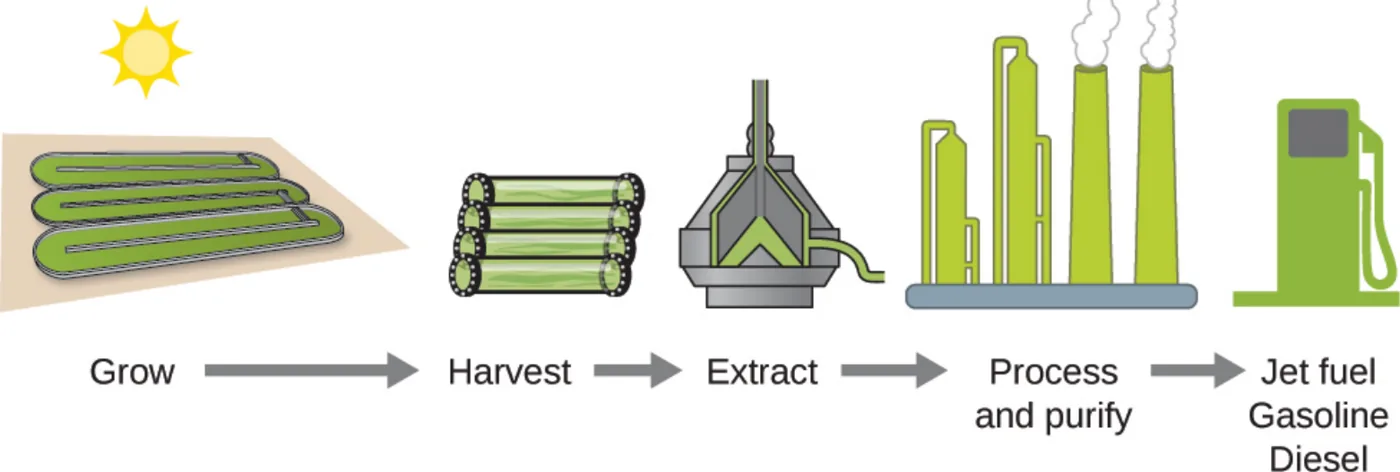
The process has five stages.
6
First, the algae are grown, using sunlight as their energy source and CO2 as a raw material.
◀ Previous2 / 4Next ▶
Chemistry in everyday life: algae-based biofuels
1
Second, they are harvested.
2
Third, the fuel compounds, or their precursors, are extracted.
3
Fourth, the material is processed as needed
for example, a transesterification reaction converts the oil into biodiesel.
4
Fifth, the fuel is purified and distributed.
5
The link to learning on this topic describes how algae biofuel is made
which is the same five-stage process.
◀ Previous3 / 4Next ▶
Algae use sunlight and carbon dioxide to make oil. The oil is harvested, extracted, purified and converted into several renewable fuels. Image: OpenStax, Chemistry 2e, CC BY 4.0.
Chemistry in everyday life: algae-based biofuels
◀ Previous4 / 4
1Standard enthalpy of formation2Standard enthalpy of formation
Standard enthalpy of formation
1
The standard enthalpy of formation, ΔH°f, is the enthalpy change for a reaction in which exactly 1 mol of a pure substance is formed from its elements in their most stable states under standard-state conditions.
2
These values are especially useful for predicting enthalpy changes of reactions that are impractical or dangerous to carry out,
or that are difficult to measure directly.
3
If the standard enthalpies of formation of all the species in a reaction are known, the enthalpy change for that reaction can be found,
as explained in the section on Hess’s law below.
4
The standard enthalpy of formation of CO2(g) is −393.5 kJ/mol.
5
This is the enthalpy change for C(graphite) + O2(g) → CO2(g), with the carbon in graphite form,
which is the most stable form of carbon under these conditions.
6
The reactants start at 1 atm and 25 °C, and the product ends at 1 atm and 25 °C.
1 / 2Next ▶
Standard enthalpy of formation
Standard enthalpy of formation
For nitrogen dioxide, ΔH°f = +33.2 kJ/mol, for the reaction ½N2(g) + O2(g) → NO2(g).
The equation uses ½ mol of N2 because the standard enthalpy of formation always refers to 1 mol of product.
Formation reactions range from strongly exothermic to strongly endothermic.
For example, the formation of P4O10 has ΔH°f = −2984 kJ/mol
while the formation of acetylene, C2H2, has ΔH°f = +226.7 kJ/mol.
By definition, the standard enthalpy of formation of an element in its most stable form is zero under standard conditions,
which means 1 atm for gases and 1 M for solutions.
Values for many common substances are tabulated in the reference appendix of the book.
◀ Previous2 / 2
1Hess’s law2Hess’s law3Hess’s law4Hess’s law
Hess’s law
Hess’s law
There are two ways to find the heat involved in a chemical change.
It can be measured experimentally, or it can be calculated from other experimentally determined enthalpy changes.
Some reactions are difficult or impossible to study directly, and even when a reaction is easy to measure, calculation avoids an experiment.
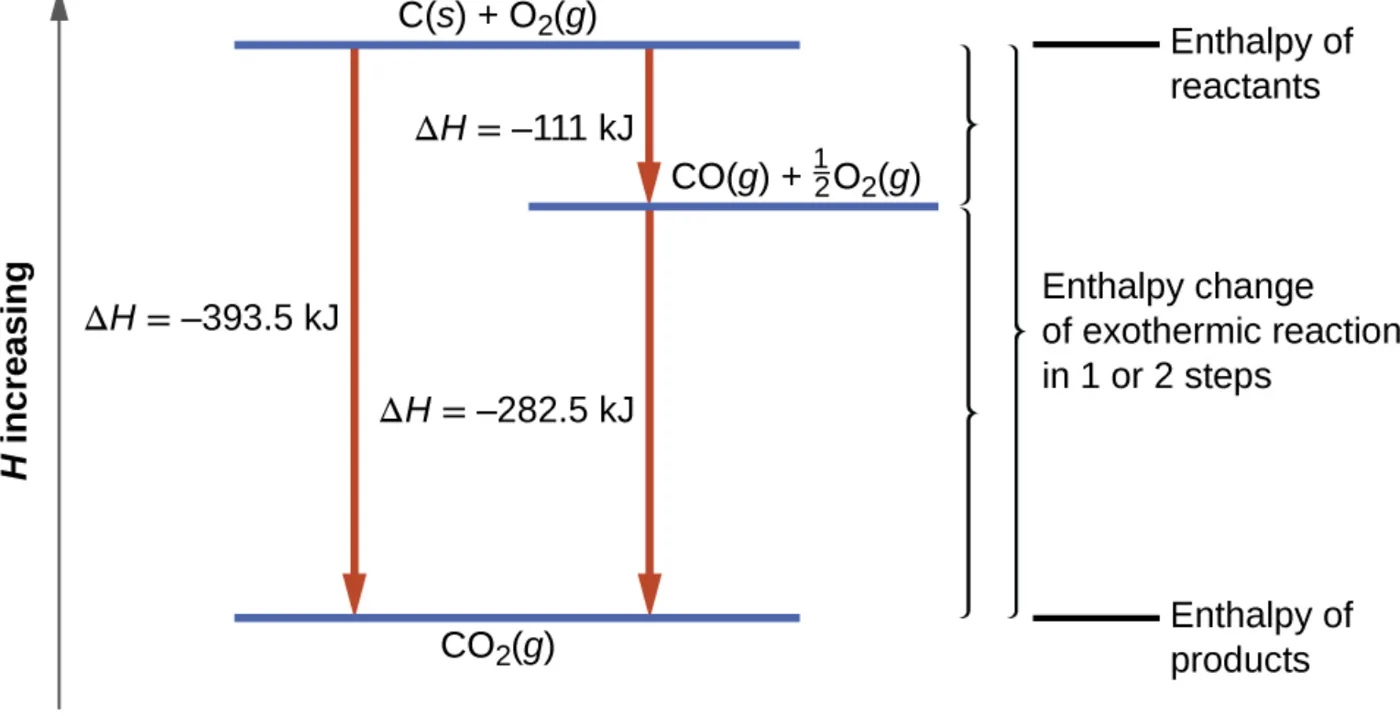
Calculation usually relies on Hess’s law: if a process can be written as the sum of several stepwise processes, the enthalpy change of the overall process equals the sum of the enthalpy changes of the steps.
Hess’s law works because enthalpy is a state function.
The enthalpy change depends only on where a process starts and ends, not on the path between them.
1 / 4Next ▶
Hess’s law
1
For example, carbon can react with oxygen to form carbon dioxide directly: C(s) + O2(g) → CO2(g), ΔH = −393.5 kJ.
2
Alternatively, it can react in two steps.
3
In step 1, carbon forms carbon monoxide: C(s) + ½O2(g) → CO(g), ΔH = −110.5 kJ.
4
In step 2, the carbon monoxide reacts further: CO(g) + ½O2(g) → CO2(g), ΔH = −283.0 kJ.
5
The CO made in step 1 is used up in step 2
so the two steps add up to the direct reaction.
6
Their enthalpy changes also add up: −110.5 kJ + (−283.0 kJ) = −393.5 kJ, the same as the direct route.
◀ Previous2 / 4Next ▶
The formation of carbon dioxide has the same overall enthalpy change whether it happens in one step or in two, because enthalpy depends only on the start and end states. Image: OpenStax, Chemistry 2e, CC BY 4.0.
Hess’s law
 ⤢ Enlarge
1
This is true in general for chemical and physical processes.
2
Two features of ΔH are needed to apply Hess’s law.
3
First, ΔH is directly proportional to the amounts of reactants or products.
4
For example, ½N2(g) + O2(g) → NO2(g) has ΔH = +33.2 kJ.
5
Forming 2 mol of NO2 has twice the enthalpy change, +66.4 kJ.
6
In general, if an equation is multiplied or divided by a number, its ΔH is multiplied or divided by the same number.
◀ Previous3 / 4Next ▶
Hess’s law
Hess’s law
Second, the enthalpy change for a reaction in one direction is equal in size and opposite in sign to the enthalpy change for the reverse reaction.
So NO2(g) → ½N2(g) + O2(g) has ΔH = −33.2 kJ.
◀ Previous4 / 4
1Calculating enthalpy change from enthalpies of formation2Calculating enthalpy change from enthalpies of formation3Calculating enthalpy change from enthalpies of formation
Calculating enthalpy change from enthalpies of formation
1
The enthalpy change of any reaction can be found from the standard enthalpies of formation of its reactants and products.
2
Imagine the reaction in two stages.
3
In the first stage, each reactant is decomposed into its elements.
4
The enthalpy change for this stage is the negative of the reactant’s enthalpy of formation.
5
In the second stage, the elements are recombined into the products.
6
The enthalpy change for this stage is the enthalpy of formation of each product.
1 / 3Next ▶
Calculating enthalpy change from enthalpies of formation
Calculating enthalpy change from enthalpies of formation
Adding the two stages gives the standard enthalpy change of the reaction:
ΔH°rxn = Σ n ΔH°f(products) − Σ n ΔH°f(reactants)
In this equation, Σ means “the sum of” and n is the stoichiometric coefficient of each species.
To use it, multiply each enthalpy of formation by its coefficient and add the products’ values.
Do the same for the reactants.
Then subtract the reactants’ total from the products’ total.
◀ Previous2 / 3Next ▶
Calculating enthalpy change from enthalpies of formation
Calculating enthalpy change from enthalpies of formation
The steps are valid because the enthalpy change depends only on the starting and ending states.
◀ Previous3 / 3
1Example 5.8: Writing a thermochemical equation from a measur2Example 5.8: Writing a thermochemical equation from a measur3Example 5.9: Thermochemical equation when reactants are not 4Example 5.9: Thermochemical equation when reactants are not 5Example 5.10: Using an enthalpy of combustion6Example 5.11: Evaluating an enthalpy of formation7Example 5.12: Writing formation reaction equations8Example 5.12: Writing formation reaction equations9Example 5.13: Stepwise calculation of an enthalpy of formati10Example 5.14: A more challenging Hess’s law problem11Example 5.14: A more challenging Hess’s law problem12Example 5.15: Using Hess’s law with enthalpies of formation
Example 5.8: Writing a thermochemical equation from a measured heat
1
Problem. When 0.0500 mol of HCl(aq) reacts with 0.0500 mol of NaOH(aq) to form 0.0500 mol of NaCl(aq), 2.9 kJ of heat are produced. Write a balanced thermochemical equation for the reaction of one mole of HCl.
2
Working. For the 0.0500 mol of acid, q = −2.9 kJ. The reactants are in the same molar ratio as the balanced equation, 1:1
so the amount of acid can be used directly. Since ΔH is extensive, the enthalpy change per mole is ΔH = (−2.9 kJ) ÷ (0.0500 mol) = −58 kJ/mol.
3
Answer. HCl(aq) + NaOH(aq) → NaCl(aq) + H2O(l), ΔH = −58 kJ.
4
Check Your Learning. When 1.34 g of Zn(s) reacts with 60.0 mL of 0.750 M HCl(aq), 3.14 kJ of heat are produced.
5
Find the enthalpy change per mole of zinc for Zn(s) + 2HCl(aq) → ZnCl2(aq) + H2(g). Answer: Moles of Zn = 1.34 g ÷ 65.38 g/mol = 0.0205 mol.
6
Moles of HCl = 0.0600 L × 0.750 mol/L = 0.0450 mol.
1 / 12Next ▶
Example 5.8: Writing a thermochemical equation from a measured heat
Example 5.8: Writing a thermochemical equation from a measured heat
Two moles of HCl are needed per mole of Zn,
so 0.0410 mol HCl is required; the HCl is in excess and Zn is the limiting reactant. ΔH = −3.14 kJ ÷ 0.0205 mol = −153 kJ/mol.
◀ Previous2 / 12Next ▶
Example 5.9: Thermochemical equation when reactants are not in stoichiometric amounts
Example 5.9: Thermochemical equation when reactants are not in stoichiometric amounts
Problem. A gummy bear contains 2.67 g of sucrose, C12H22O11. When it reacts with 7.19 g of potassium chlorate, KClO3, 43.7 kJ of heat are produced. Write a thermochemical equation for the reaction of one mole of sucrose.
Working. Moles of sucrose = 2.67 g ÷ 342.3 g/mol = 0.00780 mol.
Moles of KClO3 = 7.19 g ÷ 122.55 g/mol = 0.0587 mol.
The balanced equation is C12H22O11 + 8KClO3 → 12CO2 + 11H2O + 8KCl
so 8 mol of KClO3 are needed per mole of sucrose.
The provided ratio is 0.0587 ÷ 0.00780 = 7.5 mol KClO3 per mole of sucrose
which is less than 8.So KClO3 is the limiting reactant and sets the amount of heat.
The heat for the amounts in the equation is 43.7 kJ × (8 ÷ 0.0587) ≈ 5960 kJ.
◀ Previous3 / 12Next ▶
Example 5.9: Thermochemical equation when reactants are not in stoichiometric amounts
1
Answer. Because the equation as written represents 8 mol of KClO3, the enthalpy change is −5960 kJ: C12H22O11(s) + 8KClO3(s) → 12CO2(g) + 11H2O(g) + 8KCl(s), ΔH = −5960 kJ.
2
Check Your Learning. Iron (1.42 g) reacts with chlorine (1.80 g) to form 3.22 g of FeCl2(s), and 8.60 kJ of heat are produced. What is the enthalpy change when 1 mol of FeCl2(s) is produced? Answer: Moles of FeCl2 = 3.22 g ÷ 126.75 g/mol = 0.0254 mol. ΔH = −8.60 kJ ÷ 0.0254 mol ≈ −338 kJ/mol.
◀ Previous4 / 12Next ▶
Example 5.10: Using an enthalpy of combustion
Example 5.10: Using an enthalpy of combustion
Problem. Estimate the heat produced by burning 1.00 L of gasoline, assuming its enthalpy of combustion is the same as that of isooctane, C8H18, a common gasoline component. The density of isooctane is 0.692 g/mL.
Working. Mass = 1000 mL × 0.692 g/mL = 692 g. Molar mass of C8H18 = 114.23 g/mol
so moles = 692 g ÷ 114.23 g/mol = 6.058 mol. Heat = 6.058 mol × (−5465.5 kJ/mol) = −3.31 × 10⁴ kJ.
Answer. Burning 1.00 L of isooctane releases about 33,100 kJ of heat. This is enough to melt about 99 kg of ice, since melting ice needs 334 kJ/kg.
Check Your Learning. How much heat is produced by burning 125 g of acetylene, C2H2? Answer: Molar mass of C2H2 = 26.04 g/mol
so moles = 125 g ÷ 26.04 g/mol = 4.80 mol. Heat = 4.80 mol × 1301.1 kJ/mol = 6.25 × 10³ kJ.
◀ Previous5 / 12Next ▶
Example 5.11: Evaluating an enthalpy of formation
Example 5.11: Evaluating an enthalpy of formation
Problem. Ozone, O3(g), forms from oxygen by an endothermic process driven by ultraviolet radiation in the upper atmosphere. Assuming the reactants and products are in their standard states, find the standard enthalpy of formation of O3(g) from the reaction 3O2(g) → 2O3(g), ΔH° = +285.4 kJ.
Working. The standard enthalpy of formation is the enthalpy change for forming 1 mol of a substance in its standard state from the elements in their standard states. The equation given forms 2 mol of O3
so the ratio 285.4 kJ ÷ 2 mol = 142.7 kJ/mol can be used as a conversion factor for 1 mol.
Answer. The equation for forming 1 mol of ozone is 1½O2(g) → O3(g)
so ΔH°f of O3(g) = +142.7 kJ/mol.
Check Your Learning. Hydrogen gas reacts explosively with chlorine gas to form HCl(g): H2(g) + Cl2(g) → 2HCl(g). What is the enthalpy change for 1 mol of H2 reacting with 1 mol of Cl2, if the standard enthalpy of formation of HCl(g) is −92.3 kJ/mol? Answer: Two moles of HCl form
so ΔH = 2 × (−92.3 kJ) = −184.6 kJ.
◀ Previous6 / 12Next ▶
Example 5.12: Writing formation reaction equations
1
Problem. Write the formation reaction equations for (a) C2H5OH(l) and (b) Ca3(PO4)2(s).
2
Working. A formation equation forms exactly 1 mol of the compound from its elements in their standard states. Carbon is written as graphite, and phosphorus is written as P4.
3
Answer. (a) 2C(graphite) + 3H2(g) + ½O2(g) → C2H5OH(l).
4
Check: 2 C, 6 H and 1 O on each side.
5
(b) 3Ca(s) + ½P4(s) + 4O2(g) → Ca3(PO4)2(s).
6
Check: 3 Ca, 2 P (from ½P4) and 8 O on each side.
◀ Previous7 / 12Next ▶
Example 5.12: Writing formation reaction equations
Example 5.12: Writing formation reaction equations
Check Your Learning. Write the formation reaction equations for (a) diethyl ether, C2H5OC2H5(l), and (b) Na2CO3(s). Answer: (a) 4C(graphite) + 5H2(g) + ½O2(g) → C2H5OC2H5(l). (b) 2Na(s) + C(graphite) + 1½O2(g) → Na2CO3(s).
◀ Previous8 / 12Next ▶
Example 5.13: Stepwise calculation of an enthalpy of formation using Hess’s law
Example 5.13: Stepwise calculation of an enthalpy of formation using Hess’s law
Problem. Determine the standard enthalpy of formation of FeCl3(s)
which is the ΔH° for Fe(s) + 1½Cl2(g) → FeCl3(s), from this two-step process under standard-state conditions: Fe(s) + Cl2(g) → FeCl2(s), ΔH° = −341.8 kJand FeCl2(s) + ½Cl2(g) → FeCl3(s), ΔH° = −57.7 kJ.
Working. The target reaction is the sum of the two steps
so the enthalpy changes are added: −341.8 kJ + (−57.7 kJ) = −399.5 kJ.
Answer. The standard enthalpy of formation of FeCl3(s) is −399.5 kJ/mol.
Check Your Learning. Using the steps C(graphite) + O2(g) → CO2(g), ΔH° = −393.5 kJ, and S(s) + O2(g) → SO2(g), ΔH° = −296.8 kJ, together with 2SO2(g) + O2(g) → 2SO3(g), ΔH° = −198.4 kJ, calculate ΔH° for S(s) + 1½O2(g) → SO3(g). Answer: Halve the third equation: SO2(g) + ½O2(g) → SO3(g), ΔH° = −99.2 kJ. Add it to the second step: −296.8 + (−99.2) = −396.0 kJ.
◀ Previous9 / 12Next ▶
Example 5.14: A more challenging Hess’s law problem
1
Problem. Find ΔH° for 2C(s) + O2(g) → 2CO(g), given: C(s) + O2(g) → CO2(g), ΔH° = −393.5 kJ
and 2CO(g) + O2(g) → 2CO2(g), ΔH° = −566.0 kJ.
2
Working. Our goal is to combine the given reactions so that they add up to the target.
3
Start with the first reaction multiplied by 2
which means its ΔH° is also doubled: 2C(s) + 2O2(g) → 2CO2(g), ΔH° = −787.0 kJ.
4
Then reverse the second reaction
which changes the sign of its ΔH°: 2CO2(g) → 2CO(g) + O2(g), ΔH° = +566.0 kJ.
5
Adding the two modified reactions, 2CO2 and one O2 cancel, and the remaining reactants and products are 2C(s) + O2(g) → 2CO(g).
6
Summing the ΔH° values gives the target value.
◀ Previous10 / 12Next ▶
Example 5.14: A more challenging Hess’s law problem
Example 5.14: A more challenging Hess’s law problem
Answer. ΔH° = −787.0 kJ + 566.0 kJ = −221.0 kJ.
Check Your Learning. Using only the enthalpy of formation of CO2(g), −393.5 kJ/mol, and of CO(g), −110.5 kJ/mol, calculate ΔH° for CO(g) + ½O2(g) → CO2(g). Answer: ΔH° = −393.5 kJ − (−110.5 kJ) = −283.0 kJ.
◀ Previous11 / 12Next ▶
Example 5.15: Using Hess’s law with enthalpies of formation
Example 5.15: Using Hess’s law with enthalpies of formation
Problem. What is the standard enthalpy change for the reaction 3NO2(g) + H2O(l) → 2HNO3(aq) + NO(g)?
Working. Use the enthalpies of formation: NO2(g) = +33.2 kJ/mol
H2O(l) = −285.8 kJ/molHNO3(aq) = −207.4 kJ/molNO(g) = +90.3 kJ/mol. Products: 2 × (−207.4) + 1 × (+90.3) = −324.5 kJ. Reactants: 3 × (+33.2) + 1 × (−285.8) = −186.2 kJ. ΔH° = −324.5 kJ − (−186.2 kJ) = −138.3 kJ.
Answer. ΔH° ≈ −138 kJ. With more precise tabulated values the book quotes −138.4 kJ
the difference is rounding only. This is found by summing the products’ enthalpies of formation multiplied by their coefficients, summing the reactants’ values multiplied by their coefficientsand then subtracting.
Check Your Learning. Calculate the heat of combustion of 1 mol of ethanol, C2H5OH(l), when H2O(l) and CO2(g) form, using ΔH°f values of −278 kJ/mol for C2H5OH(l), −286 kJ/mol for H2O(l) and −394 kJ/mol for CO2(g). Answer: C2H5OH(l) + 3O2(g) → 2CO2(g) + 3H2O(l). ΔH° = [2(−394) + 3(−286)] − [(−278)] = −1646 + 278 = −1368 kJ/mol.
◀ Previous12 / 12
Key terms
| Term | Meaning |
|---|---|
| Thermochemistry | The branch of chemical thermodynamics that studies heat, work and other forms of energy in chemical and physical processes. |
| Internal energy (U) | The total of all possible kinds of energy present in a substance, including the kinetic energy of its particles. |
| Heat (q) | Energy that flows between a system and its surroundings because of a temperature difference. |
| Work (w) | Energy transferred when a force moves an object, here including pressure-volume work done on or by a system. |
| First law of thermodynamics | The statement that the change in internal energy of a system equals the heat added plus the work done on it: ΔU = q + w. |
| Expansion work (pressure-volume work) | Work done when a system expands against a restraining pressure, or when it is compressed by its surroundings. |
| State function | A property whose value depends only on the current state of a system, not on the path used to reach that state. |
| Enthalpy (H) | A state function defined as H = U + PV, which is useful for describing heat changes at constant pressure. |
| Enthalpy change (ΔH) | The heat absorbed or released by a process at constant pressure, equal to qp. |
| Exothermic process | A process that releases heat to its surroundings, so its ΔH is negative. |
| Endothermic process | A process that absorbs heat from its surroundings, so its ΔH is positive. |
| Thermochemical equation | A balanced chemical equation followed by the enthalpy change for the amounts of substances shown in the equation. |
| Extensive property | A property whose value is proportional to the amount of substance, such as enthalpy. |
| Standard state | A commonly accepted reference set of conditions, such as 1 bar for gases and 1 M for solutions. |
| Standard enthalpy of combustion (ΔH°c) | The enthalpy change when 1 mol of a substance burns completely in oxygen under standard-state conditions. |
| Standard enthalpy of formation (ΔH°f) | The enthalpy change when 1 mol of a pure substance forms from its elements in their most stable states under standard-state conditions. |
| Hess’s law | The rule that the enthalpy change of an overall process equals the sum of the enthalpy changes of its steps. |
| Bomb calorimetry | A method of measuring the heat of a reaction at constant volume, by burning a sample in a sealed metal container. |
1Avoid these mistakes2Avoid these mistakes3Avoid these mistakes4Avoid these mistakes
Avoid these mistakes
1Avoid this
Forgetting to change the sign of ΔH when a thermochemical equation is reversed.Avoid this
2Avoid this
Failing to multiply ΔH by the same factor when the coefficients of an equation are doubled, halved or otherwise scaled.Avoid this
3Avoid this
Using the ΔH value of liquid water for a reaction that forms gaseous water, or ignoring the physical states entirely.Avoid this
1 / 4Next ▶
Avoid these mistakes
4Avoid this
Dividing a measured heat by the moles of the wrong substance,Avoid this
or using the amount of an excess reactant instead of the limiting reactant when finding ΔH per mole.Avoid this
5Avoid this
Assuming that every element has a standard enthalpy of formation of zero.Avoid this
Only the element in its most stable form at standard conditions has zero; for example, O3(g) has a nonzero value.Avoid this
◀ Previous2 / 4Next ▶
Avoid these mistakes
6Avoid this
Reversing the order of subtraction in ΔH°Avoid this
rxnAvoid this
= Σ n ΔH°Avoid this
fAvoid this
(products) − Σ n ΔH°Avoid this
◀ Previous3 / 4Next ▶
Avoid these mistakes
(reactants), or forgetting to multiply each ΔH°Avoid this
by its coefficient.Avoid this
◀ Previous4 / 4