Curriculum
Chemistry 2e
Unit 1
0/7
Unit 2
0/8Unit 3
0/5Unit 4
0/6Unit 5
0/4Unit 6
0/6Unit 7
0/7Unit 8
0/5Unit 9
0/111.1Unit 9 overview: Gases9.1Gas Pressure9.2Relating Pressure, Volume, Amount, and Temperature: The Ideal Gas Law9.3Stoichiometry of Gaseous Substances, Mixtures, and Reactions9.3Stoichiometry of Gaseous Substances, Mixtures, and Reactions9.4Effusion and Diffusion of Gases9.4Effusion and Diffusion of Gases9.5The Kinetic-Molecular Theory9.5The Kinetic-Molecular Theory9.6Non-Ideal Gas Behavior9.6Non-Ideal Gas Behavior
Unit 10
0/141.1Unit 10 overview: Liquids and Solids10.1Intermolecular Forces1.3Unit 10 overview: Liquids and Solids10.1Intermolecular Forces10.2Properties of Liquids10.2Properties of Liquids10.3Phase Transitions10.3Phase Transitions10.4Phase Diagrams10.4Phase Diagrams10.5The Solid State of Matter10.5The Solid State of Matter10.6Lattice Structures in Crystalline Solids10.6Lattice Structures in Crystalline Solids
Unit 11
0/12Unit 12
0/161.1Unit 12 overview: Kinetics12.1Chemical Reaction Rates1.3Unit 12 overview: Kinetics12.1Chemical Reaction Rates12.2Factors Affecting Reaction Rates12.2Factors Affecting Reaction Rates12.3Rate Laws12.3Rate Laws12.4Integrated Rate Laws12.4Integrated Rate Laws12.5Collision Theory12.5Collision Theory12.6Reaction Mechanisms12.6Reaction Mechanisms12.7Catalysis12.7Catalysis
Unit 13
0/101.1Unit 13 overview: Fundamental Equilibrium Concepts13.1Chemical Equilibria13.1Chemical Equilibria13.2Equilibrium Constants13.2Equilibrium Constants1.6Unit 13 overview: Fundamental Equilibrium Concepts13.3Shifting Equilibria: Le Châtelier’s Principle13.3Shifting Equilibria: Le Châtelier’s Principle13.4Equilibrium Calculations13.4Equilibrium Calculations
Unit 14
0/161.1Unit 14 overview: Acid-Base Equilibria14.1Brønsted-Lowry Acids and Bases14.1Brønsted-Lowry Acids and Bases14.2pH and pOH14.2pH and pOH14.3Relative Strengths of Acids and Bases14.3Relative Strengths of Acids and Bases14.4Hydrolysis of Salts1.9Unit 14 overview: Acid-Base Equilibria14.4Hydrolysis of Salts14.5Polyprotic Acids14.5Polyprotic Acids14.6Buffers14.6Buffers14.7Acid-Base Titrations14.7Acid-Base Titrations
Unit 15
0/8Unit 16
0/10Unit 17
0/161.1Unit 17 overview: Electrochemistry17.1Review of Redox Chemistry17.1Review of Redox Chemistry17.2Galvanic Cells17.2Galvanic Cells17.3Electrode and Cell Potentials17.3Electrode and Cell Potentials17.4Potential, Free Energy, and Equilibrium1.9Unit 17 overview: Electrochemistry17.4Potential, Free Energy, and Equilibrium17.5Batteries and Fuel Cells17.5Batteries and Fuel Cells17.6Corrosion17.6Corrosion17.7Electrolysis17.7Electrolysis
Unit 18
0/261.1Unit 18 overview: Representative Metals, Metalloids, and Nonmetals18.1Periodicity18.1Periodicity18.2Occurrence and Preparation of the Representative Metals18.2Occurrence and Preparation of the Representative Metals18.3Structure and General Properties of the Metalloids18.3Structure and General Properties of the Metalloids18.4Structure and General Properties of the Nonmetals18.4Structure and General Properties of the Nonmetals18.5Occurrence, Preparation, and Compounds of Hydrogen18.5Occurrence, Preparation, and Compounds of Hydrogen18.6Occurrence, Preparation, and Properties of Carbonates18.6Occurrence, Preparation, and Properties of Carbonates1.14Unit 18 overview: Representative Metals, Metalloids, and Nonmetals18.7Occurrence, Preparation, and Properties of Nitrogen18.7Occurrence, Preparation, and Properties of Nitrogen18.8Occurrence, Preparation, and Properties of Phosphorus18.8Occurrence, Preparation, and Properties of Phosphorus18.9Occurrence, Preparation, and Compounds of Oxygen18.9Occurrence, Preparation, and Compounds of Oxygen18.10Occurrence, Preparation, and Properties of Sulfur18.10Occurrence, Preparation, and Properties of Sulfur18.11Occurrence, Preparation, and Properties of Halogens18.11Occurrence, Preparation, and Properties of Halogens18.12Occurrence, Preparation, and Properties of the Noble Gases18.12Occurrence, Preparation, and Properties of the Noble Gases
Unit 19
0/81.1Unit 19 overview: Transition Metals and Coordination Chemistry19.1Occurrence, Preparation, and Properties of Transition Metals and Their Compounds19.1Occurrence, Preparation, and Properties of Transition Metals and Their Compounds19.2Coordination Chemistry of Transition Metals1.5Unit 19 overview: Transition Metals and Coordination Chemistry19.2Coordination Chemistry of Transition Metals19.3Spectroscopic and Magnetic Properties of Coordination Compounds19.3Spectroscopic and Magnetic Properties of Coordination Compounds
Unit 20
0/101.1Unit 20 overview: Organic Chemistry20.1Hydrocarbons20.1Hydrocarbons20.2Alcohols and Ethers20.2Alcohols and Ethers1.6Unit 20 overview: Organic Chemistry20.3Aldehydes, Ketones, Carboxylic Acids, and Esters20.3Aldehydes, Ketones, Carboxylic Acids, and Esters20.4Amines and Amides20.4Amines and Amides
Unit 21
0/141.1Unit 21 overview: Nuclear Chemistry21.1Nuclear Structure and Stability21.1Nuclear Structure and Stability21.2Nuclear Equations21.2Nuclear Equations21.3Radioactive Decay21.3Radioactive Decay1.8Unit 21 overview: Nuclear Chemistry21.4Transmutation and Nuclear Energy21.4Transmutation and Nuclear Energy21.5Uses of Radioisotopes21.5Uses of Radioisotopes21.6Biological Effects of Radiation21.6Biological Effects of Radiation
Text lesson
17.7 Electrolysis
Electrolysis
17.7 What electrolysis is
What electrolysis is
What electrolysis is
What electrolysis is
- Galvanic cells run on spontaneous redox reactions. The reaction does electrical work on the surroundings
- because electrons produced by the reaction travel through an external circuit.
- Electrolysis is the opposite situation.
- An external circuit does work on a redox system by imposing a voltage large enough to drive a reaction that is not spontaneous.
- Recharging a battery is a familiar example of electrolysis.
- An external power source forces the discharge reaction to run in reverse,
- which partly restores the composition of the half-cells and the voltage of the battery.
- Electrolysis is also used to refine metal ores, to manufacture commodity chemicals,
- and to electroplate metal coatings onto products such as jewelry, utensils and auto parts.
- The sections below illustrate the key ideas with four processes.
17.7 Electrolysis · 1 / 9
17.7 Electrolysis of molten sodium chloride
Electrolysis of molten sodium chloride
- Electrolysis of molten sodium chloride3Electrolysis of molten sodium chloride4Electrolysis of molten sodium chloride
- Electrolysis of molten sodium chloride
- Electrolysis of molten sodium chloride
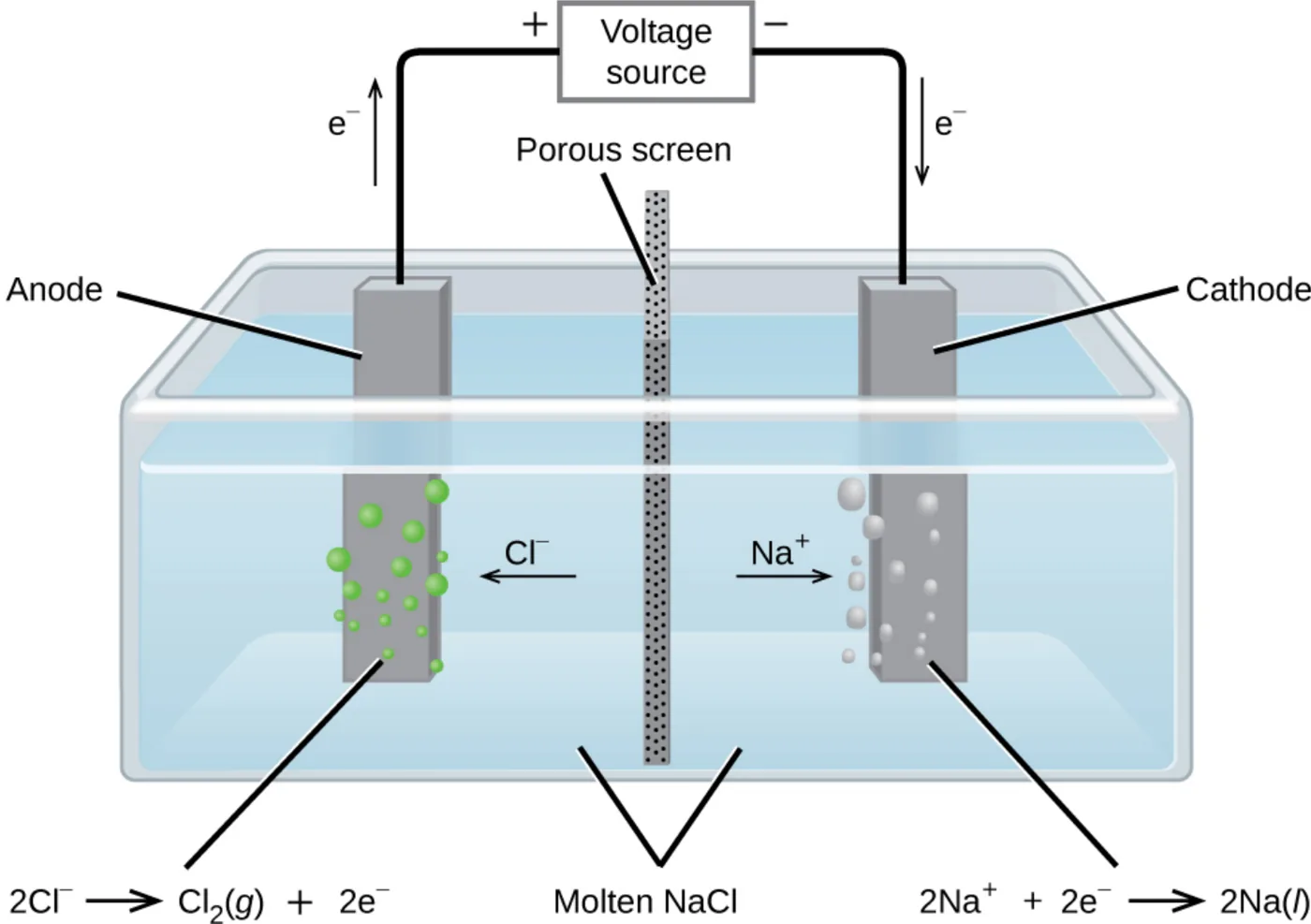
- Metallic sodium and chlorine gas are made on a large scale by electrolysis of molten sodium chloride, NaCl(l).
- The industrial process typically uses a Downs cell, shown in the diagram below.
- The two electrode reactions are:
- 1 / 4Next ▶
- Electrolysis of molten sodium chloride
- Electrolysis of molten sodium chloride
- 2Na
- +
- + 2e
- −
- → 2Na(l)
- 2Cl
- ◀ Previous, 2 / 4Next ▶
- Electrolysis of molten sodium chloride
- Electrolysis of molten sodium chloride
- → Cl
- (g) + 2e
- Adding them gives the overall reaction 2NaCl(l) → 2Na(l) + Cl2(g).
- The standard cell potential for this decomposition is negative, about −4.07 V, using the standard reduction potentials of Na+ (−2.71 V) and Cl2 (+1.36 V).
- A negative potential means the reaction is not spontaneous as written.
- ◀ Previous, 3 / 4Next ▶
- A Downs cell with molten sodium chloride between a carbon anode, where chloride ions become chlorine gas, and an iron cathode, where sodium ions become liquid sodium.
- A porous screen keeps the products apart.
- Image: OpenStax, Chemistry 2e, CC BY 4.0.
- Electrolysis of molten sodium chloride
- ⤢ Enlarge
- To force it, you must apply a positive cell voltage whose magnitude is greater than the magnitude of the negative cell potential.
- 2Sodium ions move toward the cathode
- where they gain electrons and form liquid sodium.
- Chloride ions move toward the anode, where they lose electrons and form chlorine gas.
- A porous screen separates the two products.
- ◀ Previous, 4 / 4
17.7 Electrolysis · 2 / 9
17.7 Electrolysis of water
Electrolysis of water

- Electrolysis of water3Electrolysis of water4Electrolysis of water
- Electrolysis of water
- Electrolysis of water
- Water can be decomposed electrolytically in a cell like the one shown below. Pure water conducts electricity poorly
- so the hydrogen ion concentration is raised by adding a strong acid.
- This improves conductivity without introducing a different redox-active species.
- The half-reactions are:
- 1 / 4Next ▶
- Electrolysis of water
- Electrolysis of water
- 2H
- O(l) → O
- (g) + 4H
- +
- (aq) + 4e
- ◀ Previous, 2 / 4Next ▶
- Electrolysis of water
- −
- 4H
- → 2H
- (g)
- The overall reaction is 2H2O(l) → 2H2(g) + O2(g).
- 6The cell potential as written is −1.229 V
- so the reaction is nonspontaneous and a cell voltage greater than +1.229 V must be imposed.
- ◀ Previous, 3 / 4Next ▶
- An electrolysis cell for water with dilute sulfuric acid.
- Oxygen gas collects at the positive anode and hydrogen gas collects at the negative cathode, in a 1 to 2 volume ratio.
- Image: OpenStax, Chemistry 2e, CC BY 4.0.
- Electrolysis of water
- ⤢ Enlarge
- Electrolysis of water
- Standard electrode potentials predict the thermodynamics here
- but the cell does not operate under standard-state conditions.
- Calculated potentials are therefore only ballpark estimates.
- The gases are produced in a 2 : 1 mole ratio, hydrogen at the cathode and oxygen at the anode.
- This matches the coefficients of the overall equation.
- ◀ Previous, 4 / 4
17.7 Electrolysis · 3 / 9
17.7 Electrolysis of aqueous sodium chloride
Electrolysis of aqueous sodium chloride
- Electrolysis of aqueous sodium chloride3Electrolysis of aqueous sodium chloride4Electrolysis of aqueous sodium chloride
- Electrolysis of aqueous sodium chloride
- Electrolysis of aqueous sodium chloride
- When an aqueous solution of an ionic compound is electrolyzed, either the water species (H2O, H+, OH−) or the solute ions can react at each electrode.
- In aqueous sodium chloride, the possible anode reactions are:
- 1 / 4Next ▶
- Electrolysis of aqueous sodium chloride
- 2H
- O(l) → O
- (g) + 4H
- +
- (aq) + 4e
- ◀ Previous, 2 / 4Next ▶
- Electrolysis of aqueous sodium chloride
- −
- (oxidation potential −1.229 V)
- 2Cl
- (aq) → Cl
- (g) + 2e
- (oxidation potential −1.358 V)
- ◀ Previous, 3 / 4Next ▶
- Electrolysis of aqueous sodium chloride
- Electrolysis of aqueous sodium chloride
- Thermodynamics suggests water is oxidized more readily
- because its potential is less negative.
- In practice, however, both water and chloride ion are oxidized under typical conditions, and the anode produces a mixture of oxygen and chlorine gas.
- The possible cathode reactions are reduction of hydrogen ion, 2H+(aq) + 2e− → H2(g), with a standard potential of 0 V, and reduction of water, 2H2O(l) + 2e− → H2(g) + 2OH−(aq).
- Standard potentials favor hydrogen ion reduction.
- But in a neutral solution the hydrogen ion concentration is only about 10−7 M, far below the standard value of 1 M.
- The observed cathode reaction is therefore the reduction of water.
- The net cell reaction is 2Cl−(aq) + 2H2O(l) → Cl2(g) + H2(g) + 2OH−(aq).
- This electrolysis is the basis of the chlor-alkali process
- which industry uses to produce chlorine and sodium hydroxide (lye).
- ◀ Previous, 4 / 4
17.7 Electrolysis · 4 / 9
17.7 Electroplating
Electroplating
- Electroplating3Electroplating
- Electroplating
- Electroplating deposits a thin coating of one metal on the surface of a conducting object.
- 2People electroplate to make an object more resistant to corrosion, to strengthen its surface, to give it a more attractive finish,
- or to purify a metal.
- Metals commonly used for electroplating include cadmium, chromium, copper, gold, nickel, silver and tin.
- Silver-plated tableware, gold-plated jewelry and chrome-plated car parts are everyday examples.
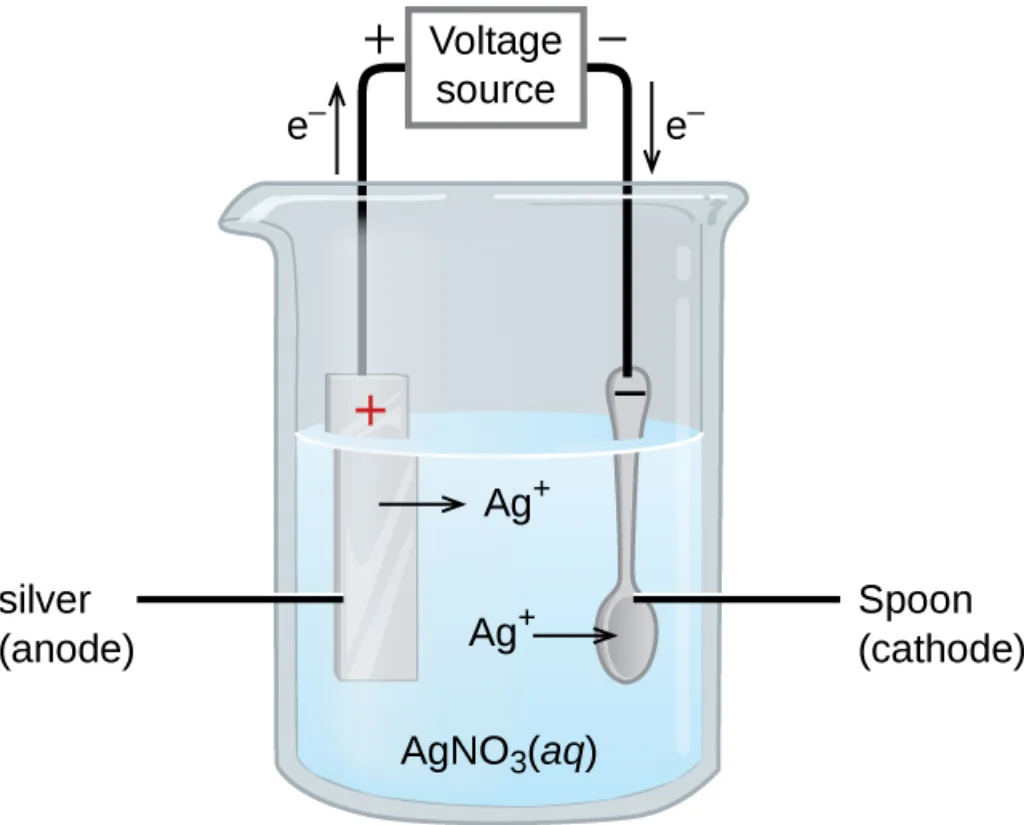
- The diagram below shows an electrolytic cell for silver-plating eating utensils.
- The anode is a block of silver, and the cathode is the spoon, made of a cheap metal.
- Both electrodes sit in a silver nitrate solution.
- A sufficient voltage oxidizes the silver anode and reduces silver ions at the spoon:
- 1 / 3Next ▶
- Electroplating
- Electroplating
- Ag(s) → Ag
- +
- (aq) + e
- −
- Ag
- → Ag(s)
- ◀ Previous, 2 / 3Next ▶
- An electrolytic cell for silver-plating a spoon.
- The silver anode dissolves as silver ions move through the silver nitrate solution, and the spoon cathode gains a silver coating.
- Image: OpenStax, Chemistry 2e, CC BY 4.0.
- Electroplating
- ⤢ Enlarge
- Electroplating
- The net result is that silver metal moves from the anode to the cathode.
- Good coatings depend on carefully controlled conditions: the exact composition of the electrolyte, the applied cell voltage, and the current
- which sets the rate of electrolysis.
- ◀ Previous, 3 / 3
17.7 Electrolysis · 5 / 9
17.7 Quantitative aspects of electrolysis
Quantitative aspects of electrolysis
- Quantitative aspects of electrolysis
- Quantitative aspects of electrolysis
- Electrical current is the rate of flow of charge, and most often the charge carried is by electrons.
- The unit of current is the ampere (A), defined as one coulomb per second: 1 A = 1 C/s.
- The charge Q, in coulombs, passed by a constant current I, in amperes, over a time t, in seconds, is Q = I × t.
- When electrons are transferred in a redox reaction, the stoichiometry gives the amount of electrical charge involved.
- For a generic reduction Mn+ + ne− → M, n moles of electrons are transferred for each mole of metal deposited.
- 6The total charge is Q = n × F
- where F is Faraday’s constant, the charge of one mole of electrons, equal to 96,485 C/mol.
- 1 / 2Next ▶
- Quantitative aspects of electrolysis
- Combining these relations gives n(electrons) = Q / F = (I × t) / F.
- Measuring the current in a cell therefore lets you calculate the amount of product formed.
- Remember to convert minutes or hours to seconds before multiplying by current,
- and to match the electrons per mole of metal to the metal’s ion charge: 1 for Ag+, 2 for Zn2+, 3 for Al3+ and Cr3+.
- ◀ Previous, 2 / 2
17.7 Electrolysis · 6 / 9
17.7 Worked examples
Worked examples
- Check your learning: aluminum from aluminum(III) ions3Example 17.10: time required for deposition4Example 17.10: time required for deposition5Check your learning: galvanizing iron with zinc
- Example 17.9: converting current to moles of electrons
- Example 17.9: converting current to moles of electrons
- In one process for electroplating silver, a current of 10.23 A flows through an electrolytic cell for exactly 1 hour. How many moles of electrons pass through the cell? What mass of silver is deposited at the cathode from the silver nitrate solution?
- Convert 1 hour to 3600 s. The charge is Q = 10.23 A × 3600 s = 3.683 × 10⁴ C. The moles of electrons are n = Q / F = 3.683 × 10⁴ C ÷ 96,485 C/mol = 0.3817 mol e−.
- The cathode reaction is Ag+ + e− → Ag
- so one mole of electrons deposits one mole of silver.
- Moles of Ag = 0.3817 mol.
- With a molar mass of 107.9 g/mol, the mass is 0.3817 mol × 107.9 g/mol = 41.18 g Ag, about 41.2 g.
- 1 / 5Next ▶
- aluminum from aluminum(III) ions
- Aluminum metal can be made from aluminum(III) ions by electrolysis. What is the cathode half-reaction? What mass of aluminum is recovered if a current of 25.0 A passes through the solution for 15.0 minutes?
- The cathode reaction is Al3+ + 3e− → Al(s).
- 3Q = 25.0 A × 900 s = 22,500 C
- so the moles of electrons are 22,500 C ÷ 96,485 C/mol = 0.2332 mol.
- 4Each mole of Al needs 3 mol e−
- so moles of Al = 0.0777 mol.
- Mass = 0.0777 mol × 26.98 g/mol = 2.10 g Al.
- ◀ Previous, 2 / 5Next ▶
- Example 17.10: time required for deposition
- Example 17.10: time required for deposition
- A chromium layer 0.010 mm thick must be deposited on a part with a total surface area of 3.3 m2 from a solution of chromium(III) ions. How long does it take at a current of 33.46 A? The density of chromium metal is 7.19 g/cm3.
- First find the volume.
- Area 3.3 m2 = 3.3 × 104 cm2 and thickness 0.010 mm = 1.0 × 10⁻³ cm
- so V = 3.3 × 104 cm2 × 1.0 × 10−3 cm = 33 cm3.
- The mass is 33 cm3 × 7.19 g/cm3 = 237 g.
- The moles of chromium are 237 g ÷ 52.00 g/mol = 4.56 mol.
- Cr3+ + 3e− → Cr requires 3 mol e− per mol Cr
- so 3 × 4.56 mol = 13.69 mol e−.
- ◀ Previous, 3 / 5Next ▶
- Example 17.10: time required for deposition
- Example 17.10: time required for deposition
- The charge is 13.69 mol × 96,485 C/mol = 1.321 × 10⁶ C.
- At 33.46 C/s, the time is t = Q / I = 1.321 × 10⁶ C ÷ 33.46 C/s = 3.95 × 10⁴ s, about 11.0 hours.
- ◀ Previous, 4 / 5Next ▶
- galvanizing iron with zinc
- What mass of zinc is needed to galvanize the top of a 3.00 m × 5.50 m sheet of iron to a zinc thickness of 0.100 mm? The zinc comes from Zn(NO3)2 and the current is 25.5 A. How long does the galvanizing take? The density of zinc is 7.140 g/cm3.
- The volume is 16.5 m2 × 1.00 × 10−4 m = 1.65 × 10⁻³ m3 = 1650 cm3.
- 3The mass is 1650 cm3 × 7.140 g/cm3 = 1.18 × 10⁴ g
- which is 11.8 kg Zn.
- Zn2+ + 2e− → Zn needs 2 mol e− per mole of zinc.
- 5Moles of Zn = 1.18 × 10⁴ g ÷ 65.38 g/mol = 180.2 mol
- so electrons = 360.4 mol and Q = 360.4 mol × 96,485 C/mol = 3.48 × 10⁷ C.
- 6Time = 3.48 × 10⁷ C ÷ 25.5 C/s = 1.36 × 10⁶ s
- which is about 379 hours.
- ◀ Previous, 5 / 5
17.7 Electrolysis · 7 / 9
17.7 Key terms
Key terms
- Key terms
| Term | Meaning |
|---|---|
| Electrolysis |
|
| Electrolytic cell |
|
| Galvanic cell |
|
| Downs cell | A cell used to make sodium and chlorine by electrolysis of molten sodium chloride. |
| Chlor-alkali process |
|
| Electroplating | Depositing a thin layer of one metal onto a conducting surface by electrolysis. |
| Electrical current |
|
| Ampere (A) |
|
| Coulomb (C) | The SI unit of electric charge. |
| Faraday’s constant (F) |
|
| Half-reaction | An equation showing only the oxidation or only the reduction that occurs at one electrode. |
| Anode |
|
| Cathode |
|
17.7 Electrolysis · 8 / 9
17.7 Avoid these mistakes
Avoid these mistakes
Avoid these mistakes2→Avoid these mistakes3Avoid these mistakes4Avoid these mistakes
Avoid these mistakes
Avoid this
- Thinking a negative cell potential means electrolysis happens by itself.Avoid this
- A negative potential means the reaction is nonspontaneous, so the applied voltage must be larger in magnitude than that potential.Avoid this
Avoid this
- Assigning the signs of a galvanic cell to an electrolytic cell.Avoid this
- In electrolysis the anode is connected to the positive terminal of the power source and the cathode to the negative terminal.Avoid this
1 / 4Next ▶
Avoid these mistakes
Avoid this
- Predicting aqueous products from standard potentials alone.Avoid this
- In neutral NaCl solution the hydrogen ion concentration is about 10−7 M, so water is reduced and H2 forms, not sodium metal.Avoid this
Avoid this
- Using minutes or hours directly in Q = I × t. Convert time to seconds before multiplying by the current in amperes.Avoid this
Avoid this
◀ Previous, 2 / 4Next ▶
Avoid these mistakes
- Forgetting the charge of the metal ion when converting coulombs to moles of metal. Ag needs 1 mol eAvoid this
−Avoid this
- per mole
- Zn needs 2 and Cr or Al need 3.Avoid this
Avoid this
- Mixing units in volume calculations. Area in mAvoid this
- and thickness in mm must be converted to consistent units, such as cmAvoid this
◀ Previous, 3 / 4Next ▶
Avoid these mistakes
, before using density.Avoid this
◀ Previous, 4 / 4
17.7 Electrolysis · 9 / 9
Well done! You finished this lesson
What would you like to do next?