Curriculum
Chemistry 2e
Unit 1: Essential Ideas
0/14
Unit 2: Atoms, Molecules, and Ions
0/16
Unit 3: Composition of Substances and Solutions
0/10
Unit 4: Stoichiometry of Chemical Reactions
0/12
Unit 5: Thermochemistry
0/8
Unit 6: Electronic Structure and Periodic Properties of Elements
0/12
Unit 7: Chemical Bonding and Molecular Geometry
0/14
Unit 8: Advanced Theories of Covalent Bonding
0/10
Unit 9: Gases
0/23
Unit 10: Liquids and Solids
0/28
Unit 11: Solutions and Colloids
0/24
Unit 12: Kinetics
0/32
Unit 13: Fundamental Equilibrium Concepts
0/20
Unit 14: Acid-Base Equilibria
0/32
Unit 15: Equilibria of Other Reaction Classes
0/16
Unit 16: Thermodynamics
0/20
Unit 17: Electrochemistry
0/32
Unit 18: Representative Metals, Metalloids, and Nonmetals
0/52
Unit 19: Transition Metals and Coordination Chemistry
0/16
Unit 20: Organic Chemistry
0/20
-
Unit 20 overview: Organic Chemistry
 Preview
-
20.1 Hydrocarbons
Preview
-
20.1 Hydrocarbons - Check yourself
 Preview
-
20.1 Hydrocarbons
Preview
-
20.1 Hydrocarbons - Check yourself
Preview
-
20.2 Alcohols and Ethers
Preview
-
20.2 Alcohols and Ethers - Check yourself
Preview
-
20.2 Alcohols and Ethers
Preview
-
20.2 Alcohols and Ethers - Check yourself
Preview
-
Unit 20 review quiz: Organic Chemistry
Preview
-
Unit 20 overview: Organic Chemistry
Preview
-
20.3 Aldehydes, Ketones, Carboxylic Acids, and Esters
Preview
-
20.3 Aldehydes, Ketones, Carboxylic Acids, and Esters - Check yourself
Preview
-
20.3 Aldehydes, Ketones, Carboxylic Acids, and Esters
Preview
-
20.3 Aldehydes, Ketones, Carboxylic Acids, and Esters - Check yourself
Preview
-
20.4 Amines and Amides
Preview
-
20.4 Amines and Amides - Check yourself
Preview
-
20.4 Amines and Amides
Preview
-
20.4 Amines and Amides - Check yourself
Preview
-
Unit 20 review quiz: Organic Chemistry
Preview
Unit 21: Nuclear Chemistry
0/28
Text lesson
20.1 Hydrocarbons
20.1 Hydrocarbons — CHEMISTRY notes: You will be able to explain why hydrocarbons are so varied, name saturated and unsaturated hydrocarbons, describe their characteristic reactions, and identify structural and geometric isomers.
1Hydrocarbons and their variety2Hydrocarbons and their variety
Hydrocarbons and their variety
Hydrocarbons and their variety
Organic compounds are substances that contain carbon as the main element, bonded to hydrogen and to other carbon atoms.
Early chemists believed these substances could only come from living things,
but in 1828 Friedrich Wöhler made urea from non-living materials,and organic molecules are now known to follow the same natural laws as all other matter.
Carbonates, cyanides and simple oxides such as CO and CO2 contain carbon but are not usually classed as organic.
Carbon forms up to four strong bonds to other carbon atoms
so it builds chains and rings of many sizes and shapes. The largest database of organic compounds lists about 10 million substances, and the number of possible organic compounds has been estimated at 1060.
The simplest organic compounds contain only carbon and hydrogen and are called hydrocarbons.
Even with only two kinds of atoms there is a huge variety,
because the carbon chains can be long, branched or ring-shaped,and because the carbon-carbon bonds can be single, double or triple.
1 / 2Next ▶
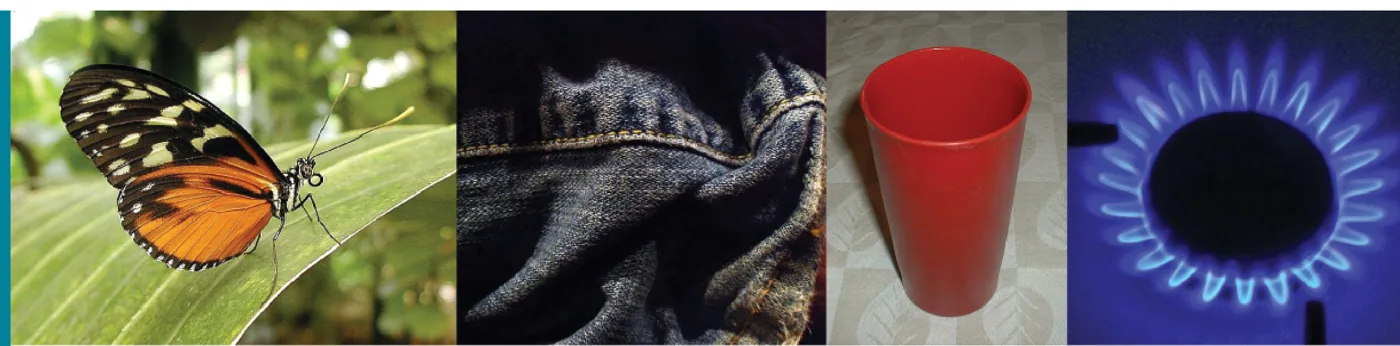
Organic compounds are all around us, in living things, fabrics, plastic containers and the natural gas that we burn for heat. Image: OpenStax, Chemistry 2e, CC BY 4.0.
Hydrocarbons and their variety
 ⤢ Enlarge
1
Hydrocarbons occur in plants, animals and fossils, and many are made in the laboratory.
2
We use them every day as fuels such as natural gas, propane, butane, gasoline, diesel and heating oil,
and as the starting materials of plastics such as polyethylene, polypropylene and polystyrene.
3
The differences in carbon-carbon bonding change the geometry around each carbon atom and the hybridization of its orbitals,
and this is how the main classes of hydrocarbons are told apart.
◀ Previous2 / 2
1Alkanes2Alkanes
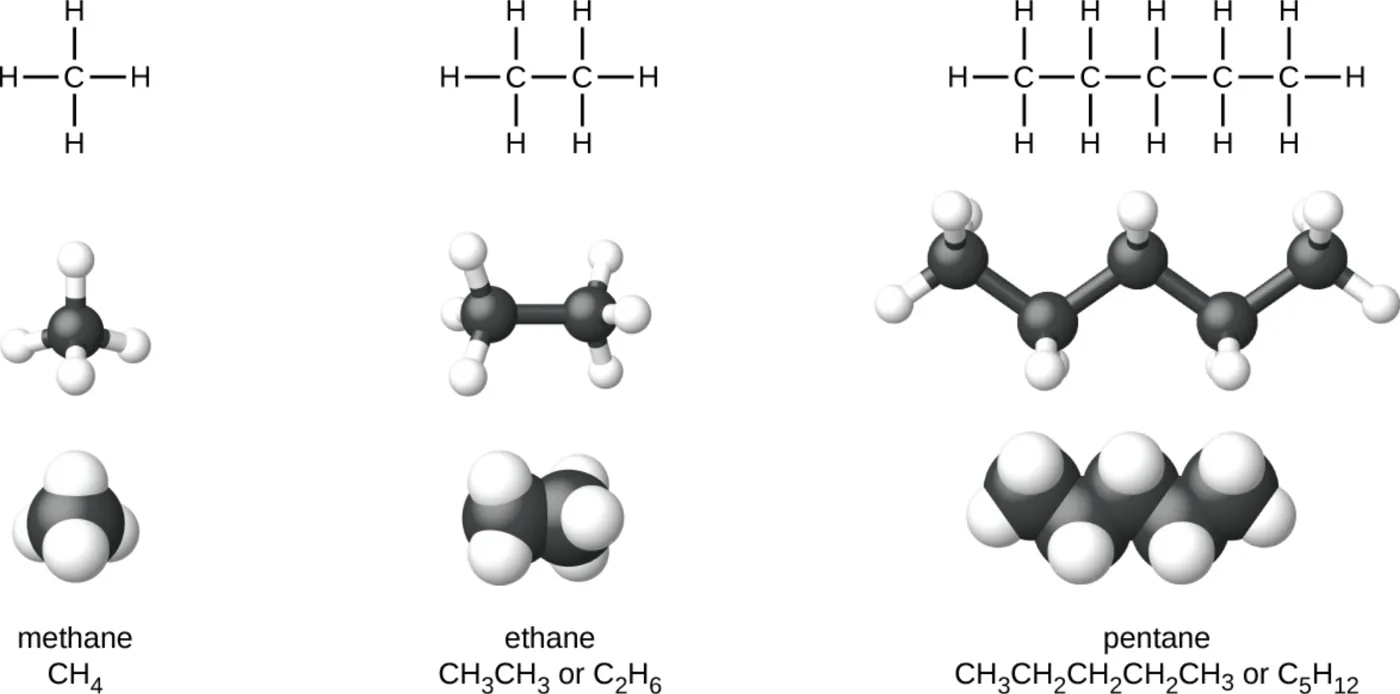
Lewis structures, ball-and-stick models and space-filling models of methane, ethane and pentane, showing how their carbon atoms are joined. Image: OpenStax, Chemistry 2e, CC BY 4.0.
Alkanes
 ⤢ Enlarge
Alkanes
Alkanes, also called saturated hydrocarbons, contain only single covalent bonds between carbon atoms. Every carbon atom in an alkane uses sp3 hybrid orbitals and is bonded to four other atoms, each of which is either carbon or hydrogen. Methane, ethane and pentane are the simplest examples to picture.
Carbon chains are usually drawn as straight lines in Lewis structures
but a Lewis structure does not show the real shape of a molecule. In pentane the carbon atoms do not lie in a straight line. Because of sp3 hybridization, the bond angles along a carbon chain are close to 109.5°so the chain has a zigzag shape.
A condensed structural formula is a shorter way to show the bonding. It looks like a Lewis structure with most of the bond lines removed
so each group is written with its atoms in order, for example CH3CH3 for ethane and CH3CH2CH2CH2CH3 for pentane.
All noncyclic alkanes have the general formula CnH2n+2.
There is no upper limit on the number of carbon atoms.
As the molecules grow, the dispersion forces between them become stronger
so melting and boiling points rise in a smooth, predictable way.
1 / 2Next ▶
Alkanes
Alkanes
Table 20.1 lists some alkanes.
The physical properties given for butane and the larger alkanes are those of the straight-chain (normal) isomer.
The table shows that the boiling point rises steadily with chain length, that the first four alkanes are gases at room conditions, and that the number of possible structural isomers grows very quickly as the carbon count increases.
| Alkane | Formula | Melting point (°C) | Boiling point (°C) | Phase at STP | Number of structural isomers |
|---|---|---|---|---|---|
| methane | CH4 | −182.5 | −161.5 | gas | 1 |
| ethane | C2H6 | −183.3 | −88.6 | gas | 1 |
| propane | C3H8 | −187.7 | −42.1 | gas | 1 |
| butane | C4H10 | −138.3 | −0.5 | gas | 2 |
| pentane | C5H12 | −129.7 | 36.1 | liquid | 3 |
| hexane | C6H14 | −95.3 | 68.7 | liquid | 5 |
| heptane | C7H16 | −90.6 | 98.4 | liquid | 9 |
| octane | C8H18 | −56.8 | 125.7 | liquid | 18 |
| nonane | C9H20 | −53.6 | 150.8 | liquid | 35 |
| decane | C10H22 | −29.7 | 174.0 | liquid | 75 |
| tetradecane | C14H30 | 5.9 | 253.5 | solid | 1858 |
| octadecane | C18H38 | 28.2 | 316.1 | solid | 60,523 |
◀ Previous2 / 2
1Skeletal structures2Skeletal structures
Skeletal structures
1
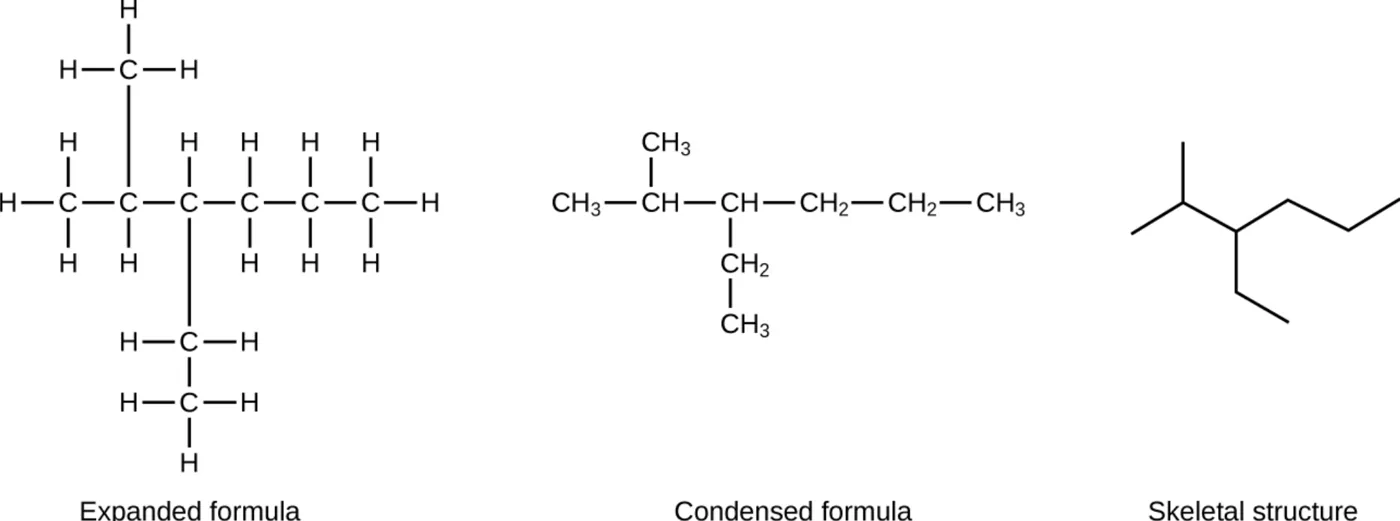
Organic chemists often use skeletal (line-angle) structures to draw larger molecules more simply.
2
Each carbon atom is not written as a C
it is shown as the end of a line or as a bend or meeting point of lines.
3
Hydrogen atoms bonded to carbon are not drawn
but they are still there.
4
Any other atom, such as O or Cl, is written with its symbol.
1 / 2Next ▶
One molecule drawn three ways: as an expanded formula with every bond shown, as a condensed formula, and as a skeletal line-angle structure. Image: OpenStax, Chemistry 2e, CC BY 4.0.
Skeletal structures
◀ Previous2 / 2
1Structural isomers of alkanes2Structural isomers of alkanes
Lewis, ball-and-stick and space-filling drawings of n-butane (left) and 2-methylpropane (right), which share the formula C4H10 but have different structures. Image: OpenStax, Chemistry 2e, CC BY 4.0.
Structural isomers of alkanes
 ⤢ Enlarge
Structural isomers of alkanes
Some hydrocarbons share the same molecular formula but have different structures. For example, two alkanes have the formula C4H10: n-butane, whose carbon chain is unbranched, and 2-methylpropane (also called isobutane), whose central carbon is bonded to three other carbons.
Compounds like these are called structural isomers, also known as constitutional isomers. They have the same molecular formula but different arrangements of their atoms. The prefix n- (normal) means that a carbon chain has no branches
so no carbon in n-butane is bonded to more than two other carbons.
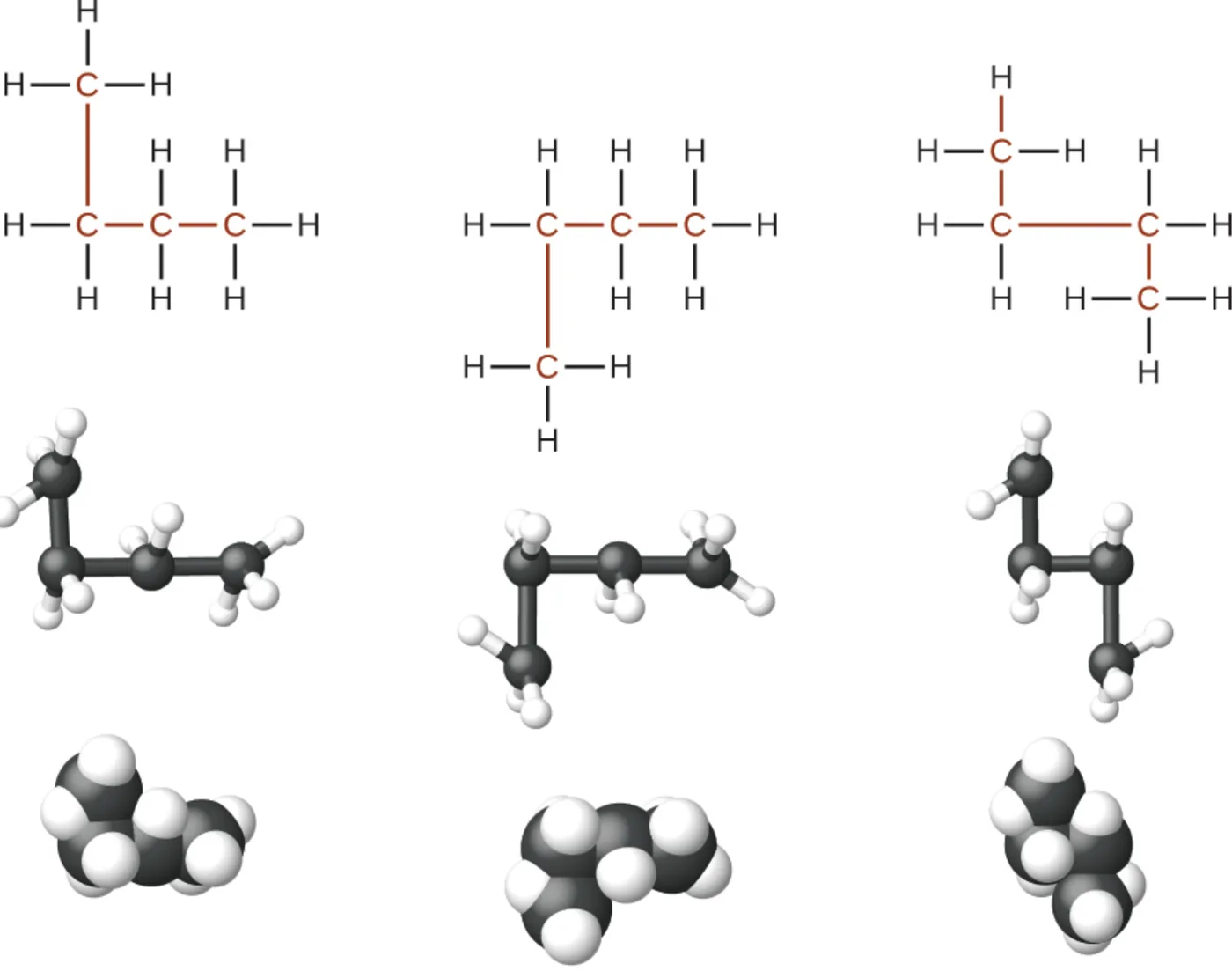
Lewis structures that look different are not always different isomers. The three drawings of n-butane in the next figure all contain the same chain of four carbon atoms
so they show one molecule and not three.
1 / 2Next ▶
Three different representations of n-butane. They look different on paper, but they all show the same arrangement of atoms and bonds, so they are not isomers of each other. Image: OpenStax, Chemistry 2e, CC BY 4.0.
Structural isomers of alkanes
◀ Previous2 / 2
1Naming alkanes2Naming alkanes
Naming alkanes
Naming alkanes
The International Union of Pure and Applied Chemistry (IUPAC) names organic compounds with a system that starts from the names of the alkanes. The name of an alkane follows two rules.
Rule 1: find the longest continuous chain of carbon atoms. A chain of two carbons is ethane, three is propane, four is butane, five is pentane, six is hexane, seven is heptane, eight is octane, nine is nonane and ten is decane.
Rule 2: add prefixes to the chain name to give the position and name of each substituent.
A substituent is a branch or a functional group that replaces a hydrogen atom on the chain.
Number the chain from the end nearest a substituent
so that the substituents get the lowest possible numbers.
Name each substituent separately, put the names in alphabetical order,
and use the prefixes di-, tri-, tetra- and so on when the same substituent appears more than once.
1 / 2Next ▶
Several alkanes and halogen-substituted alkanes, with the carbons numbered from the end that gives the substituents the lowest numbers. Image: OpenStax, Chemistry 2e, CC BY 4.0.
Naming alkanes
 ⤢ Enlarge
Naming alkanes
For a halogen substituent, the ending -ide changes to -o
so chlorine becomes chloro and bromine becomes bromo.
The link to learning box points to a short video that walks through the naming steps for alkanes. Practising with it is a good way to fix the two rules in mind before moving on to more complicated molecules.
◀ Previous2 / 2
1Alkyl groups2Alkyl groups3Alkyl groups4Alkyl groups5Alkyl groups
Alkyl groups
1
A substituent that has one hydrogen atom fewer than the corresponding alkane is called an alkyl group.
2
Its name comes from the alkane name, with the ending -ane replaced by -yl.
3
The methyl group (CH3–) comes from methane and the ethyl group (CH3CH2–) comes from ethane.
4
The open bond in each drawing shows that the group is attached to another atom.
1 / 5Next ▶
Methane and ethane next to the methyl and ethyl groups that remain when one hydrogen atom is removed from each. Image: OpenStax, Chemistry 2e, CC BY 4.0.
Alkyl groups
 ⤢ Enlarge
1
In methane all four hydrogen atoms are equivalent, and removing any one of them gives the same methyl group.
2
In ethane all six hydrogen atoms are equivalent, and removing any one gives an ethyl group.
3
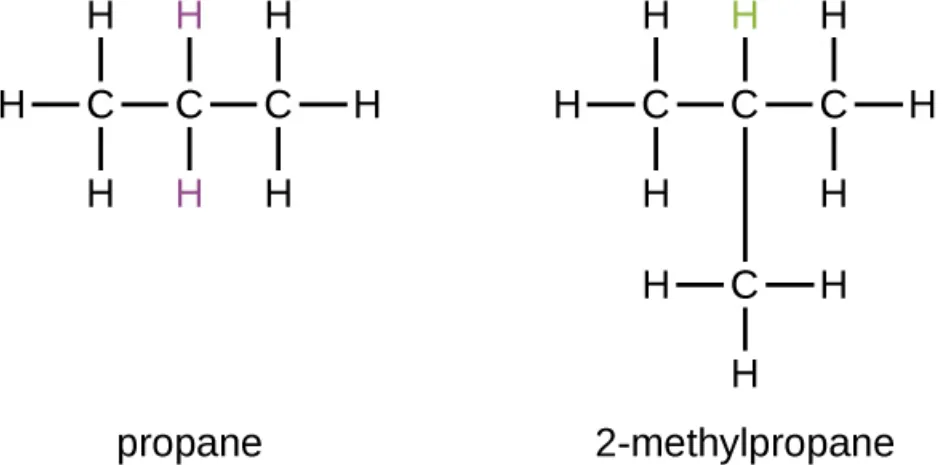
Propane and 2-methylpropane are different
because they have hydrogen atoms in two or more environments.
4
In propane, six hydrogen atoms sit on carbons bonded to only one other carbon, and two sit on the middle carbon bonded to two other carbons.
5
In 2-methylpropane, nine hydrogen atoms sit on carbons bonded to only one other carbon,
and one hydrogen sits on the central carbon bonded to three other carbons.
6
Removing a different type of hydrogen gives a different alkyl group.
◀ Previous2 / 5Next ▶
Propane and 2-methylpropane, with the hydrogen atoms of different environments shown in different colours. Image: OpenStax, Chemistry 2e, CC BY 4.0.
Alkyl groups
 ⤢ Enlarge
Alkyl groups
Figure 20.5 lists the names and structures of several alkyl groups that come from removing different hydrogen atoms. Alkyl groups never exist alone
they are always part of a larger molecule.
◀ Previous3 / 5Next ▶
A table of common alkyl groups, from methyl and ethyl to the branched isopropyl, sec-butyl, isobutyl and tert-butyl groups, with their structures. Image: OpenStax, Chemistry 2e, CC BY 4.0.
Alkyl groups
 ⤢ Enlarge
Alkyl groups
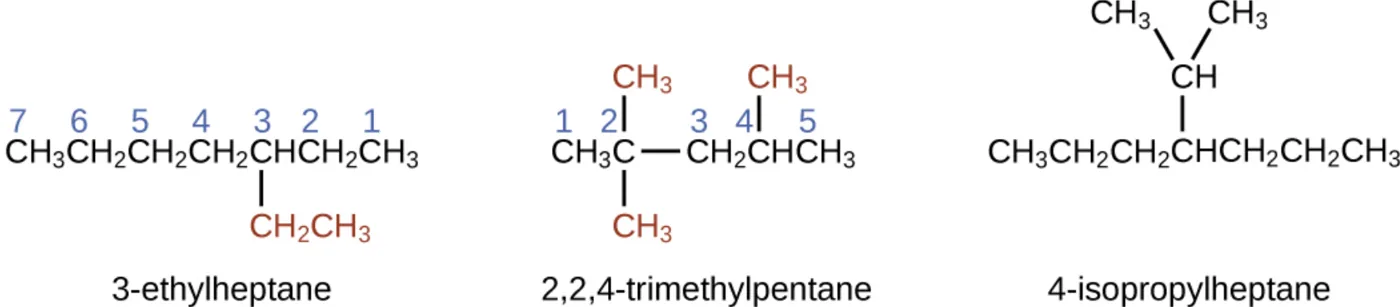
The position of an alkyl group on a chain is given in the same way as for any other substituent, using the number of the carbon atom it is bonded to. The examples below show branched alkanes with their chains numbered and their substituents labelled.
◀ Previous4 / 5Next ▶
Three branched alkanes, each with its longest chain numbered from the end that gives the lowest locations to the alkyl branches. Image: OpenStax, Chemistry 2e, CC BY 4.0.
Alkyl groups
◀ Previous5 / 5
1Reactions of alkanes2Reactions of alkanes3Reactions of alkanes4Reactions of alkanes
Reactions of alkanes
Reactions of alkanes
Alkanes are fairly stable
but heat or light can start reactions that break C–H or C–C single bonds.
The most important reaction of alkanes is combustion.
Alkanes burn in oxygen in a strongly exothermic oxidation-reduction reaction that produces carbon dioxide and water.
For methane, CH4 + 2 O2 → CO2 + 2 H2O.
This is why alkanes are excellent fuels.
Methane is the main part of natural gas, butane fuels camping stoves and lighters, gasoline is a mixture of straight and branched alkanes with five to nine carbons plus additives,
and kerosene, diesel and fuel oil are mixtures of alkanes with higher masses.
1 / 4Next ▶
Reactions of alkanes
1
These liquid fuels come from crude oil
which is a complex mixture separated by fractional distillation.
2
The crude oil is heated to about 425 °C and the vapour enters the base of a tall column.
3
As the vapour rises through the trays and cools, the fractions with higher boiling points condense first and are drawn off lower down or higher up, depending on their boiling points.
4
Boiling point depends on the intermolecular forces
which is why the separation works.
◀ Previous2 / 4Next ▶
A refinery distillation column in which heated crude oil is separated into fractions. Small, low-boiling molecules leave at the top and large, high-boiling molecules leave at the bottom. Image: OpenStax, Chemistry 2e, CC BY 4.0.
Reactions of alkanes
 ⤢ Enlarge
1
Another typical reaction of alkanes is substitution.
2
In a substitution reaction one or more hydrogen atoms are replaced by a different atom or group,
but no carbon-carbon bonds are broken and the carbon atoms keep their hybridization.
3
Ethane reacts with molecular chlorine to give chloroethane and hydrogen chloride.
4
The C–Cl part of chloroethane is a functional group, meaning the part of a molecule that gives it a specific chemical reactivity.
5
The types of functional group in a molecule largely decide its properties,
and they are the basis for classifying organic compounds in the rest of this chapter.
◀ Previous3 / 4Next ▶
Ethane reacting with chlorine in heat or light to give chloroethane, with one hydrogen atom replaced by a chlorine atom. Image: OpenStax, Chemistry 2e, CC BY 4.0.
Reactions of alkanes

◀ Previous4 / 4
1Alkenes2Alkenes
Alkenes
1
Organic compounds that contain one or more double or triple bonds between carbon atoms are called unsaturated.
2
Unsaturated hydrocarbons with at least one double bond are called alkenes.
3
Each double bond is made of one σ bond and one π bond.
4
The extra bonding changes the geometry around the carbon atoms that take part
which changes the shape and the properties of the molecule.
5
This is also why unsaturated fats behave differently from saturated fats.
6
Ethene, C2H4, is the simplest alkene and is also called ethylene.
1 / 2Next ▶
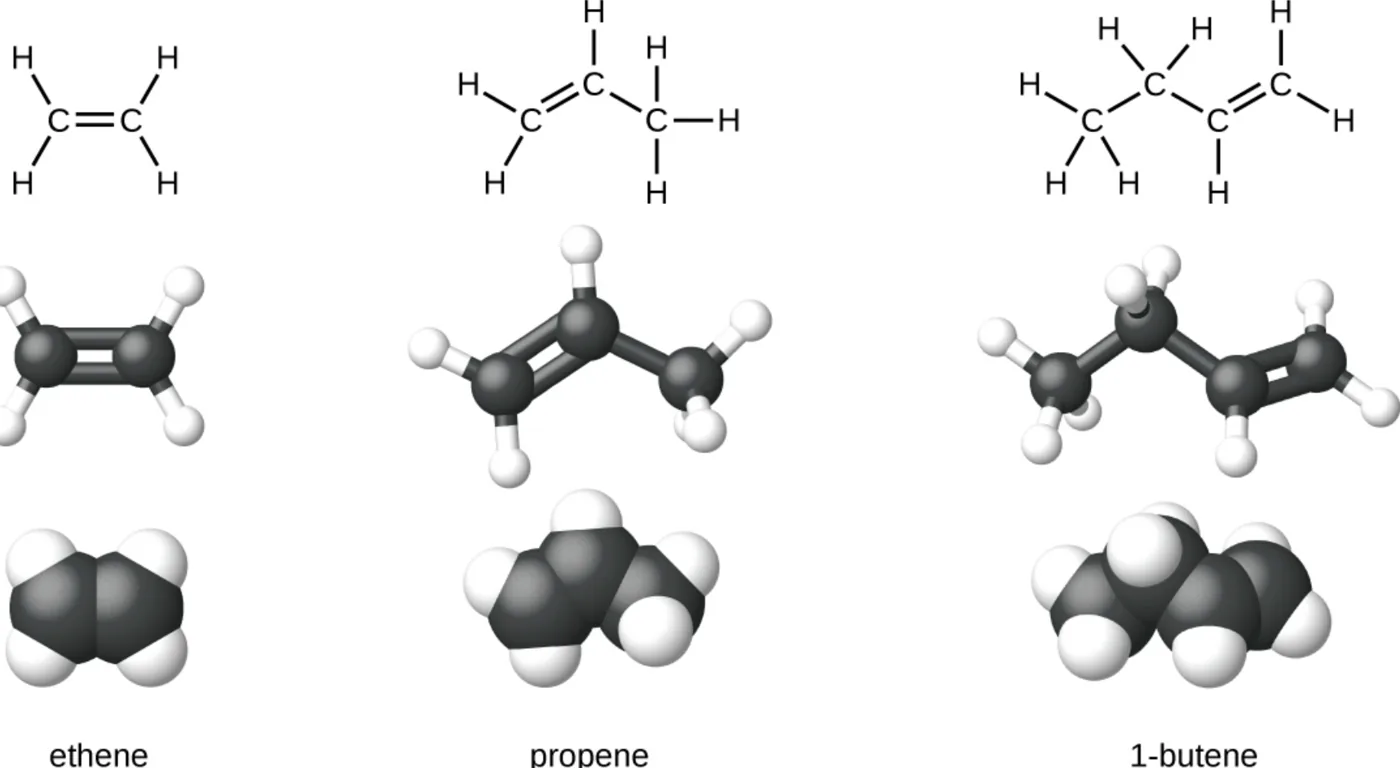
Ethene, propene and 1-butene drawn as expanded structures, ball-and-stick models and space-filling models, showing the flat geometry around the double bonds. Image: OpenStax, Chemistry 2e, CC BY 4.0.
Alkenes
 ⤢ Enlarge
Alkenes
Each carbon in ethene has a trigonal planar structure, with bond angles of about 120°.
Propene (propylene) comes next in the series, and the butenes follow.
Butene has four carbons
which allows isomers based on where the double bond sits, as well as a second kind of isomerism explained below.
Ethylene is one of the most important industrial chemicals. In 2010 more than 135 million tons of it were produced worldwide for polymers, petrochemicals and plastics. It is made by cracking, in which long hydrocarbon chains from petroleum are broken into smaller molecules, often by heating them strongly.
◀ Previous2 / 2
1Recycling plastics2Recycling plastics3Recycling plastics
Recycling plastics
Recycling plastics
Polymers are large molecules made of many repeating units called monomers.
The word comes from the Greek for many (poly) and parts (mer).
Some polymers are natural, such as starch
which is made of sugar units, and proteinswhich are made of amino acids.
Others are synthetic, such as polyethylene, polyvinyl chloride (PVC) and polystyrene.
Adding functional groups to a polymer can change its properties a great deal
which is why polymers are so useful.
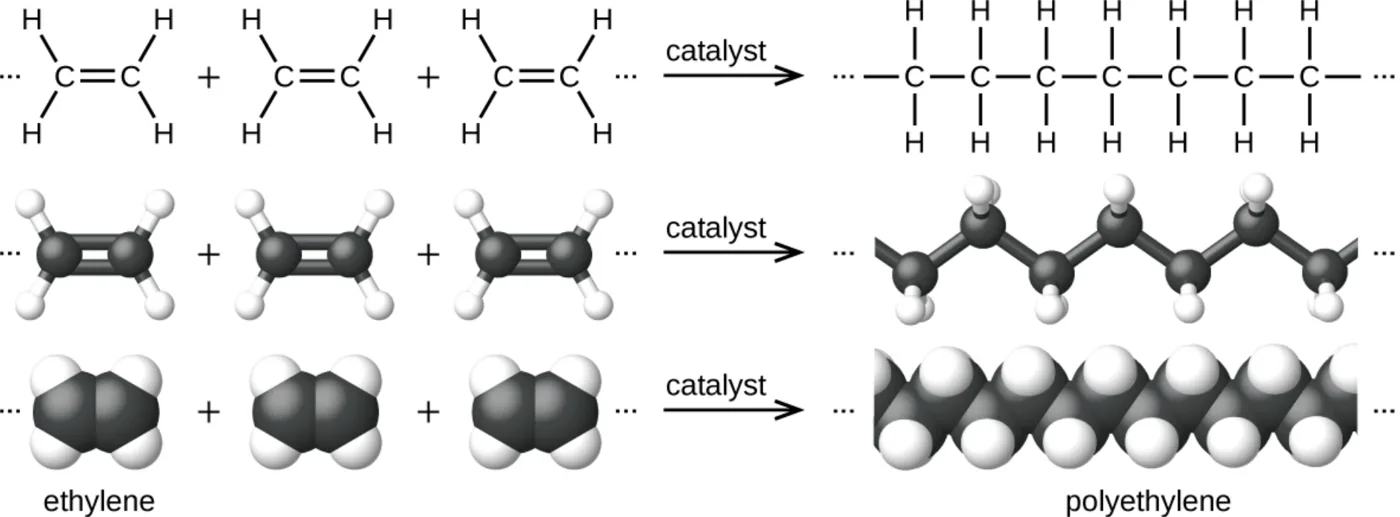
In polymerization, many monomers join together to form a long chain. Ethylene is a gas at room temperature
but when a transition metal catalyst is used it polymerizes into polyethylene, a solid made of long chains of –CH2– units. Polyethylene is mostly used for packaging such as bags and films.
1 / 3Next ▶
Many ethylene monomers join into a long chain of polyethylene when they are polymerized with a catalyst. Image: OpenStax, Chemistry 2e, CC BY 4.0.
Recycling plastics
 ⤢ Enlarge
1
A plastic is a synthetic organic solid that can be moulded, and most plastics are polymers with high molar masses.
2
Many common plastic monomers,
including ethylene, propylene, vinyl chloride, styrene and ethylene terephthalate, come from petrochemicals and do not biodegrade easily.
3
Recycling them saves petrochemical supplies and reduces the environmental harm of throwing them away.
4
Plastic recycling collects waste or used plastic and reprocesses it into new products.
5
Soft-drink bottles made of polyethylene terephthalate can be melted down into furniture, carpet fibres and other products,
while bags and cups can also be reprocessed.
6
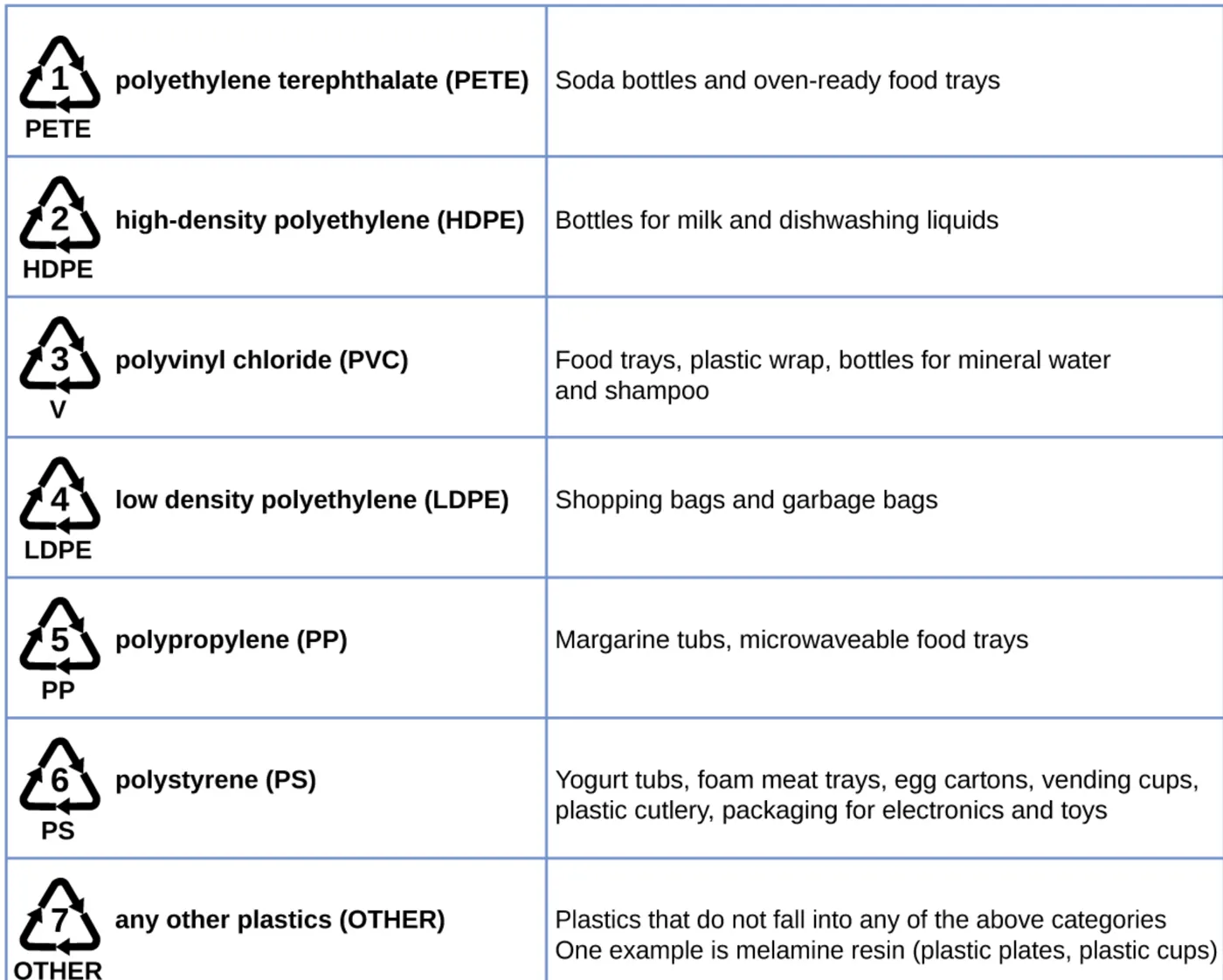
Recycling programmes focus on the commodity plastics that carry a recycling code,
and since the 1970s these operations have made some plastic production among the most efficient industrial processes today.
◀ Previous2 / 3Next ▶
The seven recycling codes printed on plastic products, with the common name of each plastic and examples of the products it is used for. Image: OpenStax, Chemistry 2e, CC BY 4.0.
Recycling plastics
◀ Previous3 / 3
Skeletal structures of ethene, propene, 1-butene and 2-butene, with the double bond located by the number of its first carbon. Image: OpenStax, Chemistry 2e, CC BY 4.0.
Naming alkenes
 ⤢ Enlarge
Naming alkenes
The name of an alkene comes from the name of the alkane with the same number of carbons. The ending -ane is replaced by -ene to show the double bond. The position of the double bond is given by the smaller of the two numbers of the carbons that it joins.
1Isomers of alkenes2Isomers of alkenes
Isomers of alkenes
1
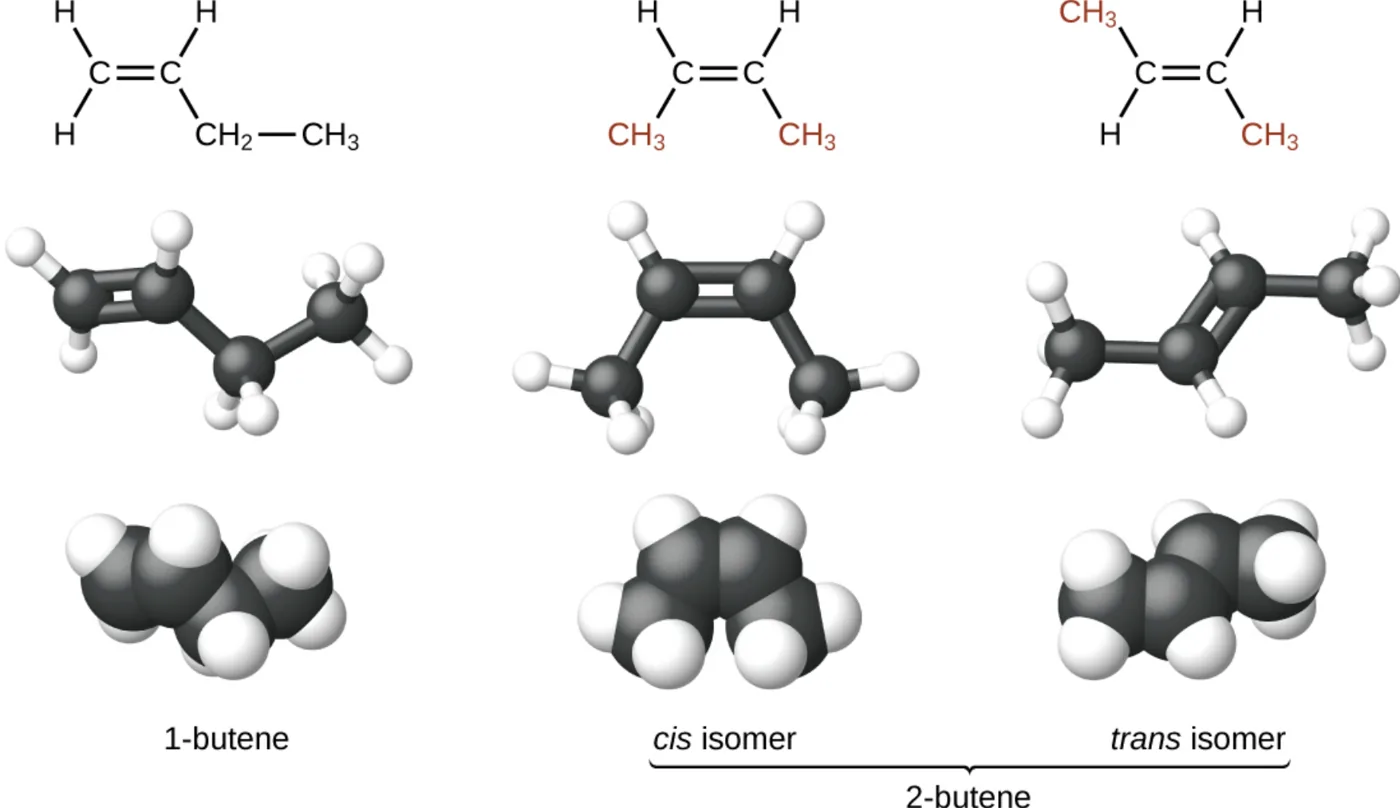
1-butene and 2-butene are structural isomers. In 1-butene the first carbon has two hydrogen atoms
while in 2-butene the first carbon has three. The atoms are arranged differently in the two molecules.
2
2-butene also has a second type of isomer, called a geometric isomer.
3
Geometric isomers have the same atoms joined in the same order
but the groups on either side of the double bond point in different directions.
4
Carbon atoms can rotate freely around a single bond but not around a double bond
because a double bond is rigid.
5
So 2-butene can exist with both methyl groups on the same side of the double bond,
which is the cis-isomer,or on opposite sides,which is the trans-isomer.
6
Because their shapes differ, the isomers also have different physical properties such as boiling point, and this can make them easier to separate.
1 / 2Next ▶
Molecular models of 1-butene and the cis and trans forms of 2-butene, showing how the methyl groups sit on either side of the rigid double bond. Image: OpenStax, Chemistry 2e, CC BY 4.0.
Isomers of alkenes
◀ Previous2 / 2
1Addition reactions of alkenes2Addition reactions of alkenes
Addition reactions of alkenes
Addition reactions of alkenes
Alkenes are much more reactive than alkanes.
The double bond contains a π bond
which is weaker than a σ bond and is broken more easily.
In a characteristic addition reaction the π bond breaks and is replaced by two new σ bonds to the added atoms.
During this reaction the carbons of the double bond change from sp2 to sp3 hybridization.
Halogens add across the double bond rather than replacing a hydrogen, as they do with alkanes.
1 / 2Next ▶
Ethene adds chlorine across its double bond to give 1,2-dichloroethane, with one chlorine atom on each of the two original carbons. Image: OpenStax, Chemistry 2e, CC BY 4.0.
Addition reactions of alkenes

◀ Previous2 / 2
1Alkynes2Alkynes3Alkynes
Alkynes
1
Hydrocarbons with one or more triple bonds are called alkynes
which form another series of unsaturated hydrocarbons. Two carbons joined by a triple bond share one σ bond and two π bonds. The sp-hybridized carbons of a triple bond have bond angles of 180°so the bond is linear and rod-shaped.
2
The simplest alkyne is ethyne, C2H2
which is commonly called acetylene.
3
It is a linear molecule.
4
Alkyne names follow the same pattern as alkene names
but the ending -yne shows the triple bond.
5
For example, a four-carbon chain with the triple bond at the end is 1-butyne
while a triple bond in the middle of the chain gives 2-butyne.
1 / 3Next ▶
The structure of ethyne, with the two carbon atoms joined by a triple bond and a hydrogen atom on each end. Image: OpenStax, Chemistry 2e, CC BY 4.0.
Alkynes
 ⤢ Enlarge
Alkynes
Alkynes are chemically similar to alkenes
but because the triple bond has two π bonds they often react more readily and take up twice as much reagent in addition reactions. Bromine adds to acetylene in two steps, with each triple-bond π pair opening up. An acetylene torch makes use of the large amount of heat released when acetylene burns.
◀ Previous2 / 3Next ▶
Acetylene reacts with two equivalent amounts of bromine to give 1,1,2,2-tetrabromoethane. Image: OpenStax, Chemistry 2e, CC BY 4.0.
Alkynes

◀ Previous3 / 3
1Aromatic hydrocarbons2Aromatic hydrocarbons3Aromatic hydrocarbons
Aromatic hydrocarbons
Aromatic hydrocarbons
Benzene, C6H6, is the simplest aromatic hydrocarbon.
Aromatic hydrocarbons contain ring structures whose bonding needs resonance (valence bond theory) or delocalization (molecular orbital theory) to be described.
Valence bond theory pictures benzene as a flat hexagon of six sp2-hybridized carbons.
Each carbon uses three electrons in sp2 orbitals to form σ bonds, and the remaining electron sits in a p orbital that is perpendicular to the ring.
These p orbitals overlap around the ring and form the π bonds.
Benzene does not behave like an alkene. All six carbon–carbon bonds are identical, and each is intermediate in length and strength between a C–C single bond and a C=C double bond. Benzene is therefore usually drawn with single bonds and a circle inside the ring
which shows the delocalized electrons.
1 / 3Next ▶
The two resonance structures of benzene, which differ only in where the double bonds are drawn. Image: OpenStax, Chemistry 2e, CC BY 4.0.
Aromatic hydrocarbons

◀ Previous2 / 3Next ▶
Benzene drawn as a hexagon with a circle in the ring, showing that the six electrons are shared equally by all six carbons. Image: OpenStax, Chemistry 2e, CC BY 4.0.
Aromatic hydrocarbons

◀ Previous3 / 3
Toluene, xylene and styrene, three benzene derivatives with a methyl, two methyl groups or a vinyl group attached to the ring. Image: OpenStax, Chemistry 2e, CC BY 4.0.
Derivatives of benzene
 ⤢ Enlarge
1
The hydrogen atoms of benzene can be replaced by many substituents to form benzene derivatives. Aromatic compounds react more readily by substitution than by addition
because replacing one hydrogen leaves the delocalized π system intact.
2
Toluene, with a methyl group on the ring, and xylene, with two methyl groups, are important solvents and raw materials in the chemical industry. Styrene, with a vinyl group, is used to make the polymer polystyrene.
1Example 20.1: Drawing skeletal structures2Example 20.1: Drawing skeletal structures3Example 20.1: Drawing skeletal structures4Example 20.2: Interpreting skeletal structures5Example 20.2: Interpreting skeletal structures6Example 20.2: Interpreting skeletal structures7Example 20.3: Naming halogen-substituted alkanes8Example 20.3: Naming halogen-substituted alkanes9Example 20.3: Naming halogen-substituted alkanes10Example 20.4: Naming substituted alkanes11Example 20.4: Naming substituted alkanes12Example 20.5: Alkene reactivity and naming13Example 20.5: Alkene reactivity and naming14Example 20.5: Alkene reactivity and naming15Example 20.6: Structure of alkynes16Example 20.6: Structure of alkynes17Example 20.7: Structure of aromatic hydrocarbons18Example 20.7: Structure of aromatic hydrocarbons19Example 20.7: Structure of aromatic hydrocarbons20Example 20.7: Structure of aromatic hydrocarbons
The two molecules of Example 20.1 written as condensed formulas, one branched and one unbranched. Image: OpenStax, Chemistry 2e, CC BY 4.0.
Example 20.1: Drawing skeletal structures
 ⤢ Enlarge
Example 20.1: Drawing skeletal structures
Two molecules are given as condensed formulas and must be drawn as skeletal structures.
Working: convert each carbon into the end of a line or a point where lines meet,
and leave out the hydrogen atoms bonded to carbon while remembering that they are there.
Each carbon in the drawn skeleton therefore carries the number of hydrogen atoms needed to make four bonds.
1 / 20Next ▶
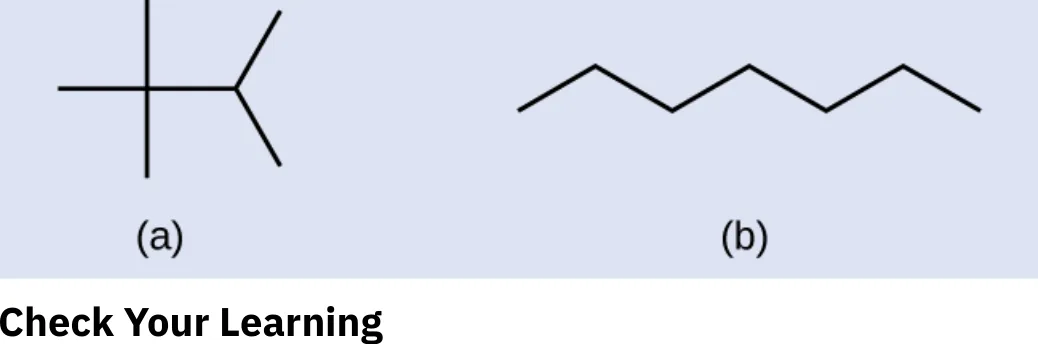
Skeletal structures of the two molecules of Example 20.1, with carbon atoms shown only as line ends and corners. Image: OpenStax, Chemistry 2e, CC BY 4.0.
Example 20.1: Drawing skeletal structures
 ⤢ Enlarge
Example 20.1: Drawing skeletal structures
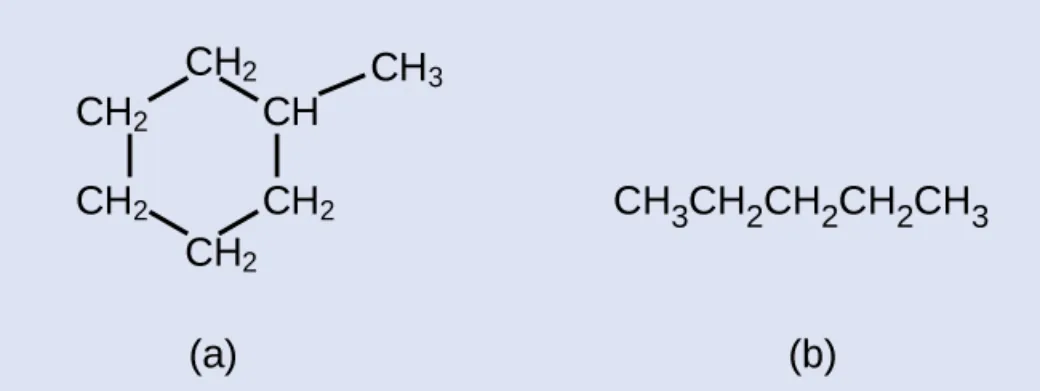
Check Your Learning: draw skeletal structures for two molecules given as condensed formulas. The first is a six-membered ring with a single methyl branch, and the second is a straight five-carbon chain. Answer: the ring is drawn as a hexagon with one line leaving it
which is methylcyclohexane, and the chain is a zigzag of five carbons.
◀ Previous2 / 20Next ▶
The two molecules for the Example 20.1 practice question, written as condensed formulas: a ring with a methyl branch and a straight chain. Image: OpenStax, Chemistry 2e, CC BY 4.0.
Example 20.1: Drawing skeletal structures
◀ Previous3 / 20Next ▶
The skeletal answer to the Example 20.1 practice question: a hexagonal ring with one branch, and a zigzag chain. Image: OpenStax, Chemistry 2e, CC BY 4.0.
Example 20.2: Interpreting skeletal structures
 ⤢ Enlarge
Example 20.2: Interpreting skeletal structures
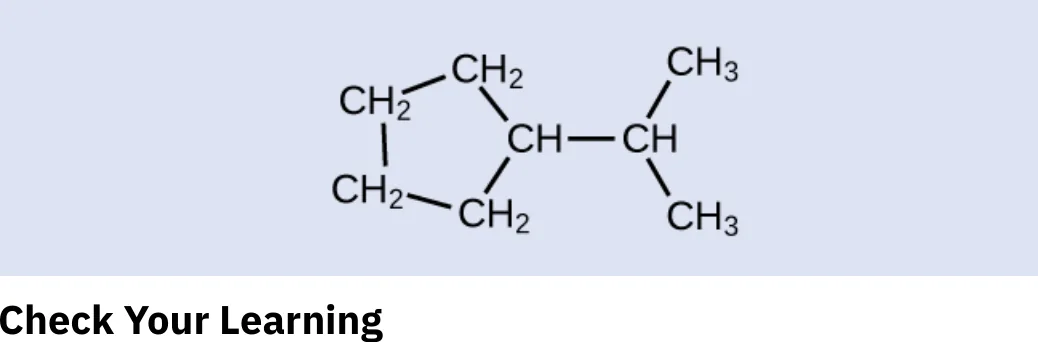
Given a skeletal structure, find its formula. Working: count the line ends and meeting points to get the number of carbon atoms
then give each carbon the number of hydrogen atoms needed for four bonds. The skeleton shown has eight carbonswhich together carry 16 hydrogen atomsso the formula is C8H16.
◀ Previous4 / 20Next ▶
The skeletal structure of Example 20.2: a five-membered ring carrying a branch with two terminal lines. Image: OpenStax, Chemistry 2e, CC BY 4.0.
Example 20.2: Interpreting skeletal structures

◀ Previous5 / 20Next ▶
The hydrogen atoms on each carbon of the Example 20.2 molecule, showing how the hydrogen count follows from the number of bonds at each carbon. Image: OpenStax, Chemistry 2e, CC BY 4.0.
Example 20.2: Interpreting skeletal structures
 ⤢ Enlarge
Example 20.2: Interpreting skeletal structures
Check Your Learning: identify the formula of the skeletal structure shown. Answer: C9H20
because nine carbons with no ring follow the general alkane formula, 2 × 9 + 2 = 20.
◀ Previous6 / 20Next ▶
The skeletal structure for the Example 20.2 practice question, a branched molecule with nine carbons. Image: OpenStax, Chemistry 2e, CC BY 4.0.
Example 20.3: Naming halogen-substituted alkanes
 ⤢ Enlarge
Example 20.3: Naming halogen-substituted alkanes
Name a four-carbon molecule with a chlorine on one end carbon and a bromine on the next carbon. Working: number the chain from the end that carries the chlorine
which gives the substituents positions 1 and 2 instead of 3 and 4. The base name is butane. Bromo- comes before chloro- alphabeticallyso the name is 2-bromo-1-chlorobutane.
◀ Previous7 / 20Next ▶
The molecule to be named in Example 20.3: a four-carbon chain with a chlorine on one end and a bromine on the second carbon from that end. Image: OpenStax, Chemistry 2e, CC BY 4.0.
Example 20.3: Naming halogen-substituted alkanes

◀ Previous8 / 20Next ▶
The same molecule with its chain numbered from the chlorine end, giving the bromine position 2 and the chlorine position 1. Image: OpenStax, Chemistry 2e, CC BY 4.0.
Example 20.3: Naming halogen-substituted alkanes
 ⤢ Enlarge
Example 20.3: Naming halogen-substituted alkanes
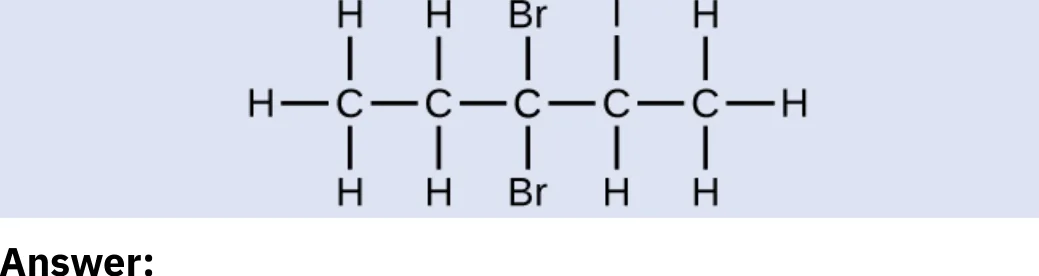
Check Your Learning: name the molecule shown. Answer: 3,3-dibromo-2-iodopentane.
◀ Previous9 / 20Next ▶
The five-carbon molecule for the Example 20.3 practice question, with two bromine atoms and one iodine atom on the chain. Image: OpenStax, Chemistry 2e, CC BY 4.0.
Example 20.4: Naming substituted alkanes
 ⤢ Enlarge
Example 20.4: Naming substituted alkanes
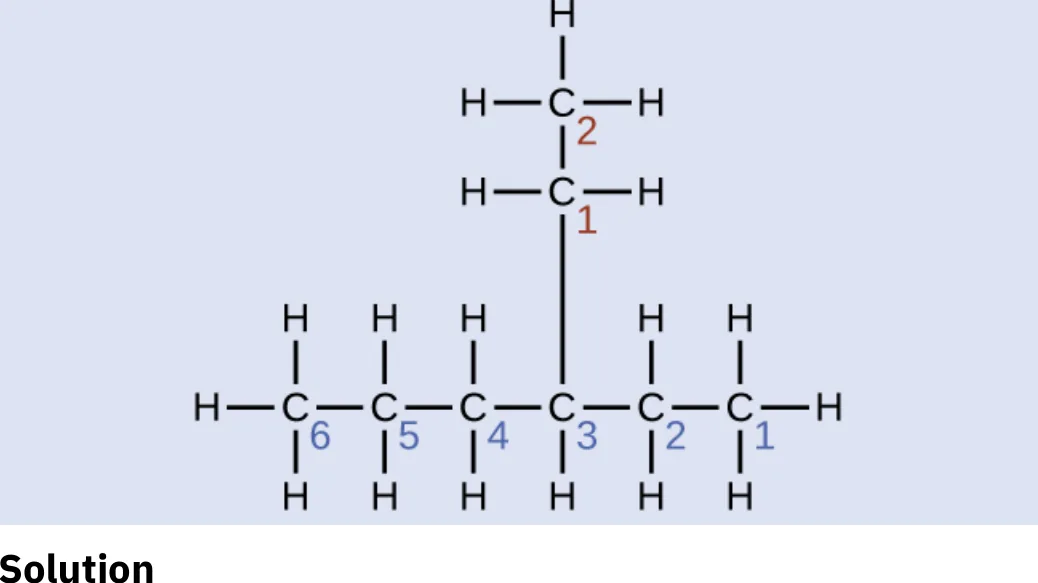
Name a molecule whose longest chain has six carbons, with an ethyl branch attached to carbon 3. Working: the longest chain runs across the page and has six carbons
so the base name is hexane.
Numbering from the right puts the branch on carbon 3
while numbering from the left would put it on carbon 4which breaks the rule.
The two-carbon branch is ethyl.
The name is 3-ethylhexane.
◀ Previous10 / 20Next ▶
The six-carbon chain of Example 20.4 numbered from the right, with a two-carbon branch on carbon 3. Image: OpenStax, Chemistry 2e, CC BY 4.0.
Example 20.4: Naming substituted alkanes
 ⤢ Enlarge
Example 20.4: Naming substituted alkanes
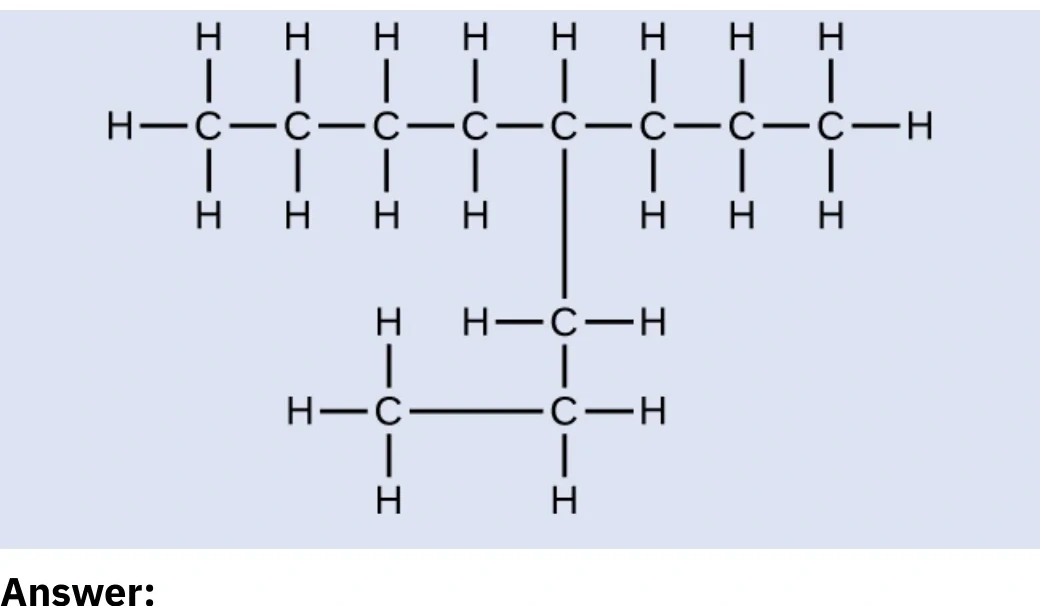
Check Your Learning: name the molecule shown. Answer: 4-propyloctane.
◀ Previous11 / 20Next ▶
The molecule for the Example 20.4 practice question: an eight-carbon chain with a three-carbon branch. Image: OpenStax, Chemistry 2e, CC BY 4.0.
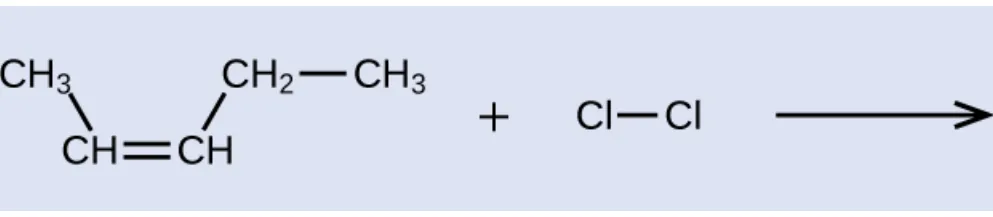
Example 20.5: Alkene reactivity and naming
 ⤢ Enlarge
1
Give the IUPAC names of the reactant and product of a halogenation reaction.
2
Working: the reactant has a five-carbon chain with a double bond
so its base name is pentene.
3
Counting from the end nearest the double bond puts it on carbons 2 and 3,
and the two groups on the same side of the bond make it the cis isomer, cis-2-pentene.
4
Chlorine adds across the double bond to give a substituted alkane with chlorines on carbons 2 and 3.
Numbering from the other end gives the lowest locations, so the product is 2,3-dichloropentane.
◀ Previous12 / 20Next ▶
The reactant of Example 20.5: a five-carbon alkene with its double bond and the chlorine molecule that adds to it. Image: OpenStax, Chemistry 2e, CC BY 4.0.
Example 20.5: Alkene reactivity and naming
◀ Previous13 / 20Next ▶
The product of Example 20.5, a five-carbon alkane with a chlorine atom on each of the two carbons that formed the former double bond. Image: OpenStax, Chemistry 2e, CC BY 4.0.
Example 20.5: Alkene reactivity and naming
 ⤢ Enlarge
Example 20.5: Alkene reactivity and naming
Check Your Learning: name the reactant and product of the reaction shown. Answer: reactant cis-3-hexene
product 3,4-dichlorohexane.
◀ Previous14 / 20Next ▶
The reactant for the Example 20.5 practice question, a six-carbon alkene reacting with chlorine. Image: OpenStax, Chemistry 2e, CC BY 4.0.
Example 20.6: Structure of alkynes
 ⤢ Enlarge
Example 20.6: Structure of alkynes
Describe the geometry and hybridization of the carbons in a molecule with a triple bond. Working: carbons 1 and 4 each have four single bonds
so they are tetrahedral with sp3 hybridization and bond angles of about 109.5°. Carbons 2 and 3 form the triple bondso they are linear, with sp hybridization and bond angles of 180°.
◀ Previous15 / 20Next ▶
The molecule of Example 20.6, a four-carbon alkyne with its carbons numbered 1 to 4 and the triple bond in the middle. Image: OpenStax, Chemistry 2e, CC BY 4.0.
Example 20.6: Structure of alkynes
 ⤢ Enlarge
Example 20.6: Structure of alkynes
Check Your Learning: identify the hybridization and bond angles at each carbon of the molecule shown. Answer: carbon 1 sp, 180°
carbon 2 sp, 180°carbon 3 sp2, 120°carbon 4 sp2, 120°carbon 5 sp3, 109.5°.
◀ Previous16 / 20Next ▶
The five-carbon molecule of the Example 20.6 practice question, with a triple bond at one end, a double bond and a methyl group. Image: OpenStax, Chemistry 2e, CC BY 4.0.
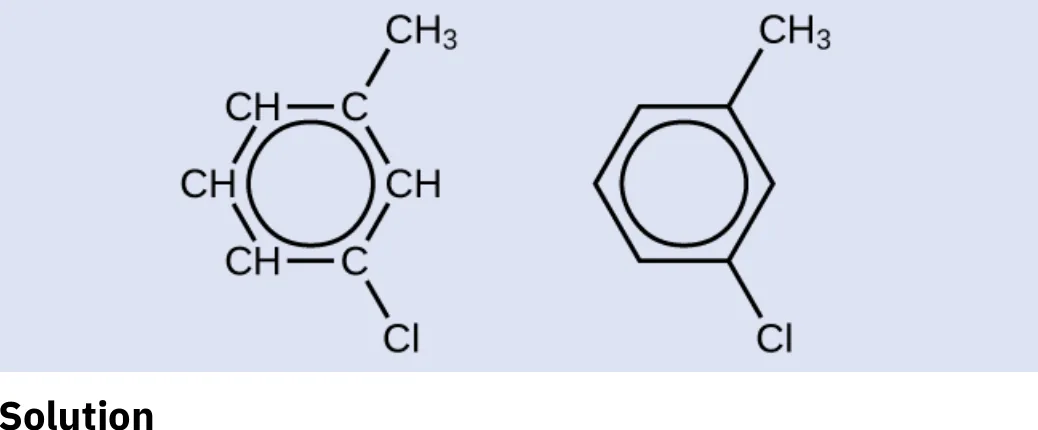
Example 20.7: Structure of aromatic hydrocarbons
 ⤢ Enlarge
1
One isomer of chlorotoluene is given, and two more must be drawn in which the chlorine replaces a different hydrogen on the ring.
2
Working: the six-carbon ring with alternating double bonds must stay intact,
so the only change allowed is the position of the chlorine relative to the methyl group.
3
Chlorine can sit next to the methyl group (ortho), one carbon further away (meta) or on the opposite corner (para).
◀ Previous17 / 20Next ▶
The chlorotoluene isomer given as the starting structure in Example 20.7, drawn in two styles. Image: OpenStax, Chemistry 2e, CC BY 4.0.
Example 20.7: Structure of aromatic hydrocarbons
◀ Previous18 / 20Next ▶
Chlorotoluene isomers in which the chlorine is moved to different positions on the ring relative to the methyl group. Image: OpenStax, Chemistry 2e, CC BY 4.0.
Example 20.7: Structure of aromatic hydrocarbons
 ⤢ Enlarge
Example 20.7: Structure of aromatic hydrocarbons
Check Your Learning: draw three isomers of a six-membered aromatic ring carrying two bromines. Answer: the three dibromobenzene isomers, with the bromines on adjacent carbons (ortho), on carbons separated by one carbon (meta) or on opposite carbons (para).
◀ Previous19 / 20Next ▶
The three dibromobenzene isomers, ortho, meta and para, drawn as ring structures. Image: OpenStax, Chemistry 2e, CC BY 4.0.
Example 20.7: Structure of aromatic hydrocarbons

◀ Previous20 / 20
Key terms
| Term | Meaning |
|---|---|
| Organic compound | A compound in which carbon is the main element, bonded to hydrogen and to other carbon atoms. |
| Hydrocarbon | An organic compound made only of carbon and hydrogen. |
| Alkane | A saturated hydrocarbon whose carbons are joined only by single bonds, with the general formula CnH2n+2 for noncyclic molecules. |
| Condensed formula | A structural formula that shows the bonding by grouping atoms in order, with most bond lines removed. |
| Skeletal structure | A line-angle drawing in which carbons are line ends or corners and hydrogens bonded to carbon are not drawn. |
| Structural isomer | A molecule with the same molecular formula as another but a different arrangement of its atoms. |
| Substituent | A branch or functional group that replaces a hydrogen atom on a carbon chain. |
| Alkyl group | A substituent formed by removing one hydrogen atom from an alkane, named by changing -ane to -yl. |
| Functional group | The part of a molecule that gives it a specific chemical reactivity. |
| Substitution reaction | A reaction in which one or more hydrogen atoms are replaced by another atom or group, with no carbon-carbon bonds broken. |
| Fractional distillation | A separation of a mixture into fractions by their boiling points, used to separate crude oil. |
| Combustion | A reaction with oxygen that releases a large amount of heat and produces carbon dioxide and water from a hydrocarbon. |
| Alkene | An unsaturated hydrocarbon that contains at least one carbon-carbon double bond. |
| Geometric isomer | An isomer in which the same atoms are joined in the same order but the groups on either side of a double bond point in different directions, such as cis and trans. |
| Addition reaction | A reaction in which a π bond breaks and two new σ bonds form to the added atoms. |
| Alkyne | An unsaturated hydrocarbon that contains at least one carbon-carbon triple bond. |
| Aromatic hydrocarbon | A hydrocarbon containing a ring structure whose bonding is delocalized, such as benzene. |
| Monomer | A small repeating unit that joins with many others to form a polymer. |
| Polymer | A large molecule made of many repeating monomer units. |
| Cracking | An industrial process that breaks long hydrocarbon chains into smaller molecules such as ethylene. |
1Avoid these mistakes2Avoid these mistakes3Avoid these mistakes