Curriculum
Course: Chemistry 2e
Login

Curriculum

Chemistry 2e

Unit 9: Gases

0/23 Dr Dabour Hub Science Diagram and Course Material

Unit 10: Liquids and Solids

0/28 Dr Dabour Hub Science Diagram and Course Material

Unit 12: Kinetics

0/32 Dr Dabour Hub Science Diagram and Course Material

Unit 14: Acid-Base Equilibria

0/32 Dr Dabour Hub Science Diagram and Course Material

Unit 17: Electrochemistry

0/32 Dr Dabour Hub Science Diagram and Course Material

Unit 18: Representative Metals, Metalloids, and Nonmetals

0/52 Dr Dabour Hub Science Diagram and Course Material

Unit 19: Transition Metals and Coordination Chemistry

0/16 Dr Dabour Hub Science Diagram and Course Material

Unit 21: Nuclear Chemistry

0/28 Dr Dabour Hub Science Diagram and Course Material
Text lesson

12.6 Reaction Mechanisms

12.6 Reaction Mechanisms — CHEMISTRY notes: You will be able to distinguish net reactions from elementary steps, identify molecularity, write an overall equation from a mechanism, and derive a rate law consistent with a proposed mechanism.
1Stepwise reactions and the reaction mechanism2Stepwise reactions and the reaction mechanism3Stepwise reactions and the reaction mechanism4Stepwise reactions and the reaction mechanism
Stepwise reactions and the reaction mechanism
A balanced equation tells you what reacts and what is produced

but it says nothing about how the reaction happens. Many reactions proceed in a sequence of distinct steps. The reaction mechanism (also called the reaction path) is the detailed, step-by-step account of how a reaction takes place.
The decomposition of ozone, for example, is believed to occur by a two-step mechanism.
In the first step, one O3 molecule breaks apart into an O2 molecule and an oxygen atom.
In the second step, the oxygen atom reacts with a second O3 molecule to form two more O2 molecules.
Each step is an elementary reaction, and the steps must add up to the balanced equation for the overall reaction.
An intermediate is a species that is produced in one step and consumed in a later step. In the ozone mechanism, the oxygen atom is an intermediate: it appears as a product of step 1 and as a reactant of step 2

so it cancels out of the overall equation and never appears in the net reaction.
1 / 4Next ▶
Stepwise reactions and the reaction mechanism
1

The overall equation for ozone decomposition shows two O3 molecules yielding three O2 molecules. The mechanism does not involve two ozone molecules colliding directly. Instead, one ozone molecule decomposes, and a second ozone molecule then reacts with the resulting oxygen atom.
2

Elementary reactions are different from overall reactions.

The equation for an elementary reaction describes exactly the bond-breaking and bond-making events that take place in that step.Because of this, the rate law for an elementary reaction can be written directly from its balanced equation.For a typical overall reaction, the rate law can only be found from experimental data.
3

Molecularity is the number of reactant particles (atoms, molecules or ions) that take part in an elementary reaction.

It is classified as unimolecular (one particle), bimolecular (two particles) or termolecular.(three particles)
4

Unimolecular elementary reactions involve a single reactant particle that breaks down or rearranges to give one or more product molecules.
5

Their rate law is first order in the reactant.
6

A unimolecular step can be one step in a multistep mechanism, or it can be the only step, in which case the overall reaction is also elementary.
◀ Previous2 / 4Next ▶
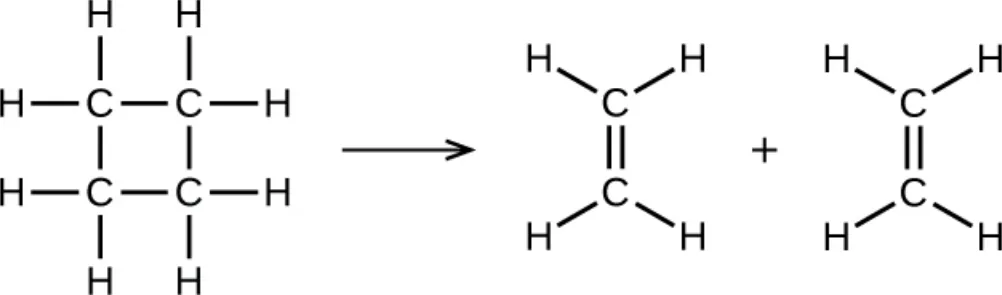
Cyclobutane (C4H8) breaks apart into two ethylene (C2H4) molecules in a single unimolecular step. Image: OpenStax, Chemistry 2e, CC BY 4.0.
Stepwise reactions and the reaction mechanism
Stepwise reactions and the reaction mechanism: Cyclobutane (C4H8) breaks apart into two ethylene (C2H4) molecules in a single unimolecular step." loading= - Dr Khaled Dabour Academy⤢ Enlarge
Stepwise reactions and the reaction mechanism
The gas-phase decomposition of cyclobutane, C4H8, into two ethylene molecules, C2H4, is an example of a single-step unimolecular reaction.
The diagram below shows cyclobutane splitting into two ethylene molecules.
The rate law predicted for this step, assuming it is elementary, matches the rate law found experimentally for the overall reaction. This first-order behavior agrees with the proposed single-step unimolecular mechanism

so that mechanism is considered reasonable.
Bimolecular elementary reactions involve two reactant particles.
If the two particles are different, the rate law is first order in each reactant and second order overall.
If two identical particles collide and react, the rate law is second order in that reactant.
◀ Previous3 / 4Next ▶
Probable single-step mechanism for NO2 reacting with CO to give NO and CO2, showing the transition state in the middle. Image: OpenStax, Chemistry 2e, CC BY 4.0.
Stepwise reactions and the reaction mechanism
Stepwise reactions and the reaction mechanism: Probable single-step mechanism for NO2 reacting with CO to give NO and CO2, showing the transition state in the middle." loading= - Dr Khaled Dabour Academy⤢ Enlarge
Stepwise reactions and the reaction mechanism
Some reactions occur by a single bimolecular step.
The reaction of nitrogen dioxide with carbon monoxide at high temperature is an example.
The mechanism is thought to involve a transition state in which the N and O atoms of NO2 and the C atom of CO are briefly bonded together before NO and CO2 form.
Bimolecular steps also appear inside multistep mechanisms. The reaction of an oxygen atom with ozone is the second step of the two-step ozone decomposition mechanism described earlier.
A termolecular elementary reaction requires three particles to collide at the same moment. This is rare

because the chance of three particles colliding simultaneously is less than one one-thousandth of the chance of two particles colliding. A few termolecular steps are known, such as steps in the reactions of nitric oxide with oxygen and with chlorine.
◀ Previous4 / 4

In a multistep mechanism, one step is usually much slower than the others.

  • A reaction cannot go faster than its slowest step,
    • so this slowest step is the rate-limiting step, also called the rate-determining step,
    • and it controls the overall rate.
  • A cattle chute is a useful everyday comparison: cattle can only leave a pen as fast as one animal can pass through the chute,
    • so the chute sets the pace for the whole process.

Rate-limiting step: A cattle chute: the narrow passage limits how fast the whole group can move, just as a slow step limits a reaction." loading= - Dr Khaled Dabour Academy
A cattle chute: the narrow passage limits how fast the whole group can move, just as a slow step limits a reaction. Image: OpenStax, Chemistry 2e, CC BY 4.0.

Rate laws derived directly from elementary steps work only for elementary reactions. For ordinary reactions the rate law must come from experiment, and the proposed mechanism must then be checked against it. A mechanism is acceptable only if the rate law it predicts matches the experimental rate law.

The reaction of NO2 with CO shows why this check matters.

  • Above 225 °C the experimental rate law is first order in NO2 and first order in CO, which agrees with the single bimolecular step.
  • Below 225 °C the experimental rate law is second order in NO2 and zero order in CO.
  • The single-step mechanism cannot explain this,
    • but a two-step mechanism can, in which the first step is a reaction of two NO2 molecules that produces NO and NO3,
      • (slow, rate-determining)
    • and the second step is a fast reaction between NO3 and CO.
  • The sum of the two steps gives the overall reaction.

When the rate-determining step is the first step, the overall rate law equals the rate law of that first step.

  • If a fast, reversible step comes before the rate-determining step, the rate law is harder to derive.
  • In that case the reversible step is at equilibrium,
    • and its equilibrium expression allows the concentration of an intermediate to be written in terms of reactants.
  • Intermediate concentrations do not appear in the final rate law, so this substitution is needed.

For example, NO can dimerize in a fast reversible step to form the intermediate N2O2. At equilibrium the forward and reverse rates are equal, which lets [N2O2] be written in terms of [NO]2 and the equilibrium constant. Substituting this into the rate expression removes the intermediate.

A related case arises when the slow step is the second step and its rate law contains an intermediate.

  • The overall rate law is then the rate law of the second step, but it cannot be used yet because it contains the intermediate concentration.
  • The first step, assumed to be at equilibrium, supplies an expression for that intermediate in terms of reactant concentrations.
  • Substituting this expression into the rate law of the second step gives a rate law that contains only reactants and matches the experiment.

Example 12.14: Deriving a rate law from a reaction mechanism

Problem: A two-step mechanism is proposed for the reaction between nitrogen monoxide and molecular chlorine. Step 1 is NO + Cl2 → NOCl2 (slow). Step 2 is NOCl2 + NO → 2 NOCl (fast). Find the overall equation and the rate law predicted by this mechanism.

Solution: Add the two steps and cancel the intermediate NOCl2, which is made in step 1 and used in step 2. The overall equation is 2 NO + Cl2 → 2 NOCl.

  • The rate of the slow first step is rate = k[NO][Cl2].
  • Because step 1 is rate-limiting, the predicted rate law is rate = k[NO][Cl2], first order in each reactant and third order overall.

Check: The overall reaction has two NO molecules and one Cl2 molecule on the reactant side, and the predicted rate law contains exactly those species. Any experimental rate law that differs from this would show the mechanism is wrong.

Check Your Learning: relating atomic and molecular fluorine concentrations

Question. Consider a first step in which molecular fluorine dissociates into two fluorine atoms and is at equilibrium: F2(g) ⇌ 2F(g). Derive the equation relating atomic fluorine concentration to molecular fluorine concentration.

Answer. The equilibrium constant is Kc = [F]2/[F2]. Solving for the atomic concentration gives [F] = √(Kc[F2]).

Term Meaning
Reaction mechanism The detailed, step-by-step sequence of elementary reactions by which an overall reaction takes place.
Elementary reaction A single reaction step whose equation describes exactly the bond-breaking and bond-making events that occur.
Intermediate A species that is formed in one step of a mechanism and consumed in a later step, so it does not appear in the overall equation.
Molecularity The number of reactant particles (atoms, molecules or ions) that take part in an elementary reaction.
Unimolecular reaction An elementary reaction involving one reactant particle; its rate law is first order.
Bimolecular reaction An elementary reaction involving two reactant particles that collide and react.
Termolecular reaction An elementary reaction involving the simultaneous collision of three particles; these are rare.
Rate-limiting step The slowest step in a mechanism, which controls the rate of the overall reaction. Also called the rate-determining step.
Transition state The short-lived arrangement of atoms at the highest-energy point of a reaction step, where bonds are partly broken and partly formed.
Rate law An equation that relates the reaction rate to the concentrations of reactants, each raised to an experimentally determined power.
Rapidly reversible step A fast step that reaches equilibrium before the slow step, and whose equilibrium expression can be used to eliminate an intermediate from the rate law.
1

Writing the rate law from the overall equation.

  • The rate law can be taken from the overall equation only for an elementary reaction; for a multistep mechanism it comes from the rate-limiting step.
2

Including an intermediate in the overall equation. Species that are made in one step and used in a later step cancel out when the steps are added.
3

Thinking the rate-limiting step is the fastest step. The slowest step controls the overall rate.
4

Assuming a termolecular step is common.

  • Three-particle collisions are very unlikely, so mechanisms with two bimolecular steps are preferred when both fit the data.
5

Using the coefficients of the overall equation as exponents in the rate law.

    Termolecular elementary reactions
    Termolecular elementary reactions
    A termolecular elementary reaction requires three particles to collide at the same moment. This is rare

    because the chance of three particles colliding simultaneously is less than one one-thousandth of the chance of two particles colliding. A few termolecular steps are known, such as steps in the reactions of nitric oxide with oxygen and with chlorine.
A cattle chute: the narrow passage limits how fast the whole group can move, just as a slow step limits a reaction. Image: OpenStax, Chemistry 2e, CC BY 4.0.
Rate-limiting step
Rate-limiting step: A cattle chute: the narrow passage limits how fast the whole group can move, just as a slow step limits a reaction." loading= - Dr Khaled Dabour Academy⤢ Enlarge
1

In a multistep mechanism, one step is usually much slower than the others.
2

A reaction cannot go faster than its slowest step,

so this slowest step is the rate-limiting step, also called the rate-determining step,and it controls the overall rate.
3

A cattle chute is a useful everyday comparison: cattle can only leave a pen as fast as one animal can pass through the chute,

so the chute sets the pace for the whole process.
1Relating mechanisms to rate laws2Relating mechanisms to rate laws3Relating mechanisms to rate laws
Relating mechanisms to rate laws
Rate laws derived directly from elementary steps work only for elementary reactions. For ordinary reactions the rate law must come from experiment, and the proposed mechanism must then be checked against it. A mechanism is acceptable only if the rate law it predicts matches the experimental rate law.
The reaction of NO2 with CO shows why this check matters.
Above 225 °C the experimental rate law is first order in NO2 and first order in CO

which agrees with the single bimolecular step.
Below 225 °C the experimental rate law is second order in NO2 and zero order in CO.
The single-step mechanism cannot explain this,

but a two-step mechanism can, in which the first step is a reaction of two NO2 molecules that produces NO and NO3,(slow, rate-determining)and the second step is a fast reaction between NO3 and CO.
The sum of the two steps gives the overall reaction.
1 / 3Next ▶
Relating mechanisms to rate laws
1

When the rate-determining step is the first step, the overall rate law equals the rate law of that first step.
2

If a fast, reversible step comes before the rate-determining step, the rate law is harder to derive.
3

In that case the reversible step is at equilibrium,

and its equilibrium expression allows the concentration of an intermediate to be written in terms of reactants.
4

Intermediate concentrations do not appear in the final rate law

so this substitution is needed.
5

For example, NO can dimerize in a fast reversible step to form the intermediate N2O2. At equilibrium the forward and reverse rates are equal

which lets [N2O2] be written in terms of [NO]2 and the equilibrium constant. Substituting this into the rate expression removes the intermediate.
6

A related case arises when the slow step is the second step and its rate law contains an intermediate.
◀ Previous2 / 3Next ▶
Relating mechanisms to rate laws
The overall rate law is then the rate law of the second step

but it cannot be used yet because it contains the intermediate concentration.
The first step, assumed to be at equilibrium, supplies an expression for that intermediate in terms of reactant concentrations.
Substituting this expression into the rate law of the second step gives a rate law that contains only reactants and matches the experiment.
◀ Previous3 / 3
1Example 12.14: Deriving a rate law from a reaction mechanism2Check Your Learning: relating atomic and molecular fluorine
Example 12.14: Deriving a rate law from a reaction mechanism
Problem: A two-step mechanism is proposed for the reaction between nitrogen monoxide and molecular chlorine. Step 1 is NO + Cl2 → NOCl2 (slow). Step 2 is NOCl2 + NO → 2 NOCl (fast). Find the overall equation and the rate law predicted by this mechanism.
Solution: Add the two steps and cancel the intermediate NOCl2

which is made in step 1 and used in step 2. The overall equation is 2 NO + Cl2 → 2 NOCl.
The rate of the slow first step is rate = k[NO][Cl2].
Because step 1 is rate-limiting, the predicted rate law is rate = k[NO][Cl2], first order in each reactant and third order overall.
Check: The overall reaction has two NO molecules and one Cl2 molecule on the reactant side, and the predicted rate law contains exactly those species. Any experimental rate law that differs from this would show the mechanism is wrong.
1 / 2Next ▶
Check Your Learning: relating atomic and molecular fluorine concentrations
1

Question. Consider a first step in which molecular fluorine dissociates into two fluorine atoms and is at equilibrium: F2(g) ⇌ 2F(g). Derive the equation relating atomic fluorine concentration to molecular fluorine concentration.
2

Answer. The equilibrium constant is Kc = [F]2/[F2]. Solving for the atomic concentration gives [F] = √(Kc[F2]).
◀ Previous2 / 2
Key terms
Term Meaning
Reaction mechanism The detailed, step-by-step sequence of elementary reactions by which an overall reaction takes place.
Elementary reaction A single reaction step whose equation describes exactly the bond-breaking and bond-making events that occur.
Intermediate A species that is formed in one step of a mechanism and consumed in a later step, so it does not appear in the overall equation.
Molecularity The number of reactant particles (atoms, molecules or ions) that take part in an elementary reaction.
Unimolecular reaction An elementary reaction involving one reactant particle; its rate law is first order.
Bimolecular reaction An elementary reaction involving two reactant particles that collide and react.
Termolecular reaction An elementary reaction involving the simultaneous collision of three particles; these are rare.
Rate-limiting step The slowest step in a mechanism, which controls the rate of the overall reaction. Also called the rate-determining step.
Transition state The short-lived arrangement of atoms at the highest-energy point of a reaction step, where bonds are partly broken and partly formed.
Rate law An equation that relates the reaction rate to the concentrations of reactants, each raised to an experimentally determined power.
Rapidly reversible step A fast step that reaches equilibrium before the slow step, and whose equilibrium expression can be used to eliminate an intermediate from the rate law.
1Avoid these mistakes2Avoid these mistakes3Avoid these mistakes
Avoid these mistakes
1Avoid this
Writing the rate law from the overall equation.Avoid this
The rate law can be taken from the overall equation only for an elementary reaction; for a multistep mechanism it comes from the rate-limiting step.Avoid this
2Avoid this
Including an intermediate in the overall equation. Species that are made in one step and used in a later step cancel out when the steps are added.Avoid this
3Avoid this
1 / 3Next ▶
Avoid these mistakes
Thinking the rate-limiting step is the fastest step. The slowest step controls the overall rate.Avoid this
4Avoid this
Assuming a termolecular step is common.Avoid this
Three-particle collisions are very unlikely, so mechanisms with two bimolecular steps are preferred when both fit the data.Avoid this
5Avoid this
Using the coefficients of the overall equation as exponents in the rate law.Avoid this
◀ Previous2 / 3Next ▶
Avoid these mistakes
Exponents must come from the reactants in the rate-determining step or from experiment.Avoid this
6Avoid this
Leaving an intermediate in the rate law. Use the equilibrium expression of a fast reversible step to replace it.Avoid this
◀ Previous3 / 3
Accepted payment methods
