Curriculum
Chemistry 2e
Unit 1: Essential Ideas
0/14
Unit 2: Atoms, Molecules, and Ions
0/16
Unit 3: Composition of Substances and Solutions
0/10
Unit 4: Stoichiometry of Chemical Reactions
0/12
Unit 5: Thermochemistry
0/8
Unit 6: Electronic Structure and Periodic Properties of Elements
0/12
Unit 7: Chemical Bonding and Molecular Geometry
0/14
Unit 8: Advanced Theories of Covalent Bonding
0/10
Unit 9: Gases
0/23
Unit 10: Liquids and Solids
0/28
Unit 11: Solutions and Colloids
0/24
Unit 12: Kinetics
0/32
Unit 13: Fundamental Equilibrium Concepts
0/20
Unit 14: Acid-Base Equilibria
0/32
Unit 15: Equilibria of Other Reaction Classes
0/16
Unit 16: Thermodynamics
0/20
Unit 17: Electrochemistry
0/32
Unit 18: Representative Metals, Metalloids, and Nonmetals
0/52
Unit 19: Transition Metals and Coordination Chemistry
0/16
Unit 20: Organic Chemistry
0/20
Unit 21: Nuclear Chemistry
0/28
-
Unit 21 overview: Nuclear Chemistry
 Preview
-
21.1 Nuclear Structure and Stability
Preview
-
21.1 Nuclear Structure and Stability - Check yourself
 Preview
-
21.1 Nuclear Structure and Stability
Preview
-
21.1 Nuclear Structure and Stability - Check yourself
Preview
-
21.2 Nuclear Equations
Preview
-
21.2 Nuclear Equations - Check yourself
Preview
-
21.2 Nuclear Equations
Preview
-
21.2 Nuclear Equations - Check yourself
Preview
-
21.3 Radioactive Decay
Preview
-
21.3 Radioactive Decay - Check yourself
Preview
-
21.3 Radioactive Decay
Preview
-
21.3 Radioactive Decay - Check yourself
Preview
-
Unit 21 review quiz: Nuclear Chemistry
Preview
-
Unit 21 overview: Nuclear Chemistry
Preview
-
21.4 Transmutation and Nuclear Energy
Preview
-
21.4 Transmutation and Nuclear Energy - Check yourself
Preview
-
21.4 Transmutation and Nuclear Energy
Preview
-
21.4 Transmutation and Nuclear Energy - Check yourself
Preview
-
21.5 Uses of Radioisotopes
Preview
-
21.5 Uses of Radioisotopes - Check yourself
Preview
-
21.5 Uses of Radioisotopes
Preview
-
21.5 Uses of Radioisotopes - Check yourself
Preview
-
21.6 Biological Effects of Radiation
Preview
-
21.6 Biological Effects of Radiation - Check yourself
Preview
-
21.6 Biological Effects of Radiation
Preview
-
21.6 Biological Effects of Radiation - Check yourself
Preview
-
Unit 21 review quiz: Nuclear Chemistry
Preview
Text lesson
21.3 Radioactive Decay
21.3 Radioactive Decay — CHEMISTRY notes: You will be able to recognize the common modes of radioactive decay, write and balance nuclear equations, calculate half-life and decay constants, and explain how radiometric dating uses these ideas.
1Radioactive decay2Radioactive decay3Radioactive decay
Radioactive decay
Radioactive decay
Radioactive decay is the spontaneous change of an unstable nuclide into a different nuclide.
The unstable nuclide is called the parent nuclide, and the nuclide that forms from it is the daughter nuclide.
The daughter nuclide may be stable, or it may decay again.
Radiation is emitted during decay in such a way that the daughter lies closer to the band of stability than the parent.
This means the position of a nuclide relative to the band of stability tells us what kind of decay it is likely to undergo.
Radioactivity was discovered by Becquerel, and Marie Curie coined the term.
1 / 3Next ▶
Radioactive decay
1
Ernest Rutherford investigated and named the three most common types of radiation.
2
Decay is too small to see directly,
3
but it can be observed indirectly in a cloud chamber,
4
where the tracks of radiation show up as lines of condensed vapor.
5
Demonstrations of this kind are a useful way to connect the abstract idea of decay to something visible.
6
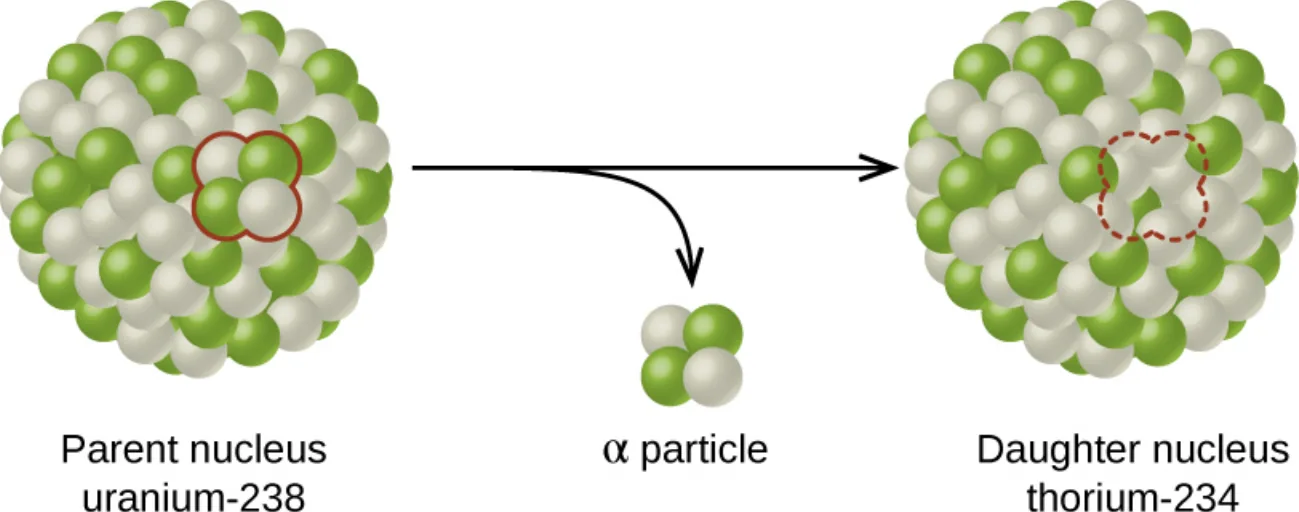
The figure below shows a uranium-238 nucleus, the parent, emitting an alpha particle to become thorium-234, the daughter.
◀ Previous2 / 3Next ▶
An alpha decay in which a uranium-238 nucleus loses an alpha particle, made of two protons and two neutrons, and becomes thorium-234. Image: OpenStax, Chemistry 2e, CC BY 4.0.
Radioactive decay
 ⤢ Enlarge
Radioactive decay
The alpha particle carries away two protons and two neutrons.
◀ Previous3 / 3
1Types of radioactive decay2Types of radioactive decay3Types of radioactive decay4Types of radioactive decay5Types of radioactive decay6Types of radioactive decay
Types of radioactive decay
Types of radioactive decay
Rutherford passed radiation through a magnetic or electric field and saw three different behaviors.
One type was deflected toward the negative plate and was positively charged and fairly massive.
This is the alpha particle
which is in fact a high-energy helium nucleus.
A second type was deflected strongly toward the positive plate and was negatively charged and very light.
This is the beta particle
which is a high-energy electron.
The third type was not deflected at all
so it is uncharged.
1 / 6Next ▶
Deflection of alpha, beta and gamma radiation in an electric field, showing the charge and relative mass of each type. Image: OpenStax, Chemistry 2e, CC BY 4.0.
Types of radioactive decay
 ⤢ Enlarge
1
This is the gamma ray
which is high-energy electromagnetic radiation.
2
Each type of decay is classified by the radiation it produces.
3
Alpha decay is the emission of an alpha particle from the nucleus. Alpha decay occurs mainly in heavy nuclei, with mass numbers above about 200 and atomic numbers above 83. For example, polonium-210 decays by alpha emission to lead-206:
4
21084Po → 20682Pb + 42He
5
Losing an alpha particle lowers the mass number by four and the atomic number by two. The daughter therefore has a higher neutron-to-proton (n:p) ratio than the parent. If the parent lies below the band of stability, the daughter moves closer to it.
6
Beta decay is the emission of an electron from the nucleus. Beta decay can be viewed as a neutron changing into a proton and an electron, and the electron is ejected from the nucleus. It is not one of the electrons that surround the nucleus. For example, iodine-131 decays by beta emission:
◀ Previous2 / 6Next ▶
Types of radioactive decay
1
13153I → 13154Xe + 0−1e
2
Beta decay occurs in nuclides with a large n:p ratio
which lie above the band of stability. The mass number does not changebut the number of protons goes up by one and the number of neutrons goes down by one. The n:p ratio therefore falls, and the daughter lies nearer the band.
3
Gamma emission (γ emission) happens when a nucleus is formed in an excited state and then drops to its ground state by releasing a gamma ray. The excited state is often marked with an asterisk (*). Cobalt-60 emits gamma radiation, and this is used in cancer treatment:
4
6027Co* → 6027Co + γ
5
Gamma emission alone does not change the mass number or the atomic number. It changes only when gamma emission accompanies another type of decay.
6
Positron emission (β+ decay) is the emission of a positron
which is a particle with the mass of an electron and a positive charge, from the nucleus. Oxygen-15 undergoes this type of decay:
◀ Previous3 / 6Next ▶
Types of radioactive decay
Types of radioactive decay
158O → 157N + 0+1e
Positron emission occurs in nuclides with a low n:p ratio
which lie below the band of stability. A proton is converted into a neutron. The atomic number falls by one while the mass number stays the sameso the n:p ratio rises and the daughter moves toward the band.
Electron capture happens when an inner-shell electron is pulled into the nucleus and combines with a proton to form a neutron. Potassium-40 is an example:
4019K + 0−1e → 4018Ar
The loss of an inner electron leaves a vacancy.
An outer electron drops into the vacancy and releases energy, usually as an X-ray.
◀ Previous4 / 6Next ▶
Types of radioactive decay
1
Electron capture has the same effect on the nucleus as positron emission: the atomic number drops by one and the mass number does not change.
2
It also occurs in proton-rich nuclei below the band of stability.
3
Which of the two happens is hard to predict.
4
The choice depends mainly on kinetic factors, and the process with the smaller activation energy is the more likely one.
5
The table below summarizes each type of decay, its nuclear equation, and the change in atomic and mass numbers.
◀ Previous5 / 6Next ▶
A summary table of the types of decay, showing the nuclear equation and the change in atomic and mass numbers for each. Image: OpenStax, Chemistry 2e, CC BY 4.0.
Types of radioactive decay

◀ Previous6 / 6
1PET scan2PET scan3PET scan
PET scan
PET scan
Positron emission tomography (PET) is a medical imaging method.
It shows how parts of the body function, rather than only their structure.
To make a PET scan, a positron-emitting radioisotope is produced in a cyclotron and attached to a compound that the body part being studied uses.
This tagged compound is called a radiotracer.
It is given to the patient by injection or by breathing, and the way the tissue uses it reveals how that organ or area works.
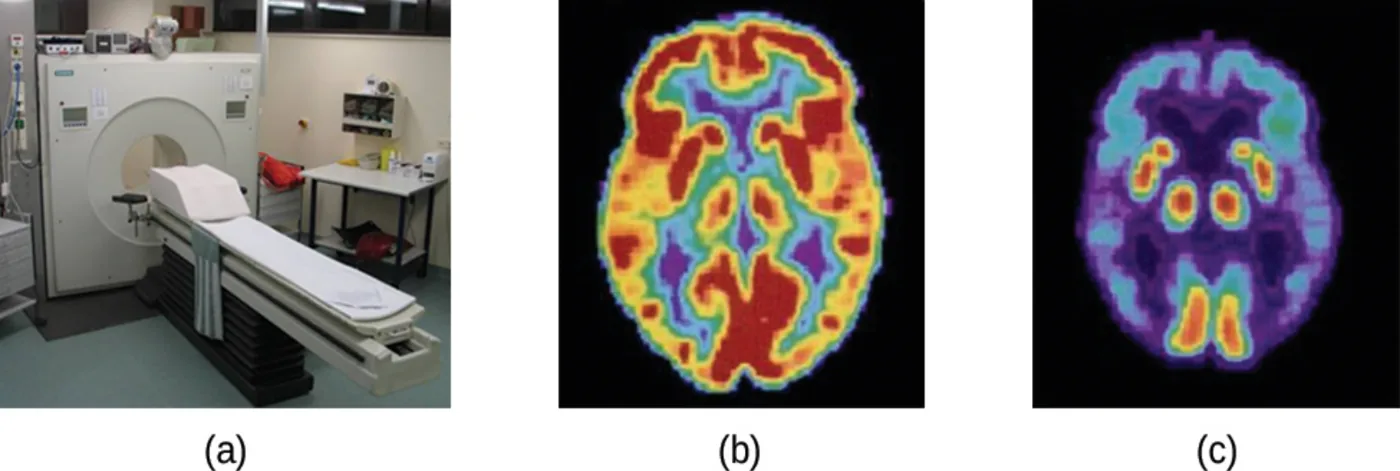
The figure below shows a PET scanner, along with brain images used to study normal function and disease.
1 / 3Next ▶
A PET scanner, and PET images of a healthy brain and of a brain affected by Alzheimer disease. Image: OpenStax, Chemistry 2e, CC BY 4.0.
PET scan
 ⤢ Enlarge
1
In a common scan, fluorine-18 is made by proton bombardment of oxygen-18 and built into fludeoxyglucose (FDG), a glucose analog.
2
Cancers use glucose differently from normal tissue
so FDG can reveal tumors.
3
The fluorine-18 emits positrons, and each positron meets an electron and produces gamma radiation.
4
The scanner detects this radiation and builds a three-dimensional color image.
5
A radiologist interprets the brightness and colors to see what is happening.
6
PET can detect heart damage, help diagnose Alzheimer disease, locate the part of the brain involved in epilepsy, show the stage and spread of cancer,
and show whether treatment is working.
◀ Previous2 / 3Next ▶
PET scan
1
Unlike MRI and X-rays
which show only what something looks like, PET shows how it functions.
2
PET is now usually combined with computed tomography (CT).
◀ Previous3 / 3
1Radioactive decay series2Radioactive decay series
Radioactive decay series
Radioactive decay series
The naturally occurring radioactive isotopes of the heaviest elements form chains of successive decays.
All the species in one chain make up a radioactive family, or decay series.
Three series contain most of the naturally radioactive elements: the uranium series, the actinide series and the thorium series.
A fourth, the neptunium series, is no longer important on Earth because its members have short half-lives.
Each series begins with a parent that has a long half-life, followed by daughters that finally reach a stable end product on the band of stability.
In all three natural series the end product is a stable isotope of lead.
1 / 2Next ▶
The uranium-238 decay series, with its many alpha and beta steps, ending in stable lead-206. Image: OpenStax, Chemistry 2e, CC BY 4.0.
Radioactive decay series
 ⤢ Enlarge
1
The neptunium series was once thought to end at bismuth-209
but it actually ends at thallium-205.
2
The figure below shows the uranium-238 series. It has 14 separate steps, made up of eight alpha decays and six beta decays, before it produces stable lead-206.
◀ Previous2 / 2
1Radioactive half-lives2Radioactive half-lives3Radioactive half-lives
Radioactive half-lives
Radioactive half-lives
Radioactive decay is a first-order process
so the kinetics ideas from the chapter on chemical kinetics apply directly.
Each radioactive nuclide has a constant half-life (t1/2)
which is the time needed for half of the atoms in a sample to decay.
Half-lives tell us how long a useful isotope will remain available,
and how long a dangerous isotope must be stored before its radiation falls to a safe level.
Cobalt-60 has a half-life of 5.27 years.
Every 5.27 years half of its nuclei decay
so both the amount of material and the radiation intensity are halved.
The intensity of radiation from a sample is proportional to both the rate of decay and the amount of substance.
1 / 3Next ▶
The fraction of a cobalt-60 sample remaining after one, two and three half-lives, falling by half each time. Image: OpenStax, Chemistry 2e, CC BY 4.0.
Radioactive half-lives
 ⤢ Enlarge
Radioactive half-lives
This is why a cobalt-60 source used for cancer treatment must be replaced regularly.
The figure below shows the fraction of cobalt-60 that remains after one, two and three half-lives.
Because the rate of decay is the amount of nuclei multiplied by the decay constant, the rate of radioactive decay is written as rate = λN.
Here λ is the decay constant of the particular radioisotope, in units of inverse time.
The decay constant is the same as a first-order rate constant.
The decay constant is related to the half-life by:
◀ Previous2 / 3Next ▶
Radioactive half-lives
1
λ = 0.693 / t1/2
2
The first-order integrated equation relates the amount remaining to the time elapsed:
3
Nt = N0e−λt and t = (1/λ) ln(N0/Nt)
4
In these equations N0 is the initial number of nuclei (or moles) of the isotope, Nt is the number remaining at time t, and λ is the decay constant in units of inverse time. When the rate is given in disintegrations per second, the rate is called the activity of the sample.
◀ Previous3 / 3
Half-lives of radioactive isotopes important to medicine
1
Half-lives make some isotopes suitable for medicine. Table 21.2 lists several medical isotopes with their decay mode, half-life and use. The metastable isotope technetium-99m (the m stands for metastable) is an unstable, high-energy state of Tc-99 that releases gamma radiation to become more stable.
2
A short half-life, such as the 110 minutes of F-18, is needed for PET because the tracer must decay before it can harm the patient, yet last long enough to be made and used. Longer half-lives, such as years for cobalt-60, suit sources that must last a long time.
| Isotope | Decay mode | Half-life | Use |
|---|---|---|---|
| F-18 | β+ decay | 110 minutes | PET scans |
| Co-60 | β and γ decay | 5.27 years | cancer treatment |
| Tc-99m | γ decay | 8.01 hours | scans of brain, lung, heart and bone |
| I-131 | β decay | 8.02 days | thyroid scans and treatment |
| Tl-201 | electron capture | 73 hours | heart and artery scans; cardiac stress tests |
Radiometric dating
Radiometric dating
Radioisotopes with suitable half-lives can be used to date objects such as archaeological artifacts, once-living organisms and geological formations. This is called radiometric dating. It has been central to discoveries about the geological history of Earth, the evolution of life and the history of human civilization. The most common methods are described below.
1Radioactive dating using carbon-142Radioactive dating using carbon-143Radioactive dating using carbon-144Radioactive dating using carbon-14
Radioactive dating using carbon-14
1
Carbon-14 dating, also called radiocarbon dating, dates objects that were once part of a living organism.
2
It is accurate for materials up to about 30,000 years old and can give reasonable dates up to about 50,000 years.
3
Natural carbon is made of three isotopes.
4
Carbon-12 makes up about 99% of carbon on Earth, carbon-13 about 1%, and carbon-14 only trace amounts.
5
Carbon-14 forms in the upper atmosphere when cosmic-ray neutrons strike nitrogen-14 atoms:
6
147N + 10n → 146C + 11H
1 / 4Next ▶
Radioactive dating using carbon-14
Radioactive dating using carbon-14
All carbon isotopes react with oxygen to form CO2.
The ratio of carbon-14 to carbon-12 in the atmosphere is about 1 part per trillion,
and it has been nearly constant over time,as gas trapped in ice confirms.
Photosynthesis takes in carbon-14 and carbon-12 in the same ratio
so a living plant has the same ratio as the atmosphere.
When the plant dies, it stops taking in carbon.
Carbon-12 is stable
so its amount does not change.
Carbon-14, however, decays by beta emission with a half-life of 5730 years:
◀ Previous2 / 4Next ▶
Carbon-14 is held at a constant level in living things, then falls after death, so the carbon-14 to carbon-12 ratio shows how long ago the organism died. Image: OpenStax, Chemistry 2e, CC BY 4.0.
Radioactive dating using carbon-14
 ⤢ Enlarge
Radioactive dating using carbon-14
146C → 147N + 0−1e
After death, the carbon-14 to carbon-12 ratio falls with time. Measuring that ratio tells us how long ago the organism died. The figure below shows this process.
For example, if a wooden object from a dig has half the carbon-14 to carbon-12 ratio of a living tree, the wood is one half-life old, or 5730 years.
Very accurate ratios can be measured on samples as small as a milligram using a mass spectrometer.
Carbon-14 dating only works for about 10 half-lives
so its limit is about 57,000 years.
The method has a known complication.
◀ Previous3 / 4Next ▶
Radioactive dating using carbon-14
1
Burning fossil fuels adds carbon dioxide with no carbon-14
which lowers the carbon-14 ratio in the atmosphere and in living things.
2
Scientists correct for this with other data, such as counting the annual growth rings of trees
so accurate dates can still be found.
3
A simulation of radiometric dating is available online as a Link to Learning,
and it lets students explore how the half-life controls the dates obtained.
◀ Previous4 / 4
1Radioactive dating using nuclides other than carbon-142Radioactive dating using nuclides other than carbon-14
1Example 21.5: Rates of radioactive decay2Example 21.6: Radiocarbon dating3Example 21.6: Radiocarbon dating4Example 21.7: Radioactive dating of rocks5Example 21.7: Radioactive dating of rocks6Check your learning: age of a rock from rubidium-strontium d
Example 21.5: Rates of radioactive decay
1
Cobalt-60 decays with a half-life of 5.27 years.
2
(a) Decay constant. λ = 0.693 / 5.27 y = 0.132 y−1
3
(b) Fraction remaining after 15.0 years. Nt/N0 = e−λt = e−(0.132 y⁻¹)(15.0 y) = e−1.98 = 0.138. So 13.8% of the original sample remains after 15 years.
4
(c) Time for only 2.00% to remain. The remaining fraction is 0.0200 N0
so N0/Nt = 50.0. Then t = ln(50.0) / 0.132 y−1 = 3.912 / 0.132 y−1 = 29.6 years.
5
Check Your Learning. Radon-222 has a half-life of 3.823 days. How long will a 0.750 g sample take to decay until only 0.100 g of radon-222 remains? Answer: about 11.1 days. Working: λ = 0.693 / 3.823 d = 0.1813 d−1
t = ln(0.750/0.100) / 0.1813 d−1 = 2.015 / 0.1813 d−1 = 11.1 days.
1 / 6Next ▶
Example 21.6: Radiocarbon dating
Example 21.6: Radiocarbon dating
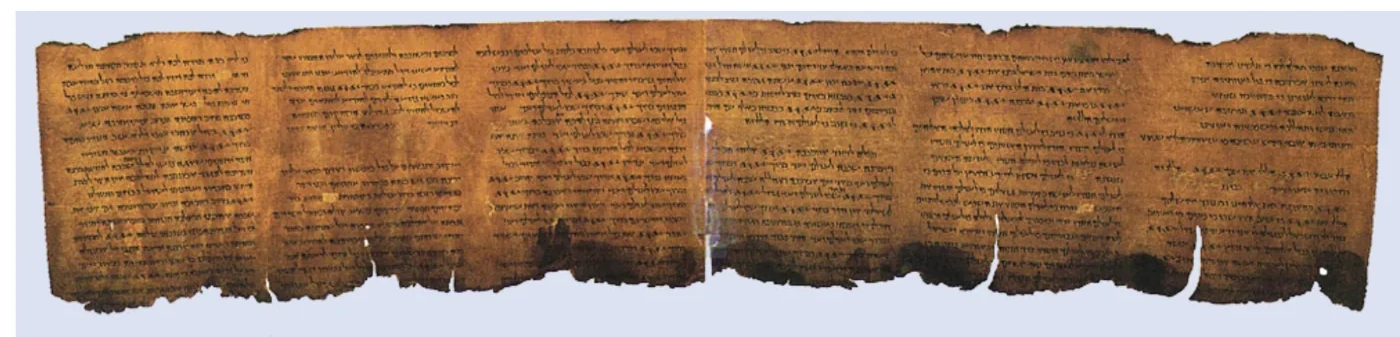
A small piece of paper made from plant matter, taken from the Dead Sea Scrolls, has an activity of 10.8 disintegrations per minute per gram of carbon. The initial carbon-14 activity was 13.6 disintegrations per minute per gram of carbon. Estimate the age of the scrolls.
Solution. Activity is proportional to the amount of carbon-14 left
so the rates can stand in for the amounts. λ = 0.693 / 5730 y = 1.21 × 10⁻⁴ y−1.
Then t = (1/λ) ln(A0/At) = ln(13.6/10.8) / (1.21 × 10⁻⁴ y−1) = 0.2305 / (1.21 × 10⁻⁴ y−1) ≈ 1900 years.
The scrolls are about 1900 years old.
The figure below shows pages from the scrolls
which were made from plants that died between 100 BC and AD 50.
◀ Previous2 / 6Next ▶
Pages from the Dead Sea Scrolls, whose paper was made from plants that died between 100 BC and AD 50, as found by carbon-14 dating. Image: OpenStax, Chemistry 2e, CC BY 4.0.
Example 21.6: Radiocarbon dating
 ⤢ Enlarge
Example 21.6: Radiocarbon dating
Check Your Learning. Samples of seeds and plant matter from the tomb of King Tutankhamun have a carbon-14 decay rate of 9.07 disintegrations per minute per gram of carbon. Assuming an initial rate of 13.6, how long ago did his reign end? Answer: about 3350 years ago, or approximately 1340 BC. Working: t = ln(13.6/9.07) / (1.21 × 10⁻⁴ y−1) = 0.4053 / (1.21 × 10⁻⁴ y−1) ≈ 3350 years.
◀ Previous3 / 6Next ▶
Example 21.7: Radioactive dating of rocks
1
An igneous rock contains 9.58 × 10⁻⁵ g of uranium-238 and 2.51 × 10⁻⁵ g of lead-206, with much smaller amounts of lead-208. Find the approximate time since the rock formed.
2
Solution. Lead-208 is very scarce
so all the lead-206 came from uranium-238 decay.
3
Molar masses are 238.05 g/mol for uranium-238 and 205.97 g/mol for lead-206. Moles of uranium-238 now: 9.58 × 10⁻⁵ g / 238.05 g/mol = 4.02 × 10⁻⁷ mol.
4
Moles of lead-206: 2.51 × 10⁻⁵ g / 205.97 g/mol = 1.22 × 10⁻⁷ mol.
5
Each mole of uranium-238 that decays makes one mole of lead-206
so the original uranium was 4.02 × 10⁻⁷ + 1.22 × 10−7 = 5.24 × 10⁻⁷ mol.
6
The ratio N0/Nt = 5.24 / 4.02 = 1.30. The decay constant from the 4.5 × 10⁹ y half-life is λ = 0.693 / 4.5 × 10⁹ y = 1.54 × 10⁻¹⁰ y−1.
◀ Previous4 / 6Next ▶
Example 21.7: Radioactive dating of rocks
1
So t = ln(1.30) / (1.54 × 10⁻¹⁰ y−1) ≈ 1.72 × 10⁹ years.
2
The rock formed about 1.72 billion years ago.
◀ Previous5 / 6Next ▶
Check your learning: age of a rock from rubidium-strontium dating
Check your learning: age of a rock from rubidium-strontium dating
Problem. A rock contains 6.14 × 10⁻⁴ g of Rb-87 and 3.51 × 10⁻⁵ g of Sr-87, its daughter. Rb-87 decays by β emission with a half-life of 4.7 × 10¹⁰ y. Calculate the age of the rock.
Answer. About 3.7 to 3.8 × 10⁹ years, depending on rounding.
The working: the original amount of Rb-87 is the Rb-87 remaining plus the Sr-87 formed,
so N0/Nt = (6.14 × 10⁻⁴ g + 3.51 × 10⁻⁵ g) / 6.14 × 10⁻⁴ g = 1.057.The decay constant is λ = 0.693 / 4.7 × 10¹⁰ y = 1.47 × 10⁻¹¹ y−1.
Then t = ln(1.057) / (1.47 × 10⁻¹¹ y−1) ≈ 3.8 × 10⁹ years.
Both isotopes have the same mass number
so the mass ratio can be used directly.
◀ Previous6 / 6
Key terms
| Term | Meaning |
|---|---|
| Radioactive decay | The spontaneous change of an unstable nuclide into another nuclide, with emission of radiation. |
| Parent nuclide | The unstable nuclide that undergoes radioactive decay. |
| Daughter nuclide | The nuclide formed by the decay of a parent nuclide. |
| Alpha particle | A positively charged, relatively massive particle that is a high-energy helium nucleus. |
| Alpha decay | Emission of an alpha particle from a nucleus, lowering the mass number by 4 and the atomic number by 2. |
| Beta particle | A high-energy electron emitted from the nucleus during beta decay. |
| Beta decay | Emission of an electron from the nucleus, which converts a neutron into a proton. |
| Gamma emission | Release of a gamma ray when an excited nucleus drops to its ground state; mass and atomic numbers do not change. |
| Positron emission (β+ decay) | Emission of a positron from the nucleus, which converts a proton into a neutron. |
| Electron capture | Capture of an inner-shell electron by the nucleus, which combines it with a proton to form a neutron. |
| Radioactive decay series | A chain of successive decays of heavy radioactive nuclides that ends in a stable isotope. |
| Half-life (t1/2) | The time required for half of the atoms in a sample to decay. |
| Decay constant (λ) | The first-order rate constant for radioactive decay, in units of inverse time. |
| Activity | The rate of nuclear decay of a radioactive sample, expressed in disintegrations per unit time. |
| PET scan | A positron emission tomography image that shows how parts of the body function. |
| Radiotracer | A radioactive compound that is put into the body so its use by tissue can be tracked. |
| Radiometric dating | Using the decay of radioisotopes to determine the age of objects or geological formations. |
| Radiocarbon dating | Dating of once-living material using the carbon-14 to carbon-12 ratio. |
1Avoid these mistakes2Avoid these mistakes3Avoid these mistakes4Avoid these mistakes