Curriculum
Chemistry 2e
Unit 1: Essential Ideas
0/14
Unit 2: Atoms, Molecules, and Ions
0/16
Unit 3: Composition of Substances and Solutions
0/10
Unit 4: Stoichiometry of Chemical Reactions
0/12
Unit 5: Thermochemistry
0/8
Unit 6: Electronic Structure and Periodic Properties of Elements
0/12
Unit 7: Chemical Bonding and Molecular Geometry
0/14
Unit 8: Advanced Theories of Covalent Bonding
0/10
Unit 9: Gases
0/23
Unit 10: Liquids and Solids
0/28
-
Unit 10 overview: Liquids and Solids
 Preview
-
10.1 Intermolecular Forces
Preview
-
Unit 10 overview: Liquids and Solids
Preview
-
10.1 Intermolecular Forces
Preview
-
10.1 Intermolecular Forces - Check yourself
 Preview
-
10.1 Intermolecular Forces - Check yourself
Preview
-
10.2 Properties of Liquids
Preview
-
10.2 Properties of Liquids - Check yourself
Preview
-
10.2 Properties of Liquids
Preview
-
10.2 Properties of Liquids - Check yourself
Preview
-
10.3 Phase Transitions
Preview
-
10.3 Phase Transitions - Check yourself
Preview
-
10.3 Phase Transitions
Preview
-
10.3 Phase Transitions - Check yourself
Preview
-
10.4 Phase Diagrams
Preview
-
10.4 Phase Diagrams
Preview
-
10.4 Phase Diagrams - Check yourself
Preview
-
10.4 Phase Diagrams - Check yourself
Preview
-
10.5 The Solid State of Matter
Preview
-
10.5 The Solid State of Matter
Preview
-
10.5 The Solid State of Matter - Check yourself
Preview
-
10.5 The Solid State of Matter - Check yourself
Preview
-
10.6 Lattice Structures in Crystalline Solids
Preview
-
10.6 Lattice Structures in Crystalline Solids
Preview
-
10.6 Lattice Structures in Crystalline Solids - Check yourself
Preview
-
10.6 Lattice Structures in Crystalline Solids - Check yourself
Preview
-
Unit 10 review quiz: Liquids and Solids
Preview
-
Unit 10 review quiz: Liquids and Solids
Preview
Unit 11: Solutions and Colloids
0/24
Unit 12: Kinetics
0/32
Unit 13: Fundamental Equilibrium Concepts
0/20
Unit 14: Acid-Base Equilibria
0/32
Unit 15: Equilibria of Other Reaction Classes
0/16
Unit 16: Thermodynamics
0/20
Unit 17: Electrochemistry
0/32
Unit 18: Representative Metals, Metalloids, and Nonmetals
0/52
Unit 19: Transition Metals and Coordination Chemistry
0/16
Unit 20: Organic Chemistry
0/20
Unit 21: Nuclear Chemistry
0/28
10.1 Intermolecular Forces
10.1 Intermolecular Forces — CHEMISTRY notes: You will be able to name the three types of intermolecular forces, identify which ones act between the particles of a given substance from its structure, and use those forces to explain differences in boiling and melting points.
 ⤢ Enlarge
 ⤢ Enlarge
 ⤢ Enlarge
 ⤢ Enlarge
London dispersion forces are present in all condensed phases, whatever the atoms or molecules are. The force is named after Fritz London, a German-born American physicist who first explained it in 1928. It is often called simply the dispersion force.
The electrons of an atom or molecule are in constant motion, so at any instant the electron distribution can be uneven.

Dispersion forces can attract two molecules even when they are not polar.
| Halogen | Molar mass (g/mol) | Atomic radius (pm) | Melting point (K) | Boiling point (K) |
|---|---|---|---|---|
| Fluorine, F2 | 38 | 72 | 53 | 85 |
| Chlorine, Cl2 | 71 | 99 | 172 | 238 |
| Bromine, Br2 | 160 | 114 | 266 | 332 |
| Iodine, I2 | 254 | 133 | 387 | 457 |
| Astatine, At2 | 420 | 150 | 575 | 610 |
- In a larger atom, the valence electrons are on average farther from the nucleus, so they are held less tightly.
- They form temporary dipoles more easily, which produces stronger attraction.
- such as a nearby ion or polar molecule, can distort the electron cloud of a molecule.
- A highly polarizable molecule has a cloud that is easily distorted and therefore has large dispersion forces.
- A molecule with a cloud that is hard to distort is weakly polarizable and has small dispersion forces.
Geckos, along with spiders and some insects, can climb smooth walls and walk across ceilings without suction cups or sticky fluid. A gecko can lift its feet easily as it walks, yet it sticks firmly if someone tries to pick it up. The explanation was uncovered only recently.
The toes of a gecko are covered with hundreds of thousands of tiny hairs called setae. Each seta branches into hundreds of flat, triangular tips called spatulae. The huge number of spatulae gives the gecko a large total surface area for contact. The figure below shows the hierarchy from the whole gecko down to the spatulae.

In 2000, Kellar Autumn and his research team showed that geckos stick equally well to polar silicon dioxide and to nonpolar gallium arsenide.
- which are weak attractions caused by temporary, synchronized charge distributions between neighboring molecules.
In 2014, researchers at Oregon State University proposed a model for how geckos switch quickly between sticky and non-sticky states.
Link to Learning: a video describes Kellar Autumn’s research, which showed that van der Waals forces allow a gecko to cling and climb. The point is the same as in the text: the attractions are very weak individually but add up across many contact points.
A polar molecule has a partial positive charge on one side and a partial negative charge on the other. This separation of charge is called a dipole. In hydrogen chloride, HCl, the more electronegative Cl atom carries the partial negative charge and the less electronegative H atom carries the partial positive charge.
The partially positive end of one HCl molecule attracts the partially negative end of another. This electrostatic attraction between polar molecules is a dipole-dipole attraction. The diagram below shows two arrangements of polar molecules that allow this attraction.

Compare HCl with the nonpolar F2.
Nitrosyl fluoride, ONF, has a molar mass of 49 amu and is a gas at room temperature.
Hydrogen bonding occurs when a hydrogen atom is bonded to a fluorine, oxygen or nitrogen atom, the three most electronegative elements.
- so molecules with F–H, O–H or N–H groups attract similar groups in neighboring molecules very strongly.
The word bond can be misleading. Hydrogen bonds are intermolecular attractions, not the covalent bonds inside a molecule. A hydrogen bond is only about 5 to 10 percent as strong as a covalent bond, but it is generally much stronger than other dipole-dipole attractions and dispersion forces.
Hydrogen bonding strongly affects the properties of liquids and solids.
- As we move down any of these groups, molecules become slightly less polar but much larger.
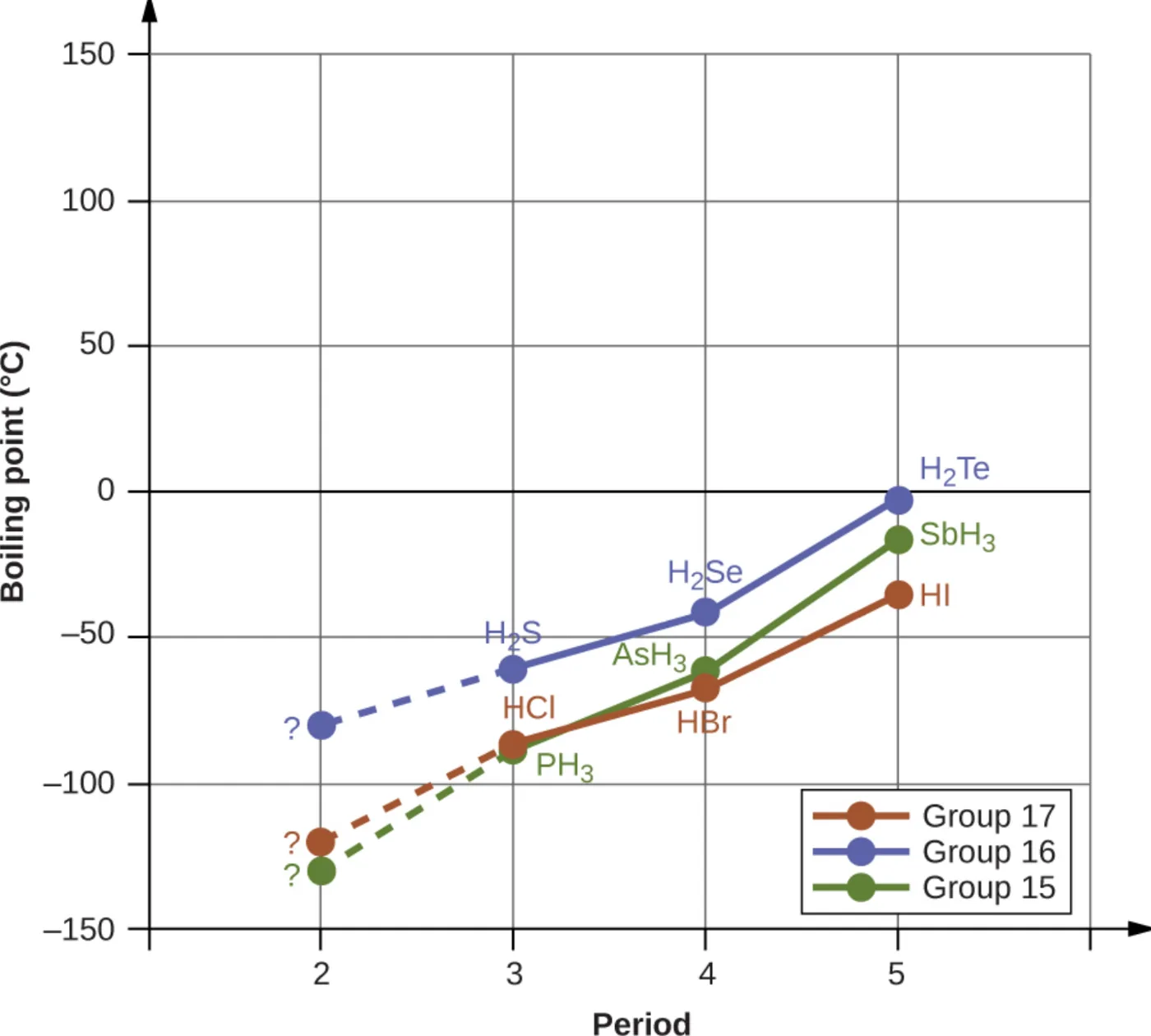
Extending this trend to the lightest hydride of each group predicts boiling points of about −120 °C for NH3, about −80 °C for H2O and about −110 °C for HF.
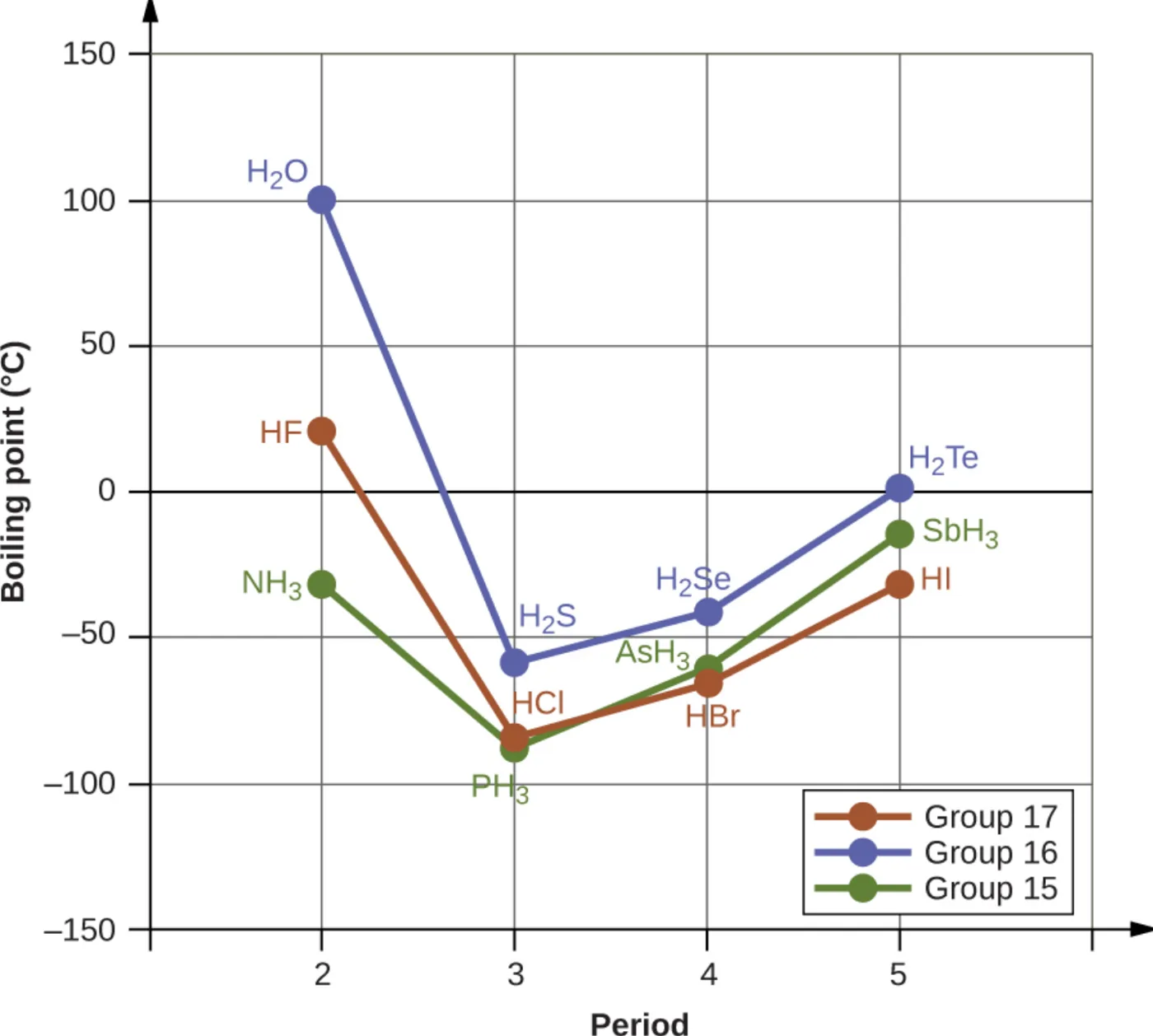
The large gap between the predicted and measured values is strong evidence for the strength of hydrogen bonding.
Deoxyribonucleic acid, DNA, is found in every living organism.
- and serves as a template for passing that information to offspring.
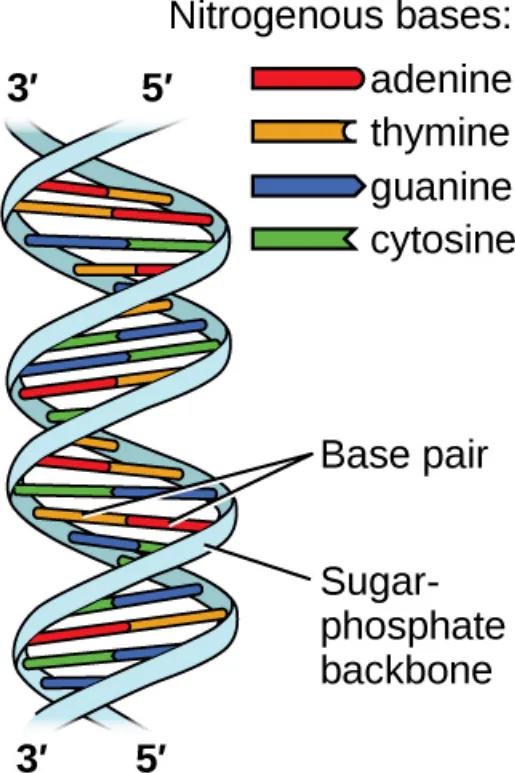
Each nucleotide contains a deoxyribose sugar bonded to a phosphate group on one side, and one of four nitrogenous bases on the other.

The combined effect of millions of hydrogen bonds holds the two DNA strands together. Hydrogen bonds are much weaker than the covalent bonds that join the atoms within each strand, so the two strands can unzip relatively easily down the middle. Each separated strand then acts as a template, which allows both strands to be copied during replication.
Example 10.1: London forces and their effects
Problem: Order CH4, SiH4, GeH4 and SnH4 from lowest to highest boiling point, and explain the reasoning.
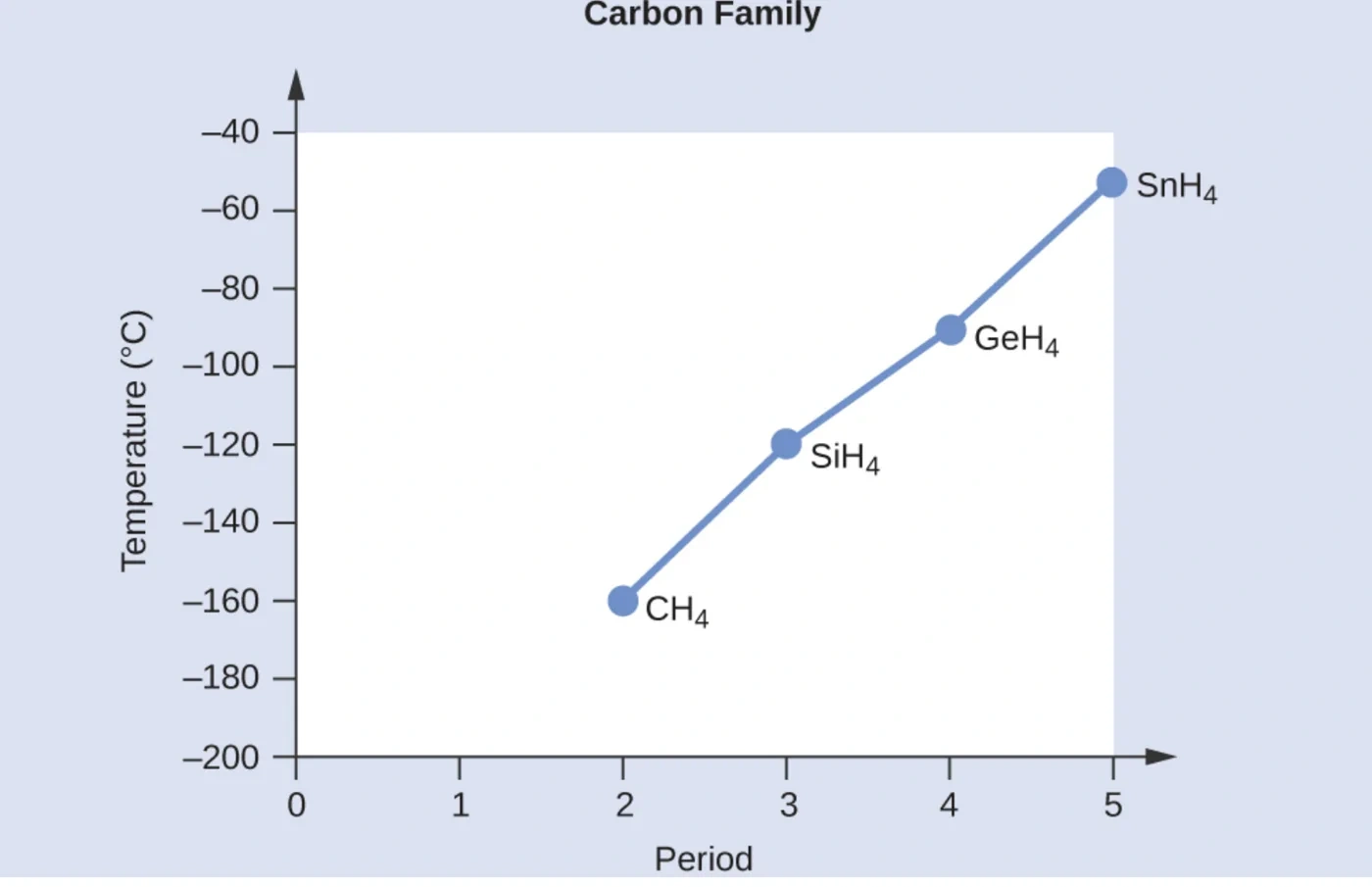
Solution: All four compounds of a group 14 element with hydrogen are nonpolar, so they experience only dispersion forces.
Check Your Learning: Order C2H6, C3H8 and C4H10 from lowest to highest boiling point. Answer: C2H6 < C3H8 < C4H10. All are nonpolar with only dispersion forces, and the larger the molecule, the stronger the dispersion forces and the higher the boiling point.
Example 10.2: Dipole-dipole forces and their effects
Problem: Predict which has the higher boiling point, N2 or CO, and explain.
Solution: CO and N2 are both diatomic with masses of about 28 amu, so they have similar dispersion forces. CO is polar and so has dipole-dipole attractions, while N2 is nonpolar and cannot have them. The dipole-dipole attractions between CO molecules are stronger than the dispersion forces between N2 molecules, so CO has the higher boiling point.
Check Your Learning: Predict which has the higher boiling point, ICl or Br2. Answer: ICl. The two have similar masses of about 160 amu and similar dispersion forces. ICl is polar and also has dipole-dipole attractions, while Br2 does not. The stronger dipole-dipole attractions need more energy to overcome, so ICl boils higher.
Example 10.3: Effect of hydrogen bonding on boiling points
Problem: The compounds dimethyl ether (CH3OCH3), ethanol (CH3CH2OH) and propane (CH3CH2CH3) have boiling points of −42.1 °C, −24.8 °C and 78.4 °C, in no particular order. Match each compound to its boiling point and explain.
Solution: The three molecules have similar shapes and molar masses of 46, 46 and 44 g/mol, so their dispersion forces are similar.
Check Your Learning: Ethane (CH3CH3) melts at −183 °C and boils at −89 °C.
- but methylamine has an −NH group and can form hydrogen bonds,
- which greatly increases its intermolecular forces.
| Term | Meaning | ||||||||||||||||||||||||||||||||||||||||||||||||||||||||||
|---|---|---|---|---|---|---|---|---|---|---|---|---|---|---|---|---|---|---|---|---|---|---|---|---|---|---|---|---|---|---|---|---|---|---|---|---|---|---|---|---|---|---|---|---|---|---|---|---|---|---|---|---|---|---|---|---|---|---|---|
| Intermolecular forces (IMFs) | The attractive forces between the atoms or molecules of a substance, arising from electrostatic effects, which hold particles close together. | ||||||||||||||||||||||||||||||||||||||||||||||||||||||||||
| Intermolecular attraction | An informal name for the attractive forces between particles of a substance, whether they are molecules, atoms or ions. | ||||||||||||||||||||||||||||||||||||||||||||||||||||||||||
| Intramolecular forces | The bonds, such as covalent bonds, that hold the atoms of one molecule together. | ||||||||||||||||||||||||||||||||||||||||||||||||||||||||||
| Van der Waals forces | The collective name for all attractive forces between neutral atoms and molecules. | ||||||||||||||||||||||||||||||||||||||||||||||||||||||||||
| London dispersion force | A weak attraction present in all condensed phases, caused by temporary, instantaneous dipoles in neighboring atoms or molecules. | ||||||||||||||||||||||||||||||||||||||||||||||||||||||||||
| Temporary dipole | A short-lived separation of charge in an atom or molecule, caused by an uneven distribution of its electrons at a given instant. | ||||||||||||||||||||||||||||||||||||||||||||||||||||||||||
| Induced dipole | A dipole produced in a neighboring atom or molecule when a nearby temporary dipole distorts its electron cloud. | ||||||||||||||||||||||||||||||||||||||||||||||||||||||||||
| Polarizability | How easily an electric charge can distort the electron cloud of an atom or molecule; higher polarizability means stronger dispersion forces. | ||||||||||||||||||||||||||||||||||||||||||||||||||||||||||
| Dipole | A separation of partial positive and partial negative charge within a molecule. | ||||||||||||||||||||||||||||||||||||||||||||||||||||||||||
| Dipole-dipole attraction | The electrostatic attraction between the partially positive end of one polar molecule and the partially negative end of another. | ||||||||||||||||||||||||||||||||||||||||||||||||||||||||||
| Hydrogen bonding | A particularly strong dipole-dipole attraction that occurs when H is bonded to F, O or N and attracts a similar group in another molecule. | ||||||||||||||||||||||||||||||||||||||||||||||||||||||||||
| Complementary base pairs | Pairs of DNA bases, one purine and one pyrimidine, that form specific hydrogen bonds: adenine w
1Forces between molecules2Forces between molecules
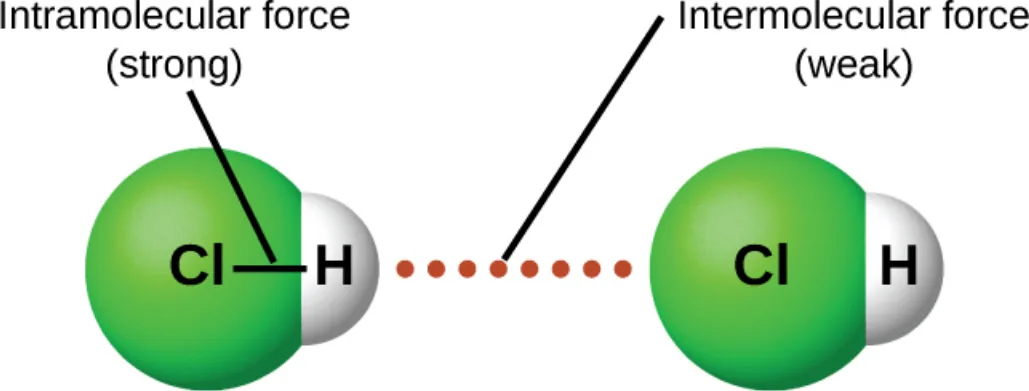
Intramolecular forces bond the atoms of one molecule together, while intermolecular forces hold separate molecules together. Image: OpenStax, Chemistry 2e, CC BY 4.0.
Forces between molecules
⤢ EnlargeForces between molecules
Under suitable conditions, the attractions between gas molecules cause them to form liquids or solids. These attractions are intermolecular forces, not intramolecular forces. Intramolecular forces hold a molecule together, for example the covalent bonds between its atoms. Intermolecular forces are the attractions between molecules, and they determine many physical properties of a substance.
The strengths of intermolecular forces vary widely.
1 / 2Next ▶
Forces between molecules
1
For small molecules, intermolecular forces are usually much weaker than the intramolecular forces that bind atoms within a molecule.
2
For example, about 17 kilojoules are needed to convert one mole of liquid HCl into gaseous HCl by overcoming its intermolecular forces.
3
Breaking the covalent H–Cl bonds in one mole of HCl requires about 25 times more energy, about 430 kilojoules.
4
All attractive forces between neutral atoms and molecules are called van der Waals forces. They are usually described more informally as intermolecular attractions. There are three types
which are covered in the next three parts: London dispersion forces, dipole-dipole attractions and hydrogen bonding.
◀ Previous2 / 2
1Dispersion forces2Dispersion forces3Dispersion forces4Dispersion forces5Dispersion forces6Dispersion forces7Dispersion forces8Dispersion forces
Dispersion forces
1
London dispersion forces are present in all condensed phases, whatever the atoms or molecules are. The force is named after Fritz London, a German-born American physicist who first explained it in 1928. It is often called simply the dispersion force.
2
The electrons of an atom or molecule are in constant motion
so at any instant the electron distribution can be uneven.
3
1
4
This produces a temporary, instantaneous dipole.
5
2
6
That dipole can distort the electron cloud of a neighboring atom or molecule and induce a dipole in it.
1 / 8Next ▶
Dispersion forces
Dispersion forces
3
The two rapidly changing temporary dipoles attract each other weakly.
4
The diagram below shows this for two nonpolar diatomic molecules.
◀ Previous2 / 8Next ▶
Two nonpolar diatomic molecules attract each other because temporary dipoles in one molecule induce matching dipoles in the other. Image: OpenStax, Chemistry 2e, CC BY 4.0.
Dispersion forces
⤢ Enlarge1
Dispersion forces can attract two molecules even when they are not polar.
2
The force is weak, however, and it matters only when molecules are very close together.
3
Larger and heavier atoms or molecules have stronger dispersion forces than small, light ones.
4
The halogens show this clearly.
5
F
6
and Cl
◀ Previous3 / 8Next ▶
Dispersion forces
Dispersion forces
are gases at room temperature, Br
is a liquid, and I
is a solid
which reflects the increase in attraction down the group.
◀ Previous4 / 8Next ▶
Dispersion forces
Dispersion forces
Melting and boiling points rise with increasing size of the halogen molecules.
In a larger atom, the valence electrons are on average farther from the nucleus
so they are held less tightly.
They form temporary dipoles more easily
which produces stronger attraction.
Polarizability describes how easily an electric charge,
such as a nearby ion or polar molecule, can distort the electron cloud of a molecule.
A highly polarizable molecule has a cloud that is easily distorted and therefore has large dispersion forces.
◀ Previous5 / 8Next ▶
Dispersion forces
1
A molecule with a cloud that is hard to distort is weakly polarizable and has small dispersion forces.
2
The shape of a molecule also changes the size of its dispersion forces.
3
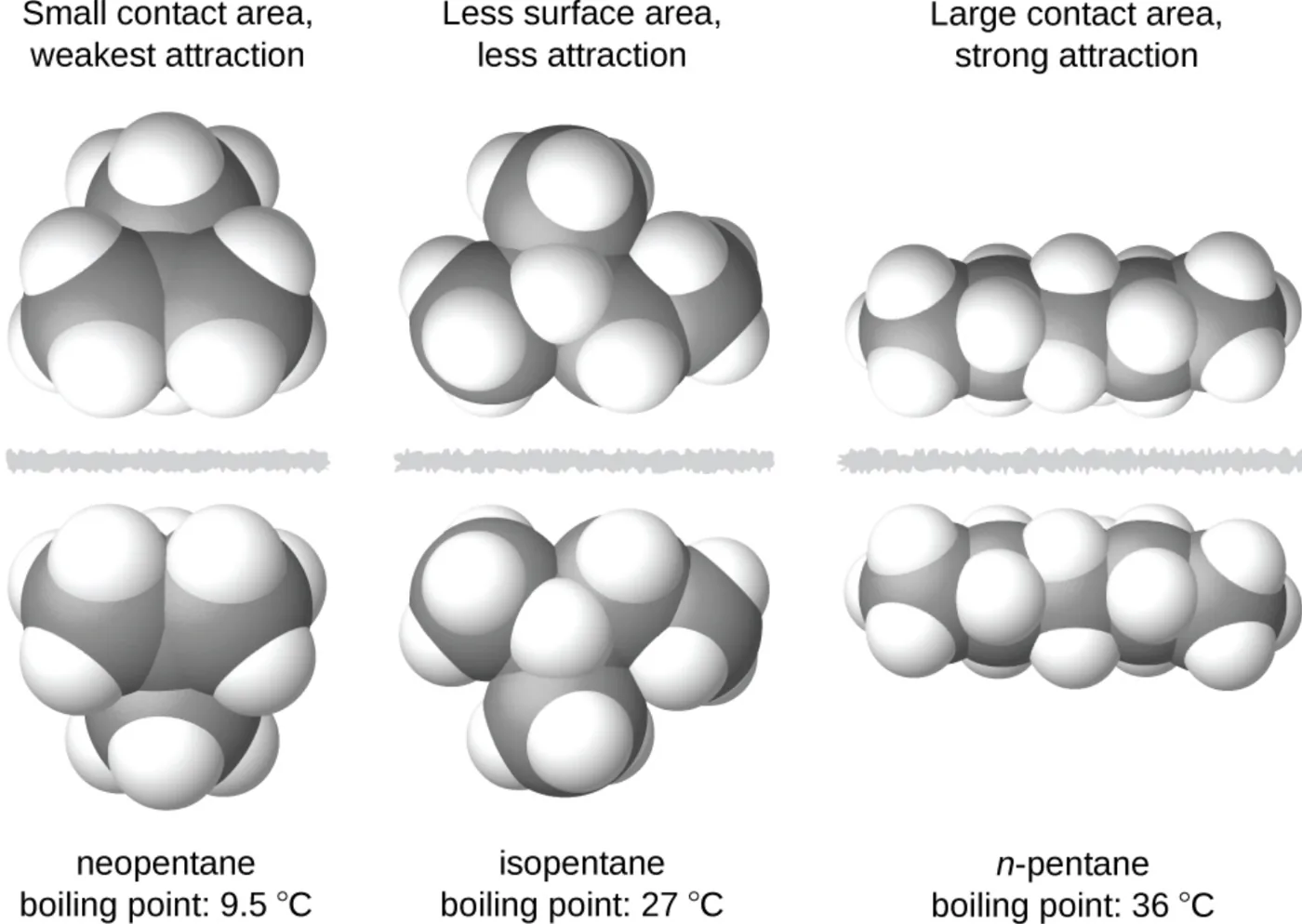
Three isomers of C
4
5
5
H
6
12
◀ Previous6 / 8Next ▶
Dispersion forces
1
have the same formula but different shapes: n-pentane, isopentane and neopentane.
2
Their boiling points are 36 °C, 27 °C and 9.5 °C.
3
The elongated n-pentane molecule has the most surface area in contact with its neighbors
so its dispersion forces are strongest.
4
The compact neopentane molecule has the least contact area and the weakest dispersion forces.
5
This is like the way strips of hook-and-loop fastener hold more firmly when more of their area touches.
◀ Previous7 / 8Next ▶
Three pentane isomers with increasing contact area between molecules, shown with their boiling points, which rise as the contact area grows. Image: OpenStax, Chemistry 2e, CC BY 4.0.
Dispersion forces
◀ Previous8 / 8
1Chemistry in Everyday Life: Geckos and intermolecular forces2Chemistry in Everyday Life: Geckos and intermolecular forces3Chemistry in Everyday Life: Geckos and intermolecular forces4Chemistry in Everyday Life: Geckos and intermolecular forces
The gecko toe at three scales: the whole animal, its setae hairs and the flat spatulae tips that make contact with the surface. Image: OpenStax, Chemistry 2e, CC BY 4.0.
Chemistry in Everyday Life: Geckos and intermolecular forces
⤢ Enlarge1
Geckos, along with spiders and some insects, can climb smooth walls and walk across ceilings without suction cups or sticky fluid. A gecko can lift its feet easily as it walks, yet it sticks firmly if someone tries to pick it up. The explanation was uncovered only recently.
2
The toes of a gecko are covered with hundreds of thousands of tiny hairs called setae. Each seta branches into hundreds of flat, triangular tips called spatulae. The huge number of spatulae gives the gecko a large total surface area for contact. The figure below shows the hierarchy from the whole gecko down to the spatulae.
3
In 2000, Kellar Autumn and his research team showed that geckos stick equally well to polar silicon dioxide and to nonpolar gallium arsenide.
1 / 4Next ▶
Chemistry in Everyday Life: Geckos and intermolecular forces
Chemistry in Everyday Life: Geckos and intermolecular forces
This showed that the stickiness comes from dispersion forces,
which are weak attractions caused by temporary, synchronized charge distributions between neighboring molecules.
Each contact is very weak
but the total attraction over millions of spatulae is large enough to support many times the gecko’s weight.
In 2014, researchers at Oregon State University proposed a model for how geckos switch quickly between sticky and non-sticky states.
1
Their model showed that the gecko changes the angle between its spatulae and the surface.
◀ Previous2 / 4Next ▶
Chemistry in Everyday Life: Geckos and intermolecular forces
Chemistry in Everyday Life: Geckos and intermolecular forces
2
The feet are normally non-sticky
but they become sticky when a small shear force is applied.
3
By curling and uncurling their toes, geckos alternate between sticking and unsticking
which lets them move across a surface.
4
Later work at the University of Akron found that geckos hold equally well to water-repelling surfaces whether those surfaces are wet or dry.
◀ Previous3 / 4Next ▶
Chemistry in Everyday Life: Geckos and intermolecular forces
1
5
2
The researchers used a ribbon to pull on the geckos until they slipped
so they could measure how well each surface held them.
3
6
4
Better adhesives may come from this research.
5
Link to Learning: a video describes Kellar Autumn’s research
which showed that van der Waals forces allow a gecko to cling and climb. The point is the same as in the text: the attractions are very weak individually but add up across many contact points.
◀ Previous4 / 4
1Dipole-dipole attractions2Dipole-dipole attractions3Dipole-dipole attractions
Two arrangements of polar molecules in which the partially negative end of one molecule sits next to the partially positive end of another. Image: OpenStax, Chemistry 2e, CC BY 4.0.
Dipole-dipole attractions
⤢ Enlarge1
A polar molecule has a partial positive charge on one side and a partial negative charge on the other. This separation of charge is called a dipole. In hydrogen chloride, HCl, the more electronegative Cl atom carries the partial negative charge and the less electronegative H atom carries the partial positive charge.
2
The partially positive end of one HCl molecule attracts the partially negative end of another. This electrostatic attraction between polar molecules is a dipole-dipole attraction. The diagram below shows two arrangements of polar molecules that allow this attraction.
3
Compare HCl with the nonpolar F2.
4
1
5
Both have two atoms and about the same molecular mass
so at 150 K their molecules have the same average kinetic energy.
6
2
1 / 3Next ▶
Dipole-dipole attractions
Dipole-dipole attractions
The dipole-dipole attractions between HCl molecules are strong enough to hold them together as a liquid.
3
The weaker dispersion forces between F
molecules are not
so F
is a gas at this temperature.
4
◀ Previous2 / 3Next ▶
Dipole-dipole attractions
1
HCl boils at 188 K
while F
2
boils at 85 K
which reflects the greater strength of dipole-dipole attractions.
3
5
4
Boiling points, melting points and enthalpies of vaporization or fusion are commonly used as indicators of the strength of intermolecular forces.
◀ Previous3 / 3
1Hydrogen bonding2Hydrogen bonding3Hydrogen bonding4Hydrogen bonding5Hydrogen bonding6Hydrogen bonding7Hydrogen bonding
Hydrogen bonding
Hydrogen bonding
Nitrosyl fluoride, ONF, has a molar mass of 49 amu and is a gas at room temperature.
1
Water, H
2
O, has a molar mass of 18 amu and is a liquid.
Dispersion forces cannot explain this
because ONF is larger and heavier and should have the stronger dispersion forces.
1 / 7Next ▶
Hydrogen bonding
Hydrogen bonding
3
Dipole moments do not explain it either
because both molecules are polar with comparable dipole moments.
4
The large difference comes from hydrogen bonding, a particularly strong dipole-dipole attraction.
Hydrogen bonding occurs when a hydrogen atom is bonded to a fluorine, oxygen or nitrogen atom, the three most electronegative elements.
The electronegativity difference between H (2.1) and F (4.0), O (3.5) or N (3.0) is very large.
◀ Previous2 / 7Next ▶
Hydrogen bonding
1
The H atom is also very small, and F, O and N atoms are relatively small.
2
Together these features concentrate partial charge on these atoms,
3
so molecules with F–H, O–H or N–H groups attract similar groups in neighboring molecules very strongly.
4
Examples include HF···HF, H
5
O···HOH and H
6
N···HNH
◀ Previous3 / 7Next ▶
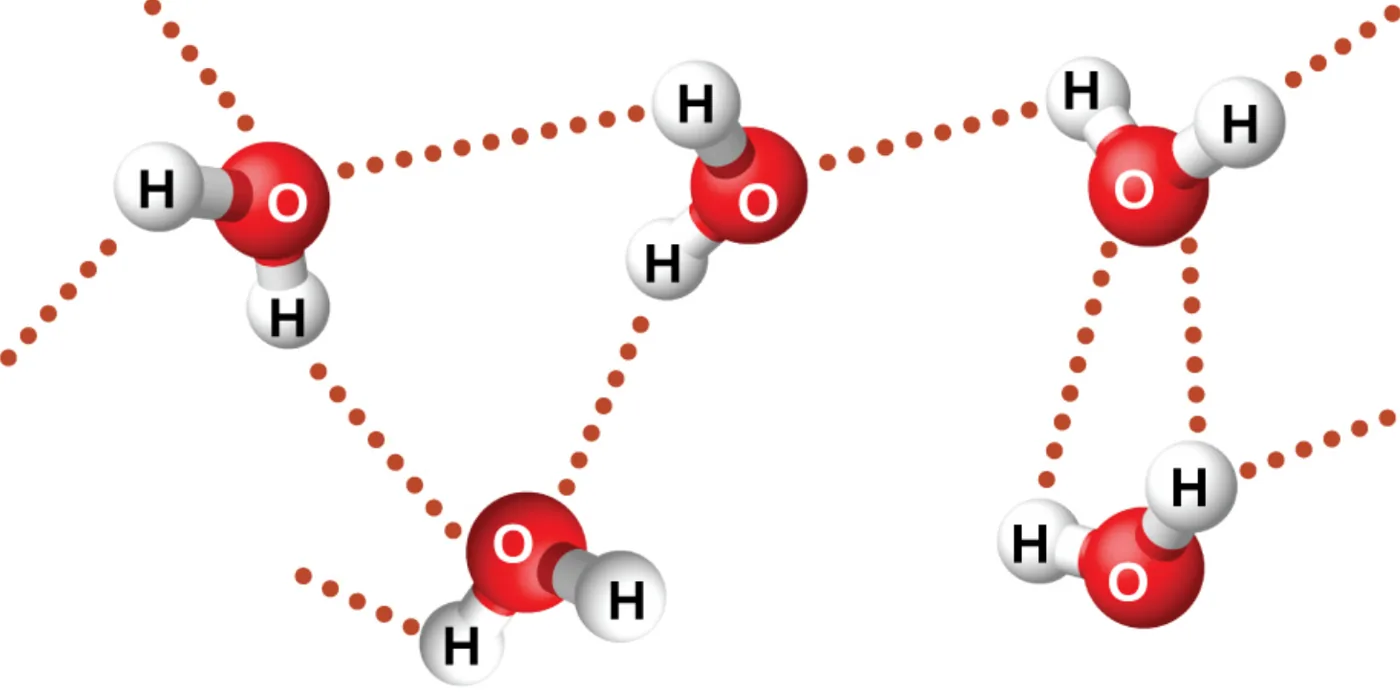
Each water molecule forms hydrogen bonds with several neighboring water molecules. Image: OpenStax, Chemistry 2e, CC BY 4.0.
Hydrogen bonding
⤢ Enlarge1
where the dots mark the hydrogen bonds.
2
5
3
The diagram below shows hydrogen bonds between water molecules.
4
The word bond can be misleading. Hydrogen bonds are intermolecular attractions, not the covalent bonds inside a molecule. A hydrogen bond is only about 5 to 10 percent as strong as a covalent bond
but it is generally much stronger than other dipole-dipole attractions and dispersion forces.
5
Hydrogen bonding strongly affects the properties of liquids and solids.
◀ Previous4 / 7Next ▶
Hydrogen bonding
Hydrogen bonding
Consider the boiling points of the binary hydrides of groups 15, 16 and 17.
As we move down any of these groups, molecules become slightly less polar but much larger.
Dispersion forces grow stronger and dominate the weakening dipole-dipole attractions
so boiling points rise steadily.
The figure below shows the heaviest three hydrides in each group.
◀ Previous5 / 7Next ▶
Boiling points of the hydrides of groups 15, 16 and 17 rise with molecular mass for the elements in periods 3, 4 and 5. Image: OpenStax, Chemistry 2e, CC BY 4.0.
Hydrogen bonding
⤢ Enlarge1
Extending this trend to the lightest hydride of each group predicts boiling points of about −120 °C for NH3, about −80 °C for H2O and about −110 °C for HF.
2
The measured values are far higher than these predictions.
3
The figure below shows the anomalously high boiling points of the period 2 hydrides
which are caused by hydrogen bonding.
◀ Previous6 / 7Next ▶
The period 2 hydrides of groups 15, 16 and 17 boil much higher than the trend from periods 3 to 5 predicts, because of hydrogen bonding. Image: OpenStax, Chemistry 2e, CC BY 4.0.
Hydrogen bonding
⤢ EnlargeHydrogen bonding
The large gap between the predicted and measured values is strong evidence for the strength of hydrogen bonding.
◀ Previous7 / 7
1How Sciences Interconnect: Hydrogen bonding and DNA2How Sciences Interconnect: Hydrogen bonding and DNA3How Sciences Interconnect: Hydrogen bonding and DNA4How Sciences Interconnect: Hydrogen bonding and DNA5How Sciences Interconnect: Hydrogen bonding and DNA
How Sciences Interconnect: Hydrogen bonding and DNA
How Sciences Interconnect: Hydrogen bonding and DNA
Deoxyribonucleic acid, DNA, is found in every living organism.
1 / 5Next ▶
How Sciences Interconnect: Hydrogen bonding and DNA
1
It carries the genetic information that determines an organism’s characteristics, provides the blueprint for making the proteins life needs,
2
and serves as a template for passing that information to offspring.
3
A DNA molecule has two antiparallel chains of repeating nucleotides that form the double helix.
4
The two strands are held together by hydrogen bonds between their bases.
◀ Previous2 / 5Next ▶
The double helix of DNA, in which two strands are linked by hydrogen bonds between base pairs. Image: OpenStax, Chemistry 2e, CC BY 4.0.
How Sciences Interconnect: Hydrogen bonding and DNA
⤢ Enlarge1
Each nucleotide contains a deoxyribose sugar bonded to a phosphate group on one side, and one of four nitrogenous bases on the other.
2
1
3
Cytosine (C) and thymine (T) are pyrimidines
which have single-ring structures.
4
2
5
Adenine (A) and guanine (G) are purines
which have double-ring structures.
6
3
◀ Previous3 / 5Next ▶
How Sciences Interconnect: Hydrogen bonding and DNA
How Sciences Interconnect: Hydrogen bonding and DNA
Bases pair as complementary pairs made of one purine and one pyrimidine: adenine with thymine, and cytosine with guanine.
4
A and T share two hydrogen bonds, and C and G share three.
5
Both pairings have similar shapes, and the geometry of the bases allows maximum hydrogen bonding in each pair.
◀ Previous4 / 5Next ▶
The adenine–thymine and guanine–cytosine base pairs, which have similar shapes and form the maximum number of hydrogen bonds for their pairing. Image: OpenStax, Chemistry 2e, CC BY 4.0.
How Sciences Interconnect: Hydrogen bonding and DNA
⤢ EnlargeHow Sciences Interconnect: Hydrogen bonding and DNA
The combined effect of millions of hydrogen bonds holds the two DNA strands together. Hydrogen bonds are much weaker than the covalent bonds that join the atoms within each strand
so the two strands can unzip relatively easily down the middle. Each separated strand then acts as a templatewhich allows both strands to be copied during replication.
◀ Previous5 / 5
1Example 10.1: London forces and their effects2Example 10.1: London forces and their effects3Example 10.1: London forces and their effects4Example 10.1: London forces and their effects5Example 10.2: Dipole-dipole forces and their effects6Example 10.3: Effect of hydrogen bonding on boiling points7Example 10.3: Effect of hydrogen bonding on boiling points8Answer:9Answer:
Example 10.1: London forces and their effects
Example 10.1: London forces and their effects
Problem: Order CH4, SiH4, GeH4 and SnH4 from lowest to highest boiling point, and explain the reasoning.
Solution: All four compounds of a group 14 element with hydrogen are nonpolar
so they experience only dispersion forces.
1
The smaller the molecule, the less polarizable it is and the weaker its dispersion forces.
2
Molar masses are about 16 g/mol for CH
1 / 9Next ▶
Example 10.1: London forces and their effects
Example 10.1: London forces and their effects
4
, 32 g/mol for SiH
, 77 g/mol for GeH
and 123 g/mol for SnH
.
3
◀ Previous2 / 9Next ▶
Example 10.1: London forces and their effects
1
CH
2
should therefore boil lowest and SnH
3
highest
giving CH
4
<
SiH
5
<
GeH
6
<
SnH
◀ Previous3 / 9Next ▶
Boiling points of the carbon family hydrides plotted against period, rising steadily from CH4 to SnH4. Image: OpenStax, Chemistry 2e, CC BY 4.0.
Example 10.1: London forces and their effects
⤢ Enlarge1
A plot of the actual boiling points against the period of the group 14 element confirms this prediction, as shown below.
2
Check Your Learning: Order C2H6, C3H8 and C4H10 from lowest to highest boiling point. Answer: C2H6 <
C3H8 <C4H10. All are nonpolar with only dispersion forces, and the larger the molecule, the stronger the dispersion forces and the higher the boiling point.
◀ Previous4 / 9Next ▶
Example 10.2: Dipole-dipole forces and their effects
Example 10.2: Dipole-dipole forces and their effects
Problem: Predict which has the higher boiling point, N2 or CO, and explain.
Solution: CO and N2 are both diatomic with masses of about 28 amu
so they have similar dispersion forces. CO is polar and so has dipole-dipole attractionswhile N2 is nonpolar and cannot have them. The dipole-dipole attractions between CO molecules are stronger than the dispersion forces between N2 moleculesso CO has the higher boiling point.
Check Your Learning: Predict which has the higher boiling point, ICl or Br2. Answer: ICl. The two have similar masses of about 160 amu and similar dispersion forces. ICl is polar and also has dipole-dipole attractions
while Br2 does not. The stronger dipole-dipole attractions need more energy to overcomeso ICl boils higher.
◀ Previous5 / 9Next ▶
Example 10.3: Effect of hydrogen bonding on boiling points
1
Problem: The compounds dimethyl ether (CH3OCH3), ethanol (CH3CH2OH) and propane (CH3CH2CH3) have boiling points of −42.1 °C, −24.8 °C and 78.4 °C, in no particular order. Match each compound to its boiling point and explain.
2
Solution: The three molecules have similar shapes and molar masses of 46, 46 and 44 g/mol
so their dispersion forces are similar.
3
Propane is nonpolar and has only dispersion forces.
4
Dimethyl ether is polar
so it also has dipole-dipole attractions.
5
Ethanol has an −OH group
so it has hydrogen bonding, the strongest of these attractions.
6
The order of intermolecular force strength is therefore propane <
dimethyl ether <ethanol.
◀ Previous6 / 9Next ▶
Example 10.3: Effect of hydrogen bonding on boiling points
Example 10.3: Effect of hydrogen bonding on boiling points
5
Propane boils at −42.1 °C, dimethyl ether at −24.8 °C and ethanol at 78.4 °C.
Check Your Learning: Ethane (CH3CH3) melts at −183 °C and boils at −89 °C.
◀ Previous7 / 9Next ▶
Answer:
Answer:
Predict the melting and boiling points of methylamine (CH
NH
).
Both should be much higher than those of ethane.
Ethane and methylamine have similar size and mass,
◀ Previous8 / 9Next ▶
Answer:
1
but methylamine has an −NH group and can form hydrogen bonds,
2
which greatly increases its intermolecular forces.
3
The actual values are a melting point of −93 °C and a boiling point of −6 °C
so the prediction holds.
◀ Previous9 / 9
Key terms
1Avoid these mistakes2Avoid these mistakes3Avoid these mistakes
Part of Unit 10: Liquids and Solids — see every lesson and quiz in this unit.
Accepted payment methods
|