Curriculum
Chemistry 2e
Unit 1: Essential Ideas
0/14
-
Unit 1 overview: Essential Ideas
 Text lessonPreview
-
1.1 Chemistry in Context
Text lessonPreview
-
1.1 Chemistry in Context - Check yourself
 6 questionsPreview
-
1.2 Phases and Classification of Matter
Text lessonPreview
-
1.2 Phases and Classification of Matter - Check yourself
6 questionsPreview
-
1.3 Physical and Chemical Properties
Text lessonPreview
-
1.3 Physical and Chemical Properties - Check yourself
6 questionsPreview
-
1.4 Measurements
Text lessonPreview
-
1.4 Measurements - Check yourself
6 questionsPreview
-
1.5 Measurement Uncertainty, Accuracy, and Precision
Text lessonPreview
-
1.5 Measurement Uncertainty, Accuracy, and Precision - Check yourself
6 questionsPreview
-
1.6 Mathematical Treatment of Measurement Results
Text lessonPreview
-
1.6 Mathematical Treatment of Measurement Results - Check yourself
6 questionsPreview
-
Unit 1 review quiz: Essential Ideas
10 questionsPreview
Unit 2: Atoms, Molecules, and Ions
0/16
-
Unit 2 overview: Atoms, Molecules, and Ions
Text lessonPreview
-
2.1 Early Ideas in Atomic Theory
Text lessonPreview
-
2.1 Early Ideas in Atomic Theory - Check yourself
6 questionsPreview
-
2.2 Evolution of Atomic Theory
Text lessonPreview
-
2.2 Evolution of Atomic Theory - Check yourself
6 questionsPreview
-
2.3 Atomic Structure and Symbolism
Text lessonPreview
-
2.3 Atomic Structure and Symbolism - Check yourself
6 questionsPreview
-
2.4 Chemical Formulas
Text lessonPreview
-
2.4 Chemical Formulas - Check yourself
6 questionsPreview
-
2.5 The Periodic Table
Text lessonPreview
-
2.5 The Periodic Table - Check yourself
6 questionsPreview
-
2.6 Ionic and Molecular Compounds
Text lessonPreview
-
2.6 Ionic and Molecular Compounds - Check yourself
6 questionsPreview
-
2.7 Chemical Nomenclature
Text lessonPreview
-
2.7 Chemical Nomenclature - Check yourself
6 questionsPreview
-
Unit 2 review quiz: Atoms, Molecules, and Ions
10 questionsPreview
Unit 3: Composition of Substances and Solutions
0/10
-
Unit 3 overview: Composition of Substances and Solutions
Text lessonPreview
-
3.1 Formula Mass and the Mole Concept
Text lessonPreview
-
3.1 Formula Mass and the Mole Concept - Check yourself
6 questionsPreview
-
3.2 Determining Empirical and Molecular Formulas
Text lessonPreview
-
3.2 Determining Empirical and Molecular Formulas - Check yourself
6 questionsPreview
-
3.3 Molarity
Text lessonPreview
-
3.3 Molarity - Check yourself
6 questionsPreview
-
3.4 Other Units for Solution Concentrations
Text lessonPreview
-
3.4 Other Units for Solution Concentrations - Check yourself
6 questionsPreview
-
Unit 3 review quiz: Composition of Substances and Solutions
10 questionsPreview
Unit 4: Stoichiometry of Chemical Reactions
0/12
-
Unit 4 overview: Stoichiometry of Chemical Reactions
Text lessonPreview
-
4.1 Writing and Balancing Chemical Equations
Text lessonPreview
-
4.1 Writing and Balancing Chemical Equations - Check yourself
6 questionsPreview
-
4.2 Classifying Chemical Reactions
Text lessonPreview
-
4.2 Classifying Chemical Reactions - Check yourself
6 questionsPreview
-
4.3 Reaction Stoichiometry
Text lessonPreview
-
4.3 Reaction Stoichiometry - Check yourself
6 questionsPreview
-
4.4 Reaction Yields
Text lessonPreview
-
4.4 Reaction Yields - Check yourself
6 questionsPreview
-
4.5 Quantitative Chemical Analysis
Text lessonPreview
-
4.5 Quantitative Chemical Analysis - Check yourself
6 questionsPreview
-
Unit 4 review quiz: Stoichiometry of Chemical Reactions
10 questionsPreview
Unit 5: Thermochemistry
0/8
-
Unit 5 overview: Thermochemistry
Text lessonPreview
-
5.1 Energy Basics
Text lessonPreview
-
5.1 Energy Basics - Check yourself
6 questionsPreview
-
5.2 Calorimetry
Text lessonPreview
-
5.2 Calorimetry - Check yourself
7 questionsPreview
-
5.3 Enthalpy
Text lessonPreview
-
5.3 Enthalpy - Check yourself
6 questionsPreview
-
Unit 5 review quiz: Thermochemistry
10 questionsPreview
Unit 6: Electronic Structure and Periodic Properties of Elements
0/12
-
Unit 6 overview: Electronic Structure and Periodic Properties of Elements
Text lessonPreview
-
6.1 Electromagnetic Energy
Text lessonPreview
-
6.1 Electromagnetic Energy - Check yourself
6 questionsPreview
-
6.2 The Bohr Model
Text lessonPreview
-
6.2 The Bohr Model - Check yourself
6 questionsPreview
-
6.3 Development of Quantum Theory
Text lessonPreview
-
6.3 Development of Quantum Theory - Check yourself
6 questionsPreview
-
6.4 Electronic Structure of Atoms (Electron Configurations)
Text lessonPreview
-
6.4 Electronic Structure of Atoms (Electron Configurations) - Check yourself
6 questionsPreview
-
6.5 Periodic Variations in Element Properties
Text lessonPreview
-
6.5 Periodic Variations in Element Properties - Check yourself
6 questionsPreview
-
Unit 6 review quiz: Electronic Structure and Periodic Properties of Elements
10 questionsPreview
Unit 7: Chemical Bonding and Molecular Geometry
0/14
-
Unit 7 overview: Chemical Bonding and Molecular Geometry
Text lessonPreview
-
7.1 Ionic Bonding
Text lessonPreview
-
7.1 Ionic Bonding - Check yourself
6 questionsPreview
-
7.2 Covalent Bonding
Text lessonPreview
-
7.2 Covalent Bonding - Check yourself
6 questionsPreview
-
7.3 Lewis Symbols and Structures
Text lessonPreview
-
7.3 Lewis Symbols and Structures - Check yourself
6 questionsPreview
-
7.4 Formal Charges and Resonance
Text lessonPreview
-
7.4 Formal Charges and Resonance - Check yourself
6 questionsPreview
-
7.5 Strengths of Ionic and Covalent Bonds
Text lessonPreview
-
7.5 Strengths of Ionic and Covalent Bonds - Check yourself
6 questionsPreview
-
7.6 Molecular Structure and Polarity
Text lessonPreview
-
7.6 Molecular Structure and Polarity - Check yourself
6 questionsPreview
-
Unit 7 review quiz: Chemical Bonding and Molecular Geometry
10 questionsPreview
Unit 8: Advanced Theories of Covalent Bonding
0/10
-
Unit 8 overview: Advanced Theories of Covalent Bonding
Text lessonPreview
-
8.1 Valence Bond Theory
Text lessonPreview
-
8.1 Valence Bond Theory - Check yourself
6 questionsPreview
-
8.2 Hybrid Atomic Orbitals
Text lessonPreview
-
8.2 Hybrid Atomic Orbitals - Check yourself
6 questionsPreview
-
8.3 Multiple Bonds
Text lessonPreview
-
8.3 Multiple Bonds - Check yourself
6 questionsPreview
-
8.4 Molecular Orbital Theory
Text lessonPreview
-
8.4 Molecular Orbital Theory - Check yourself
6 questionsPreview
-
Unit 8 review quiz: Advanced Theories of Covalent Bonding
10 questionsPreview
Unit 9: Gases
0/23
-
Unit 9 overview: Gases
Text lessonPreview
-
9.1 Gas Pressure
Text lessonPreview
-
9.1 Gas Pressure - Check yourself
6 questionsPreview
-
9.2 Relating Pressure, Volume, Amount, and Temperature: The Ideal Gas Law
Text lessonPreview
-
9.2 Relating Pressure, Volume, Amount, and Temperature: The Ideal Gas Law - Check yourself
6 questionsPreview
-
9.3 Stoichiometry of Gaseous Substances, Mixtures, and Reactions
Text lessonPreview
-
9.3 Stoichiometry of Gaseous Substances, Mixtures, and Reactions - Check yourself
6 questionsPreview
-
9.3 Stoichiometry of Gaseous Substances, Mixtures, and Reactions
Text lessonPreview
-
9.3 Stoichiometry of Gaseous Substances, Mixtures, and Reactions - Check yourself
6 questionsPreview
-
9.4 Effusion and Diffusion of Gases
Text lessonPreview
-
9.4 Effusion and Diffusion of Gases - Check yourself
6 questionsPreview
-
9.4 Effusion and Diffusion of Gases
Text lessonPreview
-
9.4 Effusion and Diffusion of Gases - Check yourself
6 questionsPreview
-
Unit 9 review quiz: Gases
10 questionsPreview
-
9.5 The Kinetic-Molecular Theory
Text lessonPreview
-
9.5 The Kinetic-Molecular Theory - Check yourself
6 questionsPreview
-
9.5 The Kinetic-Molecular Theory
Text lessonPreview
-
9.5 The Kinetic-Molecular Theory - Check yourself
6 questionsPreview
-
9.6 Non-Ideal Gas Behavior
Text lessonPreview
-
9.6 Non-Ideal Gas Behavior - Check yourself
6 questionsPreview
-
9.6 Non-Ideal Gas Behavior
Text lessonPreview
-
9.6 Non-Ideal Gas Behavior - Check yourself
6 questionsPreview
-
Unit 9 review quiz: Gases
10 questionsPreview
Unit 10: Liquids and Solids
0/28
-
Unit 10 overview: Liquids and Solids
Text lessonPreview
-
10.1 Intermolecular Forces
Text lessonPreview
-
Unit 10 overview: Liquids and Solids
Text lessonPreview
-
10.1 Intermolecular Forces
Text lessonPreview
-
10.1 Intermolecular Forces - Check yourself
6 questionsPreview
-
10.1 Intermolecular Forces - Check yourself
6 questionsPreview
-
10.2 Properties of Liquids
Text lessonPreview
-
10.2 Properties of Liquids - Check yourself
6 questionsPreview
-
10.2 Properties of Liquids
Text lessonPreview
-
10.2 Properties of Liquids - Check yourself
6 questionsPreview
-
10.3 Phase Transitions
Text lessonPreview
-
10.3 Phase Transitions - Check yourself
6 questionsPreview
-
10.3 Phase Transitions
Text lessonPreview
-
10.3 Phase Transitions - Check yourself
6 questionsPreview
-
10.4 Phase Diagrams
Text lessonPreview
-
10.4 Phase Diagrams
Text lessonPreview
-
10.4 Phase Diagrams - Check yourself
6 questionsPreview
-
10.4 Phase Diagrams - Check yourself
6 questionsPreview
-
10.5 The Solid State of Matter
Text lessonPreview
-
10.5 The Solid State of Matter
Text lessonPreview
-
10.5 The Solid State of Matter - Check yourself
6 questionsPreview
-
10.5 The Solid State of Matter - Check yourself
6 questionsPreview
-
10.6 Lattice Structures in Crystalline Solids
Text lessonPreview
-
10.6 Lattice Structures in Crystalline Solids
Text lessonPreview
-
10.6 Lattice Structures in Crystalline Solids - Check yourself
6 questionsPreview
-
10.6 Lattice Structures in Crystalline Solids - Check yourself
6 questionsPreview
-
Unit 10 review quiz: Liquids and Solids
10 questionsPreview
-
Unit 10 review quiz: Liquids and Solids
10 questionsPreview
Unit 11: Solutions and Colloids
0/24
-
Unit 11 overview: Solutions and Colloids
Text lessonPreview
-
11.1 The Dissolution Process
Text lessonPreview
-
Unit 11 overview: Solutions and Colloids
Text lessonPreview
-
11.1 The Dissolution Process
Text lessonPreview
-
11.1 The Dissolution Process - Check yourself
6 questionsPreview
-
11.1 The Dissolution Process - Check yourself
6 questionsPreview
-
11.2 Electrolytes
Text lessonPreview
-
11.2 Electrolytes - Check yourself
6 questionsPreview
-
11.2 Electrolytes
Text lessonPreview
-
11.2 Electrolytes - Check yourself
6 questionsPreview
-
11.3 Solubility
Text lessonPreview
-
11.3 Solubility - Check yourself
6 questionsPreview
-
11.3 Solubility
Text lessonPreview
-
11.3 Solubility - Check yourself
6 questionsPreview
-
11.4 Colligative Properties
Text lessonPreview
-
11.4 Colligative Properties - Check yourself
6 questionsPreview
-
11.4 Colligative Properties
Text lessonPreview
-
11.4 Colligative Properties - Check yourself
6 questionsPreview
-
11.5 Colloids
Text lessonPreview
-
11.5 Colloids - Check yourself
6 questionsPreview
-
11.5 Colloids
Text lessonPreview
-
11.5 Colloids - Check yourself
6 questionsPreview
-
Unit 11 review quiz: Solutions and Colloids
10 questionsPreview
-
Unit 11 review quiz: Solutions and Colloids
10 questionsPreview
Unit 12: Kinetics
0/32
-
Unit 12 overview: Kinetics
Text lessonPreview
-
12.1 Chemical Reaction Rates
Text lessonPreview
-
12.1 Chemical Reaction Rates - Check yourself
6 questionsPreview
-
Unit 12 overview: Kinetics
Text lessonPreview
-
12.1 Chemical Reaction Rates
Text lessonPreview
-
12.1 Chemical Reaction Rates - Check yourself
6 questionsPreview
-
12.2 Factors Affecting Reaction Rates
Text lessonPreview
-
12.2 Factors Affecting Reaction Rates - Check yourself
6 questionsPreview
-
12.2 Factors Affecting Reaction Rates
Text lessonPreview
-
12.2 Factors Affecting Reaction Rates - Check yourself
6 questionsPreview
-
12.3 Rate Laws
Text lessonPreview
-
12.3 Rate Laws - Check yourself
6 questionsPreview
-
12.3 Rate Laws
Text lessonPreview
-
12.3 Rate Laws - Check yourself
6 questionsPreview
-
12.4 Integrated Rate Laws
Text lessonPreview
-
12.4 Integrated Rate Laws - Check yourself
6 questionsPreview
-
12.4 Integrated Rate Laws
Text lessonPreview
-
12.4 Integrated Rate Laws - Check yourself
6 questionsPreview
-
12.5 Collision Theory
Text lessonPreview
-
12.5 Collision Theory - Check yourself
6 questionsPreview
-
12.5 Collision Theory
Text lessonPreview
-
Unit 12 review quiz: Kinetics
10 questionsPreview
-
12.5 Collision Theory - Check yourself
6 questionsPreview
-
12.6 Reaction Mechanisms
Text lessonPreview
-
12.6 Reaction Mechanisms - Check yourself
6 questionsPreview
-
12.6 Reaction Mechanisms
Text lessonPreview
-
12.6 Reaction Mechanisms - Check yourself
6 questionsPreview
-
12.7 Catalysis
Text lessonPreview
-
12.7 Catalysis - Check yourself
6 questionsPreview
-
12.7 Catalysis
Text lessonPreview
-
12.7 Catalysis - Check yourself
6 questionsPreview
-
Unit 12 review quiz: Kinetics
10 questionsPreview
Unit 13: Fundamental Equilibrium Concepts
0/20
-
Unit 13 overview: Fundamental Equilibrium Concepts
Text lessonPreview
-
13.1 Chemical Equilibria
Text lessonPreview
-
13.1 Chemical Equilibria - Check yourself
6 questionsPreview
-
13.1 Chemical Equilibria
Text lessonPreview
-
13.1 Chemical Equilibria - Check yourself
6 questionsPreview
-
13.2 Equilibrium Constants
Text lessonPreview
-
13.2 Equilibrium Constants - Check yourself
6 questionsPreview
-
13.2 Equilibrium Constants
Text lessonPreview
-
Unit 13 overview: Fundamental Equilibrium Concepts
Text lessonPreview
-
13.2 Equilibrium Constants - Check yourself
6 questionsPreview
-
13.3 Shifting Equilibria: Le Châtelier’s Principle
Text lessonPreview
-
13.3 Shifting Equilibria: Le Châtelier’s Principle - Check yourself
6 questionsPreview
-
13.3 Shifting Equilibria: Le Châtelier’s Principle
Text lessonPreview
-
Unit 13 review quiz: Fundamental Equilibrium Concepts
10 questionsPreview
-
13.3 Shifting Equilibria: Le Châtelier’s Principle - Check yourself
6 questionsPreview
-
13.4 Equilibrium Calculations
Text lessonPreview
-
13.4 Equilibrium Calculations - Check yourself
6 questionsPreview
-
13.4 Equilibrium Calculations
Text lessonPreview
-
13.4 Equilibrium Calculations - Check yourself
6 questionsPreview
-
Unit 13 review quiz: Fundamental Equilibrium Concepts
10 questionsPreview
Unit 14: Acid-Base Equilibria
0/32
-
Unit 14 overview: Acid-Base Equilibria
Text lessonPreview
-
14.1 Brønsted-Lowry Acids and Bases
Text lessonPreview
-
14.1 Brønsted-Lowry Acids and Bases - Check yourself
6 questionsPreview
-
14.1 Brønsted-Lowry Acids and Bases
Text lessonPreview
-
14.1 Brønsted-Lowry Acids and Bases - Check yourself
6 questionsPreview
-
14.2 pH and pOH
Text lessonPreview
-
14.2 pH and pOH - Check yourself
6 questionsPreview
-
14.2 pH and pOH
Text lessonPreview
-
14.2 pH and pOH - Check yourself
6 questionsPreview
-
14.3 Relative Strengths of Acids and Bases
Text lessonPreview
-
14.3 Relative Strengths of Acids and Bases - Check yourself
6 questionsPreview
-
14.3 Relative Strengths of Acids and Bases
Text lessonPreview
-
14.3 Relative Strengths of Acids and Bases - Check yourself
6 questionsPreview
-
14.4 Hydrolysis of Salts
Text lessonPreview
-
14.4 Hydrolysis of Salts - Check yourself
6 questionsPreview
-
Unit 14 review quiz: Acid-Base Equilibria
10 questionsPreview
-
Unit 14 overview: Acid-Base Equilibria
Text lessonPreview
-
14.4 Hydrolysis of Salts
Text lessonPreview
-
14.4 Hydrolysis of Salts - Check yourself
6 questionsPreview
-
14.5 Polyprotic Acids
Text lessonPreview
-
14.5 Polyprotic Acids - Check yourself
6 questionsPreview
-
14.5 Polyprotic Acids
Text lessonPreview
-
14.5 Polyprotic Acids - Check yourself
6 questionsPreview
-
14.6 Buffers
Text lessonPreview
-
14.6 Buffers - Check yourself
6 questionsPreview
-
14.6 Buffers
Text lessonPreview
-
14.6 Buffers - Check yourself
6 questionsPreview
-
14.7 Acid-Base Titrations
Text lessonPreview
-
14.7 Acid-Base Titrations - Check yourself
6 questionsPreview
-
14.7 Acid-Base Titrations
Text lessonPreview
-
14.7 Acid-Base Titrations - Check yourself
6 questionsPreview
-
Unit 14 review quiz: Acid-Base Equilibria
10 questionsPreview
Unit 15: Equilibria of Other Reaction Classes
0/16
-
Unit 15 overview: Equilibria of Other Reaction Classes
Text lessonPreview
-
15.1 Precipitation and Dissolution
Text lessonPreview
-
15.1 Precipitation and Dissolution - Check yourself
6 questionsPreview
-
15.1 Precipitation and Dissolution
Text lessonPreview
-
15.1 Precipitation and Dissolution - Check yourself
6 questionsPreview
-
15.2 Lewis Acids and Bases
Text lessonPreview
-
15.2 Lewis Acids and Bases - Check yourself
6 questionsPreview
-
Unit 15 review quiz: Equilibria of Other Reaction Classes
10 questionsPreview
-
Unit 15 overview: Equilibria of Other Reaction Classes
Text lessonPreview
-
15.2 Lewis Acids and Bases
Text lessonPreview
-
15.2 Lewis Acids and Bases - Check yourself
6 questionsPreview
-
15.3 Coupled Equilibria
Text lessonPreview
-
15.3 Coupled Equilibria - Check yourself
6 questionsPreview
-
15.3 Coupled Equilibria
Text lessonPreview
-
15.3 Coupled Equilibria - Check yourself
6 questionsPreview
-
Unit 15 review quiz: Equilibria of Other Reaction Classes
10 questionsPreview
Unit 16: Thermodynamics
0/20
-
Unit 16 overview: Thermodynamics
Text lessonPreview
-
16.1 Spontaneity
Text lessonPreview
-
16.1 Spontaneity - Check yourself
6 questionsPreview
-
16.1 Spontaneity
Text lessonPreview
-
16.1 Spontaneity - Check yourself
6 questionsPreview
-
16.2 Entropy
Text lessonPreview
-
16.2 Entropy - Check yourself
6 questionsPreview
-
16.2 Entropy
Text lessonPreview
-
16.2 Entropy - Check yourself
6 questionsPreview
-
Unit 16 review quiz: Thermodynamics
10 questionsPreview
-
Unit 16 overview: Thermodynamics
Text lessonPreview
-
16.3 The Second and Third Laws of Thermodynamics
Text lessonPreview
-
16.3 The Second and Third Laws of Thermodynamics - Check yourself
6 questionsPreview
-
16.3 The Second and Third Laws of Thermodynamics
Text lessonPreview
-
16.3 The Second and Third Laws of Thermodynamics - Check yourself
6 questionsPreview
-
16.4 Free Energy
Text lessonPreview
-
16.4 Free Energy - Check yourself
6 questionsPreview
-
16.4 Free Energy
Text lessonPreview
-
16.4 Free Energy - Check yourself
6 questionsPreview
-
Unit 16 review quiz: Thermodynamics
10 questionsPreview
Unit 17: Electrochemistry
0/32
-
Unit 17 overview: Electrochemistry
Text lessonPreview
-
17.1 Review of Redox Chemistry
Text lessonPreview
-
17.1 Review of Redox Chemistry - Check yourself
6 questionsPreview
-
17.1 Review of Redox Chemistry
Text lessonPreview
-
17.1 Review of Redox Chemistry - Check yourself
6 questionsPreview
-
17.2 Galvanic Cells
Text lessonPreview
-
17.2 Galvanic Cells - Check yourself
6 questionsPreview
-
17.2 Galvanic Cells
Text lessonPreview
-
17.2 Galvanic Cells - Check yourself
6 questionsPreview
-
17.3 Electrode and Cell Potentials
Text lessonPreview
-
17.3 Electrode and Cell Potentials - Check yourself
6 questionsPreview
-
17.3 Electrode and Cell Potentials
Text lessonPreview
-
17.3 Electrode and Cell Potentials - Check yourself
6 questionsPreview
-
17.4 Potential, Free Energy, and Equilibrium
Text lessonPreview
-
17.4 Potential, Free Energy, and Equilibrium - Check yourself
6 questionsPreview
-
Unit 17 review quiz: Electrochemistry
10 questionsPreview
-
Unit 17 overview: Electrochemistry
Text lessonPreview
-
17.4 Potential, Free Energy, and Equilibrium
Text lessonPreview
-
17.4 Potential, Free Energy, and Equilibrium - Check yourself
6 questionsPreview
-
17.5 Batteries and Fuel Cells
Text lessonPreview
-
17.5 Batteries and Fuel Cells - Check yourself
6 questionsPreview
-
17.5 Batteries and Fuel Cells
Text lessonPreview
-
17.5 Batteries and Fuel Cells - Check yourself
6 questionsPreview
-
17.6 Corrosion
Text lessonPreview
-
17.6 Corrosion - Check yourself
6 questionsPreview
-
17.6 Corrosion
Text lessonPreview
-
17.6 Corrosion - Check yourself
6 questionsPreview
-
17.7 Electrolysis
Text lessonPreview
-
17.7 Electrolysis - Check yourself
6 questionsPreview
-
17.7 Electrolysis
Text lessonPreview
-
17.7 Electrolysis - Check yourself
6 questionsPreview
-
Unit 17 review quiz: Electrochemistry
10 questionsPreview
Unit 18: Representative Metals, Metalloids, and Nonmetals
0/52
-
Unit 18 overview: Representative Metals, Metalloids, and Nonmetals
Text lessonPreview
-
18.1 Periodicity
Text lessonPreview
-
18.1 Periodicity - Check yourself
6 questionsPreview
-
18.1 Periodicity
Text lessonPreview
-
18.1 Periodicity - Check yourself
6 questionsPreview
-
18.2 Occurrence and Preparation of the Representative Metals
Text lessonPreview
-
18.2 Occurrence and Preparation of the Representative Metals - Check yourself
6 questionsPreview
-
18.2 Occurrence and Preparation of the Representative Metals
Text lessonPreview
-
18.2 Occurrence and Preparation of the Representative Metals - Check yourself
6 questionsPreview
-
18.3 Structure and General Properties of the Metalloids
Text lessonPreview
-
18.3 Structure and General Properties of the Metalloids - Check yourself
6 questionsPreview
-
18.3 Structure and General Properties of the Metalloids
Text lessonPreview
-
18.3 Structure and General Properties of the Metalloids - Check yourself
6 questionsPreview
-
18.4 Structure and General Properties of the Nonmetals
Text lessonPreview
-
18.4 Structure and General Properties of the Nonmetals - Check yourself
6 questionsPreview
-
18.4 Structure and General Properties of the Nonmetals
Text lessonPreview
-
18.4 Structure and General Properties of the Nonmetals - Check yourself
6 questionsPreview
-
18.5 Occurrence, Preparation, and Compounds of Hydrogen
Text lessonPreview
-
18.5 Occurrence, Preparation, and Compounds of Hydrogen - Check yourself
6 questionsPreview
-
18.5 Occurrence, Preparation, and Compounds of Hydrogen
Text lessonPreview
-
18.5 Occurrence, Preparation, and Compounds of Hydrogen - Check yourself
6 questionsPreview
-
18.6 Occurrence, Preparation, and Properties of Carbonates
Text lessonPreview
-
18.6 Occurrence, Preparation, and Properties of Carbonates - Check yourself
6 questionsPreview
-
18.6 Occurrence, Preparation, and Properties of Carbonates
Text lessonPreview
-
18.6 Occurrence, Preparation, and Properties of Carbonates - Check yourself
6 questionsPreview
-
Unit 18 review quiz: Representative Metals, Metalloids, and Nonmetals
10 questionsPreview
-
Unit 18 overview: Representative Metals, Metalloids, and Nonmetals
Text lessonPreview
-
18.7 Occurrence, Preparation, and Properties of Nitrogen
Text lessonPreview
-
18.7 Occurrence, Preparation, and Properties of Nitrogen - Check yourself
6 questionsPreview
-
18.7 Occurrence, Preparation, and Properties of Nitrogen
Text lessonPreview
-
18.7 Occurrence, Preparation, and Properties of Nitrogen - Check yourself
6 questionsPreview
-
18.8 Occurrence, Preparation, and Properties of Phosphorus
Text lessonPreview
-
18.8 Occurrence, Preparation, and Properties of Phosphorus - Check yourself
6 questionsPreview
-
18.8 Occurrence, Preparation, and Properties of Phosphorus
Text lessonPreview
-
18.8 Occurrence, Preparation, and Properties of Phosphorus - Check yourself
6 questionsPreview
-
18.9 Occurrence, Preparation, and Compounds of Oxygen
Text lessonPreview
-
18.9 Occurrence, Preparation, and Compounds of Oxygen - Check yourself
6 questionsPreview
-
18.9 Occurrence, Preparation, and Compounds of Oxygen
Text lessonPreview
-
18.9 Occurrence, Preparation, and Compounds of Oxygen - Check yourself
6 questionsPreview
-
18.10 Occurrence, Preparation, and Properties of Sulfur
Text lessonPreview
-
18.10 Occurrence, Preparation, and Properties of Sulfur - Check yourself
6 questionsPreview
-
18.10 Occurrence, Preparation, and Properties of Sulfur
Text lessonPreview
-
18.10 Occurrence, Preparation, and Properties of Sulfur - Check yourself
6 questionsPreview
-
18.11 Occurrence, Preparation, and Properties of Halogens
Text lessonPreview
-
18.11 Occurrence, Preparation, and Properties of Halogens - Check yourself
6 questionsPreview
-
18.11 Occurrence, Preparation, and Properties of Halogens
Text lessonPreview
-
18.11 Occurrence, Preparation, and Properties of Halogens - Check yourself
6 questionsPreview
-
18.12 Occurrence, Preparation, and Properties of the Noble Gases
Text lessonPreview
-
18.12 Occurrence, Preparation, and Properties of the Noble Gases - Check yourself
6 questionsPreview
-
18.12 Occurrence, Preparation, and Properties of the Noble Gases
Text lessonPreview
-
18.12 Occurrence, Preparation, and Properties of the Noble Gases - Check yourself
6 questionsPreview
-
Unit 18 review quiz: Representative Metals, Metalloids, and Nonmetals
10 questionsPreview
Unit 19: Transition Metals and Coordination Chemistry
0/16
-
Unit 19 overview: Transition Metals and Coordination Chemistry
Text lessonPreview
-
19.1 Occurrence, Preparation, and Properties of Transition Metals and Their Compounds
Text lessonPreview
-
19.1 Occurrence, Preparation, and Properties of Transition Metals and Their Compounds - Check yourself
6 questionsPreview
-
19.1 Occurrence, Preparation, and Properties of Transition Metals and Their Compounds
Text lessonPreview
-
19.1 Occurrence, Preparation, and Properties of Transition Metals and Their Compounds - Check yourself
6 questionsPreview
-
19.2 Coordination Chemistry of Transition Metals
Text lessonPreview
-
19.2 Coordination Chemistry of Transition Metals - Check yourself
6 questionsPreview
-
Unit 19 review quiz: Transition Metals and Coordination Chemistry
10 questionsPreview
-
Unit 19 overview: Transition Metals and Coordination Chemistry
Text lessonPreview
-
19.2 Coordination Chemistry of Transition Metals
Text lessonPreview
-
19.2 Coordination Chemistry of Transition Metals - Check yourself
6 questionsPreview
-
19.3 Spectroscopic and Magnetic Properties of Coordination Compounds
Text lessonPreview
-
19.3 Spectroscopic and Magnetic Properties of Coordination Compounds - Check yourself
6 questionsPreview
-
19.3 Spectroscopic and Magnetic Properties of Coordination Compounds
Text lessonPreview
-
19.3 Spectroscopic and Magnetic Properties of Coordination Compounds - Check yourself
6 questionsPreview
-
Unit 19 review quiz: Transition Metals and Coordination Chemistry
10 questionsPreview
Unit 20: Organic Chemistry
0/20
-
Unit 20 overview: Organic Chemistry
Text lessonPreview
-
20.1 Hydrocarbons
Text lessonPreview
-
20.1 Hydrocarbons - Check yourself
6 questionsPreview
-
20.1 Hydrocarbons
Text lessonPreview
-
20.1 Hydrocarbons - Check yourself
6 questionsPreview
-
20.2 Alcohols and Ethers
Text lessonPreview
-
20.2 Alcohols and Ethers - Check yourself
6 questionsPreview
-
20.2 Alcohols and Ethers
Text lessonPreview
-
20.2 Alcohols and Ethers - Check yourself
6 questionsPreview
-
Unit 20 review quiz: Organic Chemistry
10 questionsPreview
-
Unit 20 overview: Organic Chemistry
Text lessonPreview
-
20.3 Aldehydes, Ketones, Carboxylic Acids, and Esters
Text lessonPreview
-
20.3 Aldehydes, Ketones, Carboxylic Acids, and Esters - Check yourself
6 questionsPreview
-
20.3 Aldehydes, Ketones, Carboxylic Acids, and Esters
Text lessonPreview
-
20.3 Aldehydes, Ketones, Carboxylic Acids, and Esters - Check yourself
6 questionsPreview
-
20.4 Amines and Amides
Text lessonPreview
-
20.4 Amines and Amides - Check yourself
6 questionsPreview
-
20.4 Amines and Amides
Text lessonPreview
-
20.4 Amines and Amides - Check yourself
6 questionsPreview
-
Unit 20 review quiz: Organic Chemistry
10 questionsPreview
Unit 21: Nuclear Chemistry
0/28
-
Unit 21 overview: Nuclear Chemistry
Text lessonPreview
-
21.1 Nuclear Structure and Stability
Text lessonPreview
-
21.1 Nuclear Structure and Stability - Check yourself
6 questionsPreview
-
21.1 Nuclear Structure and Stability
Text lessonPreview
-
21.1 Nuclear Structure and Stability - Check yourself
6 questionsPreview
-
21.2 Nuclear Equations
Text lessonPreview
-
21.2 Nuclear Equations - Check yourself
6 questionsPreview
-
21.2 Nuclear Equations
Text lessonPreview
-
21.2 Nuclear Equations - Check yourself
6 questionsPreview
-
21.3 Radioactive Decay
Text lessonPreview
-
21.3 Radioactive Decay - Check yourself
6 questionsPreview
-
21.3 Radioactive Decay
Text lessonPreview
-
21.3 Radioactive Decay - Check yourself
6 questionsPreview
-
Unit 21 review quiz: Nuclear Chemistry
10 questionsPreview
-
Unit 21 overview: Nuclear Chemistry
Text lessonPreview
-
21.4 Transmutation and Nuclear Energy
Text lessonPreview
-
21.4 Transmutation and Nuclear Energy - Check yourself
6 questionsPreview
-
21.4 Transmutation and Nuclear Energy
Text lessonPreview
-
21.4 Transmutation and Nuclear Energy - Check yourself
6 questionsPreview
-
21.5 Uses of Radioisotopes
Text lessonPreview
-
21.5 Uses of Radioisotopes - Check yourself
6 questionsPreview
-
21.5 Uses of Radioisotopes
Text lessonPreview
-
21.5 Uses of Radioisotopes - Check yourself
6 questionsPreview
-
21.6 Biological Effects of Radiation
Text lessonPreview
-
21.6 Biological Effects of Radiation - Check yourself
6 questionsPreview
-
21.6 Biological Effects of Radiation
Text lessonPreview
-
21.6 Biological Effects of Radiation - Check yourself
6 questionsPreview
-
Unit 21 review quiz: Nuclear Chemistry
10 questionsPreview
Text lesson
5.2 Calorimetry
5.2 Calorimetry — CHEMISTRY notes: After this lesson you will be able to explain how calorimetry measures heat, use the relation q = m × c × ΔT with heat-balance reasoning to solve calorimetry problems for metals, reactions and combustion, and state whether a process is exothermic or endothermic from the sign of its heat.
Learning objectives · Learning objectives
Learning objectives
By the end of this lesson you should be able to:
Learning objectives
Explain the technique of calorimetry.
Calculate and interpret heat and related properties using typical calorimetry data.
1Measuring heat with calorimetry2Measuring heat with calorimetry3Measuring heat with calorimetry
Measuring heat with calorimetry
1
Calorimetry is a technique for measuring the amount of heat involved in a chemical or physical process.
2
It measures the heat transferred to or from a substance by exchanging that heat with a calibrated object, called a calorimeter.
3
The temperature change recorded by the calorimeter is then used to work out how much heat the process transferred.
4
Doing this correctly requires two clear definitions.
5
The system is the substance or substances that undergo the chemical or physical change.
6
The surroundings are everything else, including the parts of the apparatus, that either supplies heat to the system or takes heat away from it.
1 / 3Next ▶
A parabolic trough solar plant, where curved mirrors focus sunlight onto a heat transfer fluid, next to a diagram of how that heat produces steam that drives a turbine and generator. Image: OpenStax, Chemistry 2e, CC BY 4.0.
Measuring heat with calorimetry
 ⤢ Enlarge
Measuring heat with calorimetry
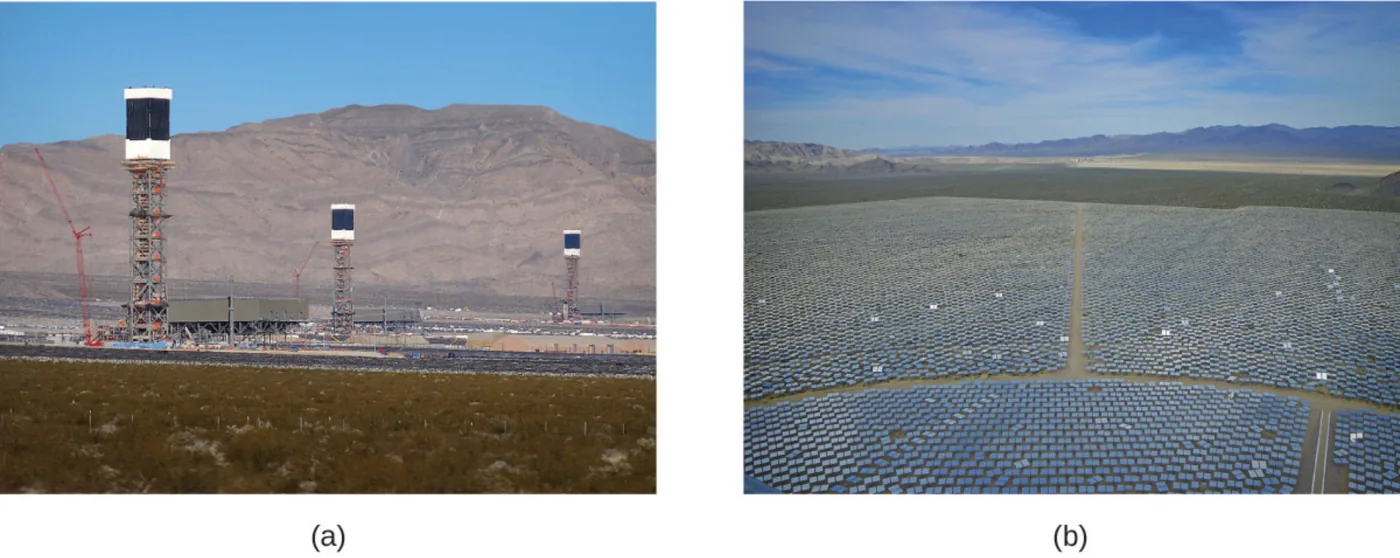
Calorimetry matters at very different scales. Solar thermal power plants, for example, use large fields of curved mirrors to focus sunlight onto a fluid that is heated and then used to make steam. The heat energy captured in this way is the quantity that engineers must track.
The Ivanpah Solar Generating System in the Mojave Desert of California is the largest solar thermal power plant in the world.
About 170,000 mirrors focus sunlight onto three water-filled towers
which produce steam above 538 °C.
That steam drives turbines that generate enough electricity for about 140,000 homes.
Water is the working fluid in this plant because it has a large heat capacity and a large heat of vaporization,
so it can absorb and carry a great deal of heat for its mass.
◀ Previous2 / 3Next ▶
The Ivanpah plant, with three tall solar towers standing in front of a mountain range, and the very large field of mirrors that covers public desert land. Image: OpenStax, Chemistry 2e, CC BY 4.0.
Measuring heat with calorimetry
◀ Previous3 / 3
1How a calorimeter works2How a calorimeter works
How a calorimeter works
1
A calorimeter is a device that measures the amount of heat involved in a chemical or physical process.
2
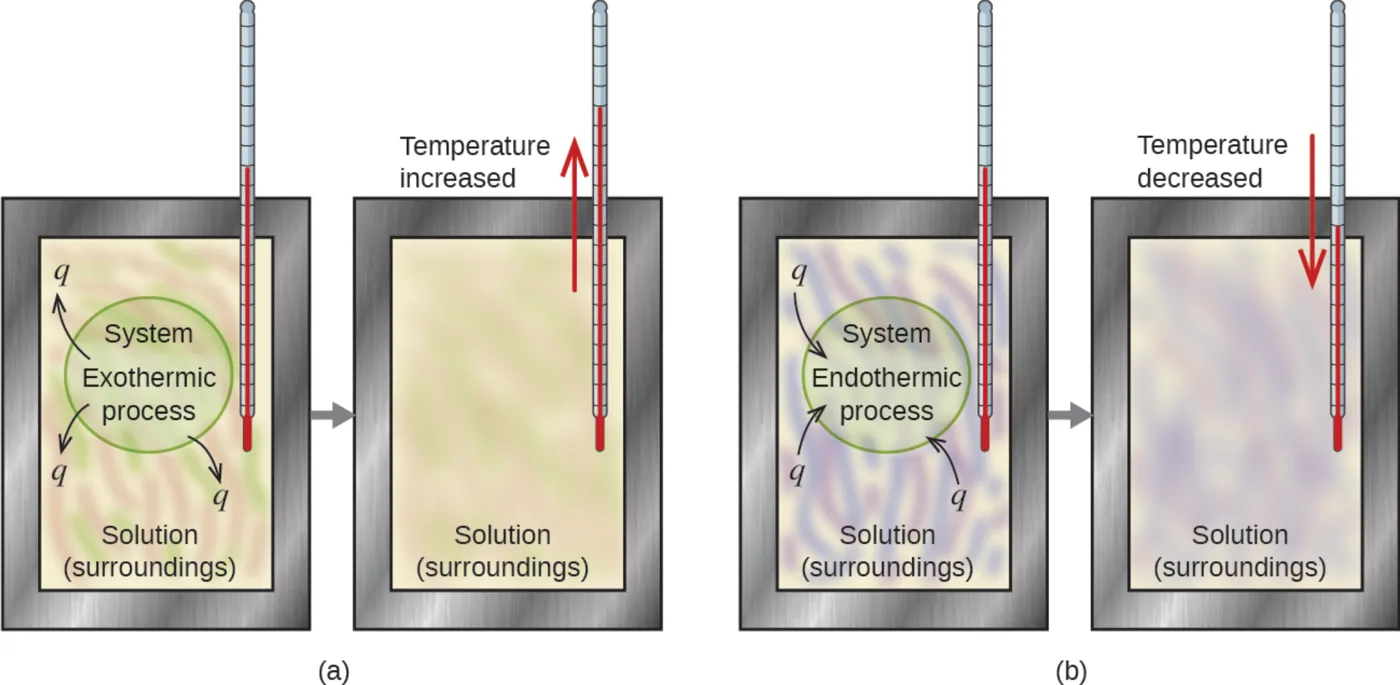
Suppose an exothermic reaction takes place in solution inside a calorimeter.
3
The heat released by the reaction is absorbed by the solution
so the solution warms up.
4
If the reaction is endothermic, it takes the heat it needs from the thermal energy of the solution
so the solution cools down.
5
In either case, the temperature change, together with the specific heat and mass of the solution, lets us calculate the heat involved.
1 / 2Next ▶
Heat flow in a calorimeter: in an exothermic process heat leaves the system and q is negative, while in an endothermic process heat enters the system and q is positive. Image: OpenStax, Chemistry 2e, CC BY 4.0.
How a calorimeter works
 ⤢ Enlarge
1
Measurements of heat are important for everything from tiny biological molecules to large machines. The chemist Reatha Clark King carried out calorimetric experiments at the National Bureau of Standards to find precise heats of several fluorine compounds. Her results helped NASA search for better rocket fuels.
2
Accurate work requires a calorimeter that is well insulated
so that heat cannot easily pass between the calorimeter and the room. With good insulation, the only surroundings that matter are the non-system parts inside the calorimeter, including the calorimeter itself. This allows the heat of chemical reactions, and the energy content of foods, to be determined accurately.
◀ Previous2 / 2
1Types of calorimeters2Types of calorimeters
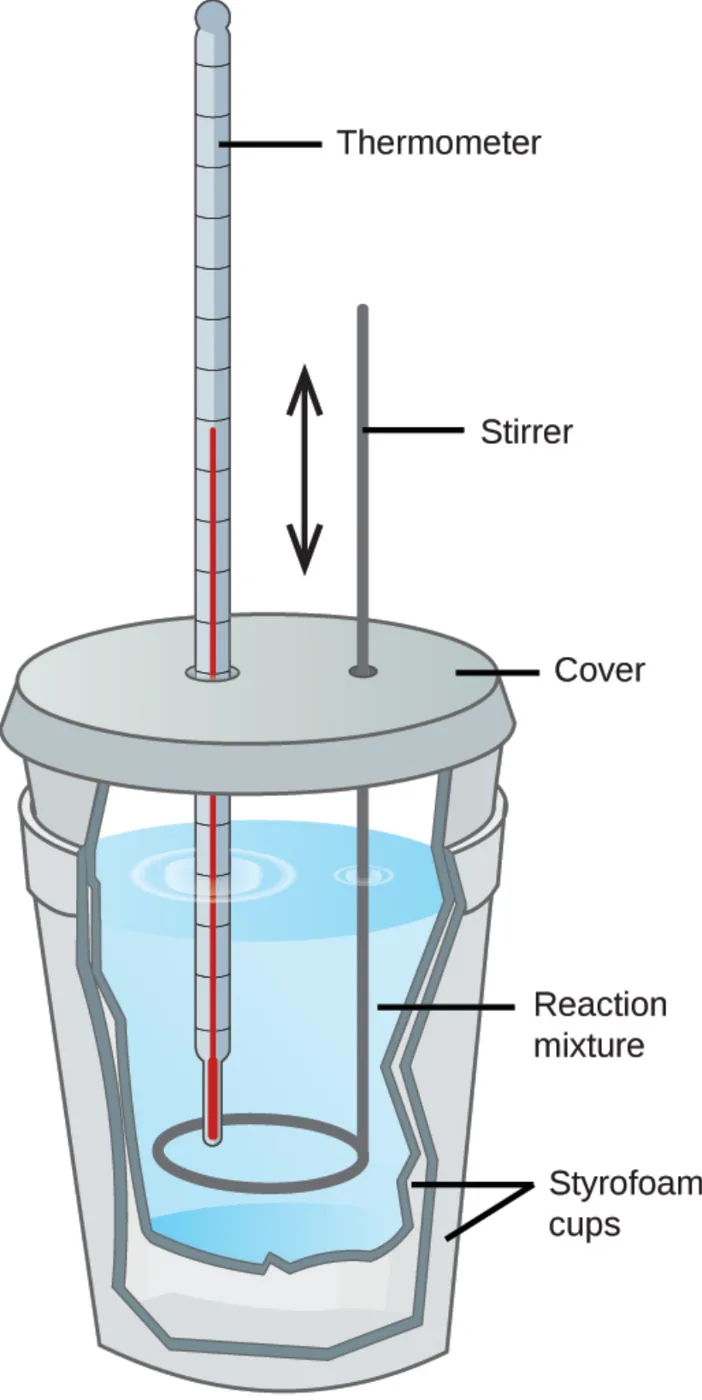
A simple calorimeter made from two polystyrene cups, with a lid through which a thermometer and a stirrer reach into the reaction mixture. Image: OpenStax, Chemistry 2e, CC BY 4.0.
Types of calorimeters
 ⤢ Enlarge
Types of calorimeters
General chemistry students often use a simple calorimeter made from two nested polystyrene cups, often called a coffee cup calorimeter.
A thermometer and a stirrer pass through the lid into the reaction mixture.
Because polystyrene lets more heat pass to the outside air than a professional instrument does, the energy values from a coffee cup calorimeter are less accurate,
but the method is simple and suitable for teaching.
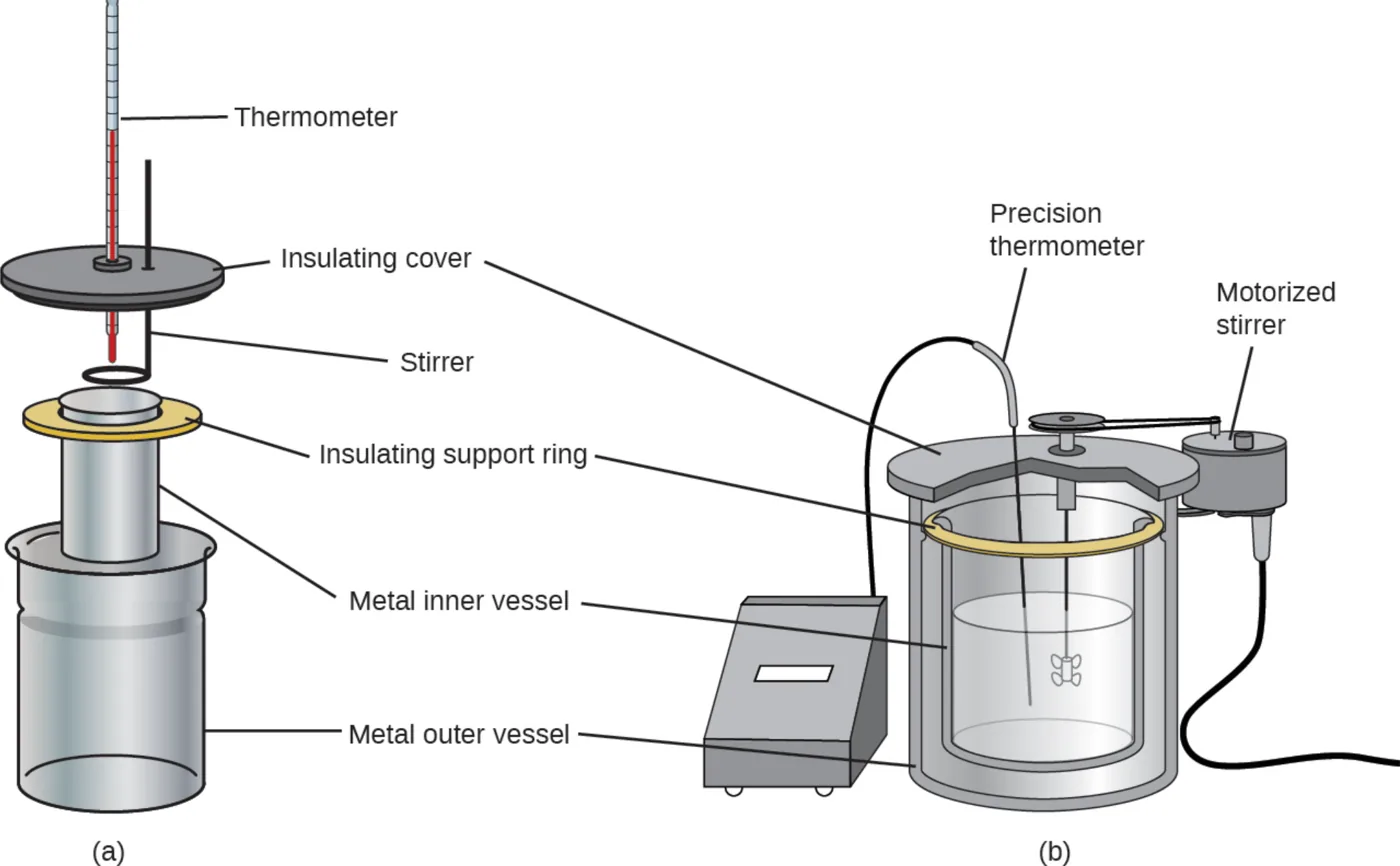
Commercial solution calorimeters are also available. Inexpensive models usually have two thin-walled cups that are nested so that little heat passes between them, an insulated cover, a hand-held stirrer and a basic thermometer. Expensive models used in industry and research have a well-insulated, fully enclosed vessel, a motor-driven stirrer and a more accurate temperature sensor.
1 / 2Next ▶
Commercial solution calorimeters, from a simple low-cost model for student use to a costly, more precise instrument for industry and research. Image: OpenStax, Chemistry 2e, CC BY 4.0.
Types of calorimeters
◀ Previous2 / 2
1Heat transfer between two substances2Heat transfer between two substances3Heat transfer between two substances
Heat transfer between two substances
Heat transfer between two substances
Before we look at reactions, consider a simpler case that shows the core idea of calorimetry.
Take a hot piece of metal, M, and cool water, W.
When the metal is placed in the water, heat flows from M to W.
The metal cools and the water warms until both reach the same temperature.
This common temperature is called thermal equilibrium.
1 / 3Next ▶
A hot metal dropped into cool water: heat passes from the metal to the water until both are at one common temperature. Image: OpenStax, Chemistry 2e, CC BY 4.0.
Heat transfer between two substances
 ⤢ Enlarge
Heat transfer between two substances
If this happens inside a calorimeter, and the calorimeter is ideal so that no heat is gained from or lost to the outside, all the heat moves between the metal and the water.
In that case the net heat change is zero.
This means the heat gained by the water equals the heat lost by the metal
so the two heats have the same magnitude but opposite signs.
The sign shows the direction of flow: the metal has a negative q because it loses heat, and the water has a positive q because it gains heat.
Heat gained or lost by a substance depends on its mass, its specific heat and its temperature change.
The specific heat of water is 4.184 J/(g °C)
which means 4.184 joules raise the temperature of 1 gram of water by 1 °C.
◀ Previous2 / 3Next ▶
Heat transfer between two substances
1
The specific heat of most metals is much smaller.
2
Because each metal has its own specific heat, a calorimetry measurement can also be used to find the specific heat of an unknown metal and so help identify it.
◀ Previous3 / 3
1Calorimetry of chemical reactions2Calorimetry of chemical reactions
Calorimetry of chemical reactions
1
The same principles apply when calorimetry is used to measure the heat of a chemical reaction.
2
The calorimeter absorbs only a small amount of heat
which can often be neglected, and it limits energy exchange with the outside air.
3
Energy is conserved,
so the heat produced or consumed by the reaction, qreaction,and the heat absorbed or lost by the solution, qsolution, add up to zero:
4
qreaction + qsolution = 0
so qreaction = −qsolution
5
In this equation, qreaction and qsolution are heats in joules (J).
6
For a solution, qsolution = m × c × ΔT,
where m is the mass of the solution in grams (g), c is its specific heat in J/(g °C),and ΔT is the temperature change in degrees Celsius (°C).
1 / 2Next ▶
Calorimetry of chemical reactions
Calorimetry of chemical reactions
The specific heat unit J/(g °C) equals 1000 J/(kg K)
so it can be converted to the SI unit J/(kg K) if needed.
This relation is the basis of nearly every calorimetry calculation.
Example 5.5 in the worked examples shows it in use.
◀ Previous2 / 2
Link to learning: precipitation in a hand warmer
1
A linked video shows the precipitation reaction that happens when the metal disc inside a chemical hand warmer is flexed.
2
Flexing the disc starts crystallization in a supersaturated solution, and the release of heat from this precipitation warms the hand.
3
The idea is the same as the calorimetry problems in this lesson: heat released by the reaction goes into the surrounding solution.
1Heat flow in an instant ice pack2Heat flow in an instant ice pack
Heat flow in an instant ice pack
Heat flow in an instant ice pack
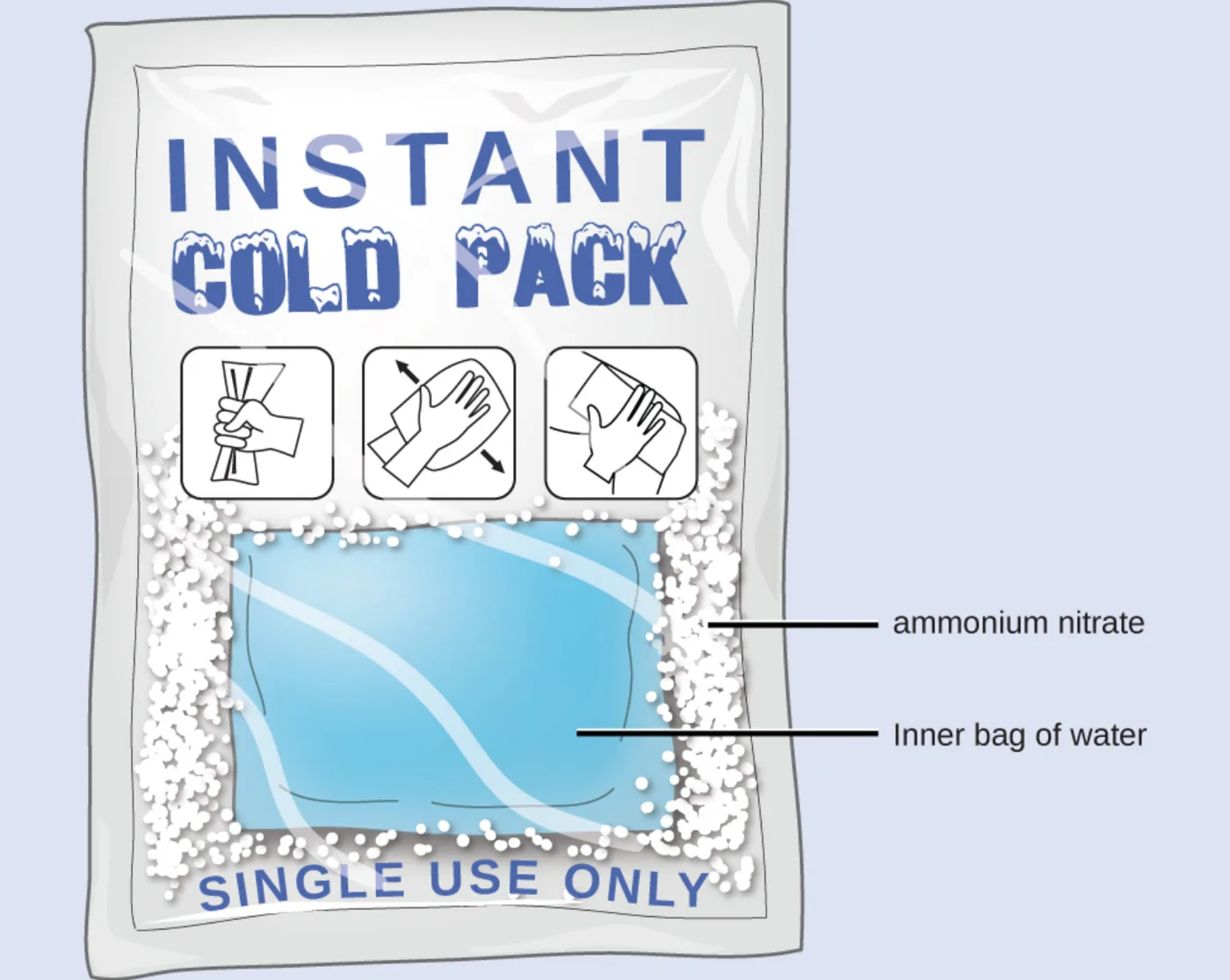
When solid ammonium nitrate dissolves in water, the solution becomes cold.
This process is the basis of an instant ice pack.
The pack contains a bag of solid ammonium nitrate and a separate bag of water.
When the water bag is broken, the solid dissolves, and the pack absorbs thermal energy from the water and from your body
so it feels cold.
1 / 2Next ▶
An instant cold pack with a bag of solid ammonium nitrate beside a bag of water; when the water bag breaks, the dissolving salt takes heat from the surroundings. Image: OpenStax, Chemistry 2e, CC BY 4.0.
Heat flow in an instant ice pack
◀ Previous2 / 2
1Chemistry in everyday life: thermochemistry of hand warmers2Chemistry in everyday life: thermochemistry of hand warmers
Chemistry in everyday life: thermochemistry of hand warmers
1
On a cold day you might use a hand warmer.
2
A common reusable hand warmer contains a supersaturated solution of sodium acetate, NaC2H3O2, and a small metal disc.
3
Bending the disc creates nucleation sites, around which the metastable sodium acetate quickly crystallizes.
4
This precipitation is exothermic, and the heat it produces is absorbed by your hands.
5
If the hand warmer is heated again, the sodium acetate dissolves and the warmer can be reused.
1 / 2Next ▶
A reusable hand warmer and the metal disc that starts the exothermic crystallization of its solution. Image: OpenStax, Chemistry 2e, CC BY 4.0.
Chemistry in everyday life: thermochemistry of hand warmers
 ⤢ Enlarge
1
Another common hand warmer produces heat when it is opened
because the iron and water inside react with oxygen from the air.
2
Salt in the mixture speeds up this exothermic oxidation
so the heat is released faster.
3
Cellulose, vermiculite and activated carbon spread the heat evenly.
4
Other hand warmers burn lighter fluid over a platinum catalyst, use charcoal, or use an electric heating element powered by a battery.
◀ Previous2 / 2
1Bomb calorimetry2Bomb calorimetry
Bomb calorimetry
Bomb calorimetry
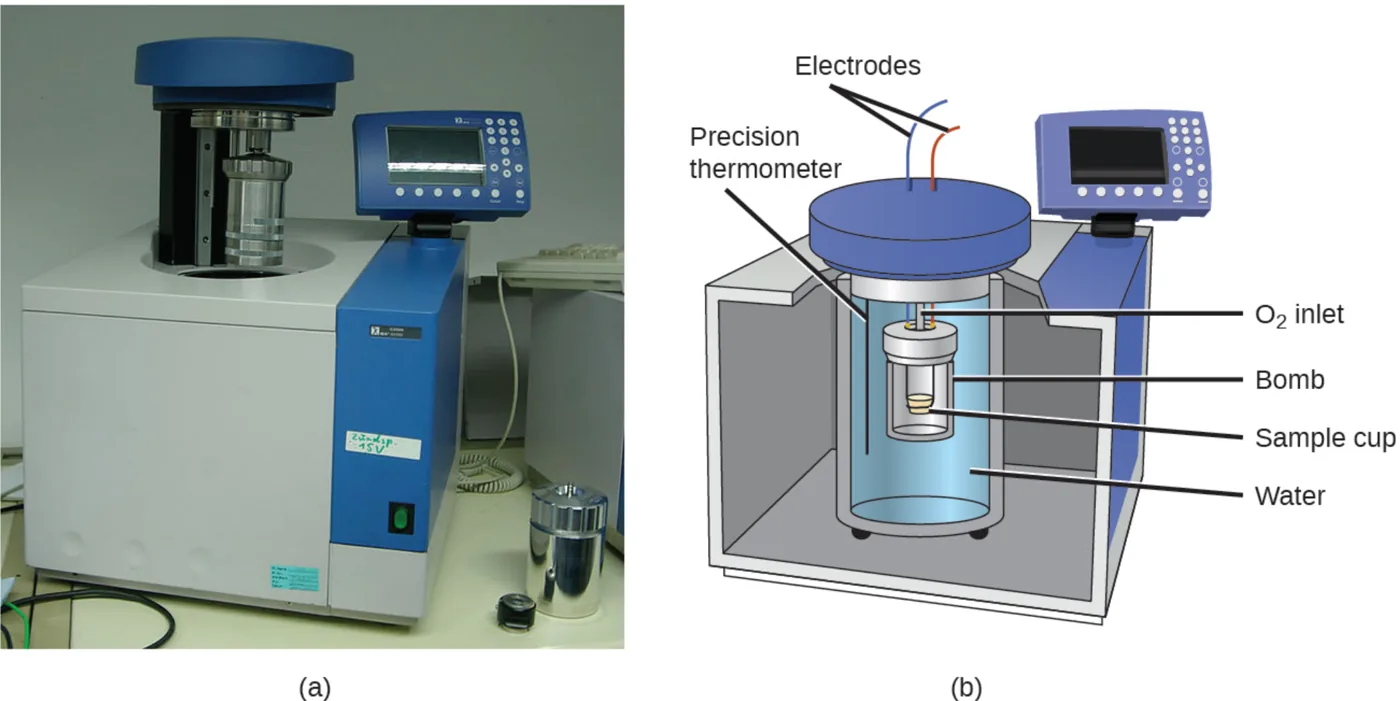
The calorimeters described so far work at constant atmospheric pressure and suit reactions in solution. A bomb calorimeter works at constant volume and measures the energy of reactions that release a large amount of heat and form gases, such as combustion. The name comes from the fact that such reactions can be violent enough to damage an ordinary calorimeter.
A bomb calorimeter has a robust steel container, the bomb
which holds the sample.
The bomb is filled with oxygen at high pressure, and a small electric spark ignites the sample.
The bomb is submerged in water inside insulation.
The heat from the reaction is absorbed by the steel bomb and by the surrounding water, and the temperature rise is measured.
Multiplying the temperature rise by the known heat capacity of the calorimeter gives the energy released.
1 / 2Next ▶
A bomb calorimeter, with a gas-tight steel vessel holding the sample, submerged in water and surrounded by insulation, shown in a photograph and in a cutaway drawing. Image: OpenStax, Chemistry 2e, CC BY 4.0.
Bomb calorimetry
 ⤢ Enlarge
1
Because the bomb itself absorbs heat, the calorimeter must be calibrated before use to find its heat capacity
which is the heat needed to raise its temperature by 1 °C, in J/°C.
2
Calibration uses a reaction with a known heat change, such as burning a weighed sample of benzoic acid ignited by a nickel fuse wire.
3
The calibration is normally repeated before each set of research measurements.
◀ Previous2 / 2
Link to learning: bomb calorimeter and calorimetric calculations
Link to learning: bomb calorimeter and calorimetric calculations
An online video shows how a bomb calorimeter is prepared for use, and a second website works through calorimetric calculations with sample data. Both are good for seeing the steps of setup, calibration and calculation that this lesson describes.
1Whole-body calorimetry2Whole-body calorimetry
Whole-body calorimetry
Whole-body calorimetry
Since 1899, about 35 calorimeters have been built to measure the heat produced by a living person.
Whole-body calorimeters are large enough to hold a person.
Whole-room calorimeters are newer and allow fairly normal activity
so their data reflect everyday life more closely.
These instruments measure metabolism under different environmental conditions, with different diets, and in people with conditions such as diabetes.
For example, Carla Prado and her team at the University of Alberta used whole-body calorimetry to study the energy use of women who had recently given birth.
Such studies help set better guidance on nutrition, exercise and health during that period of change.
1 / 2Next ▶
Whole-body calorimetry
Whole-body calorimetry
In humans, metabolism is usually reported in Calories per day.
◀ Previous2 / 2
1Chemistry in everyday life: measuring nutritional Calories2Chemistry in everyday life: measuring nutritional Calories
Chemistry in everyday life: measuring nutritional Calories
1
Food energy is usually given in Calories, the nutritional unit.
2
One calorie (cal) is exactly 4.184 joules.
3
One Calorie, with a capital C, equals 1000 cal
which is 1 kcal.
4
This is about the energy needed to heat 1 kg of water by 1 °C.
5
The three macronutrients are proteins, carbohydrates, and fats or oils.
6
Proteins and carbohydrates each provide about 4 Calories per gram
while fats and oils provide about 9 Calories per gram.
1 / 2Next ▶
Chemistry in everyday life: measuring nutritional Calories
Chemistry in everyday life: measuring nutritional Calories
The nutrition label on a food package gives the Calories in one serving and the share that comes from each macronutrient.
◀ Previous2 / 2
1Example 5.3: Heat transfer between a steel rebar and water2Example 5.3: Heat transfer between a steel rebar and water3Example 5.4: Identifying a metal by its specific heat4Example 5.4: Identifying a metal by its specific heat5Example 5.5: Heat produced by an exothermic reaction6Example 5.5: Heat produced by an exothermic reaction7Example 5.6: Heat flow in an instant ice pack8Example 5.6: Heat flow in an instant ice pack9Example 5.7: Bomb calorimetry of glucose10Example 5.7: Bomb calorimetry of glucose
Example 5.3: Heat transfer between a steel rebar and water
1
A 360.0 g piece of steel rebar is dropped into 425 mL of water at 24.0 °C. The final temperature of the water is 42.7 °C. Find the initial temperature of the rebar. Assume the specific heat of steel is close to that of iron, 0.450 J/(g °C), and that all heat moves between the rebar and the water.
2
Solution. The water warms
so it gains heat, and the rebar must lose the same amount. The density of water is 1.0 g/mLso 425 mL has a mass of 425 g. Heat given off by the rebar equals the negative of the heat taken in by the water:
3
qrebar = −qwater
so mrebar × csteel × (Tf − Ti,rebar) = −mwater × cwater × (Tf − Ti,water)
4
The water heat is 425 g × 4.184 J/(g °C) × (42.7 − 24.0) °C = 3.33 × 10⁴ J
so qwater = +33,250 J and qrebar = −33,250 J.
5
Then (42.7 − Ti,rebar) = −33,250 J ÷ (360.0 g × 0.450 J/(g °C)) = −205.2 °C.
6
Solving gives Ti,rebar ≈ 248 °C.
1 / 10Next ▶
Example 5.3: Heat transfer between a steel rebar and water
Example 5.3: Heat transfer between a steel rebar and water
The rebar started near 248 °C.
Check Your Learning: A 248 g piece of copper is dropped into 390 mL of water at 22.6 °C, and the final water temperature is 39.9 °C. Find the initial temperature of the copper, taking the specific heat of copper as 0.385 J/(g °C). Answer: about 335.5 °C.
Check Your Learning: A 248 g piece of copper at 314 °C is dropped into 390 mL of water at 22.6 °C.
Find the final temperature reached by both. Answer: about 38.7 °C.
(The copper loses heat, 248 × 0.385 × (314 − Tf), and the water gains 390 × 4.184 × (Tf − 22.6)
equating them gives Tf ≈ 38.7 °C.)
◀ Previous2 / 10Next ▶
Example 5.4: Identifying a metal by its specific heat
Example 5.4: Identifying a metal by its specific heat
A 59.7 g metal sample, first in boiling water, is moved quickly into 60.0 mL of water at 22.0 °C. The final temperature is 28.5 °C. Find the specific heat of the metal and identify it from Table 5.1.
Solution. The metal starts at 100.0 °C.
Water has a density of 1.0 g/mL
so its mass is 60.0 g.
The water gains qwater = 60.0 g × 4.184 J/(g °C) × (28.5 − 22.0) °C = +1631.8 J.
The metal therefore loses 1631.8 J
so its specific heat is cmetal = −qmetal ÷ (mmetal × ΔTmetal) = 1631.8 J ÷ (59.7 g × 71.5 °C) = 0.382 J/(g °C).
This is closest to the value for copper, 0.39 J/(g °C)
so the metal is copper.
◀ Previous3 / 10Next ▶
Example 5.4: Identifying a metal by its specific heat
1
Check Your Learning: A 92.9 g silver-gray metal is heated to 178.0 °C and then placed in 75.0 mL of water at 24.0 °C.
2
After equilibrium the temperature is 29.7 °C.
3
Find the specific heat and identify the metal. Answer: cmetal = 0.13 J/(g °C).
4
This value is close to both gold and lead.
5
Because the metal is silver-gray, it is lead.
◀ Previous4 / 10Next ▶
Example 5.5: Heat produced by an exothermic reaction
1
When 50.0 mL of 1.00 M HCl(aq) and 50.0 mL of 1.00 M NaOH(aq), both at 22.0 °C, are mixed in a coffee cup calorimeter, the temperature reaches a maximum of 28.9 °C. Find the approximate heat of the reaction.
2
Solution. Treat the two solutions as one 100.0 mL mixture at 22.0 °C
which then reacts until it reaches 28.9 °C.
3
The heat given off by the reaction equals the heat taken in by the solution.
4
The solution has a mass of about 1.0 × 10² g, and we use the specific heat of water, 4.184 J/(g °C).
5
So qsolution = 100.0 g × 4.184 J/(g °C) × (28.9 − 22.0) °C = +2.9 × 10³ J.
6
Therefore qreaction = −2.9 kJ.
◀ Previous5 / 10Next ▶
Example 5.5: Heat produced by an exothermic reaction
Example 5.5: Heat produced by an exothermic reaction
The negative sign shows that the reaction is exothermic, and it releases about 2.9 kJ of heat.
This result assumes that the calorimeter absorbs no heat and exchanges none with the room.
Check Your Learning: 100 mL of 0.200 M NaCl(aq) and 100 mL of 0.200 M AgNO3(aq), both at 21.9 °C, are mixed in a coffee cup calorimeter.
The temperature rises to 23.5 °C as solid AgCl forms.
Find the heat of the precipitation and state your assumptions. Answer: qreaction ≈ −1.34 kJ
so 1.34 kJ of heat is released.
Assumed: the calorimeter absorbs no heat, no heat is exchanged with the surroundings,
and the solution has the density and specific heat of water.(total mass 200 g)
◀ Previous6 / 10Next ▶
Example 5.6: Heat flow in an instant ice pack
1
When 3.21 g of solid NH4NO3 dissolves in 50.0 g of water at 24.9 °C in a calorimeter, the temperature drops to 20.3 °C. Find q for the reaction and explain the sign.
2
Solution. Assume the calorimeter prevents heat exchange with the outside
so qrxn = −qsoln.
3
Assume the solution has the specific heat of water.
4
The mass of the solution is taken as 50.0 g,
because the salt added is small compared with the water. qsoln = 50.0 g × 4.184 J/(g °C) × (20.3 − 24.9) °C = −962 J.
5
Therefore qrxn = +962 J, or +0.962 kJ.
6
The positive sign shows that the dissolution is endothermic: it takes thermal energy from the water.
◀ Previous7 / 10Next ▶
Example 5.6: Heat flow in an instant ice pack
Example 5.6: Heat flow in an instant ice pack
For interest, 3.21 g of NH4NO3 is 0.0401 mol (molar mass 80.04 g/mol)
so the dissolution absorbs about 24.0 kJ per mole.
Check Your Learning: A 3.00 g sample of KCl is added to 3.00 × 10² g of water in a coffee cup calorimeter, and the temperature drops by 1.05 °C.
Find the heat of dissolution. Answer: qrxn = +1.33 kJ.
Assumed: no heat leaves the calorimeter, and the solution (303 g in total) has the specific heat of water.
◀ Previous8 / 10Next ▶
Example 5.7: Bomb calorimetry of glucose
Example 5.7: Bomb calorimetry of glucose
When 3.12 g of glucose, C6H12O6, burns in a bomb calorimeter, the temperature rises from 23.8 °C to 35.6 °C. The calorimeter contains 775 g of water, and the bomb has a heat capacity of 893 J/°C. Find the heat produced by the combustion.
Solution. The heat from the reaction is absorbed by the water and by the bomb.
The heat taken by the other products and the leftover oxygen is small and is neglected.
The temperature change is ΔT = 35.6 − 23.8 = 11.8 °C.
The water absorbs 775 g × 4.184 J/(g °C) × 11.8 °C = 38,263 J.
The bomb absorbs 893 J/°C × 11.8 °C = 10,537 J.
◀ Previous9 / 10Next ▶
Example 5.7: Bomb calorimetry of glucose
1
The total heat absorbed is 48,800 J, or 48.8 kJ.
2
The reaction therefore released 48.8 kJ of heat when 3.12 g of glucose burned.
3
Check Your Learning: When 0.963 g of benzene, C6H6, burns in a bomb calorimeter, the temperature rises by 8.39 °C.
4
The bomb has a heat capacity of 784 J/°C and is submerged in 925 mL of water.
5
Find the heat of combustion. Answer: qrxn = −39.0 kJ
so the reaction releases 39.0 kJ.
6
(Water: 925 g × 4.184 × 8.39 = 32,471 J
bomb: 784 × 8.39 = 6,578 Jtotal 39,049 J.)
◀ Previous10 / 10
Key terms
| Term | Meaning |
|---|---|
| Calorimetry | A technique for measuring the heat transferred to or from a substance by exchanging that heat with a calibrated object. |
| Calorimeter | A device used to measure the amount of heat involved in a chemical or physical process. |
| System | The substance or substances that undergo the chemical or physical change being studied. |
| Surroundings | All other matter, including the parts of the apparatus, that supplies heat to the system or absorbs heat from it. |
| Thermal equilibrium | The state in which two substances in contact have the same temperature, so no net heat flows between them. |
| Exothermic process | A process that releases heat, so q for the system is negative. |
| Endothermic process | A process that absorbs heat from its surroundings, so q for the system is positive. |
| Specific heat | The amount of heat needed to raise the temperature of 1 g of a substance by 1 °C, in J/(g °C). |
| Coffee cup calorimeter | A simple calorimeter made from nested polystyrene cups, operated at constant atmospheric pressure, that gives less accurate energy values. |
| Bomb calorimeter | A robust, sealed steel calorimeter operated at constant volume, used to measure the heat of combustion and other reactions that release large amounts of heat and gas. |
| Heat capacity of a calorimeter | The heat needed to raise the temperature of the calorimeter itself by 1 °C, in J/°C. |
| Calibration | Determining the heat capacity of a calorimeter by running a reaction with a known heat change, such as burning benzoic acid. |
| Nutritional Calorie (Calorie) | The unit used to express the energy in food, equal to 1000 calories or 1 kcal. |
1Avoid these mistakes2Avoid these mistakes3Avoid these mistakes4Avoid these mistakes
Avoid these mistakes
1Avoid this
Using the mass of the reactants instead of the mass of the solution when calculating qAvoid this
solutionAvoid this
= m × c × ΔT.Avoid this
2Avoid this
Forgetting that qAvoid this
1 / 4Next ▶
Avoid these mistakes
reactionAvoid this
and qAvoid this
have opposite signs,Avoid this
so an exothermic reaction gives a positive heat for the solution and a negative heat for the reaction.Avoid this
3Avoid this
Calculating ΔT for a cooling substance as the positive difference between temperatures, instead of final minus initial,Avoid this
◀ Previous2 / 4Next ▶
Avoid these mistakes
which flips the sign of its heat.Avoid this
4Avoid this
Ignoring the heat capacity of a bomb calorimeter, which absorbs heat along with the water.Avoid this
5Avoid this
Treating a coffee cup calorimeter as perfectly insulated and ignoring its heat exchange with the surroundings when a high accuracy result is needed.Avoid this
6Avoid this
◀ Previous3 / 4Next ▶
Avoid these mistakes
Mixing up endothermic and exothermic, for example concluding that an instant ice pack releases heat because it feels cold.Avoid this
◀ Previous4 / 4