Curriculum
Chemistry 2e
Unit 1: Essential Ideas
0/14
Unit 2: Atoms, Molecules, and Ions
0/16
Unit 3: Composition of Substances and Solutions
0/10
Unit 4: Stoichiometry of Chemical Reactions
0/12
Unit 5: Thermochemistry
0/8
Unit 6: Electronic Structure and Periodic Properties of Elements
0/12
Unit 7: Chemical Bonding and Molecular Geometry
0/14
Unit 8: Advanced Theories of Covalent Bonding
0/10
Unit 9: Gases
0/23
Unit 10: Liquids and Solids
0/28
Unit 11: Solutions and Colloids
0/24
-
Unit 11 overview: Solutions and Colloids
 Preview
-
11.1 The Dissolution Process
Preview
-
Unit 11 overview: Solutions and Colloids
Preview
-
11.1 The Dissolution Process
Preview
-
11.1 The Dissolution Process - Check yourself
 Preview
-
11.1 The Dissolution Process - Check yourself
Preview
-
11.2 Electrolytes
Preview
-
11.2 Electrolytes - Check yourself
Preview
-
11.2 Electrolytes
Preview
-
11.2 Electrolytes - Check yourself
Preview
-
11.3 Solubility
Preview
-
11.3 Solubility - Check yourself
Preview
-
11.3 Solubility
Preview
-
11.3 Solubility - Check yourself
Preview
-
11.4 Colligative Properties
Preview
-
11.4 Colligative Properties - Check yourself
Preview
-
11.4 Colligative Properties
Preview
-
11.4 Colligative Properties - Check yourself
Preview
-
11.5 Colloids
Preview
-
11.5 Colloids - Check yourself
Preview
-
11.5 Colloids
Preview
-
11.5 Colloids - Check yourself
Preview
-
Unit 11 review quiz: Solutions and Colloids
Preview
-
Unit 11 review quiz: Solutions and Colloids
Preview
Unit 12: Kinetics
0/32
Unit 13: Fundamental Equilibrium Concepts
0/20
Unit 14: Acid-Base Equilibria
0/32
Unit 15: Equilibria of Other Reaction Classes
0/16
Unit 16: Thermodynamics
0/20
Unit 17: Electrochemistry
0/32
Unit 18: Representative Metals, Metalloids, and Nonmetals
0/52
Unit 19: Transition Metals and Coordination Chemistry
0/16
Unit 20: Organic Chemistry
0/20
Unit 21: Nuclear Chemistry
0/28
Text lesson
11.4 Colligative Properties
11.4 Colligative Properties — CHEMISTRY notes: You will be able to express concentration as mole fraction and molality, calculate how a nonvolatile solute changes vapor pressure, boiling point, freezing point and osmotic pressure, and use these effects to find a molar mass.
1Supersaturated solutions2Supersaturated solutions
Supersaturated solutions
Supersaturated solutions
A solution can dissolve more solute at a high temperature
where the solute is more soluble.
If it is cooled carefully, the extra solute often stays dissolved.
The result is a supersaturated solution: it contains more solute than its equilibrium solubility at the lower temperature.
Such a solution is fairly stable
but excess solute will crystallize quickly if a seed crystal is added or the solution is shaken or struck.
Reusable hand warmers use this behavior. They contain a supersaturated solution of sodium acetate. Clicking a flexible metal disk inside sends a mechanical shock through the liquid
which starts crystallization. Crystallization releases heatso the pack warms the hands. A short video in the module shows this process happening.
1 / 2Next ▶
A reusable hand warmer in which a click on a metal disk makes sodium acetate crystals form from a supersaturated solution, releasing heat. Image: OpenStax, Chemistry 2e, CC BY 4.0.
Supersaturated solutions

◀ Previous2 / 2
Colligative properties
Colligative properties
The properties of a solution differ from those of the pure solute and the pure solvent. Many of them depend on the chemical identity of the solute. For example, a hydrogen chloride solution is more acidic than pure water, an ammonia solution is more basic, a sodium chloride solution is denser, and a sucrose solution is more viscous.
A few properties depend only on the total number of dissolved solute particles, not on what those particles are.
These colligative properties are vapor pressure lowering, boiling point elevation, freezing point depression and osmotic pressure.
They are important in nature and in technology.
In this lesson you will learn the concentration units used for them and how to calculate each effect.
Mole fraction and molality
Mole fraction and molality
Molarity, the moles of solute per liter of solution, is convenient for stoichiometry. However, solution volume changes with temperature
so molarity changes too. Colligative calculations need units that depend only on moles and massesbecause those do not change with temperature.
The mole fraction, X, of a component is its moles divided by the total moles of all components, solvent and solutes.
It is dimensionless, and the mole fractions of all components add up to 1.
Molality, m, is the moles of solute divided by the mass of solvent in kilograms, so its unit is mol/kg.
Molality is the concentration unit used in the colligative equations.
1Vapor pressure lowering2Vapor pressure lowering3Vapor pressure lowering
Vapor pressure lowering
1
The equilibrium vapor pressure of a liquid is the pressure of its vapor when evaporation and condensation occur at equal rates.
2
Adding a nonvolatile solute
which has negligible vapor pressure of its own, lowers the vapor pressure of the liquid.
3
Solute particles cover part of the surface
so fewer solvent molecules can escapewhile condensation is unchanged.
4
Equilibrium is therefore reached with fewer molecules in the vapor.
5
A fuller explanation uses entropy: the dispersed mixture stabilizes the solvent molecules and makes them less likely to vaporize.
6
Raoult’s law gives the size of the effect.
1 / 3Next ▶
Vapor pressure lowering
1
The partial pressure of a component of an ideal solution equals the vapor pressure of the pure component times its mole fraction in the solution: PA = XAPA°.
2
Here PA is the partial pressure of A above the solution (atm), PA° is the vapor pressure of pure A (atm),
and XA is the mole fraction of A (dimensionless).
3
Dalton’s law says the total pressure of a mixture is the sum of its partial pressures.
4
If all solutes are nonvolatile, only the solvent contributes
so Psolution = XsolventPsolvent°.
◀ Previous2 / 3Next ▶
Nonvolatile solute molecules block the surface of a liquid, so fewer solvent molecules evaporate and the vapor pressure falls. Image: OpenStax, Chemistry 2e, CC BY 4.0.
Vapor pressure lowering

◀ Previous3 / 3
1Distillation of solutions2Distillation of solutions
A laboratory distillation unit, with a heated flask, a condenser and a collection vessel for the more volatile liquid. Image: OpenStax, Chemistry 2e, CC BY 4.0.
Distillation of solutions
 ⤢ Enlarge
1
Liquids with very different vapor pressures can be separated by distillation, a selective vaporization process. Take two volatile liquids, A and B
where A is more volatile. By Raoult’s law, the vapor above the mixture contains a larger mole fraction of A than the liquid does. Heating the mixture, condensing the vapor and collecting the condensate separates A from B.
2
Distillation is used to refine petroleum, to isolate fermentation products and to purify water. The diagram below shows a typical laboratory unit.
3
Oil refineries use large-scale fractional distillation. Crude oil is heated at the base of a tall column, and its components vaporize and rise. Each component condenses in the part of the column that is cool enough for it, and is collected. The collected fractions are simpler mixtures used as diesel fuel, kerosene or gasoline.
1 / 2Next ▶
Crude oil is separated by fractional distillation into simpler mixtures, which are then sold as fuels and other products. Image: OpenStax, Chemistry 2e, CC BY 4.0.
Distillation of solutions

◀ Previous2 / 2
Boiling point elevation
Boiling point elevation
The boiling point of a liquid is the temperature at which its vapor pressure equals the atmospheric pressure.
A nonvolatile solute lowers the vapor pressure
so the solution must be heated to a higher temperature before it boils.
The boiling point elevation is ΔTb = Kbm,
where ΔTb is the increase in boiling point (°C), Kb is the boiling point elevation constant, also called the ebullioscopic constant (°C m−1),and m is the molality of all solute species (mol/kg).
Kb depends only on the solvent. The table below gives Kb and Kf for several solvents.
The effect depends on the number of solute particles per kilogram of solvent, not on their mass, size or identity. A 1 m aqueous sucrose solution and a 1 m aqueous ethylene glycol solution have the same boiling point
because each contains 1 mol of dissolved molecules per kilogram of water.
| Solvent | Normal boiling point (°C) | Kb (°C m−1) | Normal freezing point (°C) | Kf (°C m−1) |
|---|---|---|---|---|
| Water | 100.0 | 0.512 | 0.0 | 1.86 |
| Glacial acetic acid | 118.1 | 3.07 | 16.6 | 3.9 |
| Benzene | 80.1 | 2.53 | 5.5 | 5.12 |
| Chloroform | 61.26 | 3.63 | −63.5 | 4.68 |
| Nitrobenzene | 210.9 | 5.24 | 5.67 | 8.1 |
Road salt spread on pavement lowers the freezing point of the thin water layer, so the ice melts. Image: OpenStax, Chemistry 2e, CC BY 4.0.
Freezing point depression
 ⤢ Enlarge
1
Solutions freeze at lower temperatures than pure liquids. Salt, calcium chloride or urea is spread on roads and sidewalks to melt ice, and ethylene glycol is used as antifreeze in car radiators. Seawater freezes below 0 °C
which keeps polar oceans liquid, and the body fluids of cold-water fish act the same way.
2
The freezing point depression is ΔTf = Kfm
where ΔTf is the decrease in freezing point (°C), Kf is the freezing point depression constant, also called the cryoscopic constant (°C m−1), and m is the molality of the solute (mol/kg). The values of Kf are in the table in the boiling point section.
1Colligative properties and de-icing2Colligative properties and de-icing
Colligative properties and de-icing
1
Sodium chloride, calcium chloride and magnesium chloride all lower the freezing point of water
so they are used to de-ice roads. Calcium and magnesium chlorides are often mixed with sodium chloride. They are less corrosive, and they depress the freezing point morebecause each formula unit gives three particles rather than two.
2
Ionic salts speed up the corrosion of metal
so they are not used in car radiators or on aircraft.
3
Covalent glycols such as ethylene glycol and propylene glycol are used instead.
4
They lower the freezing point and raise the boiling point
so the fluid works in both winter and summer.
5
Heated glycol is sprayed on aircraft before takeoff in icy weather to remove ice and stop new ice from forming on the control surfaces.
1 / 2Next ▶
Freezing point depression is used to clear ice from a road (a) and from the control surfaces of an aircraft (b). Image: OpenStax, Chemistry 2e, CC BY 4.0.
Colligative properties and de-icing
◀ Previous2 / 2
1Phase diagram for a solution2Phase diagram for a solution
Phase diagram for a solution
1
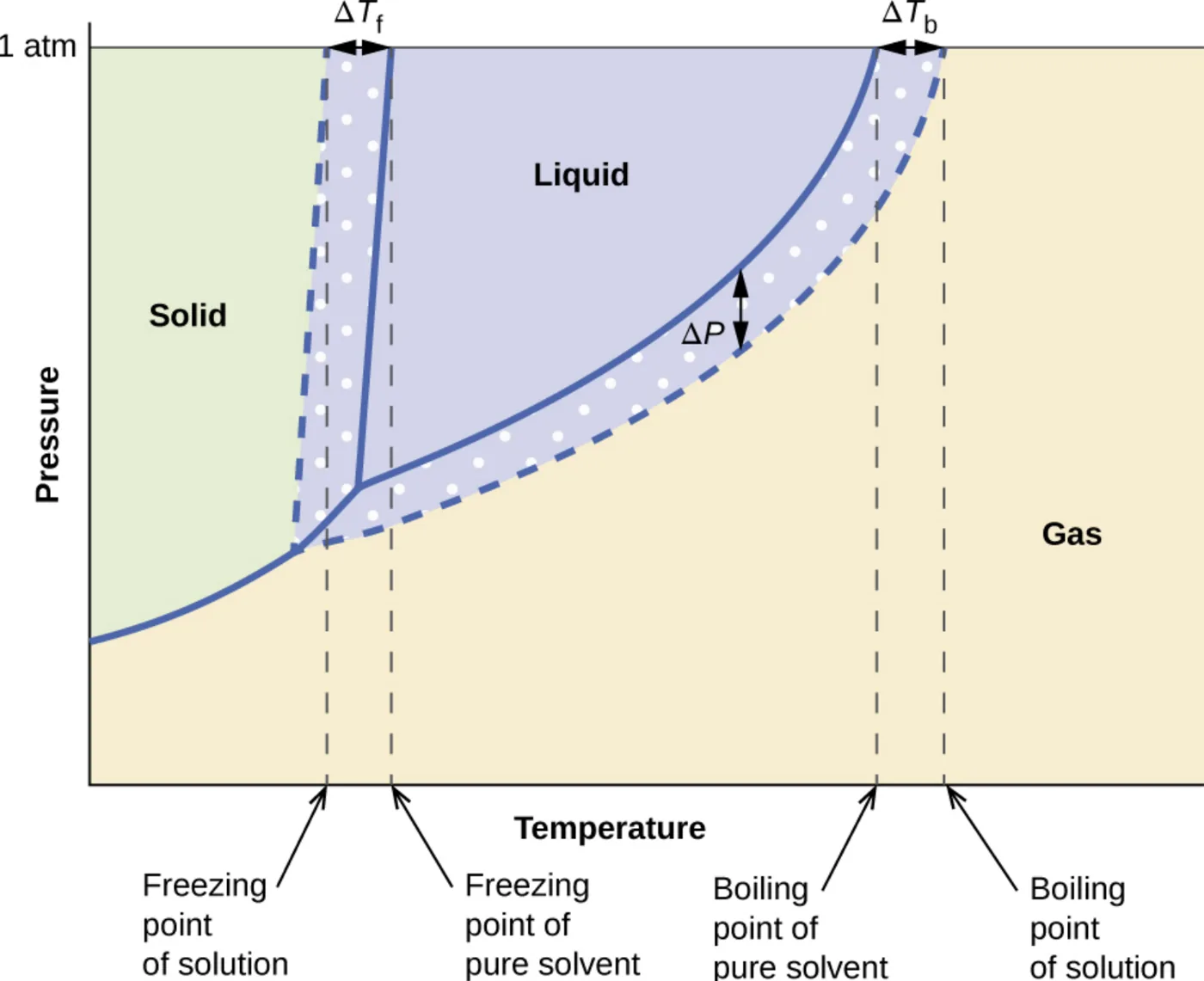
The effects on vapor pressure, boiling point and freezing point can be shown by comparing the phase diagram of a pure liquid with that of a solution made from it.
2
The solution’s liquid-vapor curve lies below the solvent’s curve
which shows the vapor pressure lowering ΔP.
3
At any given pressure the solution boils at a higher temperature
which is the boiling point elevation ΔTb.
4
Its solid-liquid curve is shifted to the left
which shows the freezing point depression ΔTf.
1 / 2Next ▶
Phase diagrams of a pure solvent (solid lines) and its solution (dashed lines), showing the lower vapor pressure, higher boiling point and lower freezing point of the solution. Image: OpenStax, Chemistry 2e, CC BY 4.0.
Phase diagram for a solution
 ⤢ Enlarge
Phase diagram for a solution
The solid-gas curves of the solvent and the solution are identical. When a solution freezes, only solvent molecules form the solid
so the solid and gas phases are pure solvent and are not affected by colligative effects.
◀ Previous2 / 2
Osmosis moves solvent through a semipermeable membrane into the solution until the pressure on the solution stops the flow. Image: OpenStax, Chemistry 2e, CC BY 4.0.
Osmosis and osmotic pressure
 ⤢ Enlarge
Osmosis and osmotic pressure
Some materials are selectively permeable: only molecules or ions of a certain size, shape, polarity or charge can pass through them. Cell membranes are natural examples. Dialysis tubing
which removes waste from blood, is a simple technical example. These materials are called semipermeable membranes.
Suppose pure solvent and a solution are separated by a membrane that passes only solvent. Solvent molecules move through the membrane in both directions
but the solvent concentration is higher on the pure sideso more molecules cross from the pure solvent into the solution. This net transfer through a semipermeable membrane is osmosis.
As the solution dilutes, its level rises
so the hydrostatic pressure grows and pushes solvent back.
Transfer stops when the back flow equals the osmotic flow.
The pressure at this point is the osmotic pressure, Π.
For a dilute solution, Π = MRT,
where Π is the osmotic pressure (atm), M is the molarity (mol/L), R is the gas constant and T is the absolute temperature (K).(0.08206 L atm mol−1 K−1)
1Osmosis in living things2Osmosis in living things
Osmosis in living things
1
Osmosis happens in plants and animals. Limp carrots and celery become crisp when placed in water
because water moves into their cells. A cucumber in concentrated salt solution loses water and takes up salt, and becomes a pickle.
2
Body cell fluids and blood serum have an osmotic pressure of about 7.7 atm.
3
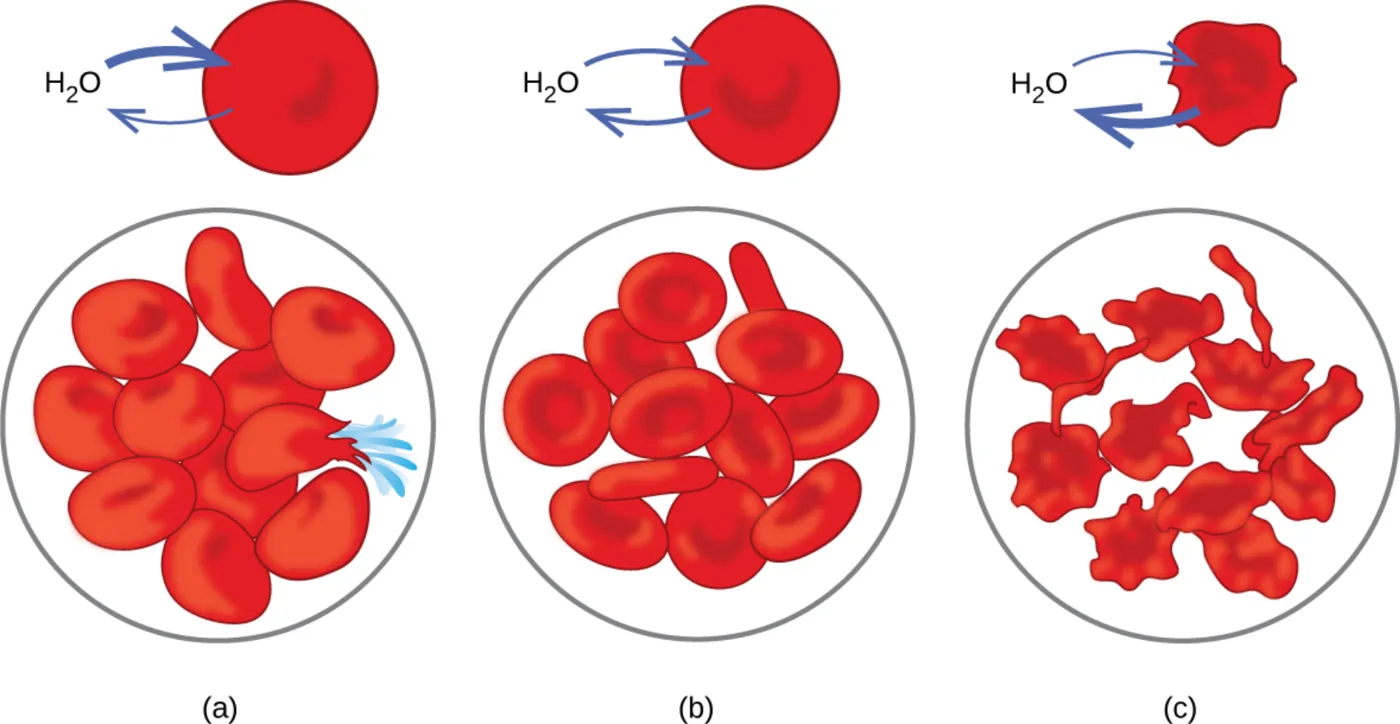
Solutions injected into the body must be isotonic, meaning they have the same osmotic pressure as blood serum.
4
A hypotonic solution is less concentrated.
5
Water enters the blood cells
which swell and rupturethis is hemolysis.
6
A hypertonic solution is more concentrated.
1 / 2Next ▶
Red blood cells swell and may burst in a hypotonic solution (a), keep their normal shape in an isotonic solution (b), and shrink in a hypertonic solution (c). Image: OpenStax, Chemistry 2e, CC BY 4.0.
Osmosis in living things
 ⤢ Enlarge
Osmosis in living things
Water leaves the blood cells
which shrink and may diethis is crenation.
◀ Previous2 / 2
1Reverse osmosis water purification2Reverse osmosis water purification3Reverse osmosis water purification
Reverse osmosis water purification
Reverse osmosis water purification
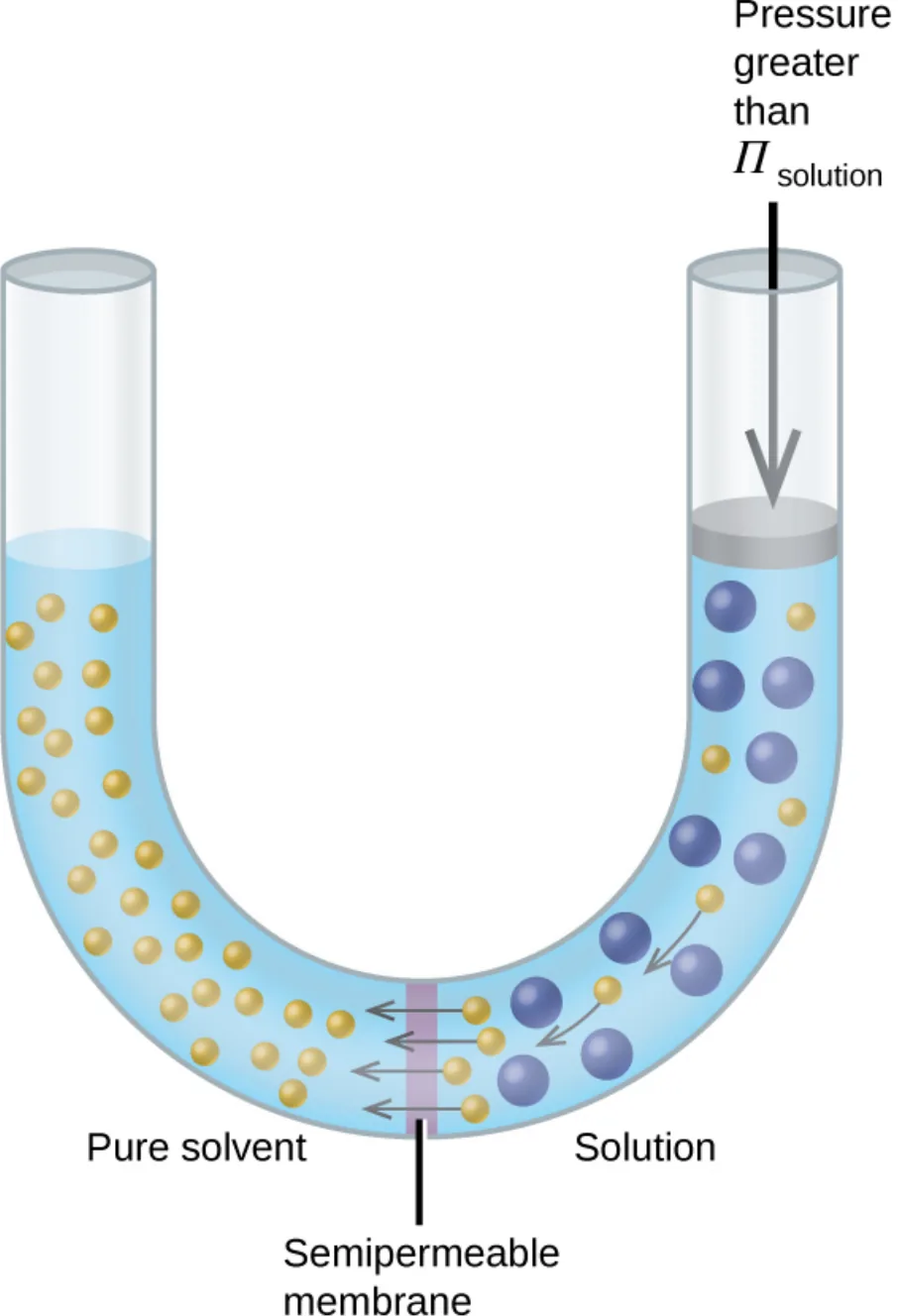
The osmotic pressure is the pressure that must be applied to the more concentrated solution to stop osmosis.
If a larger pressure is applied, solvent moves from the concentrated solution into the purer solution.
This is reverse osmosis, RO.
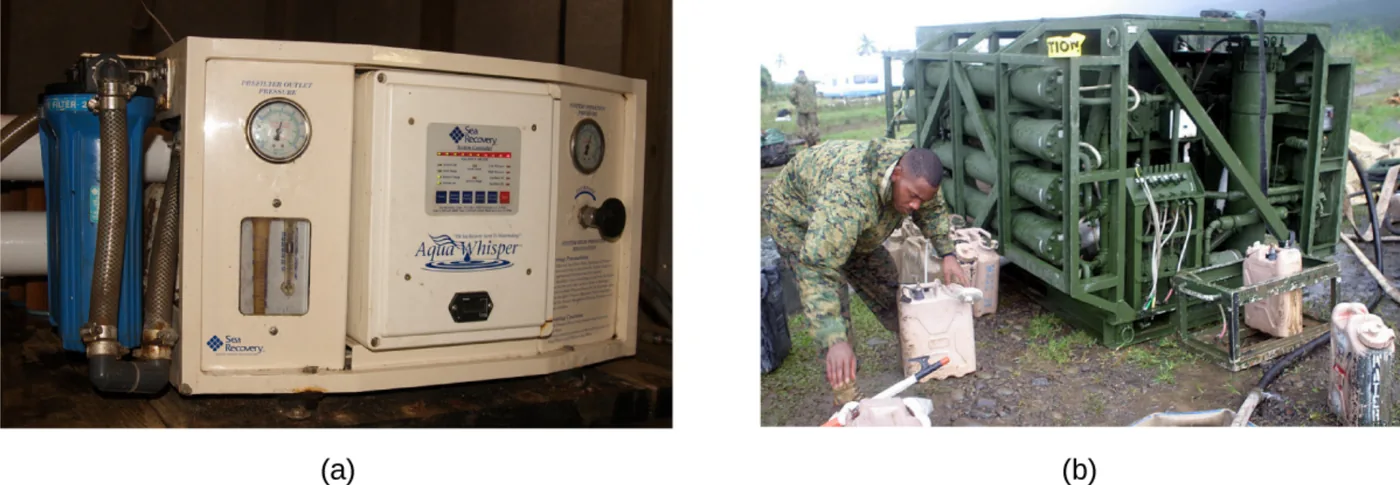
It is used to desalinate seawater in coastal cities, in water machines in grocery stores and in small household units.
Hand-operated RO units serve lifeboats and disaster areas, and generator-powered units can be moved to remote locations.
1 / 3Next ▶
A pressure larger than the osmotic pressure pushes solvent out of the solution and into the pure solvent, which reverses osmosis. Image: OpenStax, Chemistry 2e, CC BY 4.0.
Reverse osmosis water purification
◀ Previous2 / 3Next ▶
Reverse osmosis systems for drinking water, shown in a small unit (a) and a large portable unit (b). Image: OpenStax, Chemistry 2e, CC BY 4.0.
Reverse osmosis water purification
◀ Previous3 / 3
Determination of molar masses
Determination of molar masses
Osmotic pressure and the changes in freezing point, boiling point and vapor pressure are all proportional to the number of solute particles.
If one of them is measured for a solution made from a known mass of solute, the molar mass of the solute can be found.
The steps are: find the molality or molarity from the measured effect, convert it to moles using the solvent mass or solution volume,
and divide the mass of solute by the number of moles.
1Colligative properties of electrolytes2Colligative properties of electrolytes
Colligative properties of electrolytes
1
The colligative equations use the total concentration of all solute species.
2
A nonelectrolyte such as sucrose dissolves as whole molecules
so each dissolved unit gives one particle.
3
A strong electrolyte dissociates into ions.
4
A 1.0 m NaCl solution should contain 2.0 mol of ions per kilogram of water
so the expected freezing point depression is 2 × 1.86 × 1.0 = 3.7 °C.
5
The measured value is 3.4 °C.
6
The difference grows with concentration
which shows that strong electrolytes are not fully dissociated.
1 / 2Next ▶
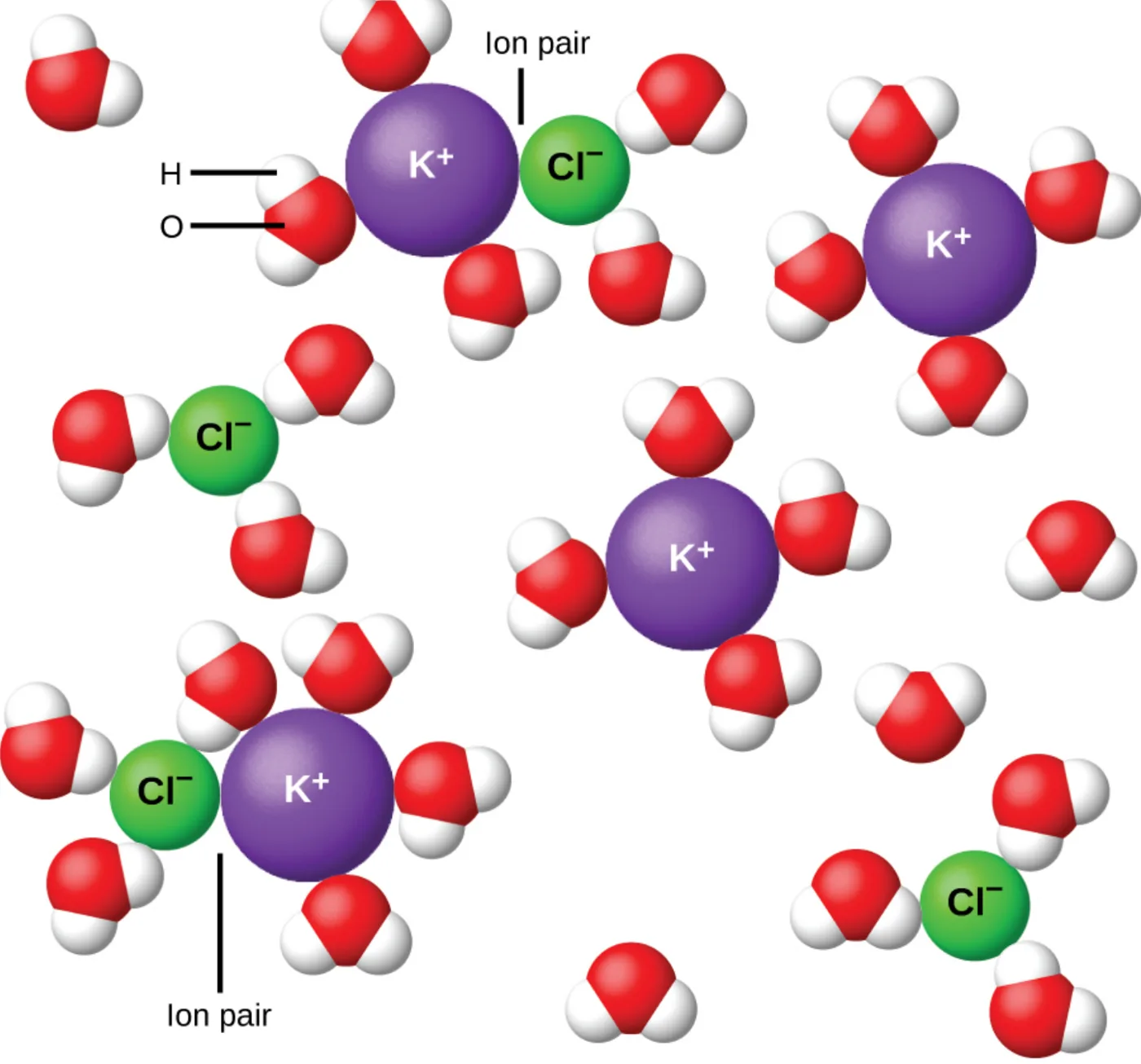
Potassium and chloride ions in water, with some ions held together as ion pairs by residual attraction. Image: OpenStax, Chemistry 2e, CC BY 4.0.
Colligative properties of electrolytes
 ⤢ Enlarge
1
Ion pairs form because residual attraction between oppositely charged ions keeps them from acting as independent particles. The effective concentration, called the activity, is therefore lower than the actual concentration. In more dilute solutions the ions are farther apart and the effect is smaller.
2
The van’t Hoff factor, i, is the ratio of moles of solute particles in solution to moles of formula units dissolved. It is measured experimentally and corrects the equations: ΔTb = iKbm, ΔTf = iKfm and Π = iMRT. The table gives values for 0.050 m solutions.
| Formula unit | Classification | Dissolution products | Predicted i | Measured i |
|---|---|---|---|---|
| C12H22O11 (sucrose) | Nonelectrolyte | C12H22O11 | 1 | 1.0 |
| NaCl | Strong electrolyte | Na+, Cl− | 2 | 1.9 |
| HCl | Strong electrolyte (acid) | H₃O+, Cl− | 2 | 1.9 |
| MgSO4 | Strong electrolyte | Mg2+, SO₄2− | 2 | 1.3 |
| MgCl2 | Strong electrolyte | Mg2+, 2Cl− | 3 | 2.7 |
| FeCl3 | Strong electrolyte | Fe3+, 3Cl− | 4 | 3.4 |
◀ Previous2 / 2
1Example 11.3: Mole fraction and molality of antifreeze2Example 11.4: Converting a molal concentration to mole fract3Example 11.5: Converting molarity to molality · Example 11.64Example 11.7: Boiling point of a 0.33 m benzene solution5Example 11.8: Boiling point of an iodine solution6Example 11.9: Freezing point of a 0.33 m benzene solution7Example 11.10: Osmotic pressure of a glucose solution8Example 11.11: Molar mass from a freezing point depression9Example 11.12: Molar mass from osmotic pressure10Example 11.12: Molar mass from osmotic pressure11Example 11.13: The freezing point of a solution of an electr12Example 11.13: The freezing point of a solution of an electr
Example 11.3: Mole fraction and molality of antifreeze
Example 11.3: Mole fraction and molality of antifreeze
Antifreeze is a mixture of ethylene glycol, C2H4(OH)2, and water. Find (a) the mole fraction and (b) the molality of ethylene glycol in a solution of 2.22 × 10³ g of glycol and 2.00 × 10³ g of water.
(a) The molar mass of glycol is 62.07 g/mol
so n = 2.22 × 10³ g ÷ 62.07 g/mol = 35.8 mol. The molar mass of water is 18.02 g/molso n = 2.00 × 10³ g ÷ 18.02 g/mol = 111.0 mol. Xglycol = 35.8 ÷ (35.8 + 111.0) = 0.244.
(b) The water mass is 2.00 kg
so m = 35.8 mol ÷ 2.00 kg = 17.9 mol/kg.
Check Your Learning: Find the mole fraction and molality of 0.850 g of NH3 dissolved in 125 g of water. Answer: 7.14 × 10⁻³ and 0.399 m.
1 / 12Next ▶
Example 11.4: Converting a molal concentration to mole fractions
1
Find the mole fractions of solute and solvent in a 3.0 m NaCl solution.
2
A 3.0 m solution contains 3.0 mol NaCl per 1.0 kg of water.
3
The moles of water in 1.0 kg are 1000 g ÷ 18.02 g/mol = 55.5 mol.
4
Total moles = 3.0 + 55.5 = 58.5 mol.
5
XNaCl = 3.0 ÷ 58.5 = 0.0513 and Xwater = 55.5 ÷ 58.5 = 0.949. The two add up to 1.
6
Check Your Learning: The mole fraction of I2 in CH2Cl2 is 0.115. Find its molality. Answer: 1.53 m.
◀ Previous2 / 12Next ▶
Example 11.5: Converting molarity to molality · Example 11.6: Vapor pressure of an ideal solution
Example 11.5: Converting molarity to molality
An intravenous glucose solution is 0.556 M and has a density of 1.04 g/mL. Find its molality.
Take 1.00 L of solution. Its mass is 1040 g. The glucose is 0.556 mol × 180.16 g/mol = 100.2 g
so the water is 1040 − 100.2 = 939.8 g = 0.9398 kg. m = 0.556 mol ÷ 0.9398 kg = 0.592 m.
Check Your Learning: Nitric acid is a 33.7 m solution with a density of 1.35 g/mL. Find its molarity. Answer: 14.6 M.
Example 11.6: Vapor pressure of an ideal solution
Find the vapor pressure at 40 °C of a solution of 92.1 g of glycerin, C3H5(OH)3, and 184.4 g of ethanol, C2H5OH. Pure ethanol has a vapor pressure of 0.178 atm at 40 °C, and glycerin is nonvolatile.
Moles of glycerin = 92.1 g ÷ 92.09 g/mol = 1.000 mol. Moles of ethanol = 184.4 g ÷ 46.07 g/mol = 4.003 mol. Xethanol = 4.003 ÷ 5.003 = 0.800. By Raoult’s law, P = 0.800 × 0.178 atm = 0.142 atm.
Check Your Learning: A solution contains 5.00 g of urea, CO(NH2)2, in 0.100 kg of water at 25 °C. Pure water has a vapor pressure of 23.7 torr. Find the vapor pressure of the solution. Answer: 23.4 torr.
◀ Previous3 / 12Next ▶
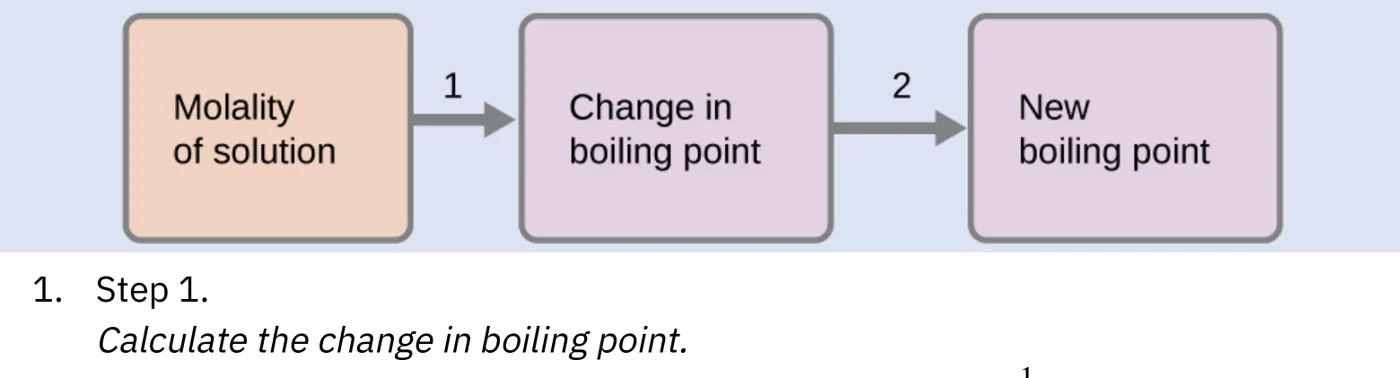
Flow diagram: molality of the solution gives the change in boiling point, which gives the new boiling point. Image: OpenStax, Chemistry 2e, CC BY 4.0.
Example 11.7: Boiling point of a 0.33 m benzene solution
 ⤢ Enlarge
Example 11.7: Boiling point of a 0.33 m benzene solution
Assume ideal behavior. Find the boiling point of a 0.33 m solution of a nonvolatile solute in benzene.
Step 1: ΔTb = Kbm = 2.53 °C m−1 × 0.33 m = 0.83 °C. Step 2: The new boiling point is 80.1 °C + 0.83 °C = 80.9 °C.
Check Your Learning: Find the boiling point of the antifreeze in Example 11.3, assuming ideal behavior. Answer: 109.2 °C.
◀ Previous4 / 12Next ▶
Flow diagram: mass of iodine, moles of iodine, molality, change in boiling point and new boiling point, in that order. Image: OpenStax, Chemistry 2e, CC BY 4.0.
Example 11.8: Boiling point of an iodine solution
 ⤢ Enlarge
1
Find the boiling point of a solution of 92.1 g of I2 in 800.0 g of chloroform, CHCl3, assuming ideal behavior and that the iodine is nonvolatile.
2
Step 1: Moles of I2 = 92.1 g ÷ 253.8 g/mol = 0.363 mol. Step 2: m = 0.363 mol ÷ 0.8000 kg = 0.454 m. Step 3: ΔTb = 3.63 °C m−1 × 0.454 m = 1.65 °C. Step 4: The new boiling point is 61.26 °C + 1.65 °C = 62.91 °C.
3
Check Your Learning: Find the boiling point of 1.0 g of glycerin in 47.8 g of water, assuming ideal behavior. Answer: 100.12 °C.
◀ Previous5 / 12Next ▶
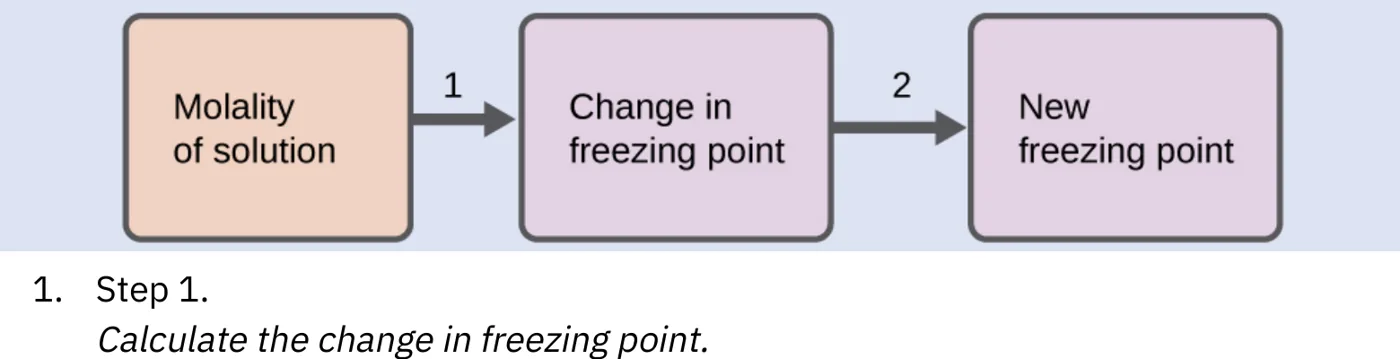
Flow diagram: molality of the solution gives the change in freezing point, which gives the new freezing point. Image: OpenStax, Chemistry 2e, CC BY 4.0.
Example 11.9: Freezing point of a 0.33 m benzene solution
 ⤢ Enlarge
1
Assume ideal behavior and a nonvolatile nonelectrolyte. Find the freezing point of the 0.33 m benzene solution from Example 11.7.
2
Step 1: ΔTf = 5.12 °C m−1 × 0.33 m = 1.69 °C. Step 2: The freezing point is 5.5 °C − 1.69 °C = 3.8 °C.
3
Check Your Learning: Find the freezing point of a 1.85 m nonelectrolyte solution in nitrobenzene, assuming ideal behavior. Answer: −9.3 °C.
◀ Previous6 / 12Next ▶
Example 11.10: Osmotic pressure of a glucose solution
Example 11.10: Osmotic pressure of a glucose solution
Find the osmotic pressure of a 0.30 M glucose solution at 37 °C, the temperature of the body, assuming ideal behavior.
T = 37 + 273 = 310 K. Π = MRT = 0.30 mol/L × 0.08206 L atm mol−1 K−1 × 310 K = 7.6 atm.
Check Your Learning: Find the osmotic pressure at 37 °C of 5.0 g of methanol, CH3OH, dissolved in water to make 0.750 L of solution. Answer: 5.3 atm.
◀ Previous7 / 12Next ▶
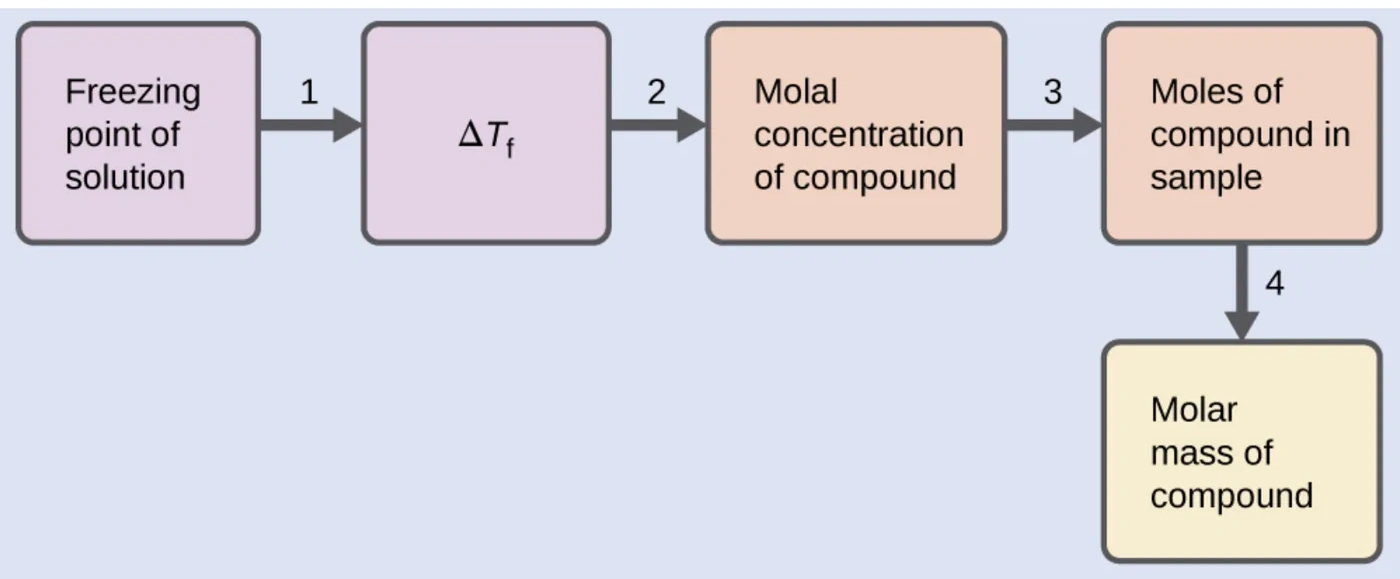
Flow diagram: freezing point of the solution gives ΔTf, then molality, moles of compound and finally molar mass. Image: OpenStax, Chemistry 2e, CC BY 4.0.
Example 11.11: Molar mass from a freezing point depression
 ⤢ Enlarge
1
A solution of 4.00 g of a nonelectrolyte in 55.0 g of benzene freezes at 2.32 °C. Find the molar mass of the compound, assuming ideal behavior.
2
Step 1: ΔTf = 5.5 °C − 2.32 °C = 3.18 °C. Step 2: m = 3.18 °C ÷ 5.12 °C m−1 = 0.621 mol/kg. Step 3: Moles = 0.621 mol/kg × 0.0550 kg = 0.0342 mol. Step 4: Molar mass = 4.00 g ÷ 0.0342 mol = 117 g/mol.
3
Check Your Learning: A solution of 35.7 g of a nonelectrolyte in 220.0 g of chloroform boils at 64.5 °C. Find the molar mass, assuming ideal behavior. Answer: 1.8 × 10² g/mol.
◀ Previous8 / 12Next ▶
Example 11.12: Molar mass from osmotic pressure
1
A 0.500 L sample contains 10.0 g of hemoglobin and has an osmotic pressure of 5.9 torr at 22 °C. Find the molar mass of hemoglobin, assuming ideal behavior.
2
Step 1: Π = 5.9 torr ÷ 760 torr/atm = 7.76 × 10⁻³ atm.
3
T = 295 K
so M = Π ÷ RT = 7.76 × 10⁻³ ÷ (0.08206 × 295) = 3.21 × 10⁻⁴ mol/L.
4
Step 2: Moles = 3.21 × 10⁻⁴ mol/L × 0.500 L = 1.60 × 10⁻⁴ mol.
5
Step 3: Molar mass = 10.0 g ÷ 1.60 × 10⁻⁴ mol = 6.2 × 10⁴ g/mol.
◀ Previous9 / 12Next ▶
Flow diagram: osmotic pressure gives molar concentration, then moles of the protein in the sample, then molar mass. Image: OpenStax, Chemistry 2e, CC BY 4.0.
Example 11.12: Molar mass from osmotic pressure
 ⤢ Enlarge
Example 11.12: Molar mass from osmotic pressure
Check Your Learning: A 0.02 g sample of a protein in 25.0 mL of solution has an osmotic pressure of 0.56 torr at 25 °C. Find the molar mass, assuming ideal behavior. Answer: about 3 × 10⁴ g/mol (2.7 × 10⁴ g/mol before rounding).
◀ Previous10 / 12Next ▶
Example 11.13: The freezing point of a solution of an electrolyte
1
The concentration of ions in seawater is approximately the same as in a solution of 4.2 g of NaCl dissolved in 125 g of water. Using the van’t Hoff factor for NaCl (i = 2, from Table 11.3 of the book’s predicted values), find the freezing point of this solution, assuming ideal behavior.
2
Solution. Step 1: moles of NaCl = 4.2 g ÷ 58.44 g/mol = 0.072 mol.
3
Step 2: moles of ions = 2 × 0.072 mol = 0.14 mol ions.
4
Step 3: molality of the ions = 0.14 mol ÷ 0.125 kg = 1.15 m.
5
Step 4: ΔTf = Kfm = 1.86 °C m−1 × 1.15 m = 2.14 °C.
6
Step 5: the freezing point is 0.0 °C − 2.14 °C = −2.1 °C.
◀ Previous11 / 12Next ▶
Example 11.13: The freezing point of a solution of an electrolyte
1
Keep guard digits in each step
because rounding early shifts the answer.
2
Check Your Learning: Assuming complete dissociation and ideal solution behavior, calculate the freezing point of a solution of 0.724 g of CaCl2 in 175 g of water. Answer: −0.208 °C.
3
(0.724 g is 0.00652 mol
which is 0.0373 mol/kg of CaCl2.
4
Three ions per formula unit give 0.112 m of ions, and 1.86 × 0.112 = 0.208 °C.)
◀ Previous12 / 12
Key terms
| Term | Meaning |
|---|---|
| Colligative property | A solution property that depends only on the total number of solute particles, not on their identity. |
| Mole fraction (X) | The moles of one component divided by the total moles of all components; it has no unit. |
| Molality (m) | The moles of solute divided by the kilograms of solvent, in mol/kg. |
| Supersaturated solution | A solution that holds more dissolved solute than its equilibrium solubility at that temperature. |
| Seed crystal | A small crystal added to a supersaturated solution to start crystallization. |
| Nonvolatile | Describes a substance whose vapor pressure is negligible at the temperature considered. |
| Vapor pressure lowering | The decrease in the vapor pressure of a solvent caused by dissolving a nonvolatile solute. |
| Raoult’s law | The partial pressure of a component of an ideal solution equals its pure vapor pressure times its mole fraction. |
| Distillation | Separation of liquids by heating and condensing the vapor, which is richer in the more volatile liquid. |
| Boiling point elevation | The increase in boiling point of a solvent when a nonvolatile solute is dissolved in it. |
| Ebullioscopic constant (Kb) | The boiling point elevation per mole of solute particles per kilogram of a given solvent, in °C m−1. |
| Freezing point depression | The decrease in freezing point of a solvent when a solute is dissolved in it. |
| Cryoscopic constant (Kf) | The freezing point depression per mole of solute particles per kilogram of a given solvent, in °C m−1. |
| Osmosis | Net movement of solvent through a semipermeable membrane into a more concentrated solution. |
| Semipermeable membrane | A barrier that allows some molecules or ions to pass but not others. |
| Osmotic pressure (Π) | The pressure needed to stop osmosis; for a dilute solution Π = MRT. |
| Reverse osmosis | Forcing solvent from a concentrated solution into a purer one by applying more than the osmotic pressure. |
| Isotonic / hypotonic / hypertonic | Describe a solution with the same, lower or higher osmotic pressure than blood serum or cell fluid. |
| Hemolysis | The swelling and bursting of blood cells in a hypotonic solution. |
| Crenation | The shrinking and possible death of blood cells in a hypertonic solution. |
| van’t Hoff factor (i) | The ratio of moles of solute particles in solution to moles of formula units dissolved. |
| Ion pair | A positive and a negative ion held together as a single solvated unit by residual attraction. |
| Activity | The effective concentration of an ion, which is lower than its actual concentration in concentrated solutions. |
1Avoid these mistakes2Avoid these mistakes3Avoid these mistakes