Curriculum
Chemistry 2e
Unit 1: Essential Ideas
0/14
Unit 2: Atoms, Molecules, and Ions
0/16
Unit 3: Composition of Substances and Solutions
0/10
Unit 4: Stoichiometry of Chemical Reactions
0/12
Unit 5: Thermochemistry
0/8
Unit 6: Electronic Structure and Periodic Properties of Elements
0/12
Unit 7: Chemical Bonding and Molecular Geometry
0/14
Unit 8: Advanced Theories of Covalent Bonding
0/10
Unit 9: Gases
0/23
Unit 10: Liquids and Solids
0/28
Unit 11: Solutions and Colloids
0/24
Unit 12: Kinetics
0/32
-
Unit 12 overview: Kinetics
 Preview
-
12.1 Chemical Reaction Rates
Preview
-
12.1 Chemical Reaction Rates - Check yourself
 Preview
-
Unit 12 overview: Kinetics
Preview
-
12.1 Chemical Reaction Rates
Preview
-
12.1 Chemical Reaction Rates - Check yourself
Preview
-
12.2 Factors Affecting Reaction Rates
Preview
-
12.2 Factors Affecting Reaction Rates - Check yourself
Preview
-
12.2 Factors Affecting Reaction Rates
Preview
-
12.2 Factors Affecting Reaction Rates - Check yourself
Preview
-
12.3 Rate Laws
Preview
-
12.3 Rate Laws - Check yourself
Preview
-
12.3 Rate Laws
Preview
-
12.3 Rate Laws - Check yourself
Preview
-
12.4 Integrated Rate Laws
Preview
-
12.4 Integrated Rate Laws - Check yourself
Preview
-
12.4 Integrated Rate Laws
Preview
-
12.4 Integrated Rate Laws - Check yourself
Preview
-
12.5 Collision Theory
Preview
-
12.5 Collision Theory - Check yourself
Preview
-
12.5 Collision Theory
Preview
-
Unit 12 review quiz: Kinetics
Preview
-
12.5 Collision Theory - Check yourself
Preview
-
12.6 Reaction Mechanisms
Preview
-
12.6 Reaction Mechanisms - Check yourself
Preview
-
12.6 Reaction Mechanisms
Preview
-
12.6 Reaction Mechanisms - Check yourself
Preview
-
12.7 Catalysis
Preview
-
12.7 Catalysis - Check yourself
Preview
-
12.7 Catalysis
Preview
-
12.7 Catalysis - Check yourself
Preview
-
Unit 12 review quiz: Kinetics
Preview
Unit 13: Fundamental Equilibrium Concepts
0/20
Unit 14: Acid-Base Equilibria
0/32
Unit 15: Equilibria of Other Reaction Classes
0/16
Unit 16: Thermodynamics
0/20
Unit 17: Electrochemistry
0/32
Unit 18: Representative Metals, Metalloids, and Nonmetals
0/52
Unit 19: Transition Metals and Coordination Chemistry
0/16
Unit 20: Organic Chemistry
0/20
Unit 21: Nuclear Chemistry
0/28
Text lesson
12.4 Integrated Rate Laws
12.4 Integrated Rate Laws — CHEMISTRY notes: you will be able to write and use the integrated rate law for zero-, first- and second-order reactions, calculate half-lives, and decide a reaction’s order from concentration-time data.
Why integrated rate laws matter
Why integrated rate laws matter
A rate law relates the rate of a reaction to the concentrations of the reactants. Calculus lets us integrate that rate law with respect to time
giving a second form that relates the concentration of a reactant or product to the elapsed time. This second form is called the integrated rate law.
An integrated rate law lets us find how much reactant remains after a given time, or how long a reaction needs to reach a chosen extent.
For example, it tells us how long a radioactive material must be stored before its radioactivity decays to a safe level.
Integration can be simple or complicated depending on the differential rate law.
Here we focus on the integrated rate laws for first-order, second-order and zero-order reactions.
1First-order reactions2First-order reactions
Second-order reactions
Second-order reactions
Rate laws of second-order reactions can be complicated.
We consider only the simplest case, in which the rate depends on the concentration of a single reactant: rate = k[A]2.What the symbols mean: rate (mol dm−3 s−1) · k = rate constant (units depend on the overall order) · [ ] = concentration (mol dm−3) · each power is the order with respect to that reactant
The integrated rate law for this case is 1/[A]t = kt + 1/[A]0
where the rate constant k has units of L mol−1 s−1 (M−1 s−1).
This equation has the form of a straight line. A plot of 1/[A]t against t gives a straight line with slope k and y-intercept 1/[A]0. If the plot is not a straight line, the reaction is not second order.
1Zero-order reactions2Zero-order reactions
Zero-order reactions
1
For a zero-order reaction, the rate law is rate = k.
2
The rate stays constant no matter how much reactant is present.
3
This seems odd
because the rate cannot be constant when the reactant runs outbut zero-order behavior is seen only under certain conditions.
4
When those conditions are not met, the reaction shows other kinetics
which is why the term pseudo-zero-order is sometimes used.
5
The integrated rate law for a zero-order reaction is a linear function: [A]t = −kt + [A]0.
6
A plot of [A] against t is a straight line with slope −k and y-intercept [A]0.
1 / 2Next ▶
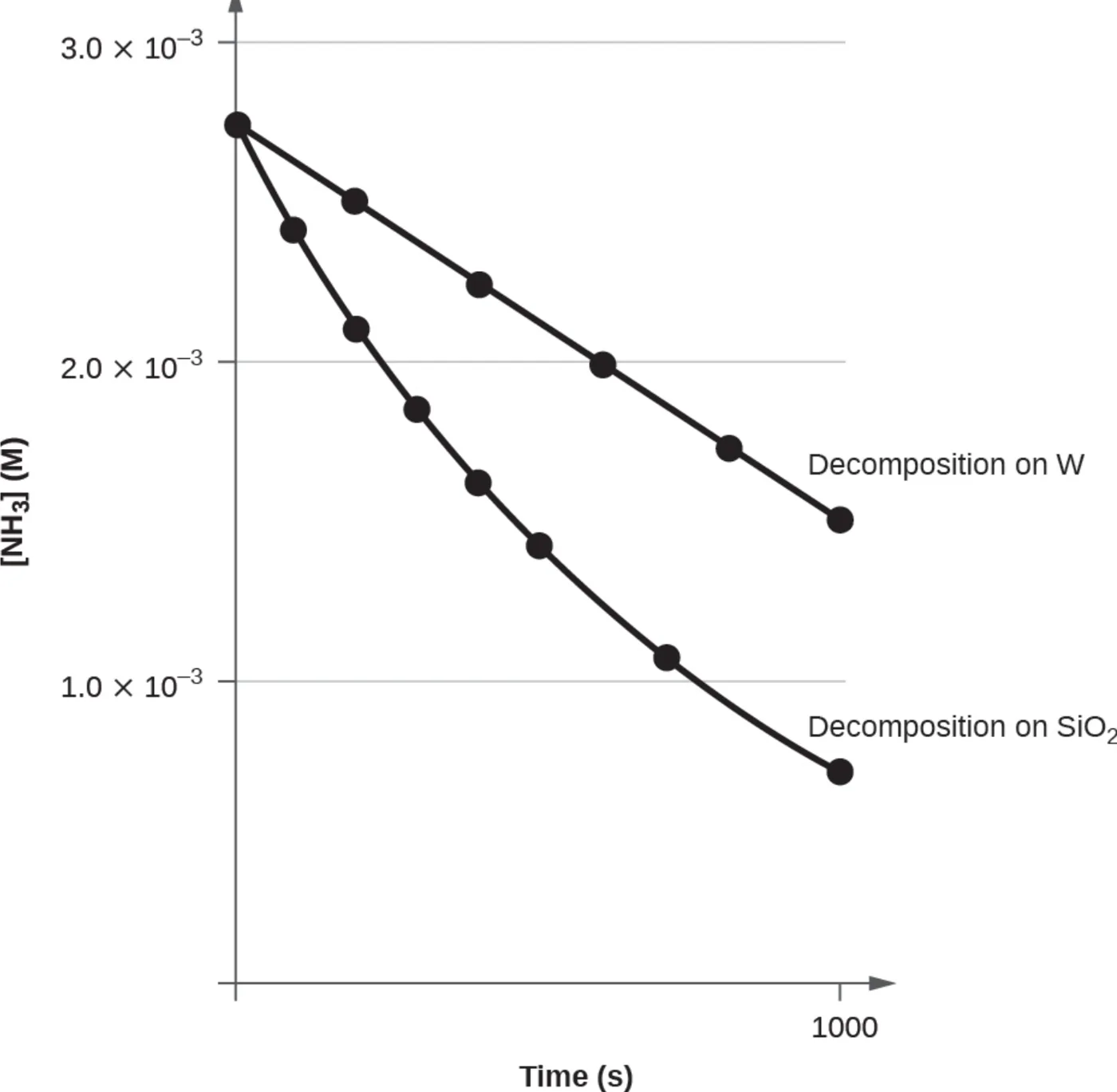
Ammonia concentration against time on two surfaces. The line for tungsten is straight, so that decomposition is zero order, while the curved line for quartz shows first-order decay. Image: OpenStax, Chemistry 2e, CC BY 4.0.
Zero-order reactions
 ⤢ Enlarge
1
The graph below compares ammonia decomposing on two surfaces.
2
On a quartz (SiO2) surface the concentration falls off exponentially
which is first-order behavior.
3
On a tungsten (W) surface the plot is straight
which shows zero-order kinetics.
◀ Previous2 / 2
The half-life of a reaction
The half-life of a reaction
The half-life of a reaction, written t1/2, is the time needed for half of a given amount of reactant to be consumed.
In each successive half-life, half of the remaining reactant is consumed.
Take the decomposition of hydrogen peroxide as an example.
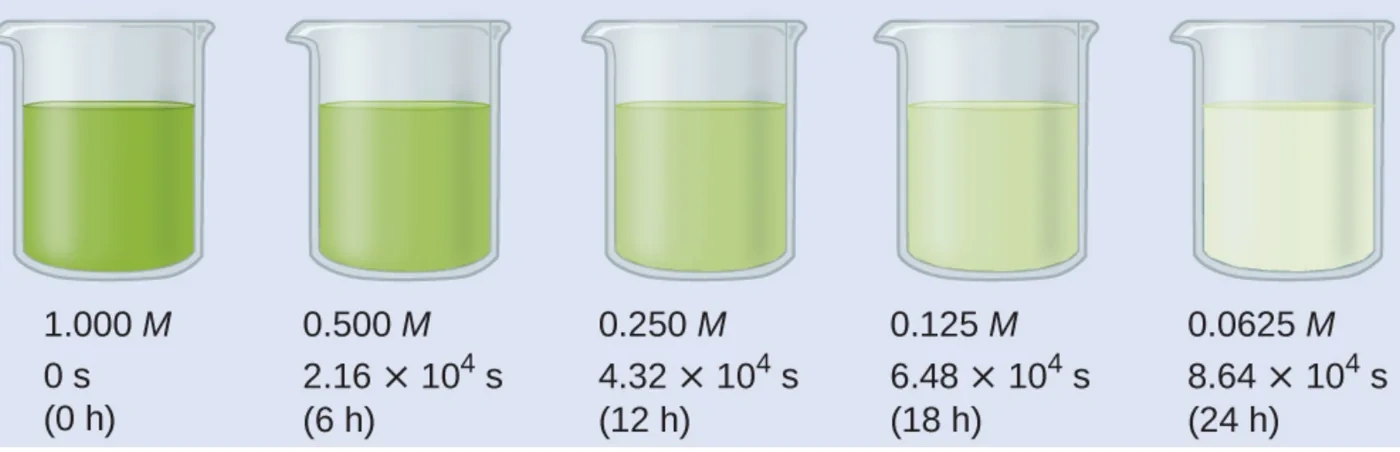
Its concentration falls from 1.000 M to 0.500 M in the first 6.00 hours,
from 0.500 M to 0.250 M in the next 6.00 hours,and from 0.250 M to 0.125 M in the third 6.00 hours.
Because each period is the same length, this is a first-order reaction.
The half-life of a first-order reaction does not depend on the reactant concentration. Half-lives of reactions of other orders do depend on the concentrations.
Half-life of a first-order reaction
1
Start from the integrated rate law for a first-order reaction and set t equal to t1/2.
2
At that moment [A]t is half of [A]0.
3
Substituting these values and simplifying gives t1/2 = ln 2 / k = 0.693 / k.
4
The half-life is inversely proportional to the rate constant: faster reactions have larger k and shorter half-lives,
and slower reactions have smaller k and longer half-lives.
Half-life of a second-order reaction
Half-life of a second-order reaction
Use the same method for second-order reactions.
Set [A]t = ½[A]0 and t = t1/2 in 1/[A]t = kt + 1/[A]0.
The result is t1/2 = 1 / (k[A]0).
The half-life is inversely proportional to the initial concentration
so it grows as the reaction proceeds and the reactant concentration falls.
Unlike the first-order case, the rate constant cannot be found from one half-life unless the initial concentration is known.
Half-life of a zero-order reaction
Half-life of a zero-order reaction
For zero-order reactions, set t = t1/2 and [A]t = ½[A]0 in [A]t = −kt + [A]0. The result is t1/2 = [A]0 / (2k). The half-life is inversely proportional to the rate constant, as for every order
but it increases as the initial concentration increases.
Summary of integrated rate laws
1
The table below summarizes the differential rate law, the integrated rate law, the linear plot and the half-life for zero-, first- and second-order reactions.
2
The units of the rate constant follow from the rate law.
3
For a zero-order reaction, rate = k
so k is in M s−1 (mol L−1 s−1).
4
For a first-order reaction k is in s−1, and for a second-order reaction k is in M−1 s−1 (L mol−1 s−1).
5
The slope of each linear plot gives k: it is −k for zero- and first-order plots and +k for second-order plots.
| Order | Differential rate law | Integrated rate law | Straight-line plot (slope) | Half-life |
|---|---|---|---|---|
| Zero | rate = k | [A]t = −kt + [A]0 | [A] against t (slope −k) | t1/2 = [A]0 / 2k |
| First | rate = k[A] | ln[A]t = −kt + ln[A]0 | ln[A] against t (slope −k) | t1/2 = 0.693 / k |
| Second | rate = k[A]2 | 1/[A]t = kt + 1/[A]0 | 1/[A] against t (slope k) | t1/2 = 1 / (k[A]0) |
1Example 12.6: Time for a first-order reaction to reach 80% d2Example 12.7: Showing first-order behavior and finding k fro3Example 12.8: Concentration of a second-order reaction after4Example 12.8: Concentration of a second-order reaction after5Example 12.9: Identifying a second-order reaction and estima6Example 12.9: Identifying a second-order reaction and estima7Example 12.10: Zero-order rate constant from a graph8Example 12.11: First-order rate constant from a half-life9Example 12.12: Half-life for zero-order and second-order rea
Example 12.6: Time for a first-order reaction to reach 80% decomposition
1
Problem. The rate constant for the first-order decomposition of cyclobutane, C4H8, at 500 °C is 9.2 × 10⁻³ s−1. How long does it take for 80.0% of a sample to decompose?
2
Solution. Because the relative change is given, the initial concentration is not needed.
3
Let the initial concentration be x.
4
After 80.0% decomposition, 20.0% remains
so [A]t = 0.200x and [A]0 = x.
5
Then [A]0/[A]t = 1⁄0.200 = 5.00.
Rearranging the integrated rate law gives t = (1/k) ln([A]0/[A]t) = (1⁄9.2 × 10⁻³ s−1)(ln 5.00) = (108.7 s)(1.609) ≈ 175 s.
6
Check Your Learning. Iodine-131 decays by a first-order process with k = 0.138 d−1. How many days does it take for 90% of a 0.500 M sample to decay? Answer: t = (1⁄0.138 d−1) ln(1⁄0.10) = (7.246 d)(2.303) ≈ 16.7 days.
1 / 9Next ▶
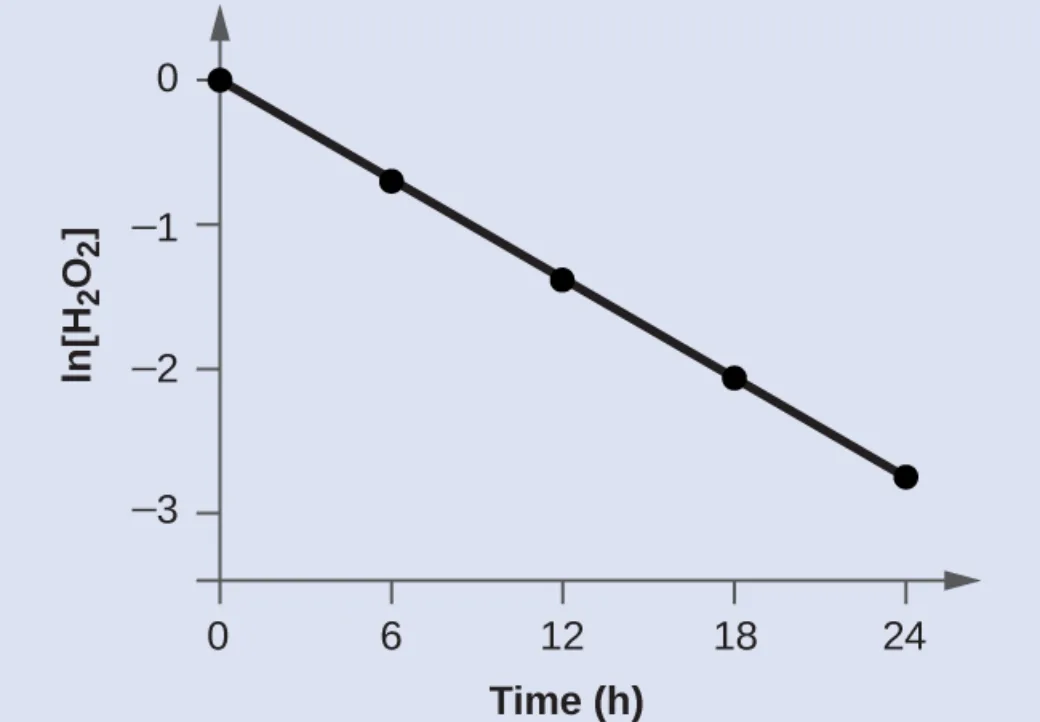
A straight line of ln[H2O2] against time shows that the decomposition of hydrogen peroxide is first order, and its slope gives the rate constant. Image: OpenStax, Chemistry 2e, CC BY 4.0.
Example 12.7: Showing first-order behavior and finding k from a graph
 ⤢ Enlarge
Example 12.7: Showing first-order behavior and finding k from a graph
Problem. Show that the hydrogen peroxide data (time 0, 6, 12, 18, 24 h
[H2O2] = 1.000, 0.500, 0.250, 0.125, 0.0625 M) can be described by a first-order rate law by plotting ln[H2O2] against time. Then find k.
Solution. The natural logarithms are 0.000, −0.693, −1.386, −2.079 and −2.772. Plotted against time, they form a straight line
so the reaction is first order. The slope comes from the two end points: slope = (−2.772 − 0.000)/(24.00 h − 0.00 h) = −0.1155 h−1. Therefore k = −slope = 0.1155 h−1 ≈ 0.116 h−1.
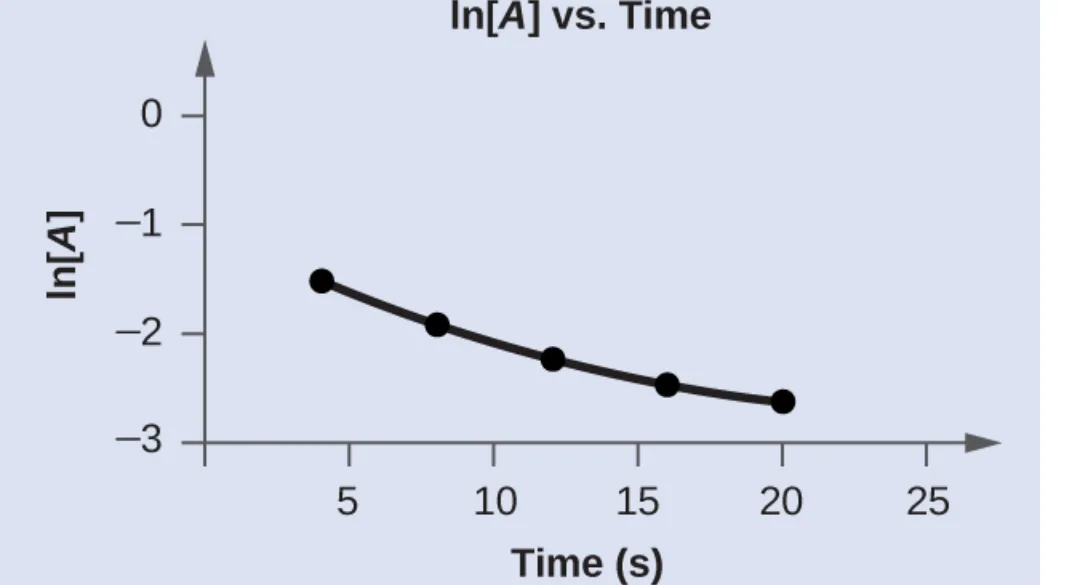
Check Your Learning. The concentrations of A at 4.0, 8.0, 12.0, 16.0 and 20.0 s are 0.220, 0.144, 0.110, 0.088 and 0.074 M. Is the reaction first order? Answer: No. The natural logarithms (−1.514, −1.938, −2.207, −2.430, −2.604) do not lie on a straight line
the plot of ln[A] against t curvesso the reaction is not first order.
◀ Previous2 / 9Next ▶
The concentration data plotted as ln[A] against time curve downward instead of falling on a straight line, so this reaction is not first order. Image: OpenStax, Chemistry 2e, CC BY 4.0.
Example 12.8: Concentration of a second-order reaction after a given time
 ⤢ Enlarge
1
Problem. Butadiene dimerizes to C8H12 by a second-order reaction with k = 5.76 × 10⁻² L mol−1 min−1. If [A]0 = 0.200 M, what is [A] after 10.0 min?
2
Solution. Use 1/[A]t = kt + 1/[A]0.
3
The data are k = 5.76 × 10⁻² L mol−1 min−1, t = 10.0 min and 1/[A]0 = 1⁄0.200 mol L−1 = 5.00 L mol−1.
4
So 1/[A]t = (5.76 × 10⁻²)(10.0) + 5.00 = 0.576 + 5.00 = 5.576 L mol−1.
5
Therefore [A]t = 1⁄5.576 = 0.179 mol/L.
6
Of the original 0.200 mol/L, 0.179 mol/L remains.
◀ Previous3 / 9Next ▶
Example 12.8: Concentration of a second-order reaction after a given time
Example 12.8: Concentration of a second-order reaction after a given time
Check Your Learning. If [A]0 = 0.0200 M, what is [A] after 20.0 min? Answer: 1/[A] = (5.76 × 10⁻²)(20.0) + 1⁄0.0200 = 1.152 + 50.0 = 51.15 L mol−1
so [A] ≈ 0.0195 mol/L.
◀ Previous4 / 9Next ▶
Example 12.9: Identifying a second-order reaction and estimating k
Example 12.9: Identifying a second-order reaction and estimating k
Problem. The data for the reaction in Example 12.8 are: t = 0 s, [C4H6] = 1.00 × 10⁻² M
1600 s, 5.04 × 10⁻³ M3200 s, 3.37 × 10⁻³ M4800 s, 2.53 × 10⁻³ M6200 s, 2.08 × 10⁻³ M. Decide whether the reaction is first or second order, and estimate k.
Solution. Make two plots and compare them.
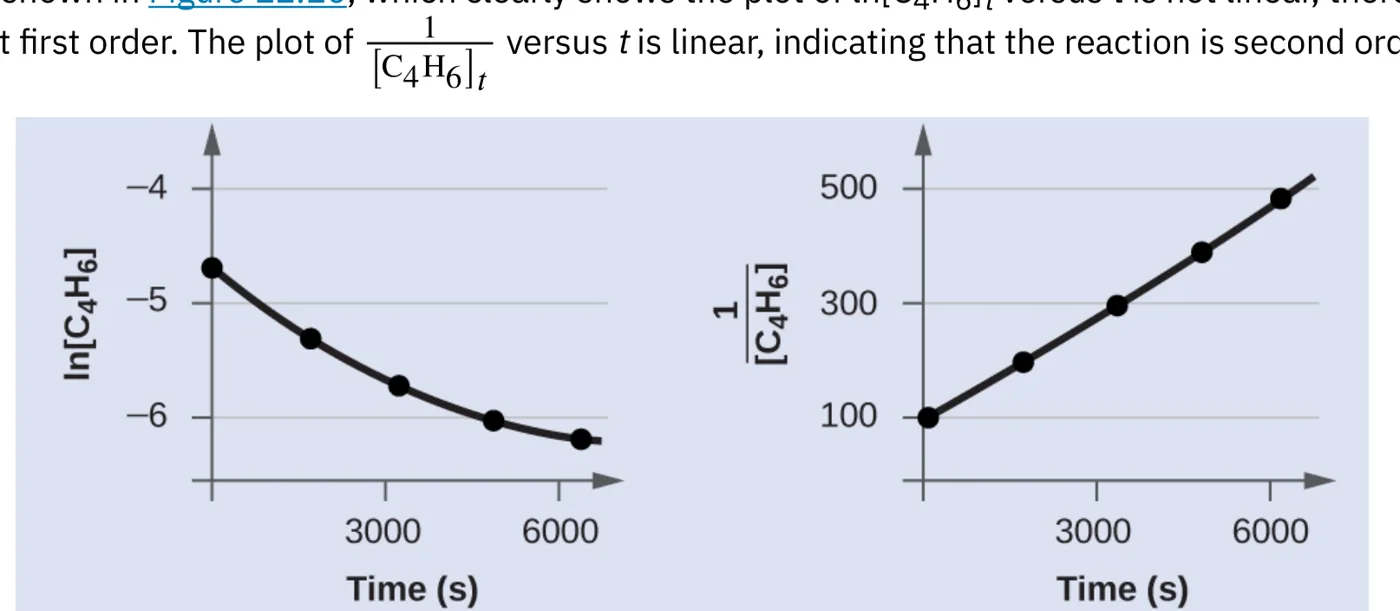
The values of ln[C4H6] are −4.605, −5.289, −5.692, −5.978 and −6.175, and the values of 1/[C4H6] are 100, 198, 297, 395 and 481 M−1.
The plot of ln[C4H6] against t curves
so the reaction is not first order.
The plot of 1/[C4H6] against t is straight
so the reaction is second order.
The slope is k.
◀ Previous5 / 9Next ▶
Two plots of the same data: the natural logarithm of concentration curves downward, while the reciprocal of concentration rises in a straight line, which identifies the reaction as second order. Image: OpenStax, Chemistry 2e, CC BY 4.0.
Example 12.9: Identifying a second-order reaction and estimating k
 ⤢ Enlarge
1
Using the points at t = 0 s and t = 6200 s: k = (481 − 100) M−1 / 6200 s ≈ 6.14 × 10⁻² L mol−1 s−1.
2
Check Your Learning. Do the data for [A] at t = 5, 10, 15, 20, 25 and 35 s (0.952, 0.625, 0.465, 0.370, 0.308 and 0.230 M) fit a second-order rate law? Answer: Yes. The plot of 1/[A] against t is linear. Its slope, about 0.110 M−1 s−1, is the rate constant.
◀ Previous6 / 9Next ▶
The reciprocal of concentration plotted against time forms a straight, rising line, confirming second-order behavior for these data. Image: OpenStax, Chemistry 2e, CC BY 4.0.
Example 12.10: Zero-order rate constant from a graph
 ⤢ Enlarge
1
Problem. Use the tungsten plot of ammonia decomposition to estimate the zero-order rate constant.
2
Solution. Read the concentration at t = 0 s as about 2.8 × 10⁻³ M and at t = 1000 s as about 1.5 × 10⁻³ M.
3
The slope of the straight line is (1.5 × 10⁻³ − 2.8 × 10⁻³) M / 1000 s ≈ −1.3 × 10⁻⁶ M s−1.
4
Therefore k ≈ 1.3 × 10⁻⁶ mol L−1 s−1.
5
Check Your Learning. The zero-order plot shows [NH3] falling linearly from 0.0028 mol L−1 for 1000 s. At what time, in minutes, does the concentration reach 0.0001 mol L−1? Answer: t = ([A]0 − [A]t)/k = (0.0028 − 0.0001) M / (1.3 × 10⁻⁶ M s−1) ≈ 2080 s ≈ 35 min.
◀ Previous7 / 9Next ▶
Five beakers of hydrogen peroxide at 40 °C fade in color as the concentration halves at each interval, from 1.000 M at the start to 0.0625 M after 24 hours. Image: OpenStax, Chemistry 2e, CC BY 4.0.
Example 12.11: First-order rate constant from a half-life
 ⤢ Enlarge
Example 12.11: First-order rate constant from a half-life
Problem. The decomposition of hydrogen peroxide in water at 40 °C has a half-life of 2.16 × 10⁴ s, as shown in the beaker series. Calculate the first-order rate constant.
Solution. The concentration halves from 0.500 M to 0.250 M in 2.16 × 10⁴ s. Using k = 0.693 / t1/2 = 0.693 / (2.16 × 10⁴ s) = 3.21 × 10⁻⁵ s−1.
Check Your Learning. The first-order radioactive decay of iodine-131 has k = 0.138 d−1. What is its half-life? Answer: t1/2 = 0.693 / 0.138 d−1 ≈ 5.02 days.
◀ Previous8 / 9Next ▶
Example 12.12: Half-life for zero-order and second-order reactions
1
Problem. What is the half-life for the butadiene dimerization reaction described in Example 12.8? The reaction is second order, starts from a 0.200 mol/L reactant solution, and has a rate constant of 0.0576 L mol−1 min−1.
2
Solution. For a second-order reaction, t1/2 = 1 ÷ (k[A]0). Substituting: t1/2 = 1 ÷ (0.0576 L mol−1 min−1 × 0.200 mol L−1) = 1 ÷ 0.01152 min−1 ≈ 86.8 min.
3
Check Your Learning. What is the half-life, in minutes, for the thermal decomposition of ammonia on tungsten (see Example 12.10)? Answer: 18 min. For a zero-order reaction, t1/2 = [A]0 ÷ 2k = 2.8 × 10⁻³ M ÷ (2 × 1.3 × 10−6 M s−1) ≈ 1077 s ≈ 18 min.
◀ Previous9 / 9
Key terms
| Term | Meaning |
|---|---|
| Integrated rate law | An equation that relates the amount of reactant or product to elapsed time, obtained by integrating a differential rate law. |
| Rate constant (k) | The proportionality constant in a rate law; its units depend on the reaction order. |
| First-order reaction | A reaction whose rate is proportional to the concentration of one reactant to the first power. |
| Second-order reaction | A reaction whose rate is proportional to the square of the concentration of one reactant. |
| Zero-order reaction | A reaction whose rate does not change with the concentration of its reactant. |
| Pseudo-zero-order | A term for a reaction that looks zero order only under specific conditions and behaves differently when those conditions are not met. |
| Linear format | A rearranged integrated rate law that plots as a straight line, used to test which order fits the data. |
| Half-life (t1/2) | The time needed for half of a given amount of reactant to be consumed. |
| Slope of a linear plot | The change in the plotted quantity divided by the change in time; for first and zero order it equals −k, and for second order it equals k. |
| y-intercept of a linear plot | The value of the plotted quantity at time zero, which is ln[A]0 (first order), [A]0 (zero order) or 1/[A]0 (second order). |
1Avoid these mistakes2Avoid these mistakes3Avoid these mistakes4Avoid these mistakes