Curriculum
Chemistry 2e
Unit 1: Essential Ideas
0/14
-
Unit 1 overview: Essential Ideas
 Text lessonPreview
-
1.1 Chemistry in Context
Text lessonPreview
-
1.1 Chemistry in Context - Check yourself
 6 questionsPreview
-
1.2 Phases and Classification of Matter
Text lessonPreview
-
1.2 Phases and Classification of Matter - Check yourself
6 questionsPreview
-
1.3 Physical and Chemical Properties
Text lessonPreview
-
1.3 Physical and Chemical Properties - Check yourself
6 questionsPreview
-
1.4 Measurements
Text lessonPreview
-
1.4 Measurements - Check yourself
6 questionsPreview
-
1.5 Measurement Uncertainty, Accuracy, and Precision
Text lessonPreview
-
1.5 Measurement Uncertainty, Accuracy, and Precision - Check yourself
6 questionsPreview
-
1.6 Mathematical Treatment of Measurement Results
Text lessonPreview
-
1.6 Mathematical Treatment of Measurement Results - Check yourself
6 questionsPreview
-
Unit 1 review quiz: Essential Ideas
10 questionsPreview
Unit 2: Atoms, Molecules, and Ions
0/16
-
Unit 2 overview: Atoms, Molecules, and Ions
Text lessonPreview
-
2.1 Early Ideas in Atomic Theory
Text lessonPreview
-
2.1 Early Ideas in Atomic Theory - Check yourself
6 questionsPreview
-
2.2 Evolution of Atomic Theory
Text lessonPreview
-
2.2 Evolution of Atomic Theory - Check yourself
6 questionsPreview
-
2.3 Atomic Structure and Symbolism
Text lessonPreview
-
2.3 Atomic Structure and Symbolism - Check yourself
6 questionsPreview
-
2.4 Chemical Formulas
Text lessonPreview
-
2.4 Chemical Formulas - Check yourself
6 questionsPreview
-
2.5 The Periodic Table
Text lessonPreview
-
2.5 The Periodic Table - Check yourself
6 questionsPreview
-
2.6 Ionic and Molecular Compounds
Text lessonPreview
-
2.6 Ionic and Molecular Compounds - Check yourself
6 questionsPreview
-
2.7 Chemical Nomenclature
Text lessonPreview
-
2.7 Chemical Nomenclature - Check yourself
6 questionsPreview
-
Unit 2 review quiz: Atoms, Molecules, and Ions
10 questionsPreview
Unit 3: Composition of Substances and Solutions
0/10
-
Unit 3 overview: Composition of Substances and Solutions
Text lessonPreview
-
3.1 Formula Mass and the Mole Concept
Text lessonPreview
-
3.1 Formula Mass and the Mole Concept - Check yourself
6 questionsPreview
-
3.2 Determining Empirical and Molecular Formulas
Text lessonPreview
-
3.2 Determining Empirical and Molecular Formulas - Check yourself
6 questionsPreview
-
3.3 Molarity
Text lessonPreview
-
3.3 Molarity - Check yourself
6 questionsPreview
-
3.4 Other Units for Solution Concentrations
Text lessonPreview
-
3.4 Other Units for Solution Concentrations - Check yourself
6 questionsPreview
-
Unit 3 review quiz: Composition of Substances and Solutions
10 questionsPreview
Unit 4: Stoichiometry of Chemical Reactions
0/12
-
Unit 4 overview: Stoichiometry of Chemical Reactions
Text lessonPreview
-
4.1 Writing and Balancing Chemical Equations
Text lessonPreview
-
4.1 Writing and Balancing Chemical Equations - Check yourself
6 questionsPreview
-
4.2 Classifying Chemical Reactions
Text lessonPreview
-
4.2 Classifying Chemical Reactions - Check yourself
6 questionsPreview
-
4.3 Reaction Stoichiometry
Text lessonPreview
-
4.3 Reaction Stoichiometry - Check yourself
6 questionsPreview
-
4.4 Reaction Yields
Text lessonPreview
-
4.4 Reaction Yields - Check yourself
6 questionsPreview
-
4.5 Quantitative Chemical Analysis
Text lessonPreview
-
4.5 Quantitative Chemical Analysis - Check yourself
6 questionsPreview
-
Unit 4 review quiz: Stoichiometry of Chemical Reactions
10 questionsPreview
Unit 5: Thermochemistry
0/8
-
Unit 5 overview: Thermochemistry
Text lessonPreview
-
5.1 Energy Basics
Text lessonPreview
-
5.1 Energy Basics - Check yourself
6 questionsPreview
-
5.2 Calorimetry
Text lessonPreview
-
5.2 Calorimetry - Check yourself
7 questionsPreview
-
5.3 Enthalpy
Text lessonPreview
-
5.3 Enthalpy - Check yourself
6 questionsPreview
-
Unit 5 review quiz: Thermochemistry
10 questionsPreview
Unit 6: Electronic Structure and Periodic Properties of Elements
0/12
-
Unit 6 overview: Electronic Structure and Periodic Properties of Elements
Text lessonPreview
-
6.1 Electromagnetic Energy
Text lessonPreview
-
6.1 Electromagnetic Energy - Check yourself
6 questionsPreview
-
6.2 The Bohr Model
Text lessonPreview
-
6.2 The Bohr Model - Check yourself
6 questionsPreview
-
6.3 Development of Quantum Theory
Text lessonPreview
-
6.3 Development of Quantum Theory - Check yourself
6 questionsPreview
-
6.4 Electronic Structure of Atoms (Electron Configurations)
Text lessonPreview
-
6.4 Electronic Structure of Atoms (Electron Configurations) - Check yourself
6 questionsPreview
-
6.5 Periodic Variations in Element Properties
Text lessonPreview
-
6.5 Periodic Variations in Element Properties - Check yourself
6 questionsPreview
-
Unit 6 review quiz: Electronic Structure and Periodic Properties of Elements
10 questionsPreview
Unit 7: Chemical Bonding and Molecular Geometry
0/14
-
Unit 7 overview: Chemical Bonding and Molecular Geometry
Text lessonPreview
-
7.1 Ionic Bonding
Text lessonPreview
-
7.1 Ionic Bonding - Check yourself
6 questionsPreview
-
7.2 Covalent Bonding
Text lessonPreview
-
7.2 Covalent Bonding - Check yourself
6 questionsPreview
-
7.3 Lewis Symbols and Structures
Text lessonPreview
-
7.3 Lewis Symbols and Structures - Check yourself
6 questionsPreview
-
7.4 Formal Charges and Resonance
Text lessonPreview
-
7.4 Formal Charges and Resonance - Check yourself
6 questionsPreview
-
7.5 Strengths of Ionic and Covalent Bonds
Text lessonPreview
-
7.5 Strengths of Ionic and Covalent Bonds - Check yourself
6 questionsPreview
-
7.6 Molecular Structure and Polarity
Text lessonPreview
-
7.6 Molecular Structure and Polarity - Check yourself
6 questionsPreview
-
Unit 7 review quiz: Chemical Bonding and Molecular Geometry
10 questionsPreview
Unit 8: Advanced Theories of Covalent Bonding
0/10
-
Unit 8 overview: Advanced Theories of Covalent Bonding
Text lessonPreview
-
8.1 Valence Bond Theory
Text lessonPreview
-
8.1 Valence Bond Theory - Check yourself
6 questionsPreview
-
8.2 Hybrid Atomic Orbitals
Text lessonPreview
-
8.2 Hybrid Atomic Orbitals - Check yourself
6 questionsPreview
-
8.3 Multiple Bonds
Text lessonPreview
-
8.3 Multiple Bonds - Check yourself
6 questionsPreview
-
8.4 Molecular Orbital Theory
Text lessonPreview
-
8.4 Molecular Orbital Theory - Check yourself
6 questionsPreview
-
Unit 8 review quiz: Advanced Theories of Covalent Bonding
10 questionsPreview
Unit 9: Gases
0/23
-
Unit 9 overview: Gases
Text lessonPreview
-
9.1 Gas Pressure
Text lessonPreview
-
9.1 Gas Pressure - Check yourself
6 questionsPreview
-
9.2 Relating Pressure, Volume, Amount, and Temperature: The Ideal Gas Law
Text lessonPreview
-
9.2 Relating Pressure, Volume, Amount, and Temperature: The Ideal Gas Law - Check yourself
6 questionsPreview
-
9.3 Stoichiometry of Gaseous Substances, Mixtures, and Reactions
Text lessonPreview
-
9.3 Stoichiometry of Gaseous Substances, Mixtures, and Reactions - Check yourself
6 questionsPreview
-
9.3 Stoichiometry of Gaseous Substances, Mixtures, and Reactions
Text lessonPreview
-
9.3 Stoichiometry of Gaseous Substances, Mixtures, and Reactions - Check yourself
6 questionsPreview
-
9.4 Effusion and Diffusion of Gases
Text lessonPreview
-
9.4 Effusion and Diffusion of Gases - Check yourself
6 questionsPreview
-
9.4 Effusion and Diffusion of Gases
Text lessonPreview
-
9.4 Effusion and Diffusion of Gases - Check yourself
6 questionsPreview
-
Unit 9 review quiz: Gases
10 questionsPreview
-
9.5 The Kinetic-Molecular Theory
Text lessonPreview
-
9.5 The Kinetic-Molecular Theory - Check yourself
6 questionsPreview
-
9.5 The Kinetic-Molecular Theory
Text lessonPreview
-
9.5 The Kinetic-Molecular Theory - Check yourself
6 questionsPreview
-
9.6 Non-Ideal Gas Behavior
Text lessonPreview
-
9.6 Non-Ideal Gas Behavior - Check yourself
6 questionsPreview
-
9.6 Non-Ideal Gas Behavior
Text lessonPreview
-
9.6 Non-Ideal Gas Behavior - Check yourself
6 questionsPreview
-
Unit 9 review quiz: Gases
10 questionsPreview
Unit 10: Liquids and Solids
0/28
-
Unit 10 overview: Liquids and Solids
Text lessonPreview
-
10.1 Intermolecular Forces
Text lessonPreview
-
Unit 10 overview: Liquids and Solids
Text lessonPreview
-
10.1 Intermolecular Forces
Text lessonPreview
-
10.1 Intermolecular Forces - Check yourself
6 questionsPreview
-
10.1 Intermolecular Forces - Check yourself
6 questionsPreview
-
10.2 Properties of Liquids
Text lessonPreview
-
10.2 Properties of Liquids - Check yourself
6 questionsPreview
-
10.2 Properties of Liquids
Text lessonPreview
-
10.2 Properties of Liquids - Check yourself
6 questionsPreview
-
10.3 Phase Transitions
Text lessonPreview
-
10.3 Phase Transitions - Check yourself
6 questionsPreview
-
10.3 Phase Transitions
Text lessonPreview
-
10.3 Phase Transitions - Check yourself
6 questionsPreview
-
10.4 Phase Diagrams
Text lessonPreview
-
10.4 Phase Diagrams
Text lessonPreview
-
10.4 Phase Diagrams - Check yourself
6 questionsPreview
-
10.4 Phase Diagrams - Check yourself
6 questionsPreview
-
10.5 The Solid State of Matter
Text lessonPreview
-
10.5 The Solid State of Matter
Text lessonPreview
-
10.5 The Solid State of Matter - Check yourself
6 questionsPreview
-
10.5 The Solid State of Matter - Check yourself
6 questionsPreview
-
10.6 Lattice Structures in Crystalline Solids
Text lessonPreview
-
10.6 Lattice Structures in Crystalline Solids
Text lessonPreview
-
10.6 Lattice Structures in Crystalline Solids - Check yourself
6 questionsPreview
-
10.6 Lattice Structures in Crystalline Solids - Check yourself
6 questionsPreview
-
Unit 10 review quiz: Liquids and Solids
10 questionsPreview
-
Unit 10 review quiz: Liquids and Solids
10 questionsPreview
Unit 11: Solutions and Colloids
0/24
-
Unit 11 overview: Solutions and Colloids
Text lessonPreview
-
11.1 The Dissolution Process
Text lessonPreview
-
Unit 11 overview: Solutions and Colloids
Text lessonPreview
-
11.1 The Dissolution Process
Text lessonPreview
-
11.1 The Dissolution Process - Check yourself
6 questionsPreview
-
11.1 The Dissolution Process - Check yourself
6 questionsPreview
-
11.2 Electrolytes
Text lessonPreview
-
11.2 Electrolytes - Check yourself
6 questionsPreview
-
11.2 Electrolytes
Text lessonPreview
-
11.2 Electrolytes - Check yourself
6 questionsPreview
-
11.3 Solubility
Text lessonPreview
-
11.3 Solubility - Check yourself
6 questionsPreview
-
11.3 Solubility
Text lessonPreview
-
11.3 Solubility - Check yourself
6 questionsPreview
-
11.4 Colligative Properties
Text lessonPreview
-
11.4 Colligative Properties - Check yourself
6 questionsPreview
-
11.4 Colligative Properties
Text lessonPreview
-
11.4 Colligative Properties - Check yourself
6 questionsPreview
-
11.5 Colloids
Text lessonPreview
-
11.5 Colloids - Check yourself
6 questionsPreview
-
11.5 Colloids
Text lessonPreview
-
11.5 Colloids - Check yourself
6 questionsPreview
-
Unit 11 review quiz: Solutions and Colloids
10 questionsPreview
-
Unit 11 review quiz: Solutions and Colloids
10 questionsPreview
Unit 12: Kinetics
0/32
-
Unit 12 overview: Kinetics
Text lessonPreview
-
12.1 Chemical Reaction Rates
Text lessonPreview
-
12.1 Chemical Reaction Rates - Check yourself
6 questionsPreview
-
Unit 12 overview: Kinetics
Text lessonPreview
-
12.1 Chemical Reaction Rates
Text lessonPreview
-
12.1 Chemical Reaction Rates - Check yourself
6 questionsPreview
-
12.2 Factors Affecting Reaction Rates
Text lessonPreview
-
12.2 Factors Affecting Reaction Rates - Check yourself
6 questionsPreview
-
12.2 Factors Affecting Reaction Rates
Text lessonPreview
-
12.2 Factors Affecting Reaction Rates - Check yourself
6 questionsPreview
-
12.3 Rate Laws
Text lessonPreview
-
12.3 Rate Laws - Check yourself
6 questionsPreview
-
12.3 Rate Laws
Text lessonPreview
-
12.3 Rate Laws - Check yourself
6 questionsPreview
-
12.4 Integrated Rate Laws
Text lessonPreview
-
12.4 Integrated Rate Laws - Check yourself
6 questionsPreview
-
12.4 Integrated Rate Laws
Text lessonPreview
-
12.4 Integrated Rate Laws - Check yourself
6 questionsPreview
-
12.5 Collision Theory
Text lessonPreview
-
12.5 Collision Theory - Check yourself
6 questionsPreview
-
12.5 Collision Theory
Text lessonPreview
-
Unit 12 review quiz: Kinetics
10 questionsPreview
-
12.5 Collision Theory - Check yourself
6 questionsPreview
-
12.6 Reaction Mechanisms
Text lessonPreview
-
12.6 Reaction Mechanisms - Check yourself
6 questionsPreview
-
12.6 Reaction Mechanisms
Text lessonPreview
-
12.6 Reaction Mechanisms - Check yourself
6 questionsPreview
-
12.7 Catalysis
Text lessonPreview
-
12.7 Catalysis - Check yourself
6 questionsPreview
-
12.7 Catalysis
Text lessonPreview
-
12.7 Catalysis - Check yourself
6 questionsPreview
-
Unit 12 review quiz: Kinetics
10 questionsPreview
Unit 13: Fundamental Equilibrium Concepts
0/20
-
Unit 13 overview: Fundamental Equilibrium Concepts
Text lessonPreview
-
13.1 Chemical Equilibria
Text lessonPreview
-
13.1 Chemical Equilibria - Check yourself
6 questionsPreview
-
13.1 Chemical Equilibria
Text lessonPreview
-
13.1 Chemical Equilibria - Check yourself
6 questionsPreview
-
13.2 Equilibrium Constants
Text lessonPreview
-
13.2 Equilibrium Constants - Check yourself
6 questionsPreview
-
13.2 Equilibrium Constants
Text lessonPreview
-
Unit 13 overview: Fundamental Equilibrium Concepts
Text lessonPreview
-
13.2 Equilibrium Constants - Check yourself
6 questionsPreview
-
13.3 Shifting Equilibria: Le Châtelier’s Principle
Text lessonPreview
-
13.3 Shifting Equilibria: Le Châtelier’s Principle - Check yourself
6 questionsPreview
-
13.3 Shifting Equilibria: Le Châtelier’s Principle
Text lessonPreview
-
Unit 13 review quiz: Fundamental Equilibrium Concepts
10 questionsPreview
-
13.3 Shifting Equilibria: Le Châtelier’s Principle - Check yourself
6 questionsPreview
-
13.4 Equilibrium Calculations
Text lessonPreview
-
13.4 Equilibrium Calculations - Check yourself
6 questionsPreview
-
13.4 Equilibrium Calculations
Text lessonPreview
-
13.4 Equilibrium Calculations - Check yourself
6 questionsPreview
-
Unit 13 review quiz: Fundamental Equilibrium Concepts
10 questionsPreview
Unit 14: Acid-Base Equilibria
0/32
-
Unit 14 overview: Acid-Base Equilibria
Text lessonPreview
-
14.1 Brønsted-Lowry Acids and Bases
Text lessonPreview
-
14.1 Brønsted-Lowry Acids and Bases - Check yourself
6 questionsPreview
-
14.1 Brønsted-Lowry Acids and Bases
Text lessonPreview
-
14.1 Brønsted-Lowry Acids and Bases - Check yourself
6 questionsPreview
-
14.2 pH and pOH
Text lessonPreview
-
14.2 pH and pOH - Check yourself
6 questionsPreview
-
14.2 pH and pOH
Text lessonPreview
-
14.2 pH and pOH - Check yourself
6 questionsPreview
-
14.3 Relative Strengths of Acids and Bases
Text lessonPreview
-
14.3 Relative Strengths of Acids and Bases - Check yourself
6 questionsPreview
-
14.3 Relative Strengths of Acids and Bases
Text lessonPreview
-
14.3 Relative Strengths of Acids and Bases - Check yourself
6 questionsPreview
-
14.4 Hydrolysis of Salts
Text lessonPreview
-
14.4 Hydrolysis of Salts - Check yourself
6 questionsPreview
-
Unit 14 review quiz: Acid-Base Equilibria
10 questionsPreview
-
Unit 14 overview: Acid-Base Equilibria
Text lessonPreview
-
14.4 Hydrolysis of Salts
Text lessonPreview
-
14.4 Hydrolysis of Salts - Check yourself
6 questionsPreview
-
14.5 Polyprotic Acids
Text lessonPreview
-
14.5 Polyprotic Acids - Check yourself
6 questionsPreview
-
14.5 Polyprotic Acids
Text lessonPreview
-
14.5 Polyprotic Acids - Check yourself
6 questionsPreview
-
14.6 Buffers
Text lessonPreview
-
14.6 Buffers - Check yourself
6 questionsPreview
-
14.6 Buffers
Text lessonPreview
-
14.6 Buffers - Check yourself
6 questionsPreview
-
14.7 Acid-Base Titrations
Text lessonPreview
-
14.7 Acid-Base Titrations - Check yourself
6 questionsPreview
-
14.7 Acid-Base Titrations
Text lessonPreview
-
14.7 Acid-Base Titrations - Check yourself
6 questionsPreview
-
Unit 14 review quiz: Acid-Base Equilibria
10 questionsPreview
Unit 15: Equilibria of Other Reaction Classes
0/16
-
Unit 15 overview: Equilibria of Other Reaction Classes
Text lessonPreview
-
15.1 Precipitation and Dissolution
Text lessonPreview
-
15.1 Precipitation and Dissolution - Check yourself
6 questionsPreview
-
15.1 Precipitation and Dissolution
Text lessonPreview
-
15.1 Precipitation and Dissolution - Check yourself
6 questionsPreview
-
15.2 Lewis Acids and Bases
Text lessonPreview
-
15.2 Lewis Acids and Bases - Check yourself
6 questionsPreview
-
Unit 15 review quiz: Equilibria of Other Reaction Classes
10 questionsPreview
-
Unit 15 overview: Equilibria of Other Reaction Classes
Text lessonPreview
-
15.2 Lewis Acids and Bases
Text lessonPreview
-
15.2 Lewis Acids and Bases - Check yourself
6 questionsPreview
-
15.3 Coupled Equilibria
Text lessonPreview
-
15.3 Coupled Equilibria - Check yourself
6 questionsPreview
-
15.3 Coupled Equilibria
Text lessonPreview
-
15.3 Coupled Equilibria - Check yourself
6 questionsPreview
-
Unit 15 review quiz: Equilibria of Other Reaction Classes
10 questionsPreview
Unit 16: Thermodynamics
0/20
-
Unit 16 overview: Thermodynamics
Text lessonPreview
-
16.1 Spontaneity
Text lessonPreview
-
16.1 Spontaneity - Check yourself
6 questionsPreview
-
16.1 Spontaneity
Text lessonPreview
-
16.1 Spontaneity - Check yourself
6 questionsPreview
-
16.2 Entropy
Text lessonPreview
-
16.2 Entropy - Check yourself
6 questionsPreview
-
16.2 Entropy
Text lessonPreview
-
16.2 Entropy - Check yourself
6 questionsPreview
-
Unit 16 review quiz: Thermodynamics
10 questionsPreview
-
Unit 16 overview: Thermodynamics
Text lessonPreview
-
16.3 The Second and Third Laws of Thermodynamics
Text lessonPreview
-
16.3 The Second and Third Laws of Thermodynamics - Check yourself
6 questionsPreview
-
16.3 The Second and Third Laws of Thermodynamics
Text lessonPreview
-
16.3 The Second and Third Laws of Thermodynamics - Check yourself
6 questionsPreview
-
16.4 Free Energy
Text lessonPreview
-
16.4 Free Energy - Check yourself
6 questionsPreview
-
16.4 Free Energy
Text lessonPreview
-
16.4 Free Energy - Check yourself
6 questionsPreview
-
Unit 16 review quiz: Thermodynamics
10 questionsPreview
Unit 17: Electrochemistry
0/32
-
Unit 17 overview: Electrochemistry
Text lessonPreview
-
17.1 Review of Redox Chemistry
Text lessonPreview
-
17.1 Review of Redox Chemistry - Check yourself
6 questionsPreview
-
17.1 Review of Redox Chemistry
Text lessonPreview
-
17.1 Review of Redox Chemistry - Check yourself
6 questionsPreview
-
17.2 Galvanic Cells
Text lessonPreview
-
17.2 Galvanic Cells - Check yourself
6 questionsPreview
-
17.2 Galvanic Cells
Text lessonPreview
-
17.2 Galvanic Cells - Check yourself
6 questionsPreview
-
17.3 Electrode and Cell Potentials
Text lessonPreview
-
17.3 Electrode and Cell Potentials - Check yourself
6 questionsPreview
-
17.3 Electrode and Cell Potentials
Text lessonPreview
-
17.3 Electrode and Cell Potentials - Check yourself
6 questionsPreview
-
17.4 Potential, Free Energy, and Equilibrium
Text lessonPreview
-
17.4 Potential, Free Energy, and Equilibrium - Check yourself
6 questionsPreview
-
Unit 17 review quiz: Electrochemistry
10 questionsPreview
-
Unit 17 overview: Electrochemistry
Text lessonPreview
-
17.4 Potential, Free Energy, and Equilibrium
Text lessonPreview
-
17.4 Potential, Free Energy, and Equilibrium - Check yourself
6 questionsPreview
-
17.5 Batteries and Fuel Cells
Text lessonPreview
-
17.5 Batteries and Fuel Cells - Check yourself
6 questionsPreview
-
17.5 Batteries and Fuel Cells
Text lessonPreview
-
17.5 Batteries and Fuel Cells - Check yourself
6 questionsPreview
-
17.6 Corrosion
Text lessonPreview
-
17.6 Corrosion - Check yourself
6 questionsPreview
-
17.6 Corrosion
Text lessonPreview
-
17.6 Corrosion - Check yourself
6 questionsPreview
-
17.7 Electrolysis
Text lessonPreview
-
17.7 Electrolysis - Check yourself
6 questionsPreview
-
17.7 Electrolysis
Text lessonPreview
-
17.7 Electrolysis - Check yourself
6 questionsPreview
-
Unit 17 review quiz: Electrochemistry
10 questionsPreview
Unit 18: Representative Metals, Metalloids, and Nonmetals
0/52
-
Unit 18 overview: Representative Metals, Metalloids, and Nonmetals
Text lessonPreview
-
18.1 Periodicity
Text lessonPreview
-
18.1 Periodicity - Check yourself
6 questionsPreview
-
18.1 Periodicity
Text lessonPreview
-
18.1 Periodicity - Check yourself
6 questionsPreview
-
18.2 Occurrence and Preparation of the Representative Metals
Text lessonPreview
-
18.2 Occurrence and Preparation of the Representative Metals - Check yourself
6 questionsPreview
-
18.2 Occurrence and Preparation of the Representative Metals
Text lessonPreview
-
18.2 Occurrence and Preparation of the Representative Metals - Check yourself
6 questionsPreview
-
18.3 Structure and General Properties of the Metalloids
Text lessonPreview
-
18.3 Structure and General Properties of the Metalloids - Check yourself
6 questionsPreview
-
18.3 Structure and General Properties of the Metalloids
Text lessonPreview
-
18.3 Structure and General Properties of the Metalloids - Check yourself
6 questionsPreview
-
18.4 Structure and General Properties of the Nonmetals
Text lessonPreview
-
18.4 Structure and General Properties of the Nonmetals - Check yourself
6 questionsPreview
-
18.4 Structure and General Properties of the Nonmetals
Text lessonPreview
-
18.4 Structure and General Properties of the Nonmetals - Check yourself
6 questionsPreview
-
18.5 Occurrence, Preparation, and Compounds of Hydrogen
Text lessonPreview
-
18.5 Occurrence, Preparation, and Compounds of Hydrogen - Check yourself
6 questionsPreview
-
18.5 Occurrence, Preparation, and Compounds of Hydrogen
Text lessonPreview
-
18.5 Occurrence, Preparation, and Compounds of Hydrogen - Check yourself
6 questionsPreview
-
18.6 Occurrence, Preparation, and Properties of Carbonates
Text lessonPreview
-
18.6 Occurrence, Preparation, and Properties of Carbonates - Check yourself
6 questionsPreview
-
18.6 Occurrence, Preparation, and Properties of Carbonates
Text lessonPreview
-
18.6 Occurrence, Preparation, and Properties of Carbonates - Check yourself
6 questionsPreview
-
Unit 18 review quiz: Representative Metals, Metalloids, and Nonmetals
10 questionsPreview
-
Unit 18 overview: Representative Metals, Metalloids, and Nonmetals
Text lessonPreview
-
18.7 Occurrence, Preparation, and Properties of Nitrogen
Text lessonPreview
-
18.7 Occurrence, Preparation, and Properties of Nitrogen - Check yourself
6 questionsPreview
-
18.7 Occurrence, Preparation, and Properties of Nitrogen
Text lessonPreview
-
18.7 Occurrence, Preparation, and Properties of Nitrogen - Check yourself
6 questionsPreview
-
18.8 Occurrence, Preparation, and Properties of Phosphorus
Text lessonPreview
-
18.8 Occurrence, Preparation, and Properties of Phosphorus - Check yourself
6 questionsPreview
-
18.8 Occurrence, Preparation, and Properties of Phosphorus
Text lessonPreview
-
18.8 Occurrence, Preparation, and Properties of Phosphorus - Check yourself
6 questionsPreview
-
18.9 Occurrence, Preparation, and Compounds of Oxygen
Text lessonPreview
-
18.9 Occurrence, Preparation, and Compounds of Oxygen - Check yourself
6 questionsPreview
-
18.9 Occurrence, Preparation, and Compounds of Oxygen
Text lessonPreview
-
18.9 Occurrence, Preparation, and Compounds of Oxygen - Check yourself
6 questionsPreview
-
18.10 Occurrence, Preparation, and Properties of Sulfur
Text lessonPreview
-
18.10 Occurrence, Preparation, and Properties of Sulfur - Check yourself
6 questionsPreview
-
18.10 Occurrence, Preparation, and Properties of Sulfur
Text lessonPreview
-
18.10 Occurrence, Preparation, and Properties of Sulfur - Check yourself
6 questionsPreview
-
18.11 Occurrence, Preparation, and Properties of Halogens
Text lessonPreview
-
18.11 Occurrence, Preparation, and Properties of Halogens - Check yourself
6 questionsPreview
-
18.11 Occurrence, Preparation, and Properties of Halogens
Text lessonPreview
-
18.11 Occurrence, Preparation, and Properties of Halogens - Check yourself
6 questionsPreview
-
18.12 Occurrence, Preparation, and Properties of the Noble Gases
Text lessonPreview
-
18.12 Occurrence, Preparation, and Properties of the Noble Gases - Check yourself
6 questionsPreview
-
18.12 Occurrence, Preparation, and Properties of the Noble Gases
Text lessonPreview
-
18.12 Occurrence, Preparation, and Properties of the Noble Gases - Check yourself
6 questionsPreview
-
Unit 18 review quiz: Representative Metals, Metalloids, and Nonmetals
10 questionsPreview
Unit 19: Transition Metals and Coordination Chemistry
0/16
-
Unit 19 overview: Transition Metals and Coordination Chemistry
Text lessonPreview
-
19.1 Occurrence, Preparation, and Properties of Transition Metals and Their Compounds
Text lessonPreview
-
19.1 Occurrence, Preparation, and Properties of Transition Metals and Their Compounds - Check yourself
6 questionsPreview
-
19.1 Occurrence, Preparation, and Properties of Transition Metals and Their Compounds
Text lessonPreview
-
19.1 Occurrence, Preparation, and Properties of Transition Metals and Their Compounds - Check yourself
6 questionsPreview
-
19.2 Coordination Chemistry of Transition Metals
Text lessonPreview
-
19.2 Coordination Chemistry of Transition Metals - Check yourself
6 questionsPreview
-
Unit 19 review quiz: Transition Metals and Coordination Chemistry
10 questionsPreview
-
Unit 19 overview: Transition Metals and Coordination Chemistry
Text lessonPreview
-
19.2 Coordination Chemistry of Transition Metals
Text lessonPreview
-
19.2 Coordination Chemistry of Transition Metals - Check yourself
6 questionsPreview
-
19.3 Spectroscopic and Magnetic Properties of Coordination Compounds
Text lessonPreview
-
19.3 Spectroscopic and Magnetic Properties of Coordination Compounds - Check yourself
6 questionsPreview
-
19.3 Spectroscopic and Magnetic Properties of Coordination Compounds
Text lessonPreview
-
19.3 Spectroscopic and Magnetic Properties of Coordination Compounds - Check yourself
6 questionsPreview
-
Unit 19 review quiz: Transition Metals and Coordination Chemistry
10 questionsPreview
Unit 20: Organic Chemistry
0/20
-
Unit 20 overview: Organic Chemistry
Text lessonPreview
-
20.1 Hydrocarbons
Text lessonPreview
-
20.1 Hydrocarbons - Check yourself
6 questionsPreview
-
20.1 Hydrocarbons
Text lessonPreview
-
20.1 Hydrocarbons - Check yourself
6 questionsPreview
-
20.2 Alcohols and Ethers
Text lessonPreview
-
20.2 Alcohols and Ethers - Check yourself
6 questionsPreview
-
20.2 Alcohols and Ethers
Text lessonPreview
-
20.2 Alcohols and Ethers - Check yourself
6 questionsPreview
-
Unit 20 review quiz: Organic Chemistry
10 questionsPreview
-
Unit 20 overview: Organic Chemistry
Text lessonPreview
-
20.3 Aldehydes, Ketones, Carboxylic Acids, and Esters
Text lessonPreview
-
20.3 Aldehydes, Ketones, Carboxylic Acids, and Esters - Check yourself
6 questionsPreview
-
20.3 Aldehydes, Ketones, Carboxylic Acids, and Esters
Text lessonPreview
-
20.3 Aldehydes, Ketones, Carboxylic Acids, and Esters - Check yourself
6 questionsPreview
-
20.4 Amines and Amides
Text lessonPreview
-
20.4 Amines and Amides - Check yourself
6 questionsPreview
-
20.4 Amines and Amides
Text lessonPreview
-
20.4 Amines and Amides - Check yourself
6 questionsPreview
-
Unit 20 review quiz: Organic Chemistry
10 questionsPreview
Unit 21: Nuclear Chemistry
0/28
-
Unit 21 overview: Nuclear Chemistry
Text lessonPreview
-
21.1 Nuclear Structure and Stability
Text lessonPreview
-
21.1 Nuclear Structure and Stability - Check yourself
6 questionsPreview
-
21.1 Nuclear Structure and Stability
Text lessonPreview
-
21.1 Nuclear Structure and Stability - Check yourself
6 questionsPreview
-
21.2 Nuclear Equations
Text lessonPreview
-
21.2 Nuclear Equations - Check yourself
6 questionsPreview
-
21.2 Nuclear Equations
Text lessonPreview
-
21.2 Nuclear Equations - Check yourself
6 questionsPreview
-
21.3 Radioactive Decay
Text lessonPreview
-
21.3 Radioactive Decay - Check yourself
6 questionsPreview
-
21.3 Radioactive Decay
Text lessonPreview
-
21.3 Radioactive Decay - Check yourself
6 questionsPreview
-
Unit 21 review quiz: Nuclear Chemistry
10 questionsPreview
-
Unit 21 overview: Nuclear Chemistry
Text lessonPreview
-
21.4 Transmutation and Nuclear Energy
Text lessonPreview
-
21.4 Transmutation and Nuclear Energy - Check yourself
6 questionsPreview
-
21.4 Transmutation and Nuclear Energy
Text lessonPreview
-
21.4 Transmutation and Nuclear Energy - Check yourself
6 questionsPreview
-
21.5 Uses of Radioisotopes
Text lessonPreview
-
21.5 Uses of Radioisotopes - Check yourself
6 questionsPreview
-
21.5 Uses of Radioisotopes
Text lessonPreview
-
21.5 Uses of Radioisotopes - Check yourself
6 questionsPreview
-
21.6 Biological Effects of Radiation
Text lessonPreview
-
21.6 Biological Effects of Radiation - Check yourself
6 questionsPreview
-
21.6 Biological Effects of Radiation
Text lessonPreview
-
21.6 Biological Effects of Radiation - Check yourself
6 questionsPreview
-
Unit 21 review quiz: Nuclear Chemistry
10 questionsPreview
Text lesson
17.2 Galvanic Cells
17.2 Galvanic Cells — CHEMISTRY notes: You will be able to describe the function of a galvanic cell and its components, and write its cell notation from a description of the cell.
1A spontaneous redox reaction without contact2A spontaneous redox reaction without contact
Three stages of the reaction: a copper wire placed in silver nitrate solution, the moment of contact, and the final blue solution with a gray silver deposit on the wire. Image: OpenStax, Chemistry 2e, CC BY 4.0.
A spontaneous redox reaction without contact
 ⤢ Enlarge
A spontaneous redox reaction without contact
A simple demonstration shows a spontaneous chemical change. When a coiled copper wire is placed in a colorless aqueous solution of silver nitrate, the solution gradually turns blue and the smooth copper wire becomes covered with a porous gray solid. The diagram below shows the wire and the solution before contact, during contact and after the change.
These observations have two chemical explanations.
Copper atoms are oxidized to copper(II) ions, Cu2+(aq)
which give the solution its blue color.
Silver(I) ions are reduced to elemental silver
which deposits as a fluffy solid on the wire.
In other words, electrons move directly from the copper to the silver ions, and this transfer happens spontaneously under the conditions used.
The overall reaction is Cu(s) + 2Ag+(aq) → Cu2+(aq) + 2Ag(s),
which is the sum of the oxidation half-reaction Cu(s) → Cu2+(aq) + 2e− and the reduction half-reaction Ag+(aq) + e− → Ag(s).
1 / 2Next ▶
A spontaneous redox reaction without contact
1
Now imagine a device that holds the same reactants and products but keeps them physically apart.
2
Direct electron transfer is then blocked, and electrons must travel through an external circuit that connects the separated reactants.
3
Devices of this kind are called electrochemical cells.
4
When the redox reaction inside the device is spontaneous, the device is called a galvanic cell (also called a voltaic cell).
◀ Previous2 / 2
1Components of a galvanic cell2Components of a galvanic cell3Components of a galvanic cell
Components of a galvanic cell
Components of a galvanic cell
A galvanic cell is built from two half-cells.
Each half-cell contains one member of a redox pair, called a redox couple, together with a solution that holds the reactant or product.
In the copper and silver cell, the left half-cell holds a solid copper foil in aqueous copper(II) nitrate
which is the Cu(0)/Cu(II) couple.
The right half-cell holds a solid silver foil in aqueous silver nitrate
which is the Ag(I)/Ag(0) couple.
The diagram below shows the complete cell.
1 / 3Next ▶
A galvanic cell with a copper foil in copper nitrate solution and a silver foil in silver nitrate solution, joined by a salt bridge and an external wire. Image: OpenStax, Chemistry 2e, CC BY 4.0.
Components of a galvanic cell
 ⤢ Enlarge
Components of a galvanic cell
An external circuit connects to each half-cell at its solid foil.
The foil is the electrode of that half-cell, and it must conduct electricity and be a separate phase from the solution.
The electrode where oxidation occurs is the anode.
The electrode where reduction occurs is the cathode.
In this cell the copper foil is the anode and the silver foil is the cathode.
Redox reactions happen only at the boundary between each solution and its electrode.
◀ Previous2 / 3Next ▶
Components of a galvanic cell
1
The two solutions must stay separated to stop direct reaction, yet the charges in each solution must stay balanced.
2
A salt bridge, a tube filled with an inert electrolyte solution, joins the two half-cells to solve this problem.
3
The spontaneous reaction produces Cu2+ ions in the anode half-cell and uses up Ag+ ions in the cathode half-cell.
4
To compensate, nitrate ions, NO3−, flow from the salt bridge into the anode half-cell
while sodium ions, Na+, flow into the cathode half-cell.
5
The salt bridge therefore carries charge through the cell without mixing the reactants.
◀ Previous3 / 3
1Cell notation2Cell notation
Cell notation
1
Chemists use a short written form called cell notation (or a cell schematic) to describe a galvanic cell.
2
The notation shows the composition and structure of the cell.
3
It follows three rules.
4
First, each component of a half-cell is written with its chemical formula or element symbol.
5
Second, every boundary between two phases is shown by a single vertical line,
and if two or more species share one phase, their formulas are separated by commas.
6
Third, the notation starts at the anode, moves from left to right through each phase boundary, and ends at the cathode.
1 / 2Next ▶
Cell notation
Cell notation
A useful first step is to describe the cell in words from anode to cathode.
For the copper and silver cell, the description is: a solid copper anode sits in aqueous copper(II) nitrate,
which is joined by a salt bridge to aqueous silver(I) nitrate, in which a solid silver cathode sits.
Turning this description into symbols gives the cell notation Cu(s) | Cu2+(aq) || Ag+(aq) | Ag(s).
The double vertical line stands for the salt bridge
which separates the two solutions.
◀ Previous2 / 2
1A cell with an inert electrode2A cell with an inert electrode
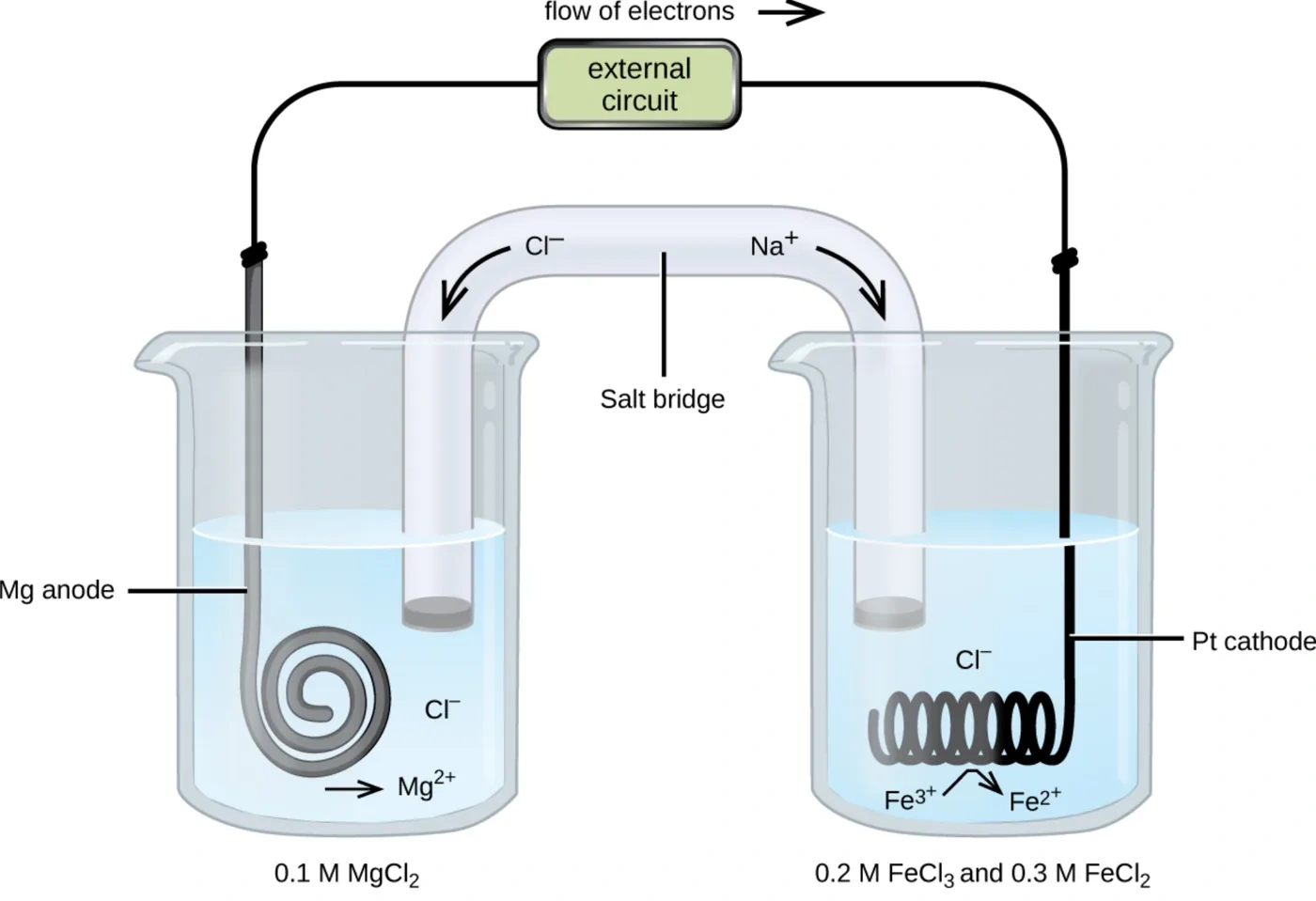
A galvanic cell in which a magnesium electrode is oxidized and a platinum electrode sits in a solution of iron(III) and iron(II) ions. Image: OpenStax, Chemistry 2e, CC BY 4.0.
A cell with an inert electrode
 ⤢ Enlarge
1
A second cell is based on the spontaneous reaction between solid magnesium and aqueous iron(III) ions. Here a solid magnesium anode sits in aqueous magnesium chloride. A salt bridge joins it to a solution that contains both iron(III) chloride and iron(II) chloride. The cathode is a platinum electrode in that solution. The diagram below shows this cell.
2
The cathode half-cell is different from the copper and silver cell.
3
Its electrode, platinum, is neither a reactant nor a product.
4
This is necessary when neither member of the redox couple can act as an electrode.
5
Both members of the Fe3+/Fe2+ couple are dissolved species
so an electrode is needed that conducts electricity but takes no part in the reaction.
6
Platinum is used as an inert electrode
which only supplies or accepts electrons for the dissolved species.
1 / 2Next ▶
A cell with an inert electrode
A cell with an inert electrode
An electrode made from a member of the redox couple, such as the magnesium anode in this cell, is called an active electrode.
The cell notation for this cell is Mg(s) | Mg2+(aq) || Fe3+(aq), Fe2+(aq) | Pt(s).
The comma inside the cathode compartment shows that both iron species are in the same phase.
◀ Previous2 / 2
Example 17.3: Writing a galvanic cell schematic
Example 17.3: Writing a galvanic cell schematic
Problem: A galvanic cell is built from two half-cells joined by a salt bridge. One half-cell holds a chromium wire in 1 M CrCl3. The other holds a copper wire in 1 M CuCl2. The chromium wire is the anode. Write the cell schematic, the anode half-reaction, the cathode half-reaction and the overall cell reaction.
Solution: Because chromium is the anode, the notation starts with it and moves left to right until it reaches the copper cathode. The cell schematic is Cr(s) | Cr3+(1 M) || Cu2+(1 M) | Cu(s).
Anode (oxidation): Cr(s) → Cr3+(aq) + 3e−
Cathode (reduction): Cu2+(aq) + 2e− → Cu(s)
Balancing the electrons: The anode releases 3 electrons per chromium atom and the cathode takes 2 electrons per copper ion. The least common multiple of 3 and 2 is 6
so multiply the anode half-reaction by 2 and the cathode half-reaction by 3. This gives 2Cr(s) → 2Cr3+(aq) + 6e− and 3Cu2+(aq) + 6e− → 3Cu(s).
Overall cell reaction: Adding the balanced half-reactions cancels the 6 electrons and gives 2Cr(s) + 3Cu2+(aq) → 2Cr3+(aq) + 3Cu(s). The chromium is oxidized and the copper(II) ions are reduced.
Key terms
| Term | Meaning |
|---|---|
| Electrochemical cell | A device that keeps the reactants of a redox reaction apart so that electrons must travel through an external circuit. |
| Galvanic cell (voltaic cell) | An electrochemical cell in which a spontaneous redox reaction produces an electric current. |
| Half-cell | One of the two compartments of a galvanic cell, containing one member of a redox couple and its electrode. |
| Redox couple | A pair consisting of an oxidized form and its reduced form, such as Cu2+/Cu. |
| Electrode | An electrically conductive solid, in a phase separate from the solution, where electrons enter or leave the cell. |
| Anode | The electrode at which oxidation occurs. |
| Cathode | The electrode at which reduction occurs. |
| Salt bridge | A tube filled with inert electrolyte solution that links two half-cells and lets ions move to keep charge balanced. |
| Inert electrode | An electrode, such as platinum, that does not take part in the reaction and only transfers electrons. |
| Active electrode | An electrode made from a member of the redox couple, such as a magnesium anode. |
| Cell notation (cell schematic) | A shorthand written form that shows the phases, interfaces and composition of a galvanic cell, starting at the anode. |
| Oxidation | Loss of electrons by a species. |
| Reduction | Gain of electrons by a species. |
| Spontaneous redox reaction | A redox reaction that proceeds on its own without an external energy input. |
1Avoid these mistakes2Avoid these mistakes
Avoid these mistakes
1Avoid this
Calling the electrode where reduction occurs the anode. The anode is always the site of oxidation, and the cathode is always the site of reduction.Avoid this
2Avoid this
Writing the cell notation starting from the cathode. The notation always begins with the anode and ends with the cathode.Avoid this
3Avoid this
Using a single vertical line for the salt bridge. The salt bridge is shown by a double vertical line, ||, which separates the two half-cells.Avoid this
1 / 2Next ▶
Avoid these mistakes
4Avoid this
Forgetting that the salt bridge does not transfer electrons. It carries ions that keep the charge in each half-cell balanced.Avoid this
5Avoid this
Thinking that an inert electrode such as platinum takes part in the reaction. It only supplies or accepts electrons for the dissolved species.Avoid this
6Avoid this
Failing to balance electrons before adding the half-reactions. Multiply each half-reaction so that the electrons lost equal the electrons gained.Avoid this
◀ Previous2 / 2