Curriculum
Chemistry 2e
Unit 1: Essential Ideas
0/14
Unit 2: Atoms, Molecules, and Ions
0/16
Unit 3: Composition of Substances and Solutions
0/10
Unit 4: Stoichiometry of Chemical Reactions
0/12
Unit 5: Thermochemistry
0/8
Unit 6: Electronic Structure and Periodic Properties of Elements
0/12
Unit 7: Chemical Bonding and Molecular Geometry
0/14
Unit 8: Advanced Theories of Covalent Bonding
0/10
Unit 9: Gases
0/23
Unit 10: Liquids and Solids
0/28
Unit 11: Solutions and Colloids
0/24
-
Unit 11 overview: Solutions and Colloids
 Preview
-
11.1 The Dissolution Process
Preview
-
Unit 11 overview: Solutions and Colloids
Preview
-
11.1 The Dissolution Process
Preview
-
11.1 The Dissolution Process - Check yourself
 Preview
-
11.1 The Dissolution Process - Check yourself
Preview
-
11.2 Electrolytes
Preview
-
11.2 Electrolytes - Check yourself
Preview
-
11.2 Electrolytes
Preview
-
11.2 Electrolytes - Check yourself
Preview
-
11.3 Solubility
Preview
-
11.3 Solubility - Check yourself
Preview
-
11.3 Solubility
Preview
-
11.3 Solubility - Check yourself
Preview
-
11.4 Colligative Properties
Preview
-
11.4 Colligative Properties - Check yourself
Preview
-
11.4 Colligative Properties
Preview
-
11.4 Colligative Properties - Check yourself
Preview
-
11.5 Colloids
Preview
-
11.5 Colloids - Check yourself
Preview
-
11.5 Colloids
Preview
-
11.5 Colloids - Check yourself
Preview
-
Unit 11 review quiz: Solutions and Colloids
Preview
-
Unit 11 review quiz: Solutions and Colloids
Preview
Unit 12: Kinetics
0/32
Unit 13: Fundamental Equilibrium Concepts
0/20
Unit 14: Acid-Base Equilibria
0/32
Unit 15: Equilibria of Other Reaction Classes
0/16
Unit 16: Thermodynamics
0/20
Unit 17: Electrochemistry
0/32
Unit 18: Representative Metals, Metalloids, and Nonmetals
0/52
Unit 19: Transition Metals and Coordination Chemistry
0/16
Unit 20: Organic Chemistry
0/20
Unit 21: Nuclear Chemistry
0/28
Text lesson
11.5 Colloids
11.5 Colloids — CHEMISTRY notes: You will be able to describe the composition and properties of colloidal dispersions and explain several technological applications of colloids.
1Suspensions, solutions and colloids2Suspensions, solutions and colloids3Suspensions, solutions and colloids
Suspensions, solutions and colloids
Suspensions, solutions and colloids
Some mixtures are easy to recognize from everyday experience.
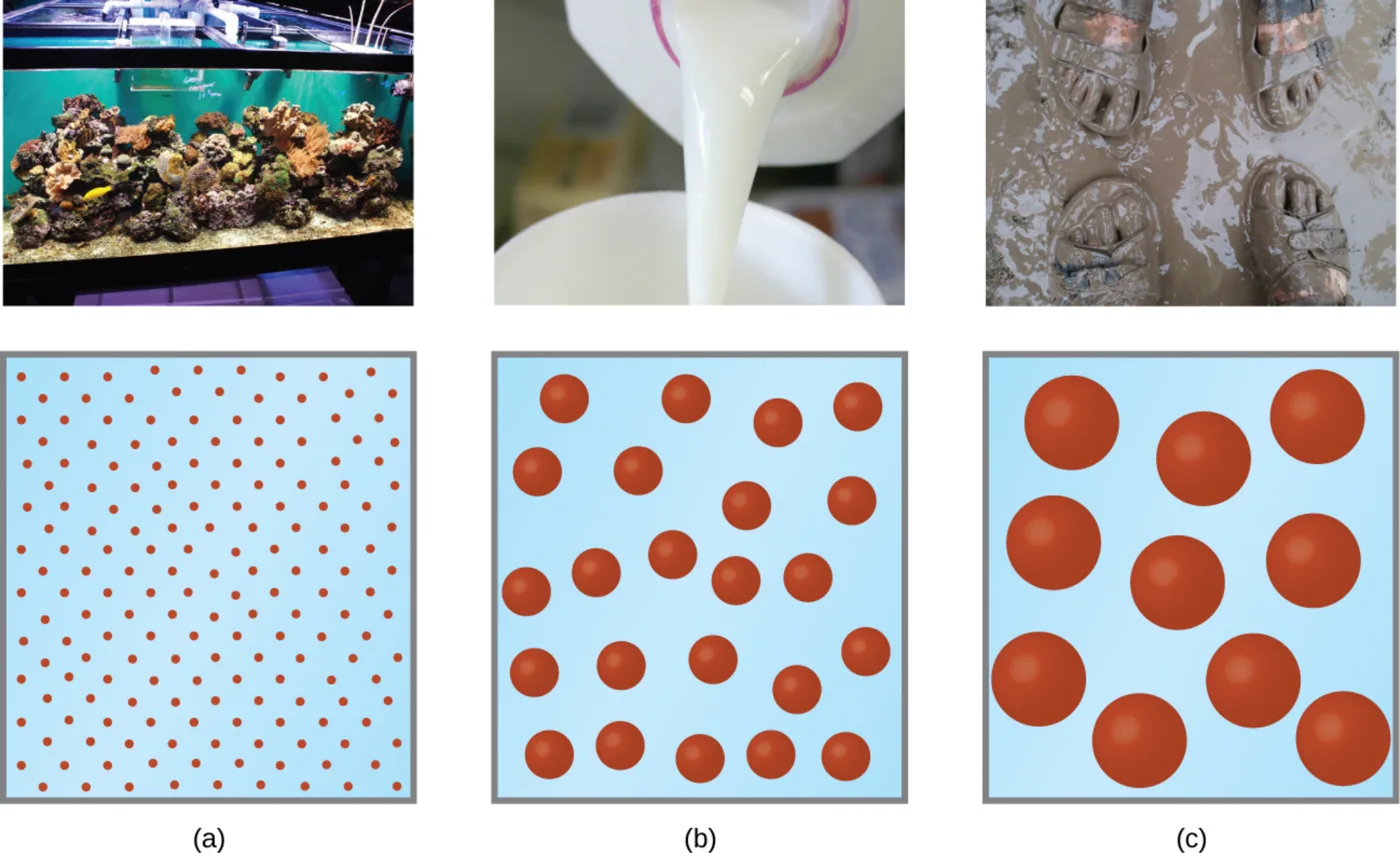
Mud in water, flour in water, and tempera paint are suspensions.
(solid pigments in water)
They are heterogeneous mixtures containing relatively large particles that can be seen, or at least seen with a magnifying glass.
They look cloudy, and their particles settle out after mixing if left standing.
A solution is a homogeneous mixture in which the dissolved species are molecules or ions.
Solutions behave very differently from suspensions.
1 / 3Next ▶
Suspensions, solutions and colloids
1
A solution may be colored
but it is transparent, its molecules or ions are invisible, and nothing settles out on standing.
2
A colloid, also called a colloidal dispersion, has properties between those of a suspension and a solution.
3
Its particles are larger than simple molecules, yet they are small enough that they do not settle out on standing.
4
The figure below compares a solution, a colloid (milk) and a suspension (mud).
(saltwater in an aquarium)
◀ Previous2 / 3Next ▶
Three mixtures side by side: a clear saltwater solution, milk whose particles stay dispersed, and muddy water whose heavy particles settle and make it cloudy. Image: OpenStax, Chemistry 2e, CC BY 4.0.
Suspensions, solutions and colloids
◀ Previous3 / 3
1The Tyndall effect2The Tyndall effect
The Tyndall effect
The Tyndall effect
The particles in a colloid are large enough to scatter light.
This is called the Tyndall effect.
Because of it, a colloid can look cloudy or opaque even though it is a uniform mixture.
A light beam passing through a colloid becomes visible
while the same beam passing through a true solution is not seen.
Clouds, fog and smoke are examples: they are colloidal mixtures made of water droplets or particles much larger than molecules, yet small enough not to fall out of the air.
1 / 2Next ▶
Searchlight beams show up in the air because fine particles in fog or smoke scatter the light, which is the Tyndall effect. Image: OpenStax, Chemistry 2e, CC BY 4.0.
The Tyndall effect

◀ Previous2 / 2
Dispersed phase and dispersion medium
1
The components of a colloid are named in the same way as the solute and solvent of a solution
but according to their relative amounts. The particulate componentwhich is present in the smaller amount, is the dispersed phase. The substance or solution in which the particles are spread is the dispersion medium.
2
Colloids can combine almost any physical states. The table below lists the common types, with their special names where they exist.
| Dispersed phase | Dispersion medium | Common examples | Name |
|---|---|---|---|
| Solid | Gas | Smoke, dust | No special name |
| Solid | Liquid | Starch in water, some inks, paints, milk of magnesia | Sol |
| Solid | Solid | Some colored gems, some alloys | No special name |
| Liquid | Gas | Clouds, fogs, mists, sprays | Aerosol |
| Liquid | Liquid | Milk, mayonnaise, butter | Emulsion |
| Liquid | Solid | Jellies, gels, pearl, opal (H2O in SiO2) | Gel |
| Gas | Liquid | Foams, whipped cream, beaten egg whites | Foam |
| Gas | Solid | Pumice, floating soaps | No special name |
1Preparing colloids · Dispersion methods2Condensation methods3Condensation methods
Emulsions and emulsifying agents
Emulsions and emulsifying agents
An emulsion is made by shaking or blending two immiscible liquids. One liquid breaks into droplets of colloidal size
which spread through the other liquid. Oil spilled in the ocean can form an emulsion with seawater when waves act on it, and this makes the oil harder to clean up.
Emulsion droplets tend to join together (coalesce), form large drops, and separate.
For this reason emulsions are usually stabilized by an emulsifying agent, a substance that stops the dispersed liquid from coalescing.
A little soap stabilizes an emulsion of kerosene in water.
Milk is an emulsion of butterfat in water, stabilized by the protein casein.
Mayonnaise is an emulsion of oil in vinegar, stabilized by components of egg yolk.
1Chemistry in everyday life: Deepwater Horizon oil spill2Chemistry in everyday life: Deepwater Horizon oil spill3Chemistry in everyday life: Deepwater Horizon oil spill
Chemistry in everyday life: Deepwater Horizon oil spill
1
The Deepwater Horizon oil drilling rig blew out on April 20, 2010, in the Gulf of Mexico near Mississippi.
2
This began the largest marine oil spill in the history of the petroleum industry.
3
In the 87 days after the blowout, about 4.9 million barrels (210 million gallons) of oil flowed from the damaged well, 5000 feet below the surface.
4
The well was declared sealed on September 19, 2010.
5
Crude oil does not mix with water and is less dense than it
so the oil rose to the surface.
6
Floating booms, skimmer ships and controlled burns removed oil from the surface to protect the beaches and wetlands along the Gulf coast.
1 / 3Next ▶
Chemistry in everyday life: Deepwater Horizon oil spill
1
Responders also tried to lessen the environmental impact by using a dispersant, Corexit 9527, to make the oil dilute into the ocean water.
2
About 1.84 million gallons were used, mostly injected underwater at the leak.
3
Corexit contains 2-butoxyethanol, C6H14O2, an amphiphilic molecule with polar and nonpolar ends.
4
It emulsifies the oil into small droplets
which increases the oil surface area and makes it easier for marine bacteria to digest.
5
The approach avoids some immediate hazards but may cause long-term effects
because toxic components of petroleum can enter the ocean food chain.
◀ Previous2 / 3Next ▶
A satellite view of the oil slick, a plane spraying dispersant, and the structure of 2-butoxyethanol, the active molecule in that dispersant. Image: OpenStax, Chemistry 2e, CC BY 4.0.
Chemistry in everyday life: Deepwater Horizon oil spill

◀ Previous3 / 3
1Soaps and detergents2Soaps and detergents3Soaps and detergents
Soaps and detergents
1
Early soap was made by boiling animal fats with a strongly basic solution, obtained by leaching potassium carbonate from wood ashes with hot water.
2
Animal fats are polyesters of fatty acids (long-chain carboxylic acids).
3
Treating them with a base such as potassium carbonate or sodium hydroxide produces glycerol and salts of fatty acids,
such as palmitic, oleic and stearic acid.
4
These fatty acid salts are called soaps.
5
Sodium stearate, C17H35CO2Na, has an uncharged, nonpolar hydrocarbon chain (C17H35–) and an ionic carboxylate group (–CO2−Na+). The hydrocarbon end is nonpolar, and the carboxylate end is polar and ionic.
1 / 3Next ▶
A soap molecule drawn as a long nonpolar tail joined to an ionic carboxylate head, with the tail length varying from soap to soap. Image: OpenStax, Chemistry 2e, CC BY 4.0.
Soaps and detergents
 ⤢ Enlarge
Soaps and detergents
Detergents are soap substitutes. They also have a nonpolar hydrocarbon chain, such as C12H25–
but their ionic group is a sulfate or a sulfonate. Soaps form insoluble calcium and magnesium compounds in hard waterwhich leaves a sticky residue. Detergents form water-soluble products with these ionswhich is a clear advantage in hard water.
◀ Previous2 / 3Next ▶
A detergent molecule with a nonpolar hydrocarbon tail and an ionic sulfate or sulfonate head, where the tail length can differ between detergents. Image: OpenStax, Chemistry 2e, CC BY 4.0.
Soaps and detergents

◀ Previous3 / 3
1How soaps and detergents clean2How soaps and detergents clean
How soaps and detergents clean
1
The cleaning action follows from the molecular structure.
2
The hydrocarbon end dissolves in, or is attracted to, nonpolar substances such as oil, grease and dirt.
3
The ionic end is attracted to water
which is polar.
4
The soap or detergent molecules therefore line up at the boundary between the dirt and the water and act as a bridge between a nonpolar and a polar substance.
5
Molecules with a hydrophobic (water-fearing) part and a hydrophilic (water-loving) part are called amphiphilic.
6
Because of this bridging, dirt particles become suspended as colloidal particles and are washed away.
1 / 2Next ▶
A cross section of an oil droplet in water, showing soap molecules with their tails in the oil and their ionic heads in the water, which lets the oil be carried away as an emulsion. Image: OpenStax, Chemistry 2e, CC BY 4.0.
How soaps and detergents clean

◀ Previous2 / 2
1Electrical properties of colloidal particles2Electrical properties of colloidal particles3Electrical properties of colloidal particles
Electrical properties of colloidal particles
Electrical properties of colloidal particles
Dispersed colloidal particles are often electrically charged.
For example, a colloidal particle of iron(III) hydroxide does not have enough hydroxide ions to cancel the positive charge of its iron(III) ions,
so each particle is positive.
The dispersion as a whole stays neutral because free hydroxide ions balance the charge.
Most metal hydroxide colloids are positive
while most metals and metal sulfides form negatively charged dispersions.
All particles in one system carry charges of the same sign.
Like charges repel one another
which helps keep the particles dispersed.
1 / 3Next ▶
Electrical properties of colloidal particles
1
This charge can be used to remove particles from a mixture.
2
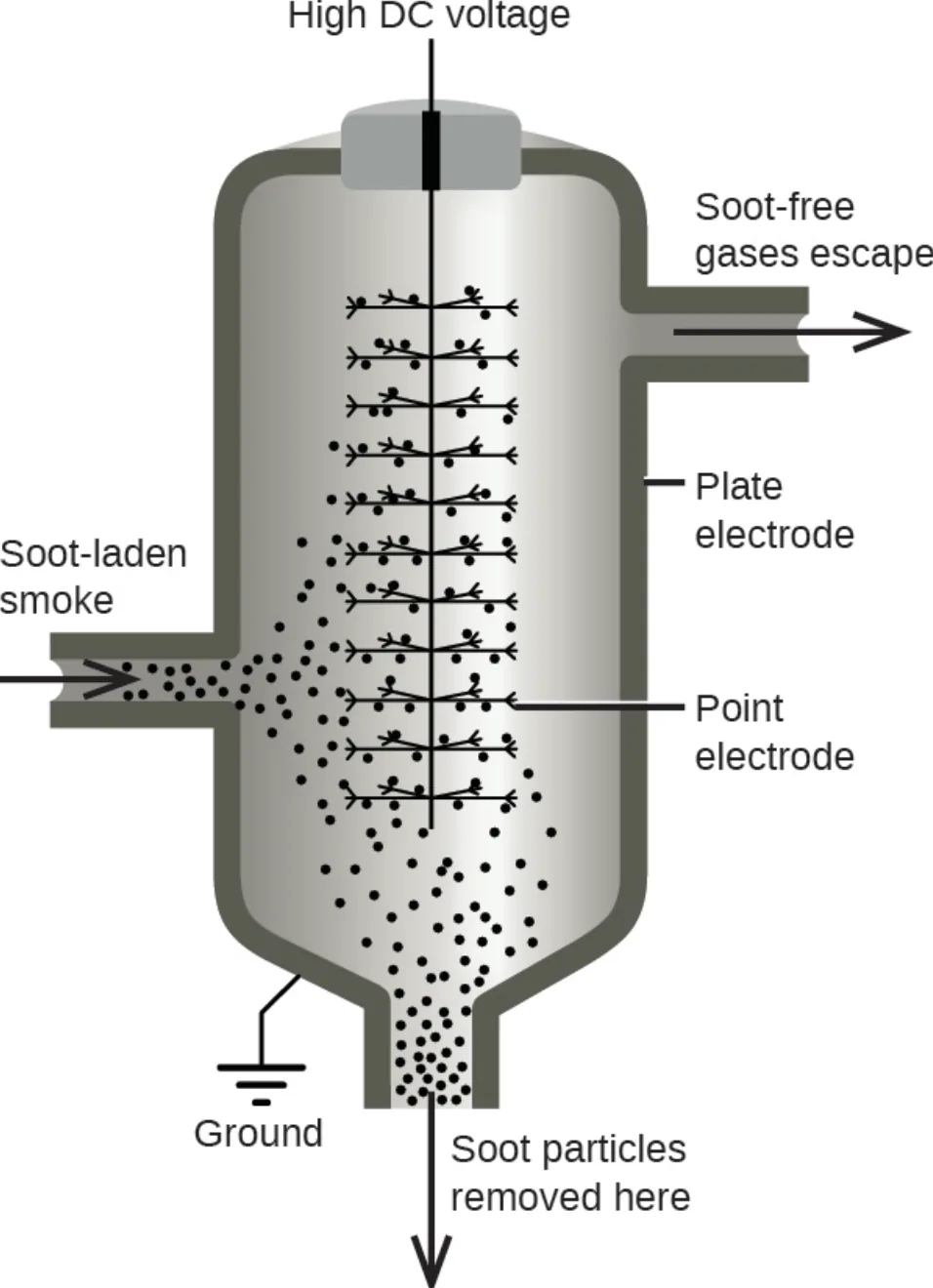
Smoke particles are often colloidal and charged.
3
In the electrostatic precipitator, invented by Frederick Cottrell, charged particles are attracted to highly charged electrodes.
4
There they are neutralized and collected as dust.
5
The method cleans smoke from many industrial processes and recovers valuable material from smelter, furnace and kiln fumes.
6
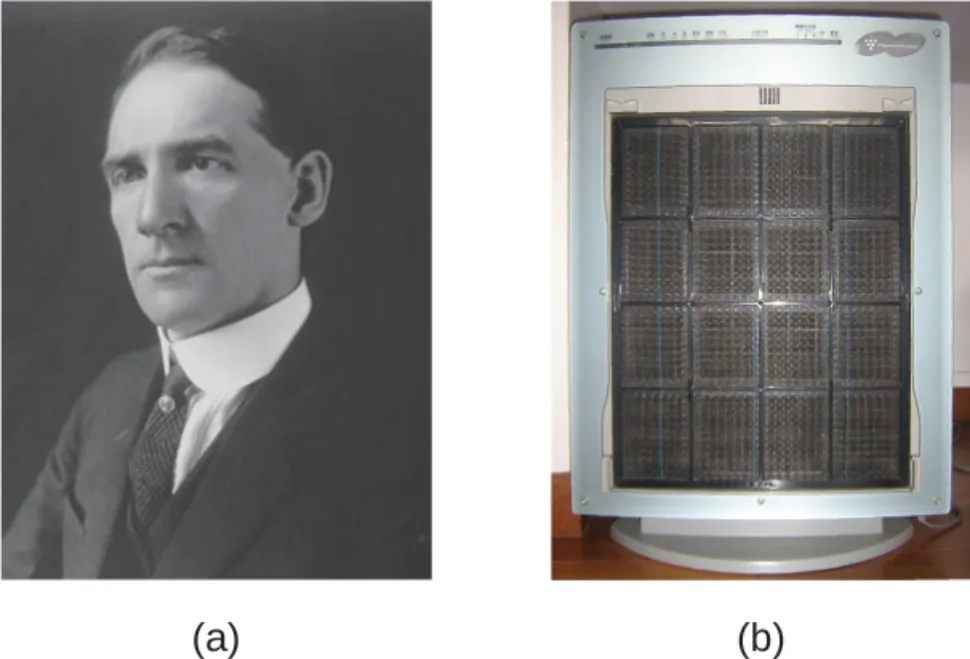
Similar electrostatic filters are sold for home use to improve indoor air.
◀ Previous2 / 3Next ▶
Inside a Cottrell precipitator, charged particles move to highly charged electrodes, where they lose their charge and fall out as dust. Image: OpenStax, Chemistry 2e, CC BY 4.0.
Electrical properties of colloidal particles
◀ Previous3 / 3
1Portrait of a chemist: Frederick Gardner Cottrell2Portrait of a chemist: Frederick Gardner Cottrell
Portrait of a chemist: Frederick Gardner Cottrell
Portrait of a chemist: Frederick Gardner Cottrell
Frederick Cottrell was born in Oakland, California, in 1877. He finished high school at 16 and completed a bachelor’s degree at the University of California, Berkeley, in three years.
While teaching chemistry at Oakland High School on a small salary, he saved money to study in Berlin with Jacobus van’t Hoff and in Leipzig with Wilhelm Ostwald, both Nobel laureates.
After a PhD in physical chemistry he returned to teach at Berkeley.
As a consultant for the DuPont Company he developed the electrostatic precipitator,
which curbs air pollution by removing colloidal particles from air.
He used the money from this invention to fund a nonprofit research corporation that financed scientific research.
1 / 2Next ▶
A portrait of Frederick Cottrell beside a photograph of the electrostatic precipitator he developed to clean air. Image: OpenStax, Chemistry 2e, CC BY 4.0.
Portrait of a chemist: Frederick Gardner Cottrell
◀ Previous2 / 2
1Gels2Gels
Gels
1
Gelatin desserts such as Jell-O are colloids.
2
Gelatin sets on cooling because the hot aqueous mixture coagulates into a very viscous body called a gel.
3
A gel is a colloidal dispersion of a liquid throughout a solid.
4
The fibers of the solid form a three-dimensional network,
and the spaces in the network are filled with the liquid or a dilute solution of the dispersing medium.
1 / 2Next ▶
A gelatin dessert is a colloid: a sweet, flavored water solution held inside a network of solid protein. Image: OpenStax, Chemistry 2e, CC BY 4.0.
Gels
 ⤢ Enlarge
Gels
Other gels are common too. Pectin, a carbohydrate from fruit juices, is the gel-forming substance used in jelly making. Silica gel, a colloidal dispersion of hydrated silicon dioxide, forms when dilute hydrochloric acid is added to dilute sodium silicate solution. Canned Heat is a flammable gel made by mixing alcohol with a saturated aqueous solution of calcium acetate.
◀ Previous2 / 2
1Example 11.13: Freezing point of an electrolyte solution2Example 11.13: Freezing point of an electrolyte solution3Example 11.13: Freezing point of an electrolyte solution
Example 11.13: Freezing point of an electrolyte solution
1
The ion concentration in seawater is about the same as that of a solution of 4.2 g NaCl dissolved in 125 g water.
2
Using this and the predicted van’t Hoff factor for NaCl (i = 2,
from the table of van’t Hoff factors), find the freezing point of the solution, assuming ideal behavior.
3
The freezing point depression is ΔTf = i × Kf × m,
where ΔTf is in °C, i is dimensionless, Kf for water is 1.86 °C·kg/mol,and m is molality in mol/kg.
4
1
5
Moles of NaCl: 4.2 g ÷ 58.44 g/mol = 0.072 mol NaCl.
6
2
1 / 3Next ▶
Example 11.13: Freezing point of an electrolyte solution
Example 11.13: Freezing point of an electrolyte solution
Moles of ions: each NaCl gives 2 ions
so 0.072 mol × 2 = 0.14 mol ions.
3
Molality of ions: 0.14 mol ÷ 0.125 kg water = 1.2 mol/kg.
4
Change in freezing point: 1.86 °C·kg/mol × 1.2 mol/kg ≈ 2.1 °C.
5
◀ Previous2 / 3Next ▶
A flow diagram of the five steps that take the mass of NaCl to the new freezing point of the solution. Image: OpenStax, Chemistry 2e, CC BY 4.0.
Example 11.13: Freezing point of an electrolyte solution
 ⤢ Enlarge
Example 11.13: Freezing point of an electrolyte solution
New freezing point: 0.0 °C − 2.1 °C = −2.1 °C.
Check each step: the answer is about −2.1 °C. Keep extra digits in each step to avoid rounding errors when the next step uses that value.
Check Your Learning: Assuming complete dissociation and ideal behavior, calculate the freezing point of a solution of 0.724 g CaCl2 in 175 g water. Answer: moles of CaCl2 = 0.724 g ÷ 110.98 g/mol = 0.00652 mol
moles of ions = 3 × 0.00652 = 0.0196 molmolality = 0.0196 mol ÷ 0.175 kg = 0.112 mol/kgΔTf = 1.86 × 0.112 = 0.208 °Cso the freezing point is −0.208 °C.
◀ Previous3 / 3
Key terms
| Term | Meaning |
|---|---|
| Suspension | A heterogeneous mixture with large particles that can be seen and that settle out on standing. |
| Solution | A homogeneous mixture whose dissolved species are molecules or ions and do not settle out. |
| Colloid (colloidal dispersion) | A mixture whose particles are too large to be simple molecules but too small to settle out; they scatter light. |
| Tyndall effect | The scattering of light by colloidal particles, which makes a beam visible and a colloid look cloudy. |
| Dispersed phase | The particulate component of a colloid, present in the smaller amount. |
| Dispersion medium | The substance in which the dispersed phase is spread. |
| Sol | A colloid of a solid dispersed in a liquid. |
| Aerosol | A colloid of a liquid dispersed in a gas, such as fog or mist. |
| Emulsion | A colloid of one liquid dispersed in another immiscible liquid, such as milk or mayonnaise. |
| Emulsifying agent | A substance that prevents the droplets of an emulsion from joining together. |
| Gel | A colloid in which a liquid is dispersed throughout a solid network. |
| Foam | A colloid of a gas dispersed in a liquid, such as whipped cream. |
| Dispersion method | A way of making colloids by breaking large particles into colloidal size, such as grinding pigments. |
| Condensation method | A way of making colloids by building particles up from molecules or ions. |
| Soap | A salt of a fatty acid, such as sodium stearate, that has a nonpolar tail and an ionic head. |
| Detergent | A soap substitute with a nonpolar hydrocarbon chain and a sulfate or sulfonate group, which stays soluble in hard water. |
| Amphiphilic | Describes a molecule with both a hydrophobic (water-fearing) part and a hydrophilic (water-loving) part. |
| Electrostatic precipitator | A device that removes charged colloidal particles from smoke or air by attracting them to charged electrodes. |
1Avoid these mistakes2Avoid these mistakes3Avoid these mistakes