Curriculum
Chemistry 2e
Unit 1: Essential Ideas
0/14
-
Unit 1 overview: Essential Ideas
 Text lessonPreview
-
1.1 Chemistry in Context
Text lessonPreview
-
1.1 Chemistry in Context - Check yourself
 6 questionsPreview
-
1.2 Phases and Classification of Matter
Text lessonPreview
-
1.2 Phases and Classification of Matter - Check yourself
6 questionsPreview
-
1.3 Physical and Chemical Properties
Text lessonPreview
-
1.3 Physical and Chemical Properties - Check yourself
6 questionsPreview
-
1.4 Measurements
Text lessonPreview
-
1.4 Measurements - Check yourself
6 questionsPreview
-
1.5 Measurement Uncertainty, Accuracy, and Precision
Text lessonPreview
-
1.5 Measurement Uncertainty, Accuracy, and Precision - Check yourself
6 questionsPreview
-
1.6 Mathematical Treatment of Measurement Results
Text lessonPreview
-
1.6 Mathematical Treatment of Measurement Results - Check yourself
6 questionsPreview
-
Unit 1 review quiz: Essential Ideas
10 questionsPreview
Unit 2: Atoms, Molecules, and Ions
0/16
-
Unit 2 overview: Atoms, Molecules, and Ions
Text lessonPreview
-
2.1 Early Ideas in Atomic Theory
Text lessonPreview
-
2.1 Early Ideas in Atomic Theory - Check yourself
6 questionsPreview
-
2.2 Evolution of Atomic Theory
Text lessonPreview
-
2.2 Evolution of Atomic Theory - Check yourself
6 questionsPreview
-
2.3 Atomic Structure and Symbolism
Text lessonPreview
-
2.3 Atomic Structure and Symbolism - Check yourself
6 questionsPreview
-
2.4 Chemical Formulas
Text lessonPreview
-
2.4 Chemical Formulas - Check yourself
6 questionsPreview
-
2.5 The Periodic Table
Text lessonPreview
-
2.5 The Periodic Table - Check yourself
6 questionsPreview
-
2.6 Ionic and Molecular Compounds
Text lessonPreview
-
2.6 Ionic and Molecular Compounds - Check yourself
6 questionsPreview
-
2.7 Chemical Nomenclature
Text lessonPreview
-
2.7 Chemical Nomenclature - Check yourself
6 questionsPreview
-
Unit 2 review quiz: Atoms, Molecules, and Ions
10 questionsPreview
Unit 3: Composition of Substances and Solutions
0/10
-
Unit 3 overview: Composition of Substances and Solutions
Text lessonPreview
-
3.1 Formula Mass and the Mole Concept
Text lessonPreview
-
3.1 Formula Mass and the Mole Concept - Check yourself
6 questionsPreview
-
3.2 Determining Empirical and Molecular Formulas
Text lessonPreview
-
3.2 Determining Empirical and Molecular Formulas - Check yourself
6 questionsPreview
-
3.3 Molarity
Text lessonPreview
-
3.3 Molarity - Check yourself
6 questionsPreview
-
3.4 Other Units for Solution Concentrations
Text lessonPreview
-
3.4 Other Units for Solution Concentrations - Check yourself
6 questionsPreview
-
Unit 3 review quiz: Composition of Substances and Solutions
10 questionsPreview
Unit 4: Stoichiometry of Chemical Reactions
0/12
-
Unit 4 overview: Stoichiometry of Chemical Reactions
Text lessonPreview
-
4.1 Writing and Balancing Chemical Equations
Text lessonPreview
-
4.1 Writing and Balancing Chemical Equations - Check yourself
6 questionsPreview
-
4.2 Classifying Chemical Reactions
Text lessonPreview
-
4.2 Classifying Chemical Reactions - Check yourself
6 questionsPreview
-
4.3 Reaction Stoichiometry
Text lessonPreview
-
4.3 Reaction Stoichiometry - Check yourself
6 questionsPreview
-
4.4 Reaction Yields
Text lessonPreview
-
4.4 Reaction Yields - Check yourself
6 questionsPreview
-
4.5 Quantitative Chemical Analysis
Text lessonPreview
-
4.5 Quantitative Chemical Analysis - Check yourself
6 questionsPreview
-
Unit 4 review quiz: Stoichiometry of Chemical Reactions
10 questionsPreview
Unit 5: Thermochemistry
0/8
-
Unit 5 overview: Thermochemistry
Text lessonPreview
-
5.1 Energy Basics
Text lessonPreview
-
5.1 Energy Basics - Check yourself
6 questionsPreview
-
5.2 Calorimetry
Text lessonPreview
-
5.2 Calorimetry - Check yourself
7 questionsPreview
-
5.3 Enthalpy
Text lessonPreview
-
5.3 Enthalpy - Check yourself
6 questionsPreview
-
Unit 5 review quiz: Thermochemistry
10 questionsPreview
Unit 6: Electronic Structure and Periodic Properties of Elements
0/12
-
Unit 6 overview: Electronic Structure and Periodic Properties of Elements
Text lessonPreview
-
6.1 Electromagnetic Energy
Text lessonPreview
-
6.1 Electromagnetic Energy - Check yourself
6 questionsPreview
-
6.2 The Bohr Model
Text lessonPreview
-
6.2 The Bohr Model - Check yourself
6 questionsPreview
-
6.3 Development of Quantum Theory
Text lessonPreview
-
6.3 Development of Quantum Theory - Check yourself
6 questionsPreview
-
6.4 Electronic Structure of Atoms (Electron Configurations)
Text lessonPreview
-
6.4 Electronic Structure of Atoms (Electron Configurations) - Check yourself
6 questionsPreview
-
6.5 Periodic Variations in Element Properties
Text lessonPreview
-
6.5 Periodic Variations in Element Properties - Check yourself
6 questionsPreview
-
Unit 6 review quiz: Electronic Structure and Periodic Properties of Elements
10 questionsPreview
Unit 7: Chemical Bonding and Molecular Geometry
0/14
-
Unit 7 overview: Chemical Bonding and Molecular Geometry
Text lessonPreview
-
7.1 Ionic Bonding
Text lessonPreview
-
7.1 Ionic Bonding - Check yourself
6 questionsPreview
-
7.2 Covalent Bonding
Text lessonPreview
-
7.2 Covalent Bonding - Check yourself
6 questionsPreview
-
7.3 Lewis Symbols and Structures
Text lessonPreview
-
7.3 Lewis Symbols and Structures - Check yourself
6 questionsPreview
-
7.4 Formal Charges and Resonance
Text lessonPreview
-
7.4 Formal Charges and Resonance - Check yourself
6 questionsPreview
-
7.5 Strengths of Ionic and Covalent Bonds
Text lessonPreview
-
7.5 Strengths of Ionic and Covalent Bonds - Check yourself
6 questionsPreview
-
7.6 Molecular Structure and Polarity
Text lessonPreview
-
7.6 Molecular Structure and Polarity - Check yourself
6 questionsPreview
-
Unit 7 review quiz: Chemical Bonding and Molecular Geometry
10 questionsPreview
Unit 8: Advanced Theories of Covalent Bonding
0/10
-
Unit 8 overview: Advanced Theories of Covalent Bonding
Text lessonPreview
-
8.1 Valence Bond Theory
Text lessonPreview
-
8.1 Valence Bond Theory - Check yourself
6 questionsPreview
-
8.2 Hybrid Atomic Orbitals
Text lessonPreview
-
8.2 Hybrid Atomic Orbitals - Check yourself
6 questionsPreview
-
8.3 Multiple Bonds
Text lessonPreview
-
8.3 Multiple Bonds - Check yourself
6 questionsPreview
-
8.4 Molecular Orbital Theory
Text lessonPreview
-
8.4 Molecular Orbital Theory - Check yourself
6 questionsPreview
-
Unit 8 review quiz: Advanced Theories of Covalent Bonding
10 questionsPreview
Unit 9: Gases
0/23
-
Unit 9 overview: Gases
Text lessonPreview
-
9.1 Gas Pressure
Text lessonPreview
-
9.1 Gas Pressure - Check yourself
6 questionsPreview
-
9.2 Relating Pressure, Volume, Amount, and Temperature: The Ideal Gas Law
Text lessonPreview
-
9.2 Relating Pressure, Volume, Amount, and Temperature: The Ideal Gas Law - Check yourself
6 questionsPreview
-
9.3 Stoichiometry of Gaseous Substances, Mixtures, and Reactions
Text lessonPreview
-
9.3 Stoichiometry of Gaseous Substances, Mixtures, and Reactions - Check yourself
6 questionsPreview
-
9.3 Stoichiometry of Gaseous Substances, Mixtures, and Reactions
Text lessonPreview
-
9.3 Stoichiometry of Gaseous Substances, Mixtures, and Reactions - Check yourself
6 questionsPreview
-
9.4 Effusion and Diffusion of Gases
Text lessonPreview
-
9.4 Effusion and Diffusion of Gases - Check yourself
6 questionsPreview
-
9.4 Effusion and Diffusion of Gases
Text lessonPreview
-
9.4 Effusion and Diffusion of Gases - Check yourself
6 questionsPreview
-
Unit 9 review quiz: Gases
10 questionsPreview
-
9.5 The Kinetic-Molecular Theory
Text lessonPreview
-
9.5 The Kinetic-Molecular Theory - Check yourself
6 questionsPreview
-
9.5 The Kinetic-Molecular Theory
Text lessonPreview
-
9.5 The Kinetic-Molecular Theory - Check yourself
6 questionsPreview
-
9.6 Non-Ideal Gas Behavior
Text lessonPreview
-
9.6 Non-Ideal Gas Behavior - Check yourself
6 questionsPreview
-
9.6 Non-Ideal Gas Behavior
Text lessonPreview
-
9.6 Non-Ideal Gas Behavior - Check yourself
6 questionsPreview
-
Unit 9 review quiz: Gases
10 questionsPreview
Unit 10: Liquids and Solids
0/28
-
Unit 10 overview: Liquids and Solids
Text lessonPreview
-
10.1 Intermolecular Forces
Text lessonPreview
-
Unit 10 overview: Liquids and Solids
Text lessonPreview
-
10.1 Intermolecular Forces
Text lessonPreview
-
10.1 Intermolecular Forces - Check yourself
6 questionsPreview
-
10.1 Intermolecular Forces - Check yourself
6 questionsPreview
-
10.2 Properties of Liquids
Text lessonPreview
-
10.2 Properties of Liquids - Check yourself
6 questionsPreview
-
10.2 Properties of Liquids
Text lessonPreview
-
10.2 Properties of Liquids - Check yourself
6 questionsPreview
-
10.3 Phase Transitions
Text lessonPreview
-
10.3 Phase Transitions - Check yourself
6 questionsPreview
-
10.3 Phase Transitions
Text lessonPreview
-
10.3 Phase Transitions - Check yourself
6 questionsPreview
-
10.4 Phase Diagrams
Text lessonPreview
-
10.4 Phase Diagrams
Text lessonPreview
-
10.4 Phase Diagrams - Check yourself
6 questionsPreview
-
10.4 Phase Diagrams - Check yourself
6 questionsPreview
-
10.5 The Solid State of Matter
Text lessonPreview
-
10.5 The Solid State of Matter
Text lessonPreview
-
10.5 The Solid State of Matter - Check yourself
6 questionsPreview
-
10.5 The Solid State of Matter - Check yourself
6 questionsPreview
-
10.6 Lattice Structures in Crystalline Solids
Text lessonPreview
-
10.6 Lattice Structures in Crystalline Solids
Text lessonPreview
-
10.6 Lattice Structures in Crystalline Solids - Check yourself
6 questionsPreview
-
10.6 Lattice Structures in Crystalline Solids - Check yourself
6 questionsPreview
-
Unit 10 review quiz: Liquids and Solids
10 questionsPreview
-
Unit 10 review quiz: Liquids and Solids
10 questionsPreview
Unit 11: Solutions and Colloids
0/24
-
Unit 11 overview: Solutions and Colloids
Text lessonPreview
-
11.1 The Dissolution Process
Text lessonPreview
-
Unit 11 overview: Solutions and Colloids
Text lessonPreview
-
11.1 The Dissolution Process
Text lessonPreview
-
11.1 The Dissolution Process - Check yourself
6 questionsPreview
-
11.1 The Dissolution Process - Check yourself
6 questionsPreview
-
11.2 Electrolytes
Text lessonPreview
-
11.2 Electrolytes - Check yourself
6 questionsPreview
-
11.2 Electrolytes
Text lessonPreview
-
11.2 Electrolytes - Check yourself
6 questionsPreview
-
11.3 Solubility
Text lessonPreview
-
11.3 Solubility - Check yourself
6 questionsPreview
-
11.3 Solubility
Text lessonPreview
-
11.3 Solubility - Check yourself
6 questionsPreview
-
11.4 Colligative Properties
Text lessonPreview
-
11.4 Colligative Properties - Check yourself
6 questionsPreview
-
11.4 Colligative Properties
Text lessonPreview
-
11.4 Colligative Properties - Check yourself
6 questionsPreview
-
11.5 Colloids
Text lessonPreview
-
11.5 Colloids - Check yourself
6 questionsPreview
-
11.5 Colloids
Text lessonPreview
-
11.5 Colloids - Check yourself
6 questionsPreview
-
Unit 11 review quiz: Solutions and Colloids
10 questionsPreview
-
Unit 11 review quiz: Solutions and Colloids
10 questionsPreview
Unit 12: Kinetics
0/32
-
Unit 12 overview: Kinetics
Text lessonPreview
-
12.1 Chemical Reaction Rates
Text lessonPreview
-
12.1 Chemical Reaction Rates - Check yourself
6 questionsPreview
-
Unit 12 overview: Kinetics
Text lessonPreview
-
12.1 Chemical Reaction Rates
Text lessonPreview
-
12.1 Chemical Reaction Rates - Check yourself
6 questionsPreview
-
12.2 Factors Affecting Reaction Rates
Text lessonPreview
-
12.2 Factors Affecting Reaction Rates - Check yourself
6 questionsPreview
-
12.2 Factors Affecting Reaction Rates
Text lessonPreview
-
12.2 Factors Affecting Reaction Rates - Check yourself
6 questionsPreview
-
12.3 Rate Laws
Text lessonPreview
-
12.3 Rate Laws - Check yourself
6 questionsPreview
-
12.3 Rate Laws
Text lessonPreview
-
12.3 Rate Laws - Check yourself
6 questionsPreview
-
12.4 Integrated Rate Laws
Text lessonPreview
-
12.4 Integrated Rate Laws - Check yourself
6 questionsPreview
-
12.4 Integrated Rate Laws
Text lessonPreview
-
12.4 Integrated Rate Laws - Check yourself
6 questionsPreview
-
12.5 Collision Theory
Text lessonPreview
-
12.5 Collision Theory - Check yourself
6 questionsPreview
-
12.5 Collision Theory
Text lessonPreview
-
Unit 12 review quiz: Kinetics
10 questionsPreview
-
12.5 Collision Theory - Check yourself
6 questionsPreview
-
12.6 Reaction Mechanisms
Text lessonPreview
-
12.6 Reaction Mechanisms - Check yourself
6 questionsPreview
-
12.6 Reaction Mechanisms
Text lessonPreview
-
12.6 Reaction Mechanisms - Check yourself
6 questionsPreview
-
12.7 Catalysis
Text lessonPreview
-
12.7 Catalysis - Check yourself
6 questionsPreview
-
12.7 Catalysis
Text lessonPreview
-
12.7 Catalysis - Check yourself
6 questionsPreview
-
Unit 12 review quiz: Kinetics
10 questionsPreview
Unit 13: Fundamental Equilibrium Concepts
0/20
-
Unit 13 overview: Fundamental Equilibrium Concepts
Text lessonPreview
-
13.1 Chemical Equilibria
Text lessonPreview
-
13.1 Chemical Equilibria - Check yourself
6 questionsPreview
-
13.1 Chemical Equilibria
Text lessonPreview
-
13.1 Chemical Equilibria - Check yourself
6 questionsPreview
-
13.2 Equilibrium Constants
Text lessonPreview
-
13.2 Equilibrium Constants - Check yourself
6 questionsPreview
-
13.2 Equilibrium Constants
Text lessonPreview
-
Unit 13 overview: Fundamental Equilibrium Concepts
Text lessonPreview
-
13.2 Equilibrium Constants - Check yourself
6 questionsPreview
-
13.3 Shifting Equilibria: Le Châtelier’s Principle
Text lessonPreview
-
13.3 Shifting Equilibria: Le Châtelier’s Principle - Check yourself
6 questionsPreview
-
13.3 Shifting Equilibria: Le Châtelier’s Principle
Text lessonPreview
-
Unit 13 review quiz: Fundamental Equilibrium Concepts
10 questionsPreview
-
13.3 Shifting Equilibria: Le Châtelier’s Principle - Check yourself
6 questionsPreview
-
13.4 Equilibrium Calculations
Text lessonPreview
-
13.4 Equilibrium Calculations - Check yourself
6 questionsPreview
-
13.4 Equilibrium Calculations
Text lessonPreview
-
13.4 Equilibrium Calculations - Check yourself
6 questionsPreview
-
Unit 13 review quiz: Fundamental Equilibrium Concepts
10 questionsPreview
Unit 14: Acid-Base Equilibria
0/32
-
Unit 14 overview: Acid-Base Equilibria
Text lessonPreview
-
14.1 Brønsted-Lowry Acids and Bases
Text lessonPreview
-
14.1 Brønsted-Lowry Acids and Bases - Check yourself
6 questionsPreview
-
14.1 Brønsted-Lowry Acids and Bases
Text lessonPreview
-
14.1 Brønsted-Lowry Acids and Bases - Check yourself
6 questionsPreview
-
14.2 pH and pOH
Text lessonPreview
-
14.2 pH and pOH - Check yourself
6 questionsPreview
-
14.2 pH and pOH
Text lessonPreview
-
14.2 pH and pOH - Check yourself
6 questionsPreview
-
14.3 Relative Strengths of Acids and Bases
Text lessonPreview
-
14.3 Relative Strengths of Acids and Bases - Check yourself
6 questionsPreview
-
14.3 Relative Strengths of Acids and Bases
Text lessonPreview
-
14.3 Relative Strengths of Acids and Bases - Check yourself
6 questionsPreview
-
14.4 Hydrolysis of Salts
Text lessonPreview
-
14.4 Hydrolysis of Salts - Check yourself
6 questionsPreview
-
Unit 14 review quiz: Acid-Base Equilibria
10 questionsPreview
-
Unit 14 overview: Acid-Base Equilibria
Text lessonPreview
-
14.4 Hydrolysis of Salts
Text lessonPreview
-
14.4 Hydrolysis of Salts - Check yourself
6 questionsPreview
-
14.5 Polyprotic Acids
Text lessonPreview
-
14.5 Polyprotic Acids - Check yourself
6 questionsPreview
-
14.5 Polyprotic Acids
Text lessonPreview
-
14.5 Polyprotic Acids - Check yourself
6 questionsPreview
-
14.6 Buffers
Text lessonPreview
-
14.6 Buffers - Check yourself
6 questionsPreview
-
14.6 Buffers
Text lessonPreview
-
14.6 Buffers - Check yourself
6 questionsPreview
-
14.7 Acid-Base Titrations
Text lessonPreview
-
14.7 Acid-Base Titrations - Check yourself
6 questionsPreview
-
14.7 Acid-Base Titrations
Text lessonPreview
-
14.7 Acid-Base Titrations - Check yourself
6 questionsPreview
-
Unit 14 review quiz: Acid-Base Equilibria
10 questionsPreview
Unit 15: Equilibria of Other Reaction Classes
0/16
-
Unit 15 overview: Equilibria of Other Reaction Classes
Text lessonPreview
-
15.1 Precipitation and Dissolution
Text lessonPreview
-
15.1 Precipitation and Dissolution - Check yourself
6 questionsPreview
-
15.1 Precipitation and Dissolution
Text lessonPreview
-
15.1 Precipitation and Dissolution - Check yourself
6 questionsPreview
-
15.2 Lewis Acids and Bases
Text lessonPreview
-
15.2 Lewis Acids and Bases - Check yourself
6 questionsPreview
-
Unit 15 review quiz: Equilibria of Other Reaction Classes
10 questionsPreview
-
Unit 15 overview: Equilibria of Other Reaction Classes
Text lessonPreview
-
15.2 Lewis Acids and Bases
Text lessonPreview
-
15.2 Lewis Acids and Bases - Check yourself
6 questionsPreview
-
15.3 Coupled Equilibria
Text lessonPreview
-
15.3 Coupled Equilibria - Check yourself
6 questionsPreview
-
15.3 Coupled Equilibria
Text lessonPreview
-
15.3 Coupled Equilibria - Check yourself
6 questionsPreview
-
Unit 15 review quiz: Equilibria of Other Reaction Classes
10 questionsPreview
Unit 16: Thermodynamics
0/20
-
Unit 16 overview: Thermodynamics
Text lessonPreview
-
16.1 Spontaneity
Text lessonPreview
-
16.1 Spontaneity - Check yourself
6 questionsPreview
-
16.1 Spontaneity
Text lessonPreview
-
16.1 Spontaneity - Check yourself
6 questionsPreview
-
16.2 Entropy
Text lessonPreview
-
16.2 Entropy - Check yourself
6 questionsPreview
-
16.2 Entropy
Text lessonPreview
-
16.2 Entropy - Check yourself
6 questionsPreview
-
Unit 16 review quiz: Thermodynamics
10 questionsPreview
-
Unit 16 overview: Thermodynamics
Text lessonPreview
-
16.3 The Second and Third Laws of Thermodynamics
Text lessonPreview
-
16.3 The Second and Third Laws of Thermodynamics - Check yourself
6 questionsPreview
-
16.3 The Second and Third Laws of Thermodynamics
Text lessonPreview
-
16.3 The Second and Third Laws of Thermodynamics - Check yourself
6 questionsPreview
-
16.4 Free Energy
Text lessonPreview
-
16.4 Free Energy - Check yourself
6 questionsPreview
-
16.4 Free Energy
Text lessonPreview
-
16.4 Free Energy - Check yourself
6 questionsPreview
-
Unit 16 review quiz: Thermodynamics
10 questionsPreview
Unit 17: Electrochemistry
0/32
-
Unit 17 overview: Electrochemistry
Text lessonPreview
-
17.1 Review of Redox Chemistry
Text lessonPreview
-
17.1 Review of Redox Chemistry - Check yourself
6 questionsPreview
-
17.1 Review of Redox Chemistry
Text lessonPreview
-
17.1 Review of Redox Chemistry - Check yourself
6 questionsPreview
-
17.2 Galvanic Cells
Text lessonPreview
-
17.2 Galvanic Cells - Check yourself
6 questionsPreview
-
17.2 Galvanic Cells
Text lessonPreview
-
17.2 Galvanic Cells - Check yourself
6 questionsPreview
-
17.3 Electrode and Cell Potentials
Text lessonPreview
-
17.3 Electrode and Cell Potentials - Check yourself
6 questionsPreview
-
17.3 Electrode and Cell Potentials
Text lessonPreview
-
17.3 Electrode and Cell Potentials - Check yourself
6 questionsPreview
-
17.4 Potential, Free Energy, and Equilibrium
Text lessonPreview
-
17.4 Potential, Free Energy, and Equilibrium - Check yourself
6 questionsPreview
-
Unit 17 review quiz: Electrochemistry
10 questionsPreview
-
Unit 17 overview: Electrochemistry
Text lessonPreview
-
17.4 Potential, Free Energy, and Equilibrium
Text lessonPreview
-
17.4 Potential, Free Energy, and Equilibrium - Check yourself
6 questionsPreview
-
17.5 Batteries and Fuel Cells
Text lessonPreview
-
17.5 Batteries and Fuel Cells - Check yourself
6 questionsPreview
-
17.5 Batteries and Fuel Cells
Text lessonPreview
-
17.5 Batteries and Fuel Cells - Check yourself
6 questionsPreview
-
17.6 Corrosion
Text lessonPreview
-
17.6 Corrosion - Check yourself
6 questionsPreview
-
17.6 Corrosion
Text lessonPreview
-
17.6 Corrosion - Check yourself
6 questionsPreview
-
17.7 Electrolysis
Text lessonPreview
-
17.7 Electrolysis - Check yourself
6 questionsPreview
-
17.7 Electrolysis
Text lessonPreview
-
17.7 Electrolysis - Check yourself
6 questionsPreview
-
Unit 17 review quiz: Electrochemistry
10 questionsPreview
Unit 18: Representative Metals, Metalloids, and Nonmetals
0/52
-
Unit 18 overview: Representative Metals, Metalloids, and Nonmetals
Text lessonPreview
-
18.1 Periodicity
Text lessonPreview
-
18.1 Periodicity - Check yourself
6 questionsPreview
-
18.1 Periodicity
Text lessonPreview
-
18.1 Periodicity - Check yourself
6 questionsPreview
-
18.2 Occurrence and Preparation of the Representative Metals
Text lessonPreview
-
18.2 Occurrence and Preparation of the Representative Metals - Check yourself
6 questionsPreview
-
18.2 Occurrence and Preparation of the Representative Metals
Text lessonPreview
-
18.2 Occurrence and Preparation of the Representative Metals - Check yourself
6 questionsPreview
-
18.3 Structure and General Properties of the Metalloids
Text lessonPreview
-
18.3 Structure and General Properties of the Metalloids - Check yourself
6 questionsPreview
-
18.3 Structure and General Properties of the Metalloids
Text lessonPreview
-
18.3 Structure and General Properties of the Metalloids - Check yourself
6 questionsPreview
-
18.4 Structure and General Properties of the Nonmetals
Text lessonPreview
-
18.4 Structure and General Properties of the Nonmetals - Check yourself
6 questionsPreview
-
18.4 Structure and General Properties of the Nonmetals
Text lessonPreview
-
18.4 Structure and General Properties of the Nonmetals - Check yourself
6 questionsPreview
-
18.5 Occurrence, Preparation, and Compounds of Hydrogen
Text lessonPreview
-
18.5 Occurrence, Preparation, and Compounds of Hydrogen - Check yourself
6 questionsPreview
-
18.5 Occurrence, Preparation, and Compounds of Hydrogen
Text lessonPreview
-
18.5 Occurrence, Preparation, and Compounds of Hydrogen - Check yourself
6 questionsPreview
-
18.6 Occurrence, Preparation, and Properties of Carbonates
Text lessonPreview
-
18.6 Occurrence, Preparation, and Properties of Carbonates - Check yourself
6 questionsPreview
-
18.6 Occurrence, Preparation, and Properties of Carbonates
Text lessonPreview
-
18.6 Occurrence, Preparation, and Properties of Carbonates - Check yourself
6 questionsPreview
-
Unit 18 review quiz: Representative Metals, Metalloids, and Nonmetals
10 questionsPreview
-
Unit 18 overview: Representative Metals, Metalloids, and Nonmetals
Text lessonPreview
-
18.7 Occurrence, Preparation, and Properties of Nitrogen
Text lessonPreview
-
18.7 Occurrence, Preparation, and Properties of Nitrogen - Check yourself
6 questionsPreview
-
18.7 Occurrence, Preparation, and Properties of Nitrogen
Text lessonPreview
-
18.7 Occurrence, Preparation, and Properties of Nitrogen - Check yourself
6 questionsPreview
-
18.8 Occurrence, Preparation, and Properties of Phosphorus
Text lessonPreview
-
18.8 Occurrence, Preparation, and Properties of Phosphorus - Check yourself
6 questionsPreview
-
18.8 Occurrence, Preparation, and Properties of Phosphorus
Text lessonPreview
-
18.8 Occurrence, Preparation, and Properties of Phosphorus - Check yourself
6 questionsPreview
-
18.9 Occurrence, Preparation, and Compounds of Oxygen
Text lessonPreview
-
18.9 Occurrence, Preparation, and Compounds of Oxygen - Check yourself
6 questionsPreview
-
18.9 Occurrence, Preparation, and Compounds of Oxygen
Text lessonPreview
-
18.9 Occurrence, Preparation, and Compounds of Oxygen - Check yourself
6 questionsPreview
-
18.10 Occurrence, Preparation, and Properties of Sulfur
Text lessonPreview
-
18.10 Occurrence, Preparation, and Properties of Sulfur - Check yourself
6 questionsPreview
-
18.10 Occurrence, Preparation, and Properties of Sulfur
Text lessonPreview
-
18.10 Occurrence, Preparation, and Properties of Sulfur - Check yourself
6 questionsPreview
-
18.11 Occurrence, Preparation, and Properties of Halogens
Text lessonPreview
-
18.11 Occurrence, Preparation, and Properties of Halogens - Check yourself
6 questionsPreview
-
18.11 Occurrence, Preparation, and Properties of Halogens
Text lessonPreview
-
18.11 Occurrence, Preparation, and Properties of Halogens - Check yourself
6 questionsPreview
-
18.12 Occurrence, Preparation, and Properties of the Noble Gases
Text lessonPreview
-
18.12 Occurrence, Preparation, and Properties of the Noble Gases - Check yourself
6 questionsPreview
-
18.12 Occurrence, Preparation, and Properties of the Noble Gases
Text lessonPreview
-
18.12 Occurrence, Preparation, and Properties of the Noble Gases - Check yourself
6 questionsPreview
-
Unit 18 review quiz: Representative Metals, Metalloids, and Nonmetals
10 questionsPreview
Unit 19: Transition Metals and Coordination Chemistry
0/16
-
Unit 19 overview: Transition Metals and Coordination Chemistry
Text lessonPreview
-
19.1 Occurrence, Preparation, and Properties of Transition Metals and Their Compounds
Text lessonPreview
-
19.1 Occurrence, Preparation, and Properties of Transition Metals and Their Compounds - Check yourself
6 questionsPreview
-
19.1 Occurrence, Preparation, and Properties of Transition Metals and Their Compounds
Text lessonPreview
-
19.1 Occurrence, Preparation, and Properties of Transition Metals and Their Compounds - Check yourself
6 questionsPreview
-
19.2 Coordination Chemistry of Transition Metals
Text lessonPreview
-
19.2 Coordination Chemistry of Transition Metals - Check yourself
6 questionsPreview
-
Unit 19 review quiz: Transition Metals and Coordination Chemistry
10 questionsPreview
-
Unit 19 overview: Transition Metals and Coordination Chemistry
Text lessonPreview
-
19.2 Coordination Chemistry of Transition Metals
Text lessonPreview
-
19.2 Coordination Chemistry of Transition Metals - Check yourself
6 questionsPreview
-
19.3 Spectroscopic and Magnetic Properties of Coordination Compounds
Text lessonPreview
-
19.3 Spectroscopic and Magnetic Properties of Coordination Compounds - Check yourself
6 questionsPreview
-
19.3 Spectroscopic and Magnetic Properties of Coordination Compounds
Text lessonPreview
-
19.3 Spectroscopic and Magnetic Properties of Coordination Compounds - Check yourself
6 questionsPreview
-
Unit 19 review quiz: Transition Metals and Coordination Chemistry
10 questionsPreview
Unit 20: Organic Chemistry
0/20
-
Unit 20 overview: Organic Chemistry
Text lessonPreview
-
20.1 Hydrocarbons
Text lessonPreview
-
20.1 Hydrocarbons - Check yourself
6 questionsPreview
-
20.1 Hydrocarbons
Text lessonPreview
-
20.1 Hydrocarbons - Check yourself
6 questionsPreview
-
20.2 Alcohols and Ethers
Text lessonPreview
-
20.2 Alcohols and Ethers - Check yourself
6 questionsPreview
-
20.2 Alcohols and Ethers
Text lessonPreview
-
20.2 Alcohols and Ethers - Check yourself
6 questionsPreview
-
Unit 20 review quiz: Organic Chemistry
10 questionsPreview
-
Unit 20 overview: Organic Chemistry
Text lessonPreview
-
20.3 Aldehydes, Ketones, Carboxylic Acids, and Esters
Text lessonPreview
-
20.3 Aldehydes, Ketones, Carboxylic Acids, and Esters - Check yourself
6 questionsPreview
-
20.3 Aldehydes, Ketones, Carboxylic Acids, and Esters
Text lessonPreview
-
20.3 Aldehydes, Ketones, Carboxylic Acids, and Esters - Check yourself
6 questionsPreview
-
20.4 Amines and Amides
Text lessonPreview
-
20.4 Amines and Amides - Check yourself
6 questionsPreview
-
20.4 Amines and Amides
Text lessonPreview
-
20.4 Amines and Amides - Check yourself
6 questionsPreview
-
Unit 20 review quiz: Organic Chemistry
10 questionsPreview
Unit 21: Nuclear Chemistry
0/28
-
Unit 21 overview: Nuclear Chemistry
Text lessonPreview
-
21.1 Nuclear Structure and Stability
Text lessonPreview
-
21.1 Nuclear Structure and Stability - Check yourself
6 questionsPreview
-
21.1 Nuclear Structure and Stability
Text lessonPreview
-
21.1 Nuclear Structure and Stability - Check yourself
6 questionsPreview
-
21.2 Nuclear Equations
Text lessonPreview
-
21.2 Nuclear Equations - Check yourself
6 questionsPreview
-
21.2 Nuclear Equations
Text lessonPreview
-
21.2 Nuclear Equations - Check yourself
6 questionsPreview
-
21.3 Radioactive Decay
Text lessonPreview
-
21.3 Radioactive Decay - Check yourself
6 questionsPreview
-
21.3 Radioactive Decay
Text lessonPreview
-
21.3 Radioactive Decay - Check yourself
6 questionsPreview
-
Unit 21 review quiz: Nuclear Chemistry
10 questionsPreview
-
Unit 21 overview: Nuclear Chemistry
Text lessonPreview
-
21.4 Transmutation and Nuclear Energy
Text lessonPreview
-
21.4 Transmutation and Nuclear Energy - Check yourself
6 questionsPreview
-
21.4 Transmutation and Nuclear Energy
Text lessonPreview
-
21.4 Transmutation and Nuclear Energy - Check yourself
6 questionsPreview
-
21.5 Uses of Radioisotopes
Text lessonPreview
-
21.5 Uses of Radioisotopes - Check yourself
6 questionsPreview
-
21.5 Uses of Radioisotopes
Text lessonPreview
-
21.5 Uses of Radioisotopes - Check yourself
6 questionsPreview
-
21.6 Biological Effects of Radiation
Text lessonPreview
-
21.6 Biological Effects of Radiation - Check yourself
6 questionsPreview
-
21.6 Biological Effects of Radiation
Text lessonPreview
-
21.6 Biological Effects of Radiation - Check yourself
6 questionsPreview
-
Unit 21 review quiz: Nuclear Chemistry
10 questionsPreview
Text lesson
21.1 Nuclear Structure and Stability
21.1 Nuclear Structure and Stability — CHEMISTRY notes: You will be able to describe nuclear structure using protons, neutrons and electrons, calculate the mass defect and binding energy of a nucleus, and explain the trends that make a nucleus stable.
1Nuclear structure and nucleons2Nuclear structure and nucleons3Nuclear structure and nucleons
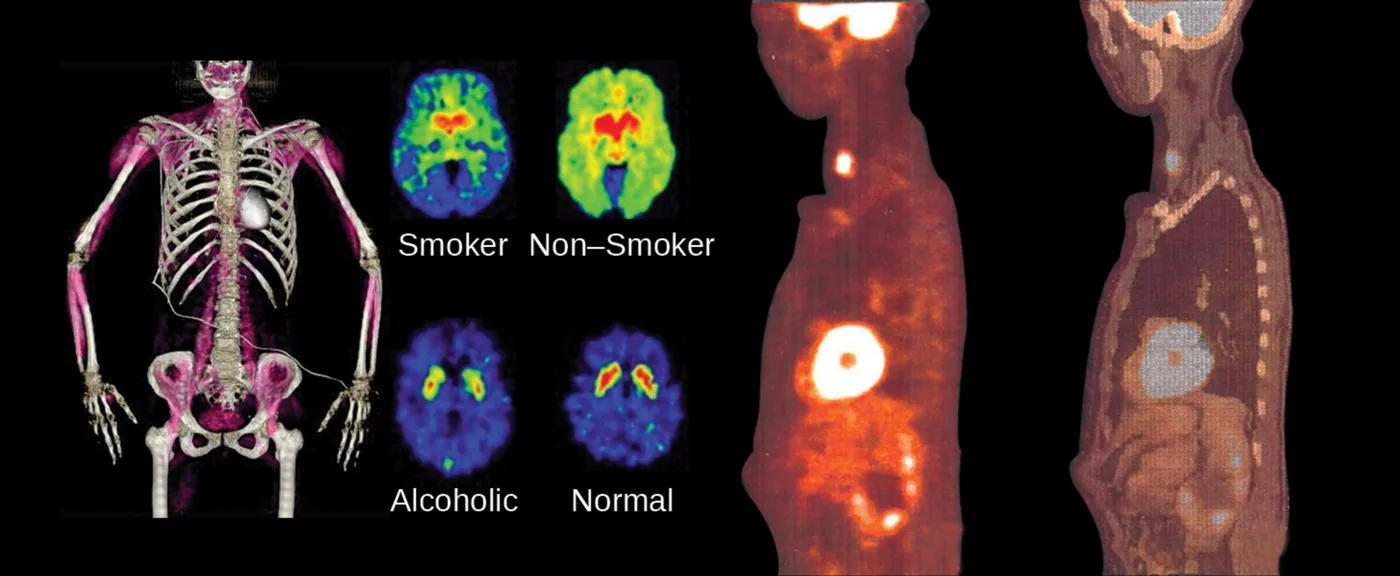
PET scans used in medicine: one shows muscle activity, two brain scans compare dopamine signaling in addicts and nonaddicts, and one shows cancer spread to lymph nodes. Image: OpenStax, Chemistry 2e, CC BY 4.0.
Nuclear structure and nucleons
 ⤢ Enlarge
Nuclear structure and nucleons
Nuclear chemistry is the study of reactions that involve changes in nuclear structure.
In ordinary chemical reactions the numbers of protons and neutrons in each nucleus stay the same
only the arrangement of electrons changes.
The field began with the discovery of radioactivity by Antoine Becquerel in 1896,
and today it supports technologies in energy, medicine, geology and many other areas.
The number of protons in a nucleus is the atomic number, symbol Z, and it identifies the element.
The mass number, symbol A, is the total number of protons and neutrons.
Atoms with the same atomic number but different mass numbers are isotopes of the same element.
1 / 3Next ▶
Nuclear structure and nucleons
1
A single type of nucleus is called a nuclide and is written as AZX
where X is the element symbol.
2
For example, the nuclide with 6 protons and 8 neutrons is written 146C and is called carbon-14.
3
Protons and neutrons are collectively called nucleons.
4
A nucleus has a radius of about 10−15 m
while the whole atom has a radius of about 10−10 mso the nucleus is very small compared with the atom.
5
Nuclei are extremely dense, averaging about 1.8×10¹⁴ g/cm3.
6
Iridium, one of the densest elements, has a density of only 22.6 g/cm3.
◀ Previous2 / 3Next ▶
Nuclear structure and nucleons
Nuclear structure and nucleons
If Earth had the average nuclear density, its radius would be only about 200 m instead of about 6.4×10⁶ m.
◀ Previous3 / 3
1Nuclear binding energy2Nuclear binding energy3Nuclear binding energy
Nuclear binding energy
Nuclear binding energy
Positively charged protons repel each other strongly at the very short distances inside a nucleus.
The force that holds nucleons together is the strong nuclear force.
It acts between protons, between neutrons, and between protons and neutrons.
Over distances less than 10−15 m inside the nucleus it is much stronger than the electrostatic repulsion between protons,
but over larger distances it is essentially zero.
It is one of the four fundamental forces, along with electromagnetism, gravity and the nuclear weak force.
Consider a helium-4 atom
which contains 2 protons, 2 neutrons and 2 electrons.
1 / 3Next ▶
Nuclear binding energy
1
The combined mass of these six particles is 4.0331 amu.
2
The measured mass of the atom is only 4.0026 amu.
3
The difference, 4.0331 amu − 4.0026 amu = 0.0305 amu, is the mass defect.
4
This “lost” mass is converted into energy as the atom forms.
5
The nuclear binding energy is the energy released when nucleons bind together,
and it is also the energy needed to break the nucleus into its separate protons and neutrons.
6
Nuclear binding energies are vastly larger than chemical bond energies.
◀ Previous2 / 3Next ▶
Nuclear binding energy
1
The link between mass and energy is given by Einstein’s mass-energy equivalence equation, E = mc2,
where E is energy in joules (J), m is the mass converted in kilograms (kg),and c is the speed of light in a vacuum, 2.998×10⁸ m/s.
2
A common energy unit for nuclei is the electron volt (eV)
where 1 eV = 1.602×10⁻¹⁹ J and 1 MeV = 106 eV.
3
The difference in scale is large.
4
The most energetic chemical reactions release thousands of kJ/mol
which corresponds to mass changes in the nanogram range (about 10−9 g).
5
Nuclear binding energies are typically billions of kJ/mol
which corresponds to mass changes in the milligram range (about 10−3 g).
6
This is why energy changes in nuclear reactions are so much greater than in chemical reactions,
and why mass changes in chemical reactions cannot be detected.
◀ Previous3 / 3
1Nuclear stability and the band of stability2Nuclear stability and the band of stability3Nuclear stability and the band of stability4Nuclear stability and the band of stability
Nuclear stability and the band of stability
Nuclear stability and the band of stability
A nucleus is stable if it cannot change into another configuration without energy being added from outside.
About 250 of the thousands of known nuclides are stable.
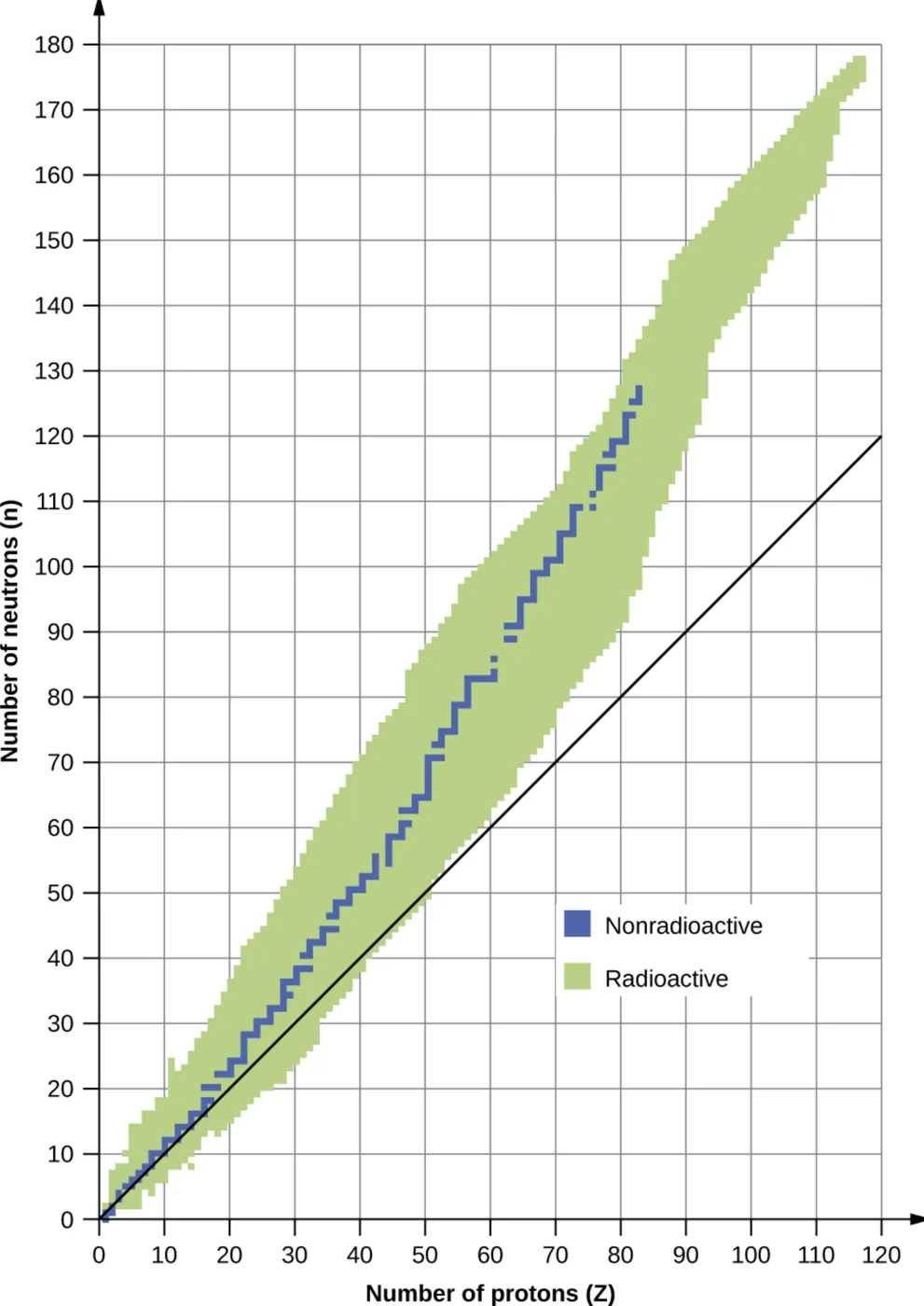
When the number of neutrons is plotted against the number of protons for stable nuclei, they fall into a narrow region called the band of stability (also called the belt, zone or valley of stability).
The straight line n = Z marks nuclei with a 1:1 ratio of neutrons to protons.
Light stable nuclei generally have equal numbers of protons and neutrons.
Nitrogen-14, for example, has 7 protons and 7 neutrons.
1 / 4Next ▶
A map of known nuclides by neutron and proton number. Stable nuclides lie in a narrow band, unstable ones lie on either side, and every isotope of an element with atomic number above 83 is unstable. Image: OpenStax, Chemistry 2e, CC BY 4.0.
Nuclear stability and the band of stability
 ⤢ Enlarge
1
Heavier stable nuclei have more neutrons than protons.
2
Iron-56 has 30 neutrons and 26 protons, an n:p ratio of 1.15.
The stable lead-207 has 125 neutrons and 82 protons, an n:p ratio of 1.52.Larger nuclei have more proton-proton repulsion,so they need extra neutrons to supply the additional strong nuclear attraction that holds the nucleus together.
3
Nuclei to the left or right of the band of stability are unstable and radioactive.
4
They change spontaneously by decay into nuclei that lie in the band or closer to it.
5
Each decay converts one unstable isotope, called a radioisotope, into a more stable one.
6
The types and products of radioactive decay are described in the following sections of this chapter.
◀ Previous2 / 4Next ▶
Nuclear stability and the band of stability
Nuclear stability and the band of stability
Several patterns link structure to stability. Nuclei with an even number of protons, neutrons, or both are more likely to be stable, as Table 21.1 shows.
Nuclei with magic numbers of nucleons are especially stable.
The magic numbers are 2, 8, 20, 28, 50, 82 and 126.
They fill complete nuclear shells, in a way similar to the stable electron shells of the noble gases.
A nucleus with a magic number of both protons and neutrons is called doubly magic and is particularly stable.
Examples are helium-4, oxygen-16, calcium-40 and lead-208.
These trends can be explained with a quantum mechanical model of nuclear energy states, which is beyond the scope of this chapter.
The relative stability of a nucleus is linked to its binding energy per nucleon
which is the total binding energy divided by the number of nucleons.
| Proton number | Neutron number | Number of stable isotopes |
|---|---|---|
| Even | Even | 157 |
| Even | Odd | 53 |
| Odd | Even | 50 |
| Odd | Odd | 5 |
◀ Previous3 / 4Next ▶
A graph of binding energy per nucleon against mass number. The curve rises, peaks near mass number 56 and then falls slowly for heavier nuclides. Image: OpenStax, Chemistry 2e, CC BY 4.0.
Nuclear stability and the band of stability
 ⤢ Enlarge
Nuclear stability and the band of stability
For helium-4, the binding energy is 28.4 MeV
so the binding energy per nucleon is 28.4 MeV ÷ 4 = 7.1 MeV.
Plotted against mass number, the binding energy per nucleon is largest for nuclides with mass number near 56,
which is why iron-56 is among the most stable nuclides.
This curve is shown in the figure below.
◀ Previous4 / 4
1Example 21.1: Density of a neutron star2Example 21.1: Density of a neutron star3Example 21.2: Nuclear binding energy of helium-44Example 21.2: Nuclear binding energy of helium-45Example 21.3: Binding energy per nucleon of iron-566Example 21.3: Binding energy per nucleon of iron-567Binding energy per nucleon of fluorine-19
Example 21.1: Density of a neutron star
1
A neutron star has a mass of 2.4 solar masses (1 solar mass = 1.99×1030 kg) and a diameter of 26 km.
2
Find its density and compare it with the density of a uranium-235 nucleus
which has a diameter of 15 fm (1 fm = 10−15 m).
3
Treat both as spheres, with density ρ = m/V and V = (4⁄3)πr3
where ρ is in kg/m3, m is in kg, V is in m3 and r is in m.
4
(a) Mass = 2.4 × 1.99×1030 kg = 4.78×1030 kg. Radius = 13 km = 1.30×10⁴ m. Volume = (4⁄3)π(1.30×10⁴ m)3 = 9.20×10¹² m3. Density = 4.78×1030 kg ÷ 9.20×10¹² m3 = 5.19×10¹⁷ kg/m3.
5
(b) Radius = 7.5 fm = 7.5×10⁻¹⁵ m. Volume = (4⁄3)π(7.5×10⁻¹⁵ m)3 = 1.77×10−42 m3. Mass = 235 × 1.66×10−27 kg = 3.90×10⁻²⁵ kg. Density = 3.90×10⁻²⁵ kg ÷ 1.77×10−42 m3 = 2.21×10¹⁷ kg/m3.
6
The two densities are of the same order of magnitude
but the neutron star is about 2.4 times as dense as the uranium nucleusso it is more than twice as dense.
1 / 7Next ▶
Example 21.1: Density of a neutron star
Example 21.1: Density of a neutron star
Check Your Learning: a neutron star with mass 1.97 solar masses and diameter 13 km, compared with a hydrogen nucleus of diameter 1.75 fm. Answer: the neutron star has a density of 3.4×10¹⁸ kg/m3. The hydrogen nucleus has a density of 6.0×10¹⁷ kg/m3
so the neutron star is about 5.7 times denser.
◀ Previous2 / 7Next ▶
Example 21.2: Nuclear binding energy of helium-4
Example 21.2: Nuclear binding energy of helium-4
Find the binding energy of helium-4 (mass defect 0.0305 amu) in (a) J/mol of nuclei, (b) J per nucleus and (c) MeV per nucleus. Because 1 amu corresponds to 1 g/mol numerically, a mass defect of 0.0305 amu is a mass defect of 0.0305 g/mol = 3.05×10⁻⁵ kg/mol.
(a) E = mc2 = (3.05×10⁻⁵ kg/mol)(2.998×108 m/s)2 = 2.74×10¹² J/mol. This is a very large amount of energy for only about 30 mg of matter.
What the symbols mean:
E = energy (J) · m or Δm = mass (change) (kg) · c = 3.00 × 10
8
m s
◀ Previous3 / 7Next ▶
Example 21.2: Nuclear binding energy of helium-4
1
−1
2
(b) Energy per nucleus = 2.74×10¹² J/mol ÷ 6.022×10²³ nuclei/mol = 4.55×10⁻¹² J per nucleus.
3
(c) Energy in MeV = 4.55×10⁻¹² J ÷ 1.602×10⁻¹³ J/MeV = 28.4 MeV per nucleus.
4
Check Your Learning: the nuclide fluorine-19 has an atomic mass of 18.9984 amu. Find its binding energy in MeV per nucleus. Working: 9 protons + 10 neutrons + 9 electrons = 19.1571 amu
so the mass defect is 19.1571 − 18.9984 = 0.1587 amu. Using 1 amu = 931.5 MeV, the binding energy is about 148 MeV per nucleus.
◀ Previous4 / 7Next ▶
Example 21.3: Binding energy per nucleon of iron-56
Example 21.3: Binding energy per nucleon of iron-56
1
Iron-56 has an atomic mass of 55.9349 amu. Find its binding energy per nucleon in MeV.
2
Step 1: The atom contains 26 protons, 30 neutrons and 26 electrons,
so the combined mass is 26(1.00728) + 30(1.00867) + 26(0.00055) = 56.4634 amu.
The mass defect is 56.4634 amu − 55.9349 amu = 0.5285 amu.
◀ Previous5 / 7Next ▶
Example 21.3: Binding energy per nucleon of iron-56
1
3
2
Step 2: Binding energy = 0.5285 amu × 931.5 MeV/amu = 492 MeV per nucleus.
3
4
4
Step 3: Binding energy per nucleon = 492 MeV ÷ 56 nucleons = 8.79 MeV per nucleon.
5
This is one of the largest values on the curve
which matches the stability of iron-56.
◀ Previous6 / 7Next ▶
Binding energy per nucleon of fluorine-19
1
Problem. Find the binding energy per nucleon of fluorine-19
which has an atomic mass of 18.9984 amu.
2
Solution. Fluorine-19 has 9 protons, 10 neutrons and 9 electrons
so the combined mass of its particles is 9(1.00728) + 10(1.00867) + 9(0.00055) = 19.1572 amu.
3
The mass defect is 19.1572 amu − 18.9984 amu = 0.1588 amu.
4
The binding energy is 0.1588 amu × 931.5 MeV/amu ≈ 148 MeV per nucleus.
5
Dividing by the 19 nucleons gives 148 MeV ÷ 19 ≈ 7.8 MeV per nucleon.
6
This is the same process as the iron-56 example, with the extra step of dividing the total binding energy by the number of nucleons.
◀ Previous7 / 7
Key terms
| Term | Meaning |
|---|---|
| Nuclear chemistry | The study of reactions that change the structure of nuclei. |
| Atomic number (Z) | The number of protons in a nucleus, which identifies the element. |
| Mass number (A) | The sum of the protons and neutrons in a nucleus. |
| Nuclide | A single type of nucleus, identified by its element, mass number and atomic number. |
| Isotopes | Atoms of the same element with the same atomic number but different mass numbers. |
| Nucleons | The protons and neutrons that make up a nucleus. |
| Strong nuclear force | The attractive force that holds nucleons together inside the nucleus and acts only over very short distances. |
| Mass defect | The difference between the sum of the masses of an atom’s separate particles and the measured mass of the atom. |
| Nuclear binding energy | The energy released when nucleons bind together, which is also the energy needed to break a nucleus apart. |
| Mass-energy equivalence | The relationship E = mc2, which links the energy released to the mass converted into energy. |
| Electron volt (eV) | An energy unit equal to 1.602×10⁻¹⁹ J, the energy gained by one electron crossing a potential difference of 1 volt. |
| Binding energy per nucleon | The total binding energy of a nucleus divided by its number of nucleons. |
| Band of stability | The narrow region on a neutron-versus-proton plot where stable nuclides are found. |
| n:p ratio | The ratio of the number of neutrons to the number of protons in a nucleus. |
| Radioisotope | An unstable isotope that decays spontaneously into a more stable nucleus. |
| Magic numbers | The nucleon numbers 2, 8, 20, 28, 50, 82 and 126, which give extra nuclear stability. |
| Doubly magic nucleus | A nucleus with a magic number of both protons and neutrons, which is particularly stable. |
1Avoid these mistakes2Avoid these mistakes3Avoid these mistakes
Avoid these mistakes
1Avoid this
Confusing the atomic number (protons) with the mass number (protons plus neutrons). The mass number of carbon-14 is 14, not 6.Avoid this
2Avoid this
Saying the mass defect is a mass that disappears in chemical reactions.Avoid this
Mass changes in ordinary chemical reactions are too small to detect; the mass defect matters mainly for nuclei.Avoid this
3Avoid this
1 / 3Next ▶
Avoid these mistakes
Using the wrong units in the mass-energy equation. Mass must be in kg and c in m/s before E is found in joules.Avoid this
4Avoid this
Forgetting that 1 amu is equal to 931.5 MeV when converting a mass defect directly to MeV.Avoid this
5Avoid this
Dividing the total binding energy by the number of protons only. Binding energy per nucleon divides by all nucleons, protons plus neutrons.Avoid this
6Avoid this
◀ Previous2 / 3Next ▶
Avoid these mistakes
Assuming every stable nucleus has a 1:1 neutron-to-proton ratio.Avoid this
Heavier stable nuclei need more neutrons than protons, for example lead-207 has an n:p ratio of 1.52.Avoid this
◀ Previous3 / 3