Curriculum
Chemistry 2e
Unit 1: Essential Ideas
0/14
Unit 2: Atoms, Molecules, and Ions
0/16
Unit 3: Composition of Substances and Solutions
0/10
Unit 4: Stoichiometry of Chemical Reactions
0/12
Unit 5: Thermochemistry
0/8
Unit 6: Electronic Structure and Periodic Properties of Elements
0/12
Unit 7: Chemical Bonding and Molecular Geometry
0/14
Unit 8: Advanced Theories of Covalent Bonding
0/10
Unit 9: Gases
0/23
Unit 10: Liquids and Solids
0/28
Unit 11: Solutions and Colloids
0/24
Unit 12: Kinetics
0/32
-
Unit 12 overview: Kinetics
 Preview
-
12.1 Chemical Reaction Rates
Preview
-
12.1 Chemical Reaction Rates - Check yourself
 Preview
-
Unit 12 overview: Kinetics
Preview
-
12.1 Chemical Reaction Rates
Preview
-
12.1 Chemical Reaction Rates - Check yourself
Preview
-
12.2 Factors Affecting Reaction Rates
Preview
-
12.2 Factors Affecting Reaction Rates - Check yourself
Preview
-
12.2 Factors Affecting Reaction Rates
Preview
-
12.2 Factors Affecting Reaction Rates - Check yourself
Preview
-
12.3 Rate Laws
Preview
-
12.3 Rate Laws - Check yourself
Preview
-
12.3 Rate Laws
Preview
-
12.3 Rate Laws - Check yourself
Preview
-
12.4 Integrated Rate Laws
Preview
-
12.4 Integrated Rate Laws - Check yourself
Preview
-
12.4 Integrated Rate Laws
Preview
-
12.4 Integrated Rate Laws - Check yourself
Preview
-
12.5 Collision Theory
Preview
-
12.5 Collision Theory - Check yourself
Preview
-
12.5 Collision Theory
Preview
-
Unit 12 review quiz: Kinetics
Preview
-
12.5 Collision Theory - Check yourself
Preview
-
12.6 Reaction Mechanisms
Preview
-
12.6 Reaction Mechanisms - Check yourself
Preview
-
12.6 Reaction Mechanisms
Preview
-
12.6 Reaction Mechanisms - Check yourself
Preview
-
12.7 Catalysis
Preview
-
12.7 Catalysis - Check yourself
Preview
-
12.7 Catalysis
Preview
-
12.7 Catalysis - Check yourself
Preview
-
Unit 12 review quiz: Kinetics
Preview
Unit 13: Fundamental Equilibrium Concepts
0/20
Unit 14: Acid-Base Equilibria
0/32
Unit 15: Equilibria of Other Reaction Classes
0/16
Unit 16: Thermodynamics
0/20
Unit 17: Electrochemistry
0/32
Unit 18: Representative Metals, Metalloids, and Nonmetals
0/52
Unit 19: Transition Metals and Coordination Chemistry
0/16
Unit 20: Organic Chemistry
0/20
Unit 21: Nuclear Chemistry
0/28
Text lesson
12.3 Rate Laws
12.3 Rate Laws — CHEMISTRY notes: You will be able to write a rate law from reaction orders, find the orders and the rate constant from initial-rate data, and state the units of k for any overall order.
Learning objectives
Learning objectives
Explain the form and function of a rate law.
Use rate laws to calculate reaction rates.
Use rate and concentration data to identify reaction orders and derive rate laws.
Hydrogen peroxide in wounds and the role of catalysts
1
Hydrogen peroxide decomposes into water and oxygen gas.
2
In a clean bottle this decomposition is slow
but on an open wound it bubbles very vigorously.
3
The reason is that substances in the exposed tissue accelerate the decomposition.
4
A substance that increases the rate of a reaction is called a catalyst, and catalysts are treated in more detail later in this chapter.
Link to learning
Link to learning
Chemical reactions happen when molecules collide and transform. Before running an experiment, scientists can use molecular modeling simulations to predict how factors such as temperature, concentration and the nature of the reactants will change a reaction rate. An online PhET simulation called Reactions and Rates lets you vary these factors yourself and watch the effect on the rate.
1Rate laws and reaction orders2Rate laws and reaction orders3rate · [A] · k4m5m
Zero order reactants
Zero order reactants
When the order with respect to a reactant is zero, its concentration has no effect on the rate.
Because any number raised to the power zero equals 1, the term [A]0 is equal to 1 and can be left out of the rate law.
Reactions can be zero order in one reactant even though that reactant takes part in the reaction
the reaction mechanism, covered in a later section, explains why.
Method of initial rates
Method of initial rates
The method of initial rates is the most common experimental way to find a rate law.
It involves measuring the initial reaction rate in several trials that use different starting concentrations of the reactants.
Comparing the rates of these trials gives the reaction orders.
Once the orders are known, the rate constant can be calculated from any one trial,
and the orders and rate constant together give the complete rate law.
To find the order with respect to one reactant, compare two trials in which only that reactant’s concentration changes. If the concentration of a reactant doubles and the rate doubles, the order is 1. If the rate quadruples, the order is 2. If the rate is unchanged, the order is 0. In general, for a reactant with order m, the ratio of two rates equals the ratio of two concentrations raised to the power m.
Reaction order and rate constant units
1
The unit of the rate constant changes with the overall order of the reaction
so that the units of the rate law work out to mol L−1 s−1.
2
For an overall order x, the unit of k is Lx−1 mol1−x s−1.
3
This is derived from the rate law by dimensional analysis.
4
Table 12.1 summarizes the units for common overall orders.
5
These units assume concentrations in mol/L and time in seconds. Any other valid units for concentration and time give the same pattern with different symbols.
| Overall reaction order (x) | Rate constant unit (Lx−1 mol1−x s−1) |
|---|---|
| 0 (zero) | mol L−1 s−1 |
| 1 (first) | s−1 |
| 2 (second) | L mol−1 s−1 |
| 3 (third) | L2 mol−2 s−1 |
1Example 12.3: Writing a rate law from reaction orders2Example 12.3: Writing a rate law from reaction orders3Example 12.4: Determining a rate law from initial rates4Example 12.4: Determining a rate law from initial rates5Find m.6Find n.7Find k.8Find k.9Example 12.5: Determining rate laws with an explicit algebra10Example 12.5: Determining rate laws with an explicit algebra11Example 12.5: Determining rate laws with an explicit algebra
Example 12.3: Writing a rate law from reaction orders
1
Problem. At 100 °C, the reaction of nitrogen dioxide with carbon monoxide, NO2 + CO → NO + CO2, is second order in NO2 and zero order in CO. What is the rate law?
2
Solution. The general form is rate = k[NO2]m[CO]n.
3
Here m = 2 and n = 0
so rate = k[NO2]2[CO]0.
4
Since [CO]0 = 1, the CO term is omitted and the rate law is rate = k[NO2]2.
5
The rate depends only on the NO2 concentration.
6
Check Your Learning. The rate law for the reaction 2NO + 2H2 → N2 + 2H2O is rate = k[NO]2[H2]. What are the orders with respect to each reactant, and what is the overall order?
1 / 11Next ▶
Example 12.3: Writing a rate law from reaction orders
Example 12.3: Writing a rate law from reaction orders
Answer. Order in NO = 2
order in H2 = 1overall order = 3.
Check Your Learning. In a transesterification reaction, methanol (CH3OH) reacts with ethyl acetate (CH3CH2OCOCH3). Under certain conditions the rate law is found to be rate = k[CH3OH]1[CH3CH2OCOCH3]0. What are the orders with respect to each reactant, and the overall order?
Answer. Order in CH3OH = 1
order in ethyl acetate = 0overall order = 1.
◀ Previous2 / 11Next ▶
Example 12.4: Determining a rate law from initial rates
1
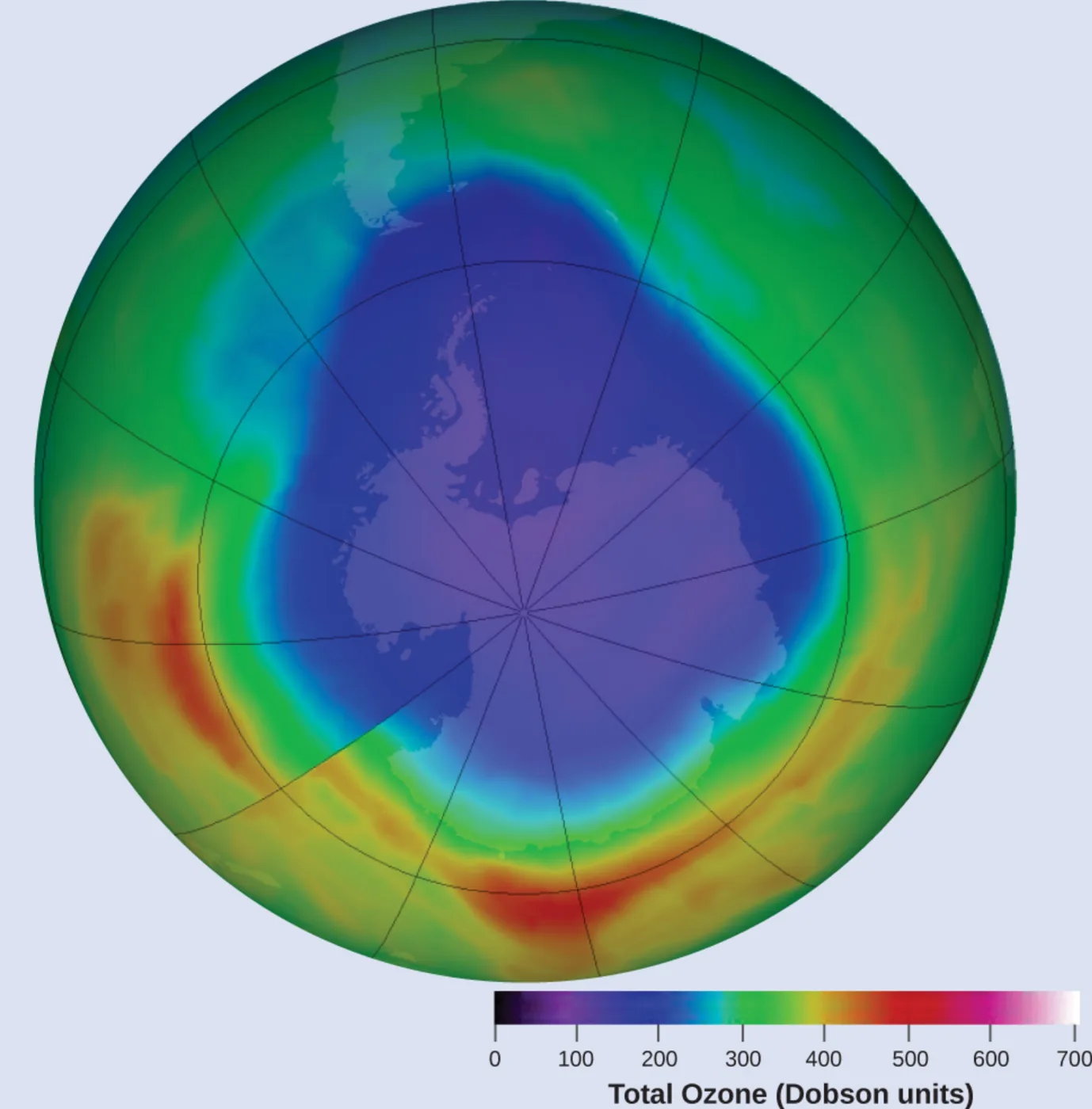
Problem. Ozone in the upper atmosphere is destroyed when it reacts with nitrogen oxides, and the rates of these reactions help explain the ozone hole over Antarctica.
2
One such reaction is the combination of nitric oxide, NO, with ozone, O3, to give NO2 and O2: NO + O3 → NO2 + O2.
3
At 25 °C, the following initial rate data were measured.
4
Determine the rate law and the rate constant at 25 °C.
◀ Previous3 / 11Next ▶
A contour map of stratospheric ozone, with the low-ozone ozone hole that forms over Antarctica in spring. Image: OpenStax, Chemistry 2e, CC BY 4.0.
Example 12.4: Determining a rate law from initial rates
 ⤢ Enlarge
Example 12.4: Determining a rate law from initial rates
Solution. The rate law has the form rate = k[NO]m[O3]n. Find m, n and k in three steps.
| Trial | [NO] (mol/L) | [O3] (mol/L) | Initial rate (mol/L/s) |
|---|---|---|---|
| 1 | 1.00 × 10⁻⁶ | 3.00 × 10⁻⁶ | 6.60 × 10⁻⁵ |
| 2 | 1.00 × 10⁻⁶ | 6.00 × 10⁻⁶ | 1.32 × 10⁻⁴ |
| 3 | 1.00 × 10⁻⁶ | 9.00 × 10⁻⁶ | 1.98 × 10⁻⁴ |
| 4 | 2.00 × 10⁻⁶ | 9.00 × 10⁻⁶ | 3.96 × 10⁻⁴ |
| 5 | 3.00 × 10⁻⁶ | 9.00 × 10⁻⁶ | 5.94 × 10⁻⁴ |
◀ Previous4 / 11Next ▶
Find m.
Find m.
In trials 3 to 5, [O3] is constant and [NO] changes.
When [NO] doubles from trial 3 to trial 4, the rate doubles.
When [NO] triples from trial 3 to trial 5, the rate triples.
The rate is directly proportional to [NO]
so m = 1.
◀ Previous5 / 11Next ▶
Find n.
1
In trials 1 to 3, [NO] is constant and [O3] changes.
2
When [O3] doubles from trial 1 to trial 2, the rate doubles.
3
When [O3] triples from trial 1 to trial 3, the rate triples.
4
The rate is directly proportional to [O3]
so n = 1.
◀ Previous6 / 11Next ▶
Find k.
1
The rate law is rate = k[NO][O3].
2
Using trial 1: k = (6.60 × 10⁻⁵ mol L−1 s−1) / [(1.00 × 10⁻⁶ mol L−1)(3.00 × 10⁻⁶ mol L−1)] = 2.20 × 10⁷ L mol−1 s−1.
3
Trial 2 gives the same value: 1.32 × 10⁻⁴ / (1.00 × 10−6 × 6.00 × 10−6) = 2.20 × 10⁷.
4
The reaction is first order in NO and first order in O3
so its overall order is 2 and the rate law is rate = k[NO][O3] with k = 2.20 × 10⁷ L mol−1 s−1 at 25 °C.
5
Check Your Learning. Acetaldehyde decomposes on heating to give methane and carbon monoxide, CH3CHO → CH4 + CO. Determine the rate law and the rate constant from these data.
6
Answer. Doubling the concentration from trial 1 to trial 2 multiplies the rate by 4
so the reaction is second order.
| Trial | [CH3CHO] (mol/L) | Initial rate (mol/L/s) |
|---|---|---|
| 1 | 1.75 × 10⁻³ | 2.06 × 10⁻¹¹ |
| 2 | 3.50 × 10⁻³ | 8.24 × 10⁻¹¹ |
| 3 | 7.00 × 10⁻³ | 3.30 × 10⁻¹⁰ |
◀ Previous7 / 11Next ▶
Find k.
Find k.
The rate law is rate = k[CH3CHO]2 with k = 6.73 × 10⁻⁶ L mol−1 s−1.
Check with trial 1: k = 2.06 × 10⁻¹¹ / (1.75 × 10⁻³)2 = 6.73 × 10⁻⁶.
◀ Previous8 / 11Next ▶
Example 12.5: Determining rate laws with an explicit algebraic method
1
Problem. Use the initial rates for the reaction between nitric oxide (NO) and chlorine (Cl2) to find the rate law and the rate constant.
2
Solution. The rate law has the form rate = k[NO]m[Cl2]n. Write the rate ratios for two trials and cancel the terms that do not change.
3
Use trials 3 and 1, in which [Cl2] is constant: 0.00675 / 0.00300 = (0.15 / 0.10)m
which gives 2.25 = 1.5m.
4
Taking logarithms, m = log 2.25 / log 1.5 = 2.00
so m = 2.
5
Use trials 2 and 1, in which [NO] is constant: 0.00450 / 0.00300 = (0.15 / 0.10)
6
n
| Trial | [NO] (mol/L) | [Cl2] (mol/L) | Initial rate (mol/L/s) |
|---|---|---|---|
| 1 | 0.10 | 0.10 | 0.00300 |
| 2 | 0.10 | 0.15 | 0.00450 |
| 3 | 0.15 | 0.10 | 0.00675 |
◀ Previous9 / 11Next ▶
Example 12.5: Determining rate laws with an explicit algebraic method
Example 12.5: Determining rate laws with an explicit algebraic method
which gives 1.50 = 1.5
. So n = 1.
The rate law is rate = k[NO]2[Cl2].
From trial 1: k = 0.00300 mol L−1 s−1 / [(0.10 mol L−1)2(0.10 mol L−1)] = 3.00 L2 mol−2 s−1.
The units are correct because the overall order is 3.
Check Your Learning. The reaction of hypochlorite ion (OCl−) with iodide ion (I−) gives the initial rates below. Derive the rate law and the value of k with units.
| Trial | [OCl−] (mol/L) | [I−] (mol/L) | Initial rate (mol/L/s) |
|---|---|---|---|
| 1 | 0.0040 | 0.0020 | 0.00184 |
| 2 | 0.0020 | 0.0040 | 0.00092 |
| 3 | 0.0020 | 0.0020 | 0.00046 |
◀ Previous10 / 11Next ▶
Example 12.5: Determining rate laws with an explicit algebraic method
Example 12.5: Determining rate laws with an explicit algebraic method
Answer. The order in I− is 1
because doubling [I−] from trial 3 to trial 2 doubles the rate.
The order in OCl− is 2
because doubling [OCl−] from trial 3 to trial 1 multiplies the rate by 4. The rate law is rate = k[OCl−]2[I−].
Using trial 3: k = 0.00046 / [(0.0020)2(0.0020)] = 5.75 × 10⁴ L2 mol−2 s−1.
◀ Previous11 / 11
Check your understanding
Check your understanding
Before moving on, be sure you can state the general rate law for a reaction, find each order from the ratio of two trials, compute k from one trial, and give the unit of k for the overall order you found.
Key terms
| Term | Meaning |
|---|---|
| Rate law | A mathematical expression that relates the rate of a reaction to the concentrations of its reactants, also called a rate equation or differential rate law. |
| Rate constant (k) | The constant in a rate law that is specific to a reaction at a given temperature and does not depend on reactant concentrations. |
| Reaction order | The exponent of a reactant’s concentration in the rate law, which describes how the rate depends on that concentration. |
| Overall reaction order | The sum of the reaction orders for all reactants in the rate law. |
| Zero-order reaction | A reaction in which the rate does not change when the concentration of a particular reactant changes. |
| First-order reaction | A reaction whose rate is directly proportional to the concentration of one reactant raised to the first power. |
| Second-order reaction | A reaction whose rate depends on a reactant concentration squared, so doubling that concentration quadruples the rate. |
| Fractional order | A reaction order that is a fraction, such as one-half, which can occur in some experimentally determined rate laws. |
| Negative order | A reaction order below zero, meaning that increasing the concentration of that reactant decreases the rate. |
| Method of initial rates | An experimental method that measures the starting rate of a reaction in several trials with different starting concentrations, to find the orders and k. |
| Initial rate | The rate of a reaction measured at the start, before the reactant concentrations have changed much. |
| Catalyst | A substance that increases the rate of a reaction without being used up in it. |
1Avoid these mistakes2Avoid these mistakes3Avoid these mistakes