Curriculum
Chemistry 2e
Unit 1: Essential Ideas
0/14
-
Unit 1 overview: Essential Ideas
 Text lessonPreview
-
1.1 Chemistry in Context
Text lessonPreview
-
1.1 Chemistry in Context - Check yourself
 6 questionsPreview
-
1.2 Phases and Classification of Matter
Text lessonPreview
-
1.2 Phases and Classification of Matter - Check yourself
6 questionsPreview
-
1.3 Physical and Chemical Properties
Text lessonPreview
-
1.3 Physical and Chemical Properties - Check yourself
6 questionsPreview
-
1.4 Measurements
Text lessonPreview
-
1.4 Measurements - Check yourself
6 questionsPreview
-
1.5 Measurement Uncertainty, Accuracy, and Precision
Text lessonPreview
-
1.5 Measurement Uncertainty, Accuracy, and Precision - Check yourself
6 questionsPreview
-
1.6 Mathematical Treatment of Measurement Results
Text lessonPreview
-
1.6 Mathematical Treatment of Measurement Results - Check yourself
6 questionsPreview
-
Unit 1 review quiz: Essential Ideas
10 questionsPreview
Unit 2: Atoms, Molecules, and Ions
0/16
-
Unit 2 overview: Atoms, Molecules, and Ions
Text lessonPreview
-
2.1 Early Ideas in Atomic Theory
Text lessonPreview
-
2.1 Early Ideas in Atomic Theory - Check yourself
6 questionsPreview
-
2.2 Evolution of Atomic Theory
Text lessonPreview
-
2.2 Evolution of Atomic Theory - Check yourself
6 questionsPreview
-
2.3 Atomic Structure and Symbolism
Text lessonPreview
-
2.3 Atomic Structure and Symbolism - Check yourself
6 questionsPreview
-
2.4 Chemical Formulas
Text lessonPreview
-
2.4 Chemical Formulas - Check yourself
6 questionsPreview
-
2.5 The Periodic Table
Text lessonPreview
-
2.5 The Periodic Table - Check yourself
6 questionsPreview
-
2.6 Ionic and Molecular Compounds
Text lessonPreview
-
2.6 Ionic and Molecular Compounds - Check yourself
6 questionsPreview
-
2.7 Chemical Nomenclature
Text lessonPreview
-
2.7 Chemical Nomenclature - Check yourself
6 questionsPreview
-
Unit 2 review quiz: Atoms, Molecules, and Ions
10 questionsPreview
Unit 3: Composition of Substances and Solutions
0/10
-
Unit 3 overview: Composition of Substances and Solutions
Text lessonPreview
-
3.1 Formula Mass and the Mole Concept
Text lessonPreview
-
3.1 Formula Mass and the Mole Concept - Check yourself
6 questionsPreview
-
3.2 Determining Empirical and Molecular Formulas
Text lessonPreview
-
3.2 Determining Empirical and Molecular Formulas - Check yourself
6 questionsPreview
-
3.3 Molarity
Text lessonPreview
-
3.3 Molarity - Check yourself
6 questionsPreview
-
3.4 Other Units for Solution Concentrations
Text lessonPreview
-
3.4 Other Units for Solution Concentrations - Check yourself
6 questionsPreview
-
Unit 3 review quiz: Composition of Substances and Solutions
10 questionsPreview
Unit 4: Stoichiometry of Chemical Reactions
0/12
-
Unit 4 overview: Stoichiometry of Chemical Reactions
Text lessonPreview
-
4.1 Writing and Balancing Chemical Equations
Text lessonPreview
-
4.1 Writing and Balancing Chemical Equations - Check yourself
6 questionsPreview
-
4.2 Classifying Chemical Reactions
Text lessonPreview
-
4.2 Classifying Chemical Reactions - Check yourself
6 questionsPreview
-
4.3 Reaction Stoichiometry
Text lessonPreview
-
4.3 Reaction Stoichiometry - Check yourself
6 questionsPreview
-
4.4 Reaction Yields
Text lessonPreview
-
4.4 Reaction Yields - Check yourself
6 questionsPreview
-
4.5 Quantitative Chemical Analysis
Text lessonPreview
-
4.5 Quantitative Chemical Analysis - Check yourself
6 questionsPreview
-
Unit 4 review quiz: Stoichiometry of Chemical Reactions
10 questionsPreview
Unit 5: Thermochemistry
0/8
-
Unit 5 overview: Thermochemistry
Text lessonPreview
-
5.1 Energy Basics
Text lessonPreview
-
5.1 Energy Basics - Check yourself
6 questionsPreview
-
5.2 Calorimetry
Text lessonPreview
-
5.2 Calorimetry - Check yourself
7 questionsPreview
-
5.3 Enthalpy
Text lessonPreview
-
5.3 Enthalpy - Check yourself
6 questionsPreview
-
Unit 5 review quiz: Thermochemistry
10 questionsPreview
Unit 6: Electronic Structure and Periodic Properties of Elements
0/12
-
Unit 6 overview: Electronic Structure and Periodic Properties of Elements
Text lessonPreview
-
6.1 Electromagnetic Energy
Text lessonPreview
-
6.1 Electromagnetic Energy - Check yourself
6 questionsPreview
-
6.2 The Bohr Model
Text lessonPreview
-
6.2 The Bohr Model - Check yourself
6 questionsPreview
-
6.3 Development of Quantum Theory
Text lessonPreview
-
6.3 Development of Quantum Theory - Check yourself
6 questionsPreview
-
6.4 Electronic Structure of Atoms (Electron Configurations)
Text lessonPreview
-
6.4 Electronic Structure of Atoms (Electron Configurations) - Check yourself
6 questionsPreview
-
6.5 Periodic Variations in Element Properties
Text lessonPreview
-
6.5 Periodic Variations in Element Properties - Check yourself
6 questionsPreview
-
Unit 6 review quiz: Electronic Structure and Periodic Properties of Elements
10 questionsPreview
Unit 7: Chemical Bonding and Molecular Geometry
0/14
-
Unit 7 overview: Chemical Bonding and Molecular Geometry
Text lessonPreview
-
7.1 Ionic Bonding
Text lessonPreview
-
7.1 Ionic Bonding - Check yourself
6 questionsPreview
-
7.2 Covalent Bonding
Text lessonPreview
-
7.2 Covalent Bonding - Check yourself
6 questionsPreview
-
7.3 Lewis Symbols and Structures
Text lessonPreview
-
7.3 Lewis Symbols and Structures - Check yourself
6 questionsPreview
-
7.4 Formal Charges and Resonance
Text lessonPreview
-
7.4 Formal Charges and Resonance - Check yourself
6 questionsPreview
-
7.5 Strengths of Ionic and Covalent Bonds
Text lessonPreview
-
7.5 Strengths of Ionic and Covalent Bonds - Check yourself
6 questionsPreview
-
7.6 Molecular Structure and Polarity
Text lessonPreview
-
7.6 Molecular Structure and Polarity - Check yourself
6 questionsPreview
-
Unit 7 review quiz: Chemical Bonding and Molecular Geometry
10 questionsPreview
Unit 8: Advanced Theories of Covalent Bonding
0/10
-
Unit 8 overview: Advanced Theories of Covalent Bonding
Text lessonPreview
-
8.1 Valence Bond Theory
Text lessonPreview
-
8.1 Valence Bond Theory - Check yourself
6 questionsPreview
-
8.2 Hybrid Atomic Orbitals
Text lessonPreview
-
8.2 Hybrid Atomic Orbitals - Check yourself
6 questionsPreview
-
8.3 Multiple Bonds
Text lessonPreview
-
8.3 Multiple Bonds - Check yourself
6 questionsPreview
-
8.4 Molecular Orbital Theory
Text lessonPreview
-
8.4 Molecular Orbital Theory - Check yourself
6 questionsPreview
-
Unit 8 review quiz: Advanced Theories of Covalent Bonding
10 questionsPreview
Unit 9: Gases
0/23
-
Unit 9 overview: Gases
Text lessonPreview
-
9.1 Gas Pressure
Text lessonPreview
-
9.1 Gas Pressure - Check yourself
6 questionsPreview
-
9.2 Relating Pressure, Volume, Amount, and Temperature: The Ideal Gas Law
Text lessonPreview
-
9.2 Relating Pressure, Volume, Amount, and Temperature: The Ideal Gas Law - Check yourself
6 questionsPreview
-
9.3 Stoichiometry of Gaseous Substances, Mixtures, and Reactions
Text lessonPreview
-
9.3 Stoichiometry of Gaseous Substances, Mixtures, and Reactions - Check yourself
6 questionsPreview
-
9.3 Stoichiometry of Gaseous Substances, Mixtures, and Reactions
Text lessonPreview
-
9.3 Stoichiometry of Gaseous Substances, Mixtures, and Reactions - Check yourself
6 questionsPreview
-
9.4 Effusion and Diffusion of Gases
Text lessonPreview
-
9.4 Effusion and Diffusion of Gases - Check yourself
6 questionsPreview
-
9.4 Effusion and Diffusion of Gases
Text lessonPreview
-
9.4 Effusion and Diffusion of Gases - Check yourself
6 questionsPreview
-
Unit 9 review quiz: Gases
10 questionsPreview
-
9.5 The Kinetic-Molecular Theory
Text lessonPreview
-
9.5 The Kinetic-Molecular Theory - Check yourself
6 questionsPreview
-
9.5 The Kinetic-Molecular Theory
Text lessonPreview
-
9.5 The Kinetic-Molecular Theory - Check yourself
6 questionsPreview
-
9.6 Non-Ideal Gas Behavior
Text lessonPreview
-
9.6 Non-Ideal Gas Behavior - Check yourself
6 questionsPreview
-
9.6 Non-Ideal Gas Behavior
Text lessonPreview
-
9.6 Non-Ideal Gas Behavior - Check yourself
6 questionsPreview
-
Unit 9 review quiz: Gases
10 questionsPreview
Unit 10: Liquids and Solids
0/28
-
Unit 10 overview: Liquids and Solids
Text lessonPreview
-
10.1 Intermolecular Forces
Text lessonPreview
-
Unit 10 overview: Liquids and Solids
Text lessonPreview
-
10.1 Intermolecular Forces
Text lessonPreview
-
10.1 Intermolecular Forces - Check yourself
6 questionsPreview
-
10.1 Intermolecular Forces - Check yourself
6 questionsPreview
-
10.2 Properties of Liquids
Text lessonPreview
-
10.2 Properties of Liquids - Check yourself
6 questionsPreview
-
10.2 Properties of Liquids
Text lessonPreview
-
10.2 Properties of Liquids - Check yourself
6 questionsPreview
-
10.3 Phase Transitions
Text lessonPreview
-
10.3 Phase Transitions - Check yourself
6 questionsPreview
-
10.3 Phase Transitions
Text lessonPreview
-
10.3 Phase Transitions - Check yourself
6 questionsPreview
-
10.4 Phase Diagrams
Text lessonPreview
-
10.4 Phase Diagrams
Text lessonPreview
-
10.4 Phase Diagrams - Check yourself
6 questionsPreview
-
10.4 Phase Diagrams - Check yourself
6 questionsPreview
-
10.5 The Solid State of Matter
Text lessonPreview
-
10.5 The Solid State of Matter
Text lessonPreview
-
10.5 The Solid State of Matter - Check yourself
6 questionsPreview
-
10.5 The Solid State of Matter - Check yourself
6 questionsPreview
-
10.6 Lattice Structures in Crystalline Solids
Text lessonPreview
-
10.6 Lattice Structures in Crystalline Solids
Text lessonPreview
-
10.6 Lattice Structures in Crystalline Solids - Check yourself
6 questionsPreview
-
10.6 Lattice Structures in Crystalline Solids - Check yourself
6 questionsPreview
-
Unit 10 review quiz: Liquids and Solids
10 questionsPreview
-
Unit 10 review quiz: Liquids and Solids
10 questionsPreview
Unit 11: Solutions and Colloids
0/24
-
Unit 11 overview: Solutions and Colloids
Text lessonPreview
-
11.1 The Dissolution Process
Text lessonPreview
-
Unit 11 overview: Solutions and Colloids
Text lessonPreview
-
11.1 The Dissolution Process
Text lessonPreview
-
11.1 The Dissolution Process - Check yourself
6 questionsPreview
-
11.1 The Dissolution Process - Check yourself
6 questionsPreview
-
11.2 Electrolytes
Text lessonPreview
-
11.2 Electrolytes - Check yourself
6 questionsPreview
-
11.2 Electrolytes
Text lessonPreview
-
11.2 Electrolytes - Check yourself
6 questionsPreview
-
11.3 Solubility
Text lessonPreview
-
11.3 Solubility - Check yourself
6 questionsPreview
-
11.3 Solubility
Text lessonPreview
-
11.3 Solubility - Check yourself
6 questionsPreview
-
11.4 Colligative Properties
Text lessonPreview
-
11.4 Colligative Properties - Check yourself
6 questionsPreview
-
11.4 Colligative Properties
Text lessonPreview
-
11.4 Colligative Properties - Check yourself
6 questionsPreview
-
11.5 Colloids
Text lessonPreview
-
11.5 Colloids - Check yourself
6 questionsPreview
-
11.5 Colloids
Text lessonPreview
-
11.5 Colloids - Check yourself
6 questionsPreview
-
Unit 11 review quiz: Solutions and Colloids
10 questionsPreview
-
Unit 11 review quiz: Solutions and Colloids
10 questionsPreview
Unit 12: Kinetics
0/32
-
Unit 12 overview: Kinetics
Text lessonPreview
-
12.1 Chemical Reaction Rates
Text lessonPreview
-
12.1 Chemical Reaction Rates - Check yourself
6 questionsPreview
-
Unit 12 overview: Kinetics
Text lessonPreview
-
12.1 Chemical Reaction Rates
Text lessonPreview
-
12.1 Chemical Reaction Rates - Check yourself
6 questionsPreview
-
12.2 Factors Affecting Reaction Rates
Text lessonPreview
-
12.2 Factors Affecting Reaction Rates - Check yourself
6 questionsPreview
-
12.2 Factors Affecting Reaction Rates
Text lessonPreview
-
12.2 Factors Affecting Reaction Rates - Check yourself
6 questionsPreview
-
12.3 Rate Laws
Text lessonPreview
-
12.3 Rate Laws - Check yourself
6 questionsPreview
-
12.3 Rate Laws
Text lessonPreview
-
12.3 Rate Laws - Check yourself
6 questionsPreview
-
12.4 Integrated Rate Laws
Text lessonPreview
-
12.4 Integrated Rate Laws - Check yourself
6 questionsPreview
-
12.4 Integrated Rate Laws
Text lessonPreview
-
12.4 Integrated Rate Laws - Check yourself
6 questionsPreview
-
12.5 Collision Theory
Text lessonPreview
-
12.5 Collision Theory - Check yourself
6 questionsPreview
-
12.5 Collision Theory
Text lessonPreview
-
Unit 12 review quiz: Kinetics
10 questionsPreview
-
12.5 Collision Theory - Check yourself
6 questionsPreview
-
12.6 Reaction Mechanisms
Text lessonPreview
-
12.6 Reaction Mechanisms - Check yourself
6 questionsPreview
-
12.6 Reaction Mechanisms
Text lessonPreview
-
12.6 Reaction Mechanisms - Check yourself
6 questionsPreview
-
12.7 Catalysis
Text lessonPreview
-
12.7 Catalysis - Check yourself
6 questionsPreview
-
12.7 Catalysis
Text lessonPreview
-
12.7 Catalysis - Check yourself
6 questionsPreview
-
Unit 12 review quiz: Kinetics
10 questionsPreview
Unit 13: Fundamental Equilibrium Concepts
0/20
-
Unit 13 overview: Fundamental Equilibrium Concepts
Text lessonPreview
-
13.1 Chemical Equilibria
Text lessonPreview
-
13.1 Chemical Equilibria - Check yourself
6 questionsPreview
-
13.1 Chemical Equilibria
Text lessonPreview
-
13.1 Chemical Equilibria - Check yourself
6 questionsPreview
-
13.2 Equilibrium Constants
Text lessonPreview
-
13.2 Equilibrium Constants - Check yourself
6 questionsPreview
-
13.2 Equilibrium Constants
Text lessonPreview
-
Unit 13 overview: Fundamental Equilibrium Concepts
Text lessonPreview
-
13.2 Equilibrium Constants - Check yourself
6 questionsPreview
-
13.3 Shifting Equilibria: Le Châtelier’s Principle
Text lessonPreview
-
13.3 Shifting Equilibria: Le Châtelier’s Principle - Check yourself
6 questionsPreview
-
13.3 Shifting Equilibria: Le Châtelier’s Principle
Text lessonPreview
-
Unit 13 review quiz: Fundamental Equilibrium Concepts
10 questionsPreview
-
13.3 Shifting Equilibria: Le Châtelier’s Principle - Check yourself
6 questionsPreview
-
13.4 Equilibrium Calculations
Text lessonPreview
-
13.4 Equilibrium Calculations - Check yourself
6 questionsPreview
-
13.4 Equilibrium Calculations
Text lessonPreview
-
13.4 Equilibrium Calculations - Check yourself
6 questionsPreview
-
Unit 13 review quiz: Fundamental Equilibrium Concepts
10 questionsPreview
Unit 14: Acid-Base Equilibria
0/32
-
Unit 14 overview: Acid-Base Equilibria
Text lessonPreview
-
14.1 Brønsted-Lowry Acids and Bases
Text lessonPreview
-
14.1 Brønsted-Lowry Acids and Bases - Check yourself
6 questionsPreview
-
14.1 Brønsted-Lowry Acids and Bases
Text lessonPreview
-
14.1 Brønsted-Lowry Acids and Bases - Check yourself
6 questionsPreview
-
14.2 pH and pOH
Text lessonPreview
-
14.2 pH and pOH - Check yourself
6 questionsPreview
-
14.2 pH and pOH
Text lessonPreview
-
14.2 pH and pOH - Check yourself
6 questionsPreview
-
14.3 Relative Strengths of Acids and Bases
Text lessonPreview
-
14.3 Relative Strengths of Acids and Bases - Check yourself
6 questionsPreview
-
14.3 Relative Strengths of Acids and Bases
Text lessonPreview
-
14.3 Relative Strengths of Acids and Bases - Check yourself
6 questionsPreview
-
14.4 Hydrolysis of Salts
Text lessonPreview
-
14.4 Hydrolysis of Salts - Check yourself
6 questionsPreview
-
Unit 14 review quiz: Acid-Base Equilibria
10 questionsPreview
-
Unit 14 overview: Acid-Base Equilibria
Text lessonPreview
-
14.4 Hydrolysis of Salts
Text lessonPreview
-
14.4 Hydrolysis of Salts - Check yourself
6 questionsPreview
-
14.5 Polyprotic Acids
Text lessonPreview
-
14.5 Polyprotic Acids - Check yourself
6 questionsPreview
-
14.5 Polyprotic Acids
Text lessonPreview
-
14.5 Polyprotic Acids - Check yourself
6 questionsPreview
-
14.6 Buffers
Text lessonPreview
-
14.6 Buffers - Check yourself
6 questionsPreview
-
14.6 Buffers
Text lessonPreview
-
14.6 Buffers - Check yourself
6 questionsPreview
-
14.7 Acid-Base Titrations
Text lessonPreview
-
14.7 Acid-Base Titrations - Check yourself
6 questionsPreview
-
14.7 Acid-Base Titrations
Text lessonPreview
-
14.7 Acid-Base Titrations - Check yourself
6 questionsPreview
-
Unit 14 review quiz: Acid-Base Equilibria
10 questionsPreview
Unit 15: Equilibria of Other Reaction Classes
0/16
-
Unit 15 overview: Equilibria of Other Reaction Classes
Text lessonPreview
-
15.1 Precipitation and Dissolution
Text lessonPreview
-
15.1 Precipitation and Dissolution - Check yourself
6 questionsPreview
-
15.1 Precipitation and Dissolution
Text lessonPreview
-
15.1 Precipitation and Dissolution - Check yourself
6 questionsPreview
-
15.2 Lewis Acids and Bases
Text lessonPreview
-
15.2 Lewis Acids and Bases - Check yourself
6 questionsPreview
-
Unit 15 review quiz: Equilibria of Other Reaction Classes
10 questionsPreview
-
Unit 15 overview: Equilibria of Other Reaction Classes
Text lessonPreview
-
15.2 Lewis Acids and Bases
Text lessonPreview
-
15.2 Lewis Acids and Bases - Check yourself
6 questionsPreview
-
15.3 Coupled Equilibria
Text lessonPreview
-
15.3 Coupled Equilibria - Check yourself
6 questionsPreview
-
15.3 Coupled Equilibria
Text lessonPreview
-
15.3 Coupled Equilibria - Check yourself
6 questionsPreview
-
Unit 15 review quiz: Equilibria of Other Reaction Classes
10 questionsPreview
Unit 16: Thermodynamics
0/20
-
Unit 16 overview: Thermodynamics
Text lessonPreview
-
16.1 Spontaneity
Text lessonPreview
-
16.1 Spontaneity - Check yourself
6 questionsPreview
-
16.1 Spontaneity
Text lessonPreview
-
16.1 Spontaneity - Check yourself
6 questionsPreview
-
16.2 Entropy
Text lessonPreview
-
16.2 Entropy - Check yourself
6 questionsPreview
-
16.2 Entropy
Text lessonPreview
-
16.2 Entropy - Check yourself
6 questionsPreview
-
Unit 16 review quiz: Thermodynamics
10 questionsPreview
-
Unit 16 overview: Thermodynamics
Text lessonPreview
-
16.3 The Second and Third Laws of Thermodynamics
Text lessonPreview
-
16.3 The Second and Third Laws of Thermodynamics - Check yourself
6 questionsPreview
-
16.3 The Second and Third Laws of Thermodynamics
Text lessonPreview
-
16.3 The Second and Third Laws of Thermodynamics - Check yourself
6 questionsPreview
-
16.4 Free Energy
Text lessonPreview
-
16.4 Free Energy - Check yourself
6 questionsPreview
-
16.4 Free Energy
Text lessonPreview
-
16.4 Free Energy - Check yourself
6 questionsPreview
-
Unit 16 review quiz: Thermodynamics
10 questionsPreview
Unit 17: Electrochemistry
0/32
-
Unit 17 overview: Electrochemistry
Text lessonPreview
-
17.1 Review of Redox Chemistry
Text lessonPreview
-
17.1 Review of Redox Chemistry - Check yourself
6 questionsPreview
-
17.1 Review of Redox Chemistry
Text lessonPreview
-
17.1 Review of Redox Chemistry - Check yourself
6 questionsPreview
-
17.2 Galvanic Cells
Text lessonPreview
-
17.2 Galvanic Cells - Check yourself
6 questionsPreview
-
17.2 Galvanic Cells
Text lessonPreview
-
17.2 Galvanic Cells - Check yourself
6 questionsPreview
-
17.3 Electrode and Cell Potentials
Text lessonPreview
-
17.3 Electrode and Cell Potentials - Check yourself
6 questionsPreview
-
17.3 Electrode and Cell Potentials
Text lessonPreview
-
17.3 Electrode and Cell Potentials - Check yourself
6 questionsPreview
-
17.4 Potential, Free Energy, and Equilibrium
Text lessonPreview
-
17.4 Potential, Free Energy, and Equilibrium - Check yourself
6 questionsPreview
-
Unit 17 review quiz: Electrochemistry
10 questionsPreview
-
Unit 17 overview: Electrochemistry
Text lessonPreview
-
17.4 Potential, Free Energy, and Equilibrium
Text lessonPreview
-
17.4 Potential, Free Energy, and Equilibrium - Check yourself
6 questionsPreview
-
17.5 Batteries and Fuel Cells
Text lessonPreview
-
17.5 Batteries and Fuel Cells - Check yourself
6 questionsPreview
-
17.5 Batteries and Fuel Cells
Text lessonPreview
-
17.5 Batteries and Fuel Cells - Check yourself
6 questionsPreview
-
17.6 Corrosion
Text lessonPreview
-
17.6 Corrosion - Check yourself
6 questionsPreview
-
17.6 Corrosion
Text lessonPreview
-
17.6 Corrosion - Check yourself
6 questionsPreview
-
17.7 Electrolysis
Text lessonPreview
-
17.7 Electrolysis - Check yourself
6 questionsPreview
-
17.7 Electrolysis
Text lessonPreview
-
17.7 Electrolysis - Check yourself
6 questionsPreview
-
Unit 17 review quiz: Electrochemistry
10 questionsPreview
Unit 18: Representative Metals, Metalloids, and Nonmetals
0/52
-
Unit 18 overview: Representative Metals, Metalloids, and Nonmetals
Text lessonPreview
-
18.1 Periodicity
Text lessonPreview
-
18.1 Periodicity - Check yourself
6 questionsPreview
-
18.1 Periodicity
Text lessonPreview
-
18.1 Periodicity - Check yourself
6 questionsPreview
-
18.2 Occurrence and Preparation of the Representative Metals
Text lessonPreview
-
18.2 Occurrence and Preparation of the Representative Metals - Check yourself
6 questionsPreview
-
18.2 Occurrence and Preparation of the Representative Metals
Text lessonPreview
-
18.2 Occurrence and Preparation of the Representative Metals - Check yourself
6 questionsPreview
-
18.3 Structure and General Properties of the Metalloids
Text lessonPreview
-
18.3 Structure and General Properties of the Metalloids - Check yourself
6 questionsPreview
-
18.3 Structure and General Properties of the Metalloids
Text lessonPreview
-
18.3 Structure and General Properties of the Metalloids - Check yourself
6 questionsPreview
-
18.4 Structure and General Properties of the Nonmetals
Text lessonPreview
-
18.4 Structure and General Properties of the Nonmetals - Check yourself
6 questionsPreview
-
18.4 Structure and General Properties of the Nonmetals
Text lessonPreview
-
18.4 Structure and General Properties of the Nonmetals - Check yourself
6 questionsPreview
-
18.5 Occurrence, Preparation, and Compounds of Hydrogen
Text lessonPreview
-
18.5 Occurrence, Preparation, and Compounds of Hydrogen - Check yourself
6 questionsPreview
-
18.5 Occurrence, Preparation, and Compounds of Hydrogen
Text lessonPreview
-
18.5 Occurrence, Preparation, and Compounds of Hydrogen - Check yourself
6 questionsPreview
-
18.6 Occurrence, Preparation, and Properties of Carbonates
Text lessonPreview
-
18.6 Occurrence, Preparation, and Properties of Carbonates - Check yourself
6 questionsPreview
-
18.6 Occurrence, Preparation, and Properties of Carbonates
Text lessonPreview
-
18.6 Occurrence, Preparation, and Properties of Carbonates - Check yourself
6 questionsPreview
-
Unit 18 review quiz: Representative Metals, Metalloids, and Nonmetals
10 questionsPreview
-
Unit 18 overview: Representative Metals, Metalloids, and Nonmetals
Text lessonPreview
-
18.7 Occurrence, Preparation, and Properties of Nitrogen
Text lessonPreview
-
18.7 Occurrence, Preparation, and Properties of Nitrogen - Check yourself
6 questionsPreview
-
18.7 Occurrence, Preparation, and Properties of Nitrogen
Text lessonPreview
-
18.7 Occurrence, Preparation, and Properties of Nitrogen - Check yourself
6 questionsPreview
-
18.8 Occurrence, Preparation, and Properties of Phosphorus
Text lessonPreview
-
18.8 Occurrence, Preparation, and Properties of Phosphorus - Check yourself
6 questionsPreview
-
18.8 Occurrence, Preparation, and Properties of Phosphorus
Text lessonPreview
-
18.8 Occurrence, Preparation, and Properties of Phosphorus - Check yourself
6 questionsPreview
-
18.9 Occurrence, Preparation, and Compounds of Oxygen
Text lessonPreview
-
18.9 Occurrence, Preparation, and Compounds of Oxygen - Check yourself
6 questionsPreview
-
18.9 Occurrence, Preparation, and Compounds of Oxygen
Text lessonPreview
-
18.9 Occurrence, Preparation, and Compounds of Oxygen - Check yourself
6 questionsPreview
-
18.10 Occurrence, Preparation, and Properties of Sulfur
Text lessonPreview
-
18.10 Occurrence, Preparation, and Properties of Sulfur - Check yourself
6 questionsPreview
-
18.10 Occurrence, Preparation, and Properties of Sulfur
Text lessonPreview
-
18.10 Occurrence, Preparation, and Properties of Sulfur - Check yourself
6 questionsPreview
-
18.11 Occurrence, Preparation, and Properties of Halogens
Text lessonPreview
-
18.11 Occurrence, Preparation, and Properties of Halogens - Check yourself
6 questionsPreview
-
18.11 Occurrence, Preparation, and Properties of Halogens
Text lessonPreview
-
18.11 Occurrence, Preparation, and Properties of Halogens - Check yourself
6 questionsPreview
-
18.12 Occurrence, Preparation, and Properties of the Noble Gases
Text lessonPreview
-
18.12 Occurrence, Preparation, and Properties of the Noble Gases - Check yourself
6 questionsPreview
-
18.12 Occurrence, Preparation, and Properties of the Noble Gases
Text lessonPreview
-
18.12 Occurrence, Preparation, and Properties of the Noble Gases - Check yourself
6 questionsPreview
-
Unit 18 review quiz: Representative Metals, Metalloids, and Nonmetals
10 questionsPreview
Unit 19: Transition Metals and Coordination Chemistry
0/16
-
Unit 19 overview: Transition Metals and Coordination Chemistry
Text lessonPreview
-
19.1 Occurrence, Preparation, and Properties of Transition Metals and Their Compounds
Text lessonPreview
-
19.1 Occurrence, Preparation, and Properties of Transition Metals and Their Compounds - Check yourself
6 questionsPreview
-
19.1 Occurrence, Preparation, and Properties of Transition Metals and Their Compounds
Text lessonPreview
-
19.1 Occurrence, Preparation, and Properties of Transition Metals and Their Compounds - Check yourself
6 questionsPreview
-
19.2 Coordination Chemistry of Transition Metals
Text lessonPreview
-
19.2 Coordination Chemistry of Transition Metals - Check yourself
6 questionsPreview
-
Unit 19 review quiz: Transition Metals and Coordination Chemistry
10 questionsPreview
-
Unit 19 overview: Transition Metals and Coordination Chemistry
Text lessonPreview
-
19.2 Coordination Chemistry of Transition Metals
Text lessonPreview
-
19.2 Coordination Chemistry of Transition Metals - Check yourself
6 questionsPreview
-
19.3 Spectroscopic and Magnetic Properties of Coordination Compounds
Text lessonPreview
-
19.3 Spectroscopic and Magnetic Properties of Coordination Compounds - Check yourself
6 questionsPreview
-
19.3 Spectroscopic and Magnetic Properties of Coordination Compounds
Text lessonPreview
-
19.3 Spectroscopic and Magnetic Properties of Coordination Compounds - Check yourself
6 questionsPreview
-
Unit 19 review quiz: Transition Metals and Coordination Chemistry
10 questionsPreview
Unit 20: Organic Chemistry
0/20
-
Unit 20 overview: Organic Chemistry
Text lessonPreview
-
20.1 Hydrocarbons
Text lessonPreview
-
20.1 Hydrocarbons - Check yourself
6 questionsPreview
-
20.1 Hydrocarbons
Text lessonPreview
-
20.1 Hydrocarbons - Check yourself
6 questionsPreview
-
20.2 Alcohols and Ethers
Text lessonPreview
-
20.2 Alcohols and Ethers - Check yourself
6 questionsPreview
-
20.2 Alcohols and Ethers
Text lessonPreview
-
20.2 Alcohols and Ethers - Check yourself
6 questionsPreview
-
Unit 20 review quiz: Organic Chemistry
10 questionsPreview
-
Unit 20 overview: Organic Chemistry
Text lessonPreview
-
20.3 Aldehydes, Ketones, Carboxylic Acids, and Esters
Text lessonPreview
-
20.3 Aldehydes, Ketones, Carboxylic Acids, and Esters - Check yourself
6 questionsPreview
-
20.3 Aldehydes, Ketones, Carboxylic Acids, and Esters
Text lessonPreview
-
20.3 Aldehydes, Ketones, Carboxylic Acids, and Esters - Check yourself
6 questionsPreview
-
20.4 Amines and Amides
Text lessonPreview
-
20.4 Amines and Amides - Check yourself
6 questionsPreview
-
20.4 Amines and Amides
Text lessonPreview
-
20.4 Amines and Amides - Check yourself
6 questionsPreview
-
Unit 20 review quiz: Organic Chemistry
10 questionsPreview
Unit 21: Nuclear Chemistry
0/28
-
Unit 21 overview: Nuclear Chemistry
Text lessonPreview
-
21.1 Nuclear Structure and Stability
Text lessonPreview
-
21.1 Nuclear Structure and Stability - Check yourself
6 questionsPreview
-
21.1 Nuclear Structure and Stability
Text lessonPreview
-
21.1 Nuclear Structure and Stability - Check yourself
6 questionsPreview
-
21.2 Nuclear Equations
Text lessonPreview
-
21.2 Nuclear Equations - Check yourself
6 questionsPreview
-
21.2 Nuclear Equations
Text lessonPreview
-
21.2 Nuclear Equations - Check yourself
6 questionsPreview
-
21.3 Radioactive Decay
Text lessonPreview
-
21.3 Radioactive Decay - Check yourself
6 questionsPreview
-
21.3 Radioactive Decay
Text lessonPreview
-
21.3 Radioactive Decay - Check yourself
6 questionsPreview
-
Unit 21 review quiz: Nuclear Chemistry
10 questionsPreview
-
Unit 21 overview: Nuclear Chemistry
Text lessonPreview
-
21.4 Transmutation and Nuclear Energy
Text lessonPreview
-
21.4 Transmutation and Nuclear Energy - Check yourself
6 questionsPreview
-
21.4 Transmutation and Nuclear Energy
Text lessonPreview
-
21.4 Transmutation and Nuclear Energy - Check yourself
6 questionsPreview
-
21.5 Uses of Radioisotopes
Text lessonPreview
-
21.5 Uses of Radioisotopes - Check yourself
6 questionsPreview
-
21.5 Uses of Radioisotopes
Text lessonPreview
-
21.5 Uses of Radioisotopes - Check yourself
6 questionsPreview
-
21.6 Biological Effects of Radiation
Text lessonPreview
-
21.6 Biological Effects of Radiation - Check yourself
6 questionsPreview
-
21.6 Biological Effects of Radiation
Text lessonPreview
-
21.6 Biological Effects of Radiation - Check yourself
6 questionsPreview
-
Unit 21 review quiz: Nuclear Chemistry
10 questionsPreview
Text lesson
15.3 Coupled Equilibria
15.3 Coupled Equilibria — CHEMISTRY notes: You will be able to describe systems in which two or more equilibria share a reactant or product, and calculate reactant and product concentrations in those coupled systems.
What coupled equilibria are
What coupled equilibria are
Coupled equilibria are two or more separate reactions that share one or more reactants or products. Because the shared species appears in both equilibria, a change that shifts one equilibrium also shifts the other. In this section you will meet solubility equilibria coupled with acid-base reactions and with complex-ion formation.
The general strategy is always the same. Write each equilibrium separately, add them to obtain the net reaction, and multiply their equilibrium constants to get the constant for the net reaction. Then use that constant with the initial conditions to find the concentrations at equilibrium.
1Ocean acidification and coral reefs2Ocean acidification and coral reefs
Ocean acidification and coral reefs
1
Coral reefs are built from skeletons of calcium carbonate, a sparingly soluble ionic solid that the small marine invertebrates called corals excrete. The dissolution equilibrium of calcium carbonate is:
2
CaCO3(s) ⇌ Ca2+(aq) + CO32−(aq)
3
Rising atmospheric carbon dioxide makes ocean water more acidic. Carbon dioxide dissolves in seawater, reacts with water (hydrolysis), and the resulting acid ionizes
so the overall effect is a supply of hydrogen ions (H3O+) to the water.
4
The carbonate ion in the dissolution equilibrium also reacts with these hydrogen ions to form bicarbonate. This is the acid hydrolysis step of the carbonate ion:
5
CO32−(aq) + H3O+(aq) ⇌ HCO3−(aq) + H2O(l)
6
Adding the dissolution equation to this acid reaction gives the net reaction, in which the carbonate ion cancels out:
1 / 2Next ▶
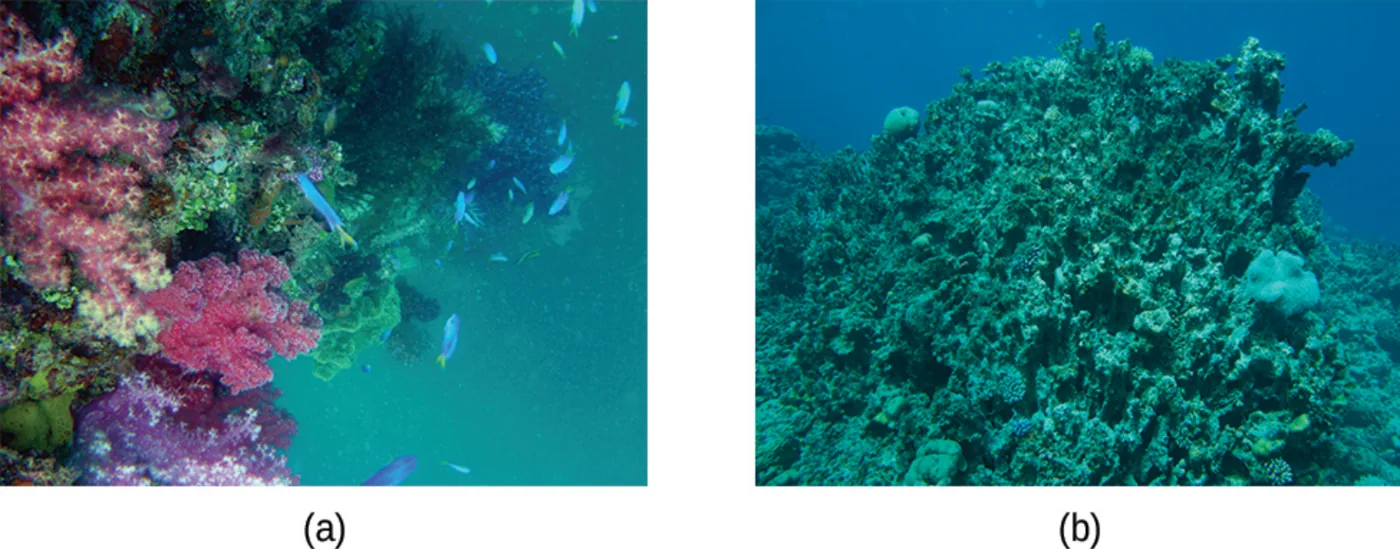
A healthy coral reef with a dense community of fish and other sea life, compared with a weakened reef that supports far fewer species because its calcium carbonate skeleton is breaking down. Image: OpenStax, Chemistry 2e, CC BY 4.0.
Ocean acidification and coral reefs
 ⤢ Enlarge
Ocean acidification and coral reefs
CaCO3(s) + H3O+(aq) ⇌ Ca2+(aq) + HCO3−(aq) + H2O(l)
The equilibrium constant of this net reaction is much larger than the solubility product of calcium carbonate. This tells you that calcium carbonate is far more soluble in acidic solutions than in neutral water. Because the carbonate ion is continually consumed, the dissolution equilibrium keeps shifting to the right as the water becomes more acidic.
As carbon dioxide levels rise, the acidity of the ocean increases, and the calcium carbonate skeletons of coral reefs dissolve more readily. Healthy reefs support a dense and varied community of sea life. Weakened reefs can support only a small fraction of the species, and the food chain built on them can begin to collapse.
Link to learning: Ocean acidification also affects many other marine animals, such as shellfish and plankton, that build shells from calcium carbonate. The same coupled-equilibrium logic explains why these organisms are at risk.
◀ Previous2 / 2
Basic anions and acid-dependent solubility
Basic anions and acid-dependent solubility
The large increase in solubility with acidity seen for calcium carbonate is typical of ionic compounds that contain a basic anion. Examples include carbonate, fluoride, hydroxide and sulfide. In each case the anion reacts with the hydrogen ions of an acid
which removes the anion from the solid’s dissolution equilibrium and pushes the equilibrium toward dissolution.
A compound with a basic anion dissolves more when the solution is acidic. The more basic the anion, the stronger this effect
because the acid is consumed more completely.
1Dental cavities and tooth enamel2Dental cavities and tooth enamel
Dental cavities and tooth enamel
1
Tooth enamel is mainly made of calcium hydroxyapatite, a sparingly soluble ionic compound with the formula Ca5(PO4)3OH. Its dissolution equilibrium is:
2
Ca5(PO4)3OH(s) ⇌ 5Ca2+(aq) + 3PO43−(aq) + OH−(aq)
3
The dissolved products include two basic ions. The phosphate ion is a triprotic base, and the hydroxide ion is a monoprotic base. Hydroxide is by far the stronger base, and it is the strongest base that can exist in water. For this reason, hydroxide is the main factor that makes the solubility of hydroxyapatite depend on acidity.
4
Dental cavities form when bacteria on the tooth surface produce acid. The acid reacts completely with the hydroxide ion
which removes it from the solution. The removal of hydroxide shifts the hydroxyapatite equilibrium to the rightso more enamel dissolves.
5
Some toothpastes and mouth rinses contain sodium fluoride (NaF) or tin(II) fluoride (SnF2). These compounds supply fluoride ions
which replace hydroxide in the mineral:
6
Ca5(PO4)3OH(s) + F−(aq) ⇌ Ca5(PO4)3F(s) + OH−(aq)
1 / 2Next ▶
Dental cavities and tooth enamel
Dental cavities and tooth enamel
Fluoride is a weak base. When acid attacks the enamel, the fluoride ion reacts only partly with the acid. The shift of the solubility equilibrium is therefore much smaller, and the enamel resists acid dissolution.
◀ Previous2 / 2
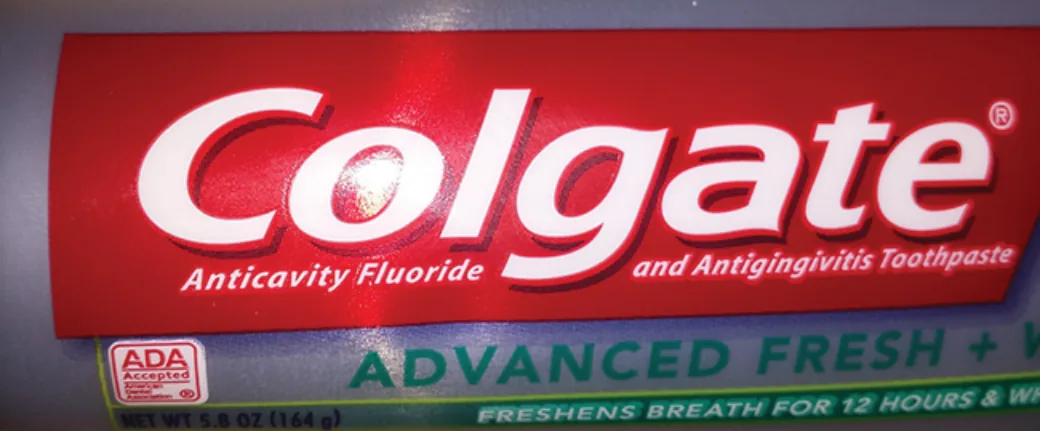
A fluoride toothpaste. Fluoride in toothpaste helps prevent tooth decay by strengthening the enamel. Image: OpenStax, Chemistry 2e, CC BY 4.0.
Role of fluoride in preventing tooth decay
 ⤢ Enlarge
Role of fluoride in preventing tooth decay
Fluoride protects teeth by reacting with hydroxyapatite to form fluorapatite, Ca5(PO4)3F. Fluorapatite contains no hydroxide ion. Since it has no strong base in its structure, it is more resistant to acid attack and less soluble than hydroxyapatite
which protects the tooth.
Because of this benefit, fluoride is commonly added to drinking water, and toothpastes and mouthwashes also contain fluoride.
Too much fluoride is harmful. The most serious side effect of excess fluoride is skeletal fluorosis, a bone disease. In this condition the joints stiffen and the bones thicken
which severely limits movement. Excess fluoride can also affect the thyroid gland. More than 2.7 million people worldwide suffer from skeletal fluorosis.
The United States Environmental Protection Agency sets a maximum fluoride level of 4 ppm (4 mg/L) in drinking water. Fluoride levels are not regulated in every country
so fluorosis is a problem in areas where groundwater has high fluoride concentrations and there is no other safe source of drinking water.
The Lewis structure of the tetrahydroxoaluminate ion, Al(OH)4−, in which an aluminum atom is bonded to four hydroxide groups. Image: OpenStax, Chemistry 2e, CC BY 4.0.
Complex-ion formation and solubility
 ⤢ Enlarge
1
The solubility of an ionic compound can also increase when its dissolution is coupled to the formation of a complex ion. For example, aluminum hydroxide, Al(OH)3, dissolves in a solution of sodium hydroxide, or another strong base
because it forms the complex ion Al(OH)4−.
2
The overall process combines three equilibria: the dissolution of aluminum hydroxide, the formation of the complex ion, and the net reaction that results when they are added together:
3
Al(OH)3(s) ⇌ Al3+(aq) + 3OH−(aq)
4
Al3+(aq) + 4OH−(aq) ⇌ Al(OH)4−(aq)
5
Al(OH)3(s) + OH−(aq) ⇌ Al(OH)4−(aq)
6
The equilibrium constant of the net reaction is the product of the constants of the two separate equilibria. Because this constant is large, complex-ion formation greatly increases the solubility of Al(OH)3 in strongly basic solution.
1Example 15.15: Increased solubility in an acidic buffer2Example 15.15: Increased solubility in an acidic buffer3Example 15.16: Multiple equilibria in photographic fixing4Example 15.16: Multiple equilibria in photographic fixing5Example 15.16: Multiple equilibria in photographic fixing6Example 15.16: Multiple equilibria in photographic fixing
Example 15.15: Increased solubility in an acidic buffer
Example 15.15: Increased solubility in an acidic buffer
Problem. Compare the molar solubility of aluminum hydroxide in (a) pure water and (b) a buffer containing 0.100 M acetic acid and 0.100 M sodium acetate. Use Ksp(Al(OH)3) = 3 × 10⁻³⁴ and Ka(acetic acid) = 1.8 × 10⁻⁵.
Solution, part (a). Only the dissolution equilibrium matters in pure water:
Al(OH)3(s) ⇌ Al3+(aq) + 3OH−(aq)
If s is the molar solubility in mol/L
then [Al3+] = s and [OH−] = 3s. So Ksp = s(3s)3 = 27s4, and
s = (Ksp/27)1/4 = (3 × 10⁻³⁴/27)1/4 ≈ 1.8 × 10⁻⁹ mol/L
Solution, part (b). In the buffer, the hydroxide concentration is fixed by the acid and its salt. Because the acid and salt concentrations are equal, [H3O+] ≈ Ka = 1.8 × 10⁻⁵ M
which corresponds to a pH of 4.74. The hydroxide concentration is then
1 / 6Next ▶
Example 15.15: Increased solubility in an acidic buffer
Example 15.15: Increased solubility in an acidic buffer
[OH−] = Kw/[H3O+] = (1.0 × 10⁻¹⁴)/(1.8 × 10−5) ≈ 5.6 × 10⁻¹⁰ M
Because the hydroxide concentration is fixed by the buffer, the dissolved aluminum ion is found directly from the solubility product:
[Al3+] = Ksp/[OH−]3 = (3 × 10⁻³⁴)/(5.6 × 10−10)3 ≈ 1.7 × 10⁻⁶ mol/L
Comparison. The solubility in the buffer, 1.7 × 10⁻⁶ mol/L, is about 900 times the solubility in pure water (1.8 × 10⁻⁹ mol/L). The solubility is still low in absolute terms
but the mildly acidic buffer increases it a great deal.
Check Your Learning. Find the solubility of aluminum hydroxide in a buffer of 0.100 M formic acid and 0.100 M sodium formate. Use Ka(formic acid) = 1.8 × 10⁻⁴. Answer: [OH−] = (1.0 × 10⁻¹⁴)/(1.8 × 10−4) ≈ 5.6 × 10⁻¹¹ M
so the solubility is 3 × 10⁻³⁴/(5.6 × 10−11)3 ≈ 1.7 × 10⁻³ mol/L.
◀ Previous2 / 6Next ▶
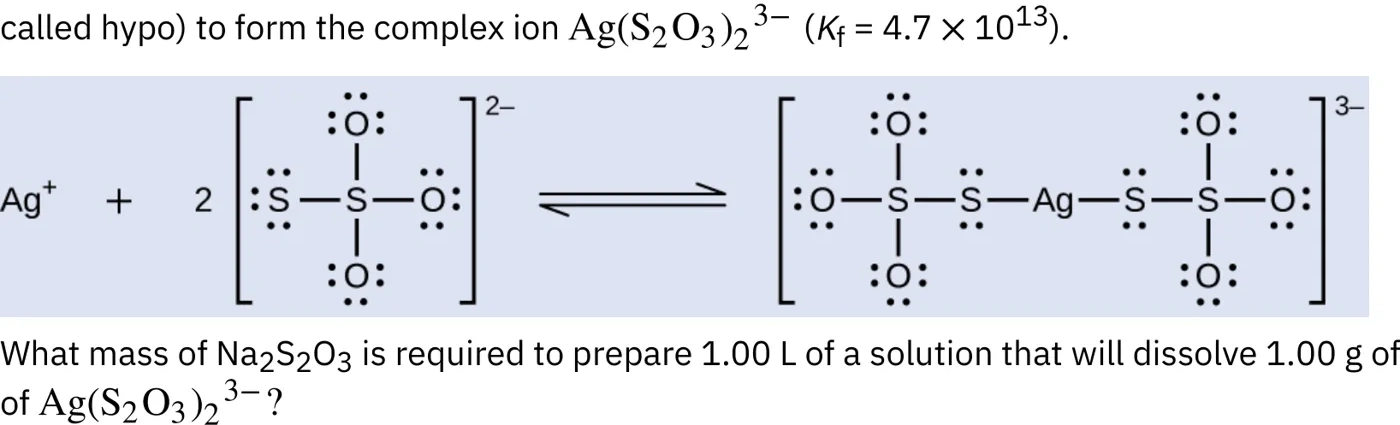
The silver ion reacts with two thiosulfate ions to form the complex ion Ag(S2O3)2 3−, which has a large formation constant. Image: OpenStax, Chemistry 2e, CC BY 4.0.
Example 15.16: Multiple equilibria in photographic fixing
 ⤢ Enlarge
1
Problem. Unexposed silver halides are removed from photographic film by sodium thiosulfate, Na2S2O3
which forms the complex ion Ag(S2O3)23− (Kf = 4.7 × 10¹³). What mass of Na2S2O3 is needed to prepare 1.00 L of solution that dissolves 1.00 g of AgBr as the complex ion?
2
Solution. Two equilibria are involved. Dissolution of silver bromide (Ksp = 5.0 × 10⁻¹³) is:
3
AgBr(s) ⇌ Ag+(aq) + Br−(aq)
4
Complex formation, with Kf = 4.7 × 10¹³, is:
5
Ag+(aq) + 2S2O32−(aq) ⇌ Ag(S2O3)23−(aq)
6
Adding the two equations gives the net reaction:
◀ Previous3 / 6Next ▶
Example 15.16: Multiple equilibria in photographic fixing
1
AgBr(s) + 2S2O32−(aq) ⇌ Ag(S2O3)23−(aq) + Br−(aq)
2
Its constant is K = Ksp × Kf = (5.0 × 10⁻¹³)(4.7 × 10¹³) ≈ 23.5.
3
The molar mass of AgBr is 187.8 g/mol
so 1.00 g of AgBr is 1.00/187.8 ≈ 0.00532 mol.
4
Dissolving this amount in 1.00 L gives [Ag(S2O3)23−] = 0.00532 M and [Br−] = 0.00532 M.
5
Because one silver ion comes from each dissolved AgBr, the same concentration of silver ion appears in solution,
and the large Kf means essentially all of it is complexed.
6
Solve the constant expression for the free thiosulfate concentration x:
◀ Previous4 / 6Next ▶
Example 15.16: Multiple equilibria in photographic fixing
Example 15.16: Multiple equilibria in photographic fixing
K = [Ag(S2O3)23−][Br−]/[S2O32−]2 = (0.00532)(0.00532)/x2 = 23.5
x2 = (0.00532)2/23.5 = 1.2 × 10⁻⁶
so x ≈ 1.10 × 10⁻³ M ≈ 0.00110 M
Each silver ion in the complex uses two thiosulfate ions, and the free thiosulfate concentration must also be supplied. Each mole of Na2S2O3 supplies one mole of thiosulfate, with molar mass 158.1 g/mol:
Mass needed for the complexed silver: 2 × 0.00532 mol × 158.1 g/mol ≈ 1.68 g
Mass needed for the free thiosulfate: 0.00110 mol × 158.1 g/mol ≈ 0.17 g
Total mass of Na2S2O3 = 1.68 g + 0.17 g = 1.85 g
◀ Previous5 / 6Next ▶
Example 15.16: Multiple equilibria in photographic fixing
1
Check Your Learning. Silver chloride has Ksp = 1.6 × 10⁻¹⁰.
2
Adding ammonia forms the complex ion Ag(NH3)2+, with Kf = 1.7 × 10⁷.
3
What mass of NH3 is needed to prepare 1.00 L of solution that dissolves 2.00 g of AgCl as the complex ion? Answer: The net constant is K = (1.6 × 10⁻¹⁰)(1.7 × 10⁷) ≈ 2.7 × 10⁻³.
4
With 2.00 g/143.3 g/mol ≈ 0.0140 M each of complex and chloride, [NH3]2 = (0.0140)2/2.7 × 10−3 gives [NH3] ≈ 0.27 M free.
5
The total is about 0.27 mol × 17.03 g/mol + 2 × 0.0140 mol × 17.03 g/mol ≈ 4.6 g + 0.5 g ≈ 5.0 g of NH3.
◀ Previous6 / 6
Key terms
| Term | Meaning |
|---|---|
| Coupled equilibria | Two or more separate equilibria that share at least one reactant or product, so a change in one affects the other. |
| Solubility product (Ksp) | The equilibrium constant for the dissolution of a sparingly soluble ionic solid into its ions in solution. |
| Net reaction | The overall reaction obtained by adding two or more equilibrium equations so that shared species cancel. |
| Basic anion | An anion that reacts with hydrogen ions, such as carbonate, fluoride, hydroxide or sulfide. |
| Ocean acidification | The lowering of seawater pH caused by dissolved carbon dioxide, which increases the solubility of calcium carbonate. |
| Calcium carbonate | A sparingly soluble ionic compound, CaCO3, that forms the skeletons of corals and other marine organisms. |
| Hydroxyapatite | The main mineral of tooth enamel, with the formula Ca5(PO4)3OH. |
| Fluorapatite | The mineral Ca5(PO4)3F formed when fluoride replaces hydroxide in hydroxyapatite; it is less soluble in acid. |
| Dental cavity | Damage to tooth enamel caused by acid, which dissolves the enamel as hydroxide is removed from its mineral. |
| Skeletal fluorosis | A bone disease caused by excess fluoride, in which joints stiffen and bones thicken. |
| Complex ion | An ion formed when a central metal ion bonds to surrounding ligands, such as Al(OH)4− or Ag(S2O3)23−. |
| Formation constant (Kf) | The equilibrium constant for the formation of a complex ion from its metal ion and ligands; a large Kf means the complex is strongly favored. |
| Molar solubility | The number of moles of a solid that dissolve in one liter of solution, in mol/L (M). |
| Henderson-Hasselbalch equation | An equation that relates the pH of a buffer to the pKa of its weak acid and to the ratio of salt and acid concentrations. |
1Avoid these mistakes2Avoid these mistakes3Avoid these mistakes4Avoid these mistakes
Avoid these mistakes
1Avoid this
Adding the constants of the two equilibria when they should be multiplied.Avoid this
The constant of a net reaction is the product of the constants of the reactions that are added.Avoid this
2Avoid this
Forgetting that an acid lowers the carbonate or hydroxide concentration, so a solid with a basic anion dissolves more in acid, not less.Avoid this
3Avoid this
1 / 4Next ▶
Avoid these mistakes
Treating fluoride as a strong base. Fluoride reacts only partly with acid, so it protects enamel but does not remove hydroxide completely.Avoid this
4Avoid this
Using the stoichiometry of the complex ion incorrectly. Each silver ion in Ag(SAvoid this
OAvoid this
)Avoid this
3−Avoid this
◀ Previous2 / 4Next ▶
Avoid these mistakes
needs two thiosulfate ions, not one.Avoid this
5Avoid this
Using the pH of a buffer as the pH of pure water, or forgetting to convert [HAvoid this
+Avoid this
] to [OHAvoid this
−Avoid this
◀ Previous3 / 4Next ▶
Avoid these mistakes
] with Kw before using the solubility product.Avoid this
6Avoid this
Assuming solubility in a buffer equals solubility in pure water.Avoid this
In a buffer, the hydroxide concentration is fixed, so the solubility is found from [Al3+] = Ksp/[OH−]3.Avoid this
◀ Previous4 / 4