Curriculum
Chemistry 2e
Unit 1: Essential Ideas
0/14
-
Unit 1 overview: Essential Ideas
 Text lessonPreview
-
1.1 Chemistry in Context
Text lessonPreview
-
1.1 Chemistry in Context - Check yourself
 6 questionsPreview
-
1.2 Phases and Classification of Matter
Text lessonPreview
-
1.2 Phases and Classification of Matter - Check yourself
6 questionsPreview
-
1.3 Physical and Chemical Properties
Text lessonPreview
-
1.3 Physical and Chemical Properties - Check yourself
6 questionsPreview
-
1.4 Measurements
Text lessonPreview
-
1.4 Measurements - Check yourself
6 questionsPreview
-
1.5 Measurement Uncertainty, Accuracy, and Precision
Text lessonPreview
-
1.5 Measurement Uncertainty, Accuracy, and Precision - Check yourself
6 questionsPreview
-
1.6 Mathematical Treatment of Measurement Results
Text lessonPreview
-
1.6 Mathematical Treatment of Measurement Results - Check yourself
6 questionsPreview
-
Unit 1 review quiz: Essential Ideas
10 questionsPreview
Unit 2: Atoms, Molecules, and Ions
0/16
-
Unit 2 overview: Atoms, Molecules, and Ions
Text lessonPreview
-
2.1 Early Ideas in Atomic Theory
Text lessonPreview
-
2.1 Early Ideas in Atomic Theory - Check yourself
6 questionsPreview
-
2.2 Evolution of Atomic Theory
Text lessonPreview
-
2.2 Evolution of Atomic Theory - Check yourself
6 questionsPreview
-
2.3 Atomic Structure and Symbolism
Text lessonPreview
-
2.3 Atomic Structure and Symbolism - Check yourself
6 questionsPreview
-
2.4 Chemical Formulas
Text lessonPreview
-
2.4 Chemical Formulas - Check yourself
6 questionsPreview
-
2.5 The Periodic Table
Text lessonPreview
-
2.5 The Periodic Table - Check yourself
6 questionsPreview
-
2.6 Ionic and Molecular Compounds
Text lessonPreview
-
2.6 Ionic and Molecular Compounds - Check yourself
6 questionsPreview
-
2.7 Chemical Nomenclature
Text lessonPreview
-
2.7 Chemical Nomenclature - Check yourself
6 questionsPreview
-
Unit 2 review quiz: Atoms, Molecules, and Ions
10 questionsPreview
Unit 3: Composition of Substances and Solutions
0/10
-
Unit 3 overview: Composition of Substances and Solutions
Text lessonPreview
-
3.1 Formula Mass and the Mole Concept
Text lessonPreview
-
3.1 Formula Mass and the Mole Concept - Check yourself
6 questionsPreview
-
3.2 Determining Empirical and Molecular Formulas
Text lessonPreview
-
3.2 Determining Empirical and Molecular Formulas - Check yourself
6 questionsPreview
-
3.3 Molarity
Text lessonPreview
-
3.3 Molarity - Check yourself
6 questionsPreview
-
3.4 Other Units for Solution Concentrations
Text lessonPreview
-
3.4 Other Units for Solution Concentrations - Check yourself
6 questionsPreview
-
Unit 3 review quiz: Composition of Substances and Solutions
10 questionsPreview
Unit 4: Stoichiometry of Chemical Reactions
0/12
-
Unit 4 overview: Stoichiometry of Chemical Reactions
Text lessonPreview
-
4.1 Writing and Balancing Chemical Equations
Text lessonPreview
-
4.1 Writing and Balancing Chemical Equations - Check yourself
6 questionsPreview
-
4.2 Classifying Chemical Reactions
Text lessonPreview
-
4.2 Classifying Chemical Reactions - Check yourself
6 questionsPreview
-
4.3 Reaction Stoichiometry
Text lessonPreview
-
4.3 Reaction Stoichiometry - Check yourself
6 questionsPreview
-
4.4 Reaction Yields
Text lessonPreview
-
4.4 Reaction Yields - Check yourself
6 questionsPreview
-
4.5 Quantitative Chemical Analysis
Text lessonPreview
-
4.5 Quantitative Chemical Analysis - Check yourself
6 questionsPreview
-
Unit 4 review quiz: Stoichiometry of Chemical Reactions
10 questionsPreview
Unit 5: Thermochemistry
0/8
-
Unit 5 overview: Thermochemistry
Text lessonPreview
-
5.1 Energy Basics
Text lessonPreview
-
5.1 Energy Basics - Check yourself
6 questionsPreview
-
5.2 Calorimetry
Text lessonPreview
-
5.2 Calorimetry - Check yourself
7 questionsPreview
-
5.3 Enthalpy
Text lessonPreview
-
5.3 Enthalpy - Check yourself
6 questionsPreview
-
Unit 5 review quiz: Thermochemistry
10 questionsPreview
Unit 6: Electronic Structure and Periodic Properties of Elements
0/12
-
Unit 6 overview: Electronic Structure and Periodic Properties of Elements
Text lessonPreview
-
6.1 Electromagnetic Energy
Text lessonPreview
-
6.1 Electromagnetic Energy - Check yourself
6 questionsPreview
-
6.2 The Bohr Model
Text lessonPreview
-
6.2 The Bohr Model - Check yourself
6 questionsPreview
-
6.3 Development of Quantum Theory
Text lessonPreview
-
6.3 Development of Quantum Theory - Check yourself
6 questionsPreview
-
6.4 Electronic Structure of Atoms (Electron Configurations)
Text lessonPreview
-
6.4 Electronic Structure of Atoms (Electron Configurations) - Check yourself
6 questionsPreview
-
6.5 Periodic Variations in Element Properties
Text lessonPreview
-
6.5 Periodic Variations in Element Properties - Check yourself
6 questionsPreview
-
Unit 6 review quiz: Electronic Structure and Periodic Properties of Elements
10 questionsPreview
Unit 7: Chemical Bonding and Molecular Geometry
0/14
-
Unit 7 overview: Chemical Bonding and Molecular Geometry
Text lessonPreview
-
7.1 Ionic Bonding
Text lessonPreview
-
7.1 Ionic Bonding - Check yourself
6 questionsPreview
-
7.2 Covalent Bonding
Text lessonPreview
-
7.2 Covalent Bonding - Check yourself
6 questionsPreview
-
7.3 Lewis Symbols and Structures
Text lessonPreview
-
7.3 Lewis Symbols and Structures - Check yourself
6 questionsPreview
-
7.4 Formal Charges and Resonance
Text lessonPreview
-
7.4 Formal Charges and Resonance - Check yourself
6 questionsPreview
-
7.5 Strengths of Ionic and Covalent Bonds
Text lessonPreview
-
7.5 Strengths of Ionic and Covalent Bonds - Check yourself
6 questionsPreview
-
7.6 Molecular Structure and Polarity
Text lessonPreview
-
7.6 Molecular Structure and Polarity - Check yourself
6 questionsPreview
-
Unit 7 review quiz: Chemical Bonding and Molecular Geometry
10 questionsPreview
Unit 8: Advanced Theories of Covalent Bonding
0/10
-
Unit 8 overview: Advanced Theories of Covalent Bonding
Text lessonPreview
-
8.1 Valence Bond Theory
Text lessonPreview
-
8.1 Valence Bond Theory - Check yourself
6 questionsPreview
-
8.2 Hybrid Atomic Orbitals
Text lessonPreview
-
8.2 Hybrid Atomic Orbitals - Check yourself
6 questionsPreview
-
8.3 Multiple Bonds
Text lessonPreview
-
8.3 Multiple Bonds - Check yourself
6 questionsPreview
-
8.4 Molecular Orbital Theory
Text lessonPreview
-
8.4 Molecular Orbital Theory - Check yourself
6 questionsPreview
-
Unit 8 review quiz: Advanced Theories of Covalent Bonding
10 questionsPreview
Unit 9: Gases
0/23
-
Unit 9 overview: Gases
Text lessonPreview
-
9.1 Gas Pressure
Text lessonPreview
-
9.1 Gas Pressure - Check yourself
6 questionsPreview
-
9.2 Relating Pressure, Volume, Amount, and Temperature: The Ideal Gas Law
Text lessonPreview
-
9.2 Relating Pressure, Volume, Amount, and Temperature: The Ideal Gas Law - Check yourself
6 questionsPreview
-
9.3 Stoichiometry of Gaseous Substances, Mixtures, and Reactions
Text lessonPreview
-
9.3 Stoichiometry of Gaseous Substances, Mixtures, and Reactions - Check yourself
6 questionsPreview
-
9.3 Stoichiometry of Gaseous Substances, Mixtures, and Reactions
Text lessonPreview
-
9.3 Stoichiometry of Gaseous Substances, Mixtures, and Reactions - Check yourself
6 questionsPreview
-
9.4 Effusion and Diffusion of Gases
Text lessonPreview
-
9.4 Effusion and Diffusion of Gases - Check yourself
6 questionsPreview
-
9.4 Effusion and Diffusion of Gases
Text lessonPreview
-
9.4 Effusion and Diffusion of Gases - Check yourself
6 questionsPreview
-
Unit 9 review quiz: Gases
10 questionsPreview
-
9.5 The Kinetic-Molecular Theory
Text lessonPreview
-
9.5 The Kinetic-Molecular Theory - Check yourself
6 questionsPreview
-
9.5 The Kinetic-Molecular Theory
Text lessonPreview
-
9.5 The Kinetic-Molecular Theory - Check yourself
6 questionsPreview
-
9.6 Non-Ideal Gas Behavior
Text lessonPreview
-
9.6 Non-Ideal Gas Behavior - Check yourself
6 questionsPreview
-
9.6 Non-Ideal Gas Behavior
Text lessonPreview
-
9.6 Non-Ideal Gas Behavior - Check yourself
6 questionsPreview
-
Unit 9 review quiz: Gases
10 questionsPreview
Unit 10: Liquids and Solids
0/28
-
Unit 10 overview: Liquids and Solids
Text lessonPreview
-
10.1 Intermolecular Forces
Text lessonPreview
-
Unit 10 overview: Liquids and Solids
Text lessonPreview
-
10.1 Intermolecular Forces
Text lessonPreview
-
10.1 Intermolecular Forces - Check yourself
6 questionsPreview
-
10.1 Intermolecular Forces - Check yourself
6 questionsPreview
-
10.2 Properties of Liquids
Text lessonPreview
-
10.2 Properties of Liquids - Check yourself
6 questionsPreview
-
10.2 Properties of Liquids
Text lessonPreview
-
10.2 Properties of Liquids - Check yourself
6 questionsPreview
-
10.3 Phase Transitions
Text lessonPreview
-
10.3 Phase Transitions - Check yourself
6 questionsPreview
-
10.3 Phase Transitions
Text lessonPreview
-
10.3 Phase Transitions - Check yourself
6 questionsPreview
-
10.4 Phase Diagrams
Text lessonPreview
-
10.4 Phase Diagrams
Text lessonPreview
-
10.4 Phase Diagrams - Check yourself
6 questionsPreview
-
10.4 Phase Diagrams - Check yourself
6 questionsPreview
-
10.5 The Solid State of Matter
Text lessonPreview
-
10.5 The Solid State of Matter
Text lessonPreview
-
10.5 The Solid State of Matter - Check yourself
6 questionsPreview
-
10.5 The Solid State of Matter - Check yourself
6 questionsPreview
-
10.6 Lattice Structures in Crystalline Solids
Text lessonPreview
-
10.6 Lattice Structures in Crystalline Solids
Text lessonPreview
-
10.6 Lattice Structures in Crystalline Solids - Check yourself
6 questionsPreview
-
10.6 Lattice Structures in Crystalline Solids - Check yourself
6 questionsPreview
-
Unit 10 review quiz: Liquids and Solids
10 questionsPreview
-
Unit 10 review quiz: Liquids and Solids
10 questionsPreview
Unit 11: Solutions and Colloids
0/24
-
Unit 11 overview: Solutions and Colloids
Text lessonPreview
-
11.1 The Dissolution Process
Text lessonPreview
-
Unit 11 overview: Solutions and Colloids
Text lessonPreview
-
11.1 The Dissolution Process
Text lessonPreview
-
11.1 The Dissolution Process - Check yourself
6 questionsPreview
-
11.1 The Dissolution Process - Check yourself
6 questionsPreview
-
11.2 Electrolytes
Text lessonPreview
-
11.2 Electrolytes - Check yourself
6 questionsPreview
-
11.2 Electrolytes
Text lessonPreview
-
11.2 Electrolytes - Check yourself
6 questionsPreview
-
11.3 Solubility
Text lessonPreview
-
11.3 Solubility - Check yourself
6 questionsPreview
-
11.3 Solubility
Text lessonPreview
-
11.3 Solubility - Check yourself
6 questionsPreview
-
11.4 Colligative Properties
Text lessonPreview
-
11.4 Colligative Properties - Check yourself
6 questionsPreview
-
11.4 Colligative Properties
Text lessonPreview
-
11.4 Colligative Properties - Check yourself
6 questionsPreview
-
11.5 Colloids
Text lessonPreview
-
11.5 Colloids - Check yourself
6 questionsPreview
-
11.5 Colloids
Text lessonPreview
-
11.5 Colloids - Check yourself
6 questionsPreview
-
Unit 11 review quiz: Solutions and Colloids
10 questionsPreview
-
Unit 11 review quiz: Solutions and Colloids
10 questionsPreview
Unit 12: Kinetics
0/32
-
Unit 12 overview: Kinetics
Text lessonPreview
-
12.1 Chemical Reaction Rates
Text lessonPreview
-
12.1 Chemical Reaction Rates - Check yourself
6 questionsPreview
-
Unit 12 overview: Kinetics
Text lessonPreview
-
12.1 Chemical Reaction Rates
Text lessonPreview
-
12.1 Chemical Reaction Rates - Check yourself
6 questionsPreview
-
12.2 Factors Affecting Reaction Rates
Text lessonPreview
-
12.2 Factors Affecting Reaction Rates - Check yourself
6 questionsPreview
-
12.2 Factors Affecting Reaction Rates
Text lessonPreview
-
12.2 Factors Affecting Reaction Rates - Check yourself
6 questionsPreview
-
12.3 Rate Laws
Text lessonPreview
-
12.3 Rate Laws - Check yourself
6 questionsPreview
-
12.3 Rate Laws
Text lessonPreview
-
12.3 Rate Laws - Check yourself
6 questionsPreview
-
12.4 Integrated Rate Laws
Text lessonPreview
-
12.4 Integrated Rate Laws - Check yourself
6 questionsPreview
-
12.4 Integrated Rate Laws
Text lessonPreview
-
12.4 Integrated Rate Laws - Check yourself
6 questionsPreview
-
12.5 Collision Theory
Text lessonPreview
-
12.5 Collision Theory - Check yourself
6 questionsPreview
-
12.5 Collision Theory
Text lessonPreview
-
Unit 12 review quiz: Kinetics
10 questionsPreview
-
12.5 Collision Theory - Check yourself
6 questionsPreview
-
12.6 Reaction Mechanisms
Text lessonPreview
-
12.6 Reaction Mechanisms - Check yourself
6 questionsPreview
-
12.6 Reaction Mechanisms
Text lessonPreview
-
12.6 Reaction Mechanisms - Check yourself
6 questionsPreview
-
12.7 Catalysis
Text lessonPreview
-
12.7 Catalysis - Check yourself
6 questionsPreview
-
12.7 Catalysis
Text lessonPreview
-
12.7 Catalysis - Check yourself
6 questionsPreview
-
Unit 12 review quiz: Kinetics
10 questionsPreview
Unit 13: Fundamental Equilibrium Concepts
0/20
-
Unit 13 overview: Fundamental Equilibrium Concepts
Text lessonPreview
-
13.1 Chemical Equilibria
Text lessonPreview
-
13.1 Chemical Equilibria - Check yourself
6 questionsPreview
-
13.1 Chemical Equilibria
Text lessonPreview
-
13.1 Chemical Equilibria - Check yourself
6 questionsPreview
-
13.2 Equilibrium Constants
Text lessonPreview
-
13.2 Equilibrium Constants - Check yourself
6 questionsPreview
-
13.2 Equilibrium Constants
Text lessonPreview
-
Unit 13 overview: Fundamental Equilibrium Concepts
Text lessonPreview
-
13.2 Equilibrium Constants - Check yourself
6 questionsPreview
-
13.3 Shifting Equilibria: Le Châtelier’s Principle
Text lessonPreview
-
13.3 Shifting Equilibria: Le Châtelier’s Principle - Check yourself
6 questionsPreview
-
13.3 Shifting Equilibria: Le Châtelier’s Principle
Text lessonPreview
-
Unit 13 review quiz: Fundamental Equilibrium Concepts
10 questionsPreview
-
13.3 Shifting Equilibria: Le Châtelier’s Principle - Check yourself
6 questionsPreview
-
13.4 Equilibrium Calculations
Text lessonPreview
-
13.4 Equilibrium Calculations - Check yourself
6 questionsPreview
-
13.4 Equilibrium Calculations
Text lessonPreview
-
13.4 Equilibrium Calculations - Check yourself
6 questionsPreview
-
Unit 13 review quiz: Fundamental Equilibrium Concepts
10 questionsPreview
Unit 14: Acid-Base Equilibria
0/32
-
Unit 14 overview: Acid-Base Equilibria
Text lessonPreview
-
14.1 Brønsted-Lowry Acids and Bases
Text lessonPreview
-
14.1 Brønsted-Lowry Acids and Bases - Check yourself
6 questionsPreview
-
14.1 Brønsted-Lowry Acids and Bases
Text lessonPreview
-
14.1 Brønsted-Lowry Acids and Bases - Check yourself
6 questionsPreview
-
14.2 pH and pOH
Text lessonPreview
-
14.2 pH and pOH - Check yourself
6 questionsPreview
-
14.2 pH and pOH
Text lessonPreview
-
14.2 pH and pOH - Check yourself
6 questionsPreview
-
14.3 Relative Strengths of Acids and Bases
Text lessonPreview
-
14.3 Relative Strengths of Acids and Bases - Check yourself
6 questionsPreview
-
14.3 Relative Strengths of Acids and Bases
Text lessonPreview
-
14.3 Relative Strengths of Acids and Bases - Check yourself
6 questionsPreview
-
14.4 Hydrolysis of Salts
Text lessonPreview
-
14.4 Hydrolysis of Salts - Check yourself
6 questionsPreview
-
Unit 14 review quiz: Acid-Base Equilibria
10 questionsPreview
-
Unit 14 overview: Acid-Base Equilibria
Text lessonPreview
-
14.4 Hydrolysis of Salts
Text lessonPreview
-
14.4 Hydrolysis of Salts - Check yourself
6 questionsPreview
-
14.5 Polyprotic Acids
Text lessonPreview
-
14.5 Polyprotic Acids - Check yourself
6 questionsPreview
-
14.5 Polyprotic Acids
Text lessonPreview
-
14.5 Polyprotic Acids - Check yourself
6 questionsPreview
-
14.6 Buffers
Text lessonPreview
-
14.6 Buffers - Check yourself
6 questionsPreview
-
14.6 Buffers
Text lessonPreview
-
14.6 Buffers - Check yourself
6 questionsPreview
-
14.7 Acid-Base Titrations
Text lessonPreview
-
14.7 Acid-Base Titrations - Check yourself
6 questionsPreview
-
14.7 Acid-Base Titrations
Text lessonPreview
-
14.7 Acid-Base Titrations - Check yourself
6 questionsPreview
-
Unit 14 review quiz: Acid-Base Equilibria
10 questionsPreview
Unit 15: Equilibria of Other Reaction Classes
0/16
-
Unit 15 overview: Equilibria of Other Reaction Classes
Text lessonPreview
-
15.1 Precipitation and Dissolution
Text lessonPreview
-
15.1 Precipitation and Dissolution - Check yourself
6 questionsPreview
-
15.1 Precipitation and Dissolution
Text lessonPreview
-
15.1 Precipitation and Dissolution - Check yourself
6 questionsPreview
-
15.2 Lewis Acids and Bases
Text lessonPreview
-
15.2 Lewis Acids and Bases - Check yourself
6 questionsPreview
-
Unit 15 review quiz: Equilibria of Other Reaction Classes
10 questionsPreview
-
Unit 15 overview: Equilibria of Other Reaction Classes
Text lessonPreview
-
15.2 Lewis Acids and Bases
Text lessonPreview
-
15.2 Lewis Acids and Bases - Check yourself
6 questionsPreview
-
15.3 Coupled Equilibria
Text lessonPreview
-
15.3 Coupled Equilibria - Check yourself
6 questionsPreview
-
15.3 Coupled Equilibria
Text lessonPreview
-
15.3 Coupled Equilibria - Check yourself
6 questionsPreview
-
Unit 15 review quiz: Equilibria of Other Reaction Classes
10 questionsPreview
Unit 16: Thermodynamics
0/20
-
Unit 16 overview: Thermodynamics
Text lessonPreview
-
16.1 Spontaneity
Text lessonPreview
-
16.1 Spontaneity - Check yourself
6 questionsPreview
-
16.1 Spontaneity
Text lessonPreview
-
16.1 Spontaneity - Check yourself
6 questionsPreview
-
16.2 Entropy
Text lessonPreview
-
16.2 Entropy - Check yourself
6 questionsPreview
-
16.2 Entropy
Text lessonPreview
-
16.2 Entropy - Check yourself
6 questionsPreview
-
Unit 16 review quiz: Thermodynamics
10 questionsPreview
-
Unit 16 overview: Thermodynamics
Text lessonPreview
-
16.3 The Second and Third Laws of Thermodynamics
Text lessonPreview
-
16.3 The Second and Third Laws of Thermodynamics - Check yourself
6 questionsPreview
-
16.3 The Second and Third Laws of Thermodynamics
Text lessonPreview
-
16.3 The Second and Third Laws of Thermodynamics - Check yourself
6 questionsPreview
-
16.4 Free Energy
Text lessonPreview
-
16.4 Free Energy - Check yourself
6 questionsPreview
-
16.4 Free Energy
Text lessonPreview
-
16.4 Free Energy - Check yourself
6 questionsPreview
-
Unit 16 review quiz: Thermodynamics
10 questionsPreview
Unit 17: Electrochemistry
0/32
-
Unit 17 overview: Electrochemistry
Text lessonPreview
-
17.1 Review of Redox Chemistry
Text lessonPreview
-
17.1 Review of Redox Chemistry - Check yourself
6 questionsPreview
-
17.1 Review of Redox Chemistry
Text lessonPreview
-
17.1 Review of Redox Chemistry - Check yourself
6 questionsPreview
-
17.2 Galvanic Cells
Text lessonPreview
-
17.2 Galvanic Cells - Check yourself
6 questionsPreview
-
17.2 Galvanic Cells
Text lessonPreview
-
17.2 Galvanic Cells - Check yourself
6 questionsPreview
-
17.3 Electrode and Cell Potentials
Text lessonPreview
-
17.3 Electrode and Cell Potentials - Check yourself
6 questionsPreview
-
17.3 Electrode and Cell Potentials
Text lessonPreview
-
17.3 Electrode and Cell Potentials - Check yourself
6 questionsPreview
-
17.4 Potential, Free Energy, and Equilibrium
Text lessonPreview
-
17.4 Potential, Free Energy, and Equilibrium - Check yourself
6 questionsPreview
-
Unit 17 review quiz: Electrochemistry
10 questionsPreview
-
Unit 17 overview: Electrochemistry
Text lessonPreview
-
17.4 Potential, Free Energy, and Equilibrium
Text lessonPreview
-
17.4 Potential, Free Energy, and Equilibrium - Check yourself
6 questionsPreview
-
17.5 Batteries and Fuel Cells
Text lessonPreview
-
17.5 Batteries and Fuel Cells - Check yourself
6 questionsPreview
-
17.5 Batteries and Fuel Cells
Text lessonPreview
-
17.5 Batteries and Fuel Cells - Check yourself
6 questionsPreview
-
17.6 Corrosion
Text lessonPreview
-
17.6 Corrosion - Check yourself
6 questionsPreview
-
17.6 Corrosion
Text lessonPreview
-
17.6 Corrosion - Check yourself
6 questionsPreview
-
17.7 Electrolysis
Text lessonPreview
-
17.7 Electrolysis - Check yourself
6 questionsPreview
-
17.7 Electrolysis
Text lessonPreview
-
17.7 Electrolysis - Check yourself
6 questionsPreview
-
Unit 17 review quiz: Electrochemistry
10 questionsPreview
Unit 18: Representative Metals, Metalloids, and Nonmetals
0/52
-
Unit 18 overview: Representative Metals, Metalloids, and Nonmetals
Text lessonPreview
-
18.1 Periodicity
Text lessonPreview
-
18.1 Periodicity - Check yourself
6 questionsPreview
-
18.1 Periodicity
Text lessonPreview
-
18.1 Periodicity - Check yourself
6 questionsPreview
-
18.2 Occurrence and Preparation of the Representative Metals
Text lessonPreview
-
18.2 Occurrence and Preparation of the Representative Metals - Check yourself
6 questionsPreview
-
18.2 Occurrence and Preparation of the Representative Metals
Text lessonPreview
-
18.2 Occurrence and Preparation of the Representative Metals - Check yourself
6 questionsPreview
-
18.3 Structure and General Properties of the Metalloids
Text lessonPreview
-
18.3 Structure and General Properties of the Metalloids - Check yourself
6 questionsPreview
-
18.3 Structure and General Properties of the Metalloids
Text lessonPreview
-
18.3 Structure and General Properties of the Metalloids - Check yourself
6 questionsPreview
-
18.4 Structure and General Properties of the Nonmetals
Text lessonPreview
-
18.4 Structure and General Properties of the Nonmetals - Check yourself
6 questionsPreview
-
18.4 Structure and General Properties of the Nonmetals
Text lessonPreview
-
18.4 Structure and General Properties of the Nonmetals - Check yourself
6 questionsPreview
-
18.5 Occurrence, Preparation, and Compounds of Hydrogen
Text lessonPreview
-
18.5 Occurrence, Preparation, and Compounds of Hydrogen - Check yourself
6 questionsPreview
-
18.5 Occurrence, Preparation, and Compounds of Hydrogen
Text lessonPreview
-
18.5 Occurrence, Preparation, and Compounds of Hydrogen - Check yourself
6 questionsPreview
-
18.6 Occurrence, Preparation, and Properties of Carbonates
Text lessonPreview
-
18.6 Occurrence, Preparation, and Properties of Carbonates - Check yourself
6 questionsPreview
-
18.6 Occurrence, Preparation, and Properties of Carbonates
Text lessonPreview
-
18.6 Occurrence, Preparation, and Properties of Carbonates - Check yourself
6 questionsPreview
-
Unit 18 review quiz: Representative Metals, Metalloids, and Nonmetals
10 questionsPreview
-
Unit 18 overview: Representative Metals, Metalloids, and Nonmetals
Text lessonPreview
-
18.7 Occurrence, Preparation, and Properties of Nitrogen
Text lessonPreview
-
18.7 Occurrence, Preparation, and Properties of Nitrogen - Check yourself
6 questionsPreview
-
18.7 Occurrence, Preparation, and Properties of Nitrogen
Text lessonPreview
-
18.7 Occurrence, Preparation, and Properties of Nitrogen - Check yourself
6 questionsPreview
-
18.8 Occurrence, Preparation, and Properties of Phosphorus
Text lessonPreview
-
18.8 Occurrence, Preparation, and Properties of Phosphorus - Check yourself
6 questionsPreview
-
18.8 Occurrence, Preparation, and Properties of Phosphorus
Text lessonPreview
-
18.8 Occurrence, Preparation, and Properties of Phosphorus - Check yourself
6 questionsPreview
-
18.9 Occurrence, Preparation, and Compounds of Oxygen
Text lessonPreview
-
18.9 Occurrence, Preparation, and Compounds of Oxygen - Check yourself
6 questionsPreview
-
18.9 Occurrence, Preparation, and Compounds of Oxygen
Text lessonPreview
-
18.9 Occurrence, Preparation, and Compounds of Oxygen - Check yourself
6 questionsPreview
-
18.10 Occurrence, Preparation, and Properties of Sulfur
Text lessonPreview
-
18.10 Occurrence, Preparation, and Properties of Sulfur - Check yourself
6 questionsPreview
-
18.10 Occurrence, Preparation, and Properties of Sulfur
Text lessonPreview
-
18.10 Occurrence, Preparation, and Properties of Sulfur - Check yourself
6 questionsPreview
-
18.11 Occurrence, Preparation, and Properties of Halogens
Text lessonPreview
-
18.11 Occurrence, Preparation, and Properties of Halogens - Check yourself
6 questionsPreview
-
18.11 Occurrence, Preparation, and Properties of Halogens
Text lessonPreview
-
18.11 Occurrence, Preparation, and Properties of Halogens - Check yourself
6 questionsPreview
-
18.12 Occurrence, Preparation, and Properties of the Noble Gases
Text lessonPreview
-
18.12 Occurrence, Preparation, and Properties of the Noble Gases - Check yourself
6 questionsPreview
-
18.12 Occurrence, Preparation, and Properties of the Noble Gases
Text lessonPreview
-
18.12 Occurrence, Preparation, and Properties of the Noble Gases - Check yourself
6 questionsPreview
-
Unit 18 review quiz: Representative Metals, Metalloids, and Nonmetals
10 questionsPreview
Unit 19: Transition Metals and Coordination Chemistry
0/16
-
Unit 19 overview: Transition Metals and Coordination Chemistry
Text lessonPreview
-
19.1 Occurrence, Preparation, and Properties of Transition Metals and Their Compounds
Text lessonPreview
-
19.1 Occurrence, Preparation, and Properties of Transition Metals and Their Compounds - Check yourself
6 questionsPreview
-
19.1 Occurrence, Preparation, and Properties of Transition Metals and Their Compounds
Text lessonPreview
-
19.1 Occurrence, Preparation, and Properties of Transition Metals and Their Compounds - Check yourself
6 questionsPreview
-
19.2 Coordination Chemistry of Transition Metals
Text lessonPreview
-
19.2 Coordination Chemistry of Transition Metals - Check yourself
6 questionsPreview
-
Unit 19 review quiz: Transition Metals and Coordination Chemistry
10 questionsPreview
-
Unit 19 overview: Transition Metals and Coordination Chemistry
Text lessonPreview
-
19.2 Coordination Chemistry of Transition Metals
Text lessonPreview
-
19.2 Coordination Chemistry of Transition Metals - Check yourself
6 questionsPreview
-
19.3 Spectroscopic and Magnetic Properties of Coordination Compounds
Text lessonPreview
-
19.3 Spectroscopic and Magnetic Properties of Coordination Compounds - Check yourself
6 questionsPreview
-
19.3 Spectroscopic and Magnetic Properties of Coordination Compounds
Text lessonPreview
-
19.3 Spectroscopic and Magnetic Properties of Coordination Compounds - Check yourself
6 questionsPreview
-
Unit 19 review quiz: Transition Metals and Coordination Chemistry
10 questionsPreview
Unit 20: Organic Chemistry
0/20
-
Unit 20 overview: Organic Chemistry
Text lessonPreview
-
20.1 Hydrocarbons
Text lessonPreview
-
20.1 Hydrocarbons - Check yourself
6 questionsPreview
-
20.1 Hydrocarbons
Text lessonPreview
-
20.1 Hydrocarbons - Check yourself
6 questionsPreview
-
20.2 Alcohols and Ethers
Text lessonPreview
-
20.2 Alcohols and Ethers - Check yourself
6 questionsPreview
-
20.2 Alcohols and Ethers
Text lessonPreview
-
20.2 Alcohols and Ethers - Check yourself
6 questionsPreview
-
Unit 20 review quiz: Organic Chemistry
10 questionsPreview
-
Unit 20 overview: Organic Chemistry
Text lessonPreview
-
20.3 Aldehydes, Ketones, Carboxylic Acids, and Esters
Text lessonPreview
-
20.3 Aldehydes, Ketones, Carboxylic Acids, and Esters - Check yourself
6 questionsPreview
-
20.3 Aldehydes, Ketones, Carboxylic Acids, and Esters
Text lessonPreview
-
20.3 Aldehydes, Ketones, Carboxylic Acids, and Esters - Check yourself
6 questionsPreview
-
20.4 Amines and Amides
Text lessonPreview
-
20.4 Amines and Amides - Check yourself
6 questionsPreview
-
20.4 Amines and Amides
Text lessonPreview
-
20.4 Amines and Amides - Check yourself
6 questionsPreview
-
Unit 20 review quiz: Organic Chemistry
10 questionsPreview
Unit 21: Nuclear Chemistry
0/28
-
Unit 21 overview: Nuclear Chemistry
Text lessonPreview
-
21.1 Nuclear Structure and Stability
Text lessonPreview
-
21.1 Nuclear Structure and Stability - Check yourself
6 questionsPreview
-
21.1 Nuclear Structure and Stability
Text lessonPreview
-
21.1 Nuclear Structure and Stability - Check yourself
6 questionsPreview
-
21.2 Nuclear Equations
Text lessonPreview
-
21.2 Nuclear Equations - Check yourself
6 questionsPreview
-
21.2 Nuclear Equations
Text lessonPreview
-
21.2 Nuclear Equations - Check yourself
6 questionsPreview
-
21.3 Radioactive Decay
Text lessonPreview
-
21.3 Radioactive Decay - Check yourself
6 questionsPreview
-
21.3 Radioactive Decay
Text lessonPreview
-
21.3 Radioactive Decay - Check yourself
6 questionsPreview
-
Unit 21 review quiz: Nuclear Chemistry
10 questionsPreview
-
Unit 21 overview: Nuclear Chemistry
Text lessonPreview
-
21.4 Transmutation and Nuclear Energy
Text lessonPreview
-
21.4 Transmutation and Nuclear Energy - Check yourself
6 questionsPreview
-
21.4 Transmutation and Nuclear Energy
Text lessonPreview
-
21.4 Transmutation and Nuclear Energy - Check yourself
6 questionsPreview
-
21.5 Uses of Radioisotopes
Text lessonPreview
-
21.5 Uses of Radioisotopes - Check yourself
6 questionsPreview
-
21.5 Uses of Radioisotopes
Text lessonPreview
-
21.5 Uses of Radioisotopes - Check yourself
6 questionsPreview
-
21.6 Biological Effects of Radiation
Text lessonPreview
-
21.6 Biological Effects of Radiation - Check yourself
6 questionsPreview
-
21.6 Biological Effects of Radiation
Text lessonPreview
-
21.6 Biological Effects of Radiation - Check yourself
6 questionsPreview
-
Unit 21 review quiz: Nuclear Chemistry
10 questionsPreview
Text lesson
2.6 Ionic and Molecular Compounds
2.6 Ionic and Molecular Compounds — CHEMISTRY notes: You will be able to define ionic and molecular (covalent) compounds, predict the type of compound that elements form from their position in the periodic table, and determine the formulas of simple ionic compounds.
1Ions and their charges2Ions and their charges3Ions and their charges4Ions and their charges5Ions and their charges6Ions and their charges
Ions and their charges
Ions and their charges
In an ordinary chemical reaction, the nucleus of each atom stays the same
so the identity of the element does not change.
What changes is the number of electrons.
Electrons can be transferred from one atom to another, received by an atom from another atom, or shared between atoms.
The transfer and sharing of electrons control the chemistry of the elements.
When atoms gain or lose electrons during the formation of a compound, they become electrically charged particles called ions.
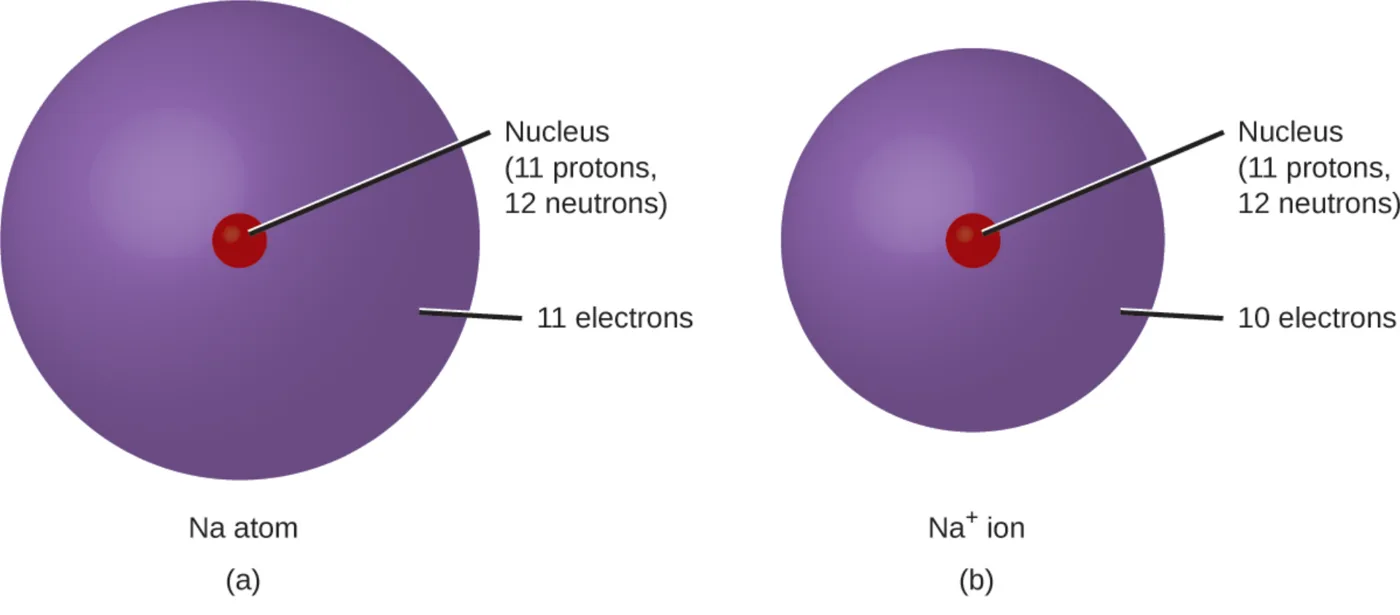
A neutral sodium atom has 11 protons and 11 electrons
so its charges balance. If it loses one electron, it keeps its 11 protons but has only 10 electrons. The extra positive charge gives a sodium cation, written Na+. The figure below compares the neutral atom with the ion.
1 / 6Next ▶
A neutral sodium atom with 11 protons and 11 electrons, next to a sodium ion that has lost one electron and carries a 1+ charge. Image: OpenStax, Chemistry 2e, CC BY 4.0.
Ions and their charges
 ⤢ Enlarge
1
A positive ion is a cation, and a negative ion is an anion. You can use the periodic table to predict which kind of ion an atom will form and often what its charge will be.
2
Atoms of most main-group metals lose enough electrons to reach the electron count of the noble gas before them in the table.
3
An alkali metal in group 1 loses one electron and forms a cation with a 1+ charge.
4
An alkaline earth metal in group 2 loses two electrons and forms a cation with a 2+ charge.
5
For example, a neutral calcium atom has 20 protons and 20 electrons.
6
It readily loses two electrons
which leaves 20 protons, 18 electrons and a 2+ charge.
◀ Previous2 / 6Next ▶
Ions and their charges
Ions and their charges
This ion has the same number of electrons as an argon atom and is written Ca2+.
A metal ion takes the name of its metal atom
so Ca2+ is the calcium ion.
Atoms of nonmetals form ions by gaining enough electrons to reach the electron count of the next noble gas.
Atoms in group 17 gain one electron and form anions with a 1− charge.
Atoms in group 16 gain two electrons and form ions with a 2− charge.
For example, a neutral bromine atom has 35 protons and 35 electrons.
◀ Previous3 / 6Next ▶
Ions and their charges
Ions and their charges
By gaining one electron it reaches 36 electrons
which gives an anion with 35 protons, 36 electrons and a 1− charge.
This ion has the same number of electrons as a krypton atom and is written Br−.
The reason noble gas electron counts are favored is explained in a later chapter.
The periodic table gives a reliable guide to ion charges.
Moving from the far left toward the right, main-group elements tend to form cations whose charge equals the group number: group 1 forms 1+ ions, group 2 forms 2+ ions,
and so on.
Moving from the far right toward the left, elements tend to form anions whose negative charge equals the number of groups between them and the noble gases: group 17 forms 1− ions and group 16 forms 2− ions.
◀ Previous4 / 6Next ▶
Ions and their charges
1
This guide becomes less reliable toward the center of the table.
2
Transition metals and some other metals often have variable charges that their position does not predict.
3
Copper forms ions with a 1+ or 2+ charge, and iron forms ions with a 2+ or 3+ charge.
4
The figure below shows the regular charge pattern of the main-group elements and the variable charges of the transition metals.
◀ Previous5 / 6Next ▶
A periodic table with the ion charge of each element labelled, showing the regular charge pattern of the main-group elements and the variable charges of several transition metals. Image: OpenStax, Chemistry 2e, CC BY 4.0.
Ions and their charges

◀ Previous6 / 6
1Polyatomic ions2Polyatomic ions3Polyatomic ions
Polyatomic ions
Polyatomic ions
The ions discussed so far are monatomic ions
which are formed from a single atom.
Many other ions are polyatomic ions.
A polyatomic ion is a group of bonded atoms that carries an overall electric charge and behaves as one unit.
An oxyanion is a polyatomic ion that contains one or more oxygen atoms.
You should memorize the names, formulas and charges of the most common polyatomic ions
because you will use them again and again.
Table 2.5 below lists the common ones with the acid related to each ion.
| Name | Formula | Related acid | Acid formula |
|---|---|---|---|
| ammonium | NH4+ | not applicable | not applicable |
| hydronium | H3O+ | not applicable | not applicable |
| peroxide | O22− | not applicable | not applicable |
| hydroxide | OH− | not applicable | not applicable |
| acetate | CH3COO− | acetic acid | CH3COOH |
| cyanide | CN− | hydrocyanic acid | HCN |
| azide | N3− | hydrazoic acid | HN3 |
| carbonate | CO32− | carbonic acid | H2CO3 |
| bicarbonate (hydrogen carbonate) | HCO3− | not applicable | not applicable |
| nitrate | NO3− | nitric acid | HNO3 |
| nitrite | NO2− | nitrous acid | HNO2 |
| sulfate | SO42− | sulfuric acid | H2SO4 |
| hydrogen sulfate | HSO4− | not applicable | not applicable |
| sulfite | SO32− | sulfurous acid | H2SO3 |
| hydrogen sulfite | HSO3− | not applicable | not applicable |
| phosphate | PO43− | phosphoric acid | H3PO4 |
| hydrogen phosphate | HPO42− | not applicable | not applicable |
| dihydrogen phosphate | H2PO4− | not applicable | not applicable |
| perchlorate | ClO4− | perchloric acid | HClO4 |
| chlorate | ClO3− | chloric acid | HClO3 |
| chlorite | ClO2− | chlorous acid | HClO2 |
| hypochlorite | ClO− | hypochlorous acid | HClO |
| chromate | CrO42− | chromic acid | H2CrO4 |
| dichromate | Cr2O72− | dichromic acid | H2Cr2O7 |
| permanganate | MnO4− | permanganic acid | HMnO4 |
1 / 3Next ▶
Polyatomic ions
1
Some oxyanions follow a naming system.
2
The suffix -ate marks an ion with more oxygen atoms than an -ite ion of the same element.
3
The prefix per- (short for hyper) means even more oxygen atoms than the -ate ion,
and the prefix hypo- (meaning under) means fewer oxygen atoms than the -ite ion.
4
For chlorine, perchlorate is ClO4−, chlorate is ClO3−, chlorite is ClO2−, and hypochlorite is ClO−.
5
The number of oxygen atoms linked to a suffix is not always the same from one element to another.
6
For example, nitrate is NO3− while sulfate is SO42−.
◀ Previous2 / 3Next ▶
Polyatomic ions
Polyatomic ions
The next naming topic covers this in more detail.
◀ Previous3 / 3
1Ionic compounds2Ionic compounds3Ionic compounds4Ionic compounds5Ionic compounds6Ionic compounds7Ionic compounds
Ionic compounds
Ionic compounds
The nature of the attractive forces that hold atoms or ions together in a compound is the basis for classifying chemical bonds.
When electrons are transferred and ions form, the result is an ionic bond, an electrostatic attraction between objects of opposite charge, in this case cations and anions.
When electrons are shared and molecules form, the result is a covalent bond.
A compound is classified as ionic or molecular (covalent) according to the bonds it contains.
When an element whose atoms readily lose electrons (a metal) reacts with an element whose atoms readily gain electrons (a nonmetal), electrons usually transfer and ions form.
The resulting ionic compound is stabilized by the electrostatic attractions between its oppositely charged ions.
1 / 7Next ▶
Ionic compounds
1
For example, each sodium atom in sodium metal gives up one electron to form Na+,
and each chlorine atom in chlorine gas accepts one electron to form the chloride anion Cl−.
2
The compound NaCl therefore contains Na+ and Cl− ions in a 1 to 1 ratio.
3
Similarly, each calcium atom can give up two electrons, transferring one to each of two chlorine atoms, to form CaCl2.
4
It contains one Ca2+ ion for every two Cl− ions.
5
The periodic table helps you recognize many ionic compounds. When a metal combines with one or more nonmetals, the compound is usually ionic. This rule works well for most compounds met in an introductory course
but it is not always true. Aluminum chloride, AlCl3, is not ionic, for example.
6
Ionic compounds have recognizable properties.
◀ Previous2 / 7Next ▶
Ionic compounds
1
They are solids that usually melt at high temperatures and boil at even higher temperatures.
2
Sodium chloride melts at 801 °C and boils at 1413 °C
while the molecular compound water melts at 0 °C and boils at 100 °C.
3
As a solid, an ionic compound does not conduct electricity
because its ions cannot flow.
4
Electricity is the flow of charged particles.
5
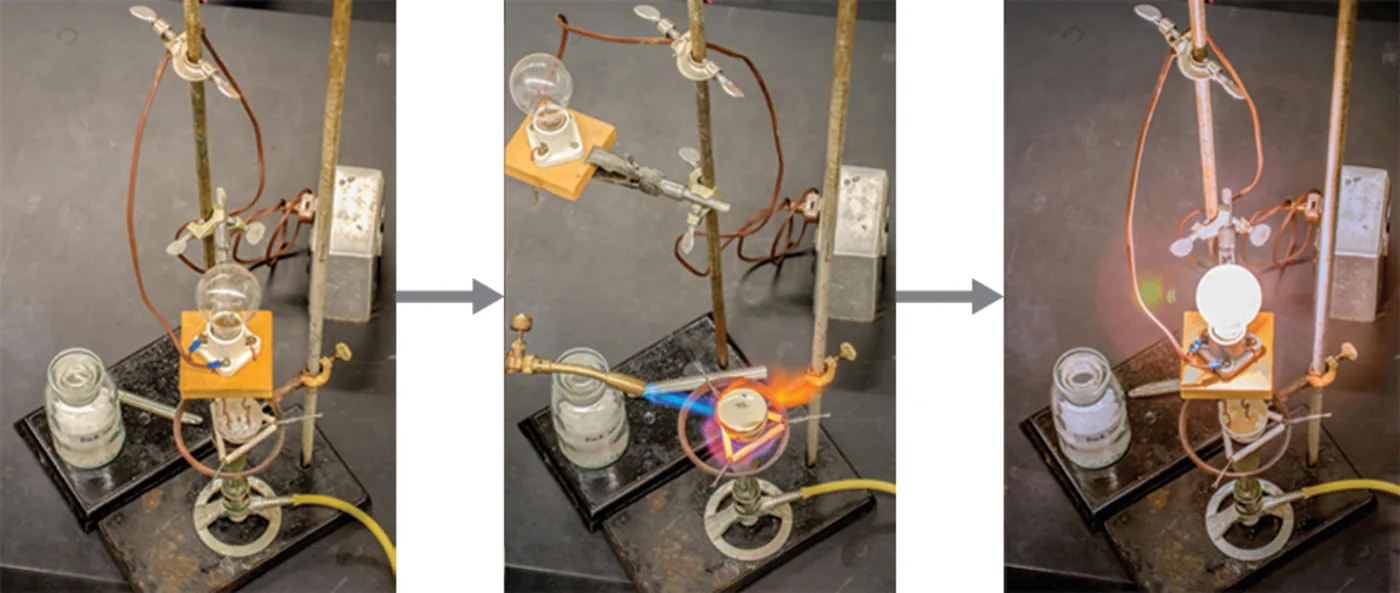
When the compound is molten, its ions can move freely through the liquid
so it conducts electricity.
6
The demonstration below shows this behavior.
◀ Previous3 / 7Next ▶
Three stages of a demonstration: an unlit bulb in a circuit with solid salt, the salt heated in a crucible until it melts, and the bulb glowing once the molten salt conducts electricity. Image: OpenStax, Chemistry 2e, CC BY 4.0.
Ionic compounds
 ⤢ Enlarge
Ionic compounds
In every ionic compound the total positive charge of the cations equals the total negative charge of the anions
so the compound is electrically neutral overall.
Use this rule to write the formula.
The subscripts must give a ratio of ions in which the positive and negative charges are equal.
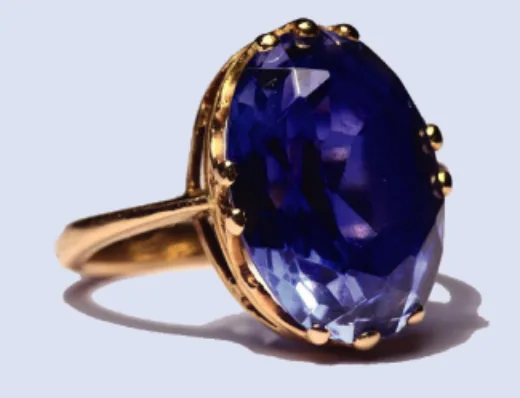
The gemstone sapphire is mostly an aluminum and oxygen compound made of Al3+ cations and O2− anions.
Because the compound must be neutral, two Al3+ ions (6+) balance three O2− ions (6−)
so the formula is Al2O3.
Pure aluminum oxide is colorless, and trace amounts of iron and titanium give sapphire its blue color, as the photograph shows.
◀ Previous4 / 7Next ▶
A blue sapphire set in a gold ring. The stone is mostly aluminum oxide, which would be colorless without small amounts of other metals. Image: OpenStax, Chemistry 2e, CC BY 4.0.
Ionic compounds
 ⤢ Enlarge
1
Many ionic compounds contain polyatomic ions as the cation, the anion or both.
2
These compounds must also be electrically neutral
so their formulas come from treating each polyatomic ion as one unit.
3
Parentheses group a polyatomic ion that appears more than once.
4
Calcium phosphate, a mineral in bones, is Ca3(PO4)2.
5
It contains three Ca2+ ions for every two phosphate ions, PO43−.
6
Its charges are 6+ and 6−, and the formula counts three Ca, two P and eight O atoms.
◀ Previous5 / 7Next ▶
Ionic compounds
Ionic compounds
An ionic compound is not made of separate molecules
so it should not be written with a molecular formula.
An ionic formula gives the relative numbers of its ions.
For compounds of monatomic ions, such as NaCl, and for many compounds of polyatomic ions, such as CaSO4, this formula is the empirical formula.
Some ionic compounds with polyatomic ions do not have empirical formulas.
Sodium oxalate contains Na+ and oxalate ions in a 2 to 1 ratio
so its formula is written Na2C2O4.
Its subscripts can all be divided by 2 to give the empirical formula NaCO2.
◀ Previous6 / 7Next ▶
Ionic compounds
Ionic compounds
That is not the accepted formula
because it does not show the oxalate ion as a unit.
◀ Previous7 / 7
1Molecular compounds2Molecular compounds3Molecular compounds4Molecular compounds
Molecular compounds
1
1
2
Molecular compounds often exist as gases, low-boiling liquids or low-melting solids under normal conditions,
3
although there are many important exceptions.
4
This is one way to recognize them.
5
Their melting and boiling points are much lower than those of ionic compounds.
6
2
1 / 4Next ▶
Molecular compounds
1
Covalent compounds are usually formed by combinations of nonmetals,
2
while ionic compounds are usually formed when a metal combines with a nonmetal.
3
The periodic table therefore helps us recognize many covalent compounds: if all the elements in a compound are nonmetals, it is probably molecular.
4
This approach is simplistic, however, and does not account for many interesting exceptions.
5
Compounds lie on a range between clearly ionic and clearly molecular, and the details are studied later.
6
3
◀ Previous2 / 4Next ▶
Molecular compounds
Molecular compounds
Many compounds contain no ions.
They consist only of discrete, neutral molecules.
These molecular compounds, also called covalent compounds, form when atoms share electrons instead of transferring them.
A covalent bond is the attraction between the positively charged nuclei of the bonded atoms and one or more pairs of electrons located between those atoms.
The covalent bond holds the atoms of each molecule together.
4
◀ Previous3 / 4Next ▶
Molecular compounds
1
To classify a compound, look at the bonds it contains.
2
A compound made of metal and nonmetal ions that are held together by transferred electrons is ionic.
3
A compound whose atoms share electrons in discrete molecules is molecular.
4
Water is an example of a molecular compound
which is why its melting and boiling points are far lower than those of sodium chloride.
◀ Previous4 / 4
1Example 2.8: Composition of ions2Example 2.9: Formation of ions3Example 2.9: Formation of ions · Example 2.10: Predicting th4Example 2.11: Predicting the formula of a compound with a po5Example 2.12: Predicting the type of bonding in compounds
Example 2.8: Composition of ions
Example 2.8: Composition of ions
Problem. An ion found in some antiperspirant compounds contains 13 protons and 10 electrons. What is its symbol?
Solution. The number of protons does not change when an atom forms an ion
so the atomic number of the element is 13. The periodic table identifies this element as aluminum, Al.
The aluminum atom has lost three electrons
so it has 13 positive charges and 10 electrons, a net charge of 3+.
The ion is the aluminum cation, Al3+.
Check your learning. Give the symbol and name of the ion with 34 protons and 36 electrons. Answer: Se2−, the selenide ion. Selenium has 34 protons, and gaining two electrons gives 36 electrons and a 2− charge.
1 / 5Next ▶
Example 2.9: Formation of ions
Example 2.9: Formation of ions
Problem. Magnesium and nitrogen react to form an ionic compound. Predict which element forms an anion
which forms a cation, and the charge of each ion. Write the symbol for each ion and name it.
Solution. Magnesium is in group 2
so it is a metal and forms a cation.
A magnesium atom must lose two electrons to match the electron count of the previous noble gas, neon.
It forms Mg2+, the magnesium ion.
Nitrogen is in group 15
so it is a nonmetal and forms an anion.
A nitrogen atom must gain three electrons to match the electron count of the following noble gas, neon.
◀ Previous2 / 5Next ▶
Example 2.9: Formation of ions · Example 2.10: Predicting the formula of an ionic compound
Example 2.9: Formation of ions
It forms N3−, the nitride ion.
Check your learning. Aluminum and carbon react to form an ionic compound. Predict which forms an anion and which forms a cation, and give the charge of each ion. Answer: Aluminum forms a cation with a 3+ charge, Al3+, the aluminum ion. Carbon forms an anion with a 4− charge, C4−, the carbide ion.
Example 2.10: Predicting the formula of an ionic compound
Problem. Sapphire is mostly a compound of aluminum cations, Al3+, and oxide anions, O2−. What is the formula of this compound?
Solution. The compound must be electrically neutral
so the total positive and negative charges must be equal. Two Al3+ ions give 6+, and three O2− ions give 6−. The formula is Al2O3.
Check your learning. Predict the formula of the ionic compound formed by the sodium cation, Na+, and the sulfide anion, S2−. Answer: Na2S. Two Na+ ions (2+) balance one S2− ion (2−).
◀ Previous3 / 5Next ▶
Example 2.11: Predicting the formula of a compound with a polyatomic anion
1
Problem. Baking powder contains calcium dihydrogen phosphate, an ionic compound made of Ca2+ ions and H2PO4− ions. What is its formula?
2
Solution. The compound must be neutral
so two negative charges are needed to balance the 2+ charge of one calcium ion. That requires one Ca2+ ion for every two H2PO4− ions. The dihydrogen phosphate formula is enclosed in parentheses and given a subscript of 2. The formula is Ca(H2PO4)2.
3
Check your learning. Predict the formula of the ionic compound formed by the lithium ion and the peroxide ion, O22−.
4
Hint: use the periodic table to find the sign and charge of the lithium ion. Answer: Li2O2.
5
Lithium is in group 1
so Li+ has a 1+ charge, and two of these balance one 2− peroxide ion.
◀ Previous4 / 5Next ▶
Example 2.12: Predicting the type of bonding in compounds
Example 2.12: Predicting the type of bonding in compounds
Problem. Predict whether each compound is ionic or molecular: (a) KI, a source of iodine added to table salt
(b) H2O2, the hydrogen peroxide used as a bleach and disinfectant(c) CHCl3, the anesthetic chloroform(d) Li2CO3, a source of lithium in antidepressant medicines.
Solution. (a) Potassium is a group 1 metal and iodine is a group 17 nonmetal
so KI is predicted to be ionic.
(b) Hydrogen and oxygen are both nonmetals
so H2O2 is predicted to be molecular.
(c) Carbon, hydrogen and chlorine are all nonmetals
so CHCl3 is predicted to be molecular.
(d) Lithium is a group 1 metal and carbonate is a polyatomic ion
so Li2CO3 is predicted to be ionic.
Check your learning. Using the periodic table, predict whether each compound is ionic or covalent: (a) SO2
(b) CaF2(c) N2H4(d) Al2(SO4)3. Answer: (a) molecular(b) ionic(c) molecular(d) ionic.
◀ Previous5 / 5
Key terms
| Term | Meaning |
|---|---|
| ion | An electrically charged atom or group of atoms formed when electrons are gained or lost. |
| cation | A positively charged ion, formed when an atom loses one or more electrons. |
| anion | A negatively charged ion, formed when an atom gains one or more electrons. |
| monatomic ion | An ion formed from a single atom, such as Na+ or Cl−. |
| polyatomic ion | A group of bonded atoms that carries an overall charge and behaves as one unit, such as SO42−. |
| oxyanion | A polyatomic ion that contains one or more oxygen atoms. |
| ionic bond | The electrostatic attraction between oppositely charged ions. |
| ionic compound | A compound made of ions held together by ionic bonds, usually formed from a metal and one or more nonmetals. |
| covalent bond | The attraction between the positively charged nuclei of two atoms and the pair or pairs of electrons shared between them. |
| molecular (covalent) compound | A compound made of discrete, neutral molecules in which atoms share electrons. |
| electrostatic attraction | The attractive force between two objects of opposite electrical charge. |
| empirical formula | A formula that shows the smallest whole-number ratio of the atoms or ions in a compound. |
| Covalent compound | A compound, usually formed from nonmetals, whose atoms share electrons to form discrete neutral molecules. |
1Avoid these mistakes2Avoid these mistakes3Avoid these mistakes4Avoid these mistakes
Avoid these mistakes
1Avoid this
Thinking that the nucleus changes when an atom forms an ion.Avoid this
Only the number of electrons changes; the number of protons, and so the element, stays the same.Avoid this
2Avoid this
Reversing the direction of electron transfer, for example writing a metal anion instead of a cation.Avoid this
Metals lose electrons and form cations; nonmetals gain electrons and form anions.Avoid this
1 / 4Next ▶
Avoid these mistakes
3Avoid this
Assuming every transition metal has one fixed charge.Avoid this
Copper can form Cu+ or Cu2+, and iron can form Fe2+ or Fe3+, so their charges must be given or checked.Avoid this
4Avoid this
Writing an ionic formula without balancing the charges, such as AlO for aluminum oxide.Avoid this
The total positive and negative charges in the formula must be equal, which gives Al2O3.Avoid this
◀ Previous2 / 4Next ▶
Avoid these mistakes
5Avoid this
Confusing the oxygen-count suffixes.Avoid this
Sulfite has fewer oxygen atoms than sulfate, and hypochlorite has fewer than chlorite.Avoid this
Remember that the names do not follow one rule for every element.Avoid this
6Avoid this
Writing a polyatomic ion without parentheses when more than one is needed,Avoid this
◀ Previous3 / 4Next ▶
Avoid these mistakes
such as CaPO42 instead of Ca3(PO4)2,Avoid this
or reducing the subscripts of sodium oxalate to NaCO2.Avoid this
7Avoid this
Believing that a solid ionic compound conducts electricity. Its ions cannot move in the solid, so it conducts only when molten or dissolved.Avoid this
◀ Previous4 / 4