Curriculum
Chemistry 2e
Unit 1: Essential Ideas
0/14
Unit 2: Atoms, Molecules, and Ions
0/16
Unit 3: Composition of Substances and Solutions
0/10
Unit 4: Stoichiometry of Chemical Reactions
0/12
Unit 5: Thermochemistry
0/8
Unit 6: Electronic Structure and Periodic Properties of Elements
0/12
Unit 7: Chemical Bonding and Molecular Geometry
0/14
Unit 8: Advanced Theories of Covalent Bonding
0/10
Unit 9: Gases
0/23
Unit 10: Liquids and Solids
0/28
Unit 11: Solutions and Colloids
0/24
Unit 12: Kinetics
0/32
-
Unit 12 overview: Kinetics
 Preview
-
12.1 Chemical Reaction Rates
Preview
-
12.1 Chemical Reaction Rates - Check yourself
 Preview
-
Unit 12 overview: Kinetics
Preview
-
12.1 Chemical Reaction Rates
Preview
-
12.1 Chemical Reaction Rates - Check yourself
Preview
-
12.2 Factors Affecting Reaction Rates
Preview
-
12.2 Factors Affecting Reaction Rates - Check yourself
Preview
-
12.2 Factors Affecting Reaction Rates
Preview
-
12.2 Factors Affecting Reaction Rates - Check yourself
Preview
-
12.3 Rate Laws
Preview
-
12.3 Rate Laws - Check yourself
Preview
-
12.3 Rate Laws
Preview
-
12.3 Rate Laws - Check yourself
Preview
-
12.4 Integrated Rate Laws
Preview
-
12.4 Integrated Rate Laws - Check yourself
Preview
-
12.4 Integrated Rate Laws
Preview
-
12.4 Integrated Rate Laws - Check yourself
Preview
-
12.5 Collision Theory
Preview
-
12.5 Collision Theory - Check yourself
Preview
-
12.5 Collision Theory
Preview
-
Unit 12 review quiz: Kinetics
Preview
-
12.5 Collision Theory - Check yourself
Preview
-
12.6 Reaction Mechanisms
Preview
-
12.6 Reaction Mechanisms - Check yourself
Preview
-
12.6 Reaction Mechanisms
Preview
-
12.6 Reaction Mechanisms - Check yourself
Preview
-
12.7 Catalysis
Preview
-
12.7 Catalysis - Check yourself
Preview
-
12.7 Catalysis
Preview
-
12.7 Catalysis - Check yourself
Preview
-
Unit 12 review quiz: Kinetics
Preview
Unit 13: Fundamental Equilibrium Concepts
0/20
Unit 14: Acid-Base Equilibria
0/32
Unit 15: Equilibria of Other Reaction Classes
0/16
Unit 16: Thermodynamics
0/20
Unit 17: Electrochemistry
0/32
Unit 18: Representative Metals, Metalloids, and Nonmetals
0/52
Unit 19: Transition Metals and Coordination Chemistry
0/16
Unit 20: Organic Chemistry
0/20
Unit 21: Nuclear Chemistry
0/28
Text lesson
Unit 12 overview: Kinetics
Unit 12: Kinetics — CHEMISTRY notes: You will be able to explain what controls the rate of a chemical reaction, describe how rate laws and integrated rate laws are used, and relate reaction mechanisms and catalysts to the speed of a reaction.
1Chapter opener2Chapter opener
Chapter opener
Chapter opener
Kinetics is the part of chemistry that studies how fast a reaction proceeds and which molecular-level steps take it from reactants to products.
Chemists planning a reaction ask two questions: will it give the desired products in useful amounts, and how quickly will it happen?
Kinetics answers the second question and also explains the mechanism behind the speed,
which is essential when the yield or rate of a reaction must be controlled.
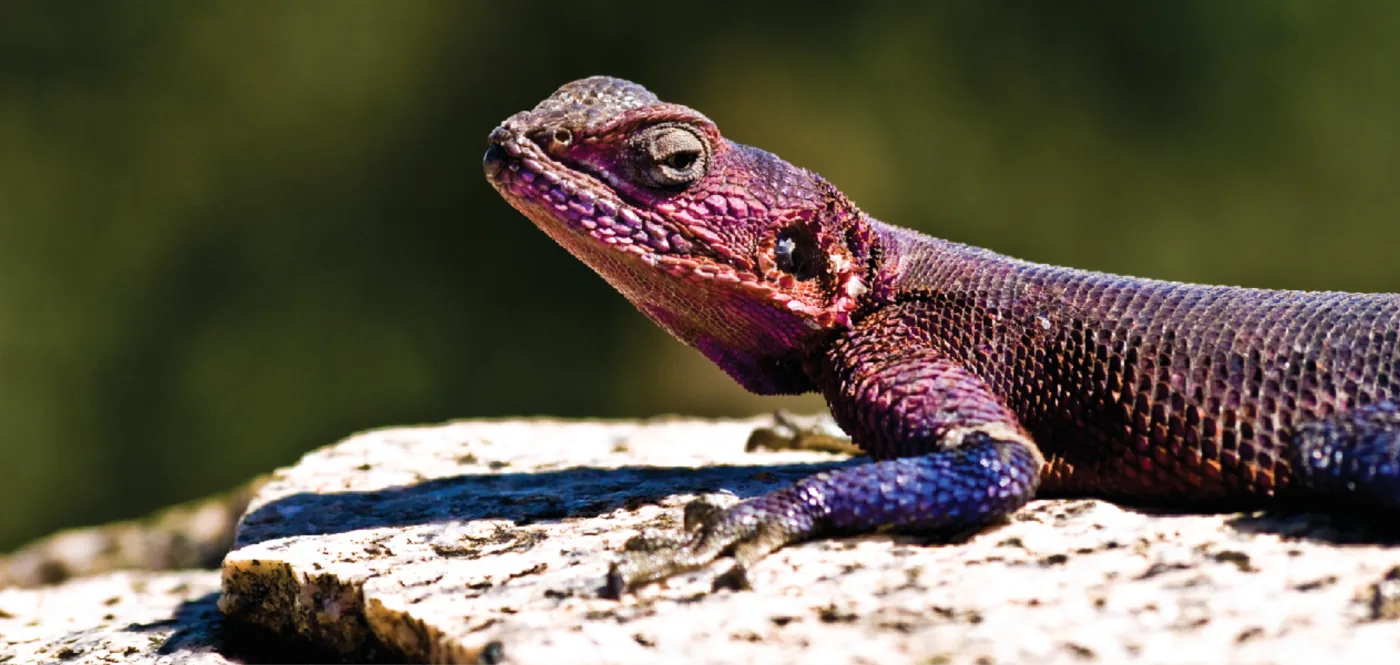
Rates matter in everyday life. Baking a cake, the warming of food, and the useful lifespan of a bridge all depend on reaction rates. The lizard in the photograph shows the effect of temperature: its muscles work through chemical reactions, and these reactions run faster when the body is warm
so a warm lizard moves faster than a cold one.
1 / 2Next ▶
An agama lizard basking in the sun; as its body warms, the chemical reactions that power its muscles speed up. Image: OpenStax, Chemistry 2e, CC BY 4.0.
Chapter opener
 ⤢ Enlarge
Chapter opener
This unit is organized into seven sections, each described below.
◀ Previous2 / 2
1Chapter sections2Chapter sections3Chapter sections
Key equations
1
Average rate of a reaction of substance A: rate = −Δ[A]/Δt
where [A] is the molar concentration in mol L−1 (M), Δt is the time interval in s, and the minus sign makes the rate of a reactant positive.
2
Rate law: rate = k[A]m[B]n
where k is the rate constant (its units depend on the overall order), and m and n are the reaction orders with respect to A and Bwhich are dimensionless.
3
Zero-order integrated rate law: [A] = −kt + [A]0, with k in mol L−1 s−1 and t in s. Half-life: t1/2 = [A]0/(2k).
4
First-order integrated rate law: ln[A] = −kt + ln[A]0, with k in s−1. Half-life: t1/2 = 0.693/k
which does not depend on concentration.
5
Second-order integrated rate law: 1/[A] = kt + 1/[A]0, with k in L mol−1 s−1. Half-life: t1/2 = 1/(k[A]0).
6
Arrhenius equation: k = Ae−Ea/RT, or in two-point form ln(k2/k1) = (Ea/R)(1/T1 − 1/T2). Here A is the frequency factor (same units as k), Ea is the activation energy in J mol−1, R = 8.314 J mol−1 K−1 is the gas constant, and T is the absolute temperature in K.
12.1 Chemical Reaction Rates
12.1 Chemical Reaction Rates
The rate of a reaction can be expressed either as the decrease in the amount of a reactant or the increase in the amount of a product per unit time.
Because the coefficients in the balanced equation fix how many moles of each species react, the rates of different species in the same reaction are directly related.
An average rate is calculated over a time interval, an instantaneous rate is the slope of the tangent to a concentration-time graph at one moment,
and the initial rate is the instantaneous rate at the start of the reaction.
12.2 Factors Affecting Reaction Rates
12.2 Factors Affecting Reaction Rates
Reactions involving two phases, such as a solid reacting with a liquid, speed up when the surface area of contact is greater
because more reactant particles are exposed at once. Raising the temperature or the concentration of a reactant generally increases the rate. A catalyst increases the rate by providing an alternative pathway with a lower activation energy.
12.3 Rate Laws
12.3 Rate Laws
A rate law is a differential equation that shows how the rate depends on the concentrations of reactants.
Rate laws are found by experiment and cannot be predicted from the balanced equation.
Each reaction order describes how strongly one reactant affects the rate, and the overall order is the sum of these orders.
Orders are usually zero, first or second
but fractional and negative values also occur.
The method of initial rates measures the initial rate at several starting concentrations to find the orders.
12.4 Integrated Rate Laws
12.4 Integrated Rate Laws
An integrated rate law is obtained from a rate law by calculus and gives the concentration of a reactant at any time.
Plotting the data in the right way reveals the order: a plot of [A] against time is a straight line for a zero-order reaction, a plot of ln[A] against time is straight for a first-order reaction,
and a plot of 1/[A] against time is straight for a second-order reaction.
The half-life is the time needed for half of a reactant to be consumed.
For a zero-order reaction, half-life gets shorter as the starting concentration falls
for a first-order reaction it is independent of concentrationfor a second-order reaction it gets shorter as the concentration rises.
12.5 Collision Theory
1
Collision theory explains the rate of a reaction by collisions between reactant particles.
2
A collision produces products only if the particles hit with the right orientation and with enough kinetic energy to overcome the activation energy.
3
Collision theory explains why higher temperature increases the rate: more molecules have the energy needed, and so more collisions succeed.
4
The Arrhenius equation links the rate constant to the activation energy, the temperature and the fraction of collisions with proper orientation,
which is represented by the frequency factor.
12.6 Reaction Mechanisms
1
The reaction mechanism is the sequence of elementary reactions, each with its own step in the chemical change, that converts reactants into products.
2
The molecularity of an elementary step is the number of reactant particles it involves: one for a unimolecular step, two for a bimolecular step,
and rarely three for a termolecular step.
3
The rate law of an elementary step follows directly from its molecularity,
so a unimolecular step is first order and a bimolecular step is second order.
4
The slowest step, the rate-determining step, controls the rate of the whole reaction.
5
A proposed mechanism is judged plausible only if the rate law it predicts matches the experimental rate law and the steps add up to the overall equation.
12.7 Catalysis
12.7 Catalysis
A catalyst speeds up a reaction by changing its mechanism so that the activation energy is lower.
It is not used up in the overall reaction and does not change the energy of reactants or products.
A homogeneous catalyst is in the same phase as the reactants,
while a heterogeneous catalyst is in a different phase and provides a surface where the reaction takes place.
Key terms
| Term | Meaning |
|---|---|
| Activated complex (transition state) | The unstable arrangement of reactant atoms at the highest point of the energy path, between reactants and products. |
| Activation energy (Ea) | The minimum energy that colliding particles must have for a reaction to take place. |
| Arrhenius equation | The relation k = Ae−Ea/RT that links the rate constant to activation energy and temperature. |
| Average rate | The change in concentration of a substance divided by the time interval over which the change happened. |
| Bimolecular reaction | An elementary reaction in which two reactant particles take part. |
| Catalyst | A substance that increases the rate of a reaction and is not consumed by it. |
| Collision theory | A model that explains reaction rates using the energy and orientation of molecular collisions. |
| Elementary reaction | A reaction that occurs in one step exactly as its equation is written. |
| Frequency factor (A) | The constant in the Arrhenius equation that measures how many collisions have a suitable orientation to form products. |
| Half-life (t1/2) | The time needed for half of a given amount of reactant to be used up. |
| Heterogeneous catalyst | A catalyst in a different phase from the reactants, which offers a surface for the reaction. |
| Homogeneous catalyst | A catalyst in the same phase as the reactants. |
| Initial rate | The instantaneous rate at the very start of a reaction, when time is zero. |
| Instantaneous rate | The rate of a reaction at one moment, found from the slope of the tangent to a concentration-time graph. |
| Integrated rate law | An equation that gives the concentration of a reactant as a function of elapsed time. |
| Intermediate | A species formed in one step of a mechanism and used up in a later step. |
| Method of initial rates | An experimental approach that measures initial rates at different starting concentrations to find a rate law. |
| Molecularity | The number of reactant particles that take part in an elementary reaction. |
| Overall reaction order | The sum of the orders with respect to each reactant in the rate law. |
| Rate constant (k) | The proportionality constant in a rate law that links the rate to the reactant concentrations. |
| Rate expression | A mathematical statement of the rate as the change in amount, concentration or pressure of a species per unit time. |
| Rate law (rate equation) | An equation showing how the rate depends on the rate constant and the concentrations of reactants. |
| Rate of reaction | A measure of how fast a chemical reaction takes place. |
| Rate-determining step (rate-limiting step) | The slowest elementary step in a mechanism, which sets the rate of the overall reaction. |
| Reaction diagram | A graph of energy against the progress of a reaction, used to show its activation energy and energy change. |
| Reaction mechanism | The stepwise sequence of elementary reactions by which a chemical change happens. |
| Reaction order | The exponent of a reactant concentration in a rate law; for example zero, first or second order. |
| Termolecular reaction | An elementary reaction in which three reactant particles take part at once. |
| Unimolecular reaction | An elementary reaction that involves a single reactant particle. |
1Avoid these mistakes2Avoid these mistakes3Avoid these mistakes