Curriculum
Chemistry 2e
Unit 1: Essential Ideas
0/14
Unit 2: Atoms, Molecules, and Ions
0/16
Unit 3: Composition of Substances and Solutions
0/10
Unit 4: Stoichiometry of Chemical Reactions
0/12
Unit 5: Thermochemistry
0/8
Unit 6: Electronic Structure and Periodic Properties of Elements
0/12
Unit 7: Chemical Bonding and Molecular Geometry
0/14
Unit 8: Advanced Theories of Covalent Bonding
0/10
Unit 9: Gases
0/23
Unit 10: Liquids and Solids
0/28
Unit 11: Solutions and Colloids
0/24
Unit 12: Kinetics
0/32
Unit 13: Fundamental Equilibrium Concepts
0/20
Unit 14: Acid-Base Equilibria
0/32
Unit 15: Equilibria of Other Reaction Classes
0/16
Unit 16: Thermodynamics
0/20
Unit 17: Electrochemistry
0/32
Unit 18: Representative Metals, Metalloids, and Nonmetals
0/52
-
Unit 18 overview: Representative Metals, Metalloids, and Nonmetals
 Preview
-
18.1 Periodicity
Preview
-
18.1 Periodicity - Check yourself
 Preview
-
18.1 Periodicity
Preview
-
18.1 Periodicity - Check yourself
Preview
-
18.2 Occurrence and Preparation of the Representative Metals
Preview
-
18.2 Occurrence and Preparation of the Representative Metals - Check yourself
Preview
-
18.2 Occurrence and Preparation of the Representative Metals
Preview
-
18.2 Occurrence and Preparation of the Representative Metals - Check yourself
Preview
-
18.3 Structure and General Properties of the Metalloids
Preview
-
18.3 Structure and General Properties of the Metalloids - Check yourself
Preview
-
18.3 Structure and General Properties of the Metalloids
Preview
-
18.3 Structure and General Properties of the Metalloids - Check yourself
Preview
-
18.4 Structure and General Properties of the Nonmetals
Preview
-
18.4 Structure and General Properties of the Nonmetals - Check yourself
Preview
-
18.4 Structure and General Properties of the Nonmetals
Preview
-
18.4 Structure and General Properties of the Nonmetals - Check yourself
Preview
-
18.5 Occurrence, Preparation, and Compounds of Hydrogen
Preview
-
18.5 Occurrence, Preparation, and Compounds of Hydrogen - Check yourself
Preview
-
18.5 Occurrence, Preparation, and Compounds of Hydrogen
Preview
-
18.5 Occurrence, Preparation, and Compounds of Hydrogen - Check yourself
Preview
-
18.6 Occurrence, Preparation, and Properties of Carbonates
Preview
-
18.6 Occurrence, Preparation, and Properties of Carbonates - Check yourself
Preview
-
18.6 Occurrence, Preparation, and Properties of Carbonates
Preview
-
18.6 Occurrence, Preparation, and Properties of Carbonates - Check yourself
Preview
-
Unit 18 review quiz: Representative Metals, Metalloids, and Nonmetals
Preview
-
Unit 18 overview: Representative Metals, Metalloids, and Nonmetals
Preview
-
18.7 Occurrence, Preparation, and Properties of Nitrogen
Preview
-
18.7 Occurrence, Preparation, and Properties of Nitrogen - Check yourself
Preview
-
18.7 Occurrence, Preparation, and Properties of Nitrogen
Preview
-
18.7 Occurrence, Preparation, and Properties of Nitrogen - Check yourself
Preview
-
18.8 Occurrence, Preparation, and Properties of Phosphorus
Preview
-
18.8 Occurrence, Preparation, and Properties of Phosphorus - Check yourself
Preview
-
18.8 Occurrence, Preparation, and Properties of Phosphorus
Preview
-
18.8 Occurrence, Preparation, and Properties of Phosphorus - Check yourself
Preview
-
18.9 Occurrence, Preparation, and Compounds of Oxygen
Preview
-
18.9 Occurrence, Preparation, and Compounds of Oxygen - Check yourself
Preview
-
18.9 Occurrence, Preparation, and Compounds of Oxygen
Preview
-
18.9 Occurrence, Preparation, and Compounds of Oxygen - Check yourself
Preview
-
18.10 Occurrence, Preparation, and Properties of Sulfur
Preview
-
18.10 Occurrence, Preparation, and Properties of Sulfur - Check yourself
Preview
-
18.10 Occurrence, Preparation, and Properties of Sulfur
Preview
-
18.10 Occurrence, Preparation, and Properties of Sulfur - Check yourself
Preview
-
18.11 Occurrence, Preparation, and Properties of Halogens
Preview
-
18.11 Occurrence, Preparation, and Properties of Halogens - Check yourself
Preview
-
18.11 Occurrence, Preparation, and Properties of Halogens
Preview
-
18.11 Occurrence, Preparation, and Properties of Halogens - Check yourself
Preview
-
18.12 Occurrence, Preparation, and Properties of the Noble Gases
Preview
-
18.12 Occurrence, Preparation, and Properties of the Noble Gases - Check yourself
Preview
-
18.12 Occurrence, Preparation, and Properties of the Noble Gases
Preview
-
18.12 Occurrence, Preparation, and Properties of the Noble Gases - Check yourself
Preview
-
Unit 18 review quiz: Representative Metals, Metalloids, and Nonmetals
Preview
Unit 19: Transition Metals and Coordination Chemistry
0/16
Unit 20: Organic Chemistry
0/20
Unit 21: Nuclear Chemistry
0/28
Text lesson
18.1 Periodicity
18.1 Periodicity — CHEMISTRY notes: Classify the elements by their electron configurations and predict how the properties of the representative metals change within groups 1, 2, 12, 13 and 14.
1Periodicity and classification2Periodicity and classification3Periodicity and classification
Periodicity and classification
Periodicity and classification
Periodicity means that many element properties repeat in a regular pattern as atomic number increases.
One useful way to organize the elements is by their electron configurations.
The representative elements are those in which the s and p orbitals are being filled.
The transition elements are those in which the d orbitals (groups 3 to 11) are being filled,
and the inner transition metals are those in which the f orbitals are being filled.
Group 12 counts as representative, not transition
because its last electron enters an s orbital.
1 / 3Next ▶
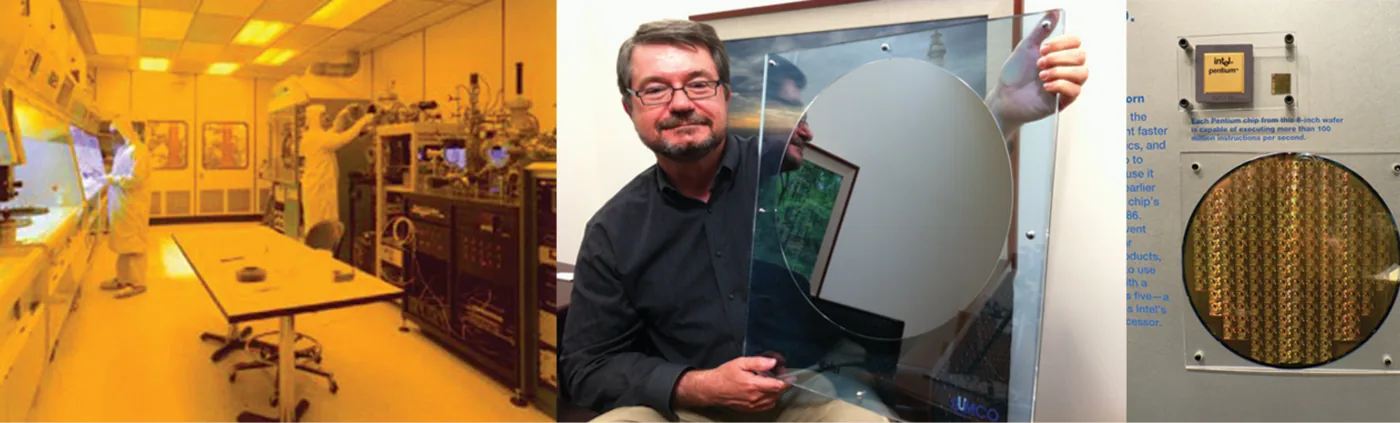
Silicon wafers must be extremely pure. A cleanroom technician handles pure silicon, a pure wafer is shown, and a finished wafer covered in microchips is shown on the right. Image: OpenStax, Chemistry 2e, CC BY 4.0.
Periodicity and classification
 ⤢ Enlarge
1
Representative metals are the metals among the representative elements.
2
Their metallic character comes from how easily they lose their outer valence electrons.
3
This gives them high thermal and electrical conductivity and other typical metallic properties.
4
There are 20 nonradioactive representative metals, found in groups 1, 2, 3, 12, 13, 14 and 15.
The radioactive metals copernicium, flerovium, polonium and livermorium are also metals, but they are outside the scope of this chapter.
5
Some representative elements are metalloids.
6
A metalloid has properties between those of metals and nonmetals, and metalloids are typically semiconductors.
◀ Previous2 / 3Next ▶
A periodic table that marks the representative metals, nonmetals, metalloids, and the transition and inner transition metals in different colors. Image: OpenStax, Chemistry 2e, CC BY 4.0.
Periodicity and classification
 ⤢ Enlarge
Periodicity and classification
The remaining representative elements are nonmetals.
Metals usually form cations and ionic compounds
while nonmetals tend to form anions or molecular compounds.
When a metal combines with a nonmetal, the product is usually a salt
which is an ionic compound made of cations and anions.
◀ Previous3 / 3
Occurrence and passivation
Occurrence and passivation
Most representative metals do not occur in nature in their uncombined form
because they react readily with water and oxygen in the air.
Beryllium, magnesium, zinc, cadmium, mercury, aluminum, tin and lead can still be isolated from their minerals
because they react slowly with air.
This slow reaction is due to passivation, in which the metal forms a nonreactive film, usually an oxide or another compound, that protects the surface from further attack.
Magnesium, aluminum, zinc and tin are important in making wire, cookware, foil and many household items.
Beryllium, cadmium, mercury and lead are available
but their use is limited by toxicity.
1Group 1: The alkali metals2Group 1: The alkali metals3Group 1: The alkali metals4Group 1: The alkali metals
Group 1: The alkali metals
1
The alkali metals are lithium, sodium, potassium, rubidium, cesium and francium. Hydrogen is also in group 1
but it is a nonmetal and is discussed later in the chapter. The name alkali metal refers to the fact that these metals and their oxides react with water to form strongly basic (alkaline) solutions.
2
The alkali metals have the largest atomic radii and the lowest first ionization energies in their periods.
3
Because their single valence electron is so easy to remove, they form stable 1+ cations.
4
Their reactivity increases down the group as the ionization energy decreases.
5
Since oxidation is so easy, the reverse process, reduction, is difficult
which is why the metals are hard to isolate.
6
The solid alkali metals are very soft.
1 / 4Next ▶
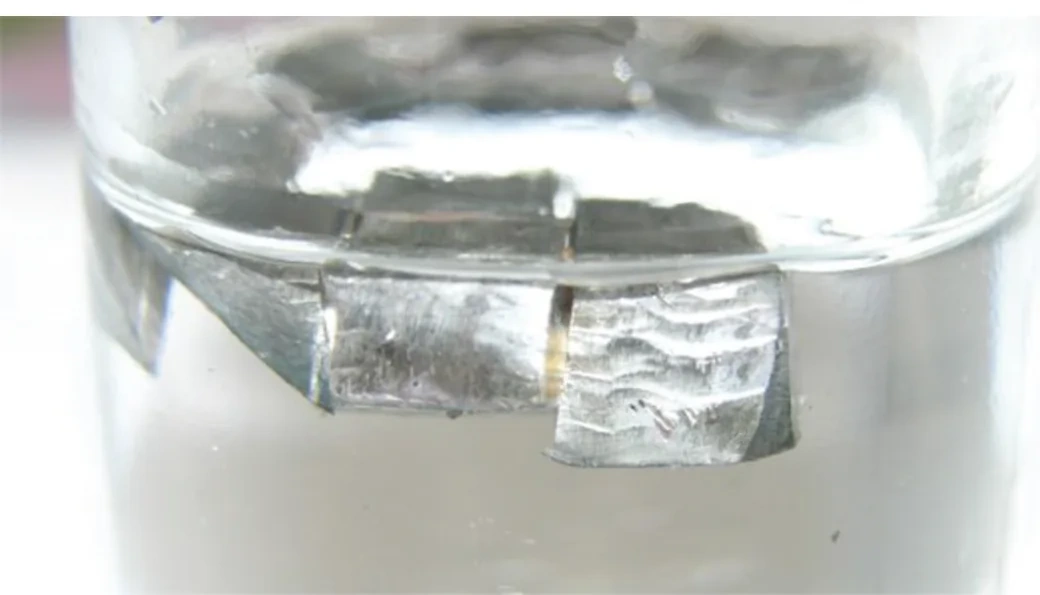
A piece of lithium floats on paraffin oil, which shows that lithium is less dense than the oil. Image: OpenStax, Chemistry 2e, CC BY 4.0.
Group 1: The alkali metals
 ⤢ Enlarge
1
Lithium has the lowest density of any metal, about 0.5 g/cm3, and it floats on paraffin oil.
2
All the alkali metals react vigorously with water to produce hydrogen gas and a basic solution of the metal hydroxide. For lithium, the reaction is 2Li(s) + 2H2O(l) → 2LiOH(aq) + H2(g).
3
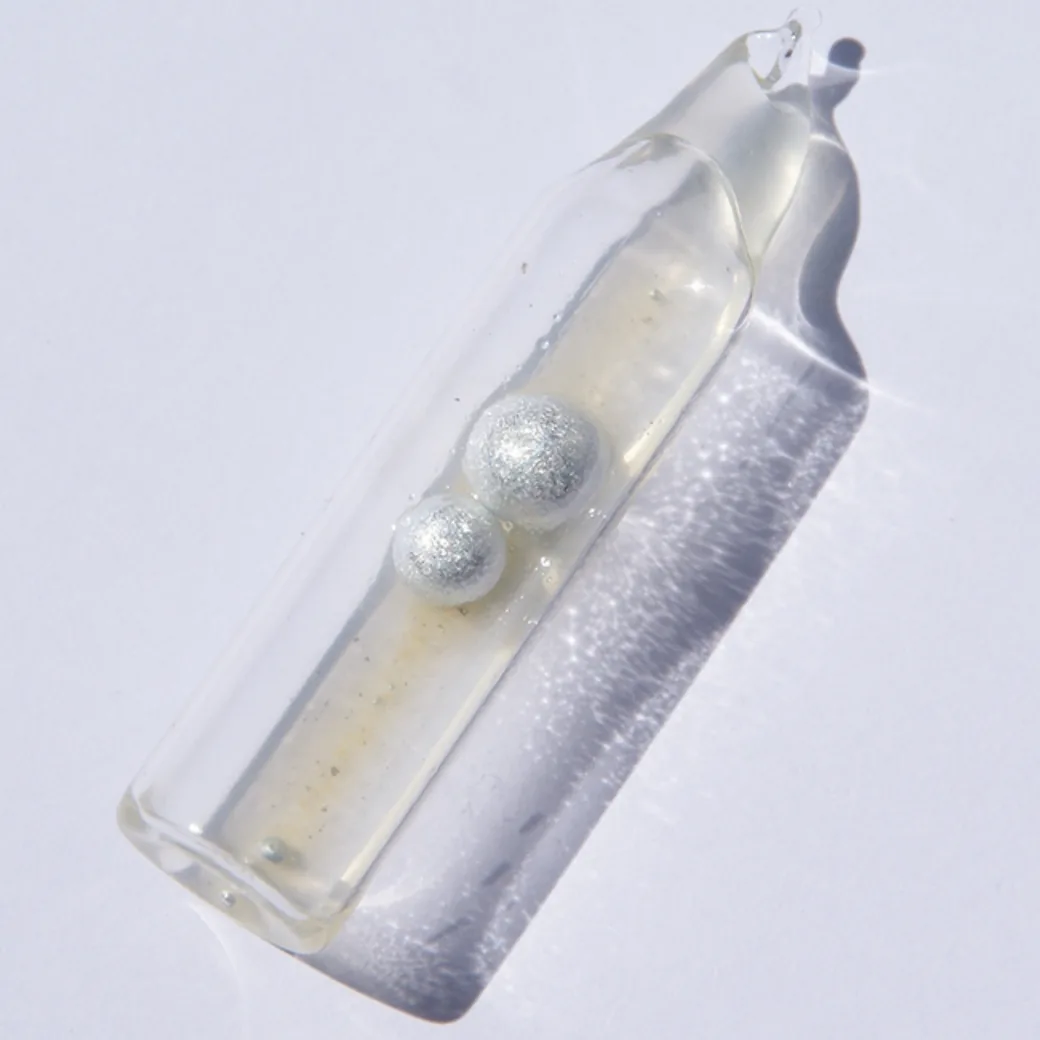
The alkali metals react directly with almost all nonmetals, except the noble gases, to form binary ionic compounds containing 1+ metal ions. Because they react with moisture and oxygen, they are stored in sealed containers under mineral oil. The pure metals never occur free in nature, and they are prepared by electrolysis of their compounds.
◀ Previous2 / 4Next ▶
Laboratory potassium is kept as sticks or beads under kerosene or mineral oil, or in sealed containers, to keep it away from air and water. Image: OpenStax, Chemistry 2e, CC BY 4.0.
Group 1: The alkali metals
 ⤢ Enlarge
Group 1: The alkali metals
Because they are soft and reactive, alkali metals are unsuitable for structural use. They are useful as reducing agents, however. Sodium is used to reduce compounds of titanium and zirconium, and lithium and sodium are used to reduce compounds in the manufacture of many organic chemicals, including some dyes, drugs and perfumes.
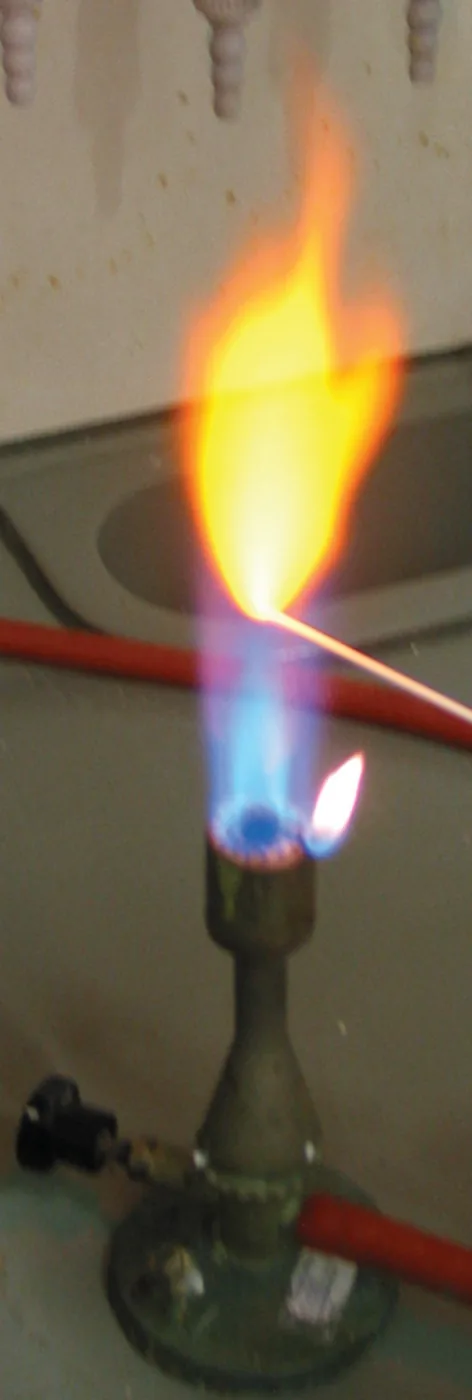
Sodium and its compounds give a bright yellow color to a flame, and an electrical discharge through sodium vapor gives the same color.
This is an emission spectrum, produced when excited electrons fall back to lower energy levels.
Sodium vapor streetlights are used because fog scatters yellow light less than white light
so yellow light passes through fog better.
Lithium gives a bright crimson flame, and the other alkali metals give a pale violet flame.
◀ Previous3 / 4Next ▶
A wire dipped in a sodium salt and heated gives off a bright yellow light, which identifies sodium. Image: OpenStax, Chemistry 2e, CC BY 4.0.
Group 1: The alkali metals
 ⤢ Enlarge
Group 1: The alkali metals
The video linked in the book demonstrates the reactions of the alkali metals with water. Watching it shows how the reaction becomes more violent as you move down group 1.
◀ Previous4 / 4
1Group 2: The alkaline earth metals2Group 2: The alkaline earth metals3Group 2: The alkaline earth metals4Group 2: The alkaline earth metals5Group 2: The alkaline earth metals
Group 2: The alkaline earth metals
Group 2: The alkaline earth metals
The alkaline earth metals are beryllium, magnesium, calcium, strontium, barium and radium.
Their oxides are called alkaline because the oxides of the heavier members react with water to form alkaline solutions.
The nuclear charge increases from group 1 to group 2,
so these atoms are smaller and have higher first ionization energies than the alkali metals in the same period.
They are therefore less reactive than the alkali metals
but they are still very reactive.
Their reactivity increases down the group as the atoms get larger and the ionization energy falls.
1 / 5Next ▶
Group 2: The alkaline earth metals
Group 2: The alkaline earth metals
Alkaline earth metals lose both of their valence electrons to form compounds in which the metal has an oxidation state of 2+.
Because they are so reactive, they are usually prepared by electrolysis.
Beryllium and magnesium have the highest ionization energies in the group, and their compounds show some covalent character.
Calcium and strontium color a flame red, and barium colors it green.
These colors come from emission spectra, as with the alkali metals.
Magnesium is a silver-white metal that is malleable and ductile at high temperatures.
◀ Previous2 / 5Next ▶
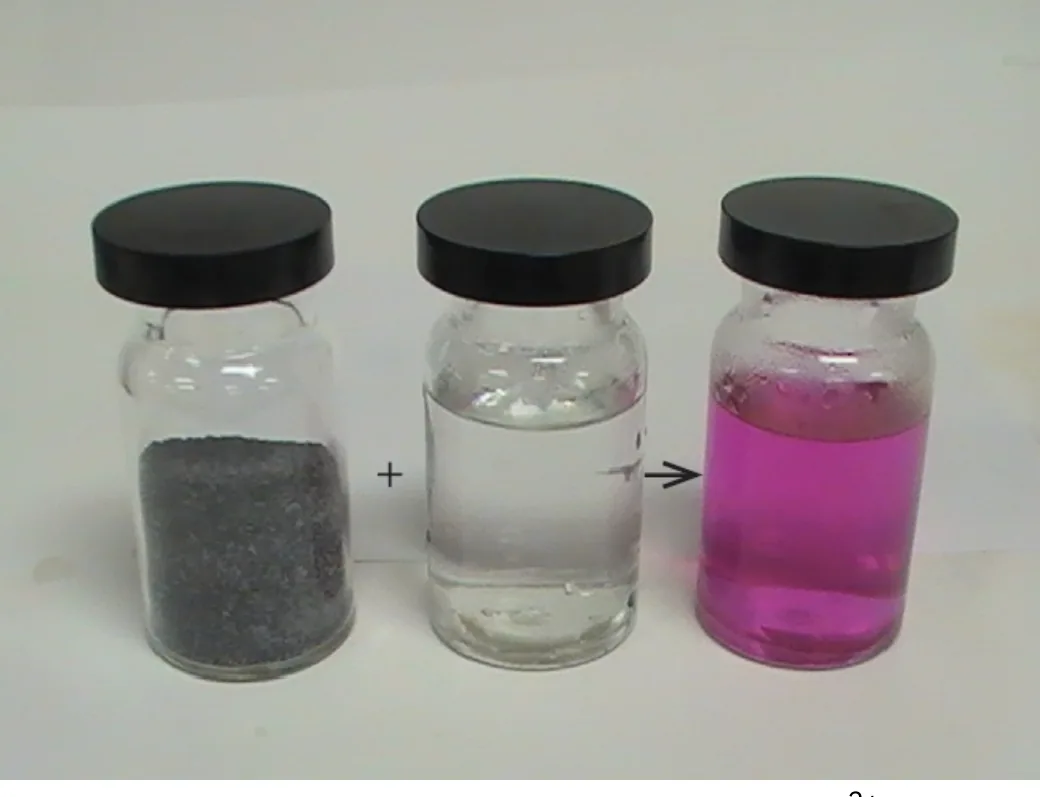
Magnesium metal in hot water slowly forms a basic solution, which turns pink when phenolphthalein indicator is added. Image: OpenStax, Chemistry 2e, CC BY 4.0.
Group 2: The alkaline earth metals
 ⤢ Enlarge
1
Air forms a tightly adhering layer of magnesium oxycarbonate on its surface
which passivates the metal.
2
The carbonate part comes from carbon dioxide in the atmosphere.
3
Magnesium is the lightest widely used structural metal
so most of its production goes into lightweight alloys.
4
Magnesium, calcium, strontium and barium react with water and air.
5
Barium is the most vigorous of these at room temperature.
6
The reaction with water gives hydrogen gas and the metal hydroxide.
◀ Previous3 / 5Next ▶
Group 2: The alkaline earth metals
1
For magnesium in hot water, the reaction is Mg(s) + 2H2O(l) → Mg(OH)2(aq) + H2(g).
2
Because these metals produce hydrogen, they are better reducing agents than hydrogen.
3
They react with acids and nonmetals to form ionic compounds.
4
Many common salts of the alkaline earth metals are insoluble in water
because the divalent ions give these compounds high lattice energies.
5
Hot magnesium is a strong reducing agent and can remove oxygen from other metal oxides.
6
Magnesium has such a strong affinity for oxygen that burning magnesium also reacts with carbon dioxide: 2Mg(s) + CO2(g) → 2MgO(s) + C(s).
◀ Previous4 / 5Next ▶
Group 2: The alkaline earth metals
Group 2: The alkaline earth metals
For this reason, a carbon dioxide fire extinguisher cannot put out a magnesium fire.
The brilliant white light of burning magnesium is used in flares and fireworks.
◀ Previous5 / 5
1Group 122Group 123Group 124Group 125Group 12
Group 12
1
The group 12 elements are zinc, cadmium, mercury and copernicium.
2
They sit among the transition metals,
but their last electron is an s electron,so they are called post-transition metals and are counted as representative metals.
3
Their chemistry is closer to the alkaline earth metals than to the transition metals.
4
Each has two outer electrons (ns2)
which they lose to form 2+ cations with pseudo-noble gas electron configurations.
5
Mercury also forms the diatomic Hg22+ ion, in which mercury has a 1+ oxidation state.
6
Cadmium and mercury are toxic in both their elemental forms and their compounds.
1 / 5Next ▶
Group 12
Group 12
Zinc is the most reactive metal in group 12, and mercury is the least reactive.
This is the reverse of the trend in groups 1 and 2
where reactivity rises down the group.
The lower reactivity of mercury comes from the pseudo-noble gas ions it forms and from other factors beyond this discussion.
Zinc and cadmium behave similarly to each other
but mercury differs from both.
Zinc and cadmium have lower reduction potentials than hydrogen
so they release hydrogen gas when they react with acids.
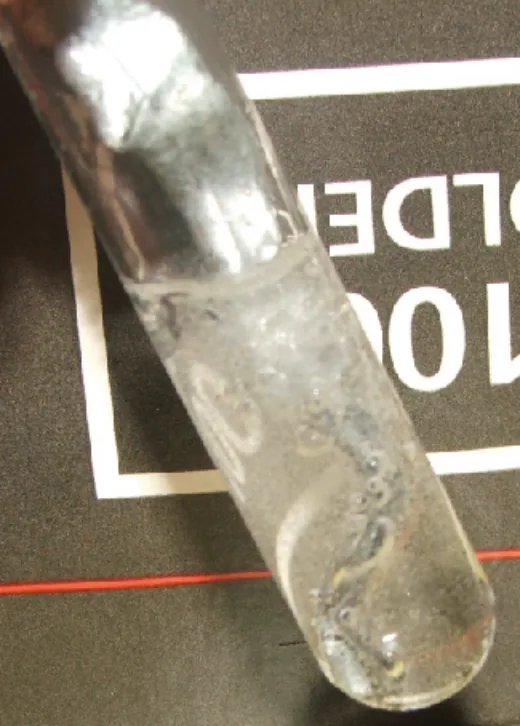
For zinc and hydrochloric acid, the reaction is Zn(s) + 2HCl(aq) → ZnCl2(aq) + H2(g).
◀ Previous2 / 5Next ▶
Zinc dissolves in hydrochloric acid, which produces a colorless solution of zinc ions and bubbles of hydrogen gas. Image: OpenStax, Chemistry 2e, CC BY 4.0.
Group 12
 ⤢ Enlarge
Group 12
Zinc is a silvery metal that tarnishes to a blue-gray color.
This tarnish is a basic carbonate, Zn2(OH)2CO3, that passivates the metal.
Zinc is used in dry cell and alkaline batteries
where it forms the anode.
Brass (copper and zinc) and some bronzes that contain zinc are important alloys.
About half of all zinc production protects iron and other metals from corrosion, either as a sacrificial anode or as a thin coating.
Galvanized steel is steel coated with zinc.
◀ Previous3 / 5Next ▶
Group 12
1
Mercury is very different from zinc and cadmium.
2
It is the only metal that is liquid at 25 °C.
3
Many metals dissolve in it to form amalgams
which are alloys of mercury with other metals.
4
Mercury is harder to oxidize than hydrogen
so it does not release hydrogen from acids.
5
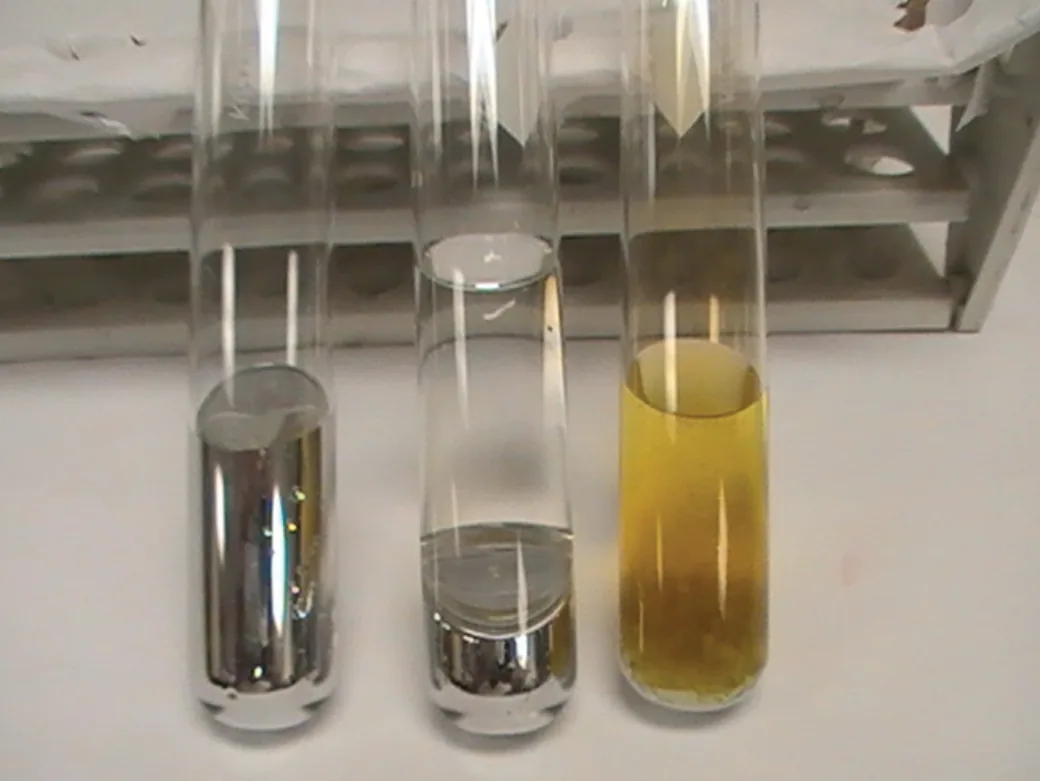
It does react with a strong oxidizing acid such as nitric acid, and the initial product is NO: 3Hg(l) + 8HNO3(aq) → 3Hg(NO3)2(aq) + 2NO(g) + 4H2O(l).
6
The colorless NO quickly oxidizes further to reddish-brown NO2.
◀ Previous4 / 5Next ▶
Three samples of mercury: liquid mercury alone, mercury with concentrated hydrochloric acid that shows no reaction, and mercury with concentrated nitric acid that reacts. Image: OpenStax, Chemistry 2e, CC BY 4.0.
Group 12
 ⤢ Enlarge
Group 12
Most mercury compounds decompose when heated. Most contain mercury in the 2+ oxidation state. When mercury is in large excess, compounds with the Hg22+ ion can form. All mercury compounds are toxic
so their preparation requires great care.
◀ Previous5 / 5
1Chemistry in Everyday Life: Sacrificial anodes2Chemistry in Everyday Life: Sacrificial anodes
1Group 132Group 133Group 134Group 135Group 13
1Chemistry in Everyday Life: Amalgams2Chemistry in Everyday Life: Amalgams
1Group 142Group 143Group 144Group 14
Group 13 and group 14 summary
1
Across the representative metals, the pattern is clear.
2
Group 1 metals are soft, very reactive and form 1+ ions.
3
Group 2 metals are less reactive and form 2+ ions.
4
Group 12 is unusual because its reactivity falls down the group.
5
Group 13 changes from covalent boron to metallic aluminum, gallium, indium and thallium, with amphoteric oxides for the lighter metals and basic oxides for the heavier ones.
6
Group 14 shows the inert pair effect, with 2+ ions becoming more stable for the heavier metals.
Group 15: Bismuth
Group 15: Bismuth
Bismuth is the heaviest member of group 15 and the least reactive of the representative metals in its group.
It readily gives up three of its five valence electrons to active nonmetals, forming the tri-positive ion Bi3+.
Bismuth forms compounds in which it has the group oxidation state of 5+ only when it is treated with strong oxidizing agents.
The preference for the 3+ state is another example of the inert pair effect. The two s electrons of the outer shell stay paired and are not lost
so the 3+ oxidation state is the stable one for bismuth.
Example: reacting lithium with water
Example: reacting lithium with water
Lithium reacts as 2Li(s) + 2H2O(l) → 2LiOH(aq) + H2(g). The coefficients show that 2 mol of lithium make 1 mol of hydrogen gas. For 0.50 mol of lithium, the product is 0.25 mol of H2
which is equal to 0.25 mol × 22.4 L/mol ≈ 5.6 L at standard temperature and pressure.
Key terms
| Term | Meaning |
|---|---|
| Representative elements | Elements in which the s and p orbitals are being filled. |
| Transition elements | Elements in which the d orbitals (groups 3 to 11) are being filled. |
| Inner transition metals | Elements in which the f orbitals are being filled. |
| Representative metals | The metals among the representative elements. |
| Metallic character | An element’s ability to lose its outer valence electrons, which gives it high conductivity and other metallic properties. |
| Metalloid | An element with properties between those of metals and nonmetals, typically a semiconductor. |
| Salt | An ionic compound made of cations and anions, usually formed from a metal and a nonmetal. |
| Passivation | The formation of a nonreactive surface film, such as an oxide, that slows further corrosion of a metal. |
| Alkali metals | Group 1 metals, which form 1+ ions and react vigorously with water to give basic solutions. |
| Alkaline earth metals | Group 2 metals, which form 2+ ions and produce alkaline solutions from their heavier oxides. |
| Post-transition metals | Metals such as the group 12 elements, whose last electron enters an s orbital although they are in the transition region. |
| Pseudo-noble gas configuration | The electron arrangement of a metal ion that resembles that of a noble gas, reached when the outer electrons are lost. |
| Amphoteric | Describes a substance that reacts with both acids and bases, such as aluminum or its oxide. |
| Inert pair effect | The tendency of heavier p-block elements to form stable ions with an oxidation state two less than the group number suggests. |
| Amalgam | An alloy of mercury with one or more other metals. |
| Cathodic protection | A method of preventing corrosion by making the metal to be protected act as a cathode. |
| Sacrificial anode | A more active metal attached to a structure so that it corrodes in place of the protected metal; also called a galvanic anode. |
| Lattice energy | The energy released when gaseous ions form a solid ionic crystal; high values make salts insoluble in water. |
1Avoid these mistakes2Avoid these mistakes3Avoid these mistakes