Curriculum
Chemistry 2e
Unit 1: Essential Ideas
0/14
Unit 2: Atoms, Molecules, and Ions
0/16
Unit 3: Composition of Substances and Solutions
0/10
Unit 4: Stoichiometry of Chemical Reactions
0/12
Unit 5: Thermochemistry
0/8
Unit 6: Electronic Structure and Periodic Properties of Elements
0/12
Unit 7: Chemical Bonding and Molecular Geometry
0/14
Unit 8: Advanced Theories of Covalent Bonding
0/10
Unit 9: Gases
0/23
Unit 10: Liquids and Solids
0/28
-
Unit 10 overview: Liquids and Solids
 Preview
-
10.1 Intermolecular Forces
Preview
-
Unit 10 overview: Liquids and Solids
Preview
-
10.1 Intermolecular Forces
Preview
-
10.1 Intermolecular Forces - Check yourself
 Preview
-
10.1 Intermolecular Forces - Check yourself
Preview
-
10.2 Properties of Liquids
Preview
-
10.2 Properties of Liquids - Check yourself
Preview
-
10.2 Properties of Liquids
Preview
-
10.2 Properties of Liquids - Check yourself
Preview
-
10.3 Phase Transitions
Preview
-
10.3 Phase Transitions - Check yourself
Preview
-
10.3 Phase Transitions
Preview
-
10.3 Phase Transitions - Check yourself
Preview
-
10.4 Phase Diagrams
Preview
-
10.4 Phase Diagrams
Preview
-
10.4 Phase Diagrams - Check yourself
Preview
-
10.4 Phase Diagrams - Check yourself
Preview
-
10.5 The Solid State of Matter
Preview
-
10.5 The Solid State of Matter
Preview
-
10.5 The Solid State of Matter - Check yourself
Preview
-
10.5 The Solid State of Matter - Check yourself
Preview
-
10.6 Lattice Structures in Crystalline Solids
Preview
-
10.6 Lattice Structures in Crystalline Solids
Preview
-
10.6 Lattice Structures in Crystalline Solids - Check yourself
Preview
-
10.6 Lattice Structures in Crystalline Solids - Check yourself
Preview
-
Unit 10 review quiz: Liquids and Solids
Preview
-
Unit 10 review quiz: Liquids and Solids
Preview
Unit 11: Solutions and Colloids
0/24
Unit 12: Kinetics
0/32
Unit 13: Fundamental Equilibrium Concepts
0/20
Unit 14: Acid-Base Equilibria
0/32
Unit 15: Equilibria of Other Reaction Classes
0/16
Unit 16: Thermodynamics
0/20
Unit 17: Electrochemistry
0/32
Unit 18: Representative Metals, Metalloids, and Nonmetals
0/52
Unit 19: Transition Metals and Coordination Chemistry
0/16
Unit 20: Organic Chemistry
0/20
Unit 21: Nuclear Chemistry
0/28
Text lesson
10.5 The Solid State of Matter
10.5 The Solid State of Matter — CHEMISTRY notes: You will be able to classify crystalline solids as ionic, metallic, covalent network or molecular, relate each type to its bonding and properties, and describe the defects that occur in crystal structures.
1Crystalline and amorphous solids2Crystalline and amorphous solids3Crystalline and amorphous solids4Crystalline and amorphous solids
Crystalline and amorphous solids
Crystalline and amorphous solids
When most liquids cool, they eventually freeze into crystalline solids, in which atoms, ions or molecules are arranged in a definite repeating pattern.
A liquid can also freeze before its particles settle into an orderly arrangement.
The result is an amorphous solid, also called a noncrystalline solid or, often, a glass.
Its particles have no ordered internal structure and are arranged randomly.
1 / 4Next ▶
A side-by-side comparison: spheres packed in a regular repeating grid on the left represent a crystalline solid, while the same spheres scattered irregularly on the right represent an amorphous solid. Image: OpenStax, Chemistry 2e, CC BY 4.0.
Crystalline and amorphous solids
 ⤢ Enlarge
1
Metals and ionic compounds usually form ordered crystalline solids.
2
Substances made of large molecules, or mixtures whose molecules move in restricted ways, often form amorphous solids.
3
Candle wax is an example: it is made of large hydrocarbon molecules.
4
Some substances can form either form depending on how they are prepared.
5
Silicon dioxide, SiO2, can be crystalline (as the mineral quartz) or amorphous (as rapidly cooled fused silica).
6
Amorphous solids can also change into the crystalline state under suitable conditions.
◀ Previous2 / 4Next ▶
Two-dimensional networks of silicon and oxygen atoms: (a) an ordered, crystalline arrangement and (b) a disordered, amorphous arrangement of the same silicon dioxide composition. Image: OpenStax, Chemistry 2e, CC BY 4.0.
Crystalline and amorphous solids

◀ Previous3 / 4Next ▶
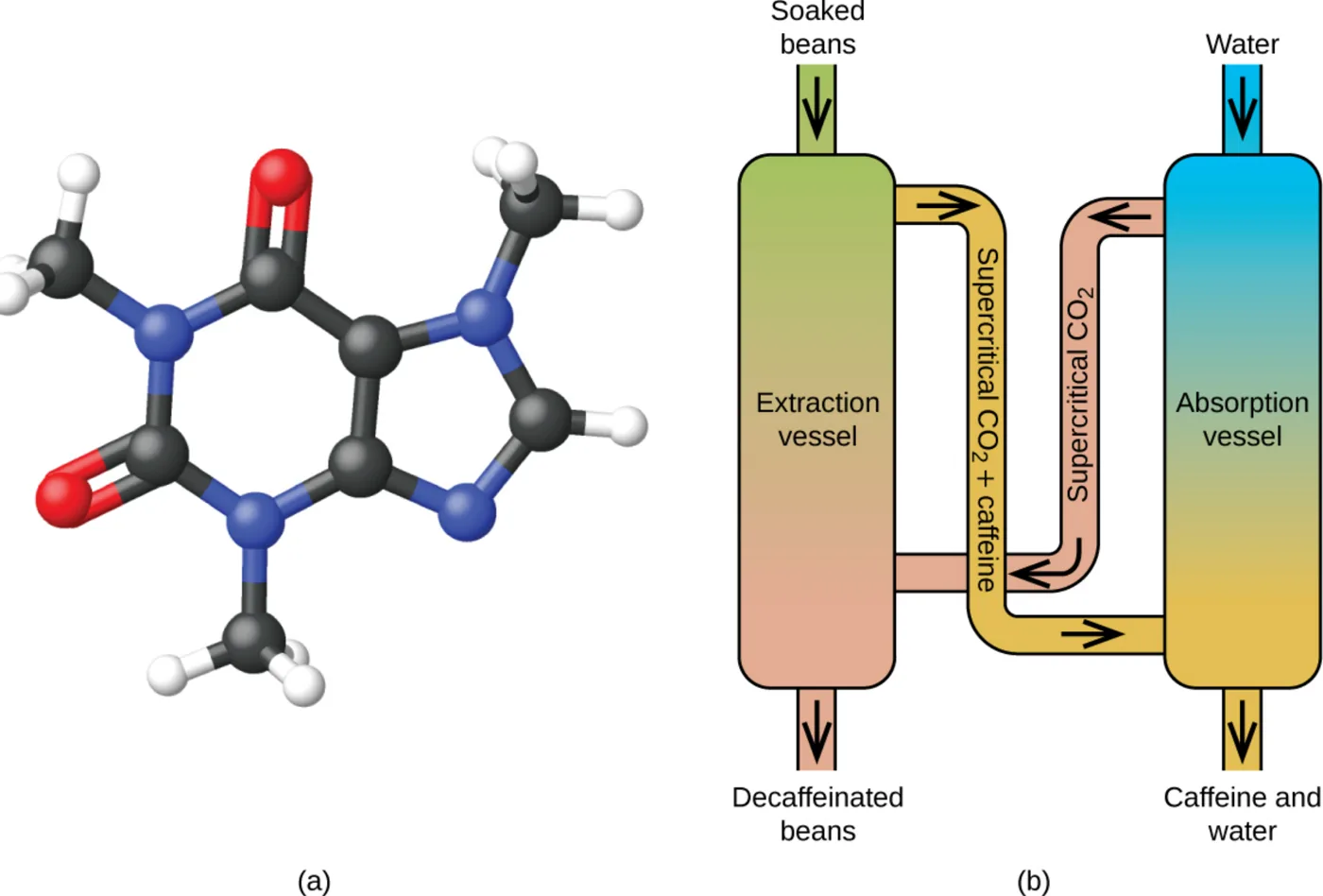
Caffeine molecules contain both polar and nonpolar regions, so they dissolve in solvents of different polarity; the schematic shows a decaffeination process that uses supercritical carbon dioxide as the solvent. Image: OpenStax, Chemistry 2e, CC BY 4.0.
Crystalline and amorphous solids
 ⤢ Enlarge
Crystalline and amorphous solids
Crystalline solids are classified by the forces that hold their particles together, and those forces largely determine the physical properties of the bulk solid. The four major types are ionic, metallic, covalent network and molecular solids.
◀ Previous4 / 4
1Ionic solids2Ionic solids
Ionic solids
1
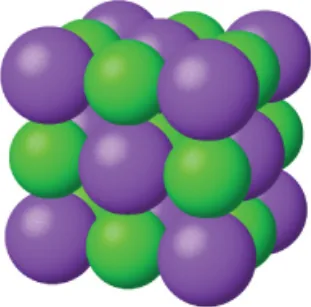
Ionic solids, such as sodium chloride (NaCl) and nickel oxide (NiO), are made of positive and negative ions held together by electrostatic attraction.
2
These attractions can be very strong
so many ionic crystals have high melting points.
3
Attractions between full ionic charges are much larger than those between the partial charges in polar molecular compounds.
4
Ionic solids are hard but brittle: they shatter rather than bend.
5
They do not conduct electricity in the solid state because their ions cannot move,
but they conduct when melted or dissolved because the ions are then free to move.
6
Simple compounds formed from a metal and a nonmetal are usually ionic.
1 / 2Next ▶
The regular cubic arrangement of sodium and chloride ions in a sodium chloride crystal, which is an ionic solid. Image: OpenStax, Chemistry 2e, CC BY 4.0.
Ionic solids
◀ Previous2 / 2
1Metallic solids2Metallic solids
Metallic solids
Metallic solids
Metallic solids such as copper, aluminum and iron are made of metal atoms.
The structure is described as a regular arrangement of atomic nuclei within a sea of delocalized electrons.
The atoms are held together by metallic bonding,
and this bonding gives metals their characteristic bulk properties: high thermal and electrical conductivity, metallic luster,and malleability.(they deform under pressure or hammering rather than shatter)
Many metals are also very hard and strong.
Melting points vary widely: mercury is a liquid at room temperature, the alkali metals melt below 200 °C,
and the transition metals melt above 1000 °C.
These differences reflect differences in the strength of metallic bonding.
1 / 2Next ▶
A block of closely packed copper atoms, showing the regular metallic arrangement. Image: OpenStax, Chemistry 2e, CC BY 4.0.
Metallic solids

◀ Previous2 / 2
1Covalent network solids2Covalent network solids
Covalent network solids
Covalent network solids
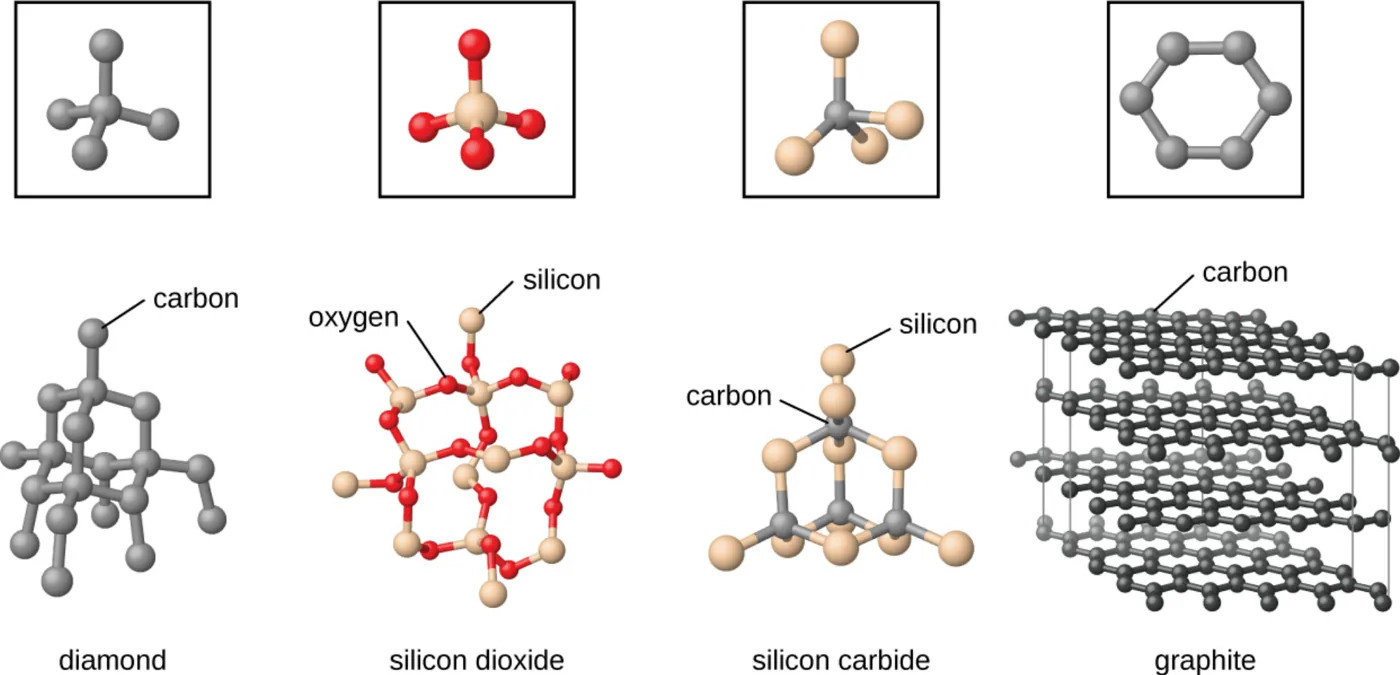
Covalent network solids include diamond, silicon, some other nonmetals, and covalent compounds such as silicon dioxide (sand) and silicon carbide (the abrasive in sandpaper).
Many minerals also have networks of covalent bonds.
Every atom is linked to its neighbours by covalent bonds that extend through the whole crystal.
To melt or break a covalent network solid, these bonds must be broken
so such solids are hard, strong and have very high melting points.
Diamond is one of the hardest known substances and melts above 3500 °C.
Graphite is an exception: its carbon atoms form planar sheets held together by weak noncovalent forces
so it is soft and conducts electricity.
1 / 2Next ▶
Three-dimensional covalent networks of diamond, silicon dioxide and silicon carbide, with graphite shown as layered sheets. Image: OpenStax, Chemistry 2e, CC BY 4.0.
Covalent network solids
◀ Previous2 / 2
1Molecular solids2Molecular solids
Molecular solids
1
Molecular solids such as ice, sucrose (table sugar) and iodine are made of neutral molecules (or atoms).
2
The forces between units in different crystals vary widely
which is reflected in their melting points.
3
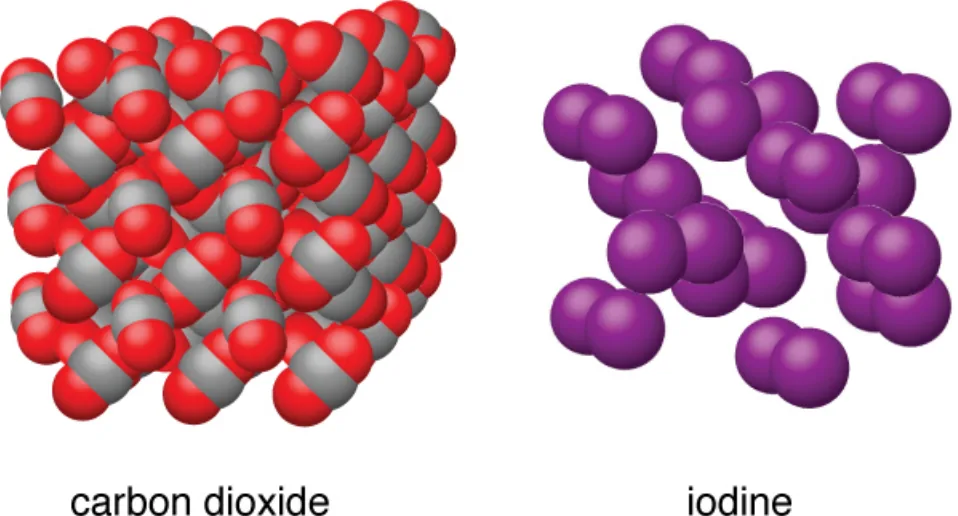
Small symmetrical nonpolar molecules such as H2, N2, O2 and F2 have weak attractions and melt below −200 °C.
4
Larger nonpolar molecules have stronger attractions and melt at higher temperatures.
5
Molecules with permanent dipole moments (polar molecules) melt at still higher temperatures
for example, ice melts at 0 °C and table sugar at 185 °C.
6
Molecular solids are usually soft or brittle and do not conduct electricity.
1 / 2Next ▶
Carbon dioxide, a small nonpolar molecule forming a low-melting molecular solid, and iodine, a larger nonpolar molecule forming a solid that melts at a higher temperature. Image: OpenStax, Chemistry 2e, CC BY 4.0.
Molecular solids
◀ Previous2 / 2
Properties of solids
Properties of solids
A crystalline solid has a sharp melting temperature because all of its units are held by forces of the same strength
so the same amount of energy breaks each attraction. An amorphous solid softens gradually over a range of temperatures. Its molecules are not structurally equivalentso the weakest attractions break first, and the stronger ones break at higher temperatures.
| Type of solid | Particles | Attractions | Typical properties | Examples |
|---|---|---|---|---|
| Ionic | Ions | Ionic bonds | Hard, brittle; conducts as a liquid but not as a solid; high to very high melting points | NaCl, Al2O3 |
| Metallic | Atoms of electropositive elements | Metallic bonds | Shiny, malleable, ductile; conducts heat and electricity well; variable hardness and melting point | Cu, Fe, Ti, Pb, U |
| Covalent network | Atoms of electronegative elements | Covalent bonds | Very hard; not conductive; very high melting points | C (diamond), SiO2, SiC |
| Molecular | Molecules (or atoms) | Intermolecular forces | Variable hardness and brittleness; not conductive; low melting points | H2O, CO2, I2, C12H22O11 |
1Graphene: material of the future2Graphene: material of the future3Graphene: material of the future
Graphene: material of the future
1
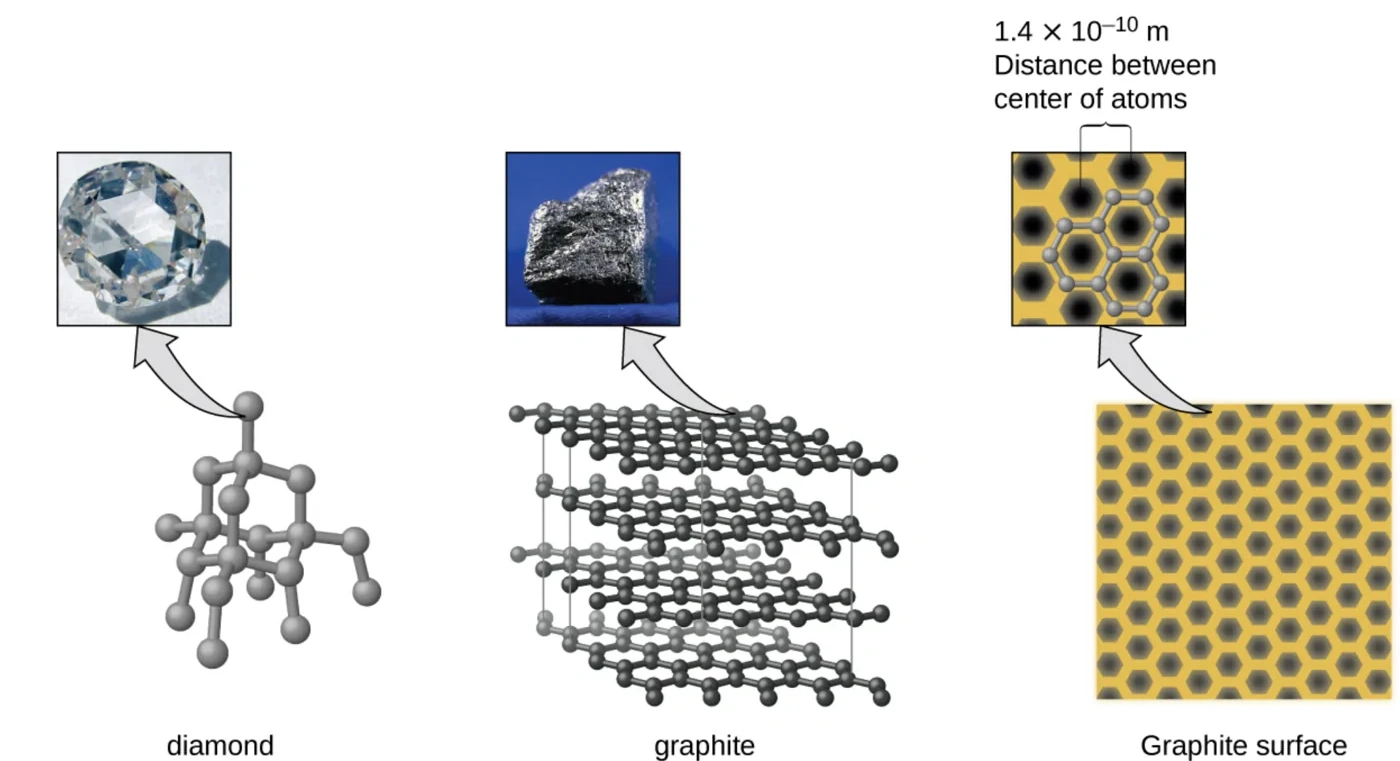
Carbon forms many everyday substances.
2
Its two most common allotropes, diamond and graphite, differ greatly in properties because their carbon atoms are arranged differently.
3
Diamond is one of the hardest substances,
while graphite is soft enough to be used as pencil lead, rubbing off onto paper because its carbon layers attract each other only weakly.
4
Graphene is a recently discovered form of carbon.
5
It is essentially one atom-thick sheet of graphite, first isolated in 2004 by peeling thinner and thinner layers from graphite with tape.
6
Graphene is strong, lightweight,
and an excellent conductor of electricity and heat,so it may improve computer chips, batteries, solar cells and structural materials.
1 / 3Next ▶
Diamond, graphite and a graphite surface image, showing how the arrangement of carbon atoms gives very different hardness and softness. Image: OpenStax, Chemistry 2e, CC BY 4.0.
Graphene: material of the future
 ⤢ Enlarge
Graphene: material of the future
The 2010 Nobel Prize in Physics was awarded to Andre Geim and Konstantin Novoselov for this work.
◀ Previous2 / 3Next ▶
A single graphene sheet, which can be rolled into a buckyball or nanotube or stacked into layers. Image: OpenStax, Chemistry 2e, CC BY 4.0.
Graphene: material of the future

◀ Previous3 / 3
1Crystal defects2Crystal defects
Crystal defects
1
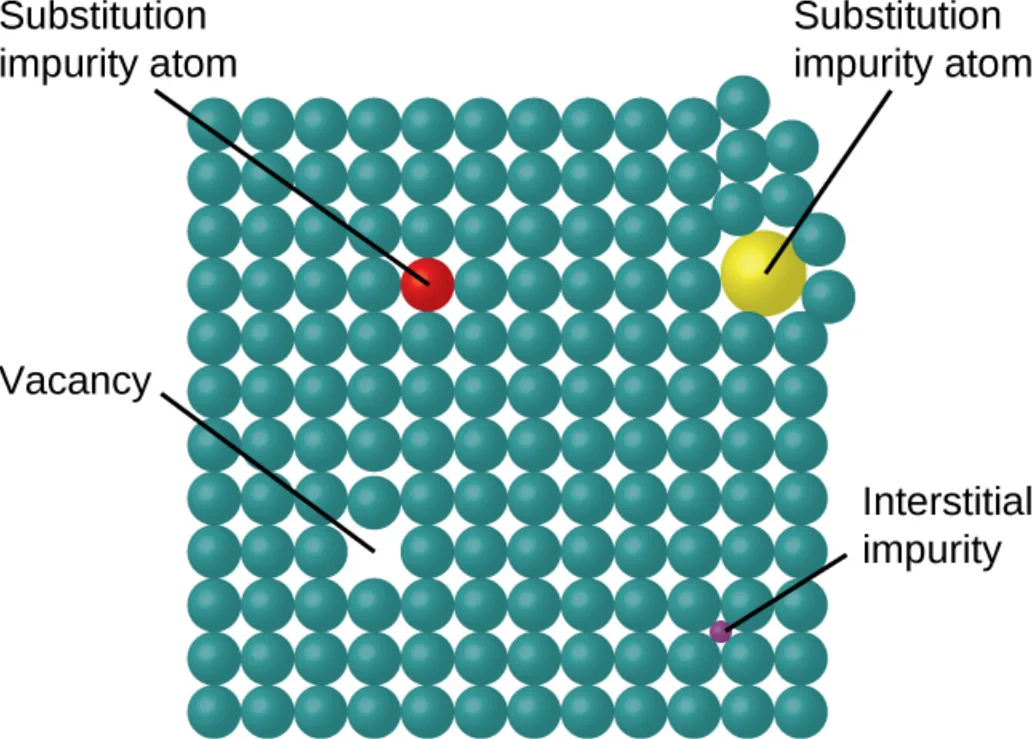
In a crystal the particles follow a repeating pattern
but occasional defects occur.
2
A vacancy is a position that should contain an atom or ion but is empty.
3
Less commonly, an atom or ion occupies an interstitial site, a position between the regular lattice positions.
4
Impure crystals can have distortions when impurity ions or molecules are too large to fit the regular positions.
5
Doping deliberately adds trace impurities to create defects that give useful properties
for example, silicon crystals are doped with different elements to make semiconductors for computer chips.
1 / 2Next ▶
Diagram of crystal defects: vacant lattice positions, an atom in an interstitial site, and a larger substituted impurity atom. Image: OpenStax, Chemistry 2e, CC BY 4.0.
Crystal defects
◀ Previous2 / 2
Example: comparing melting points · Example: predicting solid type
Example: comparing melting points
Iodine, I2, is a molecular solid that melts at 114 °C, and carbon dioxide melts at −78 °C. Which solid has stronger intermolecular attractions? Answer: iodine. Both are nonpolar
but iodine molecules are largerso their attractions are stronger, and a higher temperature is needed to overcome them.
Example: predicting solid type
Predict the type of solid formed by silicon carbide, SiC. Answer: a covalent network solid. Silicon and carbon are both nonmetals bonded covalently in a three-dimensional network
which explains its extreme hardness and very high melting point.
Key terms
| Term | Meaning |
|---|---|
| Crystalline solid | A solid whose particles are arranged in a definite repeating pattern. |
| Amorphous solid | A solid whose particles lack an ordered internal structure; also called a noncrystalline solid or glass. |
| Ionic solid | A crystalline solid of positive and negative ions held together by electrostatic attraction. |
| Metallic solid | A crystalline solid of metal atoms held together by metallic bonding. |
| Metallic bonding | The force holding metal atoms together, described as nuclei within a sea of delocalized electrons. |
| Malleability | The ability of a metal to deform under pressure or hammering without shattering. |
| Covalent network solid | A solid in which atoms are joined by a continuous network of covalent bonds. |
| Molecular solid | A solid made of neutral molecules (or atoms) held together by intermolecular forces. |
| Allotrope | A different structural form of the same element, such as diamond and graphite. |
| Graphene | A single atom-thick sheet of graphite-type carbon atoms. |
| Vacancy | A defect in which a position that should hold an atom or ion is empty. |
| Interstitial site | A position between the regular lattice positions where an atom or ion may sit. |
| Doping | Adding trace amounts of an impurity to a crystal to create defects with desired properties. |
1Avoid these mistakes2Avoid these mistakes3Avoid these mistakes