Curriculum
Chemistry 2e
Unit 1: Essential Ideas
0/14
Unit 2: Atoms, Molecules, and Ions
0/16
Unit 3: Composition of Substances and Solutions
0/10
Unit 4: Stoichiometry of Chemical Reactions
0/12
Unit 5: Thermochemistry
0/8
Unit 6: Electronic Structure and Periodic Properties of Elements
0/12
Unit 7: Chemical Bonding and Molecular Geometry
0/14
Unit 8: Advanced Theories of Covalent Bonding
0/10
Unit 9: Gases
0/23
Unit 10: Liquids and Solids
0/28
Unit 11: Solutions and Colloids
0/24
-
Unit 11 overview: Solutions and Colloids
 Preview
-
11.1 The Dissolution Process
Preview
-
Unit 11 overview: Solutions and Colloids
Preview
-
11.1 The Dissolution Process
Preview
-
11.1 The Dissolution Process - Check yourself
 Preview
-
11.1 The Dissolution Process - Check yourself
Preview
-
11.2 Electrolytes
Preview
-
11.2 Electrolytes - Check yourself
Preview
-
11.2 Electrolytes
Preview
-
11.2 Electrolytes - Check yourself
Preview
-
11.3 Solubility
Preview
-
11.3 Solubility - Check yourself
Preview
-
11.3 Solubility
Preview
-
11.3 Solubility - Check yourself
Preview
-
11.4 Colligative Properties
Preview
-
11.4 Colligative Properties - Check yourself
Preview
-
11.4 Colligative Properties
Preview
-
11.4 Colligative Properties - Check yourself
Preview
-
11.5 Colloids
Preview
-
11.5 Colloids - Check yourself
Preview
-
11.5 Colloids
Preview
-
11.5 Colloids - Check yourself
Preview
-
Unit 11 review quiz: Solutions and Colloids
Preview
-
Unit 11 review quiz: Solutions and Colloids
Preview
Unit 12: Kinetics
0/32
Unit 13: Fundamental Equilibrium Concepts
0/20
Unit 14: Acid-Base Equilibria
0/32
Unit 15: Equilibria of Other Reaction Classes
0/16
Unit 16: Thermodynamics
0/20
Unit 17: Electrochemistry
0/32
Unit 18: Representative Metals, Metalloids, and Nonmetals
0/52
Unit 19: Transition Metals and Coordination Chemistry
0/16
Unit 20: Organic Chemistry
0/20
Unit 21: Nuclear Chemistry
0/28
Text lesson
11.3 Solubility
11.3 Solubility — CHEMISTRY notes: You will be able to describe how temperature and pressure change solubility, use Henry’s law to calculate the solubility of a gas, and explain the degrees of miscibility of liquids in liquids.
1Ionic and covalent solutes in water2Ionic and covalent solutes in water3Ionic and covalent solutes in water
Ionic and covalent solutes in water
Ionic and covalent solutes in water
When an ionic compound such as KCl dissolves, its ions separate and spread evenly through the solution.
Water molecules surround each ion
which weakens the strong electrostatic attraction holding the solid together.
This physical change is called dissociation.
Because ionic compounds dissociate almost completely, they are strong electrolytes.
Even sparingly soluble ionic compounds are strong electrolytes
because the small amount that dissolves still dissociates completely.
At the microscopic level, ion-dipole forces pull the hydrogen end of each polar water molecule toward chloride ions on the crystal surface, and the oxygen end toward potassium ions.
1 / 3Next ▶
Water reacts with hydrogen chloride: a water molecule takes a proton from HCl, giving hydronium and chloride ions. Image: OpenStax, Chemistry 2e, CC BY 4.0.
Ionic and covalent solutes in water
 ⤢ Enlarge
1
The water molecules surround individual K+ and Cl− ions and carry them into solution as solvated (hydrated) ions.
2
The diagram below shows the reaction of water with hydrogen chloride
which is an example of a covalent solute that forms ions.
3
Pure water is a very poor conductor because it is only very slightly ionized: only about two molecules in every billion ionize at 25 °C. Water ionizes when one molecule gives a proton (H+) to another, forming hydronium (H3O+) and hydroxide (OH−) ions.
4
Some covalent compounds also form solutions that conduct electricity
because the solute reacts with the solvent to produce ions.
5
Pure hydrogen chloride is a gas made of covalent HCl molecules and contains no ions, yet its aqueous solution is a very good conductor.
6
HCl is a strong acid
so its molecules transfer H+ ions to water to form H3O+ and Cl− ions, and this reaction is essentially 100% complete.
◀ Previous2 / 3Next ▶
Ionic and covalent solutes in water
Ionic and covalent solutes in water
Weak acids and bases react only partly
so they produce low ion concentrations and are weak electrolytes.
◀ Previous3 / 3
1Solubility, saturation and supersaturation2Solubility, saturation and supersaturation
1Solutions of gases in liquids2Solutions of gases in liquids3Solutions of gases in liquids
Solutions of gases in liquids
1
The solubility of a gas depends on the attractive forces between solute and solvent molecules. Gas molecules are far apart and interact very little
so there is no solute-solute attraction to overcome. Solute-solvent interactions are therefore the only energy factor that controls how much gas dissolves.
2
Comparing gases in water shows this effect.
3
Oxygen dissolves about three times better than helium because the larger oxygen molecules have stronger dispersion forces with water.
4
Oxygen dissolves about 100 times less than chloroform, CHCl3
because polar chloroform molecules form dipole-dipole attractions with polar water.
5
Oxygen dissolves about 20 times better in hexane, C6H14, than in water,
because the large nonpolar hexane molecules have stronger dispersion forces with oxygen.
6
Temperature also matters. Gas solubility usually falls as temperature rises. The graph below shows this for several gases in water at a constant gas pressure of 101.3 kPa (1 atm). The inverse relation between temperature and dissolved gas is one of the main ways that thermal pollution harms natural waters.
1 / 3Next ▶
Solubility of five gases in water falls as the temperature rises, at a constant gas pressure of 1 atm. Image: OpenStax, Chemistry 2e, CC BY 4.0.
Solutions of gases in liquids
 ⤢ Enlarge
Solutions of gases in liquids
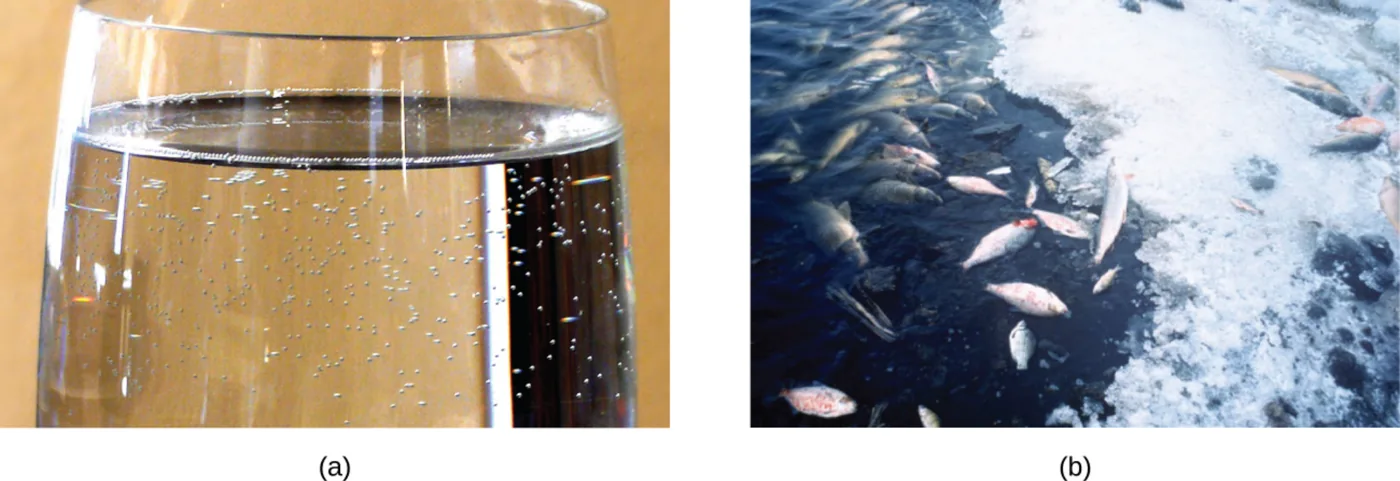
When a river, lake or stream warms, the oxygen it holds becomes less soluble. Low dissolved oxygen can damage aquatic ecosystems and, in severe cases, kill large numbers of fish. The photographs below show both a glass of water losing dissolved air as it warms, and fish killed by low oxygen levels.
◀ Previous2 / 3Next ▶
Left: small air bubbles form in a glass of chilled water as it warms and its dissolved air becomes less soluble. Right: fish died in a river where warming lowered the oxygen level. Image: OpenStax, Chemistry 2e, CC BY 4.0.
Solutions of gases in liquids
◀ Previous3 / 3
1Effect of pressure on gas solubility2Effect of pressure on gas solubility
Effect of pressure on gas solubility
Effect of pressure on gas solubility
The solubility of a gas also increases with its partial pressure above the solution.
Carbonated drinks show this clearly.
The drink is bottled under high carbon dioxide pressure and sealed
so it becomes saturated with CO2 at that pressure.
When the cap is removed, the pressure drops, a hiss is heard, and bubbles of CO2 leave the liquid.
The drink is then supersaturated, and it goes “flat” as the CO2 level falls to its new equilibrium value.
1 / 2Next ▶
Opening a bottle of carbonated drink lowers the CO2 pressure above the liquid, so dissolved CO2 comes out as gas bubbles. Image: OpenStax, Chemistry 2e, CC BY 4.0.
Effect of pressure on gas solubility
 ⤢ Enlarge
Effect of pressure on gas solubility
For many gases, solubility Cg is proportional to the partial pressure Pg: Cg = k × Pg.
Here k is a constant that depends on the gas, the solvent and the temperature.
This is Henry’s law: the quantity of an ideal gas that dissolves in a fixed volume of liquid is directly proportional to the gas pressure.
Because the relation is linear, if you know the solubility at one pressure you can find it at any other pressure by a simple ratio.
◀ Previous2 / 2
1Gas-liquid reactions and supersaturated gases2Gas-liquid reactions and supersaturated gases
Ammonia reacts partly with water: NH3 and H2O form NH4+ and OH− in an equilibrium. Image: OpenStax, Chemistry 2e, CC BY 4.0.
Gas-liquid reactions and supersaturated gases
 ⤢ Enlarge
1
Henry’s law fails when the gas reacts with the solvent. Ammonia, a base, reacts partly with water to form ammonium and hydroxide ions
so its solubility rises faster with pressure than the law predicts. The equilibrium is shown below.
2
A gas solution can also become supersaturated when it is prepared at low temperature or high pressure. If it then warms or the pressure falls, the gas comes out of solution.
3
In 1986, more than 1700 people died in Cameroon when a cloud of gas, almost certainly carbon dioxide, escaped from Lake Nyos, a deep lake in a volcanic crater.
4
The bottom water was saturated with CO2 from volcanic activity.
5
Gradual heating from below appears to have caused the lake to overturn, bringing warmer, less dense, CO2-saturated water to the surface.
6
The large release of dissolved CO2 produced a dense, colorless gas that flowed down the valley and suffocated people and animals.
1 / 2Next ▶
Lake Nyos after the 1986 gas release (left), and the vent installed later to release its CO2 slowly (right). Image: OpenStax, Chemistry 2e, CC BY 4.0.
Gas-liquid reactions and supersaturated gases
 ⤢ Enlarge
Gas-liquid reactions and supersaturated gases
A CO2 vent has since been installed to release the gas slowly and safely.
◀ Previous2 / 2
1Chemistry in Everyday Life: decompression sickness2Chemistry in Everyday Life: decompression sickness
Chemistry in Everyday Life: decompression sickness
Chemistry in Everyday Life: decompression sickness
Decompression sickness (DCS), or “the bends,” affects divers who swim at great depth.
Water adds about 1 atm of pressure for every 10 m of depth.
The air a diver breathes is therefore at a higher ambient pressure, and by Henry’s law more gas dissolves in the blood.
When the diver rises, the pressure falls and the dissolved gas becomes less soluble.
If the ascent is too fast, gas leaves the blood as bubbles, causing symptoms from rashes and joint pain to paralysis and death.
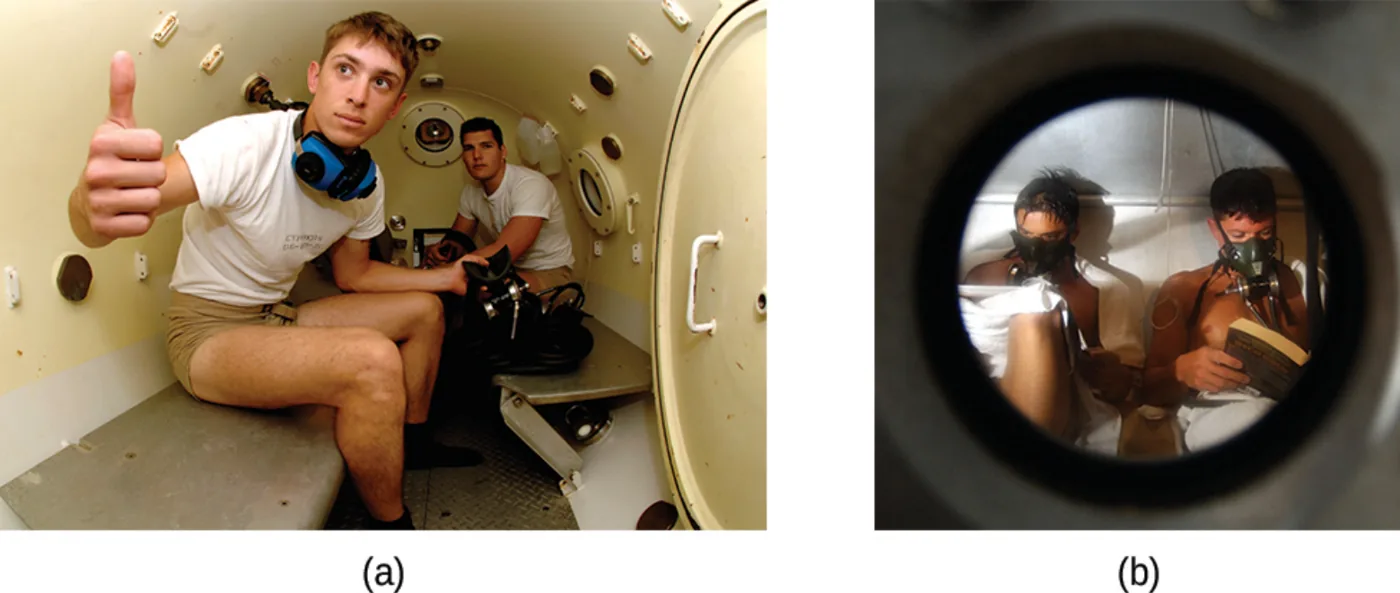
To avoid DCS, divers ascend slowly, at about 10 to 20 m per minute, and make decompression stops. If DCS occurs, hyperbaric oxygen therapy is given in a recompression chamber. Researchers are also studying how white blood cells change in DCS
which may lead to better tests and treatments.
1 / 2Next ▶
Left: divers train in a recompression chamber. Right: divers receive hyperbaric oxygen therapy inside the chamber. Image: OpenStax, Chemistry 2e, CC BY 4.0.
Chemistry in Everyday Life: decompression sickness
◀ Previous2 / 2
1Solutions of liquids in liquids2Solutions of liquids in liquids3Solutions of liquids in liquids4Solutions of liquids in liquids
Solutions of liquids in liquids
Solutions of liquids in liquids
Some liquids mix in every proportion and are called miscible.
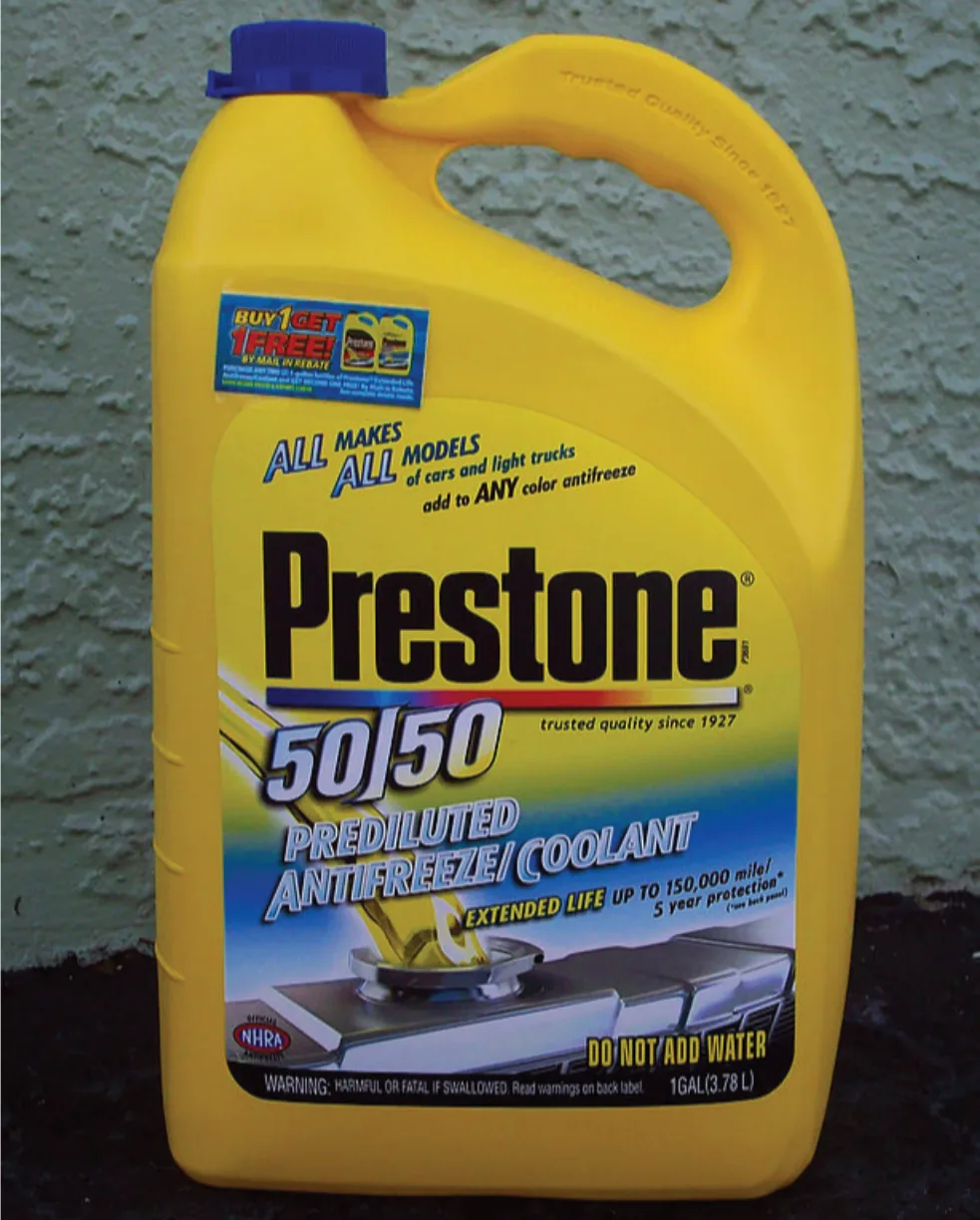
Ethanol, sulfuric acid and ethylene glycol (used in antifreeze) mix completely with water.
Two-cycle motor oil mixes with gasoline.
Liquids that are polar,
or can form hydrogen bonds, mix easily because the solute-solvent attractions are at least as strong as the attractions in the pure liquids.
Nonpolar liquids also mix with each other because their attractions are similar.
This is the rule “like dissolves like.”
1 / 4Next ▶
Antifreeze mixes with water in all proportions, giving one uniform liquid. Image: OpenStax, Chemistry 2e, CC BY 4.0.
Solutions of liquids in liquids
 ⤢ Enlarge
Solutions of liquids in liquids
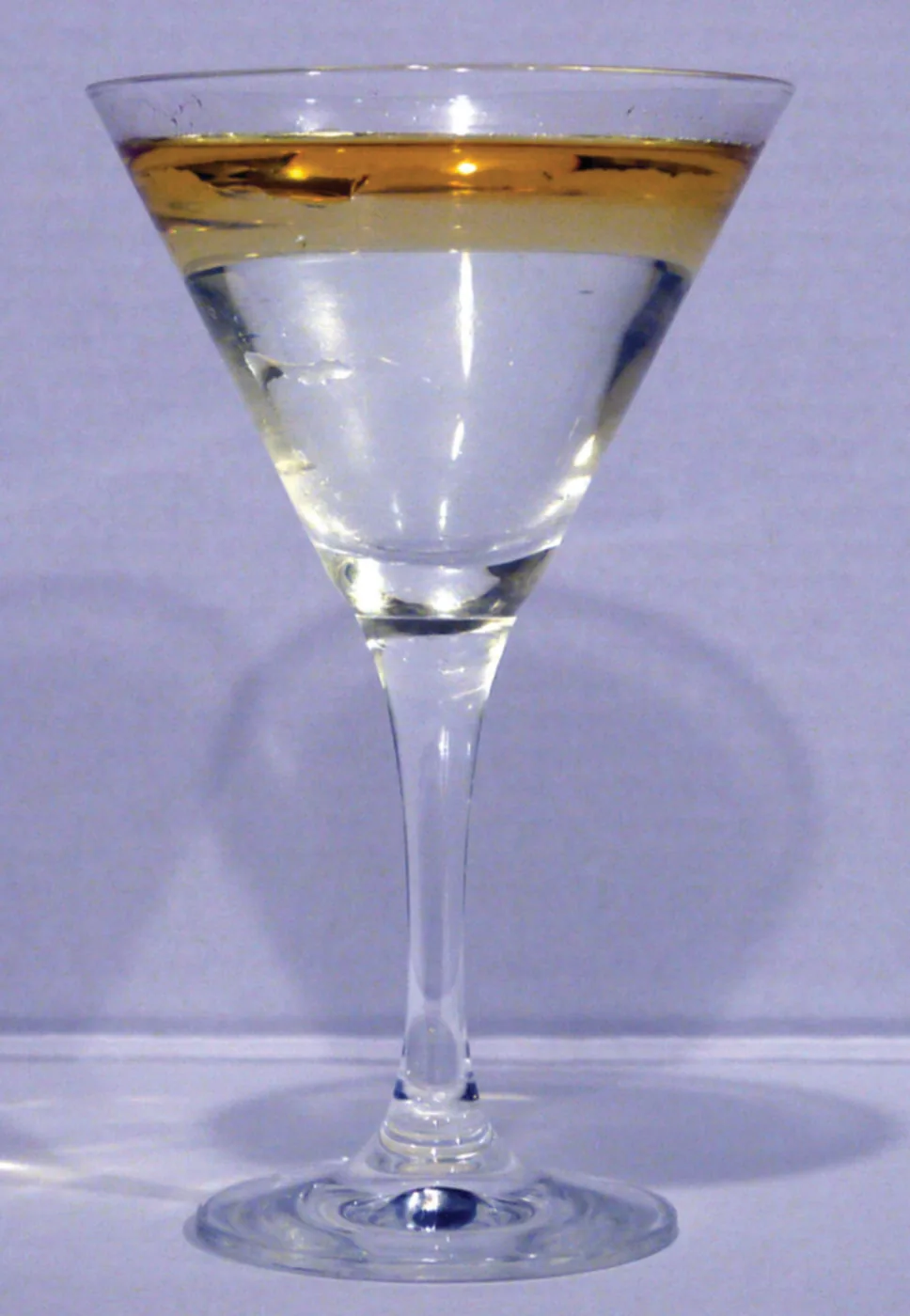
Immiscible liquids do not mix to any appreciable extent and form separate layers.
Gasoline, oil, benzene, carbon tetrachloride and many paints are nonpolar and immiscible with water.
The weak attractions between water and these nonpolar molecules cannot overcome the strong hydrogen bonds between water molecules.
Miscibility and immiscibility differ only in degree: miscible liquids dissolve in any amount,
while immiscible liquids have very low,but not zero, mutual solubility.
◀ Previous2 / 4Next ▶
Oil and water form two layers, with the less dense oil floating on the water. Image: OpenStax, Chemistry 2e, CC BY 4.0.
Solutions of liquids in liquids
 ⤢ Enlarge
1
Partially miscible liquids, such as bromine and water, have moderate mutual solubility and usually form two layers.
2
The upper layer is water saturated with bromine, and the lower layer is bromine saturated with water.
3
Because bromine is nonpolar, only a little dissolves in water
so the water layer is only slightly orange.
4
Water dissolves very little in bromine
so the bromine layer stays dark.
◀ Previous3 / 4Next ▶
Bromine (left) and water (middle) are partially miscible. The mixture on the right separates into a water layer saturated with bromine on top and a bromine layer saturated with water below. Image: OpenStax, Chemistry 2e, CC BY 4.0.
Solutions of liquids in liquids

◀ Previous4 / 4
1Solutions of solids in liquids2Solutions of solids in liquids
Solutions of solids in liquids
Solutions of solids in liquids
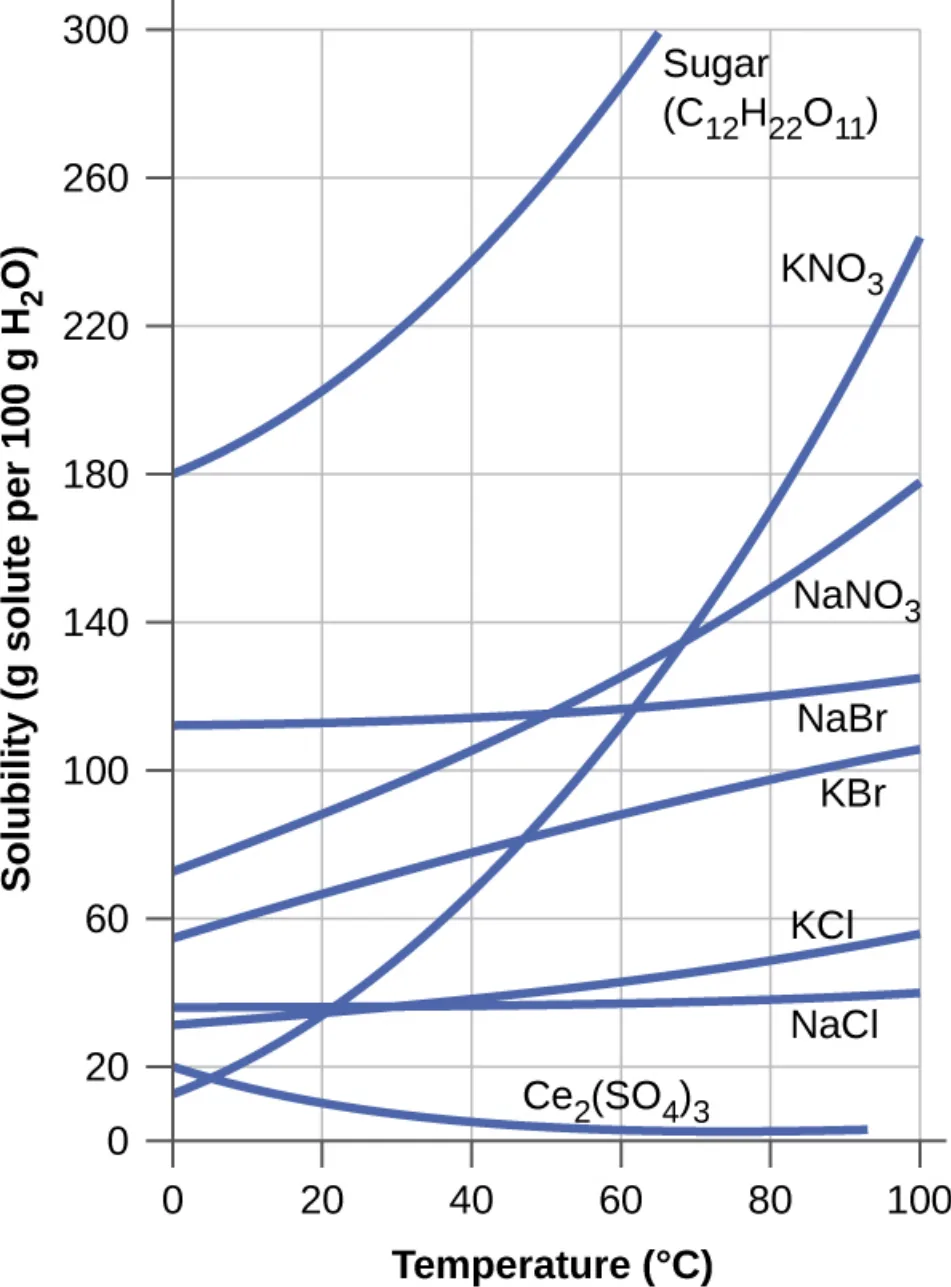
For most solids dissolved in water, solubility increases with temperature, as the solubility curves below show.
Cerium sulfate is an exception: its solubility falls as the temperature rises.
The temperature dependence of solubility can be used to prepare supersaturated solutions.
A solution is made hot with a large amount of solute and then cooled slowly
so it holds more solute than it normally would at the lower temperature.
1 / 2Next ▶
Solubility in grams per 100 g of water against temperature for sugar, several salts and cerium sulfate. Most curves rise with temperature, but cerium sulfate falls. Image: OpenStax, Chemistry 2e, CC BY 4.0.
Solutions of solids in liquids
 ⤢ Enlarge
1
A solution can be saturated with a solid at a high temperature
where the solute dissolves more readilyand then cooled to a lower temperature without the excess solute precipitating.
2
The result is a supersaturated solution that is fairly stable at the lower temperature.
3
Precipitation of the extra solute can be started by adding a seed crystal to the solution or by agitating it mechanically.
4
Some hand warmers take advantage of this behavior. Clicking a flexible metal disk inside the sodium acetate solution sends a mechanical shock through the liquid. The shock starts crystallization of the supersaturated solute, and the heat released as the crystals form warms the pack. The Link to Learning video in the module shows this crystallization happening in a hand warmer.
◀ Previous2 / 2
1Example 11.1: Applying Henry’s law2Example 11.1: Applying Henry’s law3Example 11.2: Thermal pollution and oxygen solubility4Example 11.2: Thermal pollution and oxygen solubility
Learning objectives check
Learning objectives check
You can now state Henry’s law and use it to scale a gas solubility from one pressure to another.
You can explain why gas solubility falls as temperature rises and why this matters for warm rivers.
You can classify liquid pairs as miscible, partially miscible or immiscible,
and you can read solubility curves to predict how a solid’s solubility changes with temperature.
Key terms
| Term | Meaning |
|---|---|
| Dissociation | The separation of ions in an ionic solid as it dissolves and its ions spread through the solvent. |
| Solvated ion | An ion surrounded by solvent molecules, here water molecules. |
| Strong electrolyte | A solute that dissociates or ionizes almost completely in solution, giving a good conductor. |
| Weak electrolyte | A solute that ionizes only partly in solution, giving a poor conductor. |
| Solubility | The maximum concentration of a solute that can be reached in a solvent under given conditions at equilibrium. |
| Saturated solution | A solution whose solute concentration equals the solubility. |
| Unsaturated solution | A solution whose solute concentration is below the solubility. |
| Supersaturated solution | A solution whose solute concentration is above the solubility, a nonequilibrium state. |
| Dilute solution | A solution with a relatively low solute concentration. |
| Concentrated solution | A solution with a relatively high solute concentration. |
| Henry’s law | The rule that the amount of an ideal gas dissolved in a liquid is directly proportional to the gas pressure, Cg = k × Pg. |
| Miscible liquids | Liquids that mix in all proportions. |
| Immiscible liquids | Liquids that do not mix to any appreciable extent and form separate layers. |
| Partially miscible liquids | Liquids of moderate mutual solubility that form two layers when mixed. |
| Decompression sickness | Harm caused when dissolved gas forms bubbles in the blood during a too-rapid ascent from depth. |
| Seed crystal | A small crystal added to a supersaturated solution to start crystallization of the excess solute. |
1Avoid these mistakes2Avoid these mistakes3Avoid these mistakes