Curriculum
Chemistry 2e
Unit 1: Essential Ideas
0/14
Unit 2: Atoms, Molecules, and Ions
0/16
Unit 3: Composition of Substances and Solutions
0/10
Unit 4: Stoichiometry of Chemical Reactions
0/12
Unit 5: Thermochemistry
0/8
Unit 6: Electronic Structure and Periodic Properties of Elements
0/12
Unit 7: Chemical Bonding and Molecular Geometry
0/14
Unit 8: Advanced Theories of Covalent Bonding
0/10
Unit 9: Gases
0/23
Unit 10: Liquids and Solids
0/28
Unit 11: Solutions and Colloids
0/24
Unit 12: Kinetics
0/32
-
Unit 12 overview: Kinetics
 Preview
-
12.1 Chemical Reaction Rates
Preview
-
12.1 Chemical Reaction Rates - Check yourself
 Preview
-
Unit 12 overview: Kinetics
Preview
-
12.1 Chemical Reaction Rates
Preview
-
12.1 Chemical Reaction Rates - Check yourself
Preview
-
12.2 Factors Affecting Reaction Rates
Preview
-
12.2 Factors Affecting Reaction Rates - Check yourself
Preview
-
12.2 Factors Affecting Reaction Rates
Preview
-
12.2 Factors Affecting Reaction Rates - Check yourself
Preview
-
12.3 Rate Laws
Preview
-
12.3 Rate Laws - Check yourself
Preview
-
12.3 Rate Laws
Preview
-
12.3 Rate Laws - Check yourself
Preview
-
12.4 Integrated Rate Laws
Preview
-
12.4 Integrated Rate Laws - Check yourself
Preview
-
12.4 Integrated Rate Laws
Preview
-
12.4 Integrated Rate Laws - Check yourself
Preview
-
12.5 Collision Theory
Preview
-
12.5 Collision Theory - Check yourself
Preview
-
12.5 Collision Theory
Preview
-
Unit 12 review quiz: Kinetics
Preview
-
12.5 Collision Theory - Check yourself
Preview
-
12.6 Reaction Mechanisms
Preview
-
12.6 Reaction Mechanisms - Check yourself
Preview
-
12.6 Reaction Mechanisms
Preview
-
12.6 Reaction Mechanisms - Check yourself
Preview
-
12.7 Catalysis
Preview
-
12.7 Catalysis - Check yourself
Preview
-
12.7 Catalysis
Preview
-
12.7 Catalysis - Check yourself
Preview
-
Unit 12 review quiz: Kinetics
Preview
Unit 13: Fundamental Equilibrium Concepts
0/20
Unit 14: Acid-Base Equilibria
0/32
Unit 15: Equilibria of Other Reaction Classes
0/16
Unit 16: Thermodynamics
0/20
Unit 17: Electrochemistry
0/32
Unit 18: Representative Metals, Metalloids, and Nonmetals
0/52
Unit 19: Transition Metals and Coordination Chemistry
0/16
Unit 20: Organic Chemistry
0/20
Unit 21: Nuclear Chemistry
0/28
Text lesson
12.5 Collision Theory
12.5 Collision Theory — CHEMISTRY notes: By the end of this lesson you will be able to explain how collision orientation, collision energy, concentration and temperature affect reaction rates, define activation energy and the transition state, and use the Arrhenius equation to relate rate constants to temperature and to calculate activation energy.
1Collision theory2Collision theory3Collision theory4Collision theory
Collision theory
Collision theory
Atoms, molecules and ions must come close together before they can form chemical bonds
so it is no surprise that they must collide before they can react. Collision theory turns this simple idea into a model that explains many observations about reaction rates. The theory rests on three postulates:
1 / 4Next ▶
Collision theory
1
The rate of a reaction is proportional to the rate of collisions between reactant particles.
2
The reacting species must collide with an orientation that brings into contact the atoms that will end up bonded together in the product.
3
The collision must carry enough energy to let the valence shells of the reacting species penetrate each other,
4
so that electrons can rearrange and form new bonds and new chemical species.
5
The second and third postulates explain why not every collision leads to a reaction.
6
Consider the gas-phase reaction between carbon monoxide and oxygen
which begins with a collision between one CO molecule and one O2 molecule.
◀ Previous2 / 4Next ▶
Collision theory
Collision theory
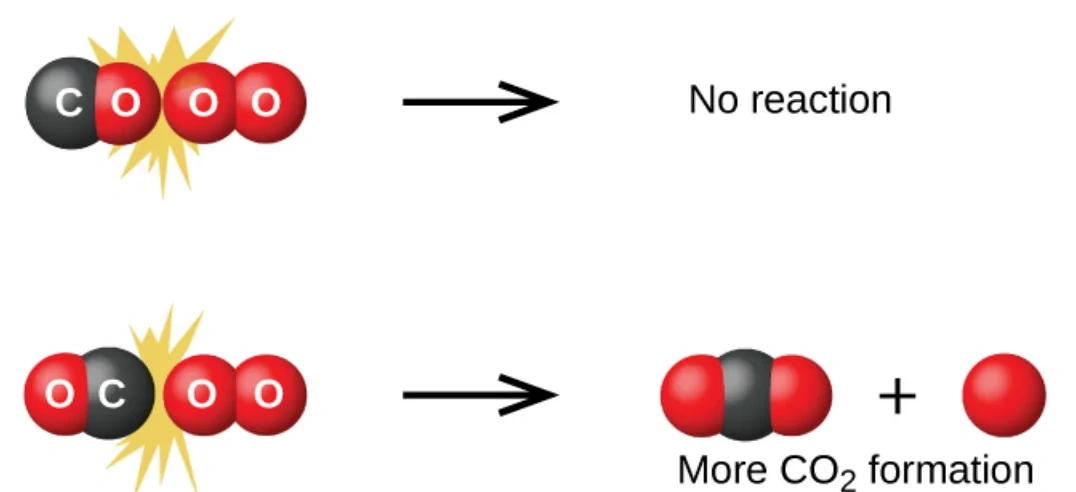
The molecules can meet in many different orientations.
If the oxygen end of the CO molecule strikes the O2 molecule, the atoms that must bond to form carbon dioxide are not in contact,
and the collision is unlikely to produce CO2.
If the carbon end of the CO molecule strikes the O2 molecule, the carbon can bond to the oxygen atoms, and product formation becomes much more likely.
The diagram below compares these two collisions.
◀ Previous3 / 4Next ▶
Two possible collisions between a carbon monoxide molecule and an oxygen molecule. Only the collision in which the carbon end of CO meets O2 has the right orientation to form carbon dioxide. Image: OpenStax, Chemistry 2e, CC BY 4.0.
Collision theory
 ⤢ Enlarge
Collision theory
A proper orientation is necessary but not sufficient.
The colliding species must also have adequate energy.
When reactant particles collide with both the correct orientation and enough energy, they form an unstable species called an activated complex,
or transition state.
Transition states are very short lived and usually cannot be detected by ordinary analytical instruments,
although sophisticated spectroscopic methods have been used to observe a few of them.
Collision theory also explains why most reaction rates increase as concentration increases. When the concentration of a reactant rises, there are more molecules in each unit of volume
so collisions between molecules become more frequent. More collisions mean a faster reaction, as long as the collisions have enough energy.
◀ Previous4 / 4
1Activation energy and the Arrhenius equation2Activation energy and the Arrhenius equation3Activation energy and the Arrhenius equation4Activation energy and the Arrhenius equation5Activation energy and the Arrhenius equation6Activation energy and the Arrhenius equation
Activation energy and the Arrhenius equation
1
The activation energy, Ea, is the minimum energy a collision must have to form products.
2
The size of Ea compared with the average kinetic energy of the molecules is one of the main factors controlling the rate of a reaction.
3
If Ea is much larger than the average kinetic energy, only a few fast-moving molecules can react
so the reaction is slow.
4
If Ea is much smaller than the average kinetic energy, a large fraction of the molecules are energetic enough to react,
and the reaction proceeds rapidly.
5
A reaction diagram shows how the energy of a chemical system changes as reactants become products.
6
Reading the diagram from left to right for the reaction A + B → C + D, the system starts with reactants only.
1 / 6Next ▶
Activation energy and the Arrhenius equation
1
Reactant molecules with enough energy collide and form the high-energy transition state.
2
The unstable transition state then decays to the stable products C and D.
3
The activation energy is the energy difference between the reactants and the transition state.
4
The enthalpy change of the reaction, ΔH, is the energy difference between the reactants and the products.
5
Here the products lie below the reactants
so ΔH is negative and the reaction is exothermic.
◀ Previous2 / 6Next ▶
Energy diagram for an exothermic reaction, showing the reactants, the higher-energy transition state, the activation energy and the lower-energy products. Image: OpenStax, Chemistry 2e, CC BY 4.0.
Activation energy and the Arrhenius equation
 ⤢ Enlarge
Activation energy and the Arrhenius equation
The relationship between the activation energy and the rate constant, k, is given by the Arrhenius equation:
k = A e−Ea/RT
What the symbols mean:
k = rate constant · A = pre-exponential (frequency) factor · E
a
= activation energy (J mol
◀ Previous3 / 6Next ▶
Activation energy and the Arrhenius equation
1
−1
2
) · R = 8.31 J mol
3
K
4
· T = temperature (K)
5
In this equation R is the ideal gas constant, 8.314 J/mol/K
T is the absolute temperature in kelvinEa is the activation energy in joules per molee is the constant 2.7183, the base of natural logarithmsand A is the frequency factor, a constant that depends on how often collisions occur and on how well the molecules are oriented for reaction. Each symbol carries its unit as listed hereso Ea is always used in J/mol and T in K.
6
The equation fits the collision model well.
◀ Previous4 / 6Next ▶
Activation energy and the Arrhenius equation
Activation energy and the Arrhenius equation
The frequency factor A reflects how well the conditions favor properly oriented collisions.
A higher probability of effective orientation gives a larger A and a faster reaction.
The exponential term e−Ea/RT describes the effect of the activation energy.
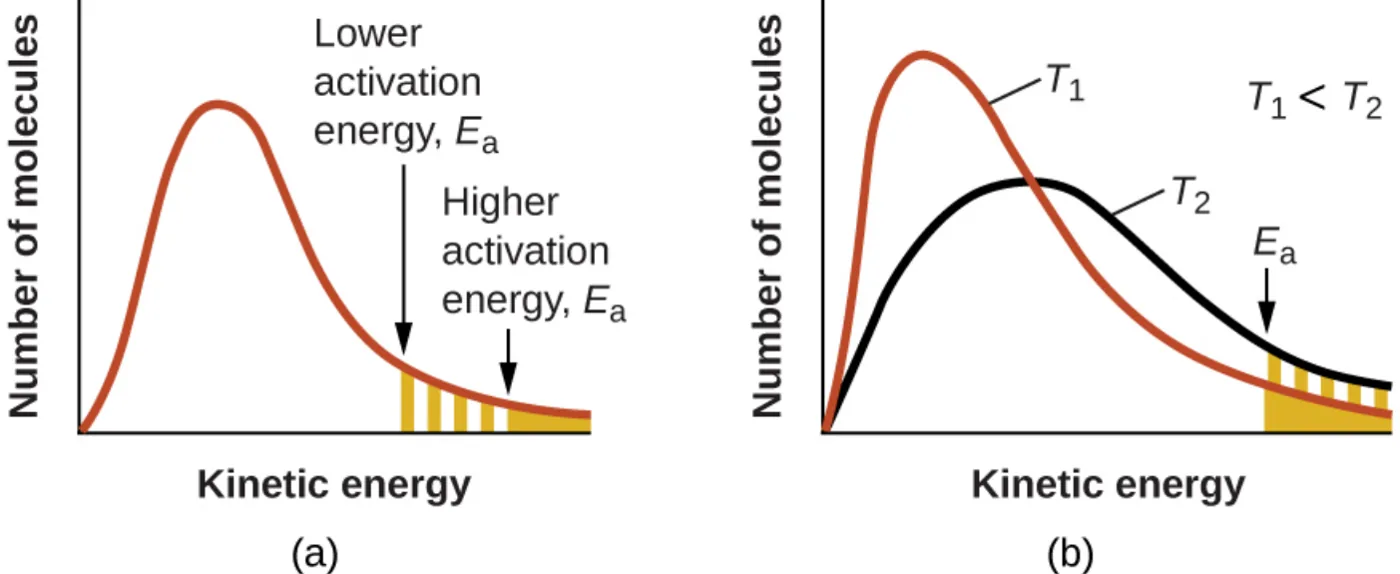
Temperature is a measure of the average kinetic energy of the particles, and the energies of the particles in a sample follow a distribution.
The fraction of particles with energy equal to or greater than Ea is set by the exponential term.
A smaller Ea means a larger fraction of energetic molecules and a faster reaction.
◀ Previous5 / 6Next ▶
Two energy distribution curves. The left panel compares two activation energies at one temperature, and the right panel compares two temperatures for one activation energy, showing how many molecules exceed the barrier in each case. Image: OpenStax, Chemistry 2e, CC BY 4.0.
Activation energy and the Arrhenius equation
 ⤢ Enlarge
Activation energy and the Arrhenius equation
Temperature has the same effect through the same exponential term. At a higher temperature, a larger fraction of molecules have enough energy to overcome the activation barrier. This gives a larger rate constant and a faster reaction. Raising the temperature does not change Ea or A
it changes the fraction of molecules that can react.
◀ Previous6 / 6
1Determining activation energy from rate data2Determining activation energy from rate data
Determining activation energy from rate data
1
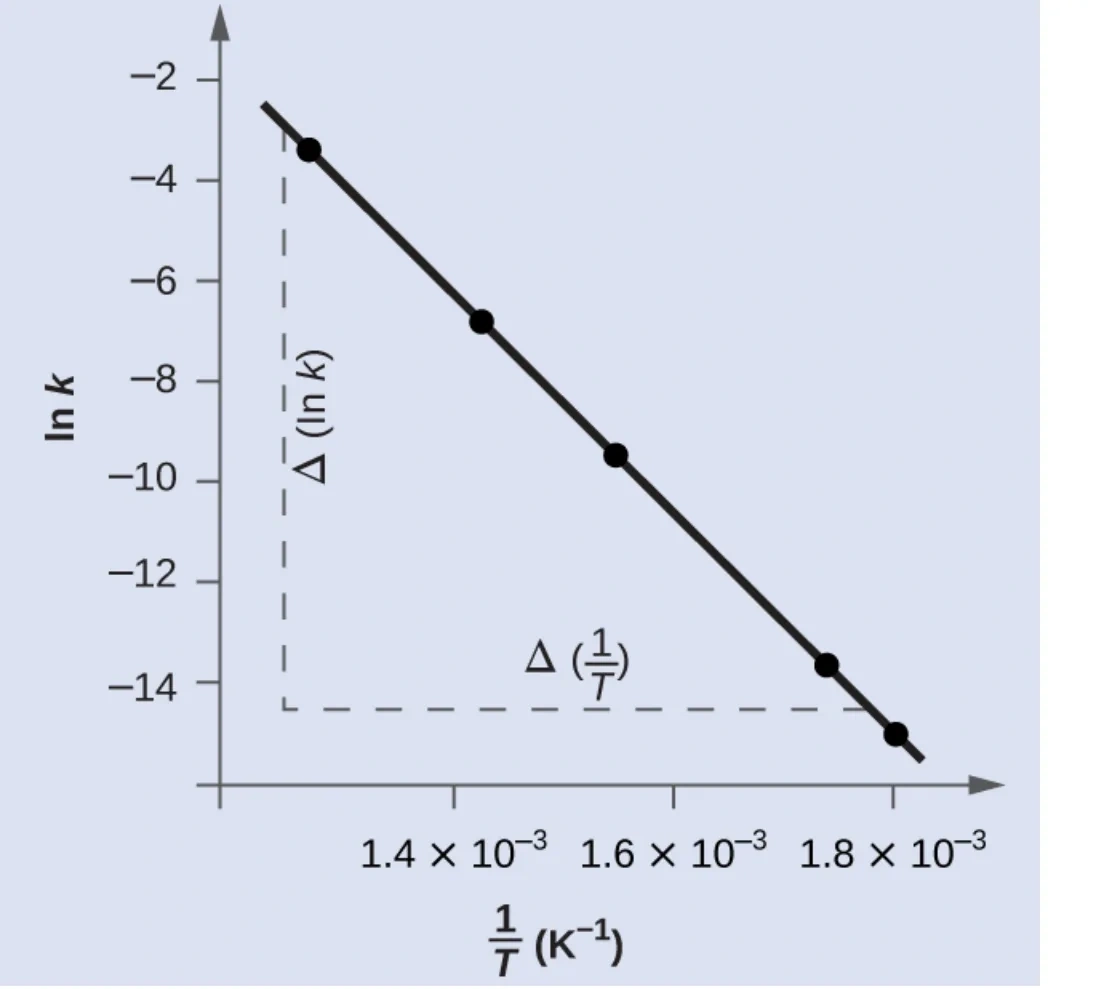
Activation energy can be found by measuring the rate constant at two or more temperatures. Taking the natural logarithm of the Arrhenius equation gives a straight-line form:
2
ln k = −(Ea/R)(1/T) + ln A
3
A plot of ln k against 1/T is a straight line.
4
Its slope equals −Ea/R, and its y-intercept equals ln A.
5
Because R is known, the activation energy is found from the slope as Ea = −slope × R.
6
When there are more than two data points, a statistical regression gives the best line.
1 / 2Next ▶
Graph of ln k against 1/T for the decomposition of HI. The points lie on a straight line whose slope gives the activation energy. Image: OpenStax, Chemistry 2e, CC BY 4.0.
Determining activation energy from rate data
 ⤢ Enlarge
1
When the data fit closely, the slope can be estimated from any two points, and the first and last points are a convenient choice.
2
A faster method uses the rate constants at only two temperatures. Writing the Arrhenius equation at each temperature and subtracting gives the two-point form:
3
ln(k2/k1) = (Ea/R)(1/T1 − 1/T2)
4
Rearranging to isolate the activation energy gives Ea = R × ln(k2/k1) ÷ (1/T1 − 1/T2). The temperatures must be in kelvin, and the rate constants must be in the same units at both temperatures.
5
Any two data pairs can be substituted into the two-point equation. Using the first and last entries of a data table gives the same answer as the graphical approach, as expected. For real experimental data, however, the graphical approach is usually more reliable
because it uses every data point and averages out measurement scatter.
◀ Previous2 / 2
1Example 12.13: Determining the activation energy from rate d2Example 12.13: Determining the activation energy from rate d
Key terms
| Term | Meaning |
|---|---|
| Collision theory | A model stating that a reaction occurs only when reactant particles collide with proper orientation and adequate energy. |
| Orientation | The direction in which colliding particles meet, which must allow the atoms that will bond in the product to come into contact. |
| Activated complex (transition state) | An unstable, short-lived species formed when reactant particles collide with proper orientation and enough energy; it can decay to products. |
| Activation energy (Ea) | The minimum energy a collision must have to form products. |
| Reaction diagram | A graph of the energy of a chemical system as reactants change into products, showing the activation energy and the enthalpy change. |
| Enthalpy change (ΔH) | The energy difference between the products and the reactants of a reaction. |
| Exothermic reaction | A reaction in which the products have lower enthalpy than the reactants, so ΔH is negative. |
| Arrhenius equation | The equation k = A e−Ea/RT that relates the rate constant to the activation energy and the absolute temperature. |
| Frequency factor (A) | A constant related to how often collisions occur and how well the molecules are oriented for reaction. |
| Rate constant (k) | The proportionality constant in the rate law that sets how fast a reaction proceeds at a given temperature. |
| Ideal gas constant (R) | The constant 8.314 J/mol/K used in the Arrhenius equation. |
| Energy distribution | The spread of kinetic energies among the particles in a sample at a given temperature. |
1Avoid these mistakes2Avoid these mistakes3Avoid these mistakes