Curriculum
Chemistry 2e
Unit 1: Essential Ideas
0/14
-
Unit 1 overview: Essential Ideas
 Text lessonPreview
-
1.1 Chemistry in Context
Text lessonPreview
-
1.1 Chemistry in Context - Check yourself
 6 questionsPreview
-
1.2 Phases and Classification of Matter
Text lessonPreview
-
1.2 Phases and Classification of Matter - Check yourself
6 questionsPreview
-
1.3 Physical and Chemical Properties
Text lessonPreview
-
1.3 Physical and Chemical Properties - Check yourself
6 questionsPreview
-
1.4 Measurements
Text lessonPreview
-
1.4 Measurements - Check yourself
6 questionsPreview
-
1.5 Measurement Uncertainty, Accuracy, and Precision
Text lessonPreview
-
1.5 Measurement Uncertainty, Accuracy, and Precision - Check yourself
6 questionsPreview
-
1.6 Mathematical Treatment of Measurement Results
Text lessonPreview
-
1.6 Mathematical Treatment of Measurement Results - Check yourself
6 questionsPreview
-
Unit 1 review quiz: Essential Ideas
10 questionsPreview
Unit 2: Atoms, Molecules, and Ions
0/16
-
Unit 2 overview: Atoms, Molecules, and Ions
Text lessonPreview
-
2.1 Early Ideas in Atomic Theory
Text lessonPreview
-
2.1 Early Ideas in Atomic Theory - Check yourself
6 questionsPreview
-
2.2 Evolution of Atomic Theory
Text lessonPreview
-
2.2 Evolution of Atomic Theory - Check yourself
6 questionsPreview
-
2.3 Atomic Structure and Symbolism
Text lessonPreview
-
2.3 Atomic Structure and Symbolism - Check yourself
6 questionsPreview
-
2.4 Chemical Formulas
Text lessonPreview
-
2.4 Chemical Formulas - Check yourself
6 questionsPreview
-
2.5 The Periodic Table
Text lessonPreview
-
2.5 The Periodic Table - Check yourself
6 questionsPreview
-
2.6 Ionic and Molecular Compounds
Text lessonPreview
-
2.6 Ionic and Molecular Compounds - Check yourself
6 questionsPreview
-
2.7 Chemical Nomenclature
Text lessonPreview
-
2.7 Chemical Nomenclature - Check yourself
6 questionsPreview
-
Unit 2 review quiz: Atoms, Molecules, and Ions
10 questionsPreview
Unit 3: Composition of Substances and Solutions
0/10
-
Unit 3 overview: Composition of Substances and Solutions
Text lessonPreview
-
3.1 Formula Mass and the Mole Concept
Text lessonPreview
-
3.1 Formula Mass and the Mole Concept - Check yourself
6 questionsPreview
-
3.2 Determining Empirical and Molecular Formulas
Text lessonPreview
-
3.2 Determining Empirical and Molecular Formulas - Check yourself
6 questionsPreview
-
3.3 Molarity
Text lessonPreview
-
3.3 Molarity - Check yourself
6 questionsPreview
-
3.4 Other Units for Solution Concentrations
Text lessonPreview
-
3.4 Other Units for Solution Concentrations - Check yourself
6 questionsPreview
-
Unit 3 review quiz: Composition of Substances and Solutions
10 questionsPreview
Unit 4: Stoichiometry of Chemical Reactions
0/12
-
Unit 4 overview: Stoichiometry of Chemical Reactions
Text lessonPreview
-
4.1 Writing and Balancing Chemical Equations
Text lessonPreview
-
4.1 Writing and Balancing Chemical Equations - Check yourself
6 questionsPreview
-
4.2 Classifying Chemical Reactions
Text lessonPreview
-
4.2 Classifying Chemical Reactions - Check yourself
6 questionsPreview
-
4.3 Reaction Stoichiometry
Text lessonPreview
-
4.3 Reaction Stoichiometry - Check yourself
6 questionsPreview
-
4.4 Reaction Yields
Text lessonPreview
-
4.4 Reaction Yields - Check yourself
6 questionsPreview
-
4.5 Quantitative Chemical Analysis
Text lessonPreview
-
4.5 Quantitative Chemical Analysis - Check yourself
6 questionsPreview
-
Unit 4 review quiz: Stoichiometry of Chemical Reactions
10 questionsPreview
Unit 5: Thermochemistry
0/8
-
Unit 5 overview: Thermochemistry
Text lessonPreview
-
5.1 Energy Basics
Text lessonPreview
-
5.1 Energy Basics - Check yourself
6 questionsPreview
-
5.2 Calorimetry
Text lessonPreview
-
5.2 Calorimetry - Check yourself
7 questionsPreview
-
5.3 Enthalpy
Text lessonPreview
-
5.3 Enthalpy - Check yourself
6 questionsPreview
-
Unit 5 review quiz: Thermochemistry
10 questionsPreview
Unit 6: Electronic Structure and Periodic Properties of Elements
0/12
-
Unit 6 overview: Electronic Structure and Periodic Properties of Elements
Text lessonPreview
-
6.1 Electromagnetic Energy
Text lessonPreview
-
6.1 Electromagnetic Energy - Check yourself
6 questionsPreview
-
6.2 The Bohr Model
Text lessonPreview
-
6.2 The Bohr Model - Check yourself
6 questionsPreview
-
6.3 Development of Quantum Theory
Text lessonPreview
-
6.3 Development of Quantum Theory - Check yourself
6 questionsPreview
-
6.4 Electronic Structure of Atoms (Electron Configurations)
Text lessonPreview
-
6.4 Electronic Structure of Atoms (Electron Configurations) - Check yourself
6 questionsPreview
-
6.5 Periodic Variations in Element Properties
Text lessonPreview
-
6.5 Periodic Variations in Element Properties - Check yourself
6 questionsPreview
-
Unit 6 review quiz: Electronic Structure and Periodic Properties of Elements
10 questionsPreview
Unit 7: Chemical Bonding and Molecular Geometry
0/14
-
Unit 7 overview: Chemical Bonding and Molecular Geometry
Text lessonPreview
-
7.1 Ionic Bonding
Text lessonPreview
-
7.1 Ionic Bonding - Check yourself
6 questionsPreview
-
7.2 Covalent Bonding
Text lessonPreview
-
7.2 Covalent Bonding - Check yourself
6 questionsPreview
-
7.3 Lewis Symbols and Structures
Text lessonPreview
-
7.3 Lewis Symbols and Structures - Check yourself
6 questionsPreview
-
7.4 Formal Charges and Resonance
Text lessonPreview
-
7.4 Formal Charges and Resonance - Check yourself
6 questionsPreview
-
7.5 Strengths of Ionic and Covalent Bonds
Text lessonPreview
-
7.5 Strengths of Ionic and Covalent Bonds - Check yourself
6 questionsPreview
-
7.6 Molecular Structure and Polarity
Text lessonPreview
-
7.6 Molecular Structure and Polarity - Check yourself
6 questionsPreview
-
Unit 7 review quiz: Chemical Bonding and Molecular Geometry
10 questionsPreview
Unit 8: Advanced Theories of Covalent Bonding
0/10
-
Unit 8 overview: Advanced Theories of Covalent Bonding
Text lessonPreview
-
8.1 Valence Bond Theory
Text lessonPreview
-
8.1 Valence Bond Theory - Check yourself
6 questionsPreview
-
8.2 Hybrid Atomic Orbitals
Text lessonPreview
-
8.2 Hybrid Atomic Orbitals - Check yourself
6 questionsPreview
-
8.3 Multiple Bonds
Text lessonPreview
-
8.3 Multiple Bonds - Check yourself
6 questionsPreview
-
8.4 Molecular Orbital Theory
Text lessonPreview
-
8.4 Molecular Orbital Theory - Check yourself
6 questionsPreview
-
Unit 8 review quiz: Advanced Theories of Covalent Bonding
10 questionsPreview
Unit 9: Gases
0/23
-
Unit 9 overview: Gases
Text lessonPreview
-
9.1 Gas Pressure
Text lessonPreview
-
9.1 Gas Pressure - Check yourself
6 questionsPreview
-
9.2 Relating Pressure, Volume, Amount, and Temperature: The Ideal Gas Law
Text lessonPreview
-
9.2 Relating Pressure, Volume, Amount, and Temperature: The Ideal Gas Law - Check yourself
6 questionsPreview
-
9.3 Stoichiometry of Gaseous Substances, Mixtures, and Reactions
Text lessonPreview
-
9.3 Stoichiometry of Gaseous Substances, Mixtures, and Reactions - Check yourself
6 questionsPreview
-
9.3 Stoichiometry of Gaseous Substances, Mixtures, and Reactions
Text lessonPreview
-
9.3 Stoichiometry of Gaseous Substances, Mixtures, and Reactions - Check yourself
6 questionsPreview
-
9.4 Effusion and Diffusion of Gases
Text lessonPreview
-
9.4 Effusion and Diffusion of Gases - Check yourself
6 questionsPreview
-
9.4 Effusion and Diffusion of Gases
Text lessonPreview
-
9.4 Effusion and Diffusion of Gases - Check yourself
6 questionsPreview
-
Unit 9 review quiz: Gases
10 questionsPreview
-
9.5 The Kinetic-Molecular Theory
Text lessonPreview
-
9.5 The Kinetic-Molecular Theory - Check yourself
6 questionsPreview
-
9.5 The Kinetic-Molecular Theory
Text lessonPreview
-
9.5 The Kinetic-Molecular Theory - Check yourself
6 questionsPreview
-
9.6 Non-Ideal Gas Behavior
Text lessonPreview
-
9.6 Non-Ideal Gas Behavior - Check yourself
6 questionsPreview
-
9.6 Non-Ideal Gas Behavior
Text lessonPreview
-
9.6 Non-Ideal Gas Behavior - Check yourself
6 questionsPreview
-
Unit 9 review quiz: Gases
10 questionsPreview
Unit 10: Liquids and Solids
0/28
-
Unit 10 overview: Liquids and Solids
Text lessonPreview
-
10.1 Intermolecular Forces
Text lessonPreview
-
Unit 10 overview: Liquids and Solids
Text lessonPreview
-
10.1 Intermolecular Forces
Text lessonPreview
-
10.1 Intermolecular Forces - Check yourself
6 questionsPreview
-
10.1 Intermolecular Forces - Check yourself
6 questionsPreview
-
10.2 Properties of Liquids
Text lessonPreview
-
10.2 Properties of Liquids - Check yourself
6 questionsPreview
-
10.2 Properties of Liquids
Text lessonPreview
-
10.2 Properties of Liquids - Check yourself
6 questionsPreview
-
10.3 Phase Transitions
Text lessonPreview
-
10.3 Phase Transitions - Check yourself
6 questionsPreview
-
10.3 Phase Transitions
Text lessonPreview
-
10.3 Phase Transitions - Check yourself
6 questionsPreview
-
10.4 Phase Diagrams
Text lessonPreview
-
10.4 Phase Diagrams
Text lessonPreview
-
10.4 Phase Diagrams - Check yourself
6 questionsPreview
-
10.4 Phase Diagrams - Check yourself
6 questionsPreview
-
10.5 The Solid State of Matter
Text lessonPreview
-
10.5 The Solid State of Matter
Text lessonPreview
-
10.5 The Solid State of Matter - Check yourself
6 questionsPreview
-
10.5 The Solid State of Matter - Check yourself
6 questionsPreview
-
10.6 Lattice Structures in Crystalline Solids
Text lessonPreview
-
10.6 Lattice Structures in Crystalline Solids
Text lessonPreview
-
10.6 Lattice Structures in Crystalline Solids - Check yourself
6 questionsPreview
-
10.6 Lattice Structures in Crystalline Solids - Check yourself
6 questionsPreview
-
Unit 10 review quiz: Liquids and Solids
10 questionsPreview
-
Unit 10 review quiz: Liquids and Solids
10 questionsPreview
Unit 11: Solutions and Colloids
0/24
-
Unit 11 overview: Solutions and Colloids
Text lessonPreview
-
11.1 The Dissolution Process
Text lessonPreview
-
Unit 11 overview: Solutions and Colloids
Text lessonPreview
-
11.1 The Dissolution Process
Text lessonPreview
-
11.1 The Dissolution Process - Check yourself
6 questionsPreview
-
11.1 The Dissolution Process - Check yourself
6 questionsPreview
-
11.2 Electrolytes
Text lessonPreview
-
11.2 Electrolytes - Check yourself
6 questionsPreview
-
11.2 Electrolytes
Text lessonPreview
-
11.2 Electrolytes - Check yourself
6 questionsPreview
-
11.3 Solubility
Text lessonPreview
-
11.3 Solubility - Check yourself
6 questionsPreview
-
11.3 Solubility
Text lessonPreview
-
11.3 Solubility - Check yourself
6 questionsPreview
-
11.4 Colligative Properties
Text lessonPreview
-
11.4 Colligative Properties - Check yourself
6 questionsPreview
-
11.4 Colligative Properties
Text lessonPreview
-
11.4 Colligative Properties - Check yourself
6 questionsPreview
-
11.5 Colloids
Text lessonPreview
-
11.5 Colloids - Check yourself
6 questionsPreview
-
11.5 Colloids
Text lessonPreview
-
11.5 Colloids - Check yourself
6 questionsPreview
-
Unit 11 review quiz: Solutions and Colloids
10 questionsPreview
-
Unit 11 review quiz: Solutions and Colloids
10 questionsPreview
Unit 12: Kinetics
0/32
-
Unit 12 overview: Kinetics
Text lessonPreview
-
12.1 Chemical Reaction Rates
Text lessonPreview
-
12.1 Chemical Reaction Rates - Check yourself
6 questionsPreview
-
Unit 12 overview: Kinetics
Text lessonPreview
-
12.1 Chemical Reaction Rates
Text lessonPreview
-
12.1 Chemical Reaction Rates - Check yourself
6 questionsPreview
-
12.2 Factors Affecting Reaction Rates
Text lessonPreview
-
12.2 Factors Affecting Reaction Rates - Check yourself
6 questionsPreview
-
12.2 Factors Affecting Reaction Rates
Text lessonPreview
-
12.2 Factors Affecting Reaction Rates - Check yourself
6 questionsPreview
-
12.3 Rate Laws
Text lessonPreview
-
12.3 Rate Laws - Check yourself
6 questionsPreview
-
12.3 Rate Laws
Text lessonPreview
-
12.3 Rate Laws - Check yourself
6 questionsPreview
-
12.4 Integrated Rate Laws
Text lessonPreview
-
12.4 Integrated Rate Laws - Check yourself
6 questionsPreview
-
12.4 Integrated Rate Laws
Text lessonPreview
-
12.4 Integrated Rate Laws - Check yourself
6 questionsPreview
-
12.5 Collision Theory
Text lessonPreview
-
12.5 Collision Theory - Check yourself
6 questionsPreview
-
12.5 Collision Theory
Text lessonPreview
-
Unit 12 review quiz: Kinetics
10 questionsPreview
-
12.5 Collision Theory - Check yourself
6 questionsPreview
-
12.6 Reaction Mechanisms
Text lessonPreview
-
12.6 Reaction Mechanisms - Check yourself
6 questionsPreview
-
12.6 Reaction Mechanisms
Text lessonPreview
-
12.6 Reaction Mechanisms - Check yourself
6 questionsPreview
-
12.7 Catalysis
Text lessonPreview
-
12.7 Catalysis - Check yourself
6 questionsPreview
-
12.7 Catalysis
Text lessonPreview
-
12.7 Catalysis - Check yourself
6 questionsPreview
-
Unit 12 review quiz: Kinetics
10 questionsPreview
Unit 13: Fundamental Equilibrium Concepts
0/20
-
Unit 13 overview: Fundamental Equilibrium Concepts
Text lessonPreview
-
13.1 Chemical Equilibria
Text lessonPreview
-
13.1 Chemical Equilibria - Check yourself
6 questionsPreview
-
13.1 Chemical Equilibria
Text lessonPreview
-
13.1 Chemical Equilibria - Check yourself
6 questionsPreview
-
13.2 Equilibrium Constants
Text lessonPreview
-
13.2 Equilibrium Constants - Check yourself
6 questionsPreview
-
13.2 Equilibrium Constants
Text lessonPreview
-
Unit 13 overview: Fundamental Equilibrium Concepts
Text lessonPreview
-
13.2 Equilibrium Constants - Check yourself
6 questionsPreview
-
13.3 Shifting Equilibria: Le Châtelier’s Principle
Text lessonPreview
-
13.3 Shifting Equilibria: Le Châtelier’s Principle - Check yourself
6 questionsPreview
-
13.3 Shifting Equilibria: Le Châtelier’s Principle
Text lessonPreview
-
Unit 13 review quiz: Fundamental Equilibrium Concepts
10 questionsPreview
-
13.3 Shifting Equilibria: Le Châtelier’s Principle - Check yourself
6 questionsPreview
-
13.4 Equilibrium Calculations
Text lessonPreview
-
13.4 Equilibrium Calculations - Check yourself
6 questionsPreview
-
13.4 Equilibrium Calculations
Text lessonPreview
-
13.4 Equilibrium Calculations - Check yourself
6 questionsPreview
-
Unit 13 review quiz: Fundamental Equilibrium Concepts
10 questionsPreview
Unit 14: Acid-Base Equilibria
0/32
-
Unit 14 overview: Acid-Base Equilibria
Text lessonPreview
-
14.1 Brønsted-Lowry Acids and Bases
Text lessonPreview
-
14.1 Brønsted-Lowry Acids and Bases - Check yourself
6 questionsPreview
-
14.1 Brønsted-Lowry Acids and Bases
Text lessonPreview
-
14.1 Brønsted-Lowry Acids and Bases - Check yourself
6 questionsPreview
-
14.2 pH and pOH
Text lessonPreview
-
14.2 pH and pOH - Check yourself
6 questionsPreview
-
14.2 pH and pOH
Text lessonPreview
-
14.2 pH and pOH - Check yourself
6 questionsPreview
-
14.3 Relative Strengths of Acids and Bases
Text lessonPreview
-
14.3 Relative Strengths of Acids and Bases - Check yourself
6 questionsPreview
-
14.3 Relative Strengths of Acids and Bases
Text lessonPreview
-
14.3 Relative Strengths of Acids and Bases - Check yourself
6 questionsPreview
-
14.4 Hydrolysis of Salts
Text lessonPreview
-
14.4 Hydrolysis of Salts - Check yourself
6 questionsPreview
-
Unit 14 review quiz: Acid-Base Equilibria
10 questionsPreview
-
Unit 14 overview: Acid-Base Equilibria
Text lessonPreview
-
14.4 Hydrolysis of Salts
Text lessonPreview
-
14.4 Hydrolysis of Salts - Check yourself
6 questionsPreview
-
14.5 Polyprotic Acids
Text lessonPreview
-
14.5 Polyprotic Acids - Check yourself
6 questionsPreview
-
14.5 Polyprotic Acids
Text lessonPreview
-
14.5 Polyprotic Acids - Check yourself
6 questionsPreview
-
14.6 Buffers
Text lessonPreview
-
14.6 Buffers - Check yourself
6 questionsPreview
-
14.6 Buffers
Text lessonPreview
-
14.6 Buffers - Check yourself
6 questionsPreview
-
14.7 Acid-Base Titrations
Text lessonPreview
-
14.7 Acid-Base Titrations - Check yourself
6 questionsPreview
-
14.7 Acid-Base Titrations
Text lessonPreview
-
14.7 Acid-Base Titrations - Check yourself
6 questionsPreview
-
Unit 14 review quiz: Acid-Base Equilibria
10 questionsPreview
Unit 15: Equilibria of Other Reaction Classes
0/16
-
Unit 15 overview: Equilibria of Other Reaction Classes
Text lessonPreview
-
15.1 Precipitation and Dissolution
Text lessonPreview
-
15.1 Precipitation and Dissolution - Check yourself
6 questionsPreview
-
15.1 Precipitation and Dissolution
Text lessonPreview
-
15.1 Precipitation and Dissolution - Check yourself
6 questionsPreview
-
15.2 Lewis Acids and Bases
Text lessonPreview
-
15.2 Lewis Acids and Bases - Check yourself
6 questionsPreview
-
Unit 15 review quiz: Equilibria of Other Reaction Classes
10 questionsPreview
-
Unit 15 overview: Equilibria of Other Reaction Classes
Text lessonPreview
-
15.2 Lewis Acids and Bases
Text lessonPreview
-
15.2 Lewis Acids and Bases - Check yourself
6 questionsPreview
-
15.3 Coupled Equilibria
Text lessonPreview
-
15.3 Coupled Equilibria - Check yourself
6 questionsPreview
-
15.3 Coupled Equilibria
Text lessonPreview
-
15.3 Coupled Equilibria - Check yourself
6 questionsPreview
-
Unit 15 review quiz: Equilibria of Other Reaction Classes
10 questionsPreview
Unit 16: Thermodynamics
0/20
-
Unit 16 overview: Thermodynamics
Text lessonPreview
-
16.1 Spontaneity
Text lessonPreview
-
16.1 Spontaneity - Check yourself
6 questionsPreview
-
16.1 Spontaneity
Text lessonPreview
-
16.1 Spontaneity - Check yourself
6 questionsPreview
-
16.2 Entropy
Text lessonPreview
-
16.2 Entropy - Check yourself
6 questionsPreview
-
16.2 Entropy
Text lessonPreview
-
16.2 Entropy - Check yourself
6 questionsPreview
-
Unit 16 review quiz: Thermodynamics
10 questionsPreview
-
Unit 16 overview: Thermodynamics
Text lessonPreview
-
16.3 The Second and Third Laws of Thermodynamics
Text lessonPreview
-
16.3 The Second and Third Laws of Thermodynamics - Check yourself
6 questionsPreview
-
16.3 The Second and Third Laws of Thermodynamics
Text lessonPreview
-
16.3 The Second and Third Laws of Thermodynamics - Check yourself
6 questionsPreview
-
16.4 Free Energy
Text lessonPreview
-
16.4 Free Energy - Check yourself
6 questionsPreview
-
16.4 Free Energy
Text lessonPreview
-
16.4 Free Energy - Check yourself
6 questionsPreview
-
Unit 16 review quiz: Thermodynamics
10 questionsPreview
Unit 17: Electrochemistry
0/32
-
Unit 17 overview: Electrochemistry
Text lessonPreview
-
17.1 Review of Redox Chemistry
Text lessonPreview
-
17.1 Review of Redox Chemistry - Check yourself
6 questionsPreview
-
17.1 Review of Redox Chemistry
Text lessonPreview
-
17.1 Review of Redox Chemistry - Check yourself
6 questionsPreview
-
17.2 Galvanic Cells
Text lessonPreview
-
17.2 Galvanic Cells - Check yourself
6 questionsPreview
-
17.2 Galvanic Cells
Text lessonPreview
-
17.2 Galvanic Cells - Check yourself
6 questionsPreview
-
17.3 Electrode and Cell Potentials
Text lessonPreview
-
17.3 Electrode and Cell Potentials - Check yourself
6 questionsPreview
-
17.3 Electrode and Cell Potentials
Text lessonPreview
-
17.3 Electrode and Cell Potentials - Check yourself
6 questionsPreview
-
17.4 Potential, Free Energy, and Equilibrium
Text lessonPreview
-
17.4 Potential, Free Energy, and Equilibrium - Check yourself
6 questionsPreview
-
Unit 17 review quiz: Electrochemistry
10 questionsPreview
-
Unit 17 overview: Electrochemistry
Text lessonPreview
-
17.4 Potential, Free Energy, and Equilibrium
Text lessonPreview
-
17.4 Potential, Free Energy, and Equilibrium - Check yourself
6 questionsPreview
-
17.5 Batteries and Fuel Cells
Text lessonPreview
-
17.5 Batteries and Fuel Cells - Check yourself
6 questionsPreview
-
17.5 Batteries and Fuel Cells
Text lessonPreview
-
17.5 Batteries and Fuel Cells - Check yourself
6 questionsPreview
-
17.6 Corrosion
Text lessonPreview
-
17.6 Corrosion - Check yourself
6 questionsPreview
-
17.6 Corrosion
Text lessonPreview
-
17.6 Corrosion - Check yourself
6 questionsPreview
-
17.7 Electrolysis
Text lessonPreview
-
17.7 Electrolysis - Check yourself
6 questionsPreview
-
17.7 Electrolysis
Text lessonPreview
-
17.7 Electrolysis - Check yourself
6 questionsPreview
-
Unit 17 review quiz: Electrochemistry
10 questionsPreview
Unit 18: Representative Metals, Metalloids, and Nonmetals
0/52
-
Unit 18 overview: Representative Metals, Metalloids, and Nonmetals
Text lessonPreview
-
18.1 Periodicity
Text lessonPreview
-
18.1 Periodicity - Check yourself
6 questionsPreview
-
18.1 Periodicity
Text lessonPreview
-
18.1 Periodicity - Check yourself
6 questionsPreview
-
18.2 Occurrence and Preparation of the Representative Metals
Text lessonPreview
-
18.2 Occurrence and Preparation of the Representative Metals - Check yourself
6 questionsPreview
-
18.2 Occurrence and Preparation of the Representative Metals
Text lessonPreview
-
18.2 Occurrence and Preparation of the Representative Metals - Check yourself
6 questionsPreview
-
18.3 Structure and General Properties of the Metalloids
Text lessonPreview
-
18.3 Structure and General Properties of the Metalloids - Check yourself
6 questionsPreview
-
18.3 Structure and General Properties of the Metalloids
Text lessonPreview
-
18.3 Structure and General Properties of the Metalloids - Check yourself
6 questionsPreview
-
18.4 Structure and General Properties of the Nonmetals
Text lessonPreview
-
18.4 Structure and General Properties of the Nonmetals - Check yourself
6 questionsPreview
-
18.4 Structure and General Properties of the Nonmetals
Text lessonPreview
-
18.4 Structure and General Properties of the Nonmetals - Check yourself
6 questionsPreview
-
18.5 Occurrence, Preparation, and Compounds of Hydrogen
Text lessonPreview
-
18.5 Occurrence, Preparation, and Compounds of Hydrogen - Check yourself
6 questionsPreview
-
18.5 Occurrence, Preparation, and Compounds of Hydrogen
Text lessonPreview
-
18.5 Occurrence, Preparation, and Compounds of Hydrogen - Check yourself
6 questionsPreview
-
18.6 Occurrence, Preparation, and Properties of Carbonates
Text lessonPreview
-
18.6 Occurrence, Preparation, and Properties of Carbonates - Check yourself
6 questionsPreview
-
18.6 Occurrence, Preparation, and Properties of Carbonates
Text lessonPreview
-
18.6 Occurrence, Preparation, and Properties of Carbonates - Check yourself
6 questionsPreview
-
Unit 18 review quiz: Representative Metals, Metalloids, and Nonmetals
10 questionsPreview
-
Unit 18 overview: Representative Metals, Metalloids, and Nonmetals
Text lessonPreview
-
18.7 Occurrence, Preparation, and Properties of Nitrogen
Text lessonPreview
-
18.7 Occurrence, Preparation, and Properties of Nitrogen - Check yourself
6 questionsPreview
-
18.7 Occurrence, Preparation, and Properties of Nitrogen
Text lessonPreview
-
18.7 Occurrence, Preparation, and Properties of Nitrogen - Check yourself
6 questionsPreview
-
18.8 Occurrence, Preparation, and Properties of Phosphorus
Text lessonPreview
-
18.8 Occurrence, Preparation, and Properties of Phosphorus - Check yourself
6 questionsPreview
-
18.8 Occurrence, Preparation, and Properties of Phosphorus
Text lessonPreview
-
18.8 Occurrence, Preparation, and Properties of Phosphorus - Check yourself
6 questionsPreview
-
18.9 Occurrence, Preparation, and Compounds of Oxygen
Text lessonPreview
-
18.9 Occurrence, Preparation, and Compounds of Oxygen - Check yourself
6 questionsPreview
-
18.9 Occurrence, Preparation, and Compounds of Oxygen
Text lessonPreview
-
18.9 Occurrence, Preparation, and Compounds of Oxygen - Check yourself
6 questionsPreview
-
18.10 Occurrence, Preparation, and Properties of Sulfur
Text lessonPreview
-
18.10 Occurrence, Preparation, and Properties of Sulfur - Check yourself
6 questionsPreview
-
18.10 Occurrence, Preparation, and Properties of Sulfur
Text lessonPreview
-
18.10 Occurrence, Preparation, and Properties of Sulfur - Check yourself
6 questionsPreview
-
18.11 Occurrence, Preparation, and Properties of Halogens
Text lessonPreview
-
18.11 Occurrence, Preparation, and Properties of Halogens - Check yourself
6 questionsPreview
-
18.11 Occurrence, Preparation, and Properties of Halogens
Text lessonPreview
-
18.11 Occurrence, Preparation, and Properties of Halogens - Check yourself
6 questionsPreview
-
18.12 Occurrence, Preparation, and Properties of the Noble Gases
Text lessonPreview
-
18.12 Occurrence, Preparation, and Properties of the Noble Gases - Check yourself
6 questionsPreview
-
18.12 Occurrence, Preparation, and Properties of the Noble Gases
Text lessonPreview
-
18.12 Occurrence, Preparation, and Properties of the Noble Gases - Check yourself
6 questionsPreview
-
Unit 18 review quiz: Representative Metals, Metalloids, and Nonmetals
10 questionsPreview
Unit 19: Transition Metals and Coordination Chemistry
0/16
-
Unit 19 overview: Transition Metals and Coordination Chemistry
Text lessonPreview
-
19.1 Occurrence, Preparation, and Properties of Transition Metals and Their Compounds
Text lessonPreview
-
19.1 Occurrence, Preparation, and Properties of Transition Metals and Their Compounds - Check yourself
6 questionsPreview
-
19.1 Occurrence, Preparation, and Properties of Transition Metals and Their Compounds
Text lessonPreview
-
19.1 Occurrence, Preparation, and Properties of Transition Metals and Their Compounds - Check yourself
6 questionsPreview
-
19.2 Coordination Chemistry of Transition Metals
Text lessonPreview
-
19.2 Coordination Chemistry of Transition Metals - Check yourself
6 questionsPreview
-
Unit 19 review quiz: Transition Metals and Coordination Chemistry
10 questionsPreview
-
Unit 19 overview: Transition Metals and Coordination Chemistry
Text lessonPreview
-
19.2 Coordination Chemistry of Transition Metals
Text lessonPreview
-
19.2 Coordination Chemistry of Transition Metals - Check yourself
6 questionsPreview
-
19.3 Spectroscopic and Magnetic Properties of Coordination Compounds
Text lessonPreview
-
19.3 Spectroscopic and Magnetic Properties of Coordination Compounds - Check yourself
6 questionsPreview
-
19.3 Spectroscopic and Magnetic Properties of Coordination Compounds
Text lessonPreview
-
19.3 Spectroscopic and Magnetic Properties of Coordination Compounds - Check yourself
6 questionsPreview
-
Unit 19 review quiz: Transition Metals and Coordination Chemistry
10 questionsPreview
Unit 20: Organic Chemistry
0/20
-
Unit 20 overview: Organic Chemistry
Text lessonPreview
-
20.1 Hydrocarbons
Text lessonPreview
-
20.1 Hydrocarbons - Check yourself
6 questionsPreview
-
20.1 Hydrocarbons
Text lessonPreview
-
20.1 Hydrocarbons - Check yourself
6 questionsPreview
-
20.2 Alcohols and Ethers
Text lessonPreview
-
20.2 Alcohols and Ethers - Check yourself
6 questionsPreview
-
20.2 Alcohols and Ethers
Text lessonPreview
-
20.2 Alcohols and Ethers - Check yourself
6 questionsPreview
-
Unit 20 review quiz: Organic Chemistry
10 questionsPreview
-
Unit 20 overview: Organic Chemistry
Text lessonPreview
-
20.3 Aldehydes, Ketones, Carboxylic Acids, and Esters
Text lessonPreview
-
20.3 Aldehydes, Ketones, Carboxylic Acids, and Esters - Check yourself
6 questionsPreview
-
20.3 Aldehydes, Ketones, Carboxylic Acids, and Esters
Text lessonPreview
-
20.3 Aldehydes, Ketones, Carboxylic Acids, and Esters - Check yourself
6 questionsPreview
-
20.4 Amines and Amides
Text lessonPreview
-
20.4 Amines and Amides - Check yourself
6 questionsPreview
-
20.4 Amines and Amides
Text lessonPreview
-
20.4 Amines and Amides - Check yourself
6 questionsPreview
-
Unit 20 review quiz: Organic Chemistry
10 questionsPreview
Unit 21: Nuclear Chemistry
0/28
-
Unit 21 overview: Nuclear Chemistry
Text lessonPreview
-
21.1 Nuclear Structure and Stability
Text lessonPreview
-
21.1 Nuclear Structure and Stability - Check yourself
6 questionsPreview
-
21.1 Nuclear Structure and Stability
Text lessonPreview
-
21.1 Nuclear Structure and Stability - Check yourself
6 questionsPreview
-
21.2 Nuclear Equations
Text lessonPreview
-
21.2 Nuclear Equations - Check yourself
6 questionsPreview
-
21.2 Nuclear Equations
Text lessonPreview
-
21.2 Nuclear Equations - Check yourself
6 questionsPreview
-
21.3 Radioactive Decay
Text lessonPreview
-
21.3 Radioactive Decay - Check yourself
6 questionsPreview
-
21.3 Radioactive Decay
Text lessonPreview
-
21.3 Radioactive Decay - Check yourself
6 questionsPreview
-
Unit 21 review quiz: Nuclear Chemistry
10 questionsPreview
-
Unit 21 overview: Nuclear Chemistry
Text lessonPreview
-
21.4 Transmutation and Nuclear Energy
Text lessonPreview
-
21.4 Transmutation and Nuclear Energy - Check yourself
6 questionsPreview
-
21.4 Transmutation and Nuclear Energy
Text lessonPreview
-
21.4 Transmutation and Nuclear Energy - Check yourself
6 questionsPreview
-
21.5 Uses of Radioisotopes
Text lessonPreview
-
21.5 Uses of Radioisotopes - Check yourself
6 questionsPreview
-
21.5 Uses of Radioisotopes
Text lessonPreview
-
21.5 Uses of Radioisotopes - Check yourself
6 questionsPreview
-
21.6 Biological Effects of Radiation
Text lessonPreview
-
21.6 Biological Effects of Radiation - Check yourself
6 questionsPreview
-
21.6 Biological Effects of Radiation
Text lessonPreview
-
21.6 Biological Effects of Radiation - Check yourself
6 questionsPreview
-
Unit 21 review quiz: Nuclear Chemistry
10 questionsPreview
Text lesson
13.3 Shifting Equilibria: Le Châtelier’s Principle
13.3 Shifting Equilibria: Le Châtelier’s Principle — CHEMISTRY notes: You will be able to describe how changes in concentration, pressure, temperature and the presence of a catalyst stress an equilibrium, and predict the direction of the shift using Le Châtelier’s principle.
1Equilibrium, stress and Le Châtelier’s principle2Equilibrium, stress and Le Châtelier’s principle
Equilibrium, stress and Le Châtelier’s principle
Equilibrium, stress and Le Châtelier’s principle
A system at equilibrium is in a state of dynamic balance. The forward and reverse reactions take place at equal rates
so the amounts of reactants and products stop changing. Dynamic does not mean inactive: molecules keep reacting in both directions.
If the system is disturbed by a change in conditions that affects the two rates differently, the rates are no longer equal and the system is no longer at equilibrium.
This disturbance is called a stress.
After a stress, the reaction runs in the direction of the greater rate for a time.
This net reaction is called a shift, and it continues until the forward and reverse rates are equal again.
Le Châtelier’s principle states that if an equilibrium system is stressed, the system shifts in the direction that responds to the stress and re-establishes equilibrium.
1 / 2Next ▶
Equilibrium, stress and Le Châtelier’s principle
1
Reaction rates depend mainly on two things.
2
Concentrations affect rates through the rate law, and temperature affects rates through the Arrhenius equation.
3
For this reason, changes in concentration and changes in temperature are the two stresses that can shift an equilibrium.
4
Changes in pressure or volume matter for gas-phase equilibria because they change concentrations, as explained in the next part.
5
A catalyst does not shift an equilibrium at all.
◀ Previous2 / 2
1Effect of a change in concentration2Effect of a change in concentration3Effect of a change in concentration4Effect of a change in concentration5Effect of a change in concentration
Effect of a change in concentration
Effect of a change in concentration
Consider the equilibrium H2(g) + I2(g) ⇌ 2HI(g).
Hydrogen and iodine react to form hydrogen iodide, and the reaction also runs in reverse.
Because the forward reaction is elementary, its rate law can be written from the equation: rateforward = kf[H2][I2],
where [H2] and [I2] are molar concentrations in mol L−1 and kf is the forward rate constant.
For the reverse reaction, ratereverse = kr[HI]2.
At equilibrium these two rates are equal.
Suppose the system is stressed by adding H2 or I2.
1 / 5Next ▶
Effect of a change in concentration
Effect of a change in concentration
The higher concentration of the reactant makes the forward rate increase
so the forward rate exceeds the reverse rate.
The system reacts in the forward direction for a time
which shifts the equilibrium to the right, until the rates match again.
Removing some HI has the same effect
because it lowers the reverse rate and again makes the forward rate larger.
In general, adding a reactant or removing a product shifts the equilibrium right.
Removing a reactant or adding a product increases the reverse rate and shifts the equilibrium left.
The same result can be read from the reaction quotient, Qc.
◀ Previous2 / 5Next ▶
Effect of a change in concentration
1
For this reaction, Qc = [HI]2/([H2][I2]).
2
At equilibrium Qc equals the equilibrium constant Kc
which is a fixed number at a given temperature.
3
Adding reactant increases the denominator
so Qc becomes smaller than Kc.
4
The system must form more product to restore Qc = Kc
so it shifts right.
5
Removing product lowers the numerator and gives the same result.
6
Adding product or removing reactant makes Qc larger than Kc, and the equilibrium shifts left.
◀ Previous3 / 5Next ▶
Effect of a change in concentration
1
The three ways of shifting this equilibrium to the right give three different final mixtures.
2
Adding H2 consumes I2 and produces HI
so the new equilibrium has more H2 and HI and less I2 than before.
3
Adding I2 leaves more I2 and HI and less H2.
4
Removing HI lowers the concentrations of all three species.
5
Even so, the value of Kc is the same after each stress as it was before.
6
This follows from the law of mass action,
which states that the ratio of product and reactant concentrations at equilibrium stays constant at a fixed temperature.
◀ Previous4 / 5Next ▶
Effect of a change in concentration
Effect of a change in concentration
Link to Learning: A demonstration of pressure changes on a gas equilibrium shows a visible colour change when a mixture is compressed or expanded. It makes the gas-phase shifts described in the next part easy to see.
◀ Previous5 / 5
1Gas-phase equilibria: pressure and volume changes2Gas-phase equilibria: pressure and volume changes
Gas-phase equilibria: pressure and volume changes
1
For an ideal gas, the partial pressure P of a species is proportional to its molar concentration M.
2
The relation is P = MRT,
where P is in pascals (Pa), M is in mol m−3, R is the gas constant, 8.314 J mol−1 K−1,and T is the temperature in kelvin (K).
3
Changing the partial pressure of a reactant or product is therefore the same as changing its concentration, and it gives the same shifts.
4
Changing the volume of a gas mixture changes the concentration of every gas in it by the same factor
because all species share the same volume. Whether the equilibrium shifts then depends on the stoichiometry of the gas-phase reaction. Compare the moles of gas on each side of the equation.
5
In H2(g) + I2(g) ⇌ 2HI(g) there are two moles of gas on each side.
6
If the volume is decreased by a factor of 3, the partial pressure of each species rises by a factor of 3.
Each term in Qc changes accordingly, but the numerator and denominator both gain the same total power of 3, so Qc stays equal to Kc.
1 / 2Next ▶
Gas-phase equilibria: pressure and volume changes
Gas-phase equilibria: pressure and volume changes
No shift occurs.
In 2NO2(g) ⇌ 2NO(g) + O2(g), the reactant side has two moles of gas and the product side has three.
Reducing the volume by a factor of 3 raises the reaction quotient by a factor of 3
so Qc becomes greater than Kc, and the equilibrium shifts left.
The reverse reaction produces fewer moles of gas
which partly relieves the compression.
Increasing the volume of this system instead shifts the equilibrium toward products.
The general rule is that if the total moles of gas are equal on both sides, a volume change does not shift the equilibrium. If the moles of gas differ, a volume change shifts the equilibrium toward the side with fewer moles of gas when the volume is reduced, and toward the side with more moles of gas when the volume is increased.
◀ Previous2 / 2
1Chemistry in Everyday Life: Equilibrium and soft drinks2Chemistry in Everyday Life: Equilibrium and soft drinks3Chemistry in Everyday Life: Equilibrium and soft drinks4Chemistry in Everyday Life: Equilibrium and soft drinks
Chemistry in Everyday Life: Equilibrium and soft drinks
Chemistry in Everyday Life: Equilibrium and soft drinks
Carbonated soft drinks depend on several linked equilibria. In 1767, Joseph Priestley developed a method of making carbonated water. He produced carbon dioxide by reacting oil of vitriol (sulfuric acid) with chalk (calcium carbonate)
and then dissolved the gas in water.
Dissolved carbon dioxide takes part in three equilibria.
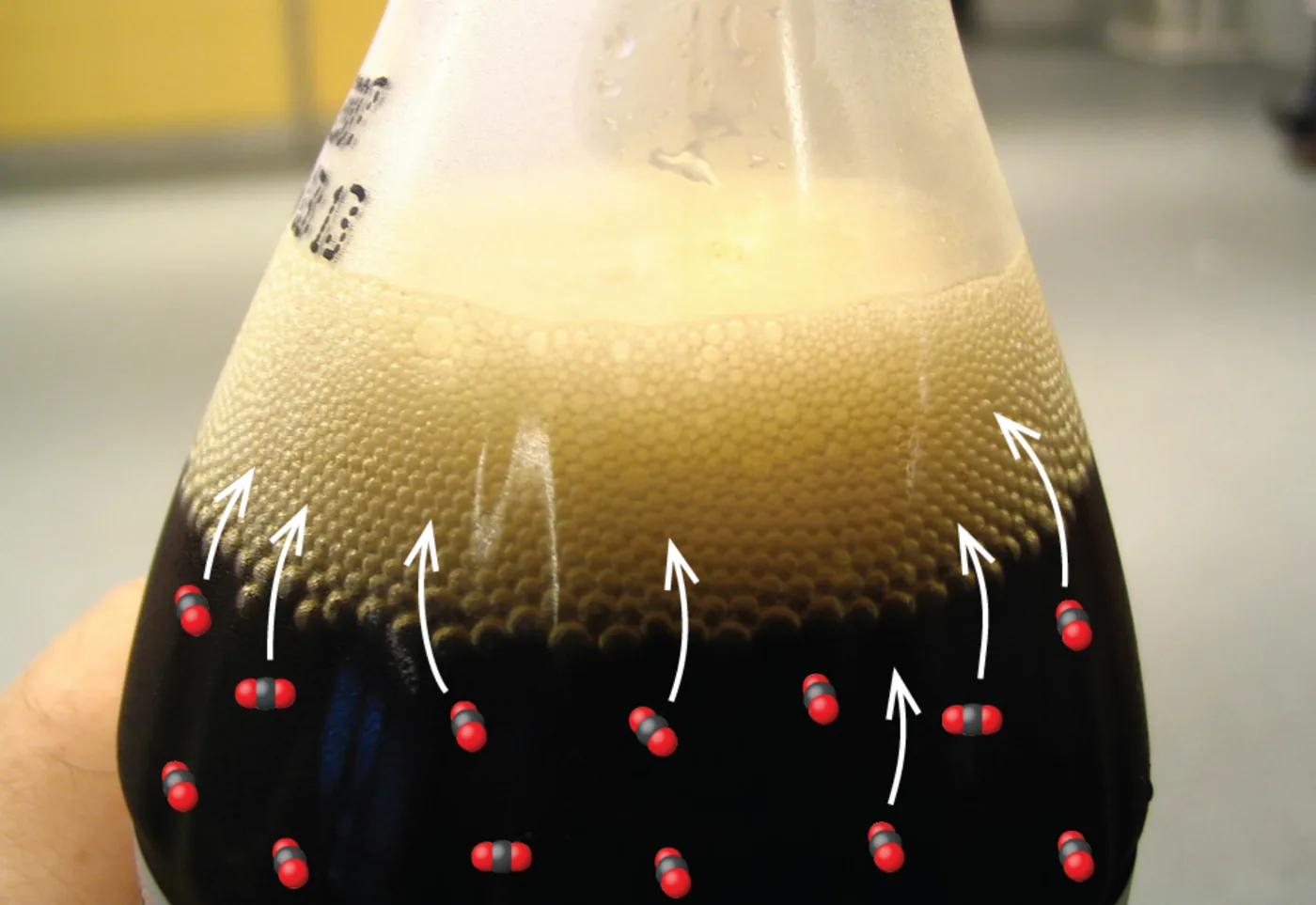
First, gaseous CO2 dissolves: CO2(g) ⇌ CO2(aq).
Second, the dissolved gas reacts with water to form hydrogen carbonate, also called carbonic acid, H2CO3(aq): CO2(aq) + H2O(l) ⇌ H2CO3(aq).
Third, this weak acid ionizes to give bicarbonate and hydrogen ions: H2CO3(aq) ⇌ H+(aq) + HCO3−(aq).
In manufacturing, the beverage is exposed to a high pressure of gaseous carbon dioxide.
1 / 4Next ▶
Chemistry in Everyday Life: Equilibrium and soft drinks
1
This shifts the first equilibrium to the right,
giving high concentrations of dissolved CO2 and, through the other two equilibria, its hydrolysis and ionization products.
2
The bottle or can is then almost filled with the drink, leaving a small volume of air above the surface, called the headspace, before it is sealed.
3
Immediately after sealing, the pressure of CO2 in the headspace is low.
4
It rises as the dissolution equilibrium re-establishes itself by shifting left.
5
Because the liquid volume is much larger than the headspace, only a small amount of dissolved CO2 escapes into the headspace.
6
When the container is opened, the pressure above the liquid drops.
◀ Previous2 / 4Next ▶
Chemistry in Everyday Life: Equilibrium and soft drinks
1
The dissolution equilibrium shifts left, and the hydrolysis and ionization equilibria shift left as well.
2
This releases the hissing gas and lowers the dissolved CO2 concentration.
3
The equilibrium is usually re-established slowly
so the drink stays fizzy long enough to enjoy.
4
Once all the equilibria are restored, the dissolved CO2 concentration is much lower, and the drink has the taste known as “flat”.
◀ Previous3 / 4Next ▶
Opening a soft-drink bottle lowers the pressure above the liquid, so the dissolution equilibrium shifts left and dissolved carbon dioxide escapes. Image: OpenStax, Chemistry 2e, CC BY 4.0.
Chemistry in Everyday Life: Equilibrium and soft drinks
◀ Previous4 / 4
1Effect of a change in temperature2Effect of a change in temperature3Effect of a change in temperature
Effect of a change in temperature
1
A change in concentration shifts an equilibrium but leaves K unchanged. A change in temperature does change the value of the equilibrium constant
so the equilibrium is re-established with a different composition and a different K.
2
Consider an elementary reaction written as aA + bB ⇌ cC
where a, b and c are the stoichiometric coefficients.
3
Because it is elementary, the rate laws for the forward and reverse reactions follow directly from these coefficients.
4
At equilibrium the forward and reverse rates are equal
so kf[A]a[B]b = kr[C]c.
5
Rearranging gives Kc = [C]c/([A]a[B]b) = kf/kr.
6
The equilibrium constant is therefore a mathematical function of the rate constants of the forward and reverse reactions.
1 / 3Next ▶
Effect of a change in temperature
Effect of a change in temperature
The rate constants change with temperature according to the Arrhenius equation, k = A e−Ea/RT.
Here A is the pre-exponential factor,
which has the same units as k, Ea is the activation energy in J mol−1, R is the gas constant,and T is the temperature in kelvin.
If the forward and reverse rate constants change by different amounts with temperature, K changes too.
The same kind of dependence on temperature applies to multistep mechanisms, although the relation is more complicated.
The easiest way to predict the direction of a temperature shift is to look at the enthalpy change ΔH of the reaction, in kJ mol−1.
Dinitrogen tetroxide decomposes in an endothermic (heat-absorbing) process: N2O4(g) ⇌ 2NO2(g), with ΔH greater than zero.
◀ Previous2 / 3Next ▶
Effect of a change in temperature
Effect of a change in temperature
For the purpose of applying Le Châtelier’s principle, heat can be treated as a reactant: N2O4(g) + heat ⇌ 2NO2(g).
Raising the temperature is like adding a reactant
so the equilibrium shifts right toward NO2.
Lowering the temperature shifts it left.
For an exothermic (heat-releasing) process, heat is treated as a product,
so raising the temperature shifts the equilibrium left and lowering it shifts the equilibrium right.
◀ Previous3 / 3
1Effect of a catalyst2Effect of a catalyst
Effect of a catalyst
1
A catalyst is a substance that allows a reaction to proceed by a different mechanism with a faster rate. The catalyzed mechanism passes through a transition state of lower energy than the uncatalyzed reaction. Its activation energy Ea is therefore lower, and the rate constant is larger.
2
Figure 13.8 compares an elementary one-step reaction with and without a catalyst.
3
The catalyst lowers the transition state energy
so it lowers the activation energies of both the forward and the reverse reactions.
4
Both directions are accelerated by the same catalyst.
5
Equilibrium is reached more quickly
but the equilibrium constant is not changed, and so the position of equilibrium is unaffected.
1 / 2Next ▶
An energy diagram of a one-step reaction with and without a catalyst: the catalyst lowers the activation energy of both the forward and reverse reactions. Image: OpenStax, Chemistry 2e, CC BY 4.0.
Effect of a catalyst

◀ Previous2 / 2
1Industrial production of ammonia2Industrial production of ammonia3Industrial production of ammonia4Industrial production of ammonia
Industrial production of ammonia
Industrial production of ammonia
Ammonia, NH3, is one of the top 10 industrial chemicals by production, with roughly two billion pounds made each year in the United States. It is a chemical feedstock for many useful compounds, including fertilizers, plastics, dyes and explosives.
Most industrial ammonia is made by the Haber-Bosch process, based on the equilibrium N2(g) + 3H2(g) ⇌ 2NH3(g).
The reaction is exothermic.
Its equilibrium constant is small, with Kp of about 10−5 at 25 °C
so very little ammonia is present at equilibrium.
The rate is also slow at low temperatures.
The industrial process is designed to favor product formation using three stresses:
1 / 4Next ▶
Industrial production of ammonia
1
High pressure
2
reactant pressures of about 150–250 atm are used.
3
Four moles of gas on the reactant side become two moles on the product side
so high pressure shifts the equilibrium right.
4
Removal of product
5
ammonia is continually collected from the mixture. Lowering its concentration shifts the equilibrium right.
6
Catalyst and moderate temperature
◀ Previous2 / 4Next ▶
Industrial production of ammonia
Industrial production of ammonia
low temperatures favor product formation for this exothermic process,
but at low temperatures the rate is too slow.
A catalyst lets the reaction run at a reasonable rate at moderate temperatures of about 400–500 °C.
A typical industrial plant for this process runs the gases in a closed loop.
Nitrogen and hydrogen are compressed to high pressure and passed over a catalyst bed in the reactor.
The gas leaving the reactor is cooled so that the ammonia condenses to a liquid and can be drawn off.
◀ Previous3 / 4Next ▶
Industrial production of ammonia
Industrial production of ammonia
The unreacted nitrogen and hydrogen are then returned to the reactor
so the mixture is continually stressed toward more product.
◀ Previous4 / 4
Example 1: Coupled reactions (method of Example 13.5) · Example 2: Volume change and the direction of the shift · Example 3: Check your learning
Example 1: Coupled reactions (method of Example 13.5)
Two reactions at the same temperature have these equilibrium constants: (1) A(g) + B(g) ⇌ C(g), K1 = 4.0
and (2) C(g) + 2D(g) ⇌ E(g), K2 = 0.50. Find K for the overall reaction A(g) + B(g) + 2D(g) ⇌ E(g)and then find K for 2C(g) ⇌ 2A(g) + 2B(g).
Solution. Add equations (1) and (2). The species C appears on both sides and cancels. The overall equilibrium constant is the product of the individual constants: K = K1 × K2 = 4.0 × 0.50 = 2.0.
For the second target, reverse equation (1). Reversing a reaction inverts its constant: C(g) ⇌ A(g) + B(g) has K = 1/4.0 = 0.25. Multiply this equation by 2 so that the coefficient of C becomes 2. Multiplying the equation by 2 raises its constant to the power 2
so 2C(g) ⇌ 2A(g) + 2B(g) has K = (0.25)2 = 0.0625.
Example 2: Volume change and the direction of the shift
The equilibrium 2NO2(g) ⇌ 2NO(g) + O2(g) has Kc = [NO]2[O2]/[NO2]2. The mixture is at equilibrium
so Qc = Kc. The volume of the container is doubled. Each concentration is halved.
Solution. The new Qc is ([NO]/2)2([O2]/2)/([NO2]/2)2. The factor is (1/2)2+1−2 = (1/2)1 = 1/2. So Qc = Kc/2
which is smaller than Kc. The equilibrium shifts right, toward the side with more moles of gas, NO and O2.
Example 3: Check your learning
Using the constants in Example 1, find K for E(g) ⇌ A(g) + B(g) + 2D(g). Answer: The reverse of the overall reaction has K = 1/2.0 = 0.50.
For the equilibrium 2NO2(g) ⇌ 2NO(g) + O2(g), predict the shift when the volume is reduced by a factor of 3. Answer: Qc increases by a factor of 32+1−2 = 3
so Qc >Kc and the equilibrium shifts left, toward NO2.
Key terms
| Term | Meaning |
|---|---|
| Dynamic equilibrium | A state in which the forward and reverse reactions occur at equal rates, so the concentrations no longer change. |
| Stress | A change in conditions, such as concentration or temperature, that makes the forward and reverse rates unequal. |
| Shift | A net reaction in one direction that follows a stress and continues until equilibrium is re-established. |
| Le Châtelier’s principle | The rule that a stressed equilibrium shifts in the direction that responds to the stress and re-establishes equilibrium. |
| Reaction quotient, Qc | The ratio of product and reactant concentrations at any moment, compared with Kc to predict the direction of a shift. |
| Equilibrium constant, Kc | The fixed value of the concentration ratio at equilibrium at a given temperature. |
| Law of mass action | The principle that the equilibrium constant stays the same after a concentration stress, even though the composition changes. |
| Rate law | An equation that gives the rate of a reaction in terms of rate constants and the concentrations of reactants. |
| Partial pressure, P | The pressure that one gas in a mixture would exert if it alone occupied the container, measured in pascals (Pa). |
| Headspace | The small volume of gas above a liquid in a sealed container, such as the space above a soft drink. |
| Arrhenius equation | The equation k = A e−Ea/RT that shows how a rate constant depends on temperature. |
| Activation energy, Ea | The minimum energy needed for a reaction to occur, in J mol−1; a lower value gives a faster rate. |
| Catalyst | A substance that provides a different mechanism with a lower activation energy and is not used up in the reaction. |
| Endothermic process | A process that absorbs heat, so heat is treated as a reactant and ΔH is positive. |
| Exothermic process | A process that releases heat, so heat is treated as a product and ΔH is negative. |
| Haber-Bosch process | The industrial process that makes ammonia from nitrogen and hydrogen over a catalyst at high pressure. |
1Avoid these mistakes2Avoid these mistakes3Avoid these mistakes
Avoid these mistakes
1Avoid this
Believing that a catalyst shifts the position of an equilibrium.Avoid this
A catalyst speeds up both directions equally, so the equilibrium is reached faster but K does not change.Avoid this
2Avoid this
Thinking that adding a reactant shifts the equilibrium to the left.Avoid this
Adding a reactant makes Qc smaller than Kc, so the equilibrium shifts right to form more product.Avoid this
1 / 3Next ▶
Avoid these mistakes
3Avoid this
Assuming that a volume change always shifts a gas-phase equilibrium. First count the moles of gas on each side; if they are equal, no shift occurs.Avoid this
4Avoid this
Treating heat as a product in an endothermic reaction, or as a reactant in an exothermic reaction, which reverses the predicted shift.Avoid this
5Avoid this
Claiming that K changes after a concentration stress. Only the composition changes; K changes only with temperature.Avoid this
◀ Previous2 / 3Next ▶
Avoid these mistakes
6Avoid this
Forgetting to reverse a reaction (K becomes 1/K) or to raise K to the power of the coefficient when a reaction is multiplied.Avoid this
◀ Previous3 / 3