Curriculum
Chemistry 2e
Unit 1: Essential Ideas
0/14
Unit 2: Atoms, Molecules, and Ions
0/16
Unit 3: Composition of Substances and Solutions
0/10
Unit 4: Stoichiometry of Chemical Reactions
0/12
Unit 5: Thermochemistry
0/8
Unit 6: Electronic Structure and Periodic Properties of Elements
0/12
Unit 7: Chemical Bonding and Molecular Geometry
0/14
Unit 8: Advanced Theories of Covalent Bonding
0/10
Unit 9: Gases
0/23
Unit 10: Liquids and Solids
0/28
Unit 11: Solutions and Colloids
0/24
Unit 12: Kinetics
0/32
Unit 13: Fundamental Equilibrium Concepts
0/20
Unit 14: Acid-Base Equilibria
0/32
-
Unit 14 overview: Acid-Base Equilibria
 Preview
-
14.1 Brønsted-Lowry Acids and Bases
Preview
-
14.1 Brønsted-Lowry Acids and Bases - Check yourself
 Preview
-
14.1 Brønsted-Lowry Acids and Bases
Preview
-
14.1 Brønsted-Lowry Acids and Bases - Check yourself
Preview
-
14.2 pH and pOH
Preview
-
14.2 pH and pOH - Check yourself
Preview
-
14.2 pH and pOH
Preview
-
14.2 pH and pOH - Check yourself
Preview
-
14.3 Relative Strengths of Acids and Bases
Preview
-
14.3 Relative Strengths of Acids and Bases - Check yourself
Preview
-
14.3 Relative Strengths of Acids and Bases
Preview
-
14.3 Relative Strengths of Acids and Bases - Check yourself
Preview
-
14.4 Hydrolysis of Salts
Preview
-
14.4 Hydrolysis of Salts - Check yourself
Preview
-
Unit 14 review quiz: Acid-Base Equilibria
Preview
-
Unit 14 overview: Acid-Base Equilibria
Preview
-
14.4 Hydrolysis of Salts
Preview
-
14.4 Hydrolysis of Salts - Check yourself
Preview
-
14.5 Polyprotic Acids
Preview
-
14.5 Polyprotic Acids - Check yourself
Preview
-
14.5 Polyprotic Acids
Preview
-
14.5 Polyprotic Acids - Check yourself
Preview
-
14.6 Buffers
Preview
-
14.6 Buffers - Check yourself
Preview
-
14.6 Buffers
Preview
-
14.6 Buffers - Check yourself
Preview
-
14.7 Acid-Base Titrations
Preview
-
14.7 Acid-Base Titrations - Check yourself
Preview
-
14.7 Acid-Base Titrations
Preview
-
14.7 Acid-Base Titrations - Check yourself
Preview
-
Unit 14 review quiz: Acid-Base Equilibria
Preview
Unit 15: Equilibria of Other Reaction Classes
0/16
Unit 16: Thermodynamics
0/20
Unit 17: Electrochemistry
0/32
Unit 18: Representative Metals, Metalloids, and Nonmetals
0/52
Unit 19: Transition Metals and Coordination Chemistry
0/16
Unit 20: Organic Chemistry
0/20
Unit 21: Nuclear Chemistry
0/28
Text lesson
14.6 Buffers
14.6 Buffers — CHEMISTRY notes: You will be able to describe the composition and function of acid–base buffers and calculate the pH of a buffer before and after adding a strong acid or base.
Polyprotic acids and bases
Polyprotic acids and bases
Each successive ionization step of a polyprotic acid is less extensive than the one before it
so the stepwise acid ionization constants get smaller. Successive ionization constants often differ by a factor of about 105 to 106.
This large difference makes calculations simpler. The changes in concentration caused by the later steps are so small that they can be neglected
which allows the math-simplifying assumptions used in the earlier examples.
Polyprotic bases can accept more than one hydrogen ion. The carbonate ion, CO32−, is a diprotic base. Its ionization constants also decrease with each step, and equilibrium calculations for polyprotic bases follow the same methods as those for polyprotic acids.
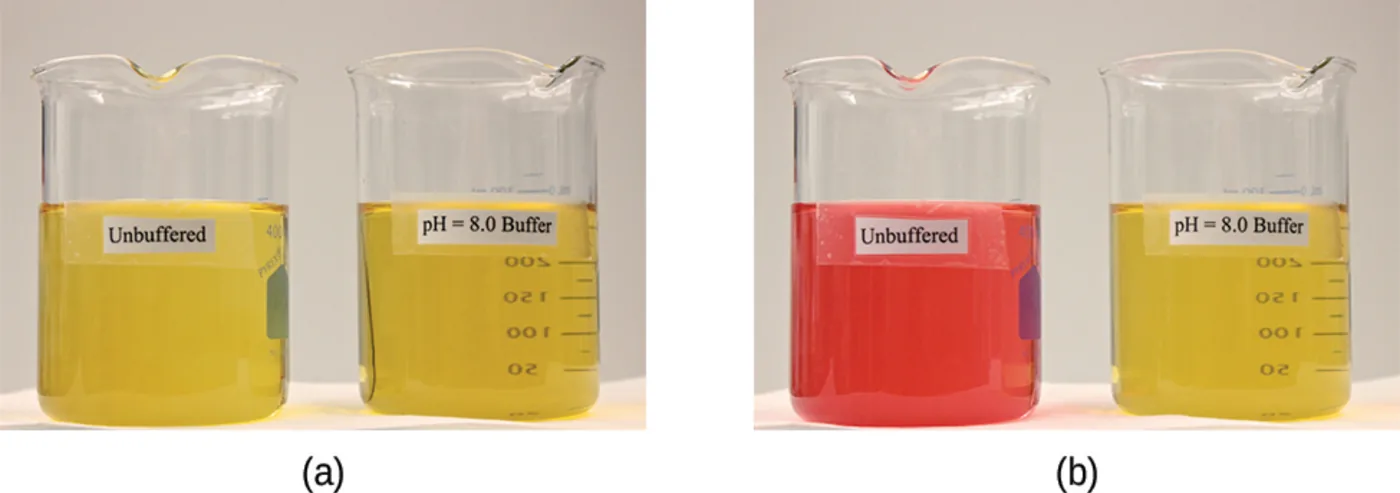
Two beakers with methyl orange indicator: the buffered solution stays yellow after adding acid, while the unbuffered solution turns red. Image: OpenStax, Chemistry 2e, CC BY 4.0.
What a buffer is
 ⤢ Enlarge
1
A solution that contains appreciable amounts of a weak conjugate acid–base pair is called a buffer solution, or simply a buffer. A buffer resists a change in pH when small amounts of a strong acid or a strong base are added.
2
A buffer can be made from a weak acid and its salt. A solution of acetic acid and sodium acetate, CH3COOH + CH3COONa, is an example. A buffer can also be made from a weak base and its salt, such as a solution of ammonia and ammonium chloride, NH3(aq) + NH4Cl(aq).
3
The diagram below compares two solutions with the same starting pH of 8, one unbuffered and one buffered, using the indicator methyl orange. After 1 mL of 0.01 M HCl is added, the buffered solution keeps its pH
while the unbuffered solution becomes acidic and the indicator turns red.
1How buffers work2How buffers work3How buffers work
How buffers work
How buffers work
1
Consider a mixture of roughly equal amounts of acetic acid and sodium acetate.
The weak acid and its conjugate base can neutralize modest amounts of added strong acid or base.
2
When a strong base is added, the hydroxide ion neutralizes hydronium ion.
The acetic acid ionization equilibrium then shifts to the right and produces more of the weak conjugate base, acetate ion.
1 / 3Next ▶
How buffers work
How buffers work
3
When a strong acid is added, the hydronium ion is consumed by the acetate ion,
which shifts the equilibrium to the left and produces more of the weak acid, acetic acid.
4
The buffering action therefore comes from converting the added strong acid or base into the weak acid or base of the conjugate pair.
These weak species ionize only slightly, compared with the complete ionization of a strong acid or base,
◀ Previous2 / 3Next ▶
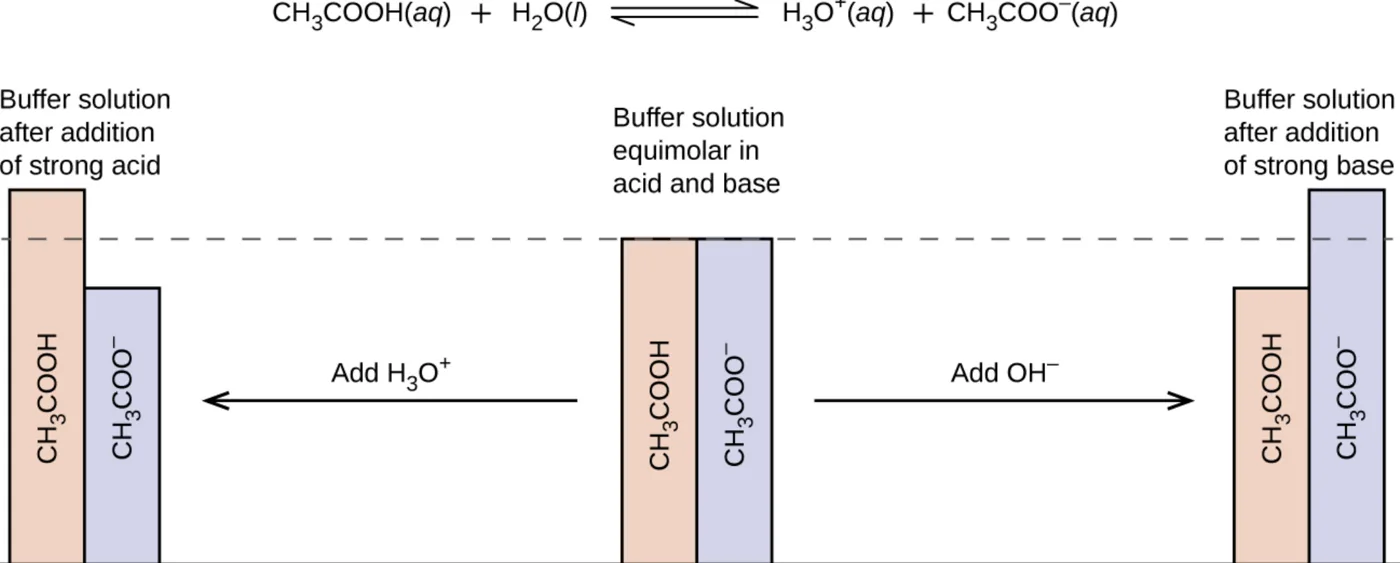
An equimolar acetic acid and acetate buffer shifts toward acetic acid when strong acid is added and toward acetate when strong base is added. Image: OpenStax, Chemistry 2e, CC BY 4.0.
How buffers work
 ⤢ Enlarge
1
so the pH changes much less than it would in an unbuffered solution.
2
The diagram below illustrates how the concentrations of the two conjugate partners change when acid and base are added.
3
Acetate buffers are used in biochemical studies of enzymes and other cell components. They hold the pH steady so that the biological activity of these compounds is not affected.
◀ Previous3 / 3
1Example 1: pH of an acetate buffer2Example 2: pH after adding 1.0 mL of 0.10 M NaOH to 100 mL o3Example 3: pH after adding 1.0 mL of 0.10 M NaOH to 100 mL o
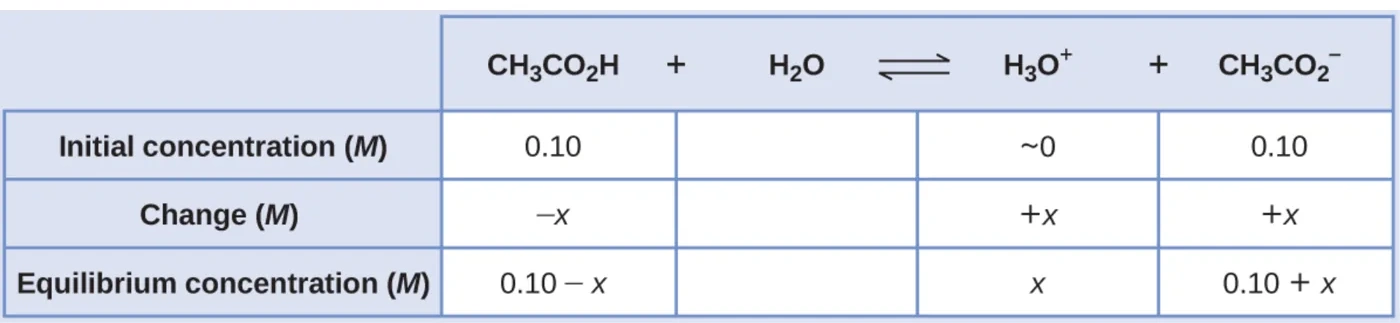
ICE table for the acetic acid and acetate buffer, showing the equilibrium concentrations in terms of x. Image: OpenStax, Chemistry 2e, CC BY 4.0.
Example 1: pH of an acetate buffer
 ⤢ Enlarge
1
Calculate the pH of a buffer that contains 0.10 M acetic acid and 0.10 M sodium acetate. Use Ka = 1.8 × 10⁻⁵ for acetic acid.
2
Set up an ICE table for the equilibrium, CH3CO2H + H2O ⇌ H3O+ + CH3CO2−. The initial acid concentration is 0.10 M, the initial hydronium concentration is about 0, and the initial acetate concentration is 0.10 M.
3
The equilibrium concentrations are 0.10 − x for acetic acid, x for hydronium ion, and 0.10 + x for acetate.
4
Substitute these into the Ka expression, Ka = [H3O+][CH3CO2−]/[CH3CO2H].
5
Because x is much smaller than 0.10, the expression simplifies to Ka ≈ x(0.10)/0.10 = x.
6
So x = 1.8 × 10⁻⁵ M, [H3O+] = 1.8 × 10⁻⁵ M, and pH = −log(1.8 × 10⁻⁵) = 4.74.
1 / 3Next ▶
Example 2: pH after adding 1.0 mL of 0.10 M NaOH to 100 mL of the buffer
Example 2: pH after adding 1.0 mL of 0.10 M NaOH to 100 mL of the buffer
The added hydroxide ion neutralizes an equal number of moles of acetic acid and forms the same number of moles of acetate.
Initial acetic acid moles: 0.10 mol/L × 0.100 L = 0.010 mol. Moles of NaOH added: 0.10 mol/L × 0.0010 L = 1.0 × 10⁻⁴ mol.
After neutralization, acetic acid = 0.010 − 0.00010 = 0.00990 mol, and acetate = 0.010 + 0.00010 = 0.01010 mol. The total volume is 0.101 L
so [CH3CO2H] = 0.0980 M and [CH3CO2−] = 0.1000 M.
Repeat the equilibrium calculation with these values. The pH is 4.75, only slightly different from the original 4.74.
◀ Previous2 / 3Next ▶
Example 3: pH after adding 1.0 mL of 0.10 M NaOH to 100 mL of an unbuffered solution at pH 4.74 · Check Your Learning: adding strong acid to a weak HCl solution
Example 3: pH after adding 1.0 mL of 0.10 M NaOH to 100 mL of an unbuffered solution at pH 4.74
An unbuffered solution at pH 4.74 has [H3O+] = 1.8 × 10⁻⁵ M
which is 1.8 × 10⁻⁶ mol in 100 mL.
The added hydroxide is 1.0 × 10⁻⁴ mol. Because the reaction H3O+ + OH− → 2H2O has a 1:1 ratio, the hydroxide is in excess. Leftover OH− = 1.0 × 10⁻⁴ − 1.8 × 10−6 = 9.82 × 10⁻⁵ mol.
In 0.101 L, [OH−] = 9.72 × 10⁻⁴ M
so pOH = 3.01 and pH = 10.99. Adding the same base raised the unbuffered pH from 4.74 to 10.99while the buffer rose only from 4.74 to 4.75.
Check Your Learning: adding strong acid to a weak HCl solution
Show that adding 1.0 mL of 0.10 M HCl changes the pH of 100 mL of a 1.8 × 10⁻⁵ M HCl solution from 4.74 to 3.00.
Initial pH = −log(1.8 × 10⁻⁵) = 4.74. Moles of H3O+ in 100 mL: 1.8 × 10⁻⁵ mol/L × 0.100 L = 1.8 × 10⁻⁶ mol. Moles of H3O+ added: 0.10 mol/L × 0.0010 L = 1.0 × 10⁻⁴ mol.
Total moles = 1.018 × 10⁻⁴ mol in 0.101 L
so [H3O+] = 1.01 × 10⁻³ M and the final pH = 3.00.
◀ Previous3 / 3
1Buffer capacity2Buffer capacity
Buffer capacity
Buffer capacity
A buffer does not hold its pH forever. Its ability to resist pH change depends on appreciable amounts of the conjugate acid–base pair. When enough strong acid or base is added to lower the concentration of either member of the pair substantially, the buffer action fails and the pH changes sharply.
The buffer capacity is the amount of strong acid or base that a given volume of buffer can absorb before the pH changes significantly, usually by about one unit.
Capacity depends on the amounts of the weak acid and its conjugate base.
One litre of a solution that is 1.0 M in acetic acid and 1.0 M in acetate has a greater capacity than one litre that is 0.10 M in each, even though both have the same pH.
1 / 2Next ▶
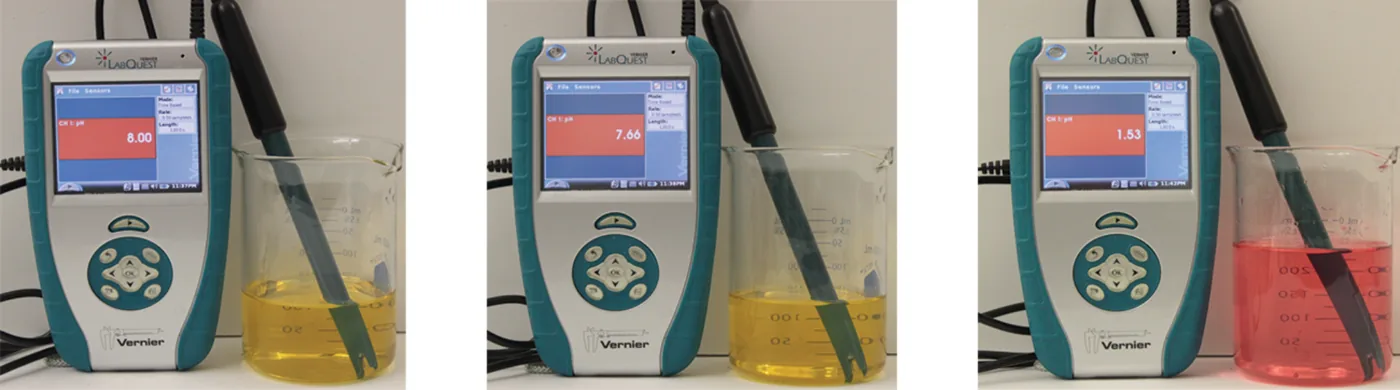
Methyl orange shows that a small amount of acid barely changes a buffer, while a large amount uses up the buffer capacity and the pH drops sharply. Image: OpenStax, Chemistry 2e, CC BY 4.0.
Buffer capacity
◀ Previous2 / 2
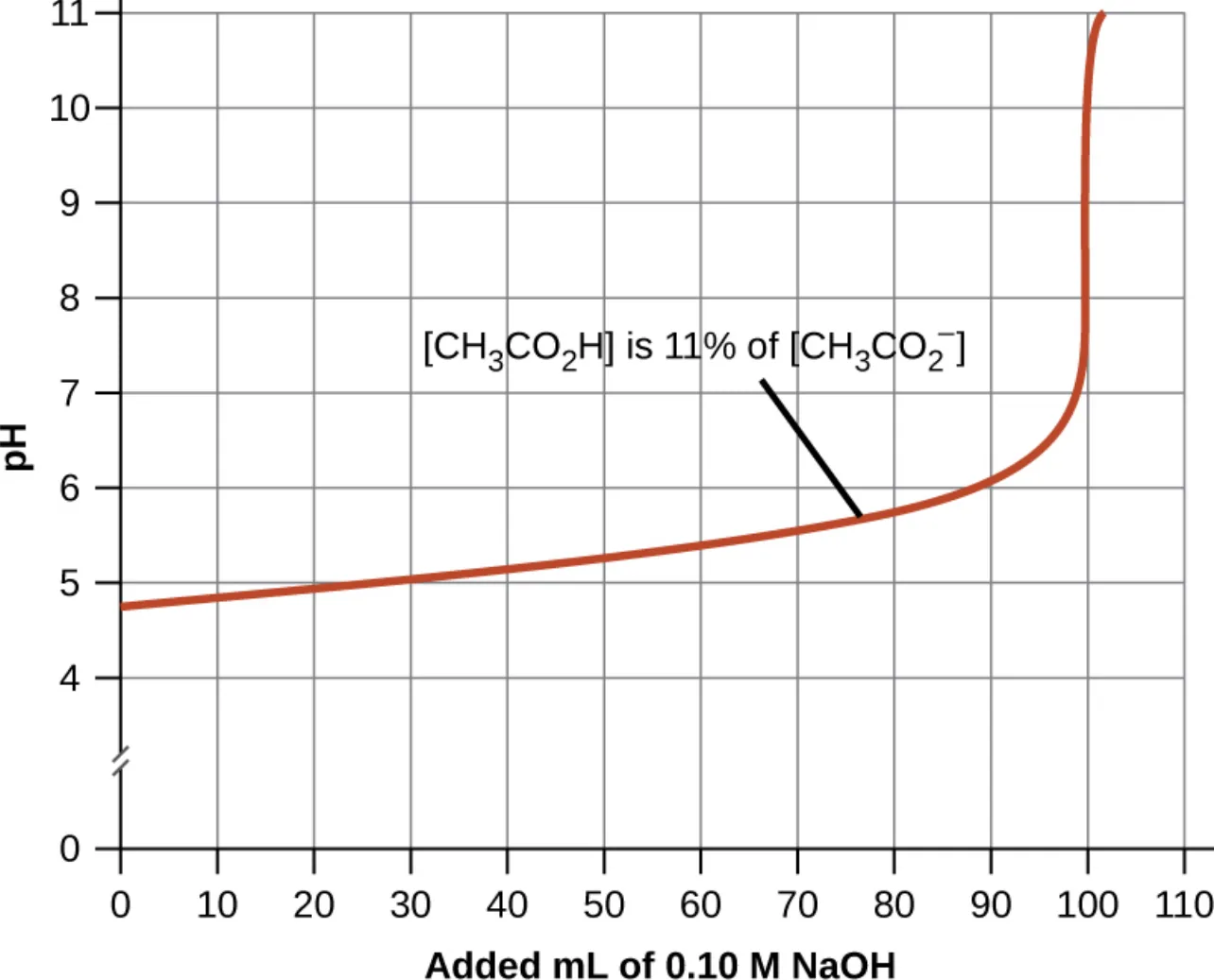
pH against added NaOH for a 100 mL acetic acid–acetate buffer: the curve is flat near the start and rises steeply after the buffer capacity is reached. Image: OpenStax, Chemistry 2e, CC BY 4.0.
Selecting a suitable buffer mixture
 ⤢ Enlarge
1
Two rules of thumb help choose a buffer. First, a good buffer has roughly equal concentrations of both components. A buffer is generally no longer useful when one component falls below about 10% of the other.
2
The graph below shows how the pH of an acetic acid–acetate buffer changes as strong base is added. The initial pH is 4.74. The pH rises by one unit when the acetic acid concentration falls to about 11% of the acetate concentration. Beyond the buffer capacity, adding more base causes large jumps in pH.
3
Second, weak acids and their salts work best as buffers at pH below 7. Weak bases and their salts work best at pH above 7.
1Buffers in blood2Buffers in blood
The Henderson–Hasselbalch equation
1
Starting from the Ka expression for a weak acid, rearranging for [H3O+], and taking the negative logarithm of both sides gives a relation between pH and the concentrations of the conjugate pair. This is the Henderson–Hasselbalch equation:
2
pH = pKa + log([conjugate base]/[weak acid])
3
Here pKa = −log Ka is a unitless number, and the concentrations are in mol/L (M). The equation is valid only when the x-is-small assumption holds
which means the acid ionizes only slightly.
4
Blood gives a useful example. Using the carbonic acid pKa of about 6.1 at body temperature, the concentrations 0.024 M HCO3− and 0.0012 M H2CO3 give pH = 6.1 + log(0.024/0.0012) = 6.1 + log 20 ≈ 7.4.
How sciences interconnect: medicine
How sciences interconnect: medicine
The carbonate buffer system in blood is a direct application of buffer chemistry. Breathing adds a second control
because carbon dioxide leaving the blood changes the H2CO3 level and therefore the pH. Medical staff use the same relationship to judge acid–base disorders in patients.
1Portrait of a chemist: Henderson and Hasselbalch2Portrait of a chemist: Henderson and Hasselbalch
Key terms
| Term | Meaning |
|---|---|
| Buffer solution (buffer) | A solution containing appreciable amounts of a weak conjugate acid–base pair that resists pH change when small amounts of strong acid or base are added. |
| Conjugate acid–base pair | Two species that differ by a single proton, such as CH3COOH and CH3COO−. |
| Buffer capacity | The amount of strong acid or base a given volume of buffer can absorb before its pH changes significantly, usually by about one unit. |
| Polyprotic acid | An acid that can donate more than one proton, with a separate ionization constant for each step. |
| Polyprotic base | A base that can accept more than one proton, such as the carbonate ion. |
| Stepwise ionization constant | The equilibrium constant for one proton-transfer step of a polyprotic acid or base. |
| Henderson–Hasselbalch equation | The relation pH = pKa + log([conjugate base]/[weak acid]) used to find the pH of a buffer. |
| pKa | The negative logarithm of the acid ionization constant, pKa = −log Ka. |
| Bicarbonate ion | The HCO3− ion, the conjugate base of carbonic acid and a key buffering species in blood. |
| Carbonic acid | H2CO3, the weak acid in the carbonate buffer system of blood. |
| Salt of a weak acid | An ionic compound, such as sodium acetate, whose anion is the conjugate base of a weak acid. |
| Salt of a weak base | An ionic compound, such as ammonium chloride, whose cation is the conjugate acid of a weak base. |
| Methyl orange | An acid–base indicator that is yellow at pH 8 and turns red near pH 4. |
1Avoid these mistakes2Avoid these mistakes3Avoid these mistakes