Curriculum
Chemistry 2e
Unit 1: Essential Ideas
0/14
Unit 2: Atoms, Molecules, and Ions
0/16
Unit 3: Composition of Substances and Solutions
0/10
Unit 4: Stoichiometry of Chemical Reactions
0/12
Unit 5: Thermochemistry
0/8
Unit 6: Electronic Structure and Periodic Properties of Elements
0/12
Unit 7: Chemical Bonding and Molecular Geometry
0/14
Unit 8: Advanced Theories of Covalent Bonding
0/10
Unit 9: Gases
0/23
Unit 10: Liquids and Solids
0/28
Unit 11: Solutions and Colloids
0/24
Unit 12: Kinetics
0/32
-
Unit 12 overview: Kinetics
 Preview
-
12.1 Chemical Reaction Rates
Preview
-
12.1 Chemical Reaction Rates - Check yourself
 Preview
-
Unit 12 overview: Kinetics
Preview
-
12.1 Chemical Reaction Rates
Preview
-
12.1 Chemical Reaction Rates - Check yourself
Preview
-
12.2 Factors Affecting Reaction Rates
Preview
-
12.2 Factors Affecting Reaction Rates - Check yourself
Preview
-
12.2 Factors Affecting Reaction Rates
Preview
-
12.2 Factors Affecting Reaction Rates - Check yourself
Preview
-
12.3 Rate Laws
Preview
-
12.3 Rate Laws - Check yourself
Preview
-
12.3 Rate Laws
Preview
-
12.3 Rate Laws - Check yourself
Preview
-
12.4 Integrated Rate Laws
Preview
-
12.4 Integrated Rate Laws - Check yourself
Preview
-
12.4 Integrated Rate Laws
Preview
-
12.4 Integrated Rate Laws - Check yourself
Preview
-
12.5 Collision Theory
Preview
-
12.5 Collision Theory - Check yourself
Preview
-
12.5 Collision Theory
Preview
-
Unit 12 review quiz: Kinetics
Preview
-
12.5 Collision Theory - Check yourself
Preview
-
12.6 Reaction Mechanisms
Preview
-
12.6 Reaction Mechanisms - Check yourself
Preview
-
12.6 Reaction Mechanisms
Preview
-
12.6 Reaction Mechanisms - Check yourself
Preview
-
12.7 Catalysis
Preview
-
12.7 Catalysis - Check yourself
Preview
-
12.7 Catalysis
Preview
-
12.7 Catalysis - Check yourself
Preview
-
Unit 12 review quiz: Kinetics
Preview
Unit 13: Fundamental Equilibrium Concepts
0/20
Unit 14: Acid-Base Equilibria
0/32
Unit 15: Equilibria of Other Reaction Classes
0/16
Unit 16: Thermodynamics
0/20
Unit 17: Electrochemistry
0/32
Unit 18: Representative Metals, Metalloids, and Nonmetals
0/52
Unit 19: Transition Metals and Coordination Chemistry
0/16
Unit 20: Organic Chemistry
0/20
Unit 21: Nuclear Chemistry
0/28
Text lesson
12.7 Catalysis
12.7 Catalysis — CHEMISTRY notes: You will be able to explain how a catalyst speeds up a reaction through a different mechanism with a lower activation energy, and list catalysis in natural and industrial processes.
1Catalysts and reaction pathways2Catalysts and reaction pathways3Catalysts and reaction pathways4Catalysts and reaction pathways
Catalysts and reaction pathways
Catalysts and reaction pathways
1
A catalyst is a substance that increases the rate of a reaction without being consumed in the reaction.
Catalysts work through the reaction mechanism, the sequence of elementary steps that make up the overall reaction.
The mechanisms covered in the previous section explain how a catalyst does this.
2
The activation energy, Eₐ, is the energy needed to reach the transition state, the highest-energy arrangement along the reaction path.
1 / 4Next ▶
Catalysts and reaction pathways
1
It is found by subtracting the energy of the reactants from the energy of the transition state, and it is measured in kJ.
2
3
3
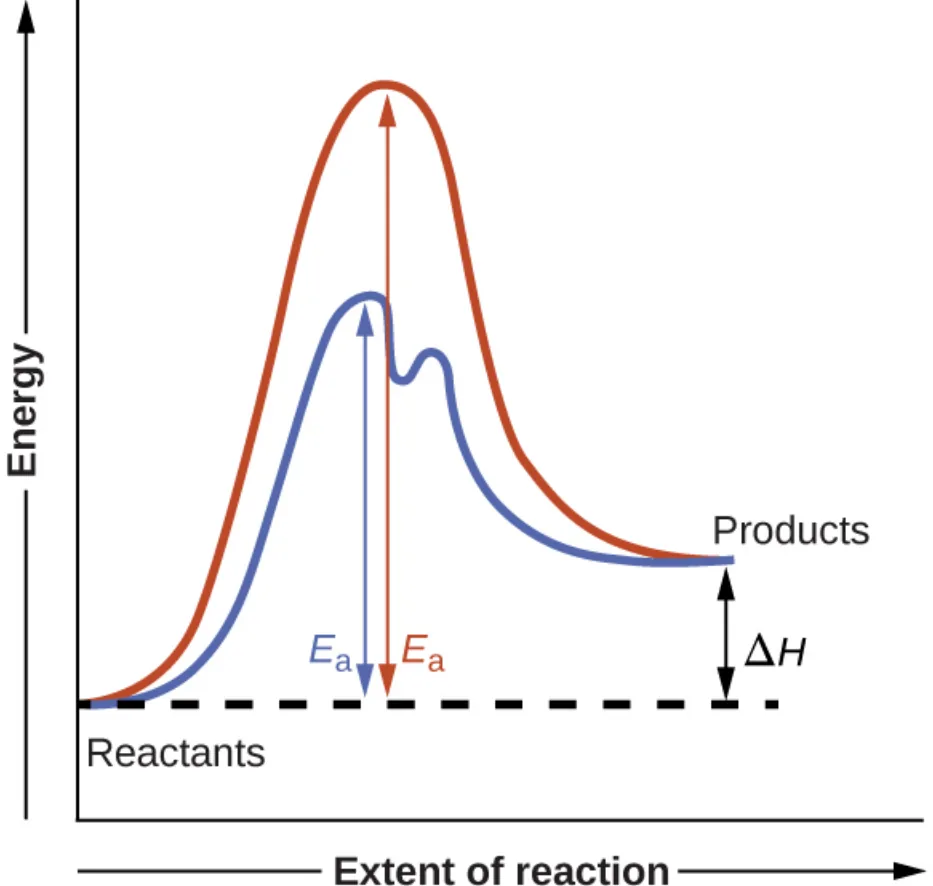
The diagram below compares one reaction with and without a catalyst.
4
Both curves start and end at the same energies because they describe the same overall reaction.
5
Here the products are higher in energy than the reactants
so the reaction is endothermic and ΔH is positive.
6
The uncatalyzed reaction (red curve) has one transition state
so it is a one-step mechanism.
◀ Previous2 / 4Next ▶
Catalysts and reaction pathways
Catalysts and reaction pathways
The catalyzed reaction (blue curve) has two transition states with an intermediate in the valley between them,
so it is a two-step mechanism.
4
The key point is that the catalyzed route has a lower activation energy.
The catalyst does not change the energies of the reactants or products, and it does not change ΔH.
It provides a different path whose rate-determining step, the slowest step, has a smaller activation energy.
◀ Previous3 / 4Next ▶
Energy profiles for an endothermic reaction with and without a catalyst. The catalyzed route has two steps and a lower peak energy. Image: OpenStax, Chemistry 2e, CC BY 4.0.
Catalysts and reaction pathways
 ⤢ Enlarge
Catalysts and reaction pathways
The catalyzed mechanism does not have to contain fewer steps than the uncatalyzed one.
It only needs a path in which the rate-determining step is faster.
◀ Previous4 / 4
1Homogeneous catalysts2Homogeneous catalysts
1Portrait of a Chemist: Mario J. Molina2Portrait of a Chemist: Mario J. Molina
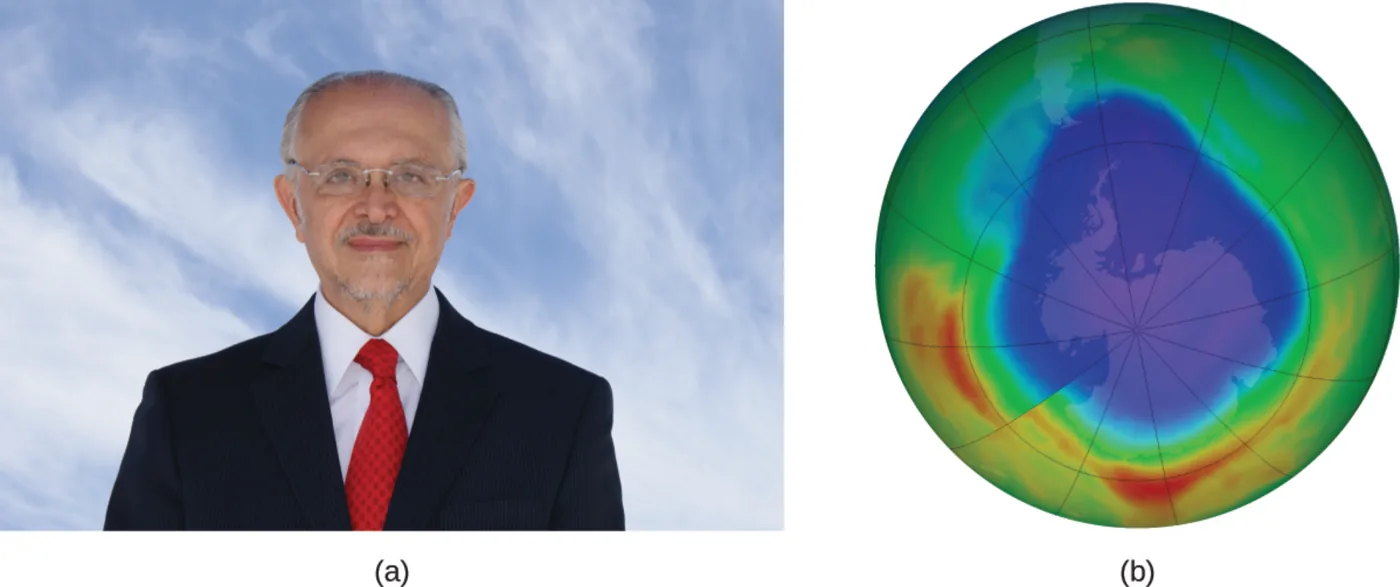
Mario Molina, who shared the 1995 Nobel Prize, beside an image of the Antarctic ozone hole. Image: OpenStax, Chemistry 2e, CC BY 4.0.
Portrait of a Chemist: Mario J. Molina
 ⤢ Enlarge
Portrait of a Chemist: Mario J. Molina
The 1995 Nobel Prize in Chemistry was shared by Paul J. Crutzen, Mario J. Molina and F. Sherwood Rowland for their work on the formation and decomposition of ozone. Molina, a Mexican citizen, did most of his research at the Massachusetts Institute of Technology (MIT).
In 1974 Molina and Rowland published a paper in the journal Nature warning that chlorofluorocarbon gases threaten the ozone layer.
The ozone layer absorbs ultraviolet light and protects Earth from solar radiation.
As chemical reactions reduce ozone, a hole forms above Antarctica and more ultraviolet radiation reaches the surface.
This increase is strongly linked to skin cancer.
Their work helped lead to the Montreal Protocol, a treaty signed in 1987 that began phasing out production of chemicals that destroy ozone.
1 / 2Next ▶
Portrait of a Chemist: Mario J. Molina
1
Molina and Rowland showed that chlorine atoms from human-made chemicals catalyze ozone destruction in a way similar to NO.
2
Chlorine atoms form when chlorocarbons or chlorofluorocarbons, once widely used as refrigerants and propellants, are broken down by ultraviolet light or react with hydroxyl radicals.
3
For example, methyl chloride, CH3Cl, can release chlorine atoms when it is decomposed by ultraviolet light.
4
The chlorine atom then takes part in a catalytic cycle: Cl + O3 → ClO + O2, followed by ClO + O → Cl + O2.
5
The chlorine atom is regenerated at the end of each cycle
so a single chlorine atom can destroy thousands of ozone molecules.
6
Most atmospheric chlorine, however, exists in the forms Cl2 and ClONO2
which do not catalyze ozone loss.
◀ Previous2 / 2
1How Sciences Interconnect: Glucose-6-phosphate dehydrogenase2How Sciences Interconnect: Glucose-6-phosphate dehydrogenase
How Sciences Interconnect: Glucose-6-phosphate dehydrogenase deficiency
How Sciences Interconnect: Glucose-6-phosphate dehydrogenase deficiency
Enzymes in the human body act as catalysts for important reactions in cellular metabolism.
A shortage of a particular enzyme can therefore cause a life-threatening disease.
Glucose-6-phosphate dehydrogenase (G6PD) deficiency is a genetic condition in which there is too little of this enzyme,
and it is the most common enzyme deficiency in humans.
The enzyme is rate-limiting for the metabolic pathway that supplies NADPH to cells.
1 / 2Next ▶
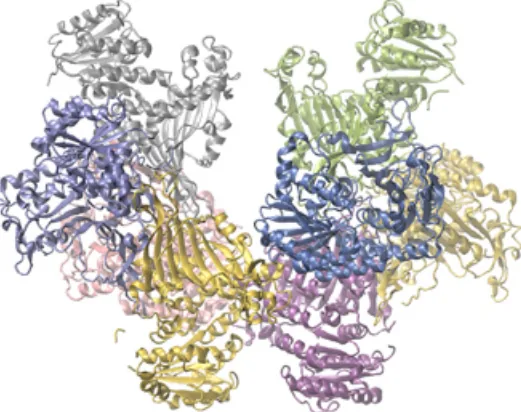
Glucose-6-phosphate dehydrogenase, the enzyme that limits how fast cells can produce NADPH. Image: OpenStax, Chemistry 2e, CC BY 4.0.
How Sciences Interconnect: Glucose-6-phosphate dehydrogenase deficiency
 ⤢ Enlarge
How Sciences Interconnect: Glucose-6-phosphate dehydrogenase deficiency
When this pathway is disrupted, red blood cells have less reduced glutathione, an antioxidant that protects them from oxidative damage.
Once all the glutathione is used up, enzymes and other proteins such as hemoglobin are open to damage.
Hemoglobin can be broken down to bilirubin
which causes jaundice that can become severe.
People with G6PD deficiency must avoid certain foods and medicines that can damage their glutathione-poor red blood cells.
◀ Previous2 / 2
1Heterogeneous catalysts2Heterogeneous catalysts3Heterogeneous catalysts4Heterogeneous catalysts
Heterogeneous catalysts
1
A heterogeneous catalyst is present in a different phase from the reactants, usually a solid.
2
It works by providing an active surface on which the reaction can take place.
3
In gas and liquid reactions, the reaction occurs on the surface of the catalyst rather than within the gas or liquid.
4
Adsorption is the binding of molecules to a surface, and desorption is their release from it.
5
Heterogeneous catalysis usually involves four processes:
6
1
1 / 4Next ▶
Heterogeneous catalysts
1
Adsorption of the reactant(s) onto the surface of the catalyst
2
2
3
Activation of the adsorbed reactant(s)
4
3
5
Reaction of the adsorbed reactant(s)
6
4
◀ Previous2 / 4Next ▶
Heterogeneous catalysts
Heterogeneous catalysts
Desorption of the product(s) from the surface of the catalyst
Nickel catalyzes the hydrogenation of polyunsaturated fats and oils
which contain several carbon–carbon double bonds, into saturated fats and oilswhich contain only single bonds.
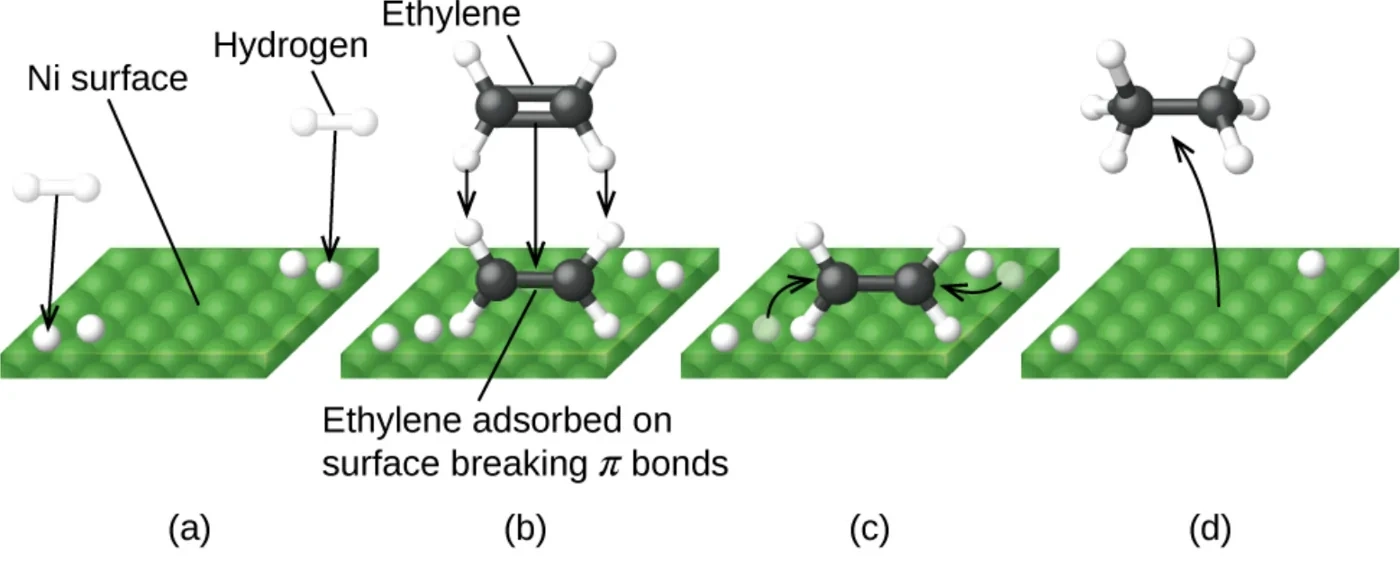
The figure below shows the steps for ethylene and hydrogen on a nickel surface.
Hydrogen adsorbs and its H–H bonds break, forming Ni–H bonds.
Ethylene adsorbs and its C–C π bond breaks, forming Ni–C bonds.
The surface atoms diffuse and form new C–H bonds when they collide.
◀ Previous3 / 4Next ▶
Four steps of the nickel-catalyzed reaction, from adsorption of hydrogen and ethylene to desorption of ethane. Image: OpenStax, Chemistry 2e, CC BY 4.0.
Heterogeneous catalysts
 ⤢ Enlarge
1
Finally, the ethane, C2H6, molecules desorb from the nickel surface.
2
Heterogeneous catalysts are used in many important industrial processes, including the production of ammonia, nitric acid, sulfuric acid and methanol.
◀ Previous4 / 4
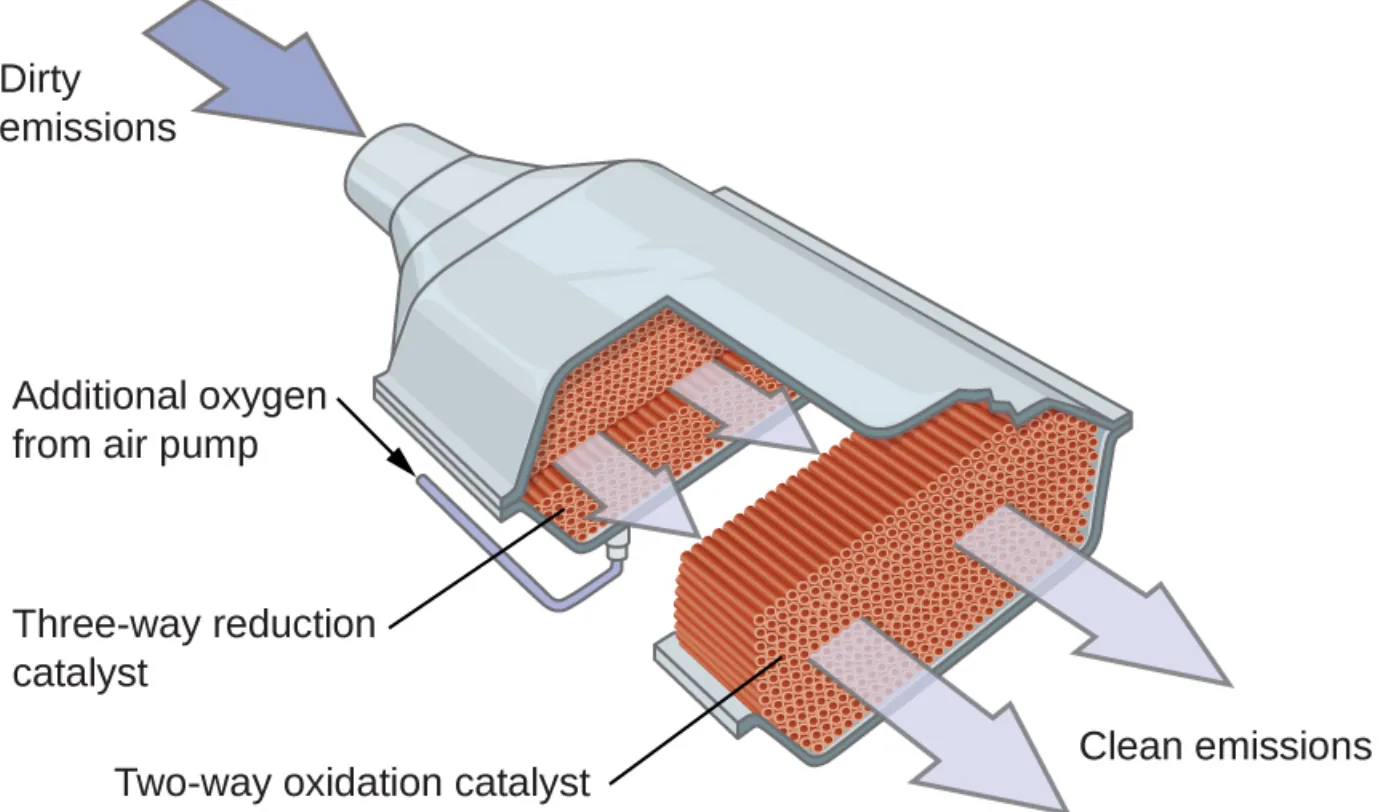
A catalytic converter in the exhaust system of a gasoline-powered car, which cuts pollutants in emissions. Image: OpenStax, Chemistry 2e, CC BY 4.0.
Chemistry in Everyday Life: Automobile catalytic converters
 ⤢ Enlarge
Chemistry in Everyday Life: Automobile catalytic converters
Catalytic converters were developed to reduce the toxic emissions produced when gasoline burns in internal combustion engines. A carefully chosen mix of catalytic metals makes all carbon-containing compounds burn completely to carbon dioxide while also reducing nitrogen oxide emissions. This is impressive because one step adds oxygen to the pollutants and another step removes oxygen from them.
Most modern three-way converters have a surface coated with a platinum–rhodium catalyst.
It converts nitric oxide into nitrogen and oxygen, 2NO → N2 + O2.
It also converts carbon monoxide and hydrocarbons into carbon dioxide and water vapor, for example 2CO + O2 → 2CO2,
and for octane 2C8H18 + 25O2 → 16CO2 + 18H2O.
To work efficiently, most catalytic converters are preheated by an electric heater. This keeps the metals in the catalyst fully active before the exhaust is hot enough to maintain the reaction temperature.
Link to learning: an online chemistry resource from the University of California at Davis explains in detail how catalytic converters work. In short, the catalyst surface holds exhaust molecules so that they can react more easily and at lower temperatures.
1How Sciences Interconnect: Enzyme structure and function2How Sciences Interconnect: Enzyme structure and function
How Sciences Interconnect: Enzyme structure and function
How Sciences Interconnect: Enzyme structure and function
The study of enzymes connects biology and chemistry. Enzymes are usually proteins (polypeptides) that control the rate of chemical reactions between biologically important compounds, especially in cellular metabolism. Enzymes are grouped into classes according to the type of reaction they catalyze.
Classes of enzymes and their functions:
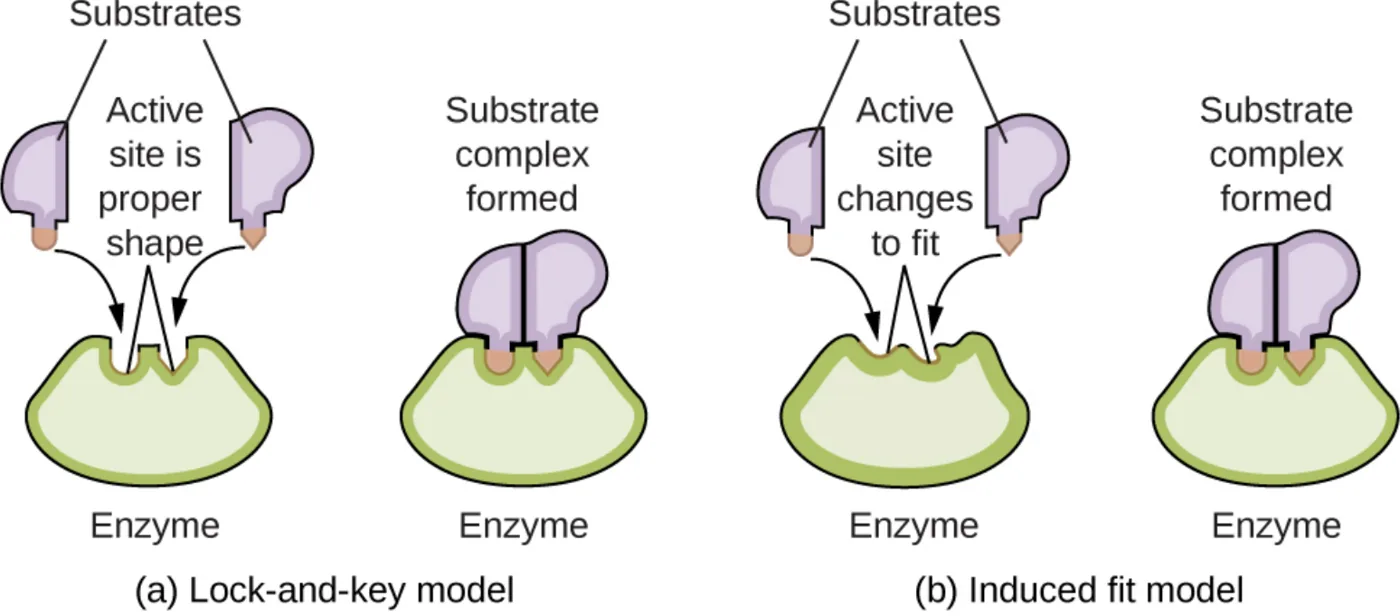
An enzyme has an active site, a part of the molecule whose shape allows it to bond to a specific substrate
which is the reactant molecule.
The enzyme and substrate form an enzyme–substrate complex
which is a reaction intermediate.
Two models explain how the active site works.
The lock-and-key hypothesis says that the shapes of the active site and the substrate are complementary, fitting together like a key in a lock.
| Class | Function |
|---|---|
| Oxidoreductases | Redox reactions |
| Transferases | Transfer of functional groups |
| Hydrolases | Hydrolysis reactions |
| Lyases | Removal of a group to form double bonds |
| Isomerases | Isomerization |
| Ligases | Bond formation coupled with ATP hydrolysis |
1 / 2Next ▶
The lock-and-key model, with a fixed active site that matches the substrate, compared with the induced-fit model, with a flexible active site. Image: OpenStax, Chemistry 2e, CC BY 4.0.
How Sciences Interconnect: Enzyme structure and function
 ⤢ Enlarge
1
The induced-fit hypothesis says that the enzyme is flexible and changes shape to accommodate the substrate.
2
The active site is not completely flexible, however.
3
Both models explain why an enzyme binds only specific substrates and usually catalyzes only one particular reaction.
4
Link to learning: the Royal Society of Chemistry provides an introduction to enzymes for students and teachers. It covers the same ideas of active sites, substrate binding and the way enzymes speed up reactions.
◀ Previous2 / 2
1Comparing activation energies on reaction diagrams2Practice: a catalyzed two-step mechanism3Practice: a catalyzed two-step mechanism
Comparing activation energies on reaction diagrams
1
Two reaction diagrams represent the same reaction, one without a catalyst and one with a catalyst.
2
Estimate the activation energy of each process and identify the catalyzed one.
3
Activation energy is the transition-state energy minus the reactant energy.
4
In diagram (a), the reactants are at about 6 kJ and the peak is at about 32 kJ
so Eₐ ≈ 32 kJ − 6 kJ = 26 kJ.
5
In diagram (b), the reactants are at the same energy and the peak is at about 20 kJ
so Eₐ ≈ 20 kJ − 6 kJ = 14 kJ.
6
Diagram (b) has the lower activation energy
so it represents the catalyzed reaction.
1 / 3Next ▶
Two reaction diagrams of the same reaction, one without a catalyst (a) and one with a catalyst (b). Image: OpenStax, Chemistry 2e, CC BY 4.0.
Practice: a catalyzed two-step mechanism
 ⤢ Enlarge
Practice: a catalyzed two-step mechanism
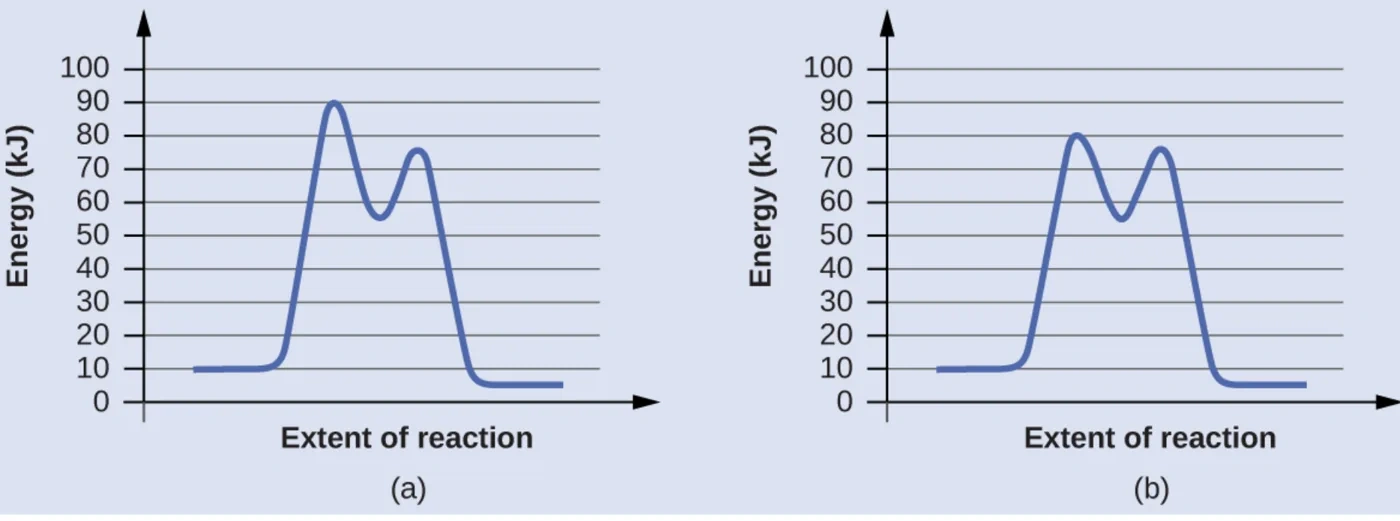
Check Your Learning: reaction diagrams (a) and (b) show a process with and without a catalyst. Both reactions involve a two-step mechanism with a rate-determining first step. Compute the activation energy of the first step of each mechanism and identify the catalyzed one. How do the second steps of the two mechanisms compare?
◀ Previous2 / 3Next ▶
Two energy diagrams for the practice question, with a first step peak at about 90 kJ in (a) and about 80 kJ in (b). Image: OpenStax, Chemistry 2e, CC BY 4.0.
Practice: a catalyzed two-step mechanism
 ⤢ Enlarge
1
Answer: For the first step, Eₐ = 90 kJ − 10 kJ = 80 kJ in diagram (a) and Eₐ = 80 kJ − 10 kJ = 70 kJ in diagram (b).
2
Diagram (b) therefore depicts the catalyzed reaction.
3
The second steps of both mechanisms have the same activation energy, 75 kJ − 55 kJ = 20 kJ
because the catalyst changes only the first step.
◀ Previous3 / 3
Key terms
| Term | Meaning |
|---|---|
| Catalyst | A substance that increases the rate of a reaction and is not consumed by it. |
| Reaction mechanism | The sequence of elementary steps by which an overall reaction takes place. |
| Activation energy (Eₐ) | The energy needed to reach the transition state, measured in kJ. |
| Transition state | The highest-energy arrangement of atoms along a reaction path. |
| Intermediate | A species formed in one step of a mechanism and used up in a later step. |
| Rate-determining step | The slowest step in a mechanism, which controls the overall reaction rate. |
| Homogeneous catalyst | A catalyst that is in the same phase as the reactants. |
| Heterogeneous catalyst | A catalyst that is in a different phase from the reactants, usually a solid that provides a surface. |
| Adsorption | The binding of molecules to the surface of a solid. |
| Desorption | The release of molecules from a solid surface. |
| Catalytic converter | A device in car exhaust systems that uses catalysts to reduce harmful emissions. |
| Enzyme | A protein, usually, that catalyzes a specific reaction in a living system. |
| Active site | The part of an enzyme whose shape allows it to bind a specific substrate. |
| Substrate | The reactant molecule that an enzyme binds. |
| Enzyme–substrate complex | The temporary species formed when an enzyme binds its substrate. |
| Lock-and-key hypothesis | The model in which the active site and substrate have complementary shapes that fit exactly. |
| Induced-fit hypothesis | The model in which a flexible enzyme changes shape to accommodate its substrate. |
1Avoid these mistakes2Avoid these mistakes3Avoid these mistakes