Curriculum
Chemistry 2e
Unit 1: Essential Ideas
0/14
-
Unit 1 overview: Essential Ideas
 Text lessonPreview
-
1.1 Chemistry in Context
Text lessonPreview
-
1.1 Chemistry in Context - Check yourself
 6 questionsPreview
-
1.2 Phases and Classification of Matter
Text lessonPreview
-
1.2 Phases and Classification of Matter - Check yourself
6 questionsPreview
-
1.3 Physical and Chemical Properties
Text lessonPreview
-
1.3 Physical and Chemical Properties - Check yourself
6 questionsPreview
-
1.4 Measurements
Text lessonPreview
-
1.4 Measurements - Check yourself
6 questionsPreview
-
1.5 Measurement Uncertainty, Accuracy, and Precision
Text lessonPreview
-
1.5 Measurement Uncertainty, Accuracy, and Precision - Check yourself
6 questionsPreview
-
1.6 Mathematical Treatment of Measurement Results
Text lessonPreview
-
1.6 Mathematical Treatment of Measurement Results - Check yourself
6 questionsPreview
-
Unit 1 review quiz: Essential Ideas
10 questionsPreview
Unit 2: Atoms, Molecules, and Ions
0/16
-
Unit 2 overview: Atoms, Molecules, and Ions
Text lessonPreview
-
2.1 Early Ideas in Atomic Theory
Text lessonPreview
-
2.1 Early Ideas in Atomic Theory - Check yourself
6 questionsPreview
-
2.2 Evolution of Atomic Theory
Text lessonPreview
-
2.2 Evolution of Atomic Theory - Check yourself
6 questionsPreview
-
2.3 Atomic Structure and Symbolism
Text lessonPreview
-
2.3 Atomic Structure and Symbolism - Check yourself
6 questionsPreview
-
2.4 Chemical Formulas
Text lessonPreview
-
2.4 Chemical Formulas - Check yourself
6 questionsPreview
-
2.5 The Periodic Table
Text lessonPreview
-
2.5 The Periodic Table - Check yourself
6 questionsPreview
-
2.6 Ionic and Molecular Compounds
Text lessonPreview
-
2.6 Ionic and Molecular Compounds - Check yourself
6 questionsPreview
-
2.7 Chemical Nomenclature
Text lessonPreview
-
2.7 Chemical Nomenclature - Check yourself
6 questionsPreview
-
Unit 2 review quiz: Atoms, Molecules, and Ions
10 questionsPreview
Unit 3: Composition of Substances and Solutions
0/10
-
Unit 3 overview: Composition of Substances and Solutions
Text lessonPreview
-
3.1 Formula Mass and the Mole Concept
Text lessonPreview
-
3.1 Formula Mass and the Mole Concept - Check yourself
6 questionsPreview
-
3.2 Determining Empirical and Molecular Formulas
Text lessonPreview
-
3.2 Determining Empirical and Molecular Formulas - Check yourself
6 questionsPreview
-
3.3 Molarity
Text lessonPreview
-
3.3 Molarity - Check yourself
6 questionsPreview
-
3.4 Other Units for Solution Concentrations
Text lessonPreview
-
3.4 Other Units for Solution Concentrations - Check yourself
6 questionsPreview
-
Unit 3 review quiz: Composition of Substances and Solutions
10 questionsPreview
Unit 4: Stoichiometry of Chemical Reactions
0/12
-
Unit 4 overview: Stoichiometry of Chemical Reactions
Text lessonPreview
-
4.1 Writing and Balancing Chemical Equations
Text lessonPreview
-
4.1 Writing and Balancing Chemical Equations - Check yourself
6 questionsPreview
-
4.2 Classifying Chemical Reactions
Text lessonPreview
-
4.2 Classifying Chemical Reactions - Check yourself
6 questionsPreview
-
4.3 Reaction Stoichiometry
Text lessonPreview
-
4.3 Reaction Stoichiometry - Check yourself
6 questionsPreview
-
4.4 Reaction Yields
Text lessonPreview
-
4.4 Reaction Yields - Check yourself
6 questionsPreview
-
4.5 Quantitative Chemical Analysis
Text lessonPreview
-
4.5 Quantitative Chemical Analysis - Check yourself
6 questionsPreview
-
Unit 4 review quiz: Stoichiometry of Chemical Reactions
10 questionsPreview
Unit 5: Thermochemistry
0/8
-
Unit 5 overview: Thermochemistry
Text lessonPreview
-
5.1 Energy Basics
Text lessonPreview
-
5.1 Energy Basics - Check yourself
6 questionsPreview
-
5.2 Calorimetry
Text lessonPreview
-
5.2 Calorimetry - Check yourself
7 questionsPreview
-
5.3 Enthalpy
Text lessonPreview
-
5.3 Enthalpy - Check yourself
6 questionsPreview
-
Unit 5 review quiz: Thermochemistry
10 questionsPreview
Unit 6: Electronic Structure and Periodic Properties of Elements
0/12
-
Unit 6 overview: Electronic Structure and Periodic Properties of Elements
Text lessonPreview
-
6.1 Electromagnetic Energy
Text lessonPreview
-
6.1 Electromagnetic Energy - Check yourself
6 questionsPreview
-
6.2 The Bohr Model
Text lessonPreview
-
6.2 The Bohr Model - Check yourself
6 questionsPreview
-
6.3 Development of Quantum Theory
Text lessonPreview
-
6.3 Development of Quantum Theory - Check yourself
6 questionsPreview
-
6.4 Electronic Structure of Atoms (Electron Configurations)
Text lessonPreview
-
6.4 Electronic Structure of Atoms (Electron Configurations) - Check yourself
6 questionsPreview
-
6.5 Periodic Variations in Element Properties
Text lessonPreview
-
6.5 Periodic Variations in Element Properties - Check yourself
6 questionsPreview
-
Unit 6 review quiz: Electronic Structure and Periodic Properties of Elements
10 questionsPreview
Unit 7: Chemical Bonding and Molecular Geometry
0/14
-
Unit 7 overview: Chemical Bonding and Molecular Geometry
Text lessonPreview
-
7.1 Ionic Bonding
Text lessonPreview
-
7.1 Ionic Bonding - Check yourself
6 questionsPreview
-
7.2 Covalent Bonding
Text lessonPreview
-
7.2 Covalent Bonding - Check yourself
6 questionsPreview
-
7.3 Lewis Symbols and Structures
Text lessonPreview
-
7.3 Lewis Symbols and Structures - Check yourself
6 questionsPreview
-
7.4 Formal Charges and Resonance
Text lessonPreview
-
7.4 Formal Charges and Resonance - Check yourself
6 questionsPreview
-
7.5 Strengths of Ionic and Covalent Bonds
Text lessonPreview
-
7.5 Strengths of Ionic and Covalent Bonds - Check yourself
6 questionsPreview
-
7.6 Molecular Structure and Polarity
Text lessonPreview
-
7.6 Molecular Structure and Polarity - Check yourself
6 questionsPreview
-
Unit 7 review quiz: Chemical Bonding and Molecular Geometry
10 questionsPreview
Unit 8: Advanced Theories of Covalent Bonding
0/10
-
Unit 8 overview: Advanced Theories of Covalent Bonding
Text lessonPreview
-
8.1 Valence Bond Theory
Text lessonPreview
-
8.1 Valence Bond Theory - Check yourself
6 questionsPreview
-
8.2 Hybrid Atomic Orbitals
Text lessonPreview
-
8.2 Hybrid Atomic Orbitals - Check yourself
6 questionsPreview
-
8.3 Multiple Bonds
Text lessonPreview
-
8.3 Multiple Bonds - Check yourself
6 questionsPreview
-
8.4 Molecular Orbital Theory
Text lessonPreview
-
8.4 Molecular Orbital Theory - Check yourself
6 questionsPreview
-
Unit 8 review quiz: Advanced Theories of Covalent Bonding
10 questionsPreview
Unit 9: Gases
0/23
-
Unit 9 overview: Gases
Text lessonPreview
-
9.1 Gas Pressure
Text lessonPreview
-
9.1 Gas Pressure - Check yourself
6 questionsPreview
-
9.2 Relating Pressure, Volume, Amount, and Temperature: The Ideal Gas Law
Text lessonPreview
-
9.2 Relating Pressure, Volume, Amount, and Temperature: The Ideal Gas Law - Check yourself
6 questionsPreview
-
9.3 Stoichiometry of Gaseous Substances, Mixtures, and Reactions
Text lessonPreview
-
9.3 Stoichiometry of Gaseous Substances, Mixtures, and Reactions - Check yourself
6 questionsPreview
-
9.3 Stoichiometry of Gaseous Substances, Mixtures, and Reactions
Text lessonPreview
-
9.3 Stoichiometry of Gaseous Substances, Mixtures, and Reactions - Check yourself
6 questionsPreview
-
9.4 Effusion and Diffusion of Gases
Text lessonPreview
-
9.4 Effusion and Diffusion of Gases - Check yourself
6 questionsPreview
-
9.4 Effusion and Diffusion of Gases
Text lessonPreview
-
9.4 Effusion and Diffusion of Gases - Check yourself
6 questionsPreview
-
Unit 9 review quiz: Gases
10 questionsPreview
-
9.5 The Kinetic-Molecular Theory
Text lessonPreview
-
9.5 The Kinetic-Molecular Theory - Check yourself
6 questionsPreview
-
9.5 The Kinetic-Molecular Theory
Text lessonPreview
-
9.5 The Kinetic-Molecular Theory - Check yourself
6 questionsPreview
-
9.6 Non-Ideal Gas Behavior
Text lessonPreview
-
9.6 Non-Ideal Gas Behavior - Check yourself
6 questionsPreview
-
9.6 Non-Ideal Gas Behavior
Text lessonPreview
-
9.6 Non-Ideal Gas Behavior - Check yourself
6 questionsPreview
-
Unit 9 review quiz: Gases
10 questionsPreview
Unit 10: Liquids and Solids
0/28
-
Unit 10 overview: Liquids and Solids
Text lessonPreview
-
10.1 Intermolecular Forces
Text lessonPreview
-
Unit 10 overview: Liquids and Solids
Text lessonPreview
-
10.1 Intermolecular Forces
Text lessonPreview
-
10.1 Intermolecular Forces - Check yourself
6 questionsPreview
-
10.1 Intermolecular Forces - Check yourself
6 questionsPreview
-
10.2 Properties of Liquids
Text lessonPreview
-
10.2 Properties of Liquids - Check yourself
6 questionsPreview
-
10.2 Properties of Liquids
Text lessonPreview
-
10.2 Properties of Liquids - Check yourself
6 questionsPreview
-
10.3 Phase Transitions
Text lessonPreview
-
10.3 Phase Transitions - Check yourself
6 questionsPreview
-
10.3 Phase Transitions
Text lessonPreview
-
10.3 Phase Transitions - Check yourself
6 questionsPreview
-
10.4 Phase Diagrams
Text lessonPreview
-
10.4 Phase Diagrams
Text lessonPreview
-
10.4 Phase Diagrams - Check yourself
6 questionsPreview
-
10.4 Phase Diagrams - Check yourself
6 questionsPreview
-
10.5 The Solid State of Matter
Text lessonPreview
-
10.5 The Solid State of Matter
Text lessonPreview
-
10.5 The Solid State of Matter - Check yourself
6 questionsPreview
-
10.5 The Solid State of Matter - Check yourself
6 questionsPreview
-
10.6 Lattice Structures in Crystalline Solids
Text lessonPreview
-
10.6 Lattice Structures in Crystalline Solids
Text lessonPreview
-
10.6 Lattice Structures in Crystalline Solids - Check yourself
6 questionsPreview
-
10.6 Lattice Structures in Crystalline Solids - Check yourself
6 questionsPreview
-
Unit 10 review quiz: Liquids and Solids
10 questionsPreview
-
Unit 10 review quiz: Liquids and Solids
10 questionsPreview
Unit 11: Solutions and Colloids
0/24
-
Unit 11 overview: Solutions and Colloids
Text lessonPreview
-
11.1 The Dissolution Process
Text lessonPreview
-
Unit 11 overview: Solutions and Colloids
Text lessonPreview
-
11.1 The Dissolution Process
Text lessonPreview
-
11.1 The Dissolution Process - Check yourself
6 questionsPreview
-
11.1 The Dissolution Process - Check yourself
6 questionsPreview
-
11.2 Electrolytes
Text lessonPreview
-
11.2 Electrolytes - Check yourself
6 questionsPreview
-
11.2 Electrolytes
Text lessonPreview
-
11.2 Electrolytes - Check yourself
6 questionsPreview
-
11.3 Solubility
Text lessonPreview
-
11.3 Solubility - Check yourself
6 questionsPreview
-
11.3 Solubility
Text lessonPreview
-
11.3 Solubility - Check yourself
6 questionsPreview
-
11.4 Colligative Properties
Text lessonPreview
-
11.4 Colligative Properties - Check yourself
6 questionsPreview
-
11.4 Colligative Properties
Text lessonPreview
-
11.4 Colligative Properties - Check yourself
6 questionsPreview
-
11.5 Colloids
Text lessonPreview
-
11.5 Colloids - Check yourself
6 questionsPreview
-
11.5 Colloids
Text lessonPreview
-
11.5 Colloids - Check yourself
6 questionsPreview
-
Unit 11 review quiz: Solutions and Colloids
10 questionsPreview
-
Unit 11 review quiz: Solutions and Colloids
10 questionsPreview
Unit 12: Kinetics
0/32
-
Unit 12 overview: Kinetics
Text lessonPreview
-
12.1 Chemical Reaction Rates
Text lessonPreview
-
12.1 Chemical Reaction Rates - Check yourself
6 questionsPreview
-
Unit 12 overview: Kinetics
Text lessonPreview
-
12.1 Chemical Reaction Rates
Text lessonPreview
-
12.1 Chemical Reaction Rates - Check yourself
6 questionsPreview
-
12.2 Factors Affecting Reaction Rates
Text lessonPreview
-
12.2 Factors Affecting Reaction Rates - Check yourself
6 questionsPreview
-
12.2 Factors Affecting Reaction Rates
Text lessonPreview
-
12.2 Factors Affecting Reaction Rates - Check yourself
6 questionsPreview
-
12.3 Rate Laws
Text lessonPreview
-
12.3 Rate Laws - Check yourself
6 questionsPreview
-
12.3 Rate Laws
Text lessonPreview
-
12.3 Rate Laws - Check yourself
6 questionsPreview
-
12.4 Integrated Rate Laws
Text lessonPreview
-
12.4 Integrated Rate Laws - Check yourself
6 questionsPreview
-
12.4 Integrated Rate Laws
Text lessonPreview
-
12.4 Integrated Rate Laws - Check yourself
6 questionsPreview
-
12.5 Collision Theory
Text lessonPreview
-
12.5 Collision Theory - Check yourself
6 questionsPreview
-
12.5 Collision Theory
Text lessonPreview
-
Unit 12 review quiz: Kinetics
10 questionsPreview
-
12.5 Collision Theory - Check yourself
6 questionsPreview
-
12.6 Reaction Mechanisms
Text lessonPreview
-
12.6 Reaction Mechanisms - Check yourself
6 questionsPreview
-
12.6 Reaction Mechanisms
Text lessonPreview
-
12.6 Reaction Mechanisms - Check yourself
6 questionsPreview
-
12.7 Catalysis
Text lessonPreview
-
12.7 Catalysis - Check yourself
6 questionsPreview
-
12.7 Catalysis
Text lessonPreview
-
12.7 Catalysis - Check yourself
6 questionsPreview
-
Unit 12 review quiz: Kinetics
10 questionsPreview
Unit 13: Fundamental Equilibrium Concepts
0/20
-
Unit 13 overview: Fundamental Equilibrium Concepts
Text lessonPreview
-
13.1 Chemical Equilibria
Text lessonPreview
-
13.1 Chemical Equilibria - Check yourself
6 questionsPreview
-
13.1 Chemical Equilibria
Text lessonPreview
-
13.1 Chemical Equilibria - Check yourself
6 questionsPreview
-
13.2 Equilibrium Constants
Text lessonPreview
-
13.2 Equilibrium Constants - Check yourself
6 questionsPreview
-
13.2 Equilibrium Constants
Text lessonPreview
-
Unit 13 overview: Fundamental Equilibrium Concepts
Text lessonPreview
-
13.2 Equilibrium Constants - Check yourself
6 questionsPreview
-
13.3 Shifting Equilibria: Le Châtelier’s Principle
Text lessonPreview
-
13.3 Shifting Equilibria: Le Châtelier’s Principle - Check yourself
6 questionsPreview
-
13.3 Shifting Equilibria: Le Châtelier’s Principle
Text lessonPreview
-
Unit 13 review quiz: Fundamental Equilibrium Concepts
10 questionsPreview
-
13.3 Shifting Equilibria: Le Châtelier’s Principle - Check yourself
6 questionsPreview
-
13.4 Equilibrium Calculations
Text lessonPreview
-
13.4 Equilibrium Calculations - Check yourself
6 questionsPreview
-
13.4 Equilibrium Calculations
Text lessonPreview
-
13.4 Equilibrium Calculations - Check yourself
6 questionsPreview
-
Unit 13 review quiz: Fundamental Equilibrium Concepts
10 questionsPreview
Unit 14: Acid-Base Equilibria
0/32
-
Unit 14 overview: Acid-Base Equilibria
Text lessonPreview
-
14.1 Brønsted-Lowry Acids and Bases
Text lessonPreview
-
14.1 Brønsted-Lowry Acids and Bases - Check yourself
6 questionsPreview
-
14.1 Brønsted-Lowry Acids and Bases
Text lessonPreview
-
14.1 Brønsted-Lowry Acids and Bases - Check yourself
6 questionsPreview
-
14.2 pH and pOH
Text lessonPreview
-
14.2 pH and pOH - Check yourself
6 questionsPreview
-
14.2 pH and pOH
Text lessonPreview
-
14.2 pH and pOH - Check yourself
6 questionsPreview
-
14.3 Relative Strengths of Acids and Bases
Text lessonPreview
-
14.3 Relative Strengths of Acids and Bases - Check yourself
6 questionsPreview
-
14.3 Relative Strengths of Acids and Bases
Text lessonPreview
-
14.3 Relative Strengths of Acids and Bases - Check yourself
6 questionsPreview
-
14.4 Hydrolysis of Salts
Text lessonPreview
-
14.4 Hydrolysis of Salts - Check yourself
6 questionsPreview
-
Unit 14 review quiz: Acid-Base Equilibria
10 questionsPreview
-
Unit 14 overview: Acid-Base Equilibria
Text lessonPreview
-
14.4 Hydrolysis of Salts
Text lessonPreview
-
14.4 Hydrolysis of Salts - Check yourself
6 questionsPreview
-
14.5 Polyprotic Acids
Text lessonPreview
-
14.5 Polyprotic Acids - Check yourself
6 questionsPreview
-
14.5 Polyprotic Acids
Text lessonPreview
-
14.5 Polyprotic Acids - Check yourself
6 questionsPreview
-
14.6 Buffers
Text lessonPreview
-
14.6 Buffers - Check yourself
6 questionsPreview
-
14.6 Buffers
Text lessonPreview
-
14.6 Buffers - Check yourself
6 questionsPreview
-
14.7 Acid-Base Titrations
Text lessonPreview
-
14.7 Acid-Base Titrations - Check yourself
6 questionsPreview
-
14.7 Acid-Base Titrations
Text lessonPreview
-
14.7 Acid-Base Titrations - Check yourself
6 questionsPreview
-
Unit 14 review quiz: Acid-Base Equilibria
10 questionsPreview
Unit 15: Equilibria of Other Reaction Classes
0/16
-
Unit 15 overview: Equilibria of Other Reaction Classes
Text lessonPreview
-
15.1 Precipitation and Dissolution
Text lessonPreview
-
15.1 Precipitation and Dissolution - Check yourself
6 questionsPreview
-
15.1 Precipitation and Dissolution
Text lessonPreview
-
15.1 Precipitation and Dissolution - Check yourself
6 questionsPreview
-
15.2 Lewis Acids and Bases
Text lessonPreview
-
15.2 Lewis Acids and Bases - Check yourself
6 questionsPreview
-
Unit 15 review quiz: Equilibria of Other Reaction Classes
10 questionsPreview
-
Unit 15 overview: Equilibria of Other Reaction Classes
Text lessonPreview
-
15.2 Lewis Acids and Bases
Text lessonPreview
-
15.2 Lewis Acids and Bases - Check yourself
6 questionsPreview
-
15.3 Coupled Equilibria
Text lessonPreview
-
15.3 Coupled Equilibria - Check yourself
6 questionsPreview
-
15.3 Coupled Equilibria
Text lessonPreview
-
15.3 Coupled Equilibria - Check yourself
6 questionsPreview
-
Unit 15 review quiz: Equilibria of Other Reaction Classes
10 questionsPreview
Unit 16: Thermodynamics
0/20
-
Unit 16 overview: Thermodynamics
Text lessonPreview
-
16.1 Spontaneity
Text lessonPreview
-
16.1 Spontaneity - Check yourself
6 questionsPreview
-
16.1 Spontaneity
Text lessonPreview
-
16.1 Spontaneity - Check yourself
6 questionsPreview
-
16.2 Entropy
Text lessonPreview
-
16.2 Entropy - Check yourself
6 questionsPreview
-
16.2 Entropy
Text lessonPreview
-
16.2 Entropy - Check yourself
6 questionsPreview
-
Unit 16 review quiz: Thermodynamics
10 questionsPreview
-
Unit 16 overview: Thermodynamics
Text lessonPreview
-
16.3 The Second and Third Laws of Thermodynamics
Text lessonPreview
-
16.3 The Second and Third Laws of Thermodynamics - Check yourself
6 questionsPreview
-
16.3 The Second and Third Laws of Thermodynamics
Text lessonPreview
-
16.3 The Second and Third Laws of Thermodynamics - Check yourself
6 questionsPreview
-
16.4 Free Energy
Text lessonPreview
-
16.4 Free Energy - Check yourself
6 questionsPreview
-
16.4 Free Energy
Text lessonPreview
-
16.4 Free Energy - Check yourself
6 questionsPreview
-
Unit 16 review quiz: Thermodynamics
10 questionsPreview
Unit 17: Electrochemistry
0/32
-
Unit 17 overview: Electrochemistry
Text lessonPreview
-
17.1 Review of Redox Chemistry
Text lessonPreview
-
17.1 Review of Redox Chemistry - Check yourself
6 questionsPreview
-
17.1 Review of Redox Chemistry
Text lessonPreview
-
17.1 Review of Redox Chemistry - Check yourself
6 questionsPreview
-
17.2 Galvanic Cells
Text lessonPreview
-
17.2 Galvanic Cells - Check yourself
6 questionsPreview
-
17.2 Galvanic Cells
Text lessonPreview
-
17.2 Galvanic Cells - Check yourself
6 questionsPreview
-
17.3 Electrode and Cell Potentials
Text lessonPreview
-
17.3 Electrode and Cell Potentials - Check yourself
6 questionsPreview
-
17.3 Electrode and Cell Potentials
Text lessonPreview
-
17.3 Electrode and Cell Potentials - Check yourself
6 questionsPreview
-
17.4 Potential, Free Energy, and Equilibrium
Text lessonPreview
-
17.4 Potential, Free Energy, and Equilibrium - Check yourself
6 questionsPreview
-
Unit 17 review quiz: Electrochemistry
10 questionsPreview
-
Unit 17 overview: Electrochemistry
Text lessonPreview
-
17.4 Potential, Free Energy, and Equilibrium
Text lessonPreview
-
17.4 Potential, Free Energy, and Equilibrium - Check yourself
6 questionsPreview
-
17.5 Batteries and Fuel Cells
Text lessonPreview
-
17.5 Batteries and Fuel Cells - Check yourself
6 questionsPreview
-
17.5 Batteries and Fuel Cells
Text lessonPreview
-
17.5 Batteries and Fuel Cells - Check yourself
6 questionsPreview
-
17.6 Corrosion
Text lessonPreview
-
17.6 Corrosion - Check yourself
6 questionsPreview
-
17.6 Corrosion
Text lessonPreview
-
17.6 Corrosion - Check yourself
6 questionsPreview
-
17.7 Electrolysis
Text lessonPreview
-
17.7 Electrolysis - Check yourself
6 questionsPreview
-
17.7 Electrolysis
Text lessonPreview
-
17.7 Electrolysis - Check yourself
6 questionsPreview
-
Unit 17 review quiz: Electrochemistry
10 questionsPreview
Unit 18: Representative Metals, Metalloids, and Nonmetals
0/52
-
Unit 18 overview: Representative Metals, Metalloids, and Nonmetals
Text lessonPreview
-
18.1 Periodicity
Text lessonPreview
-
18.1 Periodicity - Check yourself
6 questionsPreview
-
18.1 Periodicity
Text lessonPreview
-
18.1 Periodicity - Check yourself
6 questionsPreview
-
18.2 Occurrence and Preparation of the Representative Metals
Text lessonPreview
-
18.2 Occurrence and Preparation of the Representative Metals - Check yourself
6 questionsPreview
-
18.2 Occurrence and Preparation of the Representative Metals
Text lessonPreview
-
18.2 Occurrence and Preparation of the Representative Metals - Check yourself
6 questionsPreview
-
18.3 Structure and General Properties of the Metalloids
Text lessonPreview
-
18.3 Structure and General Properties of the Metalloids - Check yourself
6 questionsPreview
-
18.3 Structure and General Properties of the Metalloids
Text lessonPreview
-
18.3 Structure and General Properties of the Metalloids - Check yourself
6 questionsPreview
-
18.4 Structure and General Properties of the Nonmetals
Text lessonPreview
-
18.4 Structure and General Properties of the Nonmetals - Check yourself
6 questionsPreview
-
18.4 Structure and General Properties of the Nonmetals
Text lessonPreview
-
18.4 Structure and General Properties of the Nonmetals - Check yourself
6 questionsPreview
-
18.5 Occurrence, Preparation, and Compounds of Hydrogen
Text lessonPreview
-
18.5 Occurrence, Preparation, and Compounds of Hydrogen - Check yourself
6 questionsPreview
-
18.5 Occurrence, Preparation, and Compounds of Hydrogen
Text lessonPreview
-
18.5 Occurrence, Preparation, and Compounds of Hydrogen - Check yourself
6 questionsPreview
-
18.6 Occurrence, Preparation, and Properties of Carbonates
Text lessonPreview
-
18.6 Occurrence, Preparation, and Properties of Carbonates - Check yourself
6 questionsPreview
-
18.6 Occurrence, Preparation, and Properties of Carbonates
Text lessonPreview
-
18.6 Occurrence, Preparation, and Properties of Carbonates - Check yourself
6 questionsPreview
-
Unit 18 review quiz: Representative Metals, Metalloids, and Nonmetals
10 questionsPreview
-
Unit 18 overview: Representative Metals, Metalloids, and Nonmetals
Text lessonPreview
-
18.7 Occurrence, Preparation, and Properties of Nitrogen
Text lessonPreview
-
18.7 Occurrence, Preparation, and Properties of Nitrogen - Check yourself
6 questionsPreview
-
18.7 Occurrence, Preparation, and Properties of Nitrogen
Text lessonPreview
-
18.7 Occurrence, Preparation, and Properties of Nitrogen - Check yourself
6 questionsPreview
-
18.8 Occurrence, Preparation, and Properties of Phosphorus
Text lessonPreview
-
18.8 Occurrence, Preparation, and Properties of Phosphorus - Check yourself
6 questionsPreview
-
18.8 Occurrence, Preparation, and Properties of Phosphorus
Text lessonPreview
-
18.8 Occurrence, Preparation, and Properties of Phosphorus - Check yourself
6 questionsPreview
-
18.9 Occurrence, Preparation, and Compounds of Oxygen
Text lessonPreview
-
18.9 Occurrence, Preparation, and Compounds of Oxygen - Check yourself
6 questionsPreview
-
18.9 Occurrence, Preparation, and Compounds of Oxygen
Text lessonPreview
-
18.9 Occurrence, Preparation, and Compounds of Oxygen - Check yourself
6 questionsPreview
-
18.10 Occurrence, Preparation, and Properties of Sulfur
Text lessonPreview
-
18.10 Occurrence, Preparation, and Properties of Sulfur - Check yourself
6 questionsPreview
-
18.10 Occurrence, Preparation, and Properties of Sulfur
Text lessonPreview
-
18.10 Occurrence, Preparation, and Properties of Sulfur - Check yourself
6 questionsPreview
-
18.11 Occurrence, Preparation, and Properties of Halogens
Text lessonPreview
-
18.11 Occurrence, Preparation, and Properties of Halogens - Check yourself
6 questionsPreview
-
18.11 Occurrence, Preparation, and Properties of Halogens
Text lessonPreview
-
18.11 Occurrence, Preparation, and Properties of Halogens - Check yourself
6 questionsPreview
-
18.12 Occurrence, Preparation, and Properties of the Noble Gases
Text lessonPreview
-
18.12 Occurrence, Preparation, and Properties of the Noble Gases - Check yourself
6 questionsPreview
-
18.12 Occurrence, Preparation, and Properties of the Noble Gases
Text lessonPreview
-
18.12 Occurrence, Preparation, and Properties of the Noble Gases - Check yourself
6 questionsPreview
-
Unit 18 review quiz: Representative Metals, Metalloids, and Nonmetals
10 questionsPreview
Unit 19: Transition Metals and Coordination Chemistry
0/16
-
Unit 19 overview: Transition Metals and Coordination Chemistry
Text lessonPreview
-
19.1 Occurrence, Preparation, and Properties of Transition Metals and Their Compounds
Text lessonPreview
-
19.1 Occurrence, Preparation, and Properties of Transition Metals and Their Compounds - Check yourself
6 questionsPreview
-
19.1 Occurrence, Preparation, and Properties of Transition Metals and Their Compounds
Text lessonPreview
-
19.1 Occurrence, Preparation, and Properties of Transition Metals and Their Compounds - Check yourself
6 questionsPreview
-
19.2 Coordination Chemistry of Transition Metals
Text lessonPreview
-
19.2 Coordination Chemistry of Transition Metals - Check yourself
6 questionsPreview
-
Unit 19 review quiz: Transition Metals and Coordination Chemistry
10 questionsPreview
-
Unit 19 overview: Transition Metals and Coordination Chemistry
Text lessonPreview
-
19.2 Coordination Chemistry of Transition Metals
Text lessonPreview
-
19.2 Coordination Chemistry of Transition Metals - Check yourself
6 questionsPreview
-
19.3 Spectroscopic and Magnetic Properties of Coordination Compounds
Text lessonPreview
-
19.3 Spectroscopic and Magnetic Properties of Coordination Compounds - Check yourself
6 questionsPreview
-
19.3 Spectroscopic and Magnetic Properties of Coordination Compounds
Text lessonPreview
-
19.3 Spectroscopic and Magnetic Properties of Coordination Compounds - Check yourself
6 questionsPreview
-
Unit 19 review quiz: Transition Metals and Coordination Chemistry
10 questionsPreview
Unit 20: Organic Chemistry
0/20
-
Unit 20 overview: Organic Chemistry
Text lessonPreview
-
20.1 Hydrocarbons
Text lessonPreview
-
20.1 Hydrocarbons - Check yourself
6 questionsPreview
-
20.1 Hydrocarbons
Text lessonPreview
-
20.1 Hydrocarbons - Check yourself
6 questionsPreview
-
20.2 Alcohols and Ethers
Text lessonPreview
-
20.2 Alcohols and Ethers - Check yourself
6 questionsPreview
-
20.2 Alcohols and Ethers
Text lessonPreview
-
20.2 Alcohols and Ethers - Check yourself
6 questionsPreview
-
Unit 20 review quiz: Organic Chemistry
10 questionsPreview
-
Unit 20 overview: Organic Chemistry
Text lessonPreview
-
20.3 Aldehydes, Ketones, Carboxylic Acids, and Esters
Text lessonPreview
-
20.3 Aldehydes, Ketones, Carboxylic Acids, and Esters - Check yourself
6 questionsPreview
-
20.3 Aldehydes, Ketones, Carboxylic Acids, and Esters
Text lessonPreview
-
20.3 Aldehydes, Ketones, Carboxylic Acids, and Esters - Check yourself
6 questionsPreview
-
20.4 Amines and Amides
Text lessonPreview
-
20.4 Amines and Amides - Check yourself
6 questionsPreview
-
20.4 Amines and Amides
Text lessonPreview
-
20.4 Amines and Amides - Check yourself
6 questionsPreview
-
Unit 20 review quiz: Organic Chemistry
10 questionsPreview
Unit 21: Nuclear Chemistry
0/28
-
Unit 21 overview: Nuclear Chemistry
Text lessonPreview
-
21.1 Nuclear Structure and Stability
Text lessonPreview
-
21.1 Nuclear Structure and Stability - Check yourself
6 questionsPreview
-
21.1 Nuclear Structure and Stability
Text lessonPreview
-
21.1 Nuclear Structure and Stability - Check yourself
6 questionsPreview
-
21.2 Nuclear Equations
Text lessonPreview
-
21.2 Nuclear Equations - Check yourself
6 questionsPreview
-
21.2 Nuclear Equations
Text lessonPreview
-
21.2 Nuclear Equations - Check yourself
6 questionsPreview
-
21.3 Radioactive Decay
Text lessonPreview
-
21.3 Radioactive Decay - Check yourself
6 questionsPreview
-
21.3 Radioactive Decay
Text lessonPreview
-
21.3 Radioactive Decay - Check yourself
6 questionsPreview
-
Unit 21 review quiz: Nuclear Chemistry
10 questionsPreview
-
Unit 21 overview: Nuclear Chemistry
Text lessonPreview
-
21.4 Transmutation and Nuclear Energy
Text lessonPreview
-
21.4 Transmutation and Nuclear Energy - Check yourself
6 questionsPreview
-
21.4 Transmutation and Nuclear Energy
Text lessonPreview
-
21.4 Transmutation and Nuclear Energy - Check yourself
6 questionsPreview
-
21.5 Uses of Radioisotopes
Text lessonPreview
-
21.5 Uses of Radioisotopes - Check yourself
6 questionsPreview
-
21.5 Uses of Radioisotopes
Text lessonPreview
-
21.5 Uses of Radioisotopes - Check yourself
6 questionsPreview
-
21.6 Biological Effects of Radiation
Text lessonPreview
-
21.6 Biological Effects of Radiation - Check yourself
6 questionsPreview
-
21.6 Biological Effects of Radiation
Text lessonPreview
-
21.6 Biological Effects of Radiation - Check yourself
6 questionsPreview
-
Unit 21 review quiz: Nuclear Chemistry
10 questionsPreview
Text lesson
5.1 Energy Basics
5.1 Energy Basics — CHEMISTRY notes: You will be able to define energy, distinguish its types, explain how heat, thermal energy and temperature differ, and calculate heat from mass, specific heat and temperature change.
1Learning objectives2Learning objectives
Learning objectives
Learning objectives
1
Define energy, distinguish its types, and describe the energy changes that accompany chemical and physical changes.
2
Distinguish the related properties of heat, thermal energy and temperature.
3
Define and distinguish specific heat and heat capacity, and describe the physical implications of both.
1 / 2Next ▶
Learning objectives
1
4
2
Perform calculations involving heat, specific heat and temperature change.
◀ Previous2 / 2
1Energy changes in everyday life2Energy changes in everyday life3Energy changes in everyday life
Energy changes in everyday life
Energy changes in everyday life
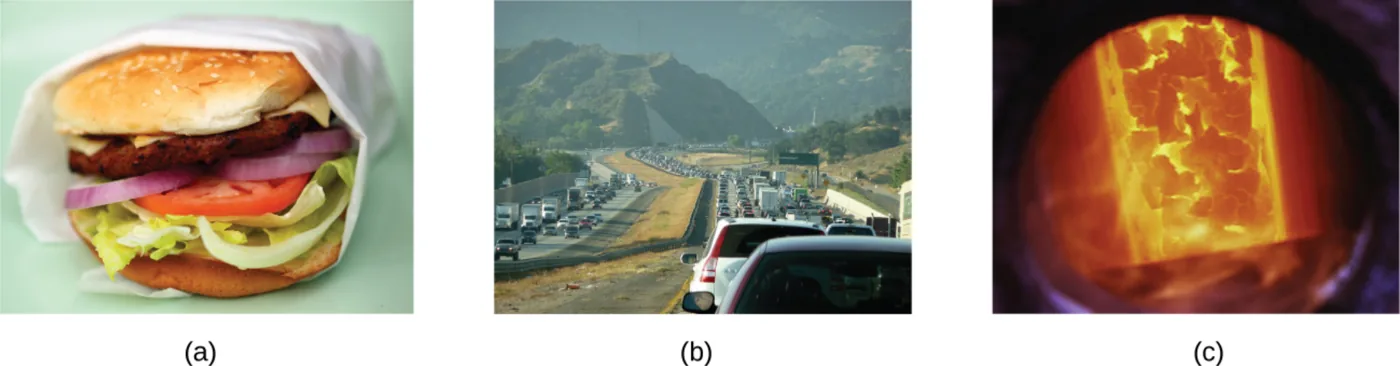
Chemical changes and the energy that goes with them are part of everyday life.
The macronutrients in food (proteins, fats and carbohydrates) undergo metabolic reactions that supply the energy that keeps the body working.
Fuels such as gasoline, natural gas and coal are burned to power transportation, heat buildings and generate electricity.
Industrial chemical reactions consume large amounts of energy to produce raw materials such as iron and aluminum,
and that energy is then used to turn those materials into cars, skyscrapers and bridges.
1 / 3Next ▶
Three everyday examples of chemical energy: a meal that fuels the body, gasoline burning in a car engine, and coke used to make iron from ore. Image: OpenStax, Chemistry 2e, CC BY 4.0.
Energy changes in everyday life
 ⤢ Enlarge
Energy changes in everyday life
Almost all the energy people use started as sunlight.
Each day the sun delivers to the earth roughly 10,000 times the energy that the world needs in that day.
The challenge is to convert and store that solar energy in forms that can be used conveniently and without pollution.
Plants and many bacteria capture solar energy through photosynthesis,
and that stored energy is released when wood or plant products such as ethanol are burned,when we eat plants or animals that ate plants,and when coal and petroleum are burned,because these fuels are fossilized plant and animal matter.
The field that studies the heat absorbed or released during chemical and physical changes is called thermochemistry.
Its ideas are used by food scientists who measure the energy content of foods, by biologists who study the energetics of living organisms such as the metabolic burning of sugar to carbon dioxide and water, by engineers who improve energy efficiency and design heating, cooling and refrigeration systems,
and by the oil, gas, transportation and renewable energy industries.
◀ Previous2 / 3Next ▶
Energy changes in everyday life
Energy changes in everyday life
Understanding thermochemistry is essential for chemists, physicists, biologists, geologists and engineers.
◀ Previous3 / 3
Energy
Energy
Energy is the capacity to supply heat or to do work. Work (w) is the process of causing matter to move against an opposing force. For example, when a bicycle tire is inflated, the pump moves air against the opposing force of the air already in the tire
so work is done.
1Types of energy2Types of energy
Types of energy
Types of energy
Energy comes in different types.
One way to classify it is into two kinds. Potential energy is the energy an object has because of its position, composition or condition. Kinetic energy is the energy an object has because of its motion.
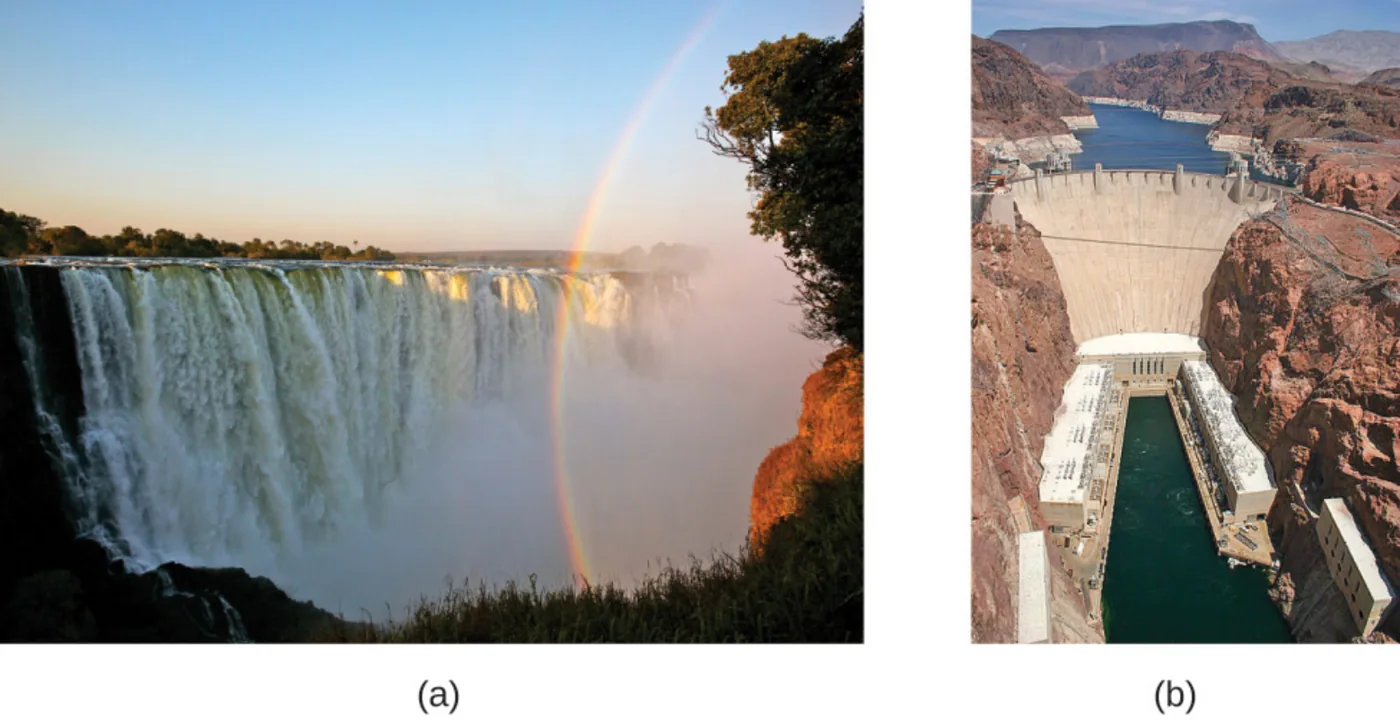
Water at the top of a waterfall or behind a dam has potential energy because of its height.
As it falls and flows through generators, that potential energy becomes kinetic energy,
which can be converted into electricity in a hydroelectric plant.
A battery also has potential energy, stored in its chemicals, that can be released as electricity to do work.
1 / 2Next ▶
Water at a high elevation has more potential energy than water at a low elevation, and its energy becomes electrical energy when it turns the generators of a dam. Image: OpenStax, Chemistry 2e, CC BY 4.0.
Types of energy
◀ Previous2 / 2
1Conservation of energy2Conservation of energy
Conservation of energy
Conservation of energy
Energy can be changed from one form into another
but the total energy present before a change is still present afterwards in some form.
This is the law of conservation of energy: during a chemical or physical change, energy can be neither created nor destroyed,
although it can change form.
This statement is also one version of the first law of thermodynamics
which is studied later.
Whenever one substance changes into another, one form of energy is converted into another.
Heat is usually released or absorbed
but the conversion can also involve light, electrical energy or other forms.
For example, chemical energy, a type of potential energy, is stored in the molecules of gasoline.
1 / 2Next ▶
Conservation of energy
Conservation of energy
When gasoline burns inside an engine cylinder, the rapidly expanding gaseous products push the piston,
producing mechanical energy,which is a type of kinetic energy.
The law of conservation of matter also applies in chemical changes: the total mass of matter does not change detectably.
In ordinary chemical reactions the energy changes are modest and the mass changes are too small to measure
so both conservation laws hold well.
In nuclear reactions the energy changes are much larger, roughly a million times greater, the mass changes can be measured,
and matter and energy convert into each other.
Nuclear reactions are treated in a later chapter.
◀ Previous2 / 2
1Thermal energy, temperature and heat2Thermal energy, temperature and heat3Thermal energy, temperature and heat4Thermal energy, temperature and heat
Thermal energy, temperature and heat
1
Thermal energy is the kinetic energy associated with the random motion of atoms and molecules. Temperature is a quantitative measure of how hot or cold a sample is.
2
When the atoms and molecules of an object move or vibrate quickly, their average kinetic energy is high and the object feels hot.
3
When they move slowly, their average kinetic energy is low and the object feels cold.
4
If no chemical reaction or phase change such as melting or vaporizing occurs, adding thermal energy to a sample raises its temperature.
5
If no chemical reaction or phase change such as condensation or freezing occurs, removing thermal energy lowers its temperature.
1 / 4Next ▶
The molecules in hot water move faster than the molecules in cold water, so hot water has the higher average kinetic energy. Image: OpenStax, Chemistry 2e, CC BY 4.0.
Thermal energy, temperature and heat
 ⤢ Enlarge
1
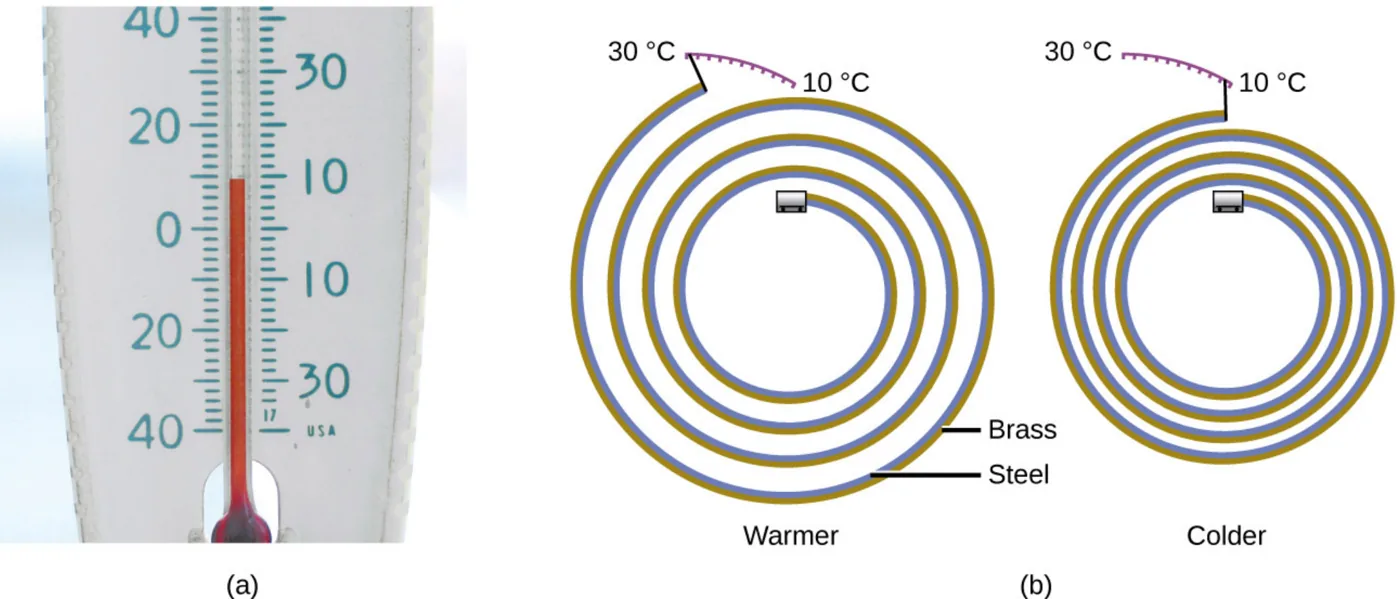
Most substances expand when their temperature rises and contract when it falls.
2
Thermometers use this property.
3
In an alcohol or mercury thermometer, the liquid expands more than the glass tube that holds it,
so the liquid column rises as the temperature increases.
4
A bimetallic thermometer uses a strip of two metals, such as brass and steel, bonded together.
5
Brass expands more than steel when heated
so the strip coils or uncoils, and a pointer on a calibrated scale shows the temperature.
◀ Previous2 / 4Next ▶
A liquid thermometer relies on the liquid expanding more than its glass tube, while a bimetallic thermometer coils or uncoils because two metals expand by different amounts. Image: OpenStax, Chemistry 2e, CC BY 4.0.
Thermal energy, temperature and heat
 ⤢ Enlarge
Thermal energy, temperature and heat
Heat (q) is the transfer of thermal energy between two bodies at different temperatures.
The term heat flow is also used, although it is redundant.
Heat flow increases the thermal energy of one body and decreases the thermal energy of the other.
Suppose a hot substance H, whose molecules have a higher average kinetic energy, is placed in contact with a cold substance L.
Thermal energy flows spontaneously from H to L.
The temperature and average kinetic energy of H fall
while those of L rise.
◀ Previous3 / 4Next ▶
Substance H is hot and L is cold; when they touch, collisions move thermal energy from H to L until both reach the same temperature. Image: OpenStax, Chemistry 2e, CC BY 4.0.
Thermal energy, temperature and heat
 ⤢ Enlarge
Thermal energy, temperature and heat
Heat flow continues until both substances reach the same temperature, a condition called thermal equilibrium.
◀ Previous4 / 4
1Exothermic and endothermic processes2Exothermic and endothermic processes
Exothermic and endothermic processes
Exothermic and endothermic processes
Matter undergoing chemical reactions or physical changes can release or absorb heat.
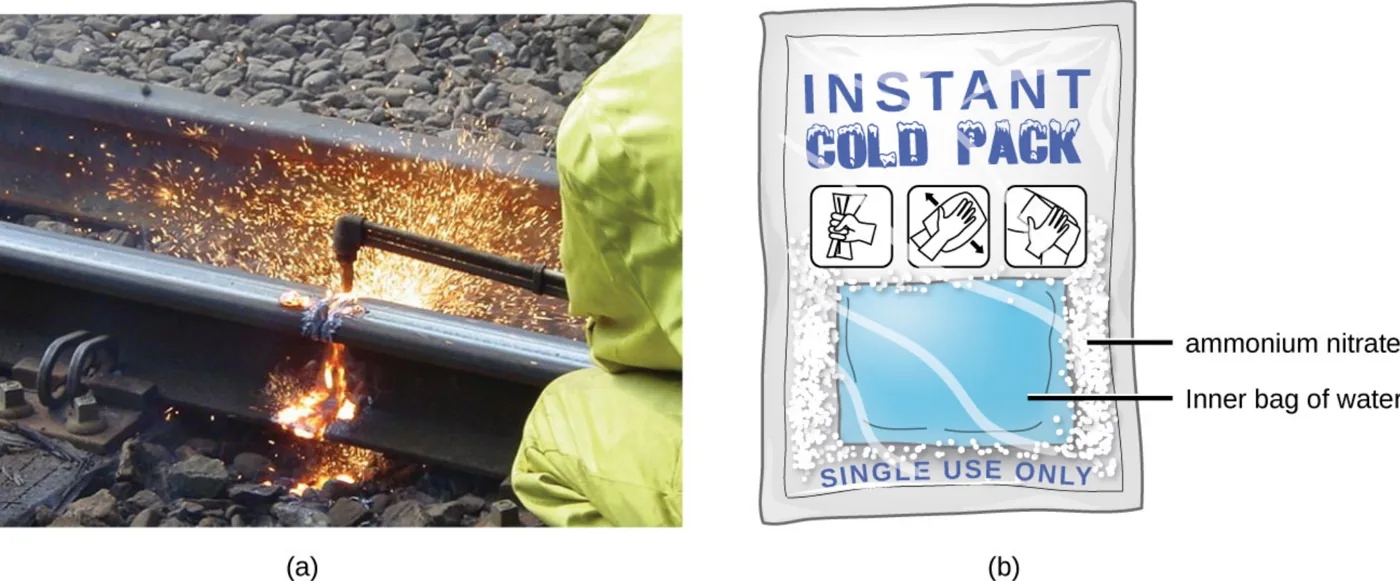
A process that releases heat is called an exothermic process.
The combustion in an oxyacetylene torch is exothermic: the energy released heats and melts the metal being cut,
and it also gives off light,which is seen as the flame.
A process that absorbs heat is called an endothermic process.
An instant cold pack used for muscle strains is an example.
When its water and a salt such as ammonium nitrate are brought together, the process absorbs heat from the surroundings
which is felt as cold.
1 / 2Next ▶
A cutting torch releases heat through an exothermic combustion, while an instant cold pack absorbs heat through an endothermic dissolving process. Image: OpenStax, Chemistry 2e, CC BY 4.0.
Exothermic and endothermic processes
◀ Previous2 / 2
1Units of energy2Units of energy
Units of energy
1
Energy was historically measured in calories.
2
One calorie (cal) is the energy needed to raise the temperature of one gram of water by 1 °C (1 K).
3
This value depends slightly on atmospheric pressure and the starting temperature
but the calorie is still often used.
4
The Calorie, written with a capital C, is the large calorie used for food energy, and it equals one kilocalorie.
5
The SI unit of heat, work and energy is the joule (J), defined as the energy used when a force of 1 newton moves an object through 1 meter.
6
One joule equals 1 kg·m2/s2
which is also called 1 newton-meter.
1 / 2Next ▶
Units of energy
1
A kilojoule (kJ) is 1000 joules.
2
For a standard definition, 1 calorie is set equal to exactly 4.184 joules.
◀ Previous2 / 2
1Heat capacity and specific heat2Heat capacity and specific heat3Heat capacity and specific heat
Heat capacity and specific heat
Heat capacity and specific heat
The heat capacity (C) of a body of matter is the quantity of heat (q) it absorbs or releases when its temperature changes by 1 °C (or equivalently 1 K).
It is written as C = q / ΔT
where q is in joules and ΔT is in °C or Kso heat capacity has the unit J/°C.
Heat capacity depends on both the type and the amount of the substance,
so it is an extensive property: its value is proportional to the amount of substance.
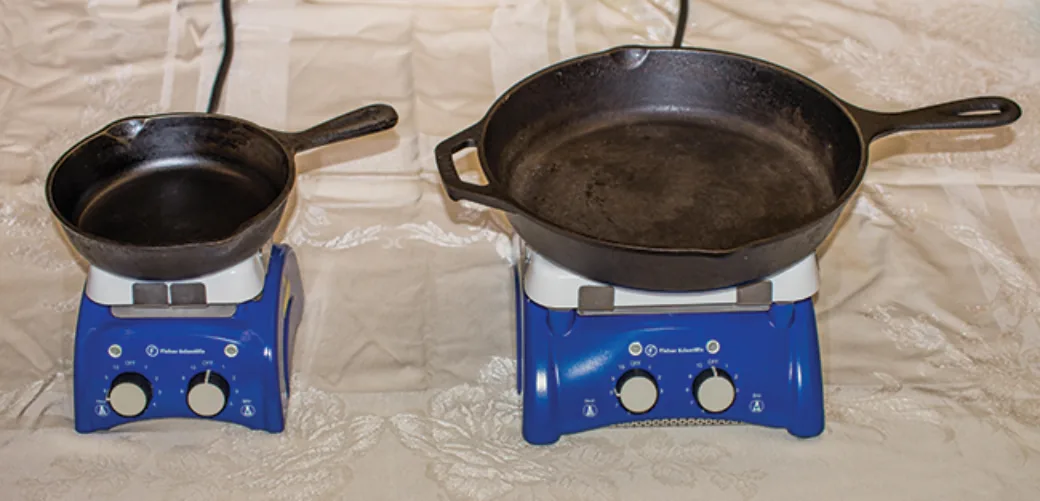
Consider two cast iron frying pans made of the same material.
The small pan needs 18,140 J to raise its temperature by 50.0 °C
so its heat capacity is 18,140 J ÷ 50.0 °C = 362.8 J/°C, or about 363 J/°C.
The large pan needs 90,700 J for the same 50.0 °C rise
so its heat capacity is about 1814 J/°C.
1 / 3Next ▶
Heat capacity and specific heat
1
The large pan has five times the heat capacity because its mass is five times greater,
which means it contains five times as many atoms that must be made to vibrate faster.
2
The specific heat capacity (c), usually just called specific heat, is the quantity of heat needed to raise the temperature of 1 gram of a substance by 1 °C (or 1 K).
3
Its unit is J/g °C.
4
Specific heat depends only on the kind of substance, not on the amount
so it is an intensive property.
5
Dividing the heat capacity by the mass gives the same value for both pans: the small pan has a mass of 808 g,
so c = 18,140 J ÷ = 0.449 J/g °C,(808 g × 50.0 °C)and the large pan, with a mass of 4040 g, gives 90,700 J ÷ = 0.449 J/g °C.(4040 g × 50.0 °C)
6
Both pans therefore have the specific heat of iron.
◀ Previous2 / 3Next ▶
The larger frying pan has the greater heat capacity because it has more mass, but both pans have the same specific heat because they are made of the same material. Image: OpenStax, Chemistry 2e, CC BY 4.0.
Heat capacity and specific heat
 ⤢ Enlarge
Heat capacity and specific heat
The molar heat capacity is the heat capacity per mole of a substance and has units of J/mol °C.
Water has a high specific heat, about 4.2 J/g °C as a liquid and 2.09 J/g °C as ice
while most metals have specific heats below 1 J/g °C.
Specific heat changes a little with temperature,
but the change is small enough that it is treated as constant over the temperature ranges in this chapter.
A table of common substances lists specific heats of common substances at 25 °C and 1 bar.
Helium gas has 5.193 J/g °C, liquid water 4.184 J/g °C, ethanol 2.376 J/g °C, water vapor 1.864 J/g °C, nitrogen gas 1.040 J/g °C, air 1.007 J/g °C, oxygen gas 0.918 J/g °C, aluminum 0.897 J/g °C, carbon dioxide gas 0.853 J/g °C, argon gas 0.522 J/g °C, iron 0.449 J/g °C, copper 0.385 J/g °C, lead 0.130 J/g °C, gold 0.129 J/g °C and silicon 0.712 J/g °C.
Substances with a high specific heat need more energy to change temperature
while metals with a low specific heat warm and cool quickly.
◀ Previous3 / 3
Calculating heat from specific heat
Calculating heat from specific heat
If the mass of a substance and its specific heat are known, the heat gained or lost can be found from the temperature change.
The equation is q = m × c × ΔT,
where q is the heat in joules, m is the mass in grams, c is the specific heat in J/g °C,and ΔT is the temperature change in °C, calculated as Tfinal − Tinitial.
If a substance gains thermal energy, its final temperature is higher, ΔT is positive and q is positive.
If it loses thermal energy, its final temperature is lower, ΔT is negative and q is negative.
The same relationship can be rearranged to find any one of the four quantities when the other three are known.
1Chemistry in everyday life: solar thermal power plants2Chemistry in everyday life: solar thermal power plants
Chemistry in everyday life: solar thermal power plants
1
Sunlight reaching the earth contains thousands of times more energy than people currently capture. Solar thermal systems are one way to convert that energy into a usable form. Large solar thermal plants use different designs
but all of them concentrate sunlight to heat a substance, and the stored heat is then turned into electricity.
2
The Solana Generating Station in the Sonoran Desert of Arizona produces 280 megawatts of electrical power.
3
Parabolic mirrors focus sunlight onto pipes filled with a heat transfer fluid (HTF).
4
The HTF does two jobs.
5
It turns water into steam,
which spins turbines that produce electricity,and it melts and heats a mixture of salts that acts as a thermal energy storage system.
6
After sunset, the molten salt mixture releases enough of its stored heat to keep producing steam for the turbines for about 6 hours.
1 / 2Next ▶
Chemistry in everyday life: solar thermal power plants
Chemistry in everyday life: solar thermal power plants
Molten salts are used because they have high heat capacities and high thermal conductivities,
which allow them to store and release a large amount of heat.
◀ Previous2 / 2
1Example 1: Heat absorbed by heated water2Example 1: Heat absorbed by heated water3Example 2: Finding the specific heat of an unknown metal4Example 3: Heat capacity of a frying pan
Example 1: Heat absorbed by heated water
Example 1: Heat absorbed by heated water
Problem: A flask holding 8.0 × 10² g of water is heated, and its temperature rises from 21 °C to 85 °C. How much heat does the water absorb?
Solution: The heat depends on the specific heat of water, the mass of water and the temperature change. Water has c = 4.184 J/g °C. The temperature change is ΔT = 85 °C − 21 °C = 64 °C. The mass is 8.0 × 10² g = 800 g.
q = m × c × ΔT = 800 g × 4.184 J/g °C × 64 °C = 2.14 × 10⁵ J
What the symbols mean:
E, Q or q = energy transferred (J) · m = mass (kg
g in chemistry calorimetry) · c = specific heat capacity (J kg
−1
1 / 4Next ▶
Example 1: Heat absorbed by heated water
1
°C
2
water 4.18 J g
3
) · ΔT or Δθ = temperature change (°C or K)
4
The temperature rose
so the water absorbed heat and q is positive.
5
Check your learning: How much heat, in joules, must be added to a 502 g iron skillet to raise its temperature from 25 °C to 250 °C? The specific heat of iron is 0.449 J/g °C.
6
Answer: ΔT = 250 °C − 25 °C = 225 °C
so q = 502 g × 0.449 J/g °C × 225 °C = 5.07 × 10⁴ J.
◀ Previous2 / 4Next ▶
Example 2: Finding the specific heat of an unknown metal
Example 2: Finding the specific heat of an unknown metal
Problem: A piece of unknown metal weighs 348 g. When it absorbs 6.64 kJ of heat, its temperature rises from 22.4 °C to 43.6 °C. What is its specific heat, and what might the metal be?
Solution: Rearrange q = m × c × ΔT to give c = q ÷ (m × ΔT). The heat is 6.64 kJ = 6640 J, and ΔT = 43.6 °C − 22.4 °C = 21.2 °C.
c = 6640 J ÷ (348 g × 21.2 °C) = 6640 ÷ 7377.6 = 0.900 J/g °C
This value is closest to the specific heat of aluminum (0.897 J/g °C) in the table of common substances
so the metal may be aluminum.
Check your learning: A piece of unknown metal weighs 217 g. When it absorbs 1.43 kJ of heat, its temperature rises from 24.5 °C to 39.1 °C. Find its specific heat and predict its identity.
Answer: ΔT = 14.6 °C
so c = 1430 J ÷ (217 g × 14.6 °C) = 0.451 J/g °C. The metal is likely iron (0.449 J/g °C).
◀ Previous3 / 4Next ▶
Example 3: Heat capacity of a frying pan
Example 3: Heat capacity of a frying pan
Problem: The small cast iron frying pan absorbs 18,140 J when its temperature rises by 50.0 °C. Find its heat capacity and its specific heat, given a mass of 808 g.
Solution: Heat capacity C = q ÷ ΔT = 18,140 J ÷ 50.0 °C = 362.8 J/°C. Specific heat c = C ÷ m = 362.8 J/°C ÷ 808 g = 0.449 J/g °C.
◀ Previous4 / 4
Key terms
| Term | Meaning |
|---|---|
| Energy | The capacity to supply heat or to do work. |
| Work (w) | The process of causing matter to move against an opposing force. |
| Potential energy | Energy an object has because of its position, composition or condition. |
| Kinetic energy | Energy an object has because of its motion. |
| Law of conservation of energy | Energy can be neither created nor destroyed in a chemical or physical change, only changed in form. |
| Thermal energy | Kinetic energy associated with the random motion of atoms and molecules. |
| Temperature | A quantitative measure of how hot or cold a sample is, related to the average kinetic energy of its particles. |
| Heat (q) | Transfer of thermal energy between two bodies at different temperatures. |
| Thermal equilibrium | The state reached when two bodies in contact have the same temperature and so the same average kinetic energy. |
| Exothermic process | A change that releases heat to its surroundings. |
| Endothermic process | A change that absorbs heat from its surroundings. |
| Calorie (cal) | The energy needed to raise the temperature of 1 gram of water by 1 °C; 1 cal = 4.184 J. |
| Calorie (Cal) | The large food calorie, equal to 1 kilocalorie. |
| Joule (J) | The SI unit of heat, work and energy; 1 J = 1 kg·m2/s2. |
| Heat capacity (C) | The heat absorbed or released per 1 °C (or 1 K) temperature change of a body; depends on the amount of substance. |
| Specific heat capacity (c) | The heat needed to raise the temperature of 1 gram of a substance by 1 °C; depends only on the substance. |
| Molar heat capacity | The heat capacity per mole of a substance, in J/mol °C. |
| Extensive property | A property whose value depends on the amount of matter, such as heat capacity. |
| Intensive property | A property whose value does not depend on the amount of matter, such as specific heat. |
1Avoid these mistakes2Avoid these mistakes3Avoid these mistakes
Avoid these mistakes
1Avoid this
Confusing heat with temperature.Avoid this
Temperature measures the average kinetic energy of particles,Avoid this
while heat is the transfer of thermal energy caused by a temperature difference.Avoid this
2Avoid this
Using the mass of the sample when a specific heat is asked for, or the reverse.Avoid this
1 / 3Next ▶
Avoid these mistakes
Specific heat is per gram, so heat capacity must be divided by mass to obtain it.Avoid this
3Avoid this
Calculating ΔT as initial minus final temperature. ΔT is always final minus initial, so a cooling sample gives a negative q.Avoid this
4Avoid this
Forgetting to convert kilojoules to joules before using q = m × c × ΔT with c in J/g °C, as in Example 2.Avoid this
5Avoid this
◀ Previous2 / 3Next ▶
Avoid these mistakes
Thinking that an exothermic process must feel hot or that an endothermic process must feel cold.Avoid this
These terms describe the direction of heat flow, not the sensation; the sign of q shows the direction.Avoid this
6Avoid this
Assuming the energy of a chemical change disappears when it is not seen.Avoid this
The law of conservation of energy requires that energy change form, not vanish.Avoid this
◀ Previous3 / 3