Curriculum
Chemistry 2e
Unit 1: Essential Ideas
0/14
-
Unit 1 overview: Essential Ideas
 Text lessonPreview
-
1.1 Chemistry in Context
Text lessonPreview
-
1.1 Chemistry in Context - Check yourself
 6 questionsPreview
-
1.2 Phases and Classification of Matter
Text lessonPreview
-
1.2 Phases and Classification of Matter - Check yourself
6 questionsPreview
-
1.3 Physical and Chemical Properties
Text lessonPreview
-
1.3 Physical and Chemical Properties - Check yourself
6 questionsPreview
-
1.4 Measurements
Text lessonPreview
-
1.4 Measurements - Check yourself
6 questionsPreview
-
1.5 Measurement Uncertainty, Accuracy, and Precision
Text lessonPreview
-
1.5 Measurement Uncertainty, Accuracy, and Precision - Check yourself
6 questionsPreview
-
1.6 Mathematical Treatment of Measurement Results
Text lessonPreview
-
1.6 Mathematical Treatment of Measurement Results - Check yourself
6 questionsPreview
-
Unit 1 review quiz: Essential Ideas
10 questionsPreview
Unit 2: Atoms, Molecules, and Ions
0/16
-
Unit 2 overview: Atoms, Molecules, and Ions
Text lessonPreview
-
2.1 Early Ideas in Atomic Theory
Text lessonPreview
-
2.1 Early Ideas in Atomic Theory - Check yourself
6 questionsPreview
-
2.2 Evolution of Atomic Theory
Text lessonPreview
-
2.2 Evolution of Atomic Theory - Check yourself
6 questionsPreview
-
2.3 Atomic Structure and Symbolism
Text lessonPreview
-
2.3 Atomic Structure and Symbolism - Check yourself
6 questionsPreview
-
2.4 Chemical Formulas
Text lessonPreview
-
2.4 Chemical Formulas - Check yourself
6 questionsPreview
-
2.5 The Periodic Table
Text lessonPreview
-
2.5 The Periodic Table - Check yourself
6 questionsPreview
-
2.6 Ionic and Molecular Compounds
Text lessonPreview
-
2.6 Ionic and Molecular Compounds - Check yourself
6 questionsPreview
-
2.7 Chemical Nomenclature
Text lessonPreview
-
2.7 Chemical Nomenclature - Check yourself
6 questionsPreview
-
Unit 2 review quiz: Atoms, Molecules, and Ions
10 questionsPreview
Unit 3: Composition of Substances and Solutions
0/10
-
Unit 3 overview: Composition of Substances and Solutions
Text lessonPreview
-
3.1 Formula Mass and the Mole Concept
Text lessonPreview
-
3.1 Formula Mass and the Mole Concept - Check yourself
6 questionsPreview
-
3.2 Determining Empirical and Molecular Formulas
Text lessonPreview
-
3.2 Determining Empirical and Molecular Formulas - Check yourself
6 questionsPreview
-
3.3 Molarity
Text lessonPreview
-
3.3 Molarity - Check yourself
6 questionsPreview
-
3.4 Other Units for Solution Concentrations
Text lessonPreview
-
3.4 Other Units for Solution Concentrations - Check yourself
6 questionsPreview
-
Unit 3 review quiz: Composition of Substances and Solutions
10 questionsPreview
Unit 4: Stoichiometry of Chemical Reactions
0/12
-
Unit 4 overview: Stoichiometry of Chemical Reactions
Text lessonPreview
-
4.1 Writing and Balancing Chemical Equations
Text lessonPreview
-
4.1 Writing and Balancing Chemical Equations - Check yourself
6 questionsPreview
-
4.2 Classifying Chemical Reactions
Text lessonPreview
-
4.2 Classifying Chemical Reactions - Check yourself
6 questionsPreview
-
4.3 Reaction Stoichiometry
Text lessonPreview
-
4.3 Reaction Stoichiometry - Check yourself
6 questionsPreview
-
4.4 Reaction Yields
Text lessonPreview
-
4.4 Reaction Yields - Check yourself
6 questionsPreview
-
4.5 Quantitative Chemical Analysis
Text lessonPreview
-
4.5 Quantitative Chemical Analysis - Check yourself
6 questionsPreview
-
Unit 4 review quiz: Stoichiometry of Chemical Reactions
10 questionsPreview
Unit 5: Thermochemistry
0/8
-
Unit 5 overview: Thermochemistry
Text lessonPreview
-
5.1 Energy Basics
Text lessonPreview
-
5.1 Energy Basics - Check yourself
6 questionsPreview
-
5.2 Calorimetry
Text lessonPreview
-
5.2 Calorimetry - Check yourself
7 questionsPreview
-
5.3 Enthalpy
Text lessonPreview
-
5.3 Enthalpy - Check yourself
6 questionsPreview
-
Unit 5 review quiz: Thermochemistry
10 questionsPreview
Unit 6: Electronic Structure and Periodic Properties of Elements
0/12
-
Unit 6 overview: Electronic Structure and Periodic Properties of Elements
Text lessonPreview
-
6.1 Electromagnetic Energy
Text lessonPreview
-
6.1 Electromagnetic Energy - Check yourself
6 questionsPreview
-
6.2 The Bohr Model
Text lessonPreview
-
6.2 The Bohr Model - Check yourself
6 questionsPreview
-
6.3 Development of Quantum Theory
Text lessonPreview
-
6.3 Development of Quantum Theory - Check yourself
6 questionsPreview
-
6.4 Electronic Structure of Atoms (Electron Configurations)
Text lessonPreview
-
6.4 Electronic Structure of Atoms (Electron Configurations) - Check yourself
6 questionsPreview
-
6.5 Periodic Variations in Element Properties
Text lessonPreview
-
6.5 Periodic Variations in Element Properties - Check yourself
6 questionsPreview
-
Unit 6 review quiz: Electronic Structure and Periodic Properties of Elements
10 questionsPreview
Unit 7: Chemical Bonding and Molecular Geometry
0/14
-
Unit 7 overview: Chemical Bonding and Molecular Geometry
Text lessonPreview
-
7.1 Ionic Bonding
Text lessonPreview
-
7.1 Ionic Bonding - Check yourself
6 questionsPreview
-
7.2 Covalent Bonding
Text lessonPreview
-
7.2 Covalent Bonding - Check yourself
6 questionsPreview
-
7.3 Lewis Symbols and Structures
Text lessonPreview
-
7.3 Lewis Symbols and Structures - Check yourself
6 questionsPreview
-
7.4 Formal Charges and Resonance
Text lessonPreview
-
7.4 Formal Charges and Resonance - Check yourself
6 questionsPreview
-
7.5 Strengths of Ionic and Covalent Bonds
Text lessonPreview
-
7.5 Strengths of Ionic and Covalent Bonds - Check yourself
6 questionsPreview
-
7.6 Molecular Structure and Polarity
Text lessonPreview
-
7.6 Molecular Structure and Polarity - Check yourself
6 questionsPreview
-
Unit 7 review quiz: Chemical Bonding and Molecular Geometry
10 questionsPreview
Unit 8: Advanced Theories of Covalent Bonding
0/10
-
Unit 8 overview: Advanced Theories of Covalent Bonding
Text lessonPreview
-
8.1 Valence Bond Theory
Text lessonPreview
-
8.1 Valence Bond Theory - Check yourself
6 questionsPreview
-
8.2 Hybrid Atomic Orbitals
Text lessonPreview
-
8.2 Hybrid Atomic Orbitals - Check yourself
6 questionsPreview
-
8.3 Multiple Bonds
Text lessonPreview
-
8.3 Multiple Bonds - Check yourself
6 questionsPreview
-
8.4 Molecular Orbital Theory
Text lessonPreview
-
8.4 Molecular Orbital Theory - Check yourself
6 questionsPreview
-
Unit 8 review quiz: Advanced Theories of Covalent Bonding
10 questionsPreview
Unit 9: Gases
0/23
-
Unit 9 overview: Gases
Text lessonPreview
-
9.1 Gas Pressure
Text lessonPreview
-
9.1 Gas Pressure - Check yourself
6 questionsPreview
-
9.2 Relating Pressure, Volume, Amount, and Temperature: The Ideal Gas Law
Text lessonPreview
-
9.2 Relating Pressure, Volume, Amount, and Temperature: The Ideal Gas Law - Check yourself
6 questionsPreview
-
9.3 Stoichiometry of Gaseous Substances, Mixtures, and Reactions
Text lessonPreview
-
9.3 Stoichiometry of Gaseous Substances, Mixtures, and Reactions - Check yourself
6 questionsPreview
-
9.3 Stoichiometry of Gaseous Substances, Mixtures, and Reactions
Text lessonPreview
-
9.3 Stoichiometry of Gaseous Substances, Mixtures, and Reactions - Check yourself
6 questionsPreview
-
9.4 Effusion and Diffusion of Gases
Text lessonPreview
-
9.4 Effusion and Diffusion of Gases - Check yourself
6 questionsPreview
-
9.4 Effusion and Diffusion of Gases
Text lessonPreview
-
9.4 Effusion and Diffusion of Gases - Check yourself
6 questionsPreview
-
Unit 9 review quiz: Gases
10 questionsPreview
-
9.5 The Kinetic-Molecular Theory
Text lessonPreview
-
9.5 The Kinetic-Molecular Theory - Check yourself
6 questionsPreview
-
9.5 The Kinetic-Molecular Theory
Text lessonPreview
-
9.5 The Kinetic-Molecular Theory - Check yourself
6 questionsPreview
-
9.6 Non-Ideal Gas Behavior
Text lessonPreview
-
9.6 Non-Ideal Gas Behavior - Check yourself
6 questionsPreview
-
9.6 Non-Ideal Gas Behavior
Text lessonPreview
-
9.6 Non-Ideal Gas Behavior - Check yourself
6 questionsPreview
-
Unit 9 review quiz: Gases
10 questionsPreview
Unit 10: Liquids and Solids
0/28
-
Unit 10 overview: Liquids and Solids
Text lessonPreview
-
10.1 Intermolecular Forces
Text lessonPreview
-
Unit 10 overview: Liquids and Solids
Text lessonPreview
-
10.1 Intermolecular Forces
Text lessonPreview
-
10.1 Intermolecular Forces - Check yourself
6 questionsPreview
-
10.1 Intermolecular Forces - Check yourself
6 questionsPreview
-
10.2 Properties of Liquids
Text lessonPreview
-
10.2 Properties of Liquids - Check yourself
6 questionsPreview
-
10.2 Properties of Liquids
Text lessonPreview
-
10.2 Properties of Liquids - Check yourself
6 questionsPreview
-
10.3 Phase Transitions
Text lessonPreview
-
10.3 Phase Transitions - Check yourself
6 questionsPreview
-
10.3 Phase Transitions
Text lessonPreview
-
10.3 Phase Transitions - Check yourself
6 questionsPreview
-
10.4 Phase Diagrams
Text lessonPreview
-
10.4 Phase Diagrams
Text lessonPreview
-
10.4 Phase Diagrams - Check yourself
6 questionsPreview
-
10.4 Phase Diagrams - Check yourself
6 questionsPreview
-
10.5 The Solid State of Matter
Text lessonPreview
-
10.5 The Solid State of Matter
Text lessonPreview
-
10.5 The Solid State of Matter - Check yourself
6 questionsPreview
-
10.5 The Solid State of Matter - Check yourself
6 questionsPreview
-
10.6 Lattice Structures in Crystalline Solids
Text lessonPreview
-
10.6 Lattice Structures in Crystalline Solids
Text lessonPreview
-
10.6 Lattice Structures in Crystalline Solids - Check yourself
6 questionsPreview
-
10.6 Lattice Structures in Crystalline Solids - Check yourself
6 questionsPreview
-
Unit 10 review quiz: Liquids and Solids
10 questionsPreview
-
Unit 10 review quiz: Liquids and Solids
10 questionsPreview
Unit 11: Solutions and Colloids
0/24
-
Unit 11 overview: Solutions and Colloids
Text lessonPreview
-
11.1 The Dissolution Process
Text lessonPreview
-
Unit 11 overview: Solutions and Colloids
Text lessonPreview
-
11.1 The Dissolution Process
Text lessonPreview
-
11.1 The Dissolution Process - Check yourself
6 questionsPreview
-
11.1 The Dissolution Process - Check yourself
6 questionsPreview
-
11.2 Electrolytes
Text lessonPreview
-
11.2 Electrolytes - Check yourself
6 questionsPreview
-
11.2 Electrolytes
Text lessonPreview
-
11.2 Electrolytes - Check yourself
6 questionsPreview
-
11.3 Solubility
Text lessonPreview
-
11.3 Solubility - Check yourself
6 questionsPreview
-
11.3 Solubility
Text lessonPreview
-
11.3 Solubility - Check yourself
6 questionsPreview
-
11.4 Colligative Properties
Text lessonPreview
-
11.4 Colligative Properties - Check yourself
6 questionsPreview
-
11.4 Colligative Properties
Text lessonPreview
-
11.4 Colligative Properties - Check yourself
6 questionsPreview
-
11.5 Colloids
Text lessonPreview
-
11.5 Colloids - Check yourself
6 questionsPreview
-
11.5 Colloids
Text lessonPreview
-
11.5 Colloids - Check yourself
6 questionsPreview
-
Unit 11 review quiz: Solutions and Colloids
10 questionsPreview
-
Unit 11 review quiz: Solutions and Colloids
10 questionsPreview
Unit 12: Kinetics
0/32
-
Unit 12 overview: Kinetics
Text lessonPreview
-
12.1 Chemical Reaction Rates
Text lessonPreview
-
12.1 Chemical Reaction Rates - Check yourself
6 questionsPreview
-
Unit 12 overview: Kinetics
Text lessonPreview
-
12.1 Chemical Reaction Rates
Text lessonPreview
-
12.1 Chemical Reaction Rates - Check yourself
6 questionsPreview
-
12.2 Factors Affecting Reaction Rates
Text lessonPreview
-
12.2 Factors Affecting Reaction Rates - Check yourself
6 questionsPreview
-
12.2 Factors Affecting Reaction Rates
Text lessonPreview
-
12.2 Factors Affecting Reaction Rates - Check yourself
6 questionsPreview
-
12.3 Rate Laws
Text lessonPreview
-
12.3 Rate Laws - Check yourself
6 questionsPreview
-
12.3 Rate Laws
Text lessonPreview
-
12.3 Rate Laws - Check yourself
6 questionsPreview
-
12.4 Integrated Rate Laws
Text lessonPreview
-
12.4 Integrated Rate Laws - Check yourself
6 questionsPreview
-
12.4 Integrated Rate Laws
Text lessonPreview
-
12.4 Integrated Rate Laws - Check yourself
6 questionsPreview
-
12.5 Collision Theory
Text lessonPreview
-
12.5 Collision Theory - Check yourself
6 questionsPreview
-
12.5 Collision Theory
Text lessonPreview
-
Unit 12 review quiz: Kinetics
10 questionsPreview
-
12.5 Collision Theory - Check yourself
6 questionsPreview
-
12.6 Reaction Mechanisms
Text lessonPreview
-
12.6 Reaction Mechanisms - Check yourself
6 questionsPreview
-
12.6 Reaction Mechanisms
Text lessonPreview
-
12.6 Reaction Mechanisms - Check yourself
6 questionsPreview
-
12.7 Catalysis
Text lessonPreview
-
12.7 Catalysis - Check yourself
6 questionsPreview
-
12.7 Catalysis
Text lessonPreview
-
12.7 Catalysis - Check yourself
6 questionsPreview
-
Unit 12 review quiz: Kinetics
10 questionsPreview
Unit 13: Fundamental Equilibrium Concepts
0/20
-
Unit 13 overview: Fundamental Equilibrium Concepts
Text lessonPreview
-
13.1 Chemical Equilibria
Text lessonPreview
-
13.1 Chemical Equilibria - Check yourself
6 questionsPreview
-
13.1 Chemical Equilibria
Text lessonPreview
-
13.1 Chemical Equilibria - Check yourself
6 questionsPreview
-
13.2 Equilibrium Constants
Text lessonPreview
-
13.2 Equilibrium Constants - Check yourself
6 questionsPreview
-
13.2 Equilibrium Constants
Text lessonPreview
-
Unit 13 overview: Fundamental Equilibrium Concepts
Text lessonPreview
-
13.2 Equilibrium Constants - Check yourself
6 questionsPreview
-
13.3 Shifting Equilibria: Le Châtelier’s Principle
Text lessonPreview
-
13.3 Shifting Equilibria: Le Châtelier’s Principle - Check yourself
6 questionsPreview
-
13.3 Shifting Equilibria: Le Châtelier’s Principle
Text lessonPreview
-
Unit 13 review quiz: Fundamental Equilibrium Concepts
10 questionsPreview
-
13.3 Shifting Equilibria: Le Châtelier’s Principle - Check yourself
6 questionsPreview
-
13.4 Equilibrium Calculations
Text lessonPreview
-
13.4 Equilibrium Calculations - Check yourself
6 questionsPreview
-
13.4 Equilibrium Calculations
Text lessonPreview
-
13.4 Equilibrium Calculations - Check yourself
6 questionsPreview
-
Unit 13 review quiz: Fundamental Equilibrium Concepts
10 questionsPreview
Unit 14: Acid-Base Equilibria
0/32
-
Unit 14 overview: Acid-Base Equilibria
Text lessonPreview
-
14.1 Brønsted-Lowry Acids and Bases
Text lessonPreview
-
14.1 Brønsted-Lowry Acids and Bases - Check yourself
6 questionsPreview
-
14.1 Brønsted-Lowry Acids and Bases
Text lessonPreview
-
14.1 Brønsted-Lowry Acids and Bases - Check yourself
6 questionsPreview
-
14.2 pH and pOH
Text lessonPreview
-
14.2 pH and pOH - Check yourself
6 questionsPreview
-
14.2 pH and pOH
Text lessonPreview
-
14.2 pH and pOH - Check yourself
6 questionsPreview
-
14.3 Relative Strengths of Acids and Bases
Text lessonPreview
-
14.3 Relative Strengths of Acids and Bases - Check yourself
6 questionsPreview
-
14.3 Relative Strengths of Acids and Bases
Text lessonPreview
-
14.3 Relative Strengths of Acids and Bases - Check yourself
6 questionsPreview
-
14.4 Hydrolysis of Salts
Text lessonPreview
-
14.4 Hydrolysis of Salts - Check yourself
6 questionsPreview
-
Unit 14 review quiz: Acid-Base Equilibria
10 questionsPreview
-
Unit 14 overview: Acid-Base Equilibria
Text lessonPreview
-
14.4 Hydrolysis of Salts
Text lessonPreview
-
14.4 Hydrolysis of Salts - Check yourself
6 questionsPreview
-
14.5 Polyprotic Acids
Text lessonPreview
-
14.5 Polyprotic Acids - Check yourself
6 questionsPreview
-
14.5 Polyprotic Acids
Text lessonPreview
-
14.5 Polyprotic Acids - Check yourself
6 questionsPreview
-
14.6 Buffers
Text lessonPreview
-
14.6 Buffers - Check yourself
6 questionsPreview
-
14.6 Buffers
Text lessonPreview
-
14.6 Buffers - Check yourself
6 questionsPreview
-
14.7 Acid-Base Titrations
Text lessonPreview
-
14.7 Acid-Base Titrations - Check yourself
6 questionsPreview
-
14.7 Acid-Base Titrations
Text lessonPreview
-
14.7 Acid-Base Titrations - Check yourself
6 questionsPreview
-
Unit 14 review quiz: Acid-Base Equilibria
10 questionsPreview
Unit 15: Equilibria of Other Reaction Classes
0/16
-
Unit 15 overview: Equilibria of Other Reaction Classes
Text lessonPreview
-
15.1 Precipitation and Dissolution
Text lessonPreview
-
15.1 Precipitation and Dissolution - Check yourself
6 questionsPreview
-
15.1 Precipitation and Dissolution
Text lessonPreview
-
15.1 Precipitation and Dissolution - Check yourself
6 questionsPreview
-
15.2 Lewis Acids and Bases
Text lessonPreview
-
15.2 Lewis Acids and Bases - Check yourself
6 questionsPreview
-
Unit 15 review quiz: Equilibria of Other Reaction Classes
10 questionsPreview
-
Unit 15 overview: Equilibria of Other Reaction Classes
Text lessonPreview
-
15.2 Lewis Acids and Bases
Text lessonPreview
-
15.2 Lewis Acids and Bases - Check yourself
6 questionsPreview
-
15.3 Coupled Equilibria
Text lessonPreview
-
15.3 Coupled Equilibria - Check yourself
6 questionsPreview
-
15.3 Coupled Equilibria
Text lessonPreview
-
15.3 Coupled Equilibria - Check yourself
6 questionsPreview
-
Unit 15 review quiz: Equilibria of Other Reaction Classes
10 questionsPreview
Unit 16: Thermodynamics
0/20
-
Unit 16 overview: Thermodynamics
Text lessonPreview
-
16.1 Spontaneity
Text lessonPreview
-
16.1 Spontaneity - Check yourself
6 questionsPreview
-
16.1 Spontaneity
Text lessonPreview
-
16.1 Spontaneity - Check yourself
6 questionsPreview
-
16.2 Entropy
Text lessonPreview
-
16.2 Entropy - Check yourself
6 questionsPreview
-
16.2 Entropy
Text lessonPreview
-
16.2 Entropy - Check yourself
6 questionsPreview
-
Unit 16 review quiz: Thermodynamics
10 questionsPreview
-
Unit 16 overview: Thermodynamics
Text lessonPreview
-
16.3 The Second and Third Laws of Thermodynamics
Text lessonPreview
-
16.3 The Second and Third Laws of Thermodynamics - Check yourself
6 questionsPreview
-
16.3 The Second and Third Laws of Thermodynamics
Text lessonPreview
-
16.3 The Second and Third Laws of Thermodynamics - Check yourself
6 questionsPreview
-
16.4 Free Energy
Text lessonPreview
-
16.4 Free Energy - Check yourself
6 questionsPreview
-
16.4 Free Energy
Text lessonPreview
-
16.4 Free Energy - Check yourself
6 questionsPreview
-
Unit 16 review quiz: Thermodynamics
10 questionsPreview
Unit 17: Electrochemistry
0/32
-
Unit 17 overview: Electrochemistry
Text lessonPreview
-
17.1 Review of Redox Chemistry
Text lessonPreview
-
17.1 Review of Redox Chemistry - Check yourself
6 questionsPreview
-
17.1 Review of Redox Chemistry
Text lessonPreview
-
17.1 Review of Redox Chemistry - Check yourself
6 questionsPreview
-
17.2 Galvanic Cells
Text lessonPreview
-
17.2 Galvanic Cells - Check yourself
6 questionsPreview
-
17.2 Galvanic Cells
Text lessonPreview
-
17.2 Galvanic Cells - Check yourself
6 questionsPreview
-
17.3 Electrode and Cell Potentials
Text lessonPreview
-
17.3 Electrode and Cell Potentials - Check yourself
6 questionsPreview
-
17.3 Electrode and Cell Potentials
Text lessonPreview
-
17.3 Electrode and Cell Potentials - Check yourself
6 questionsPreview
-
17.4 Potential, Free Energy, and Equilibrium
Text lessonPreview
-
17.4 Potential, Free Energy, and Equilibrium - Check yourself
6 questionsPreview
-
Unit 17 review quiz: Electrochemistry
10 questionsPreview
-
Unit 17 overview: Electrochemistry
Text lessonPreview
-
17.4 Potential, Free Energy, and Equilibrium
Text lessonPreview
-
17.4 Potential, Free Energy, and Equilibrium - Check yourself
6 questionsPreview
-
17.5 Batteries and Fuel Cells
Text lessonPreview
-
17.5 Batteries and Fuel Cells - Check yourself
6 questionsPreview
-
17.5 Batteries and Fuel Cells
Text lessonPreview
-
17.5 Batteries and Fuel Cells - Check yourself
6 questionsPreview
-
17.6 Corrosion
Text lessonPreview
-
17.6 Corrosion - Check yourself
6 questionsPreview
-
17.6 Corrosion
Text lessonPreview
-
17.6 Corrosion - Check yourself
6 questionsPreview
-
17.7 Electrolysis
Text lessonPreview
-
17.7 Electrolysis - Check yourself
6 questionsPreview
-
17.7 Electrolysis
Text lessonPreview
-
17.7 Electrolysis - Check yourself
6 questionsPreview
-
Unit 17 review quiz: Electrochemistry
10 questionsPreview
Unit 18: Representative Metals, Metalloids, and Nonmetals
0/52
-
Unit 18 overview: Representative Metals, Metalloids, and Nonmetals
Text lessonPreview
-
18.1 Periodicity
Text lessonPreview
-
18.1 Periodicity - Check yourself
6 questionsPreview
-
18.1 Periodicity
Text lessonPreview
-
18.1 Periodicity - Check yourself
6 questionsPreview
-
18.2 Occurrence and Preparation of the Representative Metals
Text lessonPreview
-
18.2 Occurrence and Preparation of the Representative Metals - Check yourself
6 questionsPreview
-
18.2 Occurrence and Preparation of the Representative Metals
Text lessonPreview
-
18.2 Occurrence and Preparation of the Representative Metals - Check yourself
6 questionsPreview
-
18.3 Structure and General Properties of the Metalloids
Text lessonPreview
-
18.3 Structure and General Properties of the Metalloids - Check yourself
6 questionsPreview
-
18.3 Structure and General Properties of the Metalloids
Text lessonPreview
-
18.3 Structure and General Properties of the Metalloids - Check yourself
6 questionsPreview
-
18.4 Structure and General Properties of the Nonmetals
Text lessonPreview
-
18.4 Structure and General Properties of the Nonmetals - Check yourself
6 questionsPreview
-
18.4 Structure and General Properties of the Nonmetals
Text lessonPreview
-
18.4 Structure and General Properties of the Nonmetals - Check yourself
6 questionsPreview
-
18.5 Occurrence, Preparation, and Compounds of Hydrogen
Text lessonPreview
-
18.5 Occurrence, Preparation, and Compounds of Hydrogen - Check yourself
6 questionsPreview
-
18.5 Occurrence, Preparation, and Compounds of Hydrogen
Text lessonPreview
-
18.5 Occurrence, Preparation, and Compounds of Hydrogen - Check yourself
6 questionsPreview
-
18.6 Occurrence, Preparation, and Properties of Carbonates
Text lessonPreview
-
18.6 Occurrence, Preparation, and Properties of Carbonates - Check yourself
6 questionsPreview
-
18.6 Occurrence, Preparation, and Properties of Carbonates
Text lessonPreview
-
18.6 Occurrence, Preparation, and Properties of Carbonates - Check yourself
6 questionsPreview
-
Unit 18 review quiz: Representative Metals, Metalloids, and Nonmetals
10 questionsPreview
-
Unit 18 overview: Representative Metals, Metalloids, and Nonmetals
Text lessonPreview
-
18.7 Occurrence, Preparation, and Properties of Nitrogen
Text lessonPreview
-
18.7 Occurrence, Preparation, and Properties of Nitrogen - Check yourself
6 questionsPreview
-
18.7 Occurrence, Preparation, and Properties of Nitrogen
Text lessonPreview
-
18.7 Occurrence, Preparation, and Properties of Nitrogen - Check yourself
6 questionsPreview
-
18.8 Occurrence, Preparation, and Properties of Phosphorus
Text lessonPreview
-
18.8 Occurrence, Preparation, and Properties of Phosphorus - Check yourself
6 questionsPreview
-
18.8 Occurrence, Preparation, and Properties of Phosphorus
Text lessonPreview
-
18.8 Occurrence, Preparation, and Properties of Phosphorus - Check yourself
6 questionsPreview
-
18.9 Occurrence, Preparation, and Compounds of Oxygen
Text lessonPreview
-
18.9 Occurrence, Preparation, and Compounds of Oxygen - Check yourself
6 questionsPreview
-
18.9 Occurrence, Preparation, and Compounds of Oxygen
Text lessonPreview
-
18.9 Occurrence, Preparation, and Compounds of Oxygen - Check yourself
6 questionsPreview
-
18.10 Occurrence, Preparation, and Properties of Sulfur
Text lessonPreview
-
18.10 Occurrence, Preparation, and Properties of Sulfur - Check yourself
6 questionsPreview
-
18.10 Occurrence, Preparation, and Properties of Sulfur
Text lessonPreview
-
18.10 Occurrence, Preparation, and Properties of Sulfur - Check yourself
6 questionsPreview
-
18.11 Occurrence, Preparation, and Properties of Halogens
Text lessonPreview
-
18.11 Occurrence, Preparation, and Properties of Halogens - Check yourself
6 questionsPreview
-
18.11 Occurrence, Preparation, and Properties of Halogens
Text lessonPreview
-
18.11 Occurrence, Preparation, and Properties of Halogens - Check yourself
6 questionsPreview
-
18.12 Occurrence, Preparation, and Properties of the Noble Gases
Text lessonPreview
-
18.12 Occurrence, Preparation, and Properties of the Noble Gases - Check yourself
6 questionsPreview
-
18.12 Occurrence, Preparation, and Properties of the Noble Gases
Text lessonPreview
-
18.12 Occurrence, Preparation, and Properties of the Noble Gases - Check yourself
6 questionsPreview
-
Unit 18 review quiz: Representative Metals, Metalloids, and Nonmetals
10 questionsPreview
Unit 19: Transition Metals and Coordination Chemistry
0/16
-
Unit 19 overview: Transition Metals and Coordination Chemistry
Text lessonPreview
-
19.1 Occurrence, Preparation, and Properties of Transition Metals and Their Compounds
Text lessonPreview
-
19.1 Occurrence, Preparation, and Properties of Transition Metals and Their Compounds - Check yourself
6 questionsPreview
-
19.1 Occurrence, Preparation, and Properties of Transition Metals and Their Compounds
Text lessonPreview
-
19.1 Occurrence, Preparation, and Properties of Transition Metals and Their Compounds - Check yourself
6 questionsPreview
-
19.2 Coordination Chemistry of Transition Metals
Text lessonPreview
-
19.2 Coordination Chemistry of Transition Metals - Check yourself
6 questionsPreview
-
Unit 19 review quiz: Transition Metals and Coordination Chemistry
10 questionsPreview
-
Unit 19 overview: Transition Metals and Coordination Chemistry
Text lessonPreview
-
19.2 Coordination Chemistry of Transition Metals
Text lessonPreview
-
19.2 Coordination Chemistry of Transition Metals - Check yourself
6 questionsPreview
-
19.3 Spectroscopic and Magnetic Properties of Coordination Compounds
Text lessonPreview
-
19.3 Spectroscopic and Magnetic Properties of Coordination Compounds - Check yourself
6 questionsPreview
-
19.3 Spectroscopic and Magnetic Properties of Coordination Compounds
Text lessonPreview
-
19.3 Spectroscopic and Magnetic Properties of Coordination Compounds - Check yourself
6 questionsPreview
-
Unit 19 review quiz: Transition Metals and Coordination Chemistry
10 questionsPreview
Unit 20: Organic Chemistry
0/20
-
Unit 20 overview: Organic Chemistry
Text lessonPreview
-
20.1 Hydrocarbons
Text lessonPreview
-
20.1 Hydrocarbons - Check yourself
6 questionsPreview
-
20.1 Hydrocarbons
Text lessonPreview
-
20.1 Hydrocarbons - Check yourself
6 questionsPreview
-
20.2 Alcohols and Ethers
Text lessonPreview
-
20.2 Alcohols and Ethers - Check yourself
6 questionsPreview
-
20.2 Alcohols and Ethers
Text lessonPreview
-
20.2 Alcohols and Ethers - Check yourself
6 questionsPreview
-
Unit 20 review quiz: Organic Chemistry
10 questionsPreview
-
Unit 20 overview: Organic Chemistry
Text lessonPreview
-
20.3 Aldehydes, Ketones, Carboxylic Acids, and Esters
Text lessonPreview
-
20.3 Aldehydes, Ketones, Carboxylic Acids, and Esters - Check yourself
6 questionsPreview
-
20.3 Aldehydes, Ketones, Carboxylic Acids, and Esters
Text lessonPreview
-
20.3 Aldehydes, Ketones, Carboxylic Acids, and Esters - Check yourself
6 questionsPreview
-
20.4 Amines and Amides
Text lessonPreview
-
20.4 Amines and Amides - Check yourself
6 questionsPreview
-
20.4 Amines and Amides
Text lessonPreview
-
20.4 Amines and Amides - Check yourself
6 questionsPreview
-
Unit 20 review quiz: Organic Chemistry
10 questionsPreview
Unit 21: Nuclear Chemistry
0/28
-
Unit 21 overview: Nuclear Chemistry
Text lessonPreview
-
21.1 Nuclear Structure and Stability
Text lessonPreview
-
21.1 Nuclear Structure and Stability - Check yourself
6 questionsPreview
-
21.1 Nuclear Structure and Stability
Text lessonPreview
-
21.1 Nuclear Structure and Stability - Check yourself
6 questionsPreview
-
21.2 Nuclear Equations
Text lessonPreview
-
21.2 Nuclear Equations - Check yourself
6 questionsPreview
-
21.2 Nuclear Equations
Text lessonPreview
-
21.2 Nuclear Equations - Check yourself
6 questionsPreview
-
21.3 Radioactive Decay
Text lessonPreview
-
21.3 Radioactive Decay - Check yourself
6 questionsPreview
-
21.3 Radioactive Decay
Text lessonPreview
-
21.3 Radioactive Decay - Check yourself
6 questionsPreview
-
Unit 21 review quiz: Nuclear Chemistry
10 questionsPreview
-
Unit 21 overview: Nuclear Chemistry
Text lessonPreview
-
21.4 Transmutation and Nuclear Energy
Text lessonPreview
-
21.4 Transmutation and Nuclear Energy - Check yourself
6 questionsPreview
-
21.4 Transmutation and Nuclear Energy
Text lessonPreview
-
21.4 Transmutation and Nuclear Energy - Check yourself
6 questionsPreview
-
21.5 Uses of Radioisotopes
Text lessonPreview
-
21.5 Uses of Radioisotopes - Check yourself
6 questionsPreview
-
21.5 Uses of Radioisotopes
Text lessonPreview
-
21.5 Uses of Radioisotopes - Check yourself
6 questionsPreview
-
21.6 Biological Effects of Radiation
Text lessonPreview
-
21.6 Biological Effects of Radiation - Check yourself
6 questionsPreview
-
21.6 Biological Effects of Radiation
Text lessonPreview
-
21.6 Biological Effects of Radiation - Check yourself
6 questionsPreview
-
Unit 21 review quiz: Nuclear Chemistry
10 questionsPreview
Text lesson
13.2 Equilibrium Constants
13.2 Equilibrium Constants — CHEMISTRY notes: You will be able to write reaction quotient and equilibrium constant expressions for homogeneous and heterogeneous reactions, calculate Q and K from concentrations or pressures, and use Q compared with K to predict the direction of a reaction.
1Reaction quotient2Reaction quotient
Reaction quotient
Reaction quotient
The status of a reversible reaction can be judged with its reaction quotient, Q.
The reaction quotient is the ratio of product concentrations to reactant concentrations at any moment, with each concentration raised to the power of its stoichiometric coefficient in the balanced equation.
For a general reaction aA + bB ⇌ cC + dD, the concentration-based quotient is Qc = [C]c[D]d / ([A]a[B]b),
where the square brackets mean molar concentration in mol/L (M).
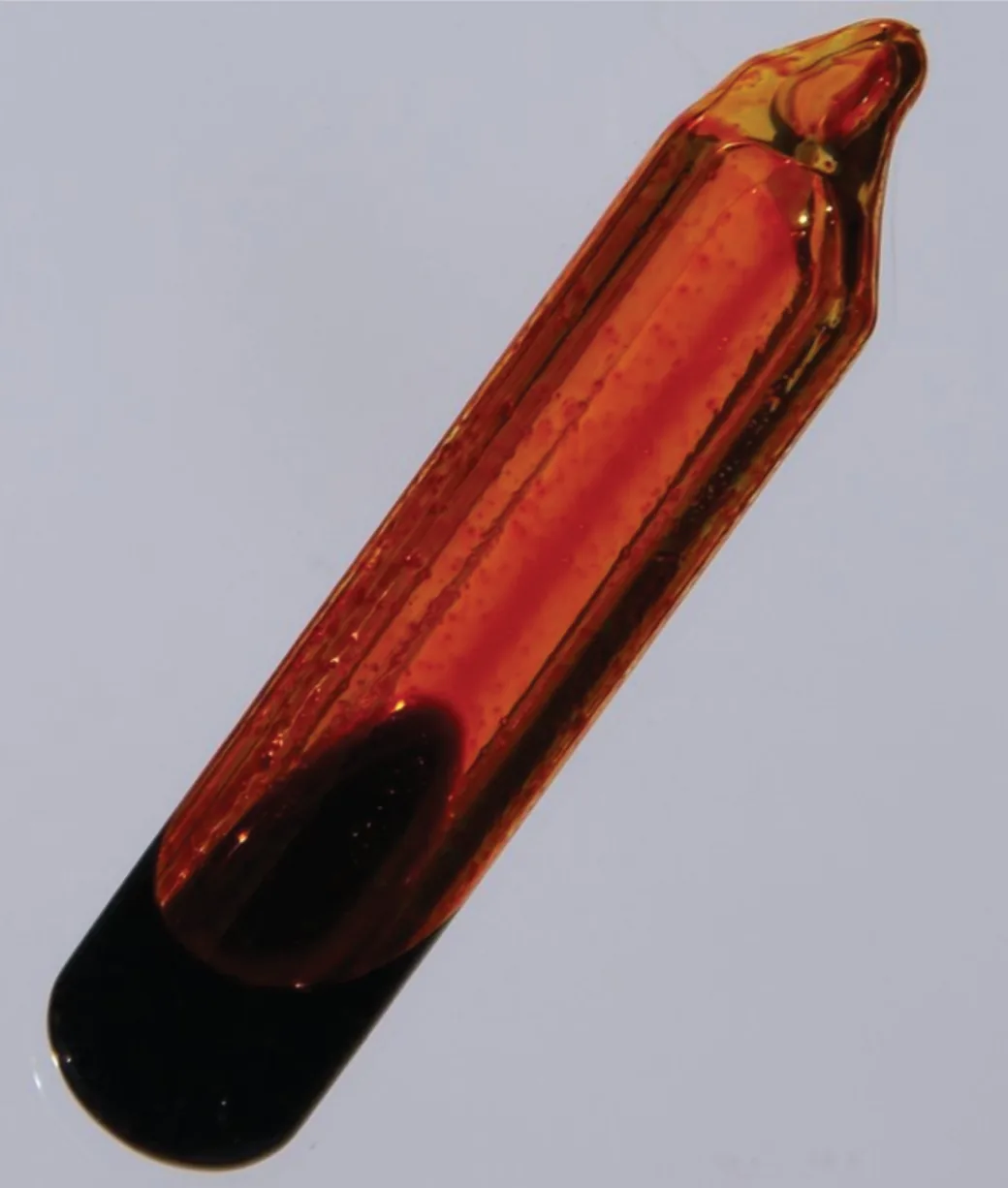
A sealed tube containing liquid and gaseous bromine in equilibrium shows that a reversible process can reach a steady state while both phases are still present.
1 / 2Next ▶
A sealed tube holds liquid bromine and its vapor in equilibrium, so both phases stay present with no net change. Image: OpenStax, Chemistry 2e, CC BY 4.0.
Reaction quotient
 ⤢ Enlarge
Reaction quotient
If the reactants and products are gases, a quotient can be written with partial pressures instead, Qp, using pressures in atm. The quotients above are simplified forms of more rigorous expressions that use relative (dimensionless) values. For introductory work, use the simplified equations and ignore units when calculating Q. This gives only small errors in most cases.
◀ Previous2 / 2
1Equilibrium constant and the law of mass action2Equilibrium constant and the law of mass action
Equilibrium constant and the law of mass action
Equilibrium constant and the law of mass action
The equilibrium constant, K, is the constant value of the reaction quotient for a system at equilibrium.
Q changes as a reaction moves toward equilibrium
so it is a useful measure of how far the reaction has progressed.
Consider the oxidation of sulfur dioxide, 2SO₂(g) + O₂(g) ⇌ 2SO₃(g).
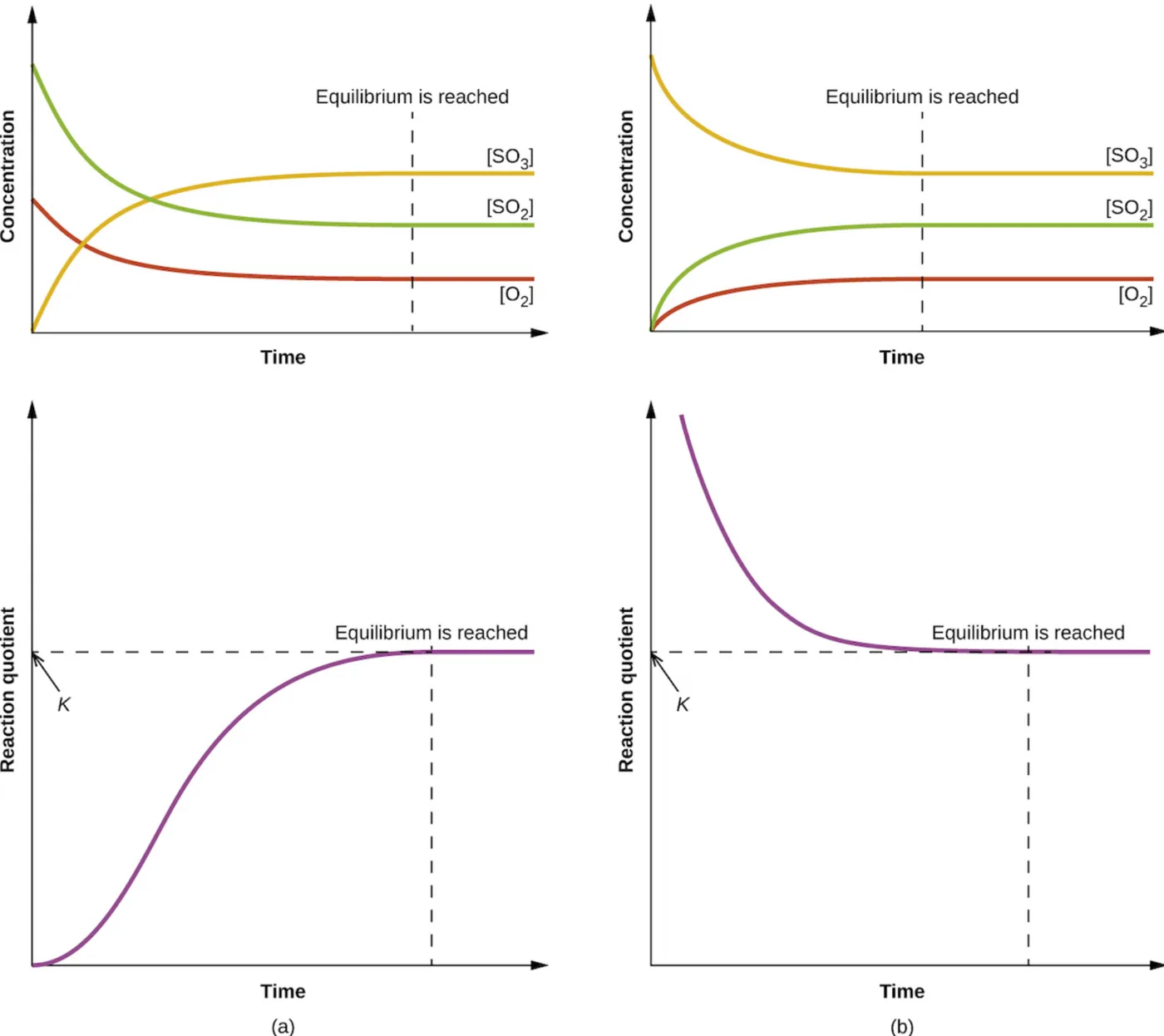
Two experiments start from different mixtures: one begins with only the reactants, SO₂ and O₂, and the other begins with only the product, SO₃.
When the reaction starts with only reactants, Q is initially zero because the numerator contains the product concentration
which is zero.
As the reaction proceeds forward, the reactant concentrations fall, the product concentration rises, and Q increases until equilibrium is reached.
1 / 2Next ▶
Two plots show concentrations and Q over time for the sulfur dioxide oxidation, one starting from reactants only and one starting from product only; both settle to the same final value of Q. Image: OpenStax, Chemistry 2e, CC BY 4.0.
Equilibrium constant and the law of mass action
 ⤢ Enlarge
Equilibrium constant and the law of mass action
When the reaction starts with only product, Q is initially undefined, effectively infinitely large
because the denominator is zero.
The reaction then runs in reverse: product concentration falls, reactant concentration rises, and Q decreases until it levels off at the same value.
The two experiments reach the same equilibrium value of K. This is a general result known as the law of mass action: at a given temperature, the reaction quotient for a system at equilibrium is constant, whatever the starting composition.
◀ Previous2 / 2
1Size of K and predicting the direction of a reaction2Size of K and predicting the direction of a reaction3Size of K and predicting the direction of a reaction
Size of K and predicting the direction of a reaction
1
The magnitude of K reflects the composition of the mixture at equilibrium and shows how far the forward reaction goes.
2
A large K means the reaction reaches equilibrium after most of the reactant has become product.
3
A small K means only a little reactant is converted before equilibrium is reached.
4
The size of K says nothing about how fast equilibrium is reached.
5
Some equilibria are established almost instantly
while others take days, years or longer.
6
The equilibrium constant can predict the behavior of any mixture of the same reactants and products.
1 / 3Next ▶
Size of K and predicting the direction of a reaction
1
A reaction always proceeds in whichever direction is needed to reach equilibrium.
2
Compare Q with K to decide the direction.
3
If Q is less than K, the reaction proceeds forward and products form.
4
If Q is greater than K, the reaction proceeds in reverse.
5
If Q equals K, the mixture is already at equilibrium and there is no net change.
6
Three mixtures of the same reaction can be compared in bar charts.
◀ Previous2 / 3Next ▶
Bar charts compare the composition of three mixtures before and after equilibrium; before equilibrium Q differs from K, and after equilibrium Q equals K. Image: OpenStax, Chemistry 2e, CC BY 4.0.
Size of K and predicting the direction of a reaction
 ⤢ Enlarge
Size of K and predicting the direction of a reaction
The mixtures with Q less than K each react forward to reach equilibrium,
and the mixture with Q greater than K reacts in reverse until equilibrium is established.
After equilibrium, Q equals K for all three.
Example 13.3 below applies this comparison to three experiments.
◀ Previous3 / 3
1Homogeneous equilibria2Homogeneous equilibria3Homogeneous equilibria4Homogeneous equilibria
Homogeneous equilibria
1
A homogeneous equilibrium is one in which all reactants and products, and any catalyst, are in the same phase.
2
Homogeneous equilibria occur in solutions
which are usually liquid or gaseous.
3
In aqueous solutions, water is the solvent.
4
When water is a reactant in an aqueous reaction, its concentration is still left out of Q,
because the liquid solvent has a relative activity of 1 in the rigorous form of the expression.
5
Therefore Q includes concentration or pressure terms only for gases and dissolved solutes.
6
For gas-phase equilibria, K can be written either with molar concentrations, Kc (dimensionless in this simplified treatment), or with partial pressures, Kp. The two are related by the ideal gas equation, PV = nRT, together with the definition of molarity, M = n/V. The relationship is Kp = Kc(RT)Δn, where:
1 / 4Next ▶
Homogeneous equilibria
Homogeneous equilibria
1
K
p
is the equilibrium constant in terms of partial pressures (dimensionless in the simplified form)
2
c
◀ Previous2 / 4Next ▶
Homogeneous equilibria
Homogeneous equilibria
is the equilibrium constant in terms of molar concentrations (dimensionless in the simplified form)
3
R is the gas constant, 0.0821 L·atm/(mol·K)
4
T is the absolute temperature in kelvin (K)
5
◀ Previous3 / 4Next ▶
Homogeneous equilibria
Homogeneous equilibria
Δn is the change in the number of moles of gas, moles of gaseous products minus moles of gaseous reactants (no unit).
◀ Previous4 / 4
Heterogeneous equilibria
1
A heterogeneous equilibrium involves reactants and products in two or more different phases, such as a solid decomposing into a solid and a gas.
2
Concentration terms are included only for gaseous and dissolved species.
3
Pure solids and pure liquids have a relative activity of 1
so they are left out of the expression.
4
For example, in CaCO₃(s) ⇌ CaO(s) + CO₂(g), the solids drop out and Kc = [CO₂].
5
If the equilibrium contains only gases, a Kp expression can be written in the same way.
1Coupled equilibria2Coupled equilibria3Coupled equilibria
Coupled equilibria
Coupled equilibria
Many systems involve two or more reversible reactions that share a reactant or product. The law of mass action lets the equilibrium constant of such a coupled system be found from the constants of the individual reactions. Three manipulations are used:
1 / 3Next ▶
Coupled equilibria
1
Reversing a reaction swaps reactants and products
so the equilibrium constant of the reversed reaction is the reciprocal of the forward value, 1/K.
2
Multiplying all stoichiometric coefficients by a factor x raises the equilibrium constant to the power x
giving K
3
x
4
.
5
Adding two or more reactions gives an overall reaction whose equilibrium constant is the product of the individual constants, K
6
net
◀ Previous2 / 3Next ▶
Coupled equilibria
Coupled equilibria
= K
1
× K
2
To find the net reaction, add the two equilibrium equations and cancel species that appear on both sides. The net K is then the product of the separate K values. The same idea is applied in the coupled equilibrium examples of the textbook.
◀ Previous3 / 3
1Example 13.1: Writing reaction quotient expressions2Example 13.2: Evaluating a reaction quotient and K3Example 13.3: Predicting the direction of reaction4Worked examples5Worked examples6Worked examples7Example 13.4: Converting Kc to Kp8Example 13.5: Equilibrium constants for coupled reactions9Example 13.5: Equilibrium constants for coupled reactions
Example 13.1: Writing reaction quotient expressions
Example 13.1: Writing reaction quotient expressions
Write Qc for H₂(g) + I₂(g) ⇌ 2HI(g). Solution: Qc = [HI]2 / ([H₂][I₂]). For N₂(g) + 3H₂(g) ⇌ 2NH₃(g), Qc = [NH₃]2 / ([N₂][H₂]3). For CaCO₃(s) ⇌ CaO(s) + CO₂(g), the solids are omitted
so Qc = [CO₂].
Check Your Learning: (a) For 2NO(g) + O₂(g) ⇌ 2NO₂(g), Qc = [NO₂]2 / ([NO]2[O₂]).
(b) For 4NH₃(g) + 5O₂(g) ⇌ 4NO(g) + 6H₂O(g), Qc = [NO]4[H₂O]6 / ([NH₃]4[O₂]5).
Water is a gas here
so it is included.
(c) For Fe₂O₃(s) + 3CO(g) ⇌ 2Fe(s) + 3CO₂(g), Qc = [CO₂]3 / [CO]3
because the solids are omitted.
1 / 9Next ▶
Example 13.2: Evaluating a reaction quotient and K
1
Gaseous NO₂ forms N₂O₄ by 2NO₂(g) ⇌ N₂O₄(g).
2
Suppose 0.10 mol NO₂ is placed in a 1.0 L flask at 25 °C.
3
The concentrations at equilibrium are [NO₂] = 0.016 M and [N₂O₄] = 0.042 M.
4
(a) Before any reaction, [N₂O₄] = 0 M
so Q = 0.(b) At equilibrium, K = [N₂O₄] / [NO₂]2 = 0.042 / (0.016)2 = 0.042 / 0.000256 ≈ 164.The equilibrium constant is 1.6 × 10².
5
Check Your Learning: For 2SO₂(g) + O₂(g) ⇌ 2SO₃(g), with [SO₂] = 0.90 M, [O₂] = 0.35 M and [SO₃] = 1.1 M at equilibrium, Kc = (1.1)2 / ((0.90)2 × 0.35) = 1.21 / 0.2835 ≈ 4.3.
◀ Previous2 / 9Next ▶
Example 13.3: Predicting the direction of reaction
Example 13.3: Predicting the direction of reaction
For CO(g) + H₂O(g) ⇌ CO₂(g) + H₂(g), Kc = 0.64. Compare Qc with Kc for three experiments.
◀ Previous3 / 9Next ▶
Worked examples
Worked examples
Experiment 1: [CO] = 0.020 M, [H₂O] = 0.020 M, [CO₂] = 0.0040 M, [H₂] = 0.0040 M.
Qc = / (0.020 × 0.020) = 0.040.
(0.0040 × 0.0040)
Since 0.040 is less than 0.64, the reaction proceeds forward.
Experiment 2: [CO] = 0.011 M, [H₂O] = 0.0011 M, [CO₂] = 0.037 M, [H₂] = 0.046 M.
Qc = (0.037 × 0.046) / (0.011 × 0.0011) ≈ 140.
Since 140 is greater than 0.64, the reaction proceeds in reverse.
◀ Previous4 / 9Next ▶
Worked examples
1
Experiment 3: [CO] = 0.0094 M, [H₂O] = 0.0025 M, [CO₂] = 0.0015 M, [H₂] = 0.0076 M.
2
Qc = / (0.0094 × 0.0025) ≈ 0.48.
(0.0015 × 0.0076)
3
Since 0.48 is less than 0.64, the reaction proceeds forward.
4
Check Your Learning: (a) For 2NO(g) + Cl₂(g) ⇌ 2NOCl(g) in a 1.00 L flask with 0.0500 mol NO, 0.0155 mol Cl₂ and 0.500 mol NOCl: Qc = (0.500)2 / ((0.0500)2 × 0.0155) ≈ 6.45 × 10³
so the reaction proceeds forward.
5
(b) For N₂ + 3H₂ ⇌ 2NH₃ in a 5.0 L flask with 17 g NH₃, 14 g N₂ and 12 g H₂: the amounts are 1.0 mol NH₃, 0.50 mol N₂ and 6.0 mol H₂,
so [NH₃] = 0.20 M, [N₂] = 0.10 M and [H₂] = 1.2 M.
6
Qc = (0.20)2 / (0.10 × (1.2)3) ≈ 0.23
so the reaction proceeds in reverse.
◀ Previous5 / 9Next ▶
Worked examples
Worked examples
(c) For 2SO₃(g) ⇌ 2SO₂(g) + O₂(g) in a 2.00 L flask with 230 g SO₃ and no products, Qc = 0
so the reaction proceeds forward.
◀ Previous6 / 9Next ▶
Example 13.4: Converting Kc to Kp
Example 13.4: Converting Kc to Kp
Using Kp = Kc(RT)Δn: (a) if Δn = (2) − (1) = +1
then Kp = Kc(RT).
(b) If Δn = (2) − (2) = 0
then Kp = Kc.
(c) For N₂ + 3H₂ ⇌ 2NH₃, Δn = 2 − 4 = −2
so Kp = Kc(RT)−2.
(d) For a reaction with Kc = 0.28 at 900 °C (1173 K): Kp = 0.28 × (0.0821 × 1173)−2 = 0.28 / (96.3)2 ≈ 3.0 × 10⁻⁵.
Check Your Learning: For a reaction in which the number of moles of gas increases by 2 (Δn = +2), with Kc = 0.0952 at 227 °C (500 K): Kp = 0.0952 × (0.0821 × 500)2 = 0.0952 × (41.05)2 ≈ 160, or 1.6 × 10².
◀ Previous7 / 9Next ▶
Example 13.5: Equilibrium constants for coupled reactions
1
Problem. A mixture of nitrogen, hydrogen and iodine reaches equilibrium at 400 °C. The equilibrium constant of the target reaction must be found from the constants of two coupled reactions that share a species.
2
Solution. Write the target reaction as the sum of the given reactions.
3
First reverse the first coupled reaction
so that its product is on the correct sideits constant becomes 1/K1.
4
Next multiply the second coupled reaction by 3 so that the shared species cancel when the equations are added
its constant becomes K23.
5
Finally add the two revised equations and cancel the species that appear on both sides.
6
The equilibrium constant of the target reaction is the product of the revised constants, K = (1/K1) × K23.
◀ Previous8 / 9Next ▶
Example 13.5: Equilibrium constants for coupled reactions
Example 13.5: Equilibrium constants for coupled reactions
Check. Each step follows the three rules for coupled equilibria: reversing inverts the constant, multiplying by a factor raises it to that power, and adding reactions multiplies the constants.
◀ Previous9 / 9
Key terms
| Term | Meaning |
|---|---|
| Reaction quotient (Q) | The ratio of product to reactant concentrations or pressures at any moment, each raised to its balanced-equation coefficient. |
| Equilibrium constant (K) | The constant value of the reaction quotient for a system at equilibrium at a given temperature. |
| Law of mass action | At a given temperature, the reaction quotient for a system at equilibrium is constant, regardless of starting composition. |
| Homogeneous equilibrium | An equilibrium in which all reactants and products are in the same phase, usually a solution or gas mixture. |
| Heterogeneous equilibrium | An equilibrium in which reactants and products are in two or more different phases. |
| Kc | The equilibrium constant written with molar concentrations. |
| Kp | The equilibrium constant written with partial pressures of gases. |
| Δn | The change in the number of moles of gas, equal to gaseous product moles minus gaseous reactant moles. |
| Coupled equilibria | Two or more reversible reactions that share one or more reactant or product species. |
1Avoid these mistakes2Avoid these mistakes3Avoid these mistakes4Avoid these mistakes
Avoid these mistakes
1Avoid this
Including pure solids or pure liquids in Q or K. Only gases and dissolved solutes appear in the expression.Avoid this
2Avoid this
Forgetting the stoichiometric coefficients as exponents, for example writing [SO₃] / ([SO₂][O₂]) for 2SO₂ + O₂ ⇌ 2SO₃ instead of [SO₃]Avoid this
/ ([SO₂]Avoid this
[O₂]).Avoid this
1 / 4Next ▶
Avoid these mistakes
3Avoid this
Thinking that Q at the start of a reaction equals K. Only at equilibrium is Q equal to K.Avoid this
4Avoid this
Reversing the prediction: when Q is less than K the reaction goes forward, and when Q is greater than K it goes in reverse.Avoid this
5Avoid this
Assuming a large K means a fast reaction. K describes the position of equilibrium, not the rate.Avoid this
◀ Previous2 / 4Next ▶
Avoid these mistakes
6Avoid this
Using KAvoid this
pAvoid this
= KAvoid this
cAvoid this
(RT)Avoid this
◀ Previous3 / 4Next ▶
Avoid these mistakes
ΔnAvoid this
with the wrong Δn, or using T in °C instead of kelvin.Avoid this
◀ Previous4 / 4