- Ions and their charges3Ions and their charges4Ions and their charges5Ions and their charges6Ions and their charges
- Ions and their charges
- Ions and their charges
- In an ordinary chemical reaction, the nucleus of each atom stays the same
- so the identity of the element does not change.
- What changes is the number of electrons.
- Electrons can be transferred from one atom to another, received by an atom from another atom, or shared between atoms.
- The transfer and sharing of electrons control the chemistry of the elements.
- When atoms gain or lose electrons during the formation of a compound, they become electrically charged particles called ions.
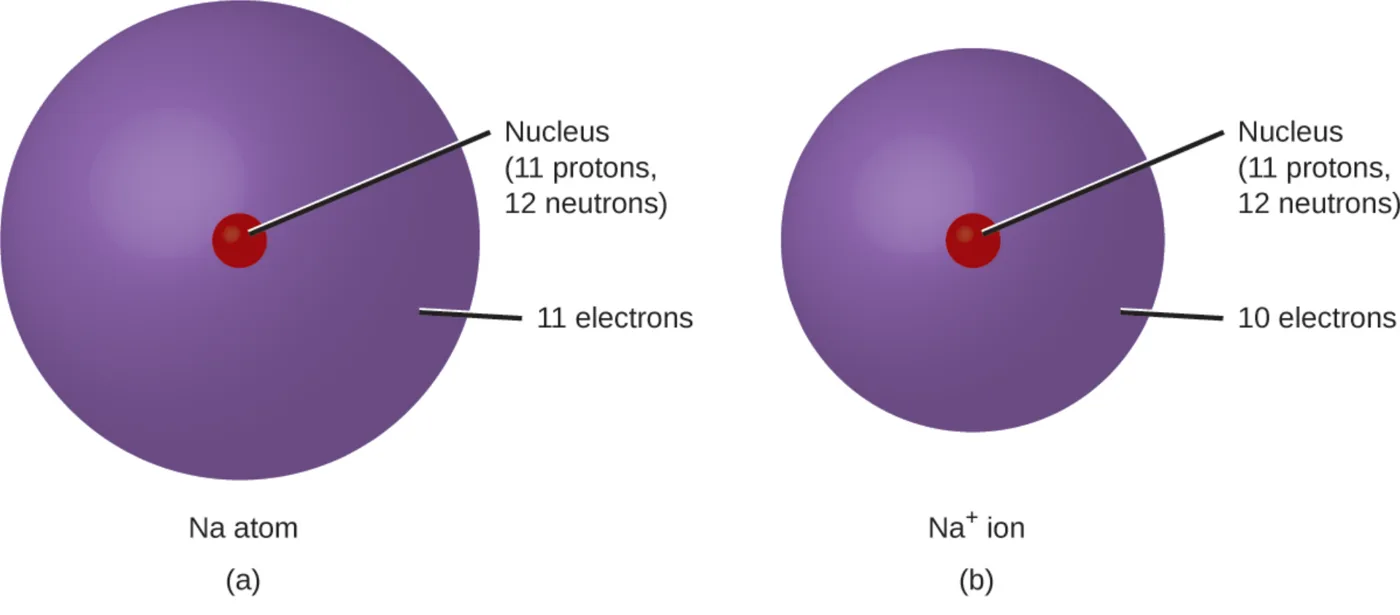
- A neutral sodium atom has 11 protons and 11 electrons
- so its charges balance.
- If it loses one electron, it keeps its 11 protons but has only 10 electrons.
- The extra positive charge gives a sodium cation, written Na+.
- The figure below compares the neutral atom with the ion.
- 1 / 6Next ▶
- A neutral sodium atom with 11 protons and 11 electrons, next to a sodium ion that has lost one electron and carries a 1+ charge.
- Image: OpenStax, Chemistry 2e, CC BY 4.0.
- Ions and their charges
- ⤢ Enlarge
- A positive ion is a cation, and a negative ion is an anion.
- You can use the periodic table to predict which kind of ion an atom will form and often what its charge will be.
- Atoms of most main-group metals lose enough electrons to reach the electron count of the noble gas before them in the table.
- An alkali metal in group 1 loses one electron and forms a cation with a 1+ charge.
- An alkaline earth metal in group 2 loses two electrons and forms a cation with a 2+ charge.
- For example, a neutral calcium atom has 20 protons and 20 electrons.
- 6It readily loses two electrons
- which leaves 20 protons, 18 electrons and a 2+ charge.
- ◀ Previous, 2 / 6Next ▶
- Ions and their charges
- Ions and their charges
- This ion has the same number of electrons as an argon atom and is written Ca2+.
- A metal ion takes the name of its metal atom
- so Ca2+ is the calcium ion.
- Atoms of nonmetals form ions by gaining enough electrons to reach the electron count of the next noble gas.
- Atoms in group 17 gain one electron and form anions with a 1− charge.
- Atoms in group 16 gain two electrons and form ions with a 2− charge.
- For example, a neutral bromine atom has 35 protons and 35 electrons.
- ◀ Previous, 3 / 6Next ▶
- Ions and their charges
- Ions and their charges
- By gaining one electron it reaches 36 electrons
- which gives an anion with 35 protons, 36 electrons and a 1− charge.
- This ion has the same number of electrons as a krypton atom and is written Br−.
- The reason noble gas electron counts are favored is explained in a later chapter.
- The periodic table gives a reliable guide to ion charges.
- Moving from the far left toward the right, main-group elements tend to form cations whose charge equals the group number: group 1 forms 1+ ions, group 2 forms 2+ ions,
- and so on.
- Moving from the far right toward the left, elements tend to form anions whose negative charge equals the number of groups between them and the noble gases: group 17 forms 1− ions and group 16 forms 2− ions.
- ◀ Previous, 4 / 6Next ▶
- Ions and their charges
- This guide becomes less reliable toward the center of the table.
- Transition metals and some other metals often have variable charges that their position does not predict.
- Copper forms ions with a 1+ or 2+ charge, and iron forms ions with a 2+ or 3+ charge.
- The figure below shows the regular charge pattern of the main-group elements and the variable charges of the transition metals.
- ◀ Previous, 5 / 6Next ▶
- A periodic table with the ion charge of each element labelled, showing the regular charge pattern of the main-group elements and the variable charges of several transition metals.
- Image: OpenStax, Chemistry 2e, CC BY 4.0.
- Ions and their charges
- ⤢ Enlarge
- ◀ Previous, 6 / 6