Curriculum
AP PHYSICS 2
9. Thermodynamics
0/52
10. Electric Force, Field, and Potential
0/6211. Electric Circuits
0/6811.3.1Resistance as opposition to charge flow11.3.2Resistivity and the geometry of a conductor11.3.3Resistivity and temperature11.3.4Ohm’s law and ohmic materials11.3.5Finding resistance from an I–V graph11.3.6Resistors and thermal energy11.3.7Worked examples11.3.8Key terms11.3.9Avoid these mistakes
11.5.1Series and parallel connections11.5.2Equivalent resistance of resistors in series11.5.3Equivalent resistance of resistors in parallel11.5.4Analysing a combined circuit11.5.5Real batteries and internal resistance11.5.6Ideal and nonideal ammeters and voltmeters11.5.7Worked examples11.5.8Key terms11.5.9Avoid these mistakes
12. Magnetism and Electromagnetism
0/3813. Geometric Optics
0/4214. Waves, Sound, and Physical Optics
0/751.1Describing any wave1.2Transverse and longitudinal waves, and electromagnetic waves1.3Boundaries, intensity and motion of sources1.4Superposition, beats and standing waves1.5Diffraction and interference of light1.6How the topics connect1.7Key equations of Unit 141.8Key terms1.9Avoid these mistakes
14.1.1Waves transfer energy, not matter14.1.2Wave pulses and continuous periodic waves14.1.3Mechanical and electromagnetic waves and the medium14.1.4Speed of waves on a string and in a medium14.1.5Transverse and longitudinal waves14.1.6Amplitude, loudness and energy14.1.7Worked examples14.1.8Key terms14.1.9Avoid these mistakes
15. Modern Physics
0/65
Text lesson
15.2 The Bohr Model of Atomic Structure
The Bohr Model of Atomic Structure
15.2 Structure of the atom and nuclear notation
Structure of the atom and nuclear notation
- Structure of the atom and nuclear notation
- Structure of the atom and nuclear notation
- Structure of the atom and nuclear notation
- An atom has internal structure.
- It consists of a small, positively charged nucleus surrounded by one or more negatively charged electrons.
- The nucleus is made up of protons
- which have positive charge, and neutrons, which have no charge.
- Almost all of the mass of an atom is in its nucleus
- so the mass of an atom is dominated by the total mass of its protons and neutrons.
- The number of protons in the nucleus is the atomic number Z, and the number of protons plus neutrons is the mass number A.
- Each element has a unique number of protons
- so the atomic number identifies the element.
- 1 / 2Next ▶
- Structure of the atom and nuclear notation
- The nuclear notation AZX represents a nucleus of element X.
- For example, 146C is a carbon nucleus with 6 protons and 8 neutrons.
- Atoms of the same element with different numbers of neutrons are isotopes of that element.
- 4A neutral atom has the same number of electrons as protons. An ion is an atom with a nonzero net electric charge
- which occurs when it has gained or lost electrons.
- The number and arrangement of the electrons determine how the atom interacts with other atoms.
- ◀ Previous, 2 / 2
15.2 The Bohr Model of Atomic Structure · 1 / 6
15.2 The Bohr model: electrons in circular orbits
The Bohr model: electrons in circular orbits
- The Bohr model: electrons in circular orbits2 The Bohr model: electrons in circular orbits
- The Bohr model electrons in circular orbits
- The Bohr model electrons in circular orbits
- The Bohr model of the atom is based on classical physics, and it was the historical model that led to a description of the hydrogen atom in terms of discrete energy states.
- In the Bohr model, an electron moves around the nucleus in a circular orbit.
- The orbit is determined by the electric force between the electron and the nucleus, and by the electron’s charge and mass.
- The electric force between the nucleus and the electron is the Coulomb force:
Fe = k|q1q2|/r2
- Here Fe is the electric force in newtons (N), k = 9.0 × 10⁹ N·m2/C2, q1 and q2 are the charges in coulombs (C), and r is the distance between their centres in metres (m).
- For a hydrogen atom, q1 and q2 are the magnitudes of the proton and electron charges, each 1.60 × 10⁻¹⁹ C.
1 / 2Next ▶
- The Bohr model electrons in circular orbits
- The Bohr model electrons in circular orbits
- The electric force is the only force that provides the centripetal force that keeps the electron moving in a circle.
- Applying Newton’s second law to the electron gives:
Fnet = mv2/r
- Here m is the mass of the electron in kilograms (kg), v is its speed in metres per second (m/s), and r is the radius of the orbit.
- Setting the two forces equal links the speed of the electron to the radius of its orbit.
◀ Previous, 2 / 2
15.2 The Bohr Model of Atomic Structure · 2 / 6
15.2 Standing waves and allowed energy states
Standing waves and allowed energy states
- Standing waves and allowed energy states
- Standing waves and allowed energy states
- The Bohr model alone does not explain why only certain orbits are allowed.
- The standing-wave model of the electron gives this explanation.
- An electron behaves as a wave with de Broglie wavelength λ = h/(mv).
- For the electron to form a stable standing wave around the nucleus, the circumference of its orbit must be an integer multiple of its wavelength:
- 1 / 2Next ▶
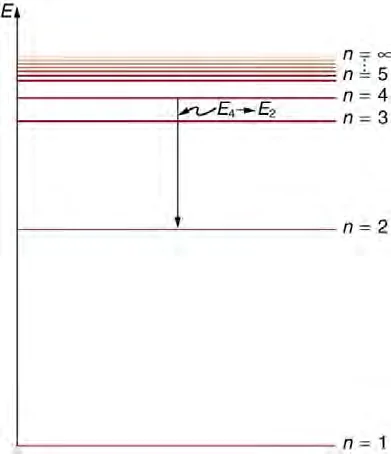
- Energy-level diagram with discrete levels and a transition between two of them.
- Image: OpenStax, College Physics for AP Courses, CC BY 4.0.
- Standing waves and allowed energy states
- ⤢ Enlarge
- 2πr = nλ, with n = 1, 2, 3, …
- Here n is the principle quantum number, a whole number that labels the allowed orbit.
- Combining this condition with λ = h/(mv) gives mvr = nh/(2π)
- so only certain values of the orbital radius and speed are possible.
- Each allowed orbit corresponds to one discrete energy state of the electron.
- The standing-wave model explains the existence of specific allowed energy states.
- It does not describe orbitals, orbital shapes or probability functions
- which are beyond the scope of this course. The analysis of electron structure in AP Physics 2 is limited to energy levels.
- For hydrogen, the allowed energy states are given by En = −13.6 eV/n2.
- The negative sign shows that the electron is bound to the nucleus.
- The state with n = 1 is the ground state
- which has the lowest energy.
- ◀ Previous, 2 / 2
15.2 The Bohr Model of Atomic Structure · 3 / 6
15.2 Worked examples
Worked examples
- Example 3: Checking the standing-wave condition
- Nuclear notation for an ion · Example 2: Coulomb force and speed of the electron in the first Bohr orbit
- Nuclear notation for an ion
- A carbon-14 ion is written 146C. It has 4 electrons. Find the number of protons, neutrons, and the net charge of the ion.
- The atomic number is 6
- so there are 6 protons.
- The mass number is 14so the number of neutrons is 14 − 6 = 8.
- The net charge is the number of protons minus the number of electrons, so the charge is (+6) + (−4) = +2 in units of the elementary charge.
- 6 protons, 8 neutrons, and a net charge of +2e
- so the ion is written 146C2+.
- Coulomb force and speed of the electron in the first Bohr orbit
- In the ground state of hydrogen, the radius of the electron’s orbit is 5.29 × 10⁻¹¹ m.
- Find the electric force on the electron and its speed, using m = 9.11 × 10⁻³¹ kg.
- The Coulomb force is F = (9.0 × 10⁹)(1.60 × 10⁻¹⁹)2/(5.29 × 10-11)2 = (2.30 × 10⁻²⁸)/(2.80 × 10-21) = 8.23 × 10⁻⁸ N. Setting this equal to mv2/r gives v2 = Fr/m = (8.23 × 10⁻⁸ N)(5.29 × 10⁻¹¹ m)/(9.11 × 10-31 kg) = 4.78 × 10¹² m2/s2
- so v = 2.19 × 10⁶ m/s.
- The electric force is 8.23 × 10⁻⁸ N, directed towards the nucleus, and the electron’s speed is 2.19 × 10⁶ m/s.
- 1 / 2Next ▶
- Checking the standing-wave condition
- Using the orbit and speed from Example 2, show that the circumference of the orbit equals one de Broglie wavelength of the electron.
- The circumference is 2πr = 2π(5.29 × 10⁻¹¹ m) = 3.32 × 10⁻¹⁰ m. The de Broglie wavelength is λ = h/(mv) = (6.63 × 10⁻³⁴ J·s)/[(9.11 × 10-31 kg)(2.19 × 10⁶ m/s)] = 3.32 × 10⁻¹⁰ m.
- The two values agree
- so the orbit contains exactly one wavelength, which is the condition for n = 1.
- ◀ Previous, 2 / 2
15.2 The Bohr Model of Atomic Structure · 4 / 6
15.2 Key terms
Key terms
- Key terms
| Term | Meaning |
|---|---|
| Atomic number (Z) |
|
| Mass number (A) | The total number of protons and neutrons in a nucleus. |
| Isotopes |
|
| Ion | An atom with a nonzero net electric charge because it has gained or lost electrons. |
| Bohr model |
|
| Coulomb force | The electric force between two charges, F = k|q1q2|/r2. |
| Standing wave |
|
| Principle quantum number (n) |
|
| Ground state | The lowest-energy state of an atom, which corresponds to n = 1 for hydrogen. |
15.2 The Bohr Model of Atomic Structure · 5 / 6
15.2 Avoid these mistakes
Avoid these mistakes
Avoid these mistakes2→Avoid these mistakes3Avoid these mistakes
Avoid these mistakes
Avoid this
- Confusing the atomic number with the mass number.
- The atomic number counts only protons, and the mass number counts protons plus neutrons.Avoid this
Avoid this
- Assuming an ion has the same charge as its nucleus.
- The net charge is the number of protons minus the number of electrons.Avoid this
Avoid this
- Using the electron mass in the Coulomb force
- or the charge in the centripetal force.Avoid this
1 / 3Next ▶
Avoid these mistakes
- The Coulomb force uses the charges
- the centripetal force uses the mass and speed.Avoid this
Avoid this
Writing the standing-wave condition asAvoid this
nAvoid this
λ = 2Avoid this
rAvoid this
◀ Previous, 2 / 3Next ▶
Avoid these mistakes
. The circumference, 2πAvoid this
, must equal, Avoid this
wavelengths.Avoid this
Avoid this
- Thinking that the Bohr model describes orbitals with a shape.
- In AP Physics 2 the model describes only fixed circular orbits and energy levels.Avoid this
◀ Previous, 3 / 3
15.2 The Bohr Model of Atomic Structure · 6 / 6
Well done! You finished this lesson
What would you like to do next?