Curriculum
AP PHYSICS 2
9. Thermodynamics
0/52
10. Electric Force, Field, and Potential
0/6211. Electric Circuits
0/6811.3.1Resistance as opposition to charge flow11.3.2Resistivity and the geometry of a conductor11.3.3Resistivity and temperature11.3.4Ohm’s law and ohmic materials11.3.5Finding resistance from an I–V graph11.3.6Resistors and thermal energy11.3.7Worked examples11.3.8Key terms11.3.9Avoid these mistakes
11.5.1Series and parallel connections11.5.2Equivalent resistance of resistors in series11.5.3Equivalent resistance of resistors in parallel11.5.4Analysing a combined circuit11.5.5Real batteries and internal resistance11.5.6Ideal and nonideal ammeters and voltmeters11.5.7Worked examples11.5.8Key terms11.5.9Avoid these mistakes
12. Magnetism and Electromagnetism
0/3813. Geometric Optics
0/4214. Waves, Sound, and Physical Optics
0/751.1Describing any wave1.2Transverse and longitudinal waves, and electromagnetic waves1.3Boundaries, intensity and motion of sources1.4Superposition, beats and standing waves1.5Diffraction and interference of light1.6How the topics connect1.7Key equations of Unit 141.8Key terms1.9Avoid these mistakes
14.1.1Waves transfer energy, not matter14.1.2Wave pulses and continuous periodic waves14.1.3Mechanical and electromagnetic waves and the medium14.1.4Speed of waves on a string and in a medium14.1.5Transverse and longitudinal waves14.1.6Amplitude, loudness and energy14.1.7Worked examples14.1.8Key terms14.1.9Avoid these mistakes
15. Modern Physics
0/65
Text lesson
9.3 Thermal Energy Transfer and Equilibrium
Thermal Energy Transfer and Equilibrium
9.3 Thermal contact, heating and cooling
Thermal contact, heating and cooling
- Two systems are in thermal contact when they can exchange energy by thermal processes.
- Thermal processes transfer energy because the particles of one system collide with, or interact with, the particles of the other system.
- They do not involve work done by a force moving through a distance on the whole system.
- Heating is the transfer of energy into a system by thermal processes.
- Cooling is the transfer of energy out of a system by thermal processes.
- The same transfer is heating for one system and cooling for the other, so the two descriptions always go together when two systems exchange energy.
- Heating and cooling are different from changing temperature in one system alone.
- A system can be heated without its temperature rising, for example during melting, and its temperature can change without thermal energy transfer if work is done on it.
- For AP Physics 2, when a question describes heating or cooling, identify which system gains energy and which loses it.
9.3 Thermal Energy Transfer and Equilibrium · 1 / 7
9.3 Conduction, convection and radiation
Conduction, convection and radiation
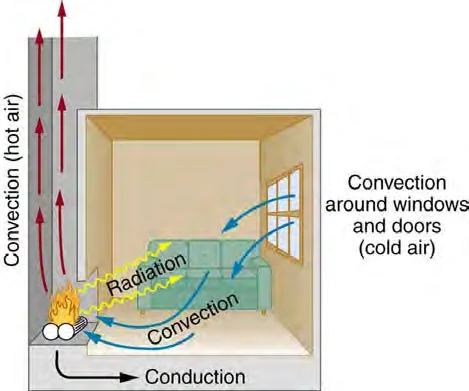
- Energy is transferred between systems at different temperatures by three thermal processes.
- In conduction, energy moves through a material, or between touching materials, as particles pass energy to their neighbours during collisions.
- Conduction is the main process inside solids, and it is fastest in metals, which contain many free electrons that carry energy quickly.
- In convection, energy is carried by the bulk motion of a fluid.
- Warm fluid is less dense, so it rises, while cooler, denser fluid sinks to take its place.
- This circulation moves energy across a room or through a pot of water.
Three processes
- Convection needs a fluid; it does not occur in a solid.
- In radiation, energy is carried by electromagnetic waves, such as infrared waves, that are emitted by hot objects and absorbed by others.
- Radiation does not need a material medium, which is why energy from the Sun reaches Earth through the vacuum of space.
- Every object, including you, emits radiation at a rate that depends on its temperature.
9.3 Thermal Energy Transfer and Equilibrium · 2 / 7
9.3 The direction of energy transfer
The direction of energy transfer
- Energy is transferred through thermal processes spontaneously from a higher-temperature system to a lower-temperature system.
- The reverse does not happen spontaneously.
- A hot object placed in contact with a cold object does not become hotter while the cold object becomes colder without some outside agent doing work.
- This direction follows from the behaviour of atoms.
- In collisions between atoms from two different systems, energy is most likely to be transferred from the higher-energy atom to the lower-energy atom.
- The higher temperature system has atoms with higher average kinetic energy, so on average the energy flows from it.
- Over many collisions, the energy is shared out until the two systems have the same average kinetic energy per atom, which means the same temperature.
- Note that the flow is from higher temperature to lower temperature, not from more energy to less energy.
- A small hot object can have less total thermal energy than a large warm object and still transfer energy to it if it is at a higher temperature.
9.3 Thermal Energy Transfer and Equilibrium · 3 / 7
9.3 Thermal equilibrium
Thermal equilibrium
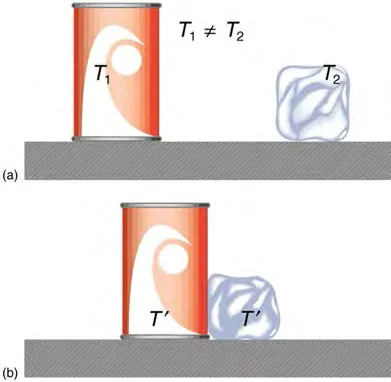
- Thermal equilibrium is reached when no net energy is transferred by thermal processes between two systems in thermal contact.
- At thermal equilibrium the two systems have the same temperature.
- Energy still moves between atoms in both systems, but the flow in one direction exactly balances the flow in the other, so the net transfer is zero.
- The most probable final state of two systems that have been in contact for a long time is therefore one in which they share the same temperature.
Equilibrium
- A thermometer works on this principle the thermometer must be in thermal contact with the object for long enough to reach equilibrium, and then its reading equals the temperature of the object.
- Thermal equilibrium does not mean that the two systems have equal energy or equal mass.
- It only means that they have equal temperature, so no net thermal energy transfer occurs between them.
9.3 Thermal Energy Transfer and Equilibrium · 4 / 7
9.3 Worked examples
Worked examples
- Example 1 · Direction of energy transfer between three objects
- Question
- Object A is at 80 °C, object B is at 35 °C and object C is at 10 °C.
- Each pair is placed in thermal contact in turn.
- State the direction of energy transfer for each pair and which object is heating and which is cooling.
- Energy flows from higher temperature to lower temperature.
- Pair A and B 80 °C is higher than 35 °C, so energy flows from A to B.
- A cools and B heats.
- Pair B and C 35 °C is higher than 10 °C, so energy flows from B to C.
- B cools and C heats.
- Pair A and C 80 °C is higher than 10 °C, so energy flows from A to C.
- A cools and C heats.
- Answer
- Energy always flows from A to B, from B to C, and from A to C.
- A is always cooling, C is always heating, and B is heating when in contact with A and cooling when in contact with C.
- Example 2 · Identifying the thermal process
- Question
- (a) a metal spoon left in hot tea becomes hot at its handle; (b) warm air rises from a radiator and cooler air sinks near the window; (c) an astronaut outside a spacecraft is warmed by sunlight.
- (a) The energy travels along the solid metal from one particle to the next, which is conduction.
- (b) The warm air moves as a fluid carrying energy with it, which is convection.
- (c) Sunlight crosses the vacuum of space as electromagnetic waves, which is radiation
- Answer
- (a) conduction, (b) convection, (c) radiation
- Example 3 · Average kinetic energy and the direction of transfer between atoms
- Question
- System X has a temperature of 400 K and system Y has a temperature of 300 K.
- Find the difference in the average kinetic energy per atom between the two systems, and state which system loses energy when they are placed in thermal contact.
- For each system, KEaverage = (3/2)kBT.
- For X, KE = (3/2)(1.38 × 10−23 J/K)(400 K) = 8.28 × 10⁻²¹ J.
- For Y, KE = (3/2)(1.38 × 10−23 J/K)(300 K) = 6.21 × 10⁻²¹ J.
- The difference is 8.28 × 10⁻²¹ J − 6.21 × 10⁻²¹ J = 2.07 × 10⁻²¹ J.
Answer
- The average kinetic energy per atom of X is 2.07 × 10⁻²¹ J greater than that of Y.
- System X is the higher-temperature system, so it loses energy to Y until both reach the same temperature.
9.3 Thermal Energy Transfer and Equilibrium · 5 / 7
9.3 Key terms
Key terms
9.3 Thermal Energy Transfer and Equilibrium · 6 / 7
9.3 Avoid these mistakes
Avoid these mistakes
- Saying that energy flows from the object with more thermal energy.
- Energy flows from the higher-temperature object, even if it has less total thermal energy.
- Describing heating and cooling as separate events
- In thermal contact, one system’s heating is the other system’s cooling.
- Assuming that two objects at thermal equilibrium have the same energy or the same mass
- Equilibrium means only equal temperature.
- Calling every energy transfer conduction.
- Use convection for transfer by moving fluid, and radiation for transfer by electromagnetic waves, which works through a vacuum.
Thinking that convection can occur in a solid
- Convection requires a fluid because it depends on bulk motion of the fluid.
- Saying that a thermometer measures the energy of the object.
- A thermometer reaches equilibrium with the object and reads the temperature, after enough time for net transfer to stop.
9.3 Thermal Energy Transfer and Equilibrium · 7 / 7
Well done! You finished this lesson
What would you like to do next?