Curriculum
AP PHYSICS 2
9. Thermodynamics
0/52
10. Electric Force, Field, and Potential
0/6211. Electric Circuits
0/6811.3.1Resistance as opposition to charge flow11.3.2Resistivity and the geometry of a conductor11.3.3Resistivity and temperature11.3.4Ohm’s law and ohmic materials11.3.5Finding resistance from an I–V graph11.3.6Resistors and thermal energy11.3.7Worked examples11.3.8Key terms11.3.9Avoid these mistakes
11.5.1Series and parallel connections11.5.2Equivalent resistance of resistors in series11.5.3Equivalent resistance of resistors in parallel11.5.4Analysing a combined circuit11.5.5Real batteries and internal resistance11.5.6Ideal and nonideal ammeters and voltmeters11.5.7Worked examples11.5.8Key terms11.5.9Avoid these mistakes
12. Magnetism and Electromagnetism
0/3813. Geometric Optics
0/4214. Waves, Sound, and Physical Optics
0/751.1Describing any wave1.2Transverse and longitudinal waves, and electromagnetic waves1.3Boundaries, intensity and motion of sources1.4Superposition, beats and standing waves1.5Diffraction and interference of light1.6How the topics connect1.7Key equations of Unit 141.8Key terms1.9Avoid these mistakes
14.1.1Waves transfer energy, not matter14.1.2Wave pulses and continuous periodic waves14.1.3Mechanical and electromagnetic waves and the medium14.1.4Speed of waves on a string and in a medium14.1.5Transverse and longitudinal waves14.1.6Amplitude, loudness and energy14.1.7Worked examples14.1.8Key terms14.1.9Avoid these mistakes
15. Modern Physics
0/65
Text lesson
13.4 Images Formed by Lenses
Images Formed by Lenses
13.4 Converging and diverging thin lenses
Converging and diverging thin lenses
- A thin lens is a lens whose thickness is small compared with the distances of the object and image from it.
- For a thin lens, the refraction is treated as happening at the centre line of the lens, and the lens is drawn as a straight line in a ray diagram.
- A thin convex lens is a converging lens, because it brings parallel incident rays together at a focal point.
- A thin concave lens is a diverging lens, because it spreads parallel incident rays apart.
13.4 Images Formed by Lenses · 1 / 9
13.4 Focal points on both sides of a lens
Focal points on both sides of a lens
- A lens has a focal point on each side.
- For a converging lens, parallel rays incident from the left are refracted to converge at a real focal point on the right, and parallel rays from the right converge at a real focal point on the left.
- For a diverging lens, parallel rays incident from the left diverge as if they came from a virtual focal point on the left.
- The position of each focal point depends on the shape of the lens and the material it is made from.
- For a thin lens in air, the two focal points are the same distance from the lens, so a single focal length f describes the lens on both sides.
- Focal length is measured in metres (m), and it is positive for a converging lens and negative for a diverging lens.
13.4 Images Formed by Lenses · 2 / 9
13.4 Real and virtual images formed by lenses
Real and virtual images formed by lenses
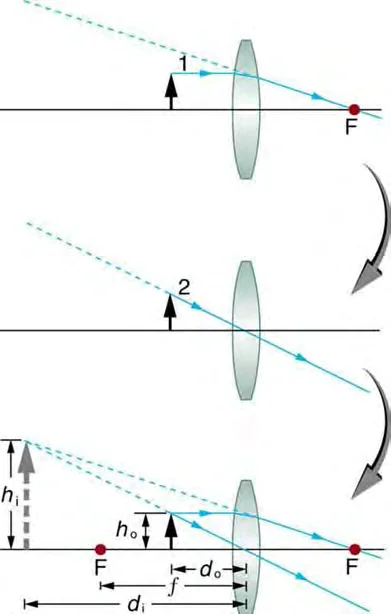
- A real image is formed by a lens when light rays from one point are refracted so that they meet at another point.
- The real image is on the opposite side of the lens from the object, and it can be projected onto a screen.
- A converging lens forms a real image when the object is placed beyond its focal point.
- A virtual image is formed when refracted rays diverge so that, when extended backward, they appear to come from a common point on the same side of the lens as the object.
- A virtual image cannot be projected onto a screen.
- A diverging lens always forms a virtual image, and a converging lens forms a virtual image when the object is inside its focal point, which is how a magnifying glass works.
13.4 Images Formed by Lenses · 3 / 9
13.4 The thin-lens equation and sign conventions
The thin-lens equation and sign conventions
- For a thin lens, the focal length, the object distance and the image distance are related by the thin-lens equation: 1/so + 1/si = 1/f.
- Here so is the distance from the object to the midline of the lens, si is the distance from the image to the midline of the lens, and all distances are measured in metres (m) or consistently in centimetres.
- The sign conventions for a lens are listed in the table.
- f
- Converging (convex) lens; Negative: Diverging (concave) lens
- so
- Real object on the incident side of the lens; Negative: Not used in this course
- si
- Real image on the far side of the lens; Negative: Virtual image on the same side as the object
- hi
- Upright image; Negative: Inverted image
13.4 Images Formed by Lenses · 4 / 9
13.4 Magnification
Magnification
- For a thin lens, the magnification is the ratio of the image height to the object height: M = hi/ho = −si/so.
- Here ho and hi are the object and image heights in metres (m).
- The magnification has no unit.
- A positive value of M means the image is upright, and a negative value means it is inverted.
- An absolute value greater than 1 means the image is enlarged, a value equal to 1 means it is the same size, and a value less than 1 means it is reduced.
13.4 Images Formed by Lenses · 5 / 9
13.4 Principal rays for lenses
Principal rays for lenses
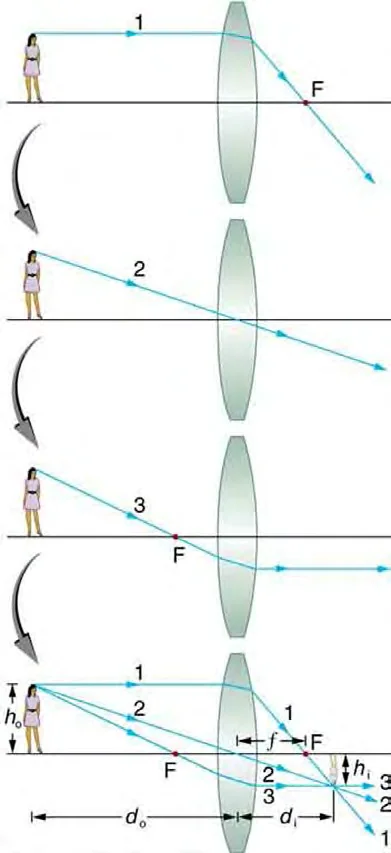
- Three principal rays locate the image formed by a lens.
- The first ray is parallel to the principal axis, and after refraction it passes through the far focal point of a converging lens, or appears to come from the near focal point of a diverging lens.
- The second ray passes through the centre of the lens, where the principal axis meets the lens, and it is not deviated.
- The third ray passes through the near focal point of the lens and emerges parallel to the principal axis.
- The image is at the point where the refracted principal rays meet, or appear to meet.
- For a converging lens, an object beyond twice the focal length gives a real, inverted and reduced image.
- An object at twice the focal length gives a real, inverted image of the same size.
- An object between one and two focal lengths gives a real, inverted and enlarged image.
- An object inside the focal length gives a virtual, upright and enlarged image.
- A diverging lens always gives a virtual, upright and reduced image, wherever the object is placed.
13.4 Images Formed by Lenses · 6 / 9
13.4 Worked examples
Worked examples
- Example 1
- Converging lens with a real image
- A thin converging lens has a focal length of 10 cm.
- An object 4.0 cm tall is placed 30 cm from the lens.
- Find the image distance, the magnification and the image height.
- 1/si = 1/f − 1/so = 1/10 cm − 1/30 cm = 2/30 cm, so si = 15 cm, a positive value, which means a real image on the far side of the lens.
- The magnification is M = −15 cm/30 cm = −0.50.
- The image height is hi = (−0.50)(4.0 cm) = −2.0 cm.
- Answer
- The image is real, 15 cm from the lens, inverted, and half the size of the object, with a height of 2.0 cm.
- Example 2
- Diverging lens
- A thin diverging lens has a focal length of −20 cm.
- An object 5.0 cm tall is placed 30 cm in front of the lens.
- Find the image distance and the image height.
- 1/si = 1/f − 1/so = −1/20 cm − 1/30 cm = (−3 − 2)/60 cm = −5/60 cm, so si = −12 cm.
- The negative sign shows a virtual image 12 cm from the lens on the same side as the object.
- The magnification is M = −(−12 cm)/30 cm = +0.40, so hi = (+0.40)(5.0 cm) = +2.0 cm.
- Answer
- The image is virtual, 12 cm in front of the lens, upright and reduced, with a height of 2.0 cm.
- Example 3
- Magnifying glass
- A converging lens has a focal length of 10 cm.
- A small insect 1.5 cm long is placed 5.0 cm from the lens.
- Find the image distance, the magnification and the image length.
- 1/si = 1/10 cm − 1/5.0 cm = (1 − 2)/10 cm = −1/10 cm, so si = −10 cm.
- The image is virtual and on the same side as the insect.
- The magnification is M = −(−10 cm)/5.0 cm = +2.0, so hi = (+2.0)(1.5 cm) = +3.0 cm.
Answer
- The image is virtual, 10 cm from the lens on the same side as the insect, upright and enlarged, with a length of 3.0 cm.
- This is the principle of a magnifying glass.
13.4 Images Formed by Lenses · 7 / 9
13.4 Key terms
Key terms
13.4 Images Formed by Lenses · 8 / 9
13.4 Avoid these mistakes
Avoid these mistakes
- Using the sign convention for mirrors on lenses, or the reverse
- For a lens, f is positive for a converging lens and negative for a diverging lens, and a negative si means a virtual image on the same side as the object.
- Assuming a converging lens always forms a real image
- When the object is inside the focal length, the image is virtual, upright and enlarged.
Reading the sign of M as a size
- The sign shows orientation, and the absolute value shows whether the image is enlarged or reduced.
- Stating that a diverging lens can form a real image
- A diverging lens always forms a virtual, upright and reduced image.
- Drawing the ray through the centre of the lens as bent
- It passes through undeviated, because the thin lens is treated as having parallel faces at that point.
Avoid→Measuring distances from the focal point instead of from the midline of the lens when using the thin-lens equation
13.4 Images Formed by Lenses · 9 / 9
Well done! You finished this lesson
What would you like to do next?