Curriculum
AP PHYSICS 2
9. Thermodynamics
0/52
10. Electric Force, Field, and Potential
0/6211. Electric Circuits
0/6811.3.1Resistance as opposition to charge flow11.3.2Resistivity and the geometry of a conductor11.3.3Resistivity and temperature11.3.4Ohm’s law and ohmic materials11.3.5Finding resistance from an I–V graph11.3.6Resistors and thermal energy11.3.7Worked examples11.3.8Key terms11.3.9Avoid these mistakes
11.5.1Series and parallel connections11.5.2Equivalent resistance of resistors in series11.5.3Equivalent resistance of resistors in parallel11.5.4Analysing a combined circuit11.5.5Real batteries and internal resistance11.5.6Ideal and nonideal ammeters and voltmeters11.5.7Worked examples11.5.8Key terms11.5.9Avoid these mistakes
12. Magnetism and Electromagnetism
0/3813. Geometric Optics
0/4214. Waves, Sound, and Physical Optics
0/751.1Describing any wave1.2Transverse and longitudinal waves, and electromagnetic waves1.3Boundaries, intensity and motion of sources1.4Superposition, beats and standing waves1.5Diffraction and interference of light1.6How the topics connect1.7Key equations of Unit 141.8Key terms1.9Avoid these mistakes
14.1.1Waves transfer energy, not matter14.1.2Wave pulses and continuous periodic waves14.1.3Mechanical and electromagnetic waves and the medium14.1.4Speed of waves on a string and in a medium14.1.5Transverse and longitudinal waves14.1.6Amplitude, loudness and energy14.1.7Worked examples14.1.8Key terms14.1.9Avoid these mistakes
15. Modern Physics
0/65
Text lesson
10.4 Electric Potential Energy
Electric Potential Energy
10.4 Potential energy of a system of two charges
Potential energy of a system of two charges
- Potential energy of a system of two charges3Potential energy of a system of two charges4Potential energy of a system of two charges
- Potential energy of a system of two charges
- Potential energy of a system of two charges
- Electric potential energy is the energy stored in a system of charged objects because of their positions relative to one another.
- 1 / 4Next ▶
- Potential energy of a system of two charges
- The electric potential energy of a system of two point charges equals the work required for an external force to bring the charges to their present positions from infinitely far apart.
- 2The reference point is chosen to be infinity
- where the potential energy is taken as zero.
- For two point charges q1 and q2 separated by a distance r, the electric potential energy is UE = kq1q2/r.
- Here UE is the potential energy in joules (J), q1 and q2 are the charges in coulombs (C) with their signs, r is the separation in metres (m), and k = 9.0 × 10⁹ N·m2/C2.
- The sign of the potential energy comes from the signs of the charges.
- If both charges have the same sign, the product
- q
- ◀ Previous, 2 / 4Next ▶
- Potential energy of a system of two charges
- Potential energy of a system of two charges
- is positive, so
- U
- E
- is positive.
- ◀ Previous, 3 / 4Next ▶
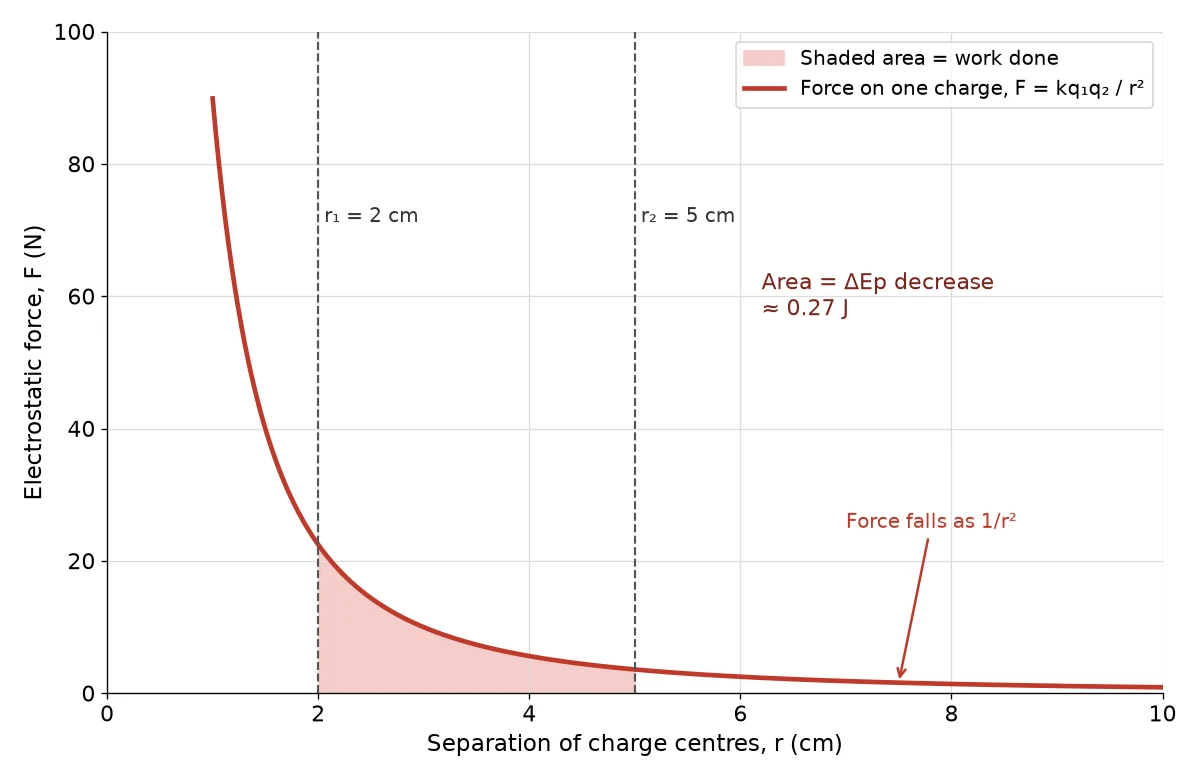
- Force against separation for two like charges, with the shaded area between 2 cm and 5 cm giving the work done
- Potential energy of a system of two charges
- ⤢ Enlarge
- Potential energy of a system of two charges
- An external force must do positive work to push like charges together, and that work is stored as potential energy.
- If the charges have opposite signs,
- is negative, and the system is at a lower energy when the charges are close together.
- ◀ Previous, 4 / 4
10.4 Electric Potential Energy · 1 / 7
10.4 How the energy depends on separation
How the energy depends on separation
- How the energy depends on separation3How the energy depends on separation4How the energy depends on separation
- How the energy depends on separation
- How the energy depends on separation
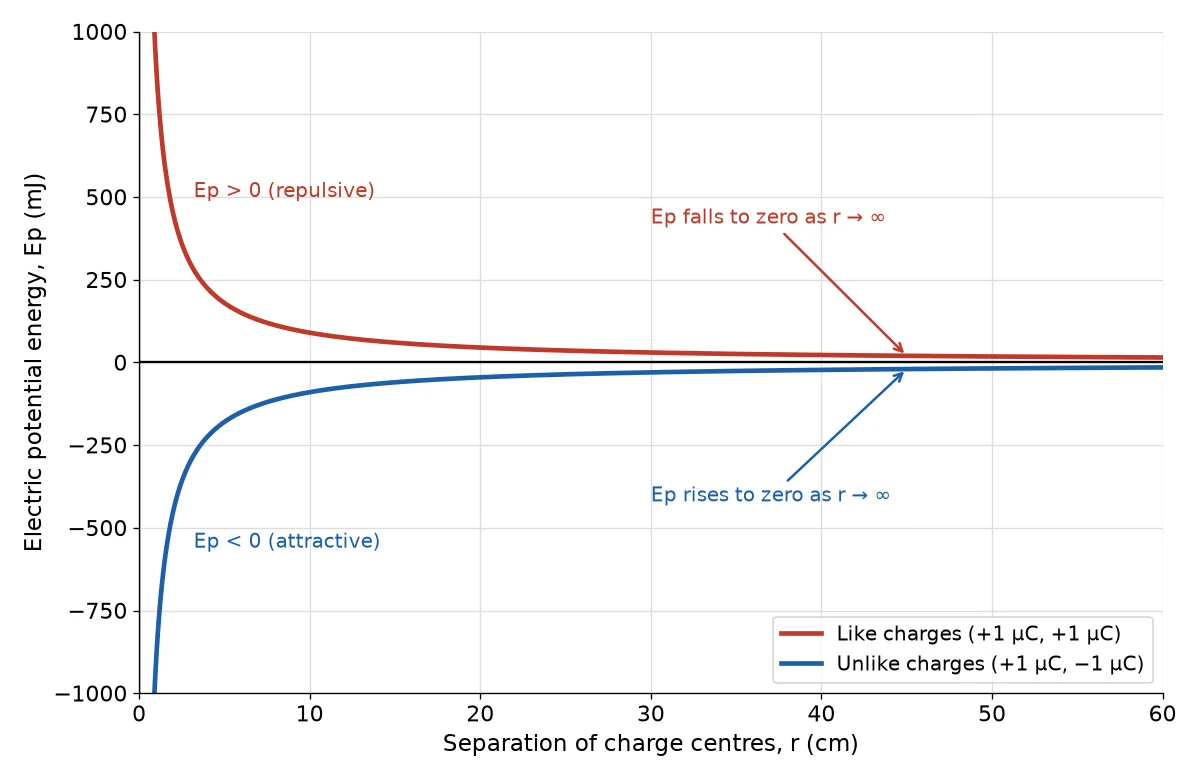
- Because UE is proportional to 1/r, the potential energy changes most rapidly when the charges are close together.
- 1 / 4Next ▶
- How the energy depends on separation
- For like charges,
- U
- E
- is positive and decreases toward zero as
- r
- increases to infinity.
- ◀ Previous, 2 / 4Next ▶
- How the energy depends on separation
- How the energy depends on separation
- For opposite charges,
- is negative and increases toward zero as
- increases.
- The graph of
- against
- is a curve shaped like a hyperbola
- which is steep at small separation and flattens at large separation.
- ◀ Previous, 3 / 4Next ▶
- Electric potential energy against separation for like charges (positive, falling to zero) and unlike charges (negative, rising to zero)
- How the energy depends on separation
- ⤢ Enlarge
- How the energy depends on separation
- When charges are released from rest, the electric force does positive work on them, the kinetic energy increases and the potential energy decreases by the same amount.
- Like charges move apart and opposite charges move together.
- The total mechanical energy of the system, kinetic plus potential, stays constant when only electric forces act.
- ◀ Previous, 4 / 4
10.4 Electric Potential Energy · 2 / 7
10.4 Potential energy of several charges
Potential energy of several charges
- Potential energy of several charges3Potential energy of several charges4Potential energy of several charges5Potential energy of several charges6Potential energy of several charges
- Potential energy of several charges
- Potential energy of several charges
- The total electric potential energy of a system of several point charges is found by summing the potential energies of every pair of charges, counting each pair only once.
- 1 / 6Next ▶
- Potential energy of several charges
- Potential energy of several charges
- For three charges,
- U
- E
- =
- k
- (
- ◀ Previous, 2 / 6Next ▶
- Potential energy of several charges
- q
- /
- r
- ◀ Previous, 3 / 6Next ▶
- Potential energy of several charges
- +
- ), where
- ij
- ◀ Previous, 4 / 6Next ▶
- Potential energy of several charges
- Potential energy of several charges
- is the separation of charges
- i
- and
- j
- .
- For AP Physics 2, you should calculate the potential energy of configurations of four or fewer point charges.
- ◀ Previous, 5 / 6Next ▶
- Potential energy of several charges
- Potential energy of several charges
- The potential energy is a scalar
- so the contributions from different pairs are added directly, with their signs.
- Unlike the electric force, it has no direction, and it does not need to be resolved into components.
- ◀ Previous, 6 / 6
10.4 Electric Potential Energy · 3 / 7
10.4 Using energy to find speeds
Using energy to find speeds
- Using energy to find speeds3Using energy to find speeds
- Using energy to find speeds
- Using energy to find speeds
- Because the electric force is conservative, the sum of kinetic and potential energy is conserved when only electric forces do work.
- 1 / 3Next ▶
- Using energy to find speeds
- Using energy to find speeds
- This allows the speed of a released charge to be found from the change in potential energy.
- If a charge starts from rest at a position where the potential energy is
- U
- i
- and moves to a position where it is
- f
- ◀ Previous, 2 / 3Next ▶
- Using energy to find speeds
- ,
- then the kinetic energy it gains is Kf = Ui − Uf.
- ◀ Previous, 3 / 3
10.4 Electric Potential Energy · 4 / 7
10.4 Worked examples
Worked examples
- Example 3: Potential energy of three charges on a line3Worked examples4Worked examples5Worked examples
- Potential energy of an attracting pair · Example 2: Work to bring a charge close to another
- Potential energy of an attracting pair
- A charge of +2.0 μC and a charge of −3.0 μC are separated by 0.10 m. Find the electric potential energy of the system.
- UE = kq1q2/r = (9.0 × 10⁹)(+2.0 × 10⁻⁶ C)(−3.0 × 10⁻⁶ C)/(0.10 m) = (9.0 × 10⁹)(−6.0 × 10⁻¹²)/0.10 = −0.54 J.
- −0.54 J. The negative value means the system has less energy when the charges are at this separation than when they are infinitely far apart, and work must be done to separate them.
- Work to bring a charge close to another
- A fixed charge of +4.0 μC is held in place.
- An external force brings a charge of +5.0 μC from infinitely far away to a point 0.20 m from the fixed charge, moving it slowly so that no kinetic energy is gained.
- Find the work done by the external force.
- The work done by the external force equals the change in potential energy of the system. The initial potential energy is zero, and the final potential energy is UE = (9.0 × 10⁹)(4.0 × 10⁻⁶ C)(5.0 × 10⁻⁶ C)/(0.20 m) = +0.90 J.
- The external force must do +0.90 J of work. This is positive because the two charges repel each other, and the external force must push the moving charge toward the fixed one.
- 1 / 5Next ▶
- Potential energy of three charges on a line
- Potential energy of three charges on a line
- q1 = +2.0 μC at x = 0, q2 = −1.0 μC at x = 0.20 m, and q3 = +3.0 μC at x = 0.50 m. Find the total electric potential energy of the system.
- The separations are r12 = 0.20 m, r13 = 0.50 m and r23 = 0.30 m.
- ◀ Previous, 2 / 5Next ▶
- Worked examples
- The three pairs give:
- U
- = (9.0 × 10
- )(+2.0 × 10
- ◀ Previous, 3 / 5Next ▶
- Worked examples
- Worked examples
- −6
- )(−1.0 × 10
- )/0.20 = −0.090 J
- )(+3.0 × 10
- )/0.50 = +0.108 J
- ◀ Previous, 4 / 5Next ▶
- Worked examples
- Worked examples
- and U23 = (9.0 × 10⁹)(−1.0 × 10⁻⁶)(+3.0 × 10⁻⁶)/0.30 = −0.090 J.
- The total is −0.090 J + 0.108 J − 0.090 J = −0.072 J.
- The total electric potential energy is −0.072 J.
- ◀ Previous, 5 / 5
10.4 Electric Potential Energy · 5 / 7
10.4 Key terms
Key terms
- Key terms
| Term | Meaning |
|---|---|
| Electric potential energy (UE) |
|
| Reference point of zero potential energy |
|
| Conservative force |
|
| Like charges |
|
| Opposite charges |
|
| Pair of charges |
|
| Work done by an external force |
|
| Mechanical energy | The sum of the kinetic energy and the potential energy of a system. |
10.4 Electric Potential Energy · 6 / 7
10.4 Avoid these mistakes
Avoid these mistakes
Avoid these mistakes2→Avoid these mistakes3Avoid these mistakes4Avoid these mistakes
Avoid these mistakes
Avoid this
Forgetting the signs of the charges inAvoid this
UAvoid this
EAvoid this
=Avoid this
kqAvoid this
1 / 4Next ▶
Avoid these mistakes
qAvoid this
Avoid this
/Avoid this
rAvoid this
- . Two like charges give positive energy and two opposite charges give negative energy.Avoid this
- Counting each pair twice when adding the energies of several charges. Each pair contributes once to the total.Avoid this
◀ Previous, 2 / 4Next ▶
Avoid these mistakes
Avoid this
- Thinking that the potential energy of a pair is zero at the separation where the force is zero.Avoid this
- The potential energy depends on the separation and reaches zero only at infinity.Avoid this
Avoid this
- Stating that the energy stored by bringing charges together is negative for like charges.Avoid this
- Like charges require positive work, so their potential energy is positive.Avoid this
◀ Previous, 3 / 4Next ▶
Avoid these mistakes
Avoid this
- Using the distance from the origin of the axes for, Avoid this
- instead of the separation between the two charges in each pair.Avoid this
Avoid this
- Stating that a released charge loses kinetic energy when it moves toward a charge of opposite sign.Avoid this
- The kinetic energy increases as the potential energy decreases.Avoid this
◀ Previous, 4 / 4
10.4 Electric Potential Energy · 7 / 7
Well done! You finished this lesson
What would you like to do next?