Curriculum
AP PHYSICS 2
9. Thermodynamics
0/52
10. Electric Force, Field, and Potential
0/6211. Electric Circuits
0/6811.3.1Resistance as opposition to charge flow11.3.2Resistivity and the geometry of a conductor11.3.3Resistivity and temperature11.3.4Ohm’s law and ohmic materials11.3.5Finding resistance from an I–V graph11.3.6Resistors and thermal energy11.3.7Worked examples11.3.8Key terms11.3.9Avoid these mistakes
11.5.1Series and parallel connections11.5.2Equivalent resistance of resistors in series11.5.3Equivalent resistance of resistors in parallel11.5.4Analysing a combined circuit11.5.5Real batteries and internal resistance11.5.6Ideal and nonideal ammeters and voltmeters11.5.7Worked examples11.5.8Key terms11.5.9Avoid these mistakes
12. Magnetism and Electromagnetism
0/3813. Geometric Optics
0/4214. Waves, Sound, and Physical Optics
0/751.1Describing any wave1.2Transverse and longitudinal waves, and electromagnetic waves1.3Boundaries, intensity and motion of sources1.4Superposition, beats and standing waves1.5Diffraction and interference of light1.6How the topics connect1.7Key equations of Unit 141.8Key terms1.9Avoid these mistakes
14.1.1Waves transfer energy, not matter14.1.2Wave pulses and continuous periodic waves14.1.3Mechanical and electromagnetic waves and the medium14.1.4Speed of waves on a string and in a medium14.1.5Transverse and longitudinal waves14.1.6Amplitude, loudness and energy14.1.7Worked examples14.1.8Key terms14.1.9Avoid these mistakes
15. Modern Physics
0/65
Text lesson
13. Geometric Optics
13. Geometric Optics
Light as rays and the law of reflection
Light as rays and the law of reflection
- Light as rays and the law of reflection · Light as rays and the law of reflection
Light as rays and the law of reflection
In geometric optics light is modelled as rays→straight lines perpendicular to the wavefronts that point in the direction of travel.
Light as rays and the law of reflection
- The model is accurate when the wave nature of light can be neglected (topic 13.1).
- Rays reflect from a surface so that the angle of incidence equals the angle of reflection, both measured from the normal.
A smooth surface gives specular reflection
- which keeps parallel rays parallel
- and a rough surface gives diffuse reflection
- which scatters them.
13. Geometric Optics · 1 / 8
Images formed by mirrors
Images formed by mirrors
- Images formed by mirrors3Images formed by mirrors4Images formed by mirrors5Images formed by mirrors
- Images formed by mirrors
- Images formed by mirrors
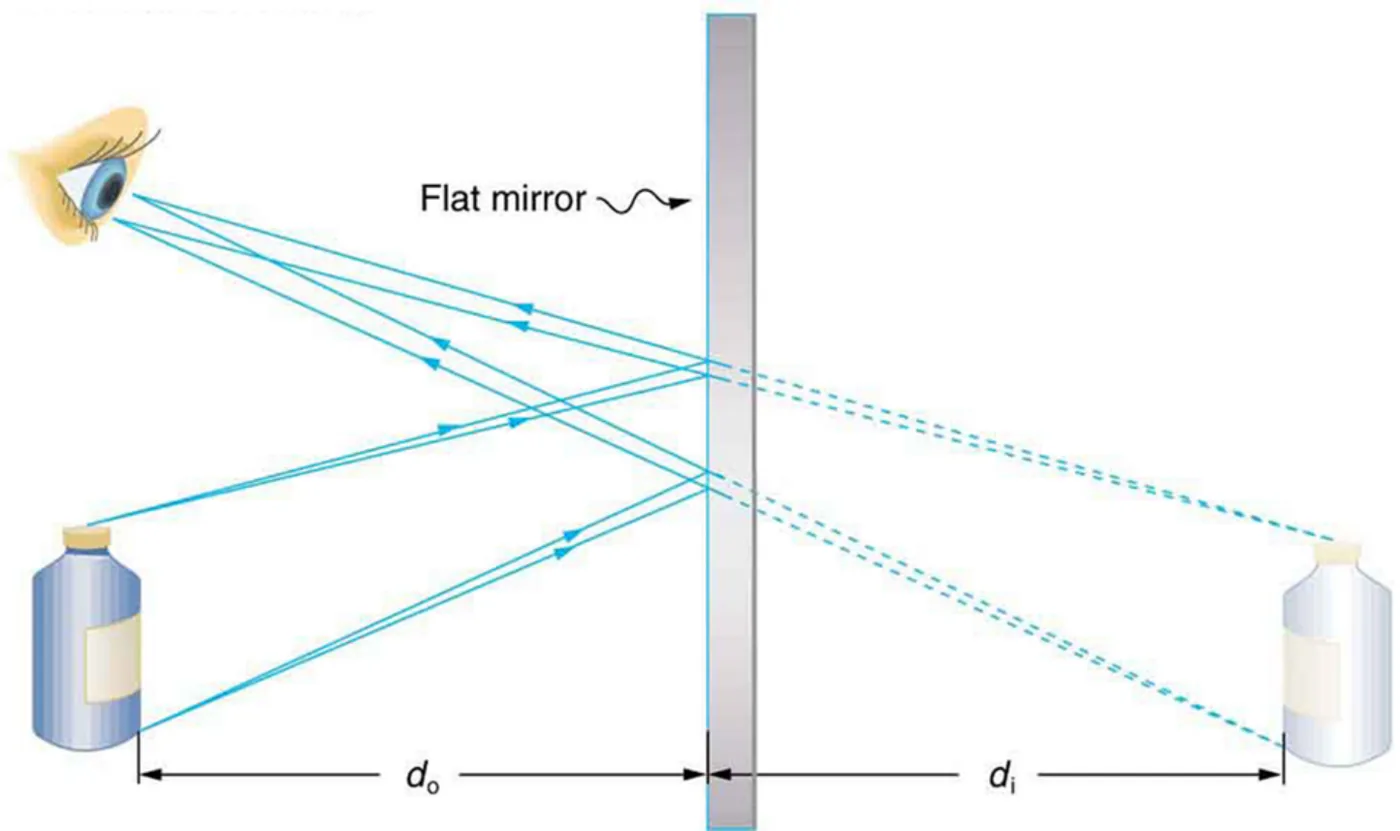
- A plane mirror forms a virtual, upright image of the same size, as far behind the mirror as the object is in front.
- 1 / 5Next ▶
- Images formed by mirrors
- Images formed by mirrors
- Spherical mirrors are either concave (converging) or convex (diverging),
- and the focal length of a spherical mirror is half its radius of curvature (topic 13.2).
- The mirror equation 1/
- s
- o
- + 1/
- ◀ Previous, 2 / 5Next ▶
- Images formed by mirrors
- Images formed by mirrors
- i
- = 1/
- f
- locates the image, and the magnification
- M
- = −
- ◀ Previous, 3 / 5Next ▶
- Images formed by mirrors
- /
- gives its height and orientation.
- a concave mirror forms real, inverted images when the object is beyond its focal point,
- and virtual, upright images when the object is inside it,
- while a convex mirror always forms a virtual, upright, reduced image.
- ◀ Previous, 4 / 5Next ▶
- Two sets of rays from points on an object reflect off a flat mirror into an observer’s eye and seem to come from behind the mirror, which locates the virtual image.
- Images formed by mirrors
- ⤢ Enlarge
- ◀ Previous, 5 / 5
13. Geometric Optics · 2 / 8
Refraction between two media
Refraction between two media
- Refraction between two media3Refraction between two media4Refraction between two media
- Refraction between two media
- Refraction between two media
- Refraction is the change in direction of light caused by a change in its speed when it enters a new medium (topic 13.3).
- 1 / 4Next ▶
- Refraction between two media
- The index of refraction
- n
- =
- c
- /
- v
- ◀ Previous, 2 / 4Next ▶
- Refraction between two media
- Refraction between two media
- describes how much a medium slows light, and Snell’s law
- sin
- θ
- gives the angle of the refracted ray.
- ◀ Previous, 3 / 4Next ▶
- Refraction between two media
- Refraction between two media
- Light bends toward the normal when it enters a medium of higher index and away from the normal when it enters a medium of lower index.
- Going from a higher index into a lower index, light can undergo total internal reflection beyond the critical angle
- where sin
- .
- ◀ Previous, 4 / 4
13. Geometric Optics · 3 / 8
Images formed by lenses
Images formed by lenses

- Images formed by lenses3Images formed by lenses4Images formed by lenses
- Images formed by lenses
- Images formed by lenses
- A thin converging lens has a real focal point on each side and forms real images of distant or outside objects
- while a thin diverging lens always forms virtual, upright, reduced images (topic 13.4).
- 1 / 4Next ▶
- Images formed by lenses
- The same thin-lens equation 1/
- s
- o
- + 1/
- i
- = 1/
- ◀ Previous, 2 / 4Next ▶
- Images formed by lenses
- Images formed by lenses
- f
- and the same magnification equation apply to lenses as to mirrors, with the sign conventions for lenses:
- is positive for a converging lens,
- and a negative si means a virtual image on the object side.
- The principal rays for a lens pass through the centre undeviated, and through or parallel to the focal points.
- ◀ Previous, 3 / 4Next ▶
- Three rays from the top of a person’s head cross at one point after passing through a converging lens, which locates the image of that point.
- Images formed by lenses
- ⤢ Enlarge
- ◀ Previous, 4 / 4
13. Geometric Optics · 4 / 8
Key equations of Unit 13
Key equations of Unit 13
- Key equations of Unit 13
| Equation | Symbols and SI units | Topic |
|---|---|---|
| θi = θr | Law of reflection; θi angle of incidence and θr angle of reflection, both from the normal (degrees) | 13.1 |
| f = R/2 | f focal length (m); R radius of curvature (m) | 13.2 |
| 1/so + 1/si = 1/f (mirror) | so object distance (m); si image distance (m); f focal length (m); signs as given in topic 13.2 | 13.2 |
| M = hi/ho = −si/so (mirror) | M magnification (no unit); hi and ho image and object heights (m) | 13.2 |
| n = c/v | n index of refraction (no unit); c = 3.00 × 10⁸ m/s; v speed in the medium (m/s) | 13.3 |
| n1 sin θ1 = n2 sin θ2 | Snell’s law; n indices of refraction; θ angles from the normal (degrees) | 13.3 |
| sin θc = n2/n1 (with n1 > n2) | θc critical angle (degrees) | 13.3 |
| 1/so + 1/si = 1/f (thin lens) | so, si, f in metres (m); signs as given in topic 13.4 | 13.4 |
| M = hi/ho = −si/so (lens) | M magnification (no unit); hi and ho image and object heights (m) | 13.4 |
13. Geometric Optics · 5 / 8
How the four topics connect
How the four topics connect
- How the four topics connect3How the four topics connect4How the four topics connect
- How the four topics connect
- How the four topics connect
- Topics 13.1 and 13.3 both start from the ray model, in which a ray changes direction at a surface.
- 1 / 4Next ▶
- How the four topics connect
- Reflection keeps the ray in the same medium and makes the angle of reflection equal the angle of incidence.
- 2Refraction moves the ray into a new medium and changes its angle according to Snell’s law
- because the speed changes.
- it is reflection that happens because refraction cannot take place beyond the critical angle.
- Topics 13.2 and 13.4 apply these ideas to curved surfaces.
- A mirror forms its image by reflection,
- and a lens forms its image by refraction at both of its surfaces,
- ◀ Previous, 2 / 4Next ▶
- How the four topics connect
- but the same ray construction, the same two equations and the same sign conventions are used for both.
- In each case the focal length determines where the image forms, and the magnification gives its size and orientation.
- A useful way to revise the unit is to follow one ray from the object to the eye.
- The ray is reflected at a mirror or refracted at a lens, the principal rays locate the image, and the equations give its position and size.
- Checking the signs of
- s
- ◀ Previous, 3 / 4Next ▶
- How the four topics connect
- How the four topics connect
- i
- ,
- f
- and
- M
- at the end tells you whether the image is real or virtual, upright or inverted, and enlarged or reduced.
- ◀ Previous, 4 / 4
13. Geometric Optics · 6 / 8
Key terms
Key terms
- Key terms
| Term | Meaning |
|---|---|
| Geometric optics |
|
| Law of reflection |
|
| Real image |
|
| Virtual image |
|
| Focal point | The point on the principal axis where parallel rays converge or appear to diverge after reflection or refraction. |
| Index of refraction |
|
| Snell’s law | The relation between the angles of incidence and refraction and the indices of the two media. |
| Critical angle |
|
| Magnification |
|
13. Geometric Optics · 7 / 8
Avoid these mistakes
Avoid these mistakes
Avoid these mistakes2→Avoid these mistakes
Avoid these mistakes
Avoid this
- Using the mirror sign convention for lenses, or the lens sign convention for mirrors.
- The focal length signs for the two are different.Avoid this
Avoid this
- Measuring angles from the surface instead of the normal in reflection and refraction.Avoid this
Avoid this
- Assuming that a negative sign always means an error.Avoid this
1 / 2Next ▶
Avoid these mistakes
- A negative image distance means a virtual image
- and a negative magnification means an inverted image.Avoid this
Avoid this
- Applying Snell’s law to find a critical angle when light goes from a lower index into a higher index.
No critical angle exists in that case.Avoid this
Avoid this
- Confusing the real image formed by a converging lens or concave mirror with the virtual image formed by a diverging lens or convex mirror.Avoid this
◀ Previous, 2 / 2
13. Geometric Optics · 8 / 8
Well done! You finished this lesson
What would you like to do next?