Curriculum
AP PHYSICS 2
9. Thermodynamics
0/52
10. Electric Force, Field, and Potential
0/6211. Electric Circuits
0/6811.3.1Resistance as opposition to charge flow11.3.2Resistivity and the geometry of a conductor11.3.3Resistivity and temperature11.3.4Ohm’s law and ohmic materials11.3.5Finding resistance from an I–V graph11.3.6Resistors and thermal energy11.3.7Worked examples11.3.8Key terms11.3.9Avoid these mistakes
11.5.1Series and parallel connections11.5.2Equivalent resistance of resistors in series11.5.3Equivalent resistance of resistors in parallel11.5.4Analysing a combined circuit11.5.5Real batteries and internal resistance11.5.6Ideal and nonideal ammeters and voltmeters11.5.7Worked examples11.5.8Key terms11.5.9Avoid these mistakes
12. Magnetism and Electromagnetism
0/3813. Geometric Optics
0/4214. Waves, Sound, and Physical Optics
0/751.1Describing any wave1.2Transverse and longitudinal waves, and electromagnetic waves1.3Boundaries, intensity and motion of sources1.4Superposition, beats and standing waves1.5Diffraction and interference of light1.6How the topics connect1.7Key equations of Unit 141.8Key terms1.9Avoid these mistakes
14.1.1Waves transfer energy, not matter14.1.2Wave pulses and continuous periodic waves14.1.3Mechanical and electromagnetic waves and the medium14.1.4Speed of waves on a string and in a medium14.1.5Transverse and longitudinal waves14.1.6Amplitude, loudness and energy14.1.7Worked examples14.1.8Key terms14.1.9Avoid these mistakes
15. Modern Physics
0/65
Text lesson
15.4 Blackbody Radiation
Blackbody Radiation
15.4 Thermal radiation and the blackbody model
Thermal radiation and the blackbody model
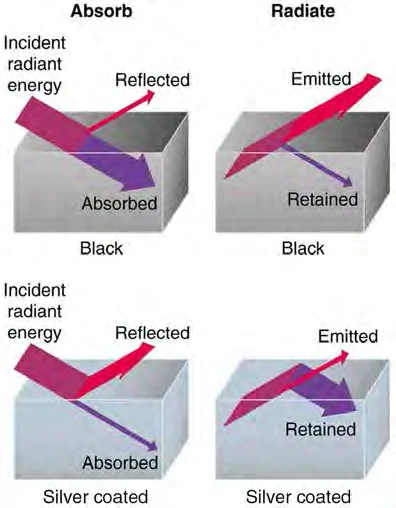
- Matter spontaneously converts some of its internal thermal energy into electromagnetic energy.
- This conversion happens at every temperature above absolute zero, and the radiation it produces is called thermal radiation.
- The amount and the wavelengths of this radiation depend on the temperature of the object.
- A blackbody is an idealized model of matter that absorbs all the radiation that falls on it.
- If a blackbody is in equilibrium at a constant temperature, it must emit energy at the same rate as it absorbs it.
- A real object that is hot, such as a stove element or the surface of a star, behaves approximately like a blackbody.
15.4 Blackbody Radiation · 1 / 7
15.4 The blackbody spectrum
The blackbody spectrum
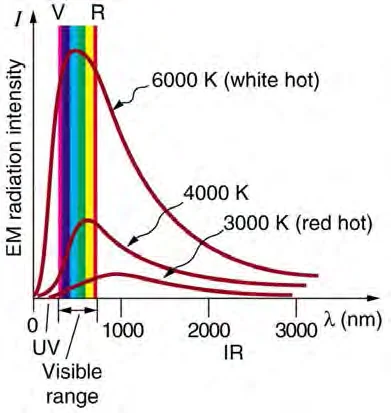
- A blackbody emits a continuous spectrum, and the spectrum depends only on the temperature of the body, not on the material it is made from.
- The radiation is often modelled by plotting the intensity of the emitted radiation per unit wavelength against wavelength.
- For a given temperature, the curve rises to a peak and then falls.
- Raising the temperature increases the intensity at every wavelength, and it moves the peak to shorter wavelengths.
- The distribution of intensity with wavelength cannot be explained with classical physics.
- Classical theory predicted that the intensity would keep increasing at short wavelengths, which does not happen.
- Planck’s law describes the observed spectrum correctly by assuming that the energy of light is quantized.
- Planck’s law is the quantum basis of this topic, and its full form is not needed in the algebra-based course; the required quantitative results are Wien’s law and the Stefan–Boltzmann law.
15.4 Blackbody Radiation · 2 / 7
15.4 Wien's law: the peak wavelength
Wien's law: the peak wavelength
- The peak wavelength of a blackbody is the wavelength at which it emits the greatest amount of radiation per unit wavelength.
- Wien’s law states that this peak wavelength is inversely proportional to the absolute temperature:
- λmax T = 2.90 × 10⁻³ m·K
- Here λmax is the peak wavelength in metres (m) and T is the absolute temperature in kelvins (K).
- The product on the left is a constant.
- Thus the peak wavelength decreases as the temperature increases.
- A cool object such as a human body has its peak in the infrared, a hot star such as the Sun has its peak in visible light, and a very hot star has its peak in the ultraviolet.
15.4 Blackbody Radiation · 3 / 7
15.4 The Stefan–Boltzmann law: the total power
The Stefan–Boltzmann law: the total power
- The rate at which energy is emitted by a blackbody, which is its power, is proportional to the surface area of the body and to the fourth power of its absolute temperature.
- This is the Stefan–Boltzmann law:
- P = σAT4
- Here P is the power radiated in watts (W), σ = 5.67 × 10⁻⁸ W/(m2·K4) is the Stefan–Boltzmann constant, A is the surface area in square metres (m2), and T is the absolute temperature in kelvins.
- Because of the fourth power, doubling the absolute temperature multiplies the power by 24 = 16, while doubling the area only doubles the power.
- What the symbols mean
- L = luminosity, the total power emitted (W) · σ = 5.67 × 10⁻⁸ W m−2 K−4 · r = radius of the star (m) · A = surface area (m2) · T = surface temperature (K)
15.4 Blackbody Radiation · 4 / 7
15.4 Worked examples
Worked examples
- Example 1
- Peak wavelength of the Sun
- The surface temperature of the Sun is about 5800 K.
- Find the peak wavelength of its radiation, and state the region of the spectrum in which it lies.
- λmax = (2.90 × 10⁻³ m·K)/(5800 K) = 5.00 × 10⁻⁷ m.
- Answer
- 5.00 × 10⁻⁷ m, or 500 nm, which lies in the visible region, in the green.
- Example 2
- Power radiated by a heated filament
- A filament of surface area 2.0 × 10⁻⁴ m2 is at an absolute temperature of 2500 K.
- Assume the filament behaves as a blackbody.
- Find the power it radiates.
- P = σAT4 = (5.67 × 10⁻⁸ W/(m2·K4))(2.0 × 10−4 m2)(2500 K)4 = (5.67 × 10⁻⁸)(2.0 × 10⁻⁴)(3.91 × 10¹³) W = 4.4 × 10² W.
- Answer
- The filament radiates about 440 W (4.4 × 10² W).
- Example 3
- Effect of doubling the temperature
- A blackbody is at 300 K.
- Its temperature is doubled to 600 K.
- Find the change in the peak wavelength and the change in the power per unit area of the surface.
- At 300 K, λmax = (2.90 × 10⁻³)/300 = 9.67 × 10⁻⁶ m.
- At 600 K, λmax = (2.90 × 10⁻³)/600 = 4.83 × 10⁻⁶ m, which is half the original value.
- The power per unit area is σT4, which increases by a factor of 24 = 16.
- Answer
- The peak wavelength is halved, from 9.67 × 10⁻⁶ m to 4.83 × 10⁻⁶ m, and the power per unit area is multiplied by 16.
15.4 Blackbody Radiation · 5 / 7
15.4 Key terms
Key terms
15.4 Blackbody Radiation · 6 / 7
15.4 Avoid these mistakes
Avoid these mistakes
- Using the temperature in degrees Celsius in Wien’s law or the Stefan–Boltzmann law
- Both require the absolute temperature in kelvins.
- Saying that a hotter blackbody has a longer peak wavelength
- The peak wavelength gets shorter as the temperature rises.
- Assuming that doubling the temperature doubles the power
- The power depends on T4, so doubling the temperature multiplies the power by 16.
- Thinking that the blackbody spectrum depends on the material of the object
- It depends only on the temperature.
- Using the area in square centimetres instead of square metres in the Stefan–Boltzmann law
- The constant σ uses SI units.
15.4 Blackbody Radiation · 7 / 7
Well done! You finished this lesson
What would you like to do next?